Your ShelfYour Projects

Signs of the Times, Vol. 29, No. 16.

A PALACE OF DEATH

Signs of the Times

Apr 22, 1903

Pacific Press Publishing Company · Oakland, California · Apr 22, 1903

A PALACE OF DEATH.
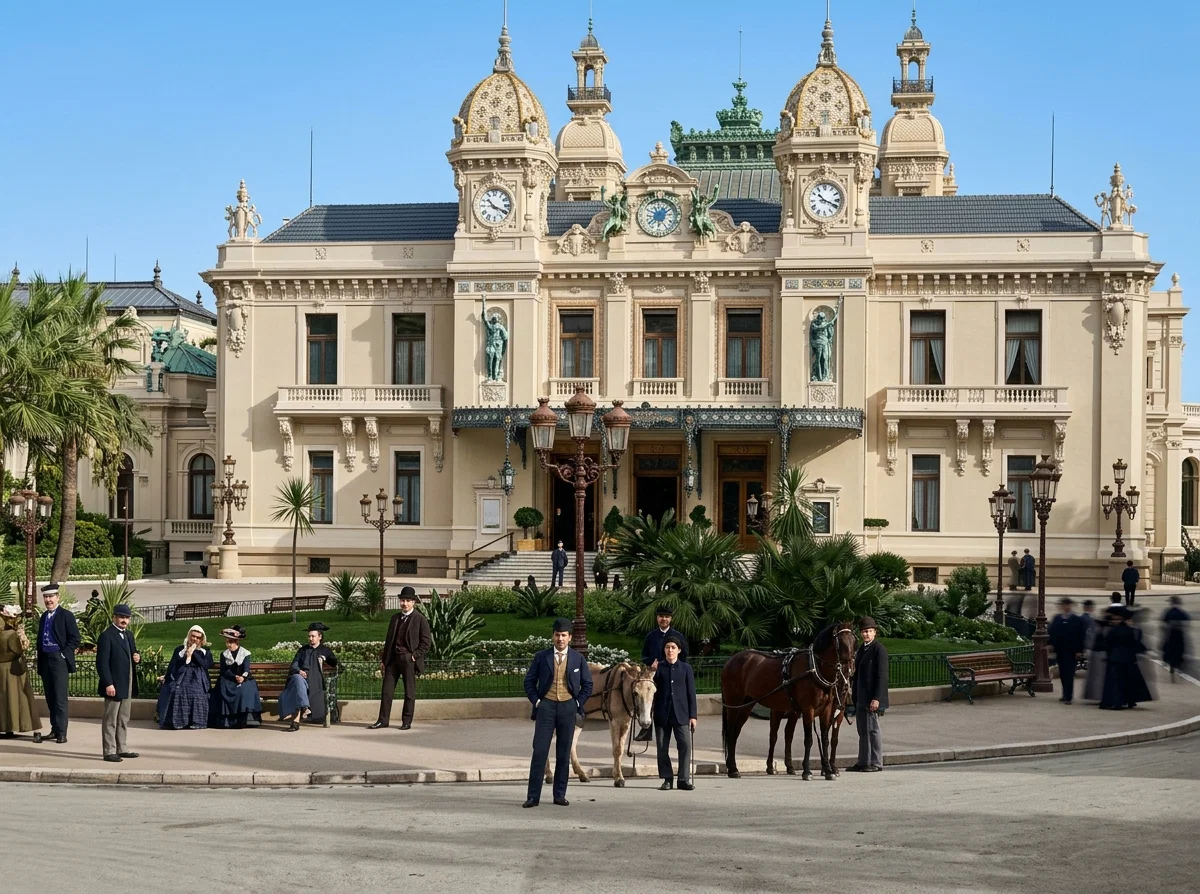
THE CASINO, MONTE CARLO, MONACO.
ON the north shore of the blue Mediterranean, nine miles east of Nice, stretching in irregular outline along the very southeast corner of France, lies the little land of Monaco, the smallest of the sovereign principalities of Europe. In the south part, on a rocky, rugged headland, nearly two hundred feet above the sea, stands the beautiful town of Monaco, with its royal palace, church, cathedral, and museum. The whole principality has a population of only about ten thousand, and an area of less than eight and one-half miles.
ACROSS the sheltered little bay to the northeast, built on what was once barren rocks, called the Spélugues, covered by soil since 1828 by the labor of Italian convicts, stands the town of Monte Carlo, wonderfully and artificially embellished on a magnificent scale. The chief attraction of the town, in fact, the center which has called into existence the villas and hotels about it, is the Palace of Death of our illustration, the first stone of which was laid in 1858, and which has been the chief attraction of many thousands since. It is not called by that name, but it is that in reality. Over its portals could well be written, "Abandon hope, all ye who enter here." For this gilded palace is none other than the Casino of Monte Carlo, the great gambling hell of Europe. We hear of physicians who will not take their own remedies, of bartenders who will not taste of the poisons they dispense over the bar. Parallel to this, the people of Monaco, the capital of the realm, are not allowed to enter the Palace of Death, and their interest in its maintenance is secured by exempting them from all taxation. Their real estate is also greatly increased. So much for the price of silence and endurance. The present prince is of a scientific character. The Casino is run by a joint stock company, capitalized at 15,000,000 francs.
TO THIS Palace of Death come the gay and wealthy young men, and many old men, of Europe, and not a few from America, to gamble and revel in the poison of excitement which fills the very atmosphere. No man with poor or soiled dress or brigade suit is permitted to enter. Fortune upon fortune has been lost, and many is the life which has gone out into utter darkness by self-destruction. The Casino is entered by the gay traveler largely out of curiosity, as he looks on he drinks in of the spirit, and thinks he will try his luck for a game or so. The spell is cast, the victim is enthralled, and there he stays till the merciless maw of the monster of the Palace of Death swallows a fortune, and a fatal poison, the stab of a stiletto, or a plunge in the blue waters of the Mediterranean, ends a life that is wrecked forevermore. This is no fancy tale, and Monte Carlo is only a type of many more gilded halls of death, the beauty, the embellishment, and the surroundings of which are luring myriads to everlasting destruction.
THIS may reach some of those who are thus tempted—some father, husband, son, or brother. Beware of its snares. "Turn fromit, pass away." Its pleasures are only for a season at best, and their end is decadence, despair, death. The gilded palace is like a whited sepulcher, beautiful in its outward appearance, marvelously beautiful and luxurious in its material structure, finishings, and embellishments; but it is a grave of blasted reputations, ruined characters, prostituted talents, pure aspirations, and wrecked lives for this world and eternity. Better, a thousand times better, life with an honest crust, a log or sod house, a home where wife and children make it glad, and from which go out rays of light, happiness, and helpfulness to all around, than to flourish in the gilded Palace of Death at Monte Carlo.
THE beautiful Palace of Death proves to many the open gateway to hell. The humblest cottage of earth, if Christ be received there, will prove the open door to God's Palace Beautiful, and life forevermore. This is the lesson of our illustration. It is not all gold that glitters. It is not all happiness that invites. That only is worthy to endure long which endures righteously. God makes for each soul, who takes Him at His word, a palace of character, grander and more glorious than all the beautiful buildings of earth. They shall "wax old and perish," and the men who set their heart on them shall die in like manner, but "he that doeth the will of God abideth forever."

SAVED FROM SIN.

Unless we are saved from sin in this life, we can not hope to be glorified in the life to come, for nothing impure can enter heaven. If saved at all, we must be saved by faith in Christ. He is the only Saviour of sinners. We must consecrate ourselves unreservedly to Him, andby the power of His Spirit and grace be pardoned and purified, before we are fit to enter heaven. We must not make any parley with sin. The old leaven of wickedness must be cast out. Christ did not come to cripple but to destroy the works of the devil; and we should not be satisfied with anything else.
The Bible makes no allowance for sin, and we should not give it any quarter. It is our great enemy, and we should not be satisfied until we have gained a complete victory over it. This is our privilege, and also our duty. Sin, we are assured, shall not have dominion over us. The strong man armed must be cast out, and Christ enthroned in the heart as Lord of all. Thus saved from sin through Christ on earth, we shall be glorified with Him forever in heaven. —Anon.

THE CO-OPERATION OF HUMANITY WITH DIVINITY.

BY MRS. E. G. WHITE.
As our Creator and Redeemer, Christ has embraced the world in His arms of infinite love. All things belong to Him by original and mediatorial efficiency. He is the first and the last, and the efficiency of everything. All the value that there is in any human being is from Christ, and all belongs to Him. All that we have was entrusted to us in order to fulfil His mediatorial plan.
In the divine plan, evil was foreseen and provided for. A remedy was provided sufficient for complete restoration. But in this plan man himself must act a part. Humanity is the instrument through which God works for humanity. As Christ labored for sinners, so man must labor, that humanity may be brought into connection with divinity.
In His vast plan God has embraced all humanity. He calls for men and women to fill their appointment as agents chosen to carry out His purposes.
Christ enlists in His service all who will consent to stand under His authority, all who will wear His yoke and accept the conditions which unite the human with the divine. Those who do this are moulded by the influence that, through the grace of Christ, unites heart to heart, mind to mind, in one complete whole.
We were brought into existence because we were needed. How sad the thought that if we stand on the wrong side, in the ranks of the enemy, we are lost to the design of our creation. We are disappointing our Redeemer; the powers He designed for His service are used to oppose His grace and matchless love.
God gave His only-begotten Son that man might be restored to oneness with Him. And however indifferent the human agent may think it his privilege to be, he will be judged according to the provisions of grace that cost Heaven so much. Man may ignore his responsibility; he may choose to be inspired and controlled by Satan, to withdraw from all righteous principles. Nevertheless he will be judged as one who might have used all his capabilities in the service of God, but who refused to do this. His failure to do the good he might have done, had he been a partaker of the divine nature, will be recorded against him as a sign that he despised and neglected the great mercy and loving-kindness of God, refusing to recognize the Creator’s claim to his service.
Those who love God will not live as if they were under little or no obligation to Him. They will not live to please themselves. They will work as Christ worked. All that they have and are will be placed on the altar of service. Earnestly and untiringly they will labor to save the souls for whom Christ died. He, the Redeemer of the world, can and will save the souls of all who come to Him. And to us He has given the privilege of co-operating with Him in the carrying out of His great plan.
The work left for us to do is to endeavor to draw all men to Christ, to uplift a crucified and risen Saviour, to tell others of His compassion, pointing to Him as did John the Baptist, saying, “Behold the Lamb of God, which taketh away the sin of the world.”

The Fifth Day—Fish and Fowl

THE GOSPEL IN CREATION. NO. 7.

The Fifth Day—Fish and Fowl.

READ the following passages from the Book of God:—
“And God said, Let the waters bring forth abundantly the moving creature that hath life, and fowl that may fly above the earth in the open firmament of heaven. And God created great whales, and every living creature that moveth, which the waters brought forth abundantly, after their kind, and every winged fowl after his kind; and God saw that it was good. And God blessed them, saying, Be fruitful, and multiply, and fill the waters in the seas, and let fowl multiply in the earth. And the evening and the morning were the fifth day.” Gen. 1:20–23.
“Ask now . . . the fowls of the air, and they shall tell thee; . . . and the fishes of the sea shall declare unto thee. Who knoweth not in all these that the hand of the Lord hath wrought this? In whose hand is the soul of every living thing, and the breath of all mankind.” Job 12:7–10.
“O Lord, how manifold are Thy works! in wisdom hast Thou made them all; the earth is full of Thy riches. So is this great and wide sea, wherein are things creeping innumerable, both small and great beasts. . . . There is that leviathan, whom Thou hast made to play therein. These wait all upon Thee; that Thou mayest give them their meat in due season. That Thou givest them they gather; Thou openest Thine hand, they are filled with good. Thou hidest Thy face, they are troubled; Thou takest away their breath, they die, and return to their dust. Thou sendest forth Thy Spirit, they are created; and Thou renewest the face of the earth.” Ps. 104:24–30.
From these words it is clear that we may learn lessons from the life, nature, characteristics and habits of fish and fowl. That the nature of man’s soul and life is like that of the inhabitants of the sea and air—only mortal and perishable—is taught in the identical and similar expressions that are used concerning them all. While man possesses some attributes, faculties, and qualities that are greatly superior to those of any of the other living creatures, it is nevertheless true that they, like him, possess souls which, like his, are dependent for existence on the breath of life, and are, therefore, subject to death, which immediately follows its departure. (Compare carefully Gen. 1:20, margin; Ps. 104:25–29; Rev. 16:3 with Gen. 2:7; Eze. 18:4; Job 12:7–10.) Additional evidences and information on this point will be found in the record and description of the work of the sixth day.
However, there are still to be noted some very precious, comforting, and instructive lessons in the life, nature, and habits of the creatures that were made on the fifth day. Our Saviour directed attention to them when He said, “Behold the fowls of the air; for they sow not, neither do they reap, nor gather into barns: yet your heavenly Father feedeth them. Are ye not much better than they?” Matt. 6:26; Luke 12:24, R. V.
Important and valuable lessons may be learned by heeding our Lord’s admonition and instruction, for in considering the birds we see that while He provideth for them their food (Job 38:41; Ps. 147:9), they have to gather it. Ps. 104:28. When the fowls, by simply gathering what the wisdom and power of God provides for them, without sowing, reaping, or storing, do not suffer, why should we fear when we have the faculties and power to co-operate with Him in all these things that they can not do? The sayings of the wise man reveal much of the cause of poverty and want, that abounds on every side: “The sluggard will not plow by reason of the cold; therefore shall he beg in harvest.” Prov. 20:4. “Slothfulness casteth into a deep sleep; and an idle soul shall suffer hunger.” Prov. 19:15. He that will not work, neither shall he eat. 2 Thess. 3:10. “Trust in the Lord, and do good; so shalt thou dwell in the land, and verily thou shalt be fed.” Ps. 37:3. See also Eph. 4:28; 1 Thess. 4:11, 12; 2 Thess. 3:6–16; Ps. 37:25. Not one of the little, twittering, industrious sparrows, valueless as they are among men, is forgotten by our loving, faithful, covenant-keeping God and Father. “Fear not therefore; ye are of more value than many sparrows.” Luke 12:6–8. Then let us “do with our might what our hands find to do” (Eccl. 9:10), and, then, “having food and raiment,” be content with such things as we have (1 Tim. 6:6–8; Heb. 13:5, 6), knowing that no good thing will the Lord withhold from them that walk uprightly. Ps. 84:11.
One more important lesson may be learned from the life of the birds of the heavens. “Yea, the stork in the heaven knoweth her appointed times; and the turtle and the crane and the swallow observe the time of their coming; but My people know not the judgment [ordinance, R. V.] of the Lord.” Jer. 8:7. Thus in one short verse Inspiration expresses, with beautiful eloquence, the obvious truth observable year after year, that the migratory birds are guided in their accurate well-timed flight through the trackless heavens by the goodness of God. The various migratory birds year after year, without chart or compass, traverse many thousands of miles of trackless space over sea and land. And the same Being, who so faithfully cares for and safely guides them, offers to pilot us over the stormy and trackless sea of life. “I will instruct thee and teach thee in the way which thou shalt go; I will counsel thee with Mine eye upon thee.” Ps. 32:8, R. V. “Thine ears shall hear a word behind thee, saying, This is the way, walk ye in it, when ye turn to the right hand, and when ye turn to the left.” Isa. 30:21. Then let us resign ourselves to His care, trustfully saying, “Thou shalt guide me with Thy counsel, and afterward receive me to glory.” Ps. 73:24.
W. A. SWEANY.

THE TWO WITNESSES.

(Concluded.)

Chapter 11: 4–13.

Recall again the law of witness of the Word: there must be, to establish a thing, at least two agreeing witnesses. That was the law as regards the trial of any man for any crime. No charge should be brought against a church elder except at the mouth of two or three witnesses. The divine mission of Jesus Christ was established by the testimony of two non-collusive but perfectly agreeing witnesses. The Father witnessed to the Son in His Word (John 5: 39); and the Son witnessed to that Word in His life, work, and teaching (Verse 36). And God grants to every believer the same blessed assurance of the twofold witness that he is a son of God. Rom. 8: 16.
Recall again that this twofold witness to Jesus Christ and His divine mission, the testimony of which affects every soul on earth, was God’s Word,—God’s Word in type, in precept, in portrayal, in prediction, and God’s Word in antitype, in character, in life-work, in fulfilment, in Jesus Christ. Men could not logically or justly gainsay that twofold witness, then. Jesus truly said to those who would not accept this witness: “Think not that I will accuse you to the Father: there is one that accuseth you, even Moses, on whom ye have set your hope. For if ye believed Moses, ye would believe Me: for he wrote of Me. But if ye believe not his writings, how shall ye believe My words?” John 5: 45–47. But Christ’s works, life, character, teaching, are written in the New Testament. The Old and the New Testaments, therefore, are two witnesses to us even as to them of the divine mission of Jesus.
“These are the two olive trees and the two candlesticks, standing before the Lord of the earth.” Rev. 11: 4. This is worthy of more than a superficial view. These figures include more than mere words. Inseparably connected with these witnessing words are the ones through whom the word is given. These are Christ Jesus, His angel, and through His prophet, apostle, preacher, to the people. Rev. 1: 1. God gives it to Christ, the “Faithful and True Witness”; Christ commits it to His angel, Gabriel; His angel brings it to God’s servant; and that servant reveals it to the people of God. Angels and men are connected inseparably with its giving. With the part which the angels have to act we need not concern ourselves here. They will ever do faithful work for the Master, and we can praise God that He, in His goodness, has given us such mighty, faithful colaborers.

“Ye Are My Witnesses.”

To His people God has given, as the twofold witness to His own blessed Gospel, His Word of truth in both Old and New Testaments, showing His own divine working in ages past, but that Word fulfilling in the world to-day, and especially in their own life and character. The great evidence to the individual soul is thus stated by Christ: “If any man willeth to do His [God’s] will, he shall know of the teaching, whether it is of God, or whether I speak from Myself.” John 7: 17. God’s will is expressed in His holy law (Ps. 40: 8); and that law has been drawn out in His Word into “ten thousand precepts” (Hos. 8: 12, R.V.). God’s witness in His own heart and life witnesses with God’s witness in His Word, and the soul is established in faith.
To such souls—souls in whom He has written His Word—the great God has committed the blessed and important privilege and responsibility of witnessing for Him. He has given His Word, and in His people in each generation, He has reposed the solemn trust of witnessing to that Word, of demonstrating its truth, its power, its life, in their lives. God’s true church is God’s living witness in each generation to the truth and power of a living Word. That church is a demonstration to the world that the written Word of God is not a form of words, no cold and lifeless system, but a living power to the heart opened by faith. God has put His case, so to speak, in the hearts and hands and the lives of His people, and trusts them, as no collusive witness, to demonstrate Him to the world as “the Way, the Truth, and the Life.”
“Ye are my witnesses, saith Jehovah; Even my servant whom I have chosen: That ye may know and believe Me; And understand that I am He.”
“I, even I, am Jehovah; And beside Me there is no Saviour. I declared My purpose, and I have saved; I made it known; nor was it any strange god among you [that made it known]; And ye are My witnesses, saith Jehovah, that I am God.”
“Fear ye not, neither be ye afraid: Have I not declared it unto you from the first? Yea, I have foreshown it; and ye are My witnesses.” Isa. 43: 10–12; 44: 8 (Lowth).
And even in her errors, her wanderings, her backslidings, her persecutions, God’s church has witnessed to the truth of His Word in life and experience. Jehovah has foreshown it; His people bear witness to His Word.
With these preliminary thoughts, let us continue our study of Revelation 11 by

Questioning the Text.

What are God’s witnesses enabled to do?
“And if any man desireth to hurt them, fire proceedeth out of their mouth and devoureth their enemies, and if any man shall desire to hurt them, in this manner must he be killed. These have the power to shut the heaven, that it rain not during the days of their prophecy; and they have power over the waters to turn them into blood, and to smite the earth with every plague, as often as they shall desire.”¹ Rev. 11: 5, 6.
What will occur when the days of their testimony in sackcloth is finished?
“And when they shall have finished their testimony, the beast that cometh up out of the abyss shall make war with them, and overcome them, and kill them.”² Verse 7.
Where will this take place?
“And their dead bodies lie in the street of the great city, which spiritually is called Sodom and Egypt, where also their Lord was crucified.”³ Verse 8.
How long do these witnesses remain dead? How do the unbelieving regard it?
“And from among the peoples and tribes and tongues and nations do men look upon their dead bodies three days and a half, and suffer not their dead bodies to be laid in a tomb. And they that dwell on the earth rejoice over them, and make merry; and they shall send gifts one to another; because these two prophets tormented them that dwell on the earth.”⁴ Verses 9, 10.
What then occurred? What voice was heard? What was the response?
“And after the three days and a half the breath of life from God entered into them, and they stood upon their feet; and great fear fell upon them that beheld them. And they heard a great voice from heaven saying unto them, Come up hither. And they went up into heaven in the cloud; and their enemies beheld them.”⁵ Verses 11, 12.
What befell the great city?
“And in that hour there was a great earthquake, and the tenth part of the city fell; and there were killed in the earthquake seven thousand persons: and the rest were affrighted, and gave glory to the God of heaven.”⁶ Verse 13.

Note and Fulfilment.

1. Power of His Word.—A few references are made to the power of God’s Word. For instance, in Leviticus 10 we have two men desiring to make of none effect God’s word respecting the use of common fire in the sanctuary. The result was that fire came forth from God and devoured the men. Uzzah and others desired to make of none effect God’s instructions concerning the carrying of the ark of God. By that same word he was slain. 2 Sam. 6: 1–7. (See Rev. 22: 18, 19.) When men are at last condemned, it will be the Word of truth that will accomplish the condemnation. John 12: 48. It was in the days of Ahab that God’s word shut heaven for three and one-half years. It was God’s word that turned water to blood in Egypt, and brought upon that proud nation by the ten plagues the utter abasement of her idolatry. But the word in the first instance was through God’s servant Elijah, and in the second by “Moses the man of God,” God’s living, human witnesses testifying with His word.
2. Witnesses Slain.—The “testimony” is that of the church during the 1,260 years of papal persecution, noted in our last week’s study, and to be noted more fully in our study of chapters 12 and 13. God had His true church during this time, but she was not riding in triumph, supported by the civil power, treading under foot the church of God (chapter 17: 3–7; 11: 2); she was driven into mourning and sackcloth, persecuted, and at times corrupted, driven into mountain fastnesses, slain by the sword, destitute, afflicted, tormented, of whom the world was not worthy, yet witnessing to the world of the power of God to sustain (chapter 12: 6, 13–16; Heb. 11: 37, 38; Dan. 11: 35). The two witnesses are slain by a new power which arises out of the corruptions of apostasy within these 1,260 years of trouble, which began in A.D. 538 and ended in A.D. 1798. Their testimony is finished, and thewitnesses are slain in educated and priest-ridden France, not directly by the papal power, but by what grew out of the corruptions of the Papacy, the recoil from dead forms and wearisome burdens, and the rejection of the Gospel. This manifestation of the beast-power was infidelity, especially manifest in France, where it was thought the Bible, God’s Word, was given its death blow.
3. Where?—In the street of the great city, spiritually called Sodom (noted for its lawlessness and licentiousness), and Egypt (for its infidelity and darkness, “I know not Jehovah,” Ex. 5: 2). See “The Bible and the French Revolution,” Chapter XV. of “Great Controversy.” For centuries, where Rome had power, relentless war had been waged against God’s Word. God sought to save men by a revival of witnessing power in the Reformation. It swept through England and Germany, and regenerated them. It seemed at times as tho it would sweep from France her refuge of lies. Burdened with the papal hierarchy, she was ready to reject the Papacy; but, loving sin, she was not ready to accept of Christianity. She therefore plunged into the darkness of infidelity, and sought to destroy all revealed religion, and set up the religion of desire and reason,—of lust and imagination. To do this the Bible must be destroyed; the French Revolution was the culmination of the teaching which rejected the Word of God. Men sought to destroy God’s Word, because they did not know it; and for this ignorance the Papacy, entrenched in Church and State and school, was responsible. That awful darkness in France was the most striking movement of that character the world has ever seen. It took both Sodom and Egypt to properly typify it. The Bible was prohibited by the national assembly; Jesus was declared an impostor: “Heaven-daring blasphemy and abominable wickedness went hand in hand, and the basest of men, the most abandoned monsters of cruelty and vice, were most highly exalted.” Satan seemed to reign supreme; Christ was in His Word crucified anew. Death was declared to be an “eternal sleep.” The week of divine origin was set aside, and a ten-day period ordained, the closing day of which was devoted to excessive reveling. To crown it all the constitutional bishop of Paris was brought forward in full procession to declare that the religion he had taught was a piece of priestcraft, having no basis in sacred truth or history (a large quantity of truth), that Deity did not exist, and then stripped himself of his Episcopal robes. A lewd female was worshiped as the goddess of reason.
4. The Rejoicing.—Three days and a half represent so many years, the time of the unholy war waged by France against God’s truth, when it seemed to all outward appearance that it had perished. The witnesses in God’s Word are spoken of as persons, because the figure better sets forth the form of witnesses generally. There is no doubt, also, that many of God’s faithful children went down in the awful “Reign of Terror” which spared neither age nor sex, in which every crime was punishable with death. The rejoicing was on the part of infidelity in all countries. It was seriously thought that the wave of infidelity would engulf England and America, and, in fact, the Christian world; they were affected, but despite the seeming triumph, God’s Word of twofold witness survived.
5. Life, Resurrection, Power.—For the great world’s sake God could not let truth be crushed; and to that very people who had declared death to be an eternal sleep, God demonstrated that they could not take the life of His seemingly, to human reason, cold, inanimate Word. Right in the beginning of the awful wickedness the French Bible Society, tho very small, was formed. In 1803 began the British Bible Society, followed a few years later by the American. Nothing could more fittingly represent the reviving of God’s Word and interest therein than resurrection and ascension. Like its Lord, it had been crucified and slain. Over it death, demons, and wicked men rejoiced, even as over Christ’s death. But as God called His Son to life, so He did His Word. As Christ ascended up on high to give new life to His church, so that Word in its entirety was exalted as never before. It is now translated into nearly all the dialects and tongues of earth, so that men can read and receive in their own lives the witness of God. And this is the lesson to God’s children. As general regard for the written Word is manifest in giving it to all the world, obscured tho it may be, as indicated by the cloud, even in greater degree it ought to be cherished and nourished and received and held forth by the children of God. To the great world that Word is given as God’s great primary witness of the ages. Every soul who accepts it as such demonstrates in himself its truth. But now God asks and entreats His church to “arise and shine,” that the world may see and know, contrary to the claims of all false science, that the Bible is the Book of God, potent with the life of its Author, able to save men from sin, and to develop a church without spot, or wrinkle, or any such thing. This is the witness this prophecy demands, anointed witnesses of God, Spirit-anointed, Spirit-filled witnesses, demonstrating that Jehovah is God, mighty to save.
6. The Result.—The great shaking came to France as the result of her infidelity. Had the Reign of Terror continued, France would have been depopulated. As it was, she was greatly shaken. “The great city” is the antitypical Babylon, Rome, embracing the ten kingdoms, of which France, spiritually Sodom and Egypt, in this great Babylon, is a tenth part. The seven thousand names or titles of men (margin) may refer to the titles and orders of nobility which were abolished at the time. And out of all these sad calamities the world then learned a lesson which she is now forgetting. Infidelity does not vaunt itself so boldly and generally as in France in 1793, but it is creeping in more subtly and dangerously in the very terms of truth. God wants faithful witnesses to truth. Are you one?

AUGUSTA C. BAINBRIDGE

GOD’S PREPARATION FOR SERVICE. NO. 3.

Flesh.

While it is true that we may accept the theory of death to self and life in Christ, yet it must be experimentally learned, if we would enjoy its power.
Have we a knowledge of self? God, who made man, says, “The heart is deceitful above all things, and desperately wicked; who can know it?” Jer. 17:9. He knows it, and we can know it only by faith in His Word. Can we accept that—I for my heart, you for yours? Do we accept it? We may pray for the Spirit’s searching, as in Ps. 139:23, but unless we continually apply the Word to our lives, we shall be expecting some good thing of ourselves.
Having already settled it that self, of itself, can not act differently in the future from what it has in the past, we know it is now just what it always has been. In Romans 7 we read of a man who tried to live a righteous life by obedience to the law. How did it end?—He found, as you and I have found, that the things he hated were the things he was constantly doing, and by these repeated experiments his faith at last grasped the situation, “I know that in me (that is, in my flesh), dwelleth no good thing.” Verse 18. This is a blessed conclusion to reach.
Human beings reach it, either by living in God’s presence in constant communion with Him, and letting His Spirit fill them with His fulness, as Isaiah did (Isa. 6:5); or in the presence of Satan, in disobedience and defeat, as David did, thus allowing the flesh to assert its own corruption, and drag us through the mire of iniquity and sin, the same blessed Spirit following us with warnings, reproofs, and invitations, bringing us, as it did him, back to the Lord by the way of Psalm 51. In David’s fall, we may learn that in the carnal nature, whatever one’s profession or past experience, “dwelleth no good thing.” Only one way can any human heart look for good, and thatis unto God. Until we learn that, we shall always be believing in ourselves; but when we have practically bowed to this truth, we are done with ourselves. This may take years of repeated effort on every trait of our character, or it may be accomplished in less time. “According to your faith be it unto you.” And faith co-operates with God. While learning, we may, through unwatchfulness, or by the force of old habits, be betrayed into sin, but we need not stay there. Out! out! at once, and away to Calvary! each experience making more sure to us the blessed Word of God. For instance, some of us may not see truth in its beauty, and have formed a careless habit of misstating or exaggerating facts. Just the moment an expression not in harmony with truth has escaped our lips, let us confess and correct it, saying, “I was wrong; it is really so and so.” That will take courage, but it will help to keep our peace abiding. So sin does not deceive us, we have learned our lesson. Rom. 5:12.
Let us each, then, accept God’s testimony against ourselves, and, learning this truth in our own experience, form the habit of taking God’s part against ourselves (our carnal nature), which is really for our new nature (Christ), and we shall find that a new day of grace and gladness, constantly in His presence, has dawned upon us.

AUGUSTA C. BAINBRIDGE

THE LORD'S PRAYER.

(The following is one of the most remarkable compositions ever written. It evinces an ingenuity peculiarly its own. The initial letters spell "My boast is in the glorious cross of Christ." The words in capitals, when read on the left-hand side from top to bottom, and on the right-hand side from bottom to top, form the Lord's Prayer complete.)
Make known the Gospel truth, OUR Father King; Yield up Thy grace, dear FATHER, from above; Bless us with hearts WHICH feelingly can sing: “Our life Thou ART forEVER, God of Love.” Assuage our grief IN love FOR Christ, we pray, Since the Prince of HEAVEN and GLORY died; Took all sins and HALLOWED THE display, Infinite BEing, first man, AND then was crucified. Stupendous God! THY grace and POWER make known; In Jesus' NAME let all THE world rejoice, Now labor in THY heavenly KINGDOM own, That blessed KINGDOM, for Thy saints THE choice. How vile to COME to Thee IS all our cry; Enemies to THYself and all that's THINE! Graceless our WILL, we live FOR vanity; Loathing the very BEing, EVIL in design— O God, Thy will be DONE FROM earth to heaven; Reclining ON the Gospel let US live, In EARTH from sin DELIVERed and forgiven, O, AS Thyself, BUT teach us to forgive; Unless ITS power TEMPTATION doth destroy, Sure IS our fall INTO the depths of woe. Carnal IN mind, we have NOT a glimpse of joy; Raised against HEAVEN; in US no hope we know. O GIVE us grace, and LEAD us on the way; Shine on US with Thy love, and give US peace. Self, and THIS sin that rises AGAINST us, slay; O, grant each DAY our TRESPASSES may cease; Forgive OUR evil deeds, THAT oft we do; Convince us DAILY of THEM, to our shame; Help us with heavenly BREAD; FORGIVE us, too, Recurrent lists; AND WE'll adore Thy name. In Thy FORGIVENess we AS saints can die; Since for US and our TRESPASSES so high, Thy Son, OUR Saviour, died on Calvary.

What Seek Ye?

Preparation for the Great Test.

That man is a seeker no one will deny. There lies in the bosom of every member of the human family a desire for something superior to that which he already has, and to obtain it he presses on, in spite of the difficulties that may arise in his path. A glance into the various classes of men will reveal this very clearly. Nearly all are striving to attain to something higher, something above where they are.
To gain a higher standard in an honest occupation is good in its way; but the danger is that our ambition may cause us to lose sight of something better, something of greater import than all such attainments. These things last but for a while; but there is another attainment—a higher calling—that is everlasting, which the Lord admonishes us to seek after.
In the fires of the last day everything that is not of God will be consumed. Thus saith the Lord, “Let all the inhabitants of the land tremble; for the day of the Lord cometh, for it is nigh at hand; a day of darkness and of gloominess, a day of clouds and of thick darkness, as the morning spread upon the mountains.” Joel 2:1, 2. Again the Lord speaks, saying: “And the heaven departed as a scroll when it is rolled together; and every mountain and island were moved out of their places. And the kings of the earth, and the great men, and the rich men, and the chief captains, and the mighty men, and every bond man, and every free man, hid themselves in the dens and in the rocks of the mountains; and said to the mountains and rocks, Fall on us, and hide us from the face of Him that sitteth on the throne, and from the wrath of the Lamb; for the great day of His wrath is come; and who shall be able to stand?” Rev. 6:14–17. That day is certainly coming when neither greatness, nor wealth, nor notoriety, will be a qualification for our standing. What then shall make us qualified to stand? This is the question that will be asked in that day. At that time no answer will be given which will help us out of our trouble; but we have the provision now, and by heeding it we may at that day be among those who will have gained the distinction of being able to stand. Let the Lord answer as to who shall be able to abide in His tabernacle: “He that walketh uprightly, and worketh righteousness, and speaketh the truth in his heart. He that backbiteth not with his tongue, nor doeth evil to his neighbor, nor taketh up a reproach against his neighbor. In whose eyes a vile person is contemned; but he honoreth them that fear the Lord. He that sweareth to his own hurt, and changeth not. He that putteth not out his money to usury, nor taketh reward against the innocent. He that doeth these things shall never be moved.” Ps. 15:2–5.
Reader, what are you seeking above all things? Is it fame, wealth, honor, or greatness in anything of this life? If so, remember that that day, in which all things not in harmony with the Word of God are burned like chaff, is nigh at hand, and that those who are not clothed with His righteousness shall be as chaff in the burning flame. Lay not up therefore your treasures upon earth, for the earth shall melt as wax in the fires of that day; but lay up for yourself treasure in heaven which shall remain forever.
What seek ye? “Seek ye the Lord while He may be found, call ye upon Him while He is near.” Now is the time in which He may be found—now is the accepted time; now is the day of salvation.
Reader, what seek you? Are you seeking the world and the things thereof? Remember what is to be the end of all such things and their seekers. Seek rather the things above. Seek the love of God which has been manifested to us in the giving of our Saviour Jesus Christ for a propitiation for our sins. Seek immortality.
Seeing all this, let us heed the voice of the Lord, and, by patient continuance in well-doing, seek for glory, and honor, and immortality, and He will render to us eternal life.
Wm. O. Beecher.
Port Maria, Jamaica.
Continue reading: How They Became Convinced