Your ShelfYour Projects

Signs of the Times, Vol. 22, No. 5.

THE CREATIVE POWER OF GOD

Signs of the Times

Jan 30, 1896

Pacific Press Publishing Company · Oakland, California · Jan 30, 1896
THE CREATIVE POWER OF GOD.

BY D. T. J.
The Bible begins with this short but comprehensive sentence: “In the beginning God created the heaven and the earth.” Nearly three thousand years later David, speaking of the works of creation, said: “The heavens declare the glory of God; and the firmament showeth his handiwork. Day unto day uttereth speech, and night unto night showeth knowledge. There is no speech nor language, without these their voice is heard.” Ps. 19:1–3, marginal reading. False gods are referred to by the prophet as “the gods who have not made the heavens and the earth.” But of the true God the same prophet says: “But the Lord is the true God. . . . He hath made the earth by his power, he hath established the world by his wisdom, and hath stretched out the heavens by his discretion.” Jer. 10:10–12.
The sacred writers often refer to the works of creation to distinguish the true God from all false gods. Those who worship idols seldom attribute to their gods the attributes of deity in their fullness, but, like the Athenians, have a place reserved in their religious system for “the Unknown God,” who is above and beyond all. But it is this same God who has revealed himself to us in his works and through the page of inspiration. Of this God Paul says in his letter to the Romans: “The invisible things of him from the creation of the world are clearly seen, being understood by the things that are made, even his eternal power and Godhead.” Rom. 1:20. The angel of Rev. 14:6, 7, which is represented as flying “in the midst of heaven, having the everlasting Gospel to preach unto them that dwell on the earth,” clears away all the rubbish that lies between when he says, “Worship him that made heaven, and earth, and the sea, and the fountains of waters.”
As we are so often referred to the created works of God to prove his right to demand obedience and worship from us, let us glance for a moment at these works, that we may better appreciate their Author. We may look into the heavens on a clear night and see the stars of different magnitudes, to all appearances scattered miscellaneously through space, without forming any definite idea of the extent of the universe or of the order and harmony that reign there. If we examine our own solar system, which is but a speck in the universe, we are astonished at its immensity. The sun itself is more than one million three hundred thousand times larger than the world on which we live. Around the sun as a common center revolve eight large planets, or worlds, besides a number of smaller ones, and several comets. Four of the eight primary planets which belong to the solar system have a combined magnitude two thousand four hundred and forty times greater than that of the earth. Notwithstanding the fact that they are so large, two of them, one seventy-four, the other one hundred and five times as large as the earth, are wholly invisible to the naked eye because of their great distance from us. From the sun to Neptune, the most distant known planet of the solar system, is a space of three billions of miles. The orbits of comets that revolve around the sun are known to extend far outside of the orbit of Neptune. All bodies within this profound space are attracted and governed by the sun. But this constitutes only one solar system. All the stars which are visible to the eye, except five, which are planets, and millions which can only be seen through the telescope, are suns with worlds revolving around them; many of them are very much larger than our sun. Sirius, for example, has a diameter of twelve millions of miles and a volume two thousand six hundred and eighty-eight times greater than that of our sun.
In calculating the distances of the fixed stars the ordinary units of measure lose alltheir significance, and a different unit must be adopted. Light travels at the rate of 192,000 miles a second, and this is taken as a unit to sound the depths of space. It takes light eight minutes to reach us from the sun, an average of forty-five minutes to reach us from Jupiter, an hour and twenty minutes to reach us from Saturn, two hours and forty minutes from Uranus, and four hours from Neptune. Proctor, one of the most eminent astronomers of the present century, says:—
From the nearest fixed stars light takes fully three years in traveling to the earth. Even the star 61 Cygni is so far from us that its light only reaches us in seven years. And, so far as observation has hitherto gone, it seems unlikely that amid the whole host of heaven there are so many as a hundred stars—lucid or telescopic—whose light reaches us in a shorter period of time than twelve or fifteen years.—Other Worlds Than Ours, p. 216.
Prof. O. M. Mitchell, founder of the Cincinnati observatory, says:—
Sir Wm. Herschell concluded from the examinations he had been able to make, that in some places the depth of the milky way was such that no less than five hundred stars were ranged one behind the other in a line, each separated from the other by a distance equal to that which divides our sun from the nearest fixed stars, so that for light to sweep across the diameter of this vast congeries of stars would require a period of a thousand years, at the rate of twelve millions of miles in every minute of time.—The Planetary and Stellar Worlds, p. 216.
These figures perhaps give us but a vague idea of the extent of the creation of God. Astronomers who have spent their lives in the study of the heavenly bodies know that the extent of their observations is limited only by the power of their instruments.
But extent is not the only point in which the attributes of God are shown in the works of creation. The system and order which reign in the distribution and motions of the heavenly bodies also testify to the wisdom and power of their Author as forcibly as do their number and extent. All are in rapid motion, the smaller revolving around the greater in orbits more or less circular but pressed into ellipses and elongations by the attractions and counter attractions of other bodies; for every celestial body attracts every other one in proportion to its size and distance.
First we have satellites revolving around the planets, then planets revolving around suns, then these suns revolving around larger centers, then these larger centers revolving about still greater ones, etc. Each celestial body as it moves forward in its orbit carries with it all that are dependent upon it. So we have first “satellite systems, then planetary systems, then star systems, then systems of star systems, then systems of systems of star systems, and so on.” But there is no confusion, no conflict. All move in obedience to fixed laws, which are so wisely ordained as to keep perfect time and perfect harmony among the rapidly moving mass of worlds. The author already quoted says:—
There is no chance work in the construction of our mighty system. Every planet has been weighed and poised and placed exactly where it should be. . . . In contemplating the delicacy and complexity of the planetary worlds . . . of one thing we are certain,—if God designed that in the heavens his glory and wisdom should be declared, and that in the study of his mighty works his intelligent creatures should rise higher and higher towards his eternal throne, then, indeed, has the present system been admirably adapted for the accomplishment of this grand design.

The Creator.

But the Christian has another standpoint from which to view this mighty work. Christ, who died on the cross of Calvary to redeem us from death, is the One who made all these things. The apostle Paul in writing to the Colossians says:—
“For by him were all things created, that are in heaven, and that are in earth, visible and invisible, whether they be thrones, or dominions, or principalities, or powers; all things were created by him, and for him; and he is before all things, and by him all things consist.” Col. 1:16, 17.
And John, speaking of Christ, says:—
“All things were made by him; and without him was not anything made that was made.” “He was in the world, and the world was made by him.” John 1:3, 10.
At the close of the six days of creation which marked the beginning of the history of our world, God “rested on the seventh day from all his work which he had made. And God blessed the seventh day, and sanctified it; because that in it he had rested from all his work which God created and made.” Gen. 2:2, 3. The day of his rest thereafter became a memorial of the work of creation, to point the minds of the people to their Creator. The fourth commandment, which enjoins the keeping of the Sabbath, cites the work of creation as the foundation for that institution. Ex. 20:11. In rehearsing the law to his people through Moses, God said: “The children of Israel shall keep the Sabbath, to observe the Sabbath throughout their generations, for a perpetual covenant. It is a sign between me and the children of Israel forever; for in six days the Lord made heaven and earth, and on the seventh day he rested, and was refreshed.” Ex. 31:16, 17.

His Memorial.

The psalmist in singing the praises of Jehovah, the great Creator, declares (Ps. 111:2–4):—
“The works of the Lord are great, Sought out of all them that have pleasure therein. His work is honorable and glorious; And his righteousness endureth forever. He hath made his wonderful works to be remembered; The Lord is gracious and full of compassion.”
In Ps. 135:13 we read:—
“Thy name, O Lord, endureth forever; And thy memorial, O Lord, throughout all generations.”
Truly God’s work is great, as set before us in the preceding article. And yet, with the utmost limit of man’s finite conception, we may say with the patriarch, “Lo, these are parts of his ways; but how little a portion is heard of him? but the thunder of his power who can understand?” Job 26:14. Verily his wonderful works should be remembered by his creatures, and what more fitting than that the memorial of the works should be coeval with the works themselves. God’s works were not wrought to be destroyed. Of the earth it is said that God “hath established it, he created it not in vain, he formed it to be inhabited” (Isa. 45:18), and that it “abideth forever” (Eccl. 1:4; Ps. 104:5). What more reasonable than that his memorial should be the same, even as he is the same, for all generations that should dwell upon the earth?
This memorial God has given us in the week, and in the crowning day of the week, after which and in respect to which all the other days of the week are named and numbered. Among the ancient people of the Lord the days of the week were “One into the Sabbath,” “Second into the Sabbath,” and so on to the crowning day of the week, the Sabbath, God’s ever-abiding, living memorial of his creative power and Godhead; for has not Jehovah said: “Remember the Sabbath day, to keep it holy. Six days shalt thou labor, and do all thy work; but the seventh day is the Sabbath of Jehovah thy God; in it thou shalt not do any work; . . . for in six days Jehovah made heaven and earth, the sea, and all that in them is, and rested the seventh day; wherefore [for which reason] Jehovah blessed the Sabbath day [the day of rest], and hallowed it.” Ex. 20:9–11.
Therefore, as creative power is the distinguishing characteristic of the true God from all false gods, the memorial of that creative power becomes the ever-recurring sign between the Creator and his subjects. It is for this reason that he declares: “And hallow my Sabbaths; and they shall be a sign between me and you, that ye may know that I am Jehovah your God.” Eze. 20:20. As long as mankind regarded the Sabbath of the Lord, there was no idolatry in the world. When they forgot his memorial, they forgot the true God, turned to false gods, and set up their own remembrance (Revised Version, memorial). See Isa. 57:8. To remember in God’s way his memorial is to know God, to acknowledge him for all he desires to be to his people.

An Important Question.

The question discussed in these pages is a vitally important one in both church and state, and even more so to every individual. The Sabbath question is not a mere question of days as such; but behind the question of days lies the authority of God, the power of his word to regenerate and uphold,—the vital facts of the Christian religion and man’s salvation. He who rejects the great facts of creation will reject the Creator in regeneration or re-creation, of which the Sabbath is a sign. As believers in our Lord Jesus Christ, Creator and Redeemer, we beseech you, reader, to peruse carefully the articles in this paper, compare them with the word of God; and act accordingly; and may God by his Spirit guide you.

THE INSTITUTION OF THE SABBATH.

BY E. E. ANDROSS.
“By the word of the Lord were the heavens made; and all the host of them by the breath of his mouth.” “For he spake, and it was done; he commanded, and it stood fast.” Ps. 33:6, 9. So the psalmist sings praise of the power of the Creator.
As the earth came from the hand of the Creator, it was beautiful beyond all comparison. Adorned with majestic trees, graceful shrubs, and delicately tinted flowers, it formed a picture with which the human eye—accustomed to the blight of the triple curse, as it rests so heavily upon all nature—is not familiar. He who filled the earth and the heavens with the wonders of his power, had prepared the earth for the home of man.
“And God said, Let us make man in our image, after our likeness; and let them have dominion over . . . the earth. So God created man in his own image; . . . male and female created he them.” Gen. 1:26, 27. Thus was man, the crowning work of creation, brought into existence, to be the representative of God on earth. He was, therefore, formed in the image and likeness of his Maker.
The creation was now complete. “Thus the heavens and the earth were finished, and all the host of them.” “And God saw everything that he had made, and, behold, it was very good.” Beautiful Eden, the garden of God, bloomed on earth. Sin, sickness, sorrow, pain, and death were not known in all that fair domain. Adam and Eve had access to the tree of life, and communion with God,and nothing seemed wanting that could contribute to the happiness of the holy pair. “The morning-stars sang together, and all the sons of God shouted for joy.” Job 38:7.
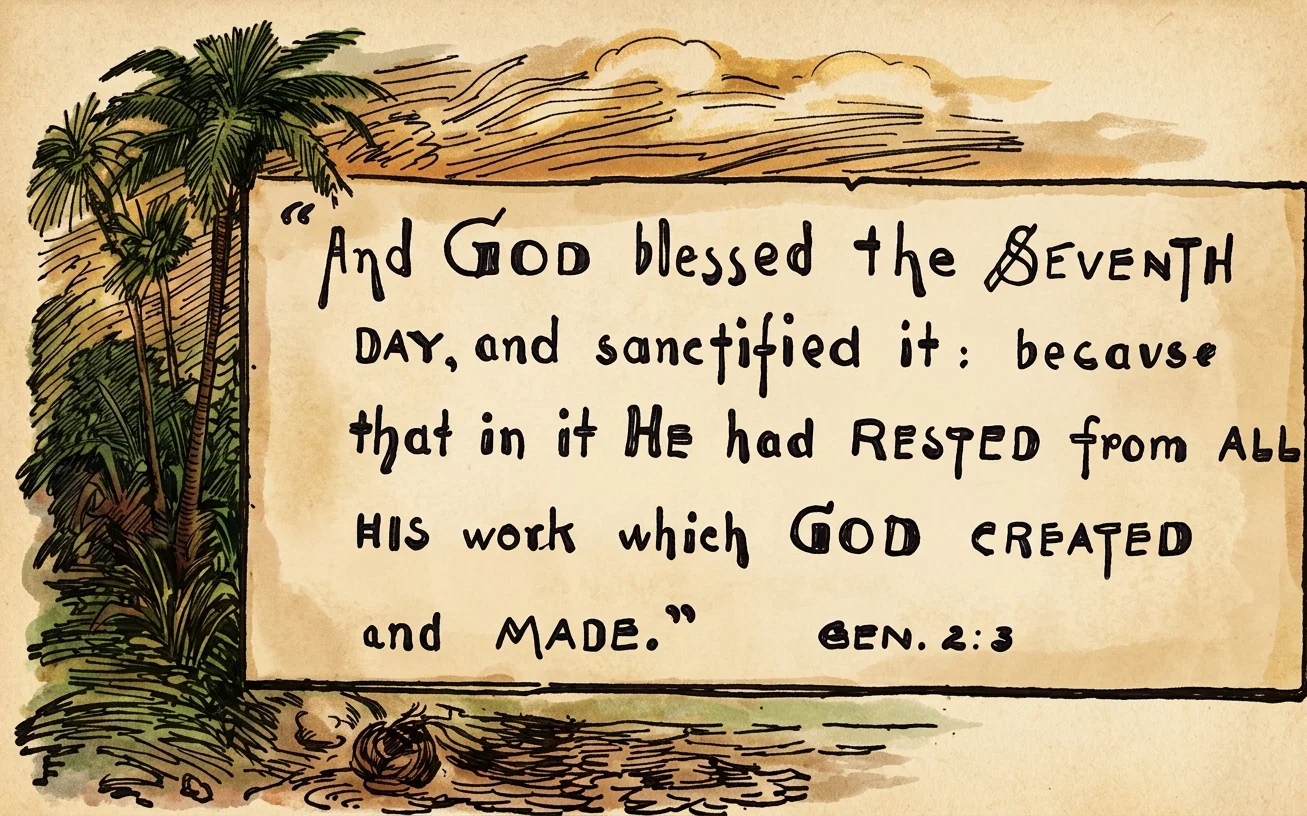
In six days the wonderful works of God had been finished. And God “rested on the seventh day from all his work which he had made. And God blessed the seventh day, and sanctified it; because that in it he had rested from all his work which God created and made.” Such is the sublimely simple, yet all-comprehensive, statement of facts concerning the making of that institution which, alone with marriage, shares the glory of being saved to the fallen race from their lost paradise; and with it equally essential to the wellbeing of man.
The reason for the institution of the Sabbath is to be found in the great facts of creation. It is the one institution standing as a monument to all the world of the wonders of God’s power manifested in the creation. And so long as the fact of creation, or the knowledge of a Creator, has any influence upon human thought, or makes any appeal to human sympathies, so long will the Sabbath remain as a constant reminder of the Creator’s power, a sign of the one true God.

When Instituted.

The time when the Sabbath was instituted is worthy of special notice. The language used in relating what took place on the seventh day, concerning the sanctification of the seventh day as a day of rest, would certainly convey to the mind the idea that it took place at the close of the creative week.
And God “blessed the seventh day, and sanctified it.” To sanctify is “to set apart as holy, or for holy purposes; consecrate; hallow.”—Standard Dictionary. The Hebrew verb quadash, here rendered sanctify, is translated elsewhere “appoint,” “proclaim” for a public appointment, or proclamation. See Joshua 20:7, margin; Joel 1:14; 2:15; 2 Kings 10:20, 21; Zeph. 1:7, margin. These cities of refuge, and fasts, and solemn assemblies, were sanctified, or set apart, by a public appointment, or proclamation of the fact. When, therefore, God sanctified, or set apart, the seventh day to be used by man (Mark 2:27) as a holy rest day, it was necessary that he state that fact to man. We may, therefore, conclude that from the first such a proclamation was made.
Our Saviour, when speaking of the corruptions of the marriage relation which had arisen under the Mosaic code, and which was suffered because of the hardness of their hearts, said, “From the beginning it was not so.” Matt. 19:8. Thus he shows the high obligation of the primitive law, that law of which the Sabbath commandment was an integral part. Whatever institutions were given to man then, were given for all time. Thus there is given to the marriage institution, and the Sabbath, which are so closely related, and each of which is so sacredly guarded in that law which is holy, just, good, and spiritual (Rom. 7:12, 14), a permanency of character and authority which show them to have been given to all mankind, for all time.
Dr. Nicholas Bound, in his “True Doctrine of the Sabbath,” London, 1606, page 7, thus states the antiquity of the Sabbath precept:—
This first commandment of the Sabbath was no more than first given when it was pronounced from heaven by the Lord, than any other one of the moral precepts, nay, that it hath so much antiquity as the seventh day hath being; for so soon as the day was, so soon was it sanctified, that we might know that, as it came in with the first man, so it must not go out but with the last man; and as it was in the beginning of the world, so it must continue to the end of the same, and as the first seventh day was sanctified, so must the last be. And this is that which one saith, that the Sabbath was commanded by God, and the seventh day was sanctified of him even from the beginning of the world; where (the latter words expounding the former) he showeth that, when God did sanctify it, then also he commanded it to be kept; and therefore look how ancient the sanctification of the day is, the same antiquity also as the commandment of keeping it holy; for they two are all one.

How Instituted.

And God “rested on the seventh day from all his work which he had made.” Gen. 2:2. “In six days the Lord made heaven and earth, and on the seventh day he rested, and was refreshed.” Ex. 31:17. He rested not as one weary (Isa. 40:28), but as being well pleased with the fruits of his wisdom and love, in his completed work, and the manifestations of his glory. God being spirit (John 4:24), the rest which he had was, therefore, spiritual rest. And, although man has departed far from God and his ways, yet “the heavens declare the glory of God; and the firmament showeth his handiwork.” Ps. 19:1. Notwithstanding the fact that evidences of the curse are seen on every hand, showing that “the wages of sin is death” (Rom. 6:23), still his eternal power and godhead may be understood by the things that are made (Rom. 1:20). Jesus invites us, saying: “Come unto me, all ye that labor and are heavy laden, and I will give you rest. Take my yoke upon you, and learn of me; . . . and ye shall find rest unto your souls.” Matt. 11:28, 29. With the return of the monument of his power and goodness, we are encouraged to trust in him that speaketh “in righteousness, mighty to save.”
After the Creator had rested upon the seventh day—thus laying the foundation of a divine institution, the memorial of his own great work—the record states that “God blessed the seventh day, and sanctified it; because that in it he had rested from all his work which God created and made.” Gen. 2:3. The same thought is stated in the fourth commandment thus: He “rested the seventh day; wherefore the Lord blessed the Sabbath day, and hallowed it.” The second act, then, in instituting this memorial was to place his blessing upon the day of his rest, thus making it the blessed rest day of the Lord. A third act completed the sacred institution. The blessed rest day of the Lord is now sanctified, or hallowed. In other words, it was made sacred, or holy, set apart for a holy purpose. It was thus evermore to be the blessed, sanctified rest day of the Lord.

By Whom Instituted.

It is quite important that we understand by whom this great work was all accomplished. “All things were made by him [Christ]; and without him was not anything made that was made.” “He was in the world, and the world was made by him, and the world knew him not.” John 1:3, 10. “God, who created all things by Jesus Christ.” Eph. 3:9. So, also, see Col. 1:14–17; 1 Cor. 8:6.
As Christ is the one by whom all things were made, and as the Sabbath was among the things that were made (Mark 2:27), it therefore follows that Christ was associated with the Father in resting, blessing and sanctifying the seventh day; that it was he who was refreshed—took delight in the rest of a completed work.
Finally, the Sabbath is shown to have been committed to Adam, the representative of the human race, and so to all mankind, to be an eternal witness to the “one God, the Father, of whom are all things, and we in him; and one Lord Jesus Christ, by whom are all things, and we by him;” to have been set as a perpetual memorial of that power and wisdom which brought all things into being, and ordered their adaptations and harmony; to be a witness of the most important truths that it is possible for man to know. It, therefore, imposes upon all races and generations of men a dutiful observance.

THE SABBATH AND THE LAW.

The Giving of the Law.

God chose to speak his law from Sinai’s peak, amid the solitudes of earth. He did not trust prophet or priest to proclaim it; he uttered it with his own voice. Deut. 4:12, 13; Ex. 20:1–17. He did not proclaim it in stillness to the heart, but in trumpet tones, which shook the earth, amid such glory as the world had never seen nor will see till He who was on Sinai shall come again in his glory. Ex. 19:18; Heb. 12:26. This law was not written on parchment or papyrus, but graven by God’s finger on tables of enduring rock. Ex. 31:18; 32:16. A costly receptacle—the ark of the testimony—was made for it, the cover of which was symbolic of God’s throne. Ex. 25:21. Everything attending the giving of the law showed its exceeding and extraordinary importance, majesty, holiness, comprehensiveness, singularity, and obligation, high over all other laws. It was the reflect of God’s character, the expression of his righteousness (Ps. 119:172; Isa. 51:6, 7), and is a complete compendium of all morality. After referring to the Decalogue, and in greater part repeating it, forty years after God gave it, Moses thus declares:—
“These words the Lord spake unto all your assembly in the mount out of the midst of the fire, of the cloud, and of the thick darkness; with a great voice, and he added no more. And he wrote them in two tables of stone, and delivered them unto me.” Deut. 5:22.
As God “added no more,” it must have been complete and perfect, and it is so declared to be. “The law of the Lord is perfect, converting the soul.” Ps. 19:7. It contains “the whole duty of man.” Eccl. 12:13. To add or to take from a perfect and complete law would make it incomplete and therefore imperfect.

The Fourth Commandment.

In the very heart of this law, containing about one-third of its words, is the law of the Sabbath, the fourth commandment of the Decalogue:—
“Remember the Sabbath day, to keep it holy. Six days shalt thou labor, and do all thy work; but the seventh day is the Sabbath of the Lord thy God; in it thou shalt not do any work, thou, nor thy son, nor thy daughter, thy manservant, nor thy maidservant, nor thy cattle, nor thy stranger that is within thy gates; for in six days the Lord made heaven and earth, the sea, and all that in them is,and rested the seventh day; wherefore the Lord blessed the Sabbath day, and hallowed it.” Ex. 20:8–11.
Notice the following facts:—
1. The very word “remember,” with which the commandment begins, shows that the Sabbath is not a new institution, and indicates how carefully God would have the Sabbath regarded.
2. Remember the Sabbath to keep it holy. God had already made it holy; man’s duty was to keep holy what God had made holy. God made it holy at its institution. Gen. 2:2, 3. He alone can make anything holy. This he does by placing in it his own presence. He only can keep the Sabbath holy who is himself holy, made so by the indwelling of the Lord Jesus Christ. A recognition of these facts will show the utter futility and assumption of all man-made or civil Sabbath laws.
3. It is the same day of the weekly cycle as we have in Gen. 2:2, 3, based on the same facts,—the Creator’s rest, blessing, and sanctification,—thus identifying it with the original Edenic Sabbath.
4. It is a memorial of God’s creative power, wisdom, and love.
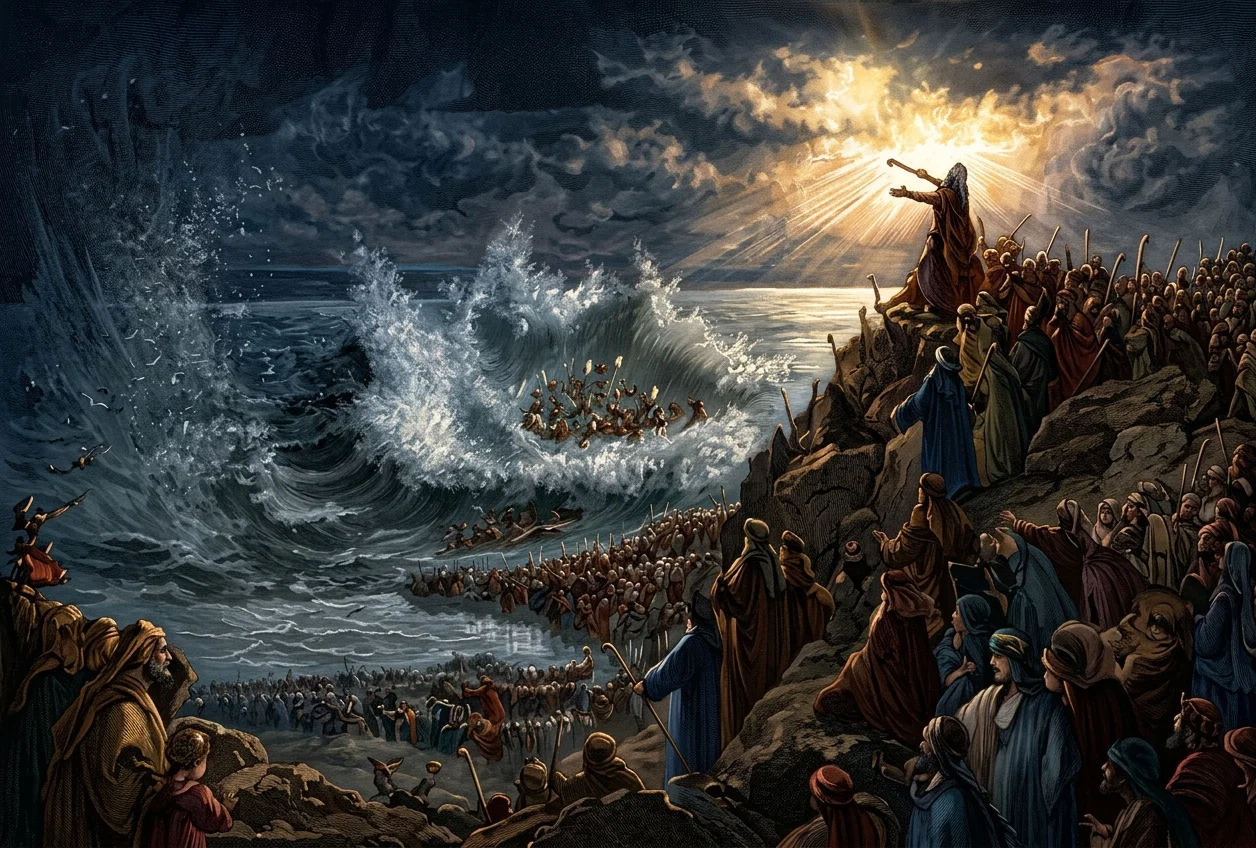
Copyrighted 1890. From “Patriarchs and Prophets,” by permission. REDEMPTION OF ISRAEL AT THE RED SEA.
5. It points out the seventh day of the cycle as the Sabbath—the seventh day of the seven—the day on which God rested, which he blessed, which he set apart for man.
6. There is not one hint of a seventh-part-of-time Sabbath, or that the Sabbath was for the Jews. The commandment is addressed to the individual, not to a race or nation.
Note again the position of the Sabbath commandment in the law. It is not at the beginning or at the close. Were it at the beginning, it might be declared to be no part of the law. Were it at the close, it might be declared to have been added. But divine wisdom placed it in the very heart of the moral law, so that three immutable precepts guarding man’s duty to God must be passed over, on the one hand, and six immutable precepts guarding man’s duty to his fellow, crushed out, on the other hand, before the impregnable fortress of the Sabbath can be reached in order to attack it. But not one of these massive walls which surround it can be successfully assaulted. The Sabbath law is a part of the Decalogue, and no sophistry can evade it.

Made Known the Sabbath.

Says Nehemiah, in alluding to this fact:—
“Thou camest down also upon Mount Sinai, and spakest with them from heaven, and gavest them right judgments, and true laws, good statutes and commandments; and madest known unto them thy holy Sabbath; and commandedst them precepts, statutes, and laws by the hand of Moses thy servant.” Neh. 9:13, 14.
“And madest known unto them thy holy Sabbath,” does not mean that it was at Sinai that the Israelites first had a knowledge of the Sabbath, for they knew it at the least calculation more than two weeks previous to this in the wilderness, as has been before shown from Exodus 16. “Madest known” means to have made acquainted with, to have revealed its true character. And how did God do this?—He did it in two ways:—
1. He spoke it in connection with nine other moral precepts, and placed it right in the very heart of that law about which the generations to come would have no question. They could not say that the Sabbath was ceremonial or typical; God made it known to them, and to all who should come after them, that the Sabbath was just as moral and unchangeable as any other precept of his law. It was founded on facts which concern the race, and was made a memorial of God’s creative power. Fasten this fact, dear reader, in your memory forever, that you may remember that the holy Sabbath of the Lord is as moral, permanent, and obligatory as the other nine precepts with which it is associated.

A Sign of Redemption.

2. The Lord made known his Sabbath in a still fuller sense in the beginning of the Levitical dispensation. He revealed it not only as a memorial of his creative power, but as a sign of his mighty power to redeem. All through the word of God the deliverance of Israel from Egypt is presented as an evidence of God’s redeeming love and power, typical of the greater redemption and deliverance of the whole Israel of God when Christ comes. How many times in history, in prophecy, and inspired song do we read of how God brought Israel out of Egypt “by a mighty hand, and by a stretched-out arm” (Deut. 4:34; Ex. 15:11–13; Deut. 9:26, 29); “in his love and in his pity he redeemed them” (Isa. 63:9); and he manifested his mighty power that his people might “know that the Lord [Jehovah] he is God; there is none else beside him” (Deut. 4:35). The very power of creation is manifest in the redemption, or salvation, of his people. “Israel shall be saved in the Lord with an everlasting salvation; . . . for thus saith the Lord that created the heavens; God himself that formed the earth and made it; he hath established it, he created it not in vain, he formed it to be inhabited; I am the Lord; and there is none else.” Isa. 45:17, 18. See Isa. 43:3, 14, 15; 44:24; 45:15, 22; 49:26, where creative, redeeming, and saving power are joined together in the names by which God reveals himself to his people. Who can not see from the scriptures cited above, and many others, that the same power which created is the same power which redeems, sanctifies, and saves? In fact, redemption, or regeneration, is creation.
“For we are His workmanship, created in Christ Jesus unto good works.” Eph. 2:10.
“Therefore if any man be in Christ, he is a new creature.” R. V., margin, “a new creation.” 2 Cor. 5:17.
Therefore as the Sabbath is the memorial of God’s creative power in the beginning, how fitting it is that it shall ever be a sign of the same power in the redemption and sanctification of man! And this is what in the wisdom of God the Sabbath is. Thus saith the Lord: “I gave them my Sabbaths, to be a sign between me and them; that they might know that I am the Lord that sanctify them” (Eze. 20:12), that his people might ever remember that God’s creative power is pledged to make them holy and to save them. It is for this reason that the Lord not only gave the Sabbath as a memorial of his creative power, as spoken by his own voice, but he made it known as a sign of Israel’s redemption from Egypt, typical of the redemption of all the Israel of God from the bondage of sin and Satan. Thus we read:—
“Keep the Sabbath day to sanctify it, as the Lord thy God hath commanded thee. . . . And remember that thou wast a servant in the land of Egypt, and that the Lord thy God brought thee out thence through a mighty hand and by a stretched-out arm; therefore the Lord thy God commanded thee to keep the Sabbath day.” Deut. 5:12–15.
God redeemed his people from Egypt that they might be a holy people, like himself. “Ye shall be holy; for I the Lord your God am holy.” Lev. 19:2. Therefore the Sabbath, which was given of God primarily and forever to be a memorial of the mighty power of God in the creation of the heaven and the earth, a memorial of that same power which redeemed Israel from Egypt, typical of the greater deliverance from sin, was at the same time to be to them a continual sign that the same mighty power was pledged to their continual sanctification, as shown by Eze. 20:12, before quoted. Thus God made known his Sabbath, as he did himself—a memorial and sign of both Creator and Redeemer.—The Lord’s Day the Test of the Ages, chapter 1, part 2.
Continue reading: JESUS AND THE SABBATH