Pacific Press Publishing Company · Oakland, California · Jul 30, 1896
The Sand, or the Rock?
Which, reader, will you choose for your foundation? You must choose one or the other, and you may choose either; which shall it be?
What You Would Do.
We know that if you were building for yourself, one of the costly palaces of earth, you would seek for a good foundation. You would, if it were at all practicable, dig deep, that you might base it upon the best of all foundations—the solid rock. And if the rock were too far away, you would build a wall which would harden into rock. You would not proceed in your work unless you were sure that the foundation of your building were good. You would, if in doubt, seek the opinions of men who would be likely to know, of experts whose judgment was valuable. You would not care to risk thousands of dollars upon an imperfect foundation. Practical common sense would not permit it.
The Value of a Good Foundation.
The worth of a good foundation is known to every one; and the greater the building to be erected, the more permanent it is desired to be, the more important it is that the foundation be good. It matters little how good the superstructure may be if the foundation be defective or insecure; for the whole building will suffer from an unsubstantial foundation. In order that the building be what it ought to be, a prime requisite is a solid, good foundation. And this you would demand. Good judgment would not allow anything else, even for a worthy structure of earth.
Character Building.
Well, character is eternal for weal or woe. Eternal consequences hinge upon it. Eternal life, eternal death—events of eternal import—are involved in it. In the grandest marble palaces of earth but a few millions of dollars, at the most, are involved; and if the palace be wrecked, the loss is but temporary; it may be possible to save much and retrieve all. But character is eternal; of how much more importance, then, is its foundation! How much more worthy of anxious care and thought, of earnestness of purpose, of long-suffering, and of unwearied patience and devotion! It is as much more worthy of all these as any temporal structure can be, as eternity is of more value than time.
The Foundation.
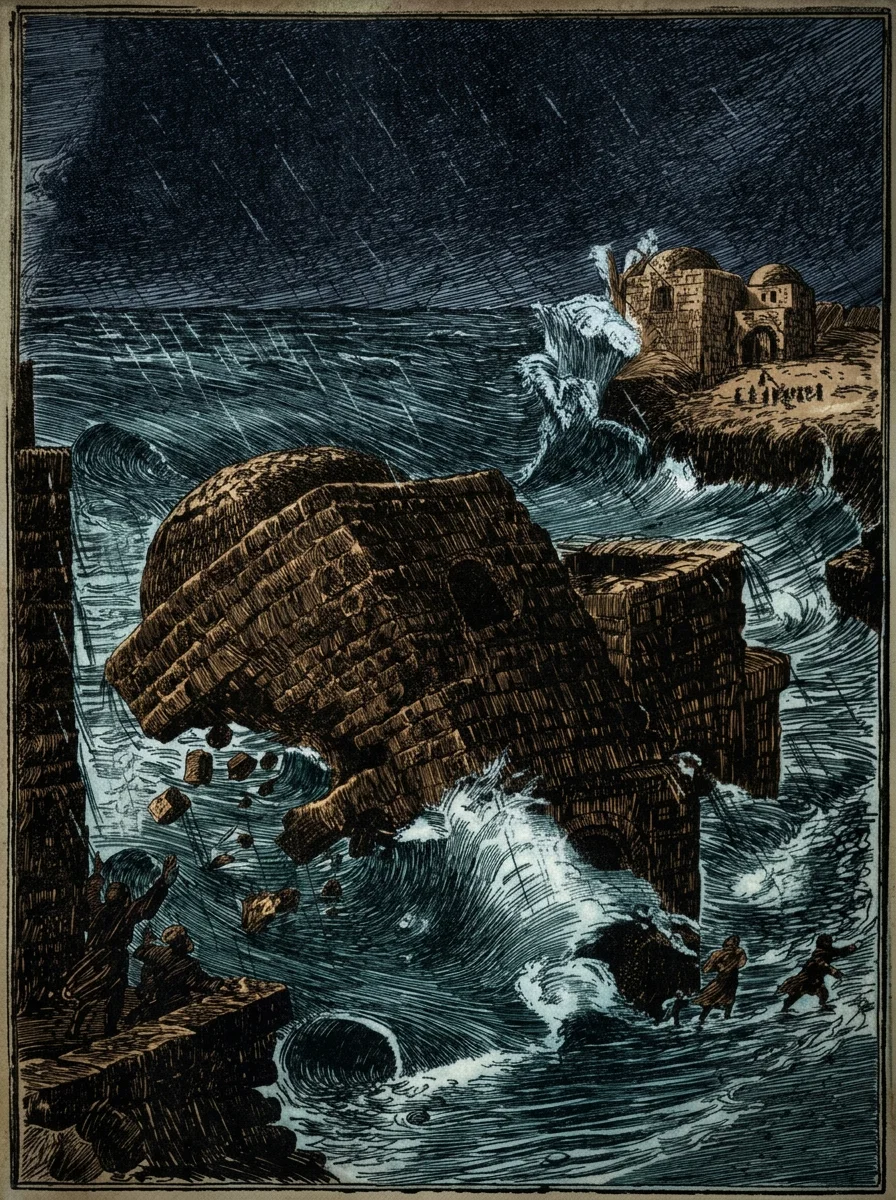
In the building of character God gives us the choice of foundations—the Sand or the Rock. It is for us to choose. This is what our Lord says of the good foundation , as he concludes that wonderful epitome of Christian teaching—the Sermon on the Mount: “Every one therefore which heareth these words of mine, and doeth them, shall be likened unto a wise man, which built his house upon the rock; and the rain descended, and the floods came, and the winds blew, and beat upon that house; and it fell not; for it was founded upon the rock.” Matt. 7:24, 25, R. V. The words of Christ are not, however, confined to this sermon. He is himself the Word through whom all the word of God came, the One by whom the works of creation were wrought, the One whose Spirit inspired the prophets of old, the only One who primarily has declared God and God’s will to men. (See John 1:1-3, 18; 1 Cor. 8:6; 1 Peter 1:11, et al.) The words, or sayings, of Christ are, therefore, the “Scriptures of truth.” He who hears one and does it will hear all and do it. He who rejects one command, however small it may be, rejects Him who gave it. Jesus Christ is the Foundation Rock for all true character building; “for other foundation can no man lay than that is laid, which is Jesus Christ.” 1 Cor. 3:11. “He is the Rock; his way is perfect.”
Building on Him.
Building on Christ means to give up all of self, and take him, and him alone, for our foundation. In Luke the additional thought is expressed, “He is like a man building a house, who digged and went deep, and laid a foundation upon the rock.” Deep digging is sometimes necessary. Early teaching, the rubbish of error and hoary tradition, church creeds, sectarian prejudices,—all of which seem precious to us, as hard as the very rock,—may hide from us the Rock itself—the pure, solid teachings of Jesus Christ, the Truth. Dig, and dig deep, till the Rock is reached. Do not be turned from the object of your search. Do not cease to dig till you know that every particle of foreign matter is removed and the Rock is laid bare. Then build; and if you build aright, your structure will grow onto2the Rock; or, rather, the Rock will grow into your structure, and make it a part of itself. The rains, the storms, the winds can not affect it any more than they can the very Rock.
On the Sand.
He who does not build on Christ is thus spoken of by the Master: “And every one that heareth these words of mine, and doeth them not, shall be likened unto a foolish man, which built his house upon the sand; and the rain descended, and the floods came, and the winds blew, and smote upon that house; and it fell; and great was the fall thereof.” Luke has it, “built a house upon the earth.” It need not be sand alone; it need not be loose earth alone. The foundation may seem to be almost as hard as the rock itself; but if it is not the rock, the house will be ruined. The falling rain will loosen the soil; the sweeping flood will wash it away and undermine the house; and the wind will topple it over into the raging torrent, which will sweep it on to destruction. So it is with the character of him who builds on anything but Jesus Christ. The foundation may be a creed of a thousand years; it may be a superficial, self-righteous character, as all self-righteous characters are; it may be all the hoary traditions of the fathers; it may be a foundation that has stood for centuries, tho not the very Rock of Truth; it may be very near the Rock; but, O soul, if it be not the Rock, the very Living Rock itself, the subtle rain of error will loosen it, and the storms of the last days “will sweep away the refuge of lies,” and “the covenant with death be disannulled.” “Be not deceived; God is not mocked.” Build on the Sure Foundation, which God has laid in Zion for every one; for none who seek him, will seek him in vain. Let self be crushed on the Rock Christ Jesus, and a character eternal and pure built up in him.
All Israel Saved
We come now to the eleventh chapter of Romans, the closing up of the special discussion of Israel. In each of these three chapters we are plainly shown that the gentiles, if they believe, have an equal share with the Jews, and that the latter forfeit all the privileges of the people of God through unbelief. Nothing could show more plainly than do these chapters that all men are on a level, and that the promises of God are to all who believe, irrespective of birth or nation.
Since this chapter is long, and we wish to present it all at one view, we do not reproduce the text, but urgently request the reader to study the chapter through carefully, reading it several times, before going further.
Not a Castaway
The apostle Paul knew that God had not cast off his people, the lineal descendants of Abraham, and his proof was the fact that he himself was accepted with God. If the Jewish nation had been cast off by the Lord, then there would have been no hope for Paul, because he was “an Hebrew of the Hebrews.” The words “God forbid” mislead some people. The idea obtains that Paul was praying that the Lord would not cast off his people, lest he also should be cast away. Instead of “God forbid,” read, “by no means.” Then all is clear. Thus: “I say then, Hath God cast away his people? By no means.” How do you prove that? Why, “I also am an Israelite, of the seed of Abraham, of the tribe of Benjamin.”
Who Are Rejected?
Altho God had not cast away his people, they were in a bad way. The fact that God had not cast them off, did not prove that they would be saved. Paul intimated that there was danger that even he, after he had preached to others, might be a castaway. 1 Cor. 9:27. The case, however, lay wholly in his own hands. There was no danger that God would cast him away against his will. We have the words of the Lord, “Him that cometh to me I will in nowise cast out.” John 6:37. And all may come; for he says also that “whosoever will” may come. God casts no one off; but if they utterly reject him, then, since he forces no one, he has no alternative but to leave them to themselves. “Because I have called, and ye refused; I have stretched out my hand, and no man regarded; but ye have set at naught all my counsel, and would none of my reproof; . . . therefore shall they eat of the fruit of their own way, and be filled with their own devices. For the turning away of the simple shall slay them, and the prosperity of fools shall destroy them.” Prov. 1:24–32. God stretches forth his hands to a disobedient and gainsaying people (Rom. 10:21), and they have it in their own power to say if they will be saved. God accepts everybody; the only question is, Will they accept him?
The Remnant
In the illustration from Elijah’s time, we learn something further about the matter of acceptance and rejection. It seemed then as tho all Israel had departed from the Lord, but there were seven thousand men who had not acknowledged Baal. “Even so at this present moment there is a remnant according to the election of grace.” The grace of God appears to all men, and is extended to all. Those who accept the grace are the elect, no matter of what tribe or nation they are. Altho the plan of salvation embraces all the world, it is a sad fact that but few of any people or generation will accept it. “Tho the number of the children of Israel be as the sand of the sea, a remnant shall be saved.”
The Olive Tree
While there are single expressions in the eleventh chapter of Romans that are difficult to understand, the chapter as a whole is very simple. Under the figure of an olive tree, the people of God are represented, and by the figure of grafting, the relation of all men to God is shown. Before going into the particulars of this illustration, we must for a moment consider
The Commonwealth of Israel
In the second chapter of Ephesians we learn that as gentiles, the Ephesians had been “aliens from the commonwealth of Israel,” “having no hope, and without God in the world.” That is, those who are not of the commonwealth of Israel are without God; or, those who are without God are aliens from the commonwealth of Israel. Now Christ is the only manifestation of God to man, and “he came unto his own, and his own received him not.” John 1:11. Therefore the mass of the Jewish nation were without God, just as surely as the heathen were, and consequently were aliens from the commonwealth of Israel. The same chapter of Ephesians tells us that Christ came to reconcile both Jews and gentiles unto God, showing that both were separate from him. Still further in the same chapter we learn that the commonwealth of Israel is the “household of God,” and is composed of saints, those who are reconciled to God. Only such are not strangers and foreigners from Israel.
The Origin of Israel
The name originated that night when Jacob wrestled with the Lord, and finally by his faith obtained the blessing that he sought. He could not gain anything whatever by his physical strength; indeed, one touch by the Lord was sufficient to make him utterly helpless; but it was when, in his utter helplessness, he cast himself in simple faith on the Lord, that he gained the victory, and was named Israel—prince of God. This title was applied to all his descendants, altho it strictly belonged only to those who had living faith in God, just as we use the term “Christian” of those who are in “the church,” with no thought of asserting that they really know the Lord.
A Righteous Nation
Much is said of the unbelief of the children of Israel; but there were times when they as an entire nation had faith to a marked degree. One instance will suffice at present. “By faith the walls of Jericho fell down, after they were compassed3about seven days.” Heb. 11:30. Thirteen times the whole host marched round the city, seemingly to no purpose, without a murmur. Such faith showed that they were then a righteous nation, in close union with God; because, “being justified by faith, we have peace with God through our Lord Jesus Christ.” Rom. 5:1. Then their name truly indicated their character; they were Israelites indeed. They were walking “in the steps of that faith of our father Abraham.”
Severed Branches
But they did not keep the faith. “We are made partakers of Christ, if we hold the beginning of our confidence steadfast unto the end.” Heb. 3:14. This they did not do, and so they became “without Christ,” “aliens from the commonwealth of Israel.” Eph. 2:12. In Rom. 11:17 the apostle asks, What “if some of the branches be broken off?” etc., not meaning, however, to imply that some were not broken off, as we learn from what follows. For he says, “Well; because of unbelief they were broken off” (verse 20), and again, “God hath concluded them all in unbelief” (verse 32), thus showing that all were broken off. So we find the people who were “beloved for the fathers’ sakes” (verse 28) and who had at one time in their history been “children of God by faith in Christ Jesus” (Gal. 3:26), reduced through their unbelief to the level of those who had never known God.
Grafted Branches
All the branches of the olive tree—Israel—were broken off through unbelief. To supply their places God took branches from the wild olive tree,—the gentiles,—and grafted them on. This grafting was “contrary to nature” (verse 24), since it was wholly a work of grace. If it had been according to nature, then the branches would have borne natural fruit, and there would be no gain from the grafting, since the natural fruit was bad. See Gal. 5:19–21; Eph. 2:1, 2. But a miracle was wrought by grace, and the branches that were grafted in partook of the nature of the root. The fruit of the grafted-in branches is no more natural, but that of the Spirit. Gal. 5:22, 23.
A Reunion
We must remember that God did not cast off his people. They fell away through unbelief. “They also, if they abide not still in unbelief, shall be grafted in; for God is able to graff them in again.” Verse 23. The Jew has as good a chance as the gentile. “There is no difference between the Jew and the Greek; for the same Lord over all is rich unto all that call upon him.” Rom. 10:12. Christ came “that he might reconcile both unto God in one body by the cross,” and “through him we both have access by one Spirit unto the Father.” Eph. 2:16, 18.
No Change of Plan
Let us not forget that in thus grafting in the gentiles to take the place of rebellious Israel, there has been no change in God’s plan. It was all included in the original promise to Abraham. “Know therefore that they which be of faith, the same are the sons of Abraham. And the Scripture, foreseeing that God would justify the gentiles by faith, preached the Gospel beforehand unto Abraham, saying, In thee shall all the nations be blessed.” Gal. 3:7, 8, R.V. In the beginning God made Adam, the father of the human race. Adam was the son of God (Luke 3:38); therefore all his descendants are by right God’s people. He did not cast them off because they sinned. His love embraced the world (John 3:16), and it did not contract in the days of Abraham, Isaac, and Jacob. The only advantage of Israel was that they had the privilege of carrying the glorious Gospel to the gentiles, for whom it was always designed as much as for them.
Visiting the Gentiles
That the gentiles, as well as the descendants of Jacob, were from the beginning intended to become Israel, was shown at the conference in Jerusalem. Peter told how he had been divinely sent to preach the Gospel to them, and that God put no difference between them and the Jews. Then James said: “Simeon hath declared how God at the first did visit the gentiles, to take out of them a people for his name. And to this agree the words of the prophets; as it is written, After this I will return, and will build again the tabernacle of David, which is fallen down; and I will build again the ruins thereof, and I will set it up; that the residue of men might seek after the Lord, and all the gentiles, upon whom my name is called, saith the Lord, who doeth all these things. Known unto God are all his works from the beginning of the world.” Acts 15:14–18. See also Amos 9:11–15.
From the above we learn that the “tabernacle of David,” the house or kingdom of David, is to be restored through the preaching of the Gospel to the gentiles, and that this is according to the mind of the Lord from the beginning of the world. What these scriptures need is not comment, but believing thought.
“The Fulness of the Gentiles.”
“Blindness in part is happened to Israel, until the fulness of the gentiles be come in.” Rom. 11:25. Until the fulness of the gentiles be come into what place?—Into Israel, of course; for it is by the bringing in of the fulness of the gentiles that “all Israel shall be saved.” When will the fulness of the gentiles be come in? The Lord himself furnishes the answer: “This Gospel of the kingdom shall be preached in all the world for a witness unto all nations; and then shall the end come.” Matt. 24:14. God is visiting the gentiles, “to take out of them a people for his name.” By them Israel is to be made full or complete. As soon as this work of preaching the Gospel to the gentiles is finished, then the end will come. There will then be no more preaching to anybody—not to the gentiles, because they will all have made the final decision; and not to the Jews, because then “all Israel shall be saved.” There will then be no more need of the Gospel; it will have accomplished its work.
All through Christ
Note carefully verses 25–27. When the fulness of the gentiles shall have been brought in, “all Israel shall be saved.” Indeed, it is only by the bringing in of the gentiles that all Israel will be saved. And this will be a fulfilment of that which is written, “There shall come out of Zion the Deliverer, and shall turn away ungodliness from Jacob.” Only through Christ can Israel be saved and gathered; and all who are Christ’s are Israel; for “if ye be Christ’s then are ye Abraham’s seed, and heirs according to the promise.” Gal. 3:29.
Taking Away Sin
There shall come out of Zion the Deliverer, who shall turn away ungodliness from Israel. But Christ is “the Lamb of God, which taketh away the sin of the world.” John 1:29. “He is the propitiation for our sins; and not for ours only, but also for the sins of the whole world.” 1 John 2:2. The high priest Caiaphas spoke by the Spirit “that Jesus should die for that nation; and not for that nation only, but that also he should gather together in one the children of God that were scattered abroad.” John 11:51, 52. So Peter, speaking in the temple at Jerusalem, said: “Ye are the children of the prophets, and of the covenant which God made with our fathers, saying unto Abraham, And in thy seed shall all the kindreds of the earth be blessed. Unto you first God, having raised up his Son Jesus, sent him to bless you, in turning away every one of you from his iniquities.” Acts 3:25, 26. The blessing of Abraham is the forgiveness of sins through Christ; and men of all nations become Israelites indeed by the taking away of iniquity.
All of Faith
It was through faith that Jacob became Israel. It was through unbelief that his descendants were broken off from the stock of Israel. It is through faith that the gentiles are grafted in, and only by faith that they stand; and it is through faith that the Jews may become reunited to the parent stock. That faith in Christ is the only thing that makes one an Israelite, and that unbelief cuts one off from Israel, were fully shown by Christ when he marveled at the faith of the centurion, saying: “I have not found so great faith, no, not in Israel. And I say unto you, That many shall come from the east and west, and shall sit down with Abraham, and Isaac, and Jacob, in the kingdom of heaven. But the children of the kingdom shall be cast out into outer darkness.” Matt. 8:10–12.
All in Prison
“God hath concluded them all in unbelief, that he might have mercy upon all.” The word “conclude” means literally “to shut up,” as indicated in the margin. He hath “shut them all up together.”4 (468)So in Gal. 3:22 we read that “the Scripture hath concluded all under sin, that the promise by faith of Jesus Christ might be given to them that believe;” and the next verse speaks of all being “shut up” and guarded by the law. Both Jews and gentiles “are all under sin.” Rom. 3:9. All are shut up in prison together, with no hope of escape except by Christ, “the Deliverer,” who proclaims “liberty to the captives, and the opening of the prison to them that are bound.” Isa. 61:1. He comes as the deliverer “out of Zion,” bringing the freedom of “Jerusalem which is above.” Gal. 4:26. All, therefore, who accept the liberty wherewith Christ makes free, are the children of Jerusalem which is above, heirs of the heavenly Canaan, members of the true commonwealth of Israel.
The Free Man.
The free man believes in freedom for others. It has ever been a characteristic of humanity to claim liberty for one's self; but he who truly loves and knows freedom will claim liberty for the other man. The other man may be his enemy religiously, he may not believe in religion or God, yet the free man will demand freedom for him. The true enlightened Christian is free—made free by Jesus Christ. He believes in freedom for himself, but not less for others; and he knows that the only true freedom there is is freedom for all. To admit the right of the state to deprive one man of freedom on account of his religion is to admit of its right to deprive any man or class of men of freedom in religion. The free man can not be bound in conscience by others; he will not seek to bind others.
The Refiner’s Image
By Thomas Aquinas
WHEN one inquired of the refiner of silver how he knew when the dross was sufficiently separated, he received answer, “When I can see my own image perfectly reflected in it.” —Thomas Aquinas.
Prayers and Willing Action
“Our prayers only go as far as our hands and feet are willing to follow.”
Question Corner.
“Enquire, and make search, and ask diligently.”
No. 382. “Ought” and “Ought,” Again.
If “ought” in John 13:14 is binding, is not “ought” in 1 John 3:16 binding? S. S. O.
Most assuredly it is; both are obligatory, just as much so as God’s ought can make them. But the last “ought” does not mean that a man should go out and sacrifice himself. Every true disciple of Christ counts himself, as did Paul, a debtor to Jew and Greek, for Christ’s sake, and he yields himself a “living sacrifice” (Rom. 12:1), to be used as God desires. If it is death, well; if it is life, well; he does not know which to choose (Phil. 1:20–22). When he gives himself to Christ, he lays down his life at Christ’s feet, to be used for Christ in winning souls of all nations; and how much more his brethren!
No. 383. The Fate of the Wicked.
IS THERE any scripture stating regarding the wicked that they shall be as tho they had not been? S. S. O.
Yes; Obadiah, verse 16, in speaking of the heathen, says: “For as ye have drunk upon my holy mountain, so shall all the heathen drink continually; yea, they shall drink, and they shall swallow down, and they shall be as tho they had not been.” See also Eze. 28:19; Ps. 37:10.
No. 384. “Absent from the Body.”
PLEASE explain Paul’s words where he says, “We are confident, I say, and willing rather to be absent from the body, and present with the Lord.” Mrs. E. J. W.
“Absent from the body” means apart from this life; it may mean death, or at home with Christ by a translation or a resurrection. It was the latter, not the former, which Paul desired. He did not wish to be “unclothed,” or die, but clothed upon, present with the Lord, mortality swallowed up of life. Read the context. We will be present with the Lord when Christ comes. Matt. 16:27; 1 Thess. 4:16, 17. For a fuller exposition see SIGNS of April 30, 1896, No. 18, page 2.
No. 385. Fountains and Traditions.
PLEASE explain the following scriptures:— “For my people have committed two evils: they have forsaken me the fountain of living waters, and hewed them out cisterns, broken cisterns, that can hold no water.” Jer. 2:13. “Therefore, brethren, stand fast, and hold the traditions which ye have been taught, whether by word, or our epistle.” 2 Thess. 2:15. INQUIRER FOR PRESENT TRUTH.
1. Read the context. It meant with Israel of old that they had not only forsaken God, the Living Fountain, but had gone after other gods, which could be of no more value than broken cisterns. In time of need the gods could give no help; in time of drought the cisterns would furnish no water. The text is just as true now concerning those who leave God’s word for the errors of men.
2. The second text teaches that the brethren in Thessalonica should hold fast to the teaching of the apostles, whether by word of mouth, or by epistle. The word from which tradition comes is paradosis, and means “delivery, handing over, transmission,” “what is transmitted in the way of teaching, precept, doctrine.” See 1 Cor. 11:2, where the word is translated “ordinances.” The word “traditions,” in 2 Thess. 2:15, refers to what Christ delivered over, or transmitted to, his apostles to teach. That we might know what was taught by spoken word, God has given us the written word. The text does not refer to erroneous tradition which claims to be apostolic. All such should be tested by the written word.
No. 386. The Shiloh of Judah.
DOES Shiloh of Gen. 49:10 refer to Christ? If so, how do we reconcile the text with the fact that Zedekiah was the last earthly king of Judah, and that Rome itself (the third overturning, Eze. 21:25–27) became practically universal in B.C. 168? Mrs. A. H.
The declaration in Gen. 49:10 is to the effect that Judah should remain a distinct tribe, having a sufficiency of tribal government, etc., to preserve the tribe intact till Christ came. Around it the remnant of the nation would gather; but when Christ came, he would be the center. While Zedekiah was the last regular king, yet Judah in a greater or less degree preserved its customs, laws, and government, altho subordinate, till after the crucifixion.
No. 387. Yoke of Bondage.
PLEASE explain Acts 15:10, 28. Does this refer to or imply the abolition of the law? T. L. S.
It is impossible to give a good exposition of these texts without a consideration of the entire chapter. But, briefly, the certain men who went down from Judea taught justification, or salvation, by ceremonies or works. “Except ye be circumcised after the manner of Moses, ye can not be saved.” Verse 1. Now it is evident that just as soon as man trusts to anything apart from Christ for salvation, he makes Christ of no effect; and as only Christ can save from sin, by choosing the something else he turns from Christ to all his sins. Circumcision of itself is nothing either way (1 Cor. 7:19), but if it is trusted in as a means of salvation, it makes the death of Christ in vain, and leaves the sinner under his yoke of sin. This is the yoke which the Jewish fathers vainly sought to remove by ordinances, traditions, and ceremonies without number, but which daily added to the yoke. So these Jewish teachers were blinding by their burdensome ordinances the gentiles in Christ. These works of self-righteousness the council declared should not be imposed upon the gentile converts. All that the true child of God needs is instruction, not prohibition. There were instructions, seemingly ceremonial, yet having a moral bearing, upon which these gentile converts needed instruction; these the council mentions (verses 28, 29), abstention from meats offered to idols, lest they seem to be idolaters; from eating of blood, in which was the animal life; from things strangled, dying without bleeding, and from fornication. This did not imply that they were at liberty to worship idols, or profane God’s name, or break his Sabbath; over these duties there was no question. The only apostolic prohibitions were concerning things which outwardly might seem to be purely ceremonial, but which really had a moral bearing.