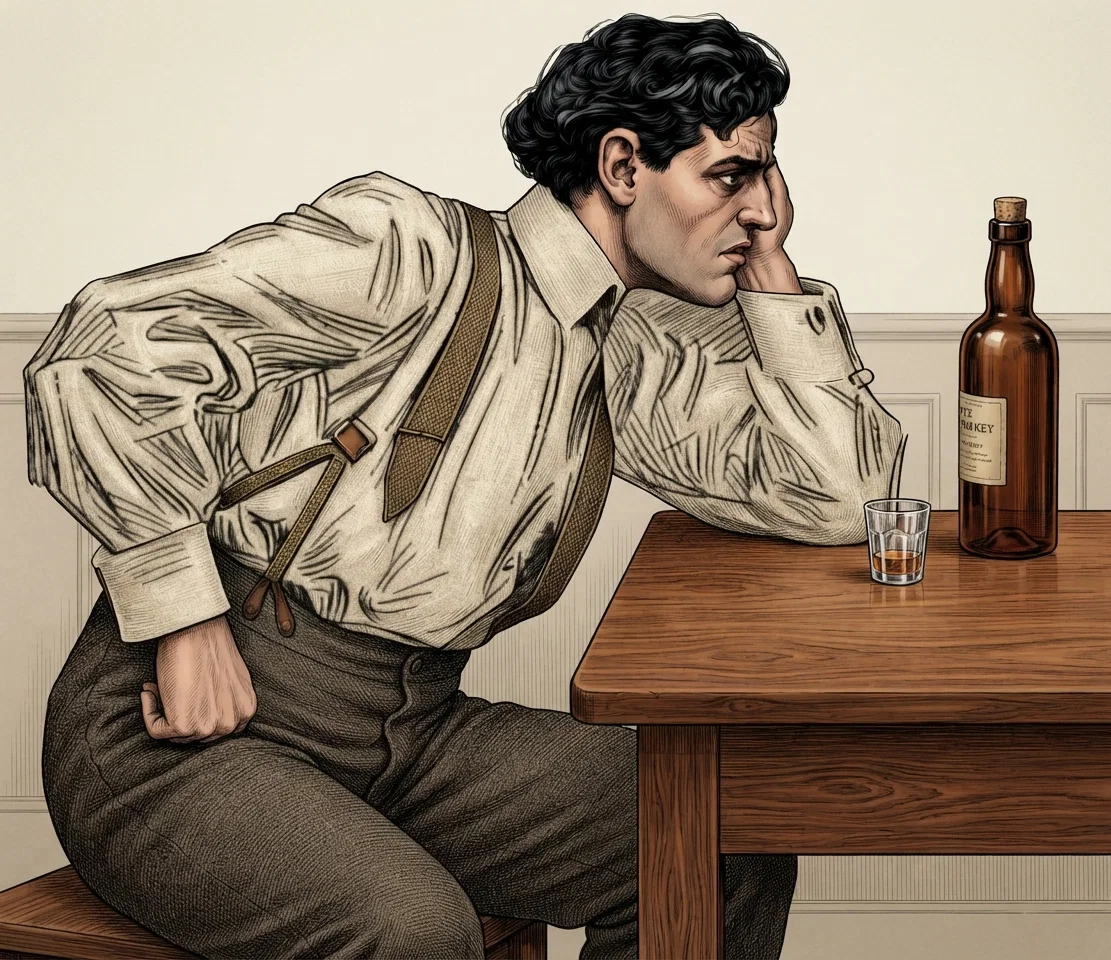
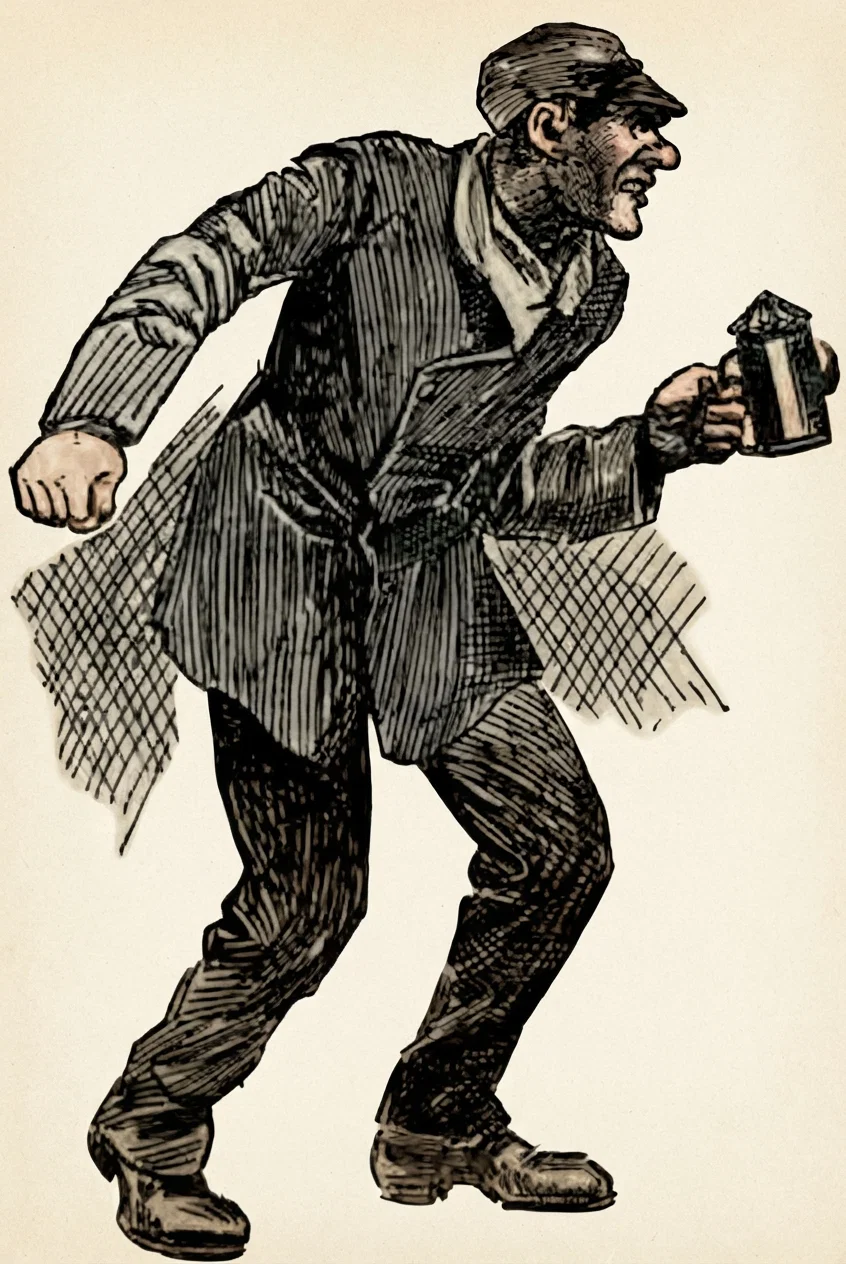
"O God, that men should put an enemy in their mouths to steal away their brains!"
The Enemy of the Workingman
By George W. Rine
THE degree of human progress is largely determined in terms of labor. In both the physical and the intellectual world, there can be no excellence without labor. A progressive society is objectively conditioned upon skill in the cultivation of the soil, in the building of roads and bridges, in the construction of private and public buildings, in the operating of mines, in the multifarious phases of manufacture, in the transportation and distribution of the products of labor, and so on almost indefinitely.
It follows, therefore, that the degree of progress made by civilized society is commensurate with the degree of the efficiency of its individual workers. Hence whatever tends to impair the effectiveness of the toilers, injures society, retards social advancement.
It is a fact of common knowledge that corporations and other employers are everywhere demanding sobriety of not only their office force, but also their manual workers. Captains and other officers of vessels, and even the common sailors, are strictly forbidden to touch alcoholic drink while on duty. Locomotive engineers, firemen, and train conductors can no longer keep their positions if they show the slightest inclination to befog their faculties with grog.
Several months ago, the Delaware, Lackawanna, and Western Railroad made a rule that all its employees must totally abstain from alcoholic drink, not only when on duty, but when off duty as well. This rule was enforced on the ground that it meant life and safety to passengers, and dollars and prestige to the company.
A recent report sent out by the United States Department of Labor informs us that seventy-two per cent of agriculturists, seventy-nine per cent of manufacturers, eighty-eight per cent of "trades" employers, and ninety-eight per cent of transportation companies, rigidly exclude from their employ all persons not known to be habitual abstainers. The Fidelity and Casualty Company testifies concerning the prevention of industrial accidents: "A man whose nerves have been made unsteady by a recent debauch, or by the habitual use of alcohol, should not be permitted to operate dangerous machinery or to carry on dangerous work. He endangers not only his own life, but the lives of others."
It is because drink leads one to be reckless and foolhardy, and because it dulls the senses by which danger is perceived, impairs one's judgment, and lessens motor control, that it so amazingly increases liability to accident.
Alcohol not only unfits a man for labor, but deprives him of nearly all his chance of engaging in remunerative labor. And since alcohol is the enemy of labor, it is the enemy of all social progress and well-being.
Every alcoholic is a candidate for tuberculosis.
RUM conquered Alexander the Great after he had conquered the world.
Fatal Effects of Alcohol
THE alcohol problem is more important than the tuberculosis problem, as (1) it costs more lives and more money; (2) it costs the United States over $2,000,000,000 annually; (3) it probably causes, directly and indirectly, at least ten per cent of all the deaths in the United States; (4) it predisposes to infection, destroys acquired immunity, prevents the occurrence of artificial immunity, at least in rabies, lessens resistance, leads to an increased mortality in all infectious diseases and after surgical operations; (5) it lessens the power of the individual to resist the injurious influences of extreme heat and cold; (6) it causes a deterioration of the quality of mental work; (7) it diminishes the power to withstand fatigue, and lessens the general efficiency of the individual; (8) it is a poison, and should be classified as such, instead of as a food or stimulant; (9) when the physicians take hold of the question in the same spirit as they have shown concerning yellow fever, malaria, and smallpox, instead of treating it as a moral question, and leaving it to clergymen, temperance workers, and enthusiastic reformers, we may expect better results; (10) more may be accomplished by teaching the people the truth in regard to the fatal effects of alcohol upon mental and physical efficiency than by expatiating on the moral wickedness of drinking.
We deserve condemnation as a profession when we assume the attitude of sneering contempt for the efforts of clergymen, laymen, enthusiasts, and reformers in their attempts to stamp out this evil, just as we would deserve it if we would assume the same attitude toward them if they attempted to stamp out yellow fever and malaria. Fortunately, the question is receiving new attention from earnest men who have the courage of their convictions, and who see with clear vision, and who will not be deterred by sneers or criticisms.
Public opinion demands, and has a right to demand, in no uncertain tones, that the action and influence of alcohol be determined and settled by the medical profession, and that we then teach the people the truth fully, conscientiously, and fearlessly.—George W. Webster, M. D.
SCIENTIFIC experiments show that even comparatively small amounts of alcohol decrease the amount of work accomplished, and increase the fatigue therefrom.
Impairs Muscular Power
ALCOHOL does not increase strength for muscle work, but distinctly decreases it. The reason that many persons imagine they are working better and with less weariness after taking alcohol is that the alcohol blurs judgment. Thus one judges that he has accomplished more work than he really has done, while the alcohol temporarily covers the feeling of fatigue. This is soon followed by greater depression; but the drinker seldom realizes that this is due to the alcohol, and sometimes he uses more drinks to overcome it.
The learned Dr. Abel says, "Both science and the experience of life have exploded the pernicious theory that alcohol gives any persistent increase of muscular power."
Careful tests with delicate instruments have shown that even a small quantity of alcohol—no more than that in a bottle of claret wine—caused disturbances of the mental faculties. It slowed reaction time—the response of the mind to signals—or if a choice had to be made, the worker answered the signal more quickly but made more mistakes. With larger quantities of alcohol, the reaction was always slower. The alcohol brings on a condition similar to that of fatigue, so that work done is of a lower order than that of which the mind is naturally capable. It impairs the power to memorize, to add, to judge.—Cora Frances Stoddard.
"THAT drink impairs the scholarship of school children is undeniable. High scholarship decreases, and poor scholarship increases, as the use of alcohol is increased."
The Foe of Efficiency
"SCIENCE has demonstrated that alcohol is a poison to the human system. It weakens man's brawn, impoverishes his blood, and injures his brain. The evil effect is proportionate to the extent to which alcohol is used. It lessens the power of the toiling man to do his labor. It makes the burdens of the miner heavier to be borne, and makes it harder for the mason to lift the stone, for the carpenter to wield his hammer, for the engineer to hold the throttle. It diminishes the logic of the lawyer, dims the genius of the writer, makes unsteady the knife of the surgeon, weakens the grasp of the business man over his affairs, quenches the ambition, cools the courage, and clouds the mind of the statesman."
"SCIENCE has shown alcohol to be responsible for a large part of our insanity, imbecility, disease, and degeneracy. And now comes big business showing us that alcohol is responsible for most of our inefficiency."
Dangerous Drug
IT is clear, in the light of experience and of recent research work, that alcohol ought to be classed in the list of dangerous drugs, along with morphine, cocaine, and chloral, a drug which may so affect the will power as to gain the complete mastery over a patient, and in the end destroy him. English and German physiologists have demonstrated, beyond a question, that the continued use of alcohol in any quantity is not only useless, but positively harmful; and on the basis of experience, I appeal to my colleagues everywhere to abjure its use.
One of the most alarming effects is that observed in the arterial walls and in the heart muscle, which are weakened. The impairment of nutritive processes is another pronounced factor. All rational surgery and treatment of disease takes into serious account the question of the use of alcohol by the patient. This is science, and not sentiment or theory.—Dr. Howard A. Kelly, professor of diseases of women, Johns Hopkins University.
DR. W. F. BOOS says: "The excessive Monday accidents result from the paralyzing effect of the Saturday night and Sunday debauch — the 'hang over,' which may last for twenty-four hours and longer. The victim is . . . not in complete control of his faculties, and is therefore more liable to have an accident."
Between 1901 and 1910, there were 14,411 cases of suicide to which alcohol contributed.
Is Beer Injurious?
MODERN scientific research has shown that, contrary to general belief, beer is proportionately much more noxious than are wines or liquors. The Bremen anti-alcohol congress, a conclave of many of the most famous physicians in Europe, concluded that, while liquor makes a man brutal and dulls his judgment, an adequate amount of beer makes him slow-witted and abolishes judgment. While wine or brandy, in405sufficient quantity, makes a man crazy, beer tends to make him stupid.
As regards the recent claims that lecithin, or "nerve fat," has been discovered in beer, this is interesting, if true. If it has — despite all the painstaking negative analyses of many generations of chemists — it is quite safe to estimate that the total amount contained in four carloads of beer might approximate the quantity concealed about the person of one vigorous fresh egg.—Edwin F. Bowers, M. D.
"EVERY DRINK IS A DRINK TOO MUCH."
Does Alcohol Shorten Life?
By G. H. Heald, M. D.
G. H. HEALD, M. D.
WHEN Professor H., followed by a class of senior medical students, made his rounds from ward to ward of the old City and County Hospital, San Francisco, he was nothing if not dramatic. He evidently believed in delivering his instruction in such a way that it would cling to the gray matter of his auditors. In the effort to leave a lively impress on the mind of the student, he probably left, as a by-product, a more than lively impression on the mind of the patient. We were ranged three or four deep around a cot on which lay a patient half bolstered up, who had that look of apathetic resignation betokening a man who has had more downs than ups. Standing near the head of the cot and facing his audience, the professor said, with an air of omniscience: "Young men, this patient has pneumonia, and he is going to die. Nothing we can do for him will save him, for he is a drinker." He was right. Our next visit to that patient was at the morgue or the autopsy room.
We then learned a fact which has been further impressed upon us, both as students and as practitioners — that the prognosis in a case of pneumonia is bad if the patient is a steady drinker. He need not be a hard drinker, either.
We afterward learned that there is a reason for this unfavorable effect of alcohol. In pneumonia, it is a pretty even fight between the invading germs and the body of defenders, the white blood cells. Every drink of alcohol damages these cells — helps to put them out of commission, as it were, so that the steady drinker is in a worse state of "unpreparedness" than are some governments we know of.
And as a government that is unprepared for the attacks of one nation is similarly unprepared for the attacks of other nations, so the body unprepared to defend itself against pneumonia is also unprepared to defend itself against other diseases.
Perhaps there is no body of men who, from the very nature of their calling, are so interested in the factors that shorten life as are insurance men.
In an address "Can Insurance Experience Be Applied to Lengthen Life?" Arthur Hunter, actuary of the New York Life Insurance Company, said: "Nothing has been more conclusively proved than that a steady free use of alcoholic beverages, or occasional excesses, are detrimental to the individual. . . . It is certain that abstainers live longer than persons who use alcoholic beverages."
The following is from a folder prepared by the medical director of the Provident Savings Life Insurance Company, and sent out to their policy holders:
"Published statistics relating to the mortality among immoderate drinkers are meager, but the effect of alcohol has in a broad way been measured by the experience of the United Kingdom Temperance and General Provident Institution, covering the period from 1866 to 1905. This company aimed to take none but total abstainers and temperate drinkers.
"On analyzing the experience in these two groups, it was found that for every one hundred deaths among the total abstainers, there were one hundred and thirty-one deaths among the temperate drinkers, showing a difference of thirty-one per cent in favor of the abstainers.
"Taking the experience of the same company for sixty-one years prior to 1901, and considering the mortality at the different age periods, we find that from age thirty-five to thirty-nine, the mortality in the general group was eighty-three per cent in excess of that among the total abstainers."
Should not this drug, capable of so much harm, be restricted in its sales, as are other dangerous drugs? And should not you, Mr. Voter or Mrs. Voter, do your share at the polls to effect its restriction?
DRINKING IMPAIRS THE MEMORY.
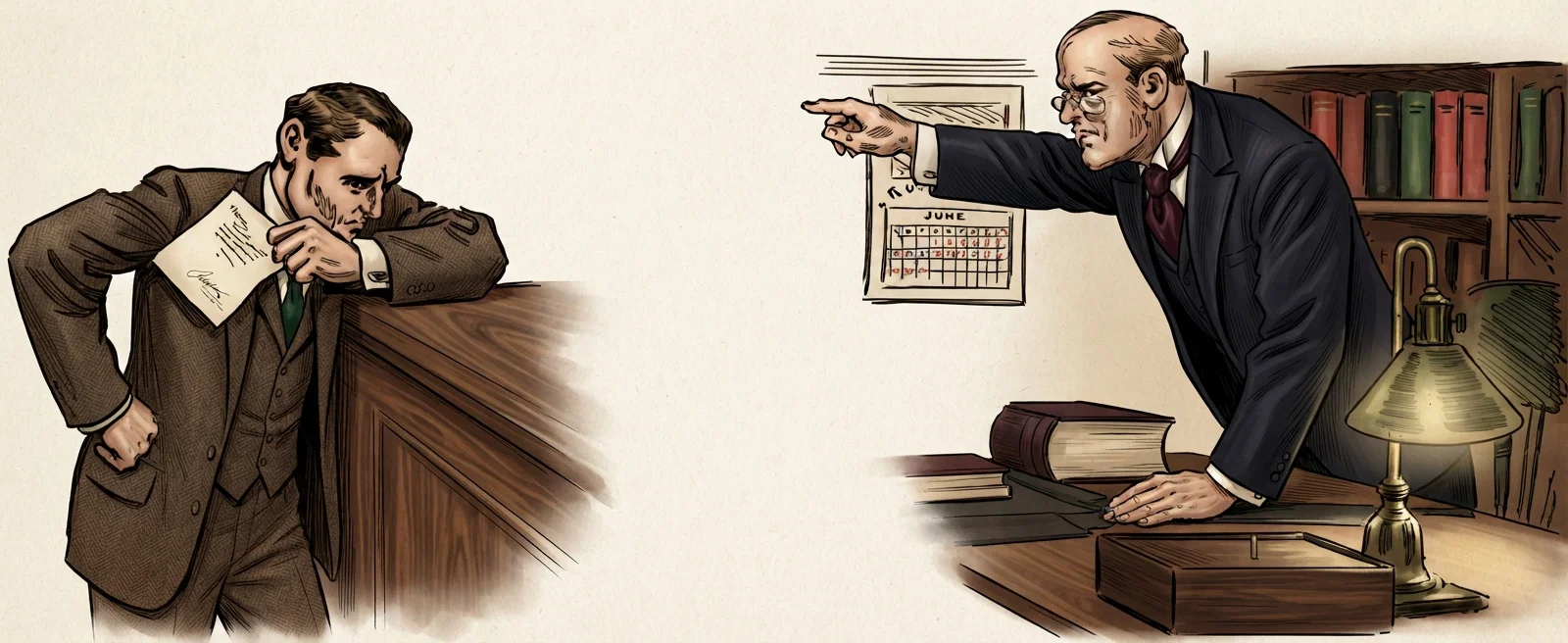
DISCHARGED BECAUSE OF DRINK "One cannot climb the ladder of success with one foot on a bar rail."
OUT OF A JOB
Recommended by Drink
"Go to the best friend you have, and ask him for a recommendation. Tell him to make it as strong as possible. After he has said all the good he can of you, let him write at the end of the recommendation three words, and write them in red ink, so they will be sure to be seen — 'And he drinks.' Then take the recommendation to any man who has money enough to employ another, and watch his face when he reads the recommendation — and then wait for a job."
"ALCOHOL impairs muscle work. It makes the drinker expend more energy. It increases his fatigue. It decreases the amount of muscle work done in a given time. It compels him to work longer to do a given amount of work."
Candidates for Tuberculosis
By H. J. Achard, M. D.
ESPINA Y CAPO declared before the Paris congress on tuberculosis, in 1905, that alcoholism and tuberculosis form the worst possible combination; that every alcoholic is a candidate for tuberculosis. Reynier has been struck by the observation that in external tuberculosis occurring after the fortieth year of life, the abuse of alcohol is frequently the only predisposing factor which can be ascertained, and that in such cases, all history of family taint is generally absent. Crothers quite recently demonstrated, in a study of one hundred cases of alcoholism, that it lowers the vitality and resistance, and predisposes to consumption; and Cornet explains the favoring influence of alcohol on the development of pulmonary phthisis thus, — that the ciliated epithelial cells are, by alcohol, temporarily weakened and paralyzed, so that one important defensive provision against the inhalation of tubercle bacilli is rendered inactive. Another harmful consequence he sees in the weakening of the heart muscle.
The general conviction thus prevails that alcoholism is distinctly a predisposing factor for the acquirement of tuberculosis, by virtue of its enfeebling, paralyzing effect on the defensive apparatus of the organism and the general systemic resistance to infectious diseases. — H. J. Achard, M. D.
SEVENTY-FIVE insurance companies carried on an investigation running back through fifty years, and reached the conclusion that the man who takes two beers or one whisky a day increases his death risk eighteen per cent.
Puts the Ban on Drinking
THE Standard Oil Company has issued the following notice to all employees:
"Everywhere the use of intoxicating liquors is being regarded with increasing disfavor, and many large corporations have recently issued circulars to their employees on the subject. The habit, as we all know, greatly reduces a man's efficiency, and makes him unreliable.
"A great many of our men are sober and industrious, and we desire that their influence be exerted to induce the drinking minority to follow their example.
"It has been decided that hereafter promotions will be made only from the ranks of the non-drinkers, and continuance of the drinking habit by employees will be cause for dismissal."
MERCHANTS display their products in their show windows. Not so with the saloon. It buries its products in the potter's field.
Abbreviates Longevity
THE following questions were sent out to several American insurance companies by a New York paper:
"As a rule, other things being equal, do you consider the habitual user of intoxicating beverages as good an insurance risk as the total abstainer? If not, why not?"
Extracts from replies are given below:
"No; drink diseases the system."
"No; drink is destructive to health."
"No; less vitality and recuperative power."
"No; use tends to shorten life."
"No; drink shortens life."
"No; drink cuts short life expectations."
"No; drink is dangerous to health and longevity."
"No; predisposes to disease."
"No; reduces expectation of life nearly two thirds."
Outlaw This Wrecker of Brain and Brawn!
The Decay of the Nation
By Carlyle B. Haynes
CARLYLE B. HAYNES
BY careful breeding, a thoroughbred race of horses has been produced; likewise a thoroughbred race of corn; also a thoroughbred race of dogs; similarly a thoroughbred race of flowers and fruit.
It is time we were producing a thoroughbred race of men. And the first step in the process would be to destroy alcohol, for alcohol is destructive to manhood.
It has now been scientifically demonstrated that alcohol is a toxin — poison. A toxin is the excretion of some form of life. It will poison the form of life producing it, and all other more highly organized life. This is a universal law, which stands unchallenged and undisputed.
The rise and fall of crime in Chicago has been found to correspond to the privileges accorded the all-night saloon.
Alcohol is produced by the lowest form of life known, the yeast germ. It will therefore act only as a poison on all forms of life more highly organized than the yeast germ. It is because of this that nothing living can get into any organic matter placed in alcohol.
By cultivation, there can be developed in a plant certain colors that were not in it by nature. Apply alcohol to the plant, and color will at once stop developing.
By domestication and breeding, a wolf can be evolved into a gentle, faithful dog. Give him alcohol, and he will develop again the nature of a wolf. The most highly civilized and educated man can be changed into a besotted, stupid lump of flesh by alcohol. This is not guesswork. These things are absolutely scientific in their results. They can be watched and measured, and the result never fails.
Sixteen thousand men in the United States last year deserted their children. Three thousand men murdered their wives. Twenty-five hundred fathers killed their own children. No other race of animals has fallen so low as to make such a record. Alcohol is the cause.
The processes of nature, when acting normally, build up and strengthen. Alcohol reverses nature's processes by tearing down, by degenerating. And when the processes of degeneracy set in and are not checked, nature herself assists the progress of degeneracy, and proceeds to exterminate. Nature does this in the case of the user of alcohol by shortening his own life and blighting his offspring.
Take fifty thousand young men who are total abstainers, and they will live to an average age of sixty-five years. Turn them into moderate drinkers, and they will live but fifty-one years. If they become heavy drinkers, they will live but thirty-five years. The cost of being a moderate drinker is fourteen years of life. The cost of being a heavy drinker is thirty years of life.
It is estimated that three fourths of the fallen women were lured from the path of chastity while under the influence of drink.
Americans are consuming alcoholic liquors at the rate of twenty-two gallons every year for each man, woman, and child in the country. As a result, alcohol kills between six hundred thousand and seven hundred thousand citizens every year — about two thousand a day. Very nearly one half of the deaths in America — forty-four per cent, to be exact — are premature, due to alcohol.
But far worse than the shortening of the drinker's life is the blighting of his children. For both parents to be moderate drinkers means an increase of infant mortality under the age of one year, of nearly eighty per cent. On the same basis — moderate drinking by both parents — the disturbances of the processes of reproduction, the dangers of maternity, and the chances of accident are increased more than four hundred per cent. With both parents alcoholics, one child in seven will be born incurably deformed; one child in five of those who live will become insane; every third child will become either epileptic or hysteric; and only one child in six will be normal.
One of the objects of the United States constitution is to protect life. To do this, alcohol must be destroyed. You will soon have an opportunity to help destroy it. A campaign, "the stakes of which are the existence of the nation and the race," is on.
VOTE DRY.
If you would reduce crime to the minimum, destroy the liquor traffic, the chief cause of crime.
The Company It Keeps
ALCOHOL is a cause of crime; first because many commit crimes in order to obtain drink; further because men sometimes seek in drink the courage necessary to commit crime; again because, by the aid of drink, young men are drawn into crime, and young women led into prostitution; lastly because the saloon is the meeting place of criminals, where they not only plan their crime, but also squander their gains.
— August Vollmer.
"THE black flag of the legalized saloon stands for poverty, misery, and crime, for destruction, death, and damnation." It must be supplanted by the white ribbon of the Stars and Stripes.
Jeopardizing the Foundations
SOCIETY can only exist by virtue of a full and normal recognition, on the part of each individual, of the mutual rights of one another. One of the early effects of alcohol upon the novice is a lessening of that appreciation of the right relation of things which makes him a normal being. When a large number of individuals, through the influence of a drug environment, begin to have a lessening of the perception of right and wrong, then the real foundations of society are in jeopardy.
— De Witt G. Wilcox, M. D.
ALCOHOL benumbs the higher controlling faculties of the mind, and obliterates, to a large degree, the sense of responsibility and discretion, stimulating the animal passions, and creating a desire for sensual things.
Cause of National Inefficiency
ARTHUR NEWSHOLME, after reviewing the experience of the United Kingdom Temperance and General Provident Institution, from 1849 onward, in which the recorded experience concerned 31,776 whole life policies of non-abstainers, passing through a period of 466,942 years of life, and 29,094 whole life policies of abstainers, passing through 398,010 years of life, and after showing the greater life expectancy of the latter, says:
"In alcoholism we have to deal with a chief cause of national inefficiency. This inefficiency is partly caused by the sickness and mortality due to alcoholism, and the numerous diseases which it favors, or actually produces, including insanity. Alcoholism is a chief cause, if not actually the chief cause, of poverty. The evil really wrought by alcoholism is much greater than any official figures reveal."
"ALCOHOL is one of the most dreadful and insidious of all corrupting agents known to men, in debauching legislatures, and robbing our citizens of the results of their labors at the ballot box, making a government of the people, by the people, for the people a farcical phrase, while King Alcohol sits enthroned in the legislative hall."