THE evils of alcoholism are apparent enough in the drinker himself, but often the children and even the children's children, though abstainers, must pay a heavier toll than the parents who indulge. The immutable laws of heredity here operate.
These paragraphs propose to discuss briefly alcoholism and heredity from the viewpoint of degeneracy, epilepsy, feeble-mindedness, and insanity.
Prof. J. G. Adami, a pathologist of world-wide reputation, from McGill University, Montreal, in the London Lancet of November 2, 1912, states that "intoxicants have a deleterious effect on the offspring," and that "they cause instability and imperfect development of the nervous system, showing itself in convulsions, epilepsy, imbecility, and insanity." As the years pass, evidence corroborating this testimony is constantly increasing.
DEGENERACY.
Dr. Stockard, of Cornell University, reporting in the Archives of Internal Medicine, October, 1912, shows that of thirty-two young born of alcoholized guinea pigs, twenty-five soon died; but that of seventeen young born of normal animals, all lived and were vigorous. What is true of animals in this case, proves to be true of men. Professor Laitinen, of Finland, declares that in 3,600 families studied, thirteen per cent of the children of abstainers died; twenty-three per cent of those from moderate drinking families died; and that thirty-two per cent of the children in heavy drinking families died. Professor Demme, of Switzerland, says that of fifty-seven children born of ten alcoholic families, ten were deformed, six idiotic, six choreic or epileptic, and twenty-five were born dead. Only seventeen were normal; while of the children of ten temperate families, eighty-eight per cent were normal. These facts are found in the report of the International Congress of Alcoholism, 1909.
EPILEPSY AND IDIOCY.
The following is quoted from McClure's Magazine, October, 1908: "In examining into the histories of 2,554 idiotic, epileptic, and weak-minded children in the institution at Bicetre, France, Bourneville found that forty-one per cent had alcoholic parents." In the same article, it is stated that at the Craig colony for epileptics at Sonyea, New York, 313 cases out of 960 had a history of alcoholism in the parents. The lesson from these facts cannot be ignored.
INSANITY.
Census Bulletin No. 119, compiling facts for the year 1910, shows that the rate of commitment to insane hospitals for a given number of inhabitants is, in the whole United States, sixty-six; in license states, seventy; and in prohibition states, forty-four. And since prohibition does not wholly prohibit where wet states border the dry, under absolute prohibition the figures would doubtless be more striking still. These reports certainly furnish food for thought.
DEFECTS TRANSMITTED.
Dr. H. H. Goddard, of the training school for feeble-minded, Vineland, New Jersey, writing in the Journal of Heredity, December, 1915, shows that of 337 cases investigated, the parents of about fifty per cent were feeble-minded or epileptic. Dr. M. W. Barr, the superintendent of a similar training school near Philadelphia, states, in the same journal, that of about four thousand cases studied, fifty-five per cent had a family history of idiocy. And what is here shown of epilepsy and feeble-mindedness is also true of insanity and degenerative diseases of the nervous system in general. They are conditions very frequently passed on by heredity. And, too, while many of these defective individuals are confined in institutions, probably a far greater number are at large in society, having defects of a lesser degree, it is true, but nevertheless equally potent to transmit to their children the major defects as well as the minor ones.
Alcohol, therefore, not only too often blights the life of the drinker, but is also notorious for exacting a heavy toll of misery from his offspring. Alcohol sets in motion a stream of degeneracy which, when once started, continues its destructive course even "to the third and fourth generation."
From Drink to Immorality
By Cora Frances Stoddard
ONE of the first effects of alcohol is to impair the power of self-control, to relax the self-restraint that normally preserves modesty of thought and action in both men and women. As Jane Addams says: "Even a slight exhilaration from alcohol throws a sentimental or adventurous glamour over an aspect of life from which a decent young man would ordinarily recoil." "The lower tendencies and desires that have been held in check then run their course." Dr. Shaller declares that "it is impossible to lead many women astray without the use of liquors."
Many young men and young women first step aside from the path of chastity when under the influence of wine or other alcoholic drink, which has temporarily narcotized judgment and self-restraint. Forel reports on 211 cases of diseases of vice, that seventy-five per cent were infected while more or less under the influence of drink. Forty-six and nine tenths per cent were merely in "a state of slight exhilaration" from drink when they contracted the disease.
Many a girl, ignorantly brought into white slavery under the influence of drink, in sheer shame remains in it.
The drink habit also opens the paths to immorality which the victim pursues step by step. The drink habit leads eventually to loss of her social status, then to loss of her own self-respect, and to the formation of bad companionship. All this ends in the "don't care" attitude, a "self-abandonment and surrender to a life that seems to offer the best chance of obtaining alcohol and the greatest amount of excitement and attraction."
twenty years between 1887 and 1906 — an average of 9,228 a year. One in every three husbands divorced for cruelty was intemperate. Drink is the great home wrecker.
Another path from drink to immorality is the economic. The drinking woman becomes inefficient, unsuitable for decent occupations; consequently there is loss of employment, employers refuse work, friends get tired of supporting her, and as a result, faced with the prospect of starvation, the woman turns to the life of immorality for self-support.—Cora Frances Stoddard.
IF you would reduce the number of divorces, and maintain happy homes, you must destroy the liquor traffic, the great crusher of homes.
An Opiate to Morality
By M. Ellsworth Olsen
M. ELLSWORTH OLSEN
AT least one half (some estimate it at three fourths) of the crime of this country, and a very large portion of its poverty and disease, undoubtedly are the outcome of indulgence in alcoholic drinks. In fact, crime and alcohol have been vitally connected for so very long a period that they seem almost inseparable. Who ever knew a band of desperadoes who didn't screw up their courage with liberal potations of alcohol? Where is the red-light district to-day that can exist without liquor? How are the young of both sexes lured into sin? Is it not by means of this potent ally of all evil? But these general statements have been made so many times that they don't mean very much to the average reader. Let us consider a few tangible examples.
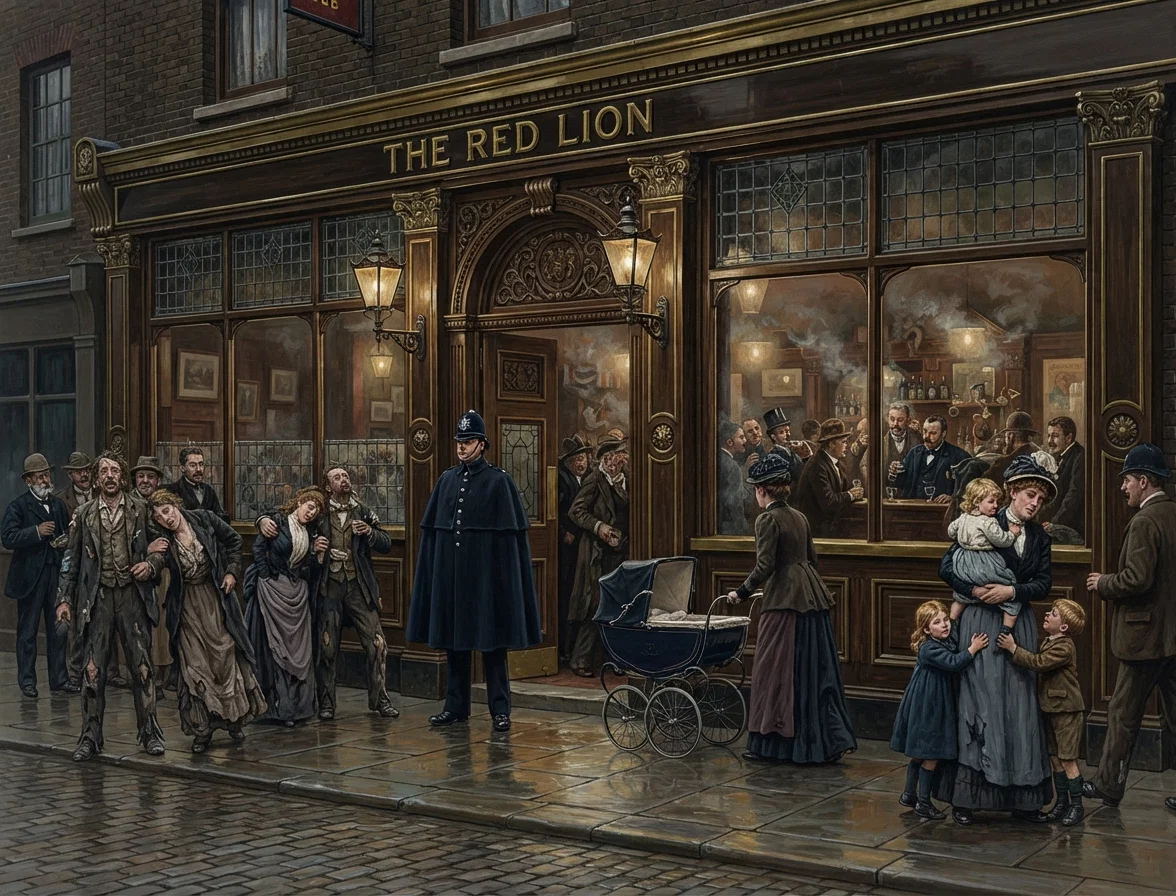
A public house (saloon) in London, England, was watched one Saturday night for an hour and a half. This is what the watchers saw, as reported in a London daily:
During that short period of time, 795 persons entered the doors. Of these, 209 were men, 380 women, 83 youths and girls, and 123 very young children and babies in arms. [England now has a law prohibiting children from entering a public house.] Seven perambulators were taken in, some of which had in them two children. Outside there was scarcely an uneventful moment. Three women were turned out, and five men. There were six disturbances and one very bad fight. Three girls about seventeen came out quite drunk. Twenty-four men, including a footman in livery, and nineteen women left the house helplessly drunk. Two of the women had babies in their arms. At 10:50 the house had to be closed, with the exception of one small door, on account of a frightful row. A policeman had to stay outside after that until closing time.
Such were the activities of one saloon in the short period of an hour and a half. Would these things happen in connection with a grocery store, or at an ordinary restaurant, or even at a public market thronged by far greater crowds of people than any one saloon? The answer is an emphatic No. It is only in connection with saloons that this utter demoralization occurs, and the reason is plain. The alcoholic drinks dispensed at such places dethrone the reason and self-control in men, and at the same time excite the baser passions.
But this public house scene is a mild picture compared with some of the things drink has wrought. The man under the influence of alcohol is really not himself at all. He is under the control of a fiend. For all practical purposes, he is insane.
John B. Gough tells of a man who underwent one of those "awful surprises" that come to the victims of the drink fiend. He was considered a very respectable sort of man except for an occasional fit of intoxication. He went into a saloon and took a drink, then another, and another. At last he staggered home, and in the madness of drink, inflicted on his wife, whom in his right mind he dearly loved, blows that killed her. He was arrested, and spent the night in jail. In the morning, on being awakened from his drunken stupor, he was astounded.
"This is a jail, isn't it?" he asked of the keeper.
"Yes," was the reply, "you are in jail."
"What have you got me in jail for?"
"Don't you know?"
"Don't I know? I know I was never in jail before in my life; and this is an awful disgrace. But what have you got me in jail for?"
"You are in jail for murder."
"What! You don't mean it!"
"Yes, I do."
"You are joking!"
"No, I am not."
"For murder? Have I killed somebody?"
"You have."
"Oh, my God! What will become of me? Tell me, does my wife know of it?"
"Your wife! Why, don't you know? It is your wife you have killed."
At these words, the poor victim of the licensed saloon fell as one dead.
Just such things are happening to-day; but where one woman is killed in this comparatively merciful manner, hundreds — yes, thousands — die a slower, more painful death, die by inches, we may say, of neglect and want arising solely from the fact that the husband drinks.
Look at another picture: The night is bitterly cold, and the wind cuts like a knife. A little girl, covered with only one thin garment, is on her way to the public house, with a blacking bottle in one hand and a piece of silver in the other. She is fetching gin to satisfy the insane thirst of her drink-ridden father, while back in the hovel she has come from lies her half-starved mother on the floor, with a newborn babe crying at her side. Yet the drink-cursed man who could be guilty of this infamy was a tender father and loving husband when sober. Alcohol made him, for the time, a fiend.
At these words, the poor victim of the licensed saloon fell as one dead.
Perhaps the saddest thing about the awful immorality wrought by drink is the helplessness of the victim of the habit. He is utterly unnerved morally and physically. He has no will power. Humanly speaking, there is no hope for the confirmed drunkard. "Gentlemen," said one such man to a group of friends, "you ask me to give up the drink. Ask me to sever my right hand from my wrist, and I can do it; but to give up the drink — never!" Six days later, the poor man stabbed himself to death in a hotel.
The gospel alone has power to lift the drunkard out of the gutter and once more put him on his feet. But God expects men to coöperate with Him; and it is the privilege and duty of men who believe the gospel and love their fellow men, not only to labor for the succor of the lost and fallen, but to do everything in their power to banish the saloon — to root the liquor traffic out of this fair land of ours.
If conditions in a "dry" town are bad, what is needed is not more whisky, but less whisky.
Many a hand has been inspired by drink to slay even a friend.
Clasps Hands with Divorce
MORE than seven times as much alcoholic liquor was consumed in 1906 as in 1870, while divorces increased in almost exactly the same proportion. In the city of Chicago, drink is the cause of almost as many divorces as all other causes combined, or, to be explicit, forty-six per cent. Drink is playing a leading part in the wrecking of an average of one home a day in that one city. Thus one more link is formed in the long chain of evidence against this terrible curse, which leaves nothing but disgrace and degradation in its wake.
ALCOHOL IS THE WORST ENEMY OF THE HOME.
The Producer of Insanity
THE fact is generally admitted that the use of alcohol is the sole cause in upwards of one fourth of the cases of insanity, according to diagnosis on admission to asylums. Statistics gathered from all parts of the civilized world exhibit remarkable uniformity on this point. Taking men and women together, this is the result; but taking them separately, the per cent of women insane on account of alcohol is generally a mere fraction — one fourth, or such a matter — of the general average. Thus it appears that the predominance of males in the insane population is chiefly due to alcohol.
The statement of these facts does not take into account a large number of cases where alcohol as a partial cause was the real determining factor, without which other causes would probably not have been sufficient to produce derangement. It leaves out of consideration all the hereditary mental disorders — idiocy, deficiency, and epilepsy — which are caused or accentuated by the influence of alcohol.
Not all the insane are in asylums or under surveillance. It is probable that a number equal to those confined are constantly at large in the world, consisting of the various individuals more or less deranged temporarily by the use of liquor. About half of the 7,500 murders estimated to have been committed in the United States in 1915 were committed by this class of insane. This prevalent temporary dementia was also the cause of thousands of other crimes of violence, of suicides, and disastrous failures of mind under responsibility of various kinds. It costs over $5,000,000 each year to care for these alcoholic insane in the United States, and the voters pay the bill.
ONE insane person in every four owes his insanity to drink. According to Dr. Rosanoff, there are 46,605 insane in the United States whose insanity is chargeable to drink.