Your ShelfYour Projects

Signs of the Times, Vol. 26, No. 25.

WORTHY OF PRESERVATION

Signs of the Times

Jun 20, 1900

Pacific Press Publishing Company · OAKLAND, CALIFORNIA · Jun 20, 1900

WORTHY OF PRESERVATION.
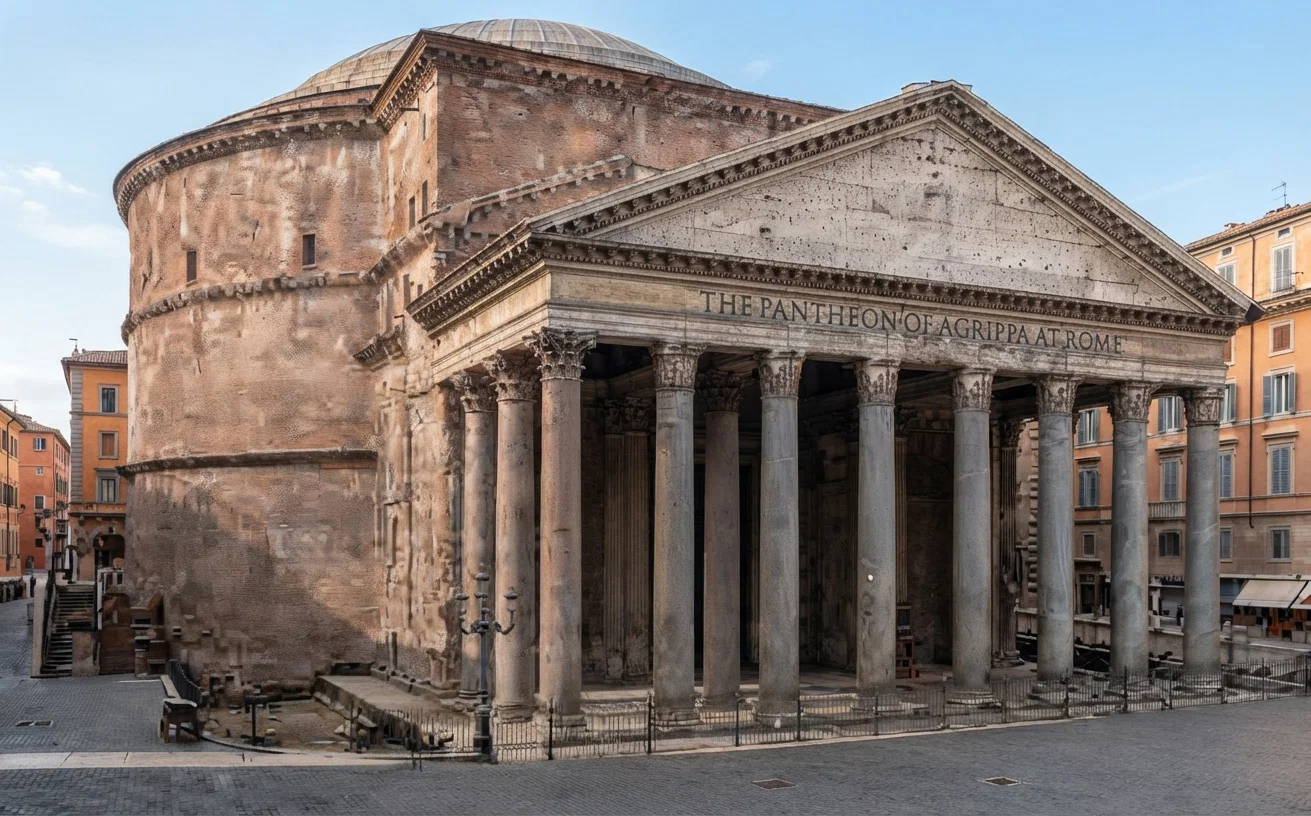
NOTHING of earth more pitifully brings to our mind the powerlessness of man, his unrealized ambitions, his hopeless struggles, and the sad end of all earth's hopes, than does the gazing upon some magnificent monument of the past, perhaps in ruin, devised by his brain and erected by his hand.
THE PANTHEON OF AGRIPPA AT ROME.
SUCH a monument is the one pictured on this page, the Pantheon at Rome, erected by M. Agrippa, son-in-law of Augustus Caesar, in the third year of his consulship, A.D. 27, the very year that Jesus Christ began His ministry. The name of the architect—Valerius of Ostia—is preserved to us. It is noted in history that the emperors Septimius Severus and Caracalla repaired the wonderful structure. This historic edifice is remarkable not only for its size, but for its magnificence and beauty. The external diameter is one hundred and eighty-eight feet; its height to the summit of its cornice, one hundred and two feet; and to the top of the dome, one hundred and forty-eight feet. Its portico, one hundred and three feet wide, its sixteen columns, forty-seven feet high, of polished granite with white marble bases and capitals, its gilded bronze roof, its marvelous decorations and ornamentations in stone and silver and bronze, gave the great pile "an extraordinary air of majesty." The walls were twenty-three feet thick, and the huge rotunda was lighted by an opening in the dome—like a great eye—twenty-six feet in diameter. It was a structure so beautiful that it has been said, "There is nothing wanted to desire, nothing committed to rectify."
IT was named the Pantheon, not signifying, as is generally supposed, Anthon tells us, devoted to the worship of all the gods, but from pan, "all," and theion, "divine," "all divine." It was dedicated to Jupiter Ultor, with niches for six more great deities, such as Mars, Venus, and others.
THE builders of the tower of Babel called it Bab-il, "the gate of God." God called it what all history has demonstrated it to be,—Babel, Babylon, confusion. Agrippa built his glorious monument and named it All-divine, but the subsequent history has demonstrated it all human. Pagan Christianity tried to preserve it. The emperor Phocas gave it to Pope Boniface IV. in 609, who dedicated it as a church to the Virgin and holy martyrs, "a quantity of whose relics were placed under its great altar." In 830 Gregory IV. dedicated it to "all the saints." But future emperors and popes despoiled it of its beauty. Some of its precious metals were carried to Egypt, whence Agrippa brought the plunder with which he built it. Urban VIII. robbed the structure of its bronze beams, amounting to over twenty-two thousand tons.
Now THE "all-divine" temple of humanity is stripped of its glory. Says a historian: "During the eighteen centuries it has suffered from the dilapidations of time and the cupidity of barbarians. The seven steps which elevated it above the level of ancient Rome are buried beneath the modern pavement. Its rotunda of brick is blackened and decayed; its leaden dome [formerly of gilded bronze], overlooked by the cupolas of every neighboring church, boasts no imposing loftiness of elevation; the marble statues, the bassi relievi, the brazen columns have disappeared; its ornaments have vanished; its granite columns have lost their luster, and its marble capitals their purity; all looks dark and neglected, and its splendor is gone forever."—Anthon. It was not worthy of preservation.
MAN can make nothing divine. Himself sinful, he can make nothing holy. He may carve beautiful forms from the dead marble, but they are cold, pulseless, irresponsive, lifeless images. He may polish huge granite shafts; the hand of time will mar and ruin his work. He is human, and his work is "all human," not "all divine." He is of the earth, earthy. He builds for self; it perishes. This is the negative side of the lesson.
THE positive side of the lesson is this: There is but one building of earth worthy of eternal preservation; and in that building every person has been, is, or will sometime be interested. That is the building of character. But one character shines out above all others, of which all others with any degree of worthiness are but reflections, and that is the character of Jesus Christ. Tho wrought out in this world at the very time when the Pantheon (the "All-divine") was building, tho condemned by the sinful of earth whom Christ came to save, that character is truly all divine, and will exist forever in never-dimming glory and luster. "Too low they build who build beneath the stars." And it is the privilege of every soul to be built up in Jesus Christ, to become "partakers of the divine nature," and finally to be "all divine" for all eternity, the sons of the living God. This is the ideal, the real, the glorious possibility of every soul who will build in Jesus Christ. "For in Him dwelleth all the fulness of the Godhead bodily. And ye are complete in Him." This is the lesson the Pantheon should teach every believer in Christ.

THE RIGHT SIDE AND THE WRONG SIDE.

THERE is a right side and a wrong side. Let each ask himself the question, On which side am I standing? Those who do not choose the side of Christ range themselves under the banner of darkness, with the great apostate, who in heaven refused to obey God, and who in the Garden of Eden deceived the holy pair, and opened the flood-gates of woe upon our world.
On the side of obedience Christ stands, giving to all the invitation, "If any man will come after Me, let him deny himself, and take up his cross, and follow Me." "Strive [agonize] to enter in at the strait gate; for many, I say unto you, will seek to enter in"—with all their worldly treasures—"and shall not be able." "Enter ye in at the strait gate; for wide is the gate, and broad is the way, that leadeth to destruction, and many there be which go in thereat; because strait is the gate, and narrow is the way, which leadeth unto life, and few there be that find it."
In every possible way Satan tries to make the broad road attractive and the narrow road grievous, humiliating, and objectionable. He lays ingenious plans to lead men and women to indulge appetite. Cheap, unsatisfying pleasures are made all and in all in this age; for over these pleasures Satan has thrown a glamor, and men and women allow them to take the place of eternal things. There are many who, like Esau, sell their birthright for self-indulgence. To them worldly pleasure appears more desirable than the heavenly birthright.
We are to come out from the world and be separate, and our works are to be in accordance with the works of Christ. He declares, "I have kept My Father's commandments." Are we on His side, obeying God's commands, or on Satan's side, warring against the law of God. "As the Father hath loved Me," Christ says, "so have I loved you; continue ye in My love." How can we continue in Christ's love? By disobeying God's law?—No, no. By showing to the world that we choose to be among the loyal people of God. "This is the love of God, that we keep His commandments." This love is more than an impulse, an emotion. It is a living, active, working principle. It is not guided by the feelings, but by the will. In it is comprehended the stern resolve of a mind subdued and softened, which lays hold of the strength of the Infinite, saying, I will serve Thee even unto death.
"If ye abide in Me, and My words abide in you, ye shall ask what ye will, and it shall be done unto you. Herein is My Father glorified, that ye bear much fruit; so shall ye be My disciples." All who are true and loyal to God will bear fruit, not the fruit of transgression, but the fruit of a glad, willing obedience. They are filled with thankfulness that they are not numbered with those who have chosen the wide gate and broad road as more convenient than the road cast up for the ransomed of the Lord to walk in.
Sin is the transgression of the law. Those who continue in sin, notwithstanding the fact that light has come to show them what sin is, those who refuse to lift the cross because doing so would possibly limit their prospect of worldly gain, will meet with great loss. They show that they do not choose to be partakers of Christ's life of self-denial and self-sacrifice, and they will lose eternal life. "What shall it profit a man, if he shall gain the whole world, and lose his own soul?"
Both the Old and the New Testament exalt the law of God, and those who reverentially study the Scriptures for themselves, laying aside all the preconceived opinions taught by human wisdom, will not be left in the darkness of error. But many, rather than lift the cross, put their own construction upon a plain "Thus saith the Lord," and drag the Scriptures in the direction of their own suppositions. They are blind leaders of the blind, and both they and those they are leading must fall into the ditch.
When Christ was upon the earth, the great mass of the people would have accepted Him had it not been that they were afraid of what the scribes and Pharisees might do. These leaders, sitting in Moses' seat, claiming to know God, saw that Christ was drawing the attention of the people from them. They determined to oppose His work, and, once started in the path of opposition, no evidence had any weight with them. The wonderful works Christ did were denied. The gracious words which fell from His lips were misstated and misconstrued. By the priests and rulers the rejoicing shown because of His works of compassion and healing were regarded as a personal slight to themselves. The appeals which Christ made, appeals which were freighted with love, the conclusive arguments which He presented, only kindled fires of hatred in hearts that, once convicted, had refused the light. Christ came to His own, but His own received Him not. He had to forsake Judea in order to preserve His life till the fulness of the time. "After these things," we read, "Jesus walked in Galilee; for He would not walk in Jewry, because the Jews sought to kill Him." So will all act who choose to stand on the side of rebellion.
High and holy must be the purposes of every one who obtains the character all must obtain who win the crown of everlasting life. God is in earnest with us. We can not play at loose purposes with Him. In His service He requires the whole being, heart, mind, soul, and strength. Christ has made every provision that men and women may obtain salvation; but, notwithstanding the light shining upon them, leading to the strait gate and the narrow way, many are choosing the broad way. What road are we traveling? We may take with us into the broad road all our evil tendencies, our cheapness of character, our associates in evil. We may choose to listen to the words of these companions and to laugh at their wit; but in so doing we shall descend lower and lower in the scale, and at last the words will be spoken: "Cut down the unfruitful tree. Why cumbereth it the ground?"
Do not suppose that you can unite yourself with the amusement-loving, the gay and pleasure-loving, and at the same time resist temptation. By trying to serve two masters, you spoil yourself utterly for both. You make neither a successful worldling nor a successful Christian. Your Redeemer has said, and His lips never made a false statement, "Ye can not serve God and mammon." Then why not do the only safe thing to do,—follow the road you know to be right, irrespective of consequences?
The inhabitants of the unfallen worlds and of the heavenly courts are watching with intense interest the conflict between good and evil. They rejoice as Satan's subtleties are one after another discerned and met with, "It is written," as Christ met them in His conflict with the wily foe. Every victory gained is a gem in the crown of life. And in the day of final victory all the heavenly universe will triumph. The harps of the angels will sound forth heavenly music, accompanying the music of their voices, as they sing: "Be glad and rejoice with all the heart, O daughter of Jerusalem. The Lord hath taken away thy judgments, He hath cast out thine enemy; the King of Israel, even the Lord, is in the midst of thee; thou shalt not see evil any more. In that day it shall be said to Jerusalem, Fear thou not; and to Zion, Let not thine hands be slack. The Lord thy God in the midst of thee is mighty; He will save, He will rejoice over thee with joy; He will rest in His love; He will joy over thee with singing."
MRS. E. G. WHITE.

HAVE PATIENCE.

"SEVENTY times seven." What a test! Does Jesus actually mean that we shall forgive an offender four hundred and ninety times? Yea, more, for this number is only a play on the number seven, which Peter mentioned as a possible limit to our endurance. It enjoins unlimited patience and a willingness to bear with the ill-deserving, in the hope of winning them to a nobler spirit.
This is God's way with us. He suffers long and is kind. His love never faileth. Patience is born of love. How continuously the parent is called to bear with the child! What hope would there be for the child if this were not so? It is doubtful if people often thank God for His patience. "His loving-kindnesses are ever of old." His tender mercies are the basis of our hope.
In all our dealings with others, we should become possessors of God's patience. "Be ye kind one to another, tender-hearted, forgiving one another, even as God for Christ's sake hath forgiven you." The weak need our patient help. Sin and ignorance need it. No one can minister to any human infirmity without it. Patience is an intelligent virtue. It comprehends the situation. It measures the want and capacity of the individual needing assistance. For this reason it is able to pity, and give sympathy, and wait and forgive.
Patience implies complete self-mastery. Aggravating trials are enough, it is said, "to provoke a saint." But patience is a saintliness that rises above provocation. The equipoise of some people, in the face of every kind of ill treatment, is marvelous. It demonstrates the great spiritual fact that God's strength may possess our weak hearts; that we can become so indwelt by His Spirit as to hold impatience and passion under constant and complete control. That there are such people in the world is sufficient to show that there might be more, and that we may belong to the number.
Patience is always hopeful. It believes enough in the lost to labor for their recovery. It makes its possessor optimistic also regarding the outcome of his own trials. He sees the smile of God behind every cloud. He has confidence in the final outcome of life. He prefers rather "to suffer affliction with the people of God, than to enjoy the pleasures of sin for a season." No "hard times" can daunt his courage or overthrow his faith. Patience with others, with circumstances, with all forms of trial, disappointment, and ill, is the Christian's duty, nay, more, his high privilege and glory.—N. Y. Observer.

Gratitude

GRATITUDE is the fairest blossom that springs from the soul, and the heart of man knoweth none so fragrant; while its opponent, ingratitude, is a deadly weed, not only poisonous in itself, but impregnating the very atmosphere in which it grows, with fetid vapors.—Hosea Ballou.

Gravity and Pleasure

As in a man's life, so in his studies, I think it is the most beautiful and humane thing in the world so to mingle gravity with pleasure that the one may not sink into melancholy nor the other rise up in wantonness.—Pliny.

REMARKABLE PROPHECIES.

[This is article twelve of the series. Article thirteen preceded it last week, by mistake. Read that after this.]
LET us at this juncture recur to the "sure word of prophecy." If a work so significant to God's people as a change in His holy rest day was to be attempted by the forces of evil, surely God, before whom "all things are naked and open," who sees the end from the beginning, and who "revealeth His secret unto His servants the prophets," will expose this work of apostasy clearly and unmistakably in His Word, which He has given to His people to be a light to their pathway. In 2 Thess. 2:3-8, R.V., we have the following:—
"Let no man beguile you in anywise; for it [the coming of Christ, verses 1, 2] will not be, except the falling away come first, and the man of sin be revealed, the son of perdition, he that opposeth and exalteth himself against all that is called God or that is worshiped; so that he sitteth in the temple of God, setting himself forth as God. . . . And now ye know that which restraineth, to the end that he may be revealed in his own season. For the mystery of lawlessness doth already work; only there is one that restraineth now, until he be taken out of the way. And then shall be revealed the lawless one, whom the Lord Jesus shall slay with the breath of His mouth, and bring to naught by the manifestation of His coming."
Note carefully the following facts, as stated by this scripture:—
1. Before the day of Christ's coming should be ushered in, there was to be an apostasy, called "the falling away."
2. This apostasy was to be caused by the revealing of a definite power, designated as "the man of sin," "the son of perdition," "the lawless one," "the mystery of lawlessness."
3. In the apostle's time its mysterious working was already beginning to be manifested, but there was "one," another definite power, that restrained.
4. This restraining power was to be taken out of the way, after which the "lawless one" was to be revealed, and its work of "lawlessness" was to begin in its fulness.
5. This "lawless one," "the man of sin," was to oppose God and to exalt himself above "all that is called God or that is worshiped."
6. He was to sit "in the temple of God, setting himself forth as God." Tho professedly Christian, he was in reality antichristian, "lawless," i. e., characterized by a notable disregard for law. He is also the "man of sin." He would, therefore, disregard the law of God, the transgression of which is sin. 1 John 3:4; Rom. 7:7.
Has such a power arisen to fulfil the specifications of this prophecy?—We shall soon see.
In the prophecy of Daniel the same ground is covered by several lines of symbols. In the eighth chapter we have three symbols presented, a ram (verse 3), a rough goat (verse 5), and a little horn (verse 9). The ram symbolizes Medo-Persia (verse 20), the rough goat, Greece (verse 21), and the little horn succeeding it, which "waxed exceeding great"—the "king of fierce countenance, and understanding dark sentences" (verse 23)—must represent the fourth universal kingdom, or Rome. This is shown from the fact that this power was to "stand up against the Prince of princes." Verses 11, 25. This Rome did when, in the persons of Herod and Pilate, she sought to destroy Christ. It will be seen that in this prophecy Rome appears under a double title: first as the "daily" (desolation—"sacrifice" in the text being supplied), later as the "transgression of desolation." Verse 13.
The little horn representing Rome, the most natural application of the prophecy would be to refer these symbols to the two great phases of Roman power,—pagan and papal. Let us study the prophecy and thus determine whether that is the application intended.
The former of these was to magnify himself even to the Prince of the host (verse 11)—stand up against the Prince of princes (verse 25)—by the crucifixion of Christ. The daily, or continual (R.V.), desolation was "taken away" (verse 11), to make room for "the transgression that maketh desolate" (verse 25, R.V.).
The power that ruled the world in the days of the early Christian church was Pagan Rome. It was Roman soldiers who crucified Christ. Said the Saviour, "If they have persecuted Me, they will also persecute you." It was Pagan Rome that, with relentless hand, for more than two centuries pressed the followers of Christ with persecutions so severe that the Christians were hunted like beasts of prey. In very truth, she was a daily and continual desolation to the church of Christ. But when the host (the church, since Christ is the Prince of the host, verse 11) is taken from the daily and given to the transgression of desolation (verse 12, margin), the desolation does not cease; the host (the church) is still trodden underfoot (verse 13); the truth is cast down to the ground (verse 12); he destroys the mighty and the holy people (verse 24); through his policy he causes craft to prosper in his hand. He magnifies himself in his heart, and his power is mighty, but not by his own power. Verse 25. Thus is represented the terrible desolation wrought by that power which was to succeed Pagan Rome.
In a parallel prophecy in the seventh chapter of Daniel, Pagan Rome is symbolized as a great and terrible beast, having great iron teeth. It devoured and brake in pieces, and stamped the residue with its feet. The beast had ten horns, representing "the ten kingdoms of Western Europe" which should arise out of the territory of Rome. Verse 24. This division occurred A.D. 300-488. Then says the prophet:—
"I considered the horns [the Roman kingdom in its divided state], and, behold, there came up among them another little horn, before whom there were three of the first horns plucked up by the roots; and, behold, in this horn were eyes like the eyes of man [of "the man of sin," 2 Thess. 2:3], and a mouth speaking great ["presumptuous," Jewish Version] things." Verse 8. "I beheld, and the same horn made war with the saints, and prevailed against them." Verse 21.
Said the angel, in explanation of what the prophet had seen:—
"And another shall rise after them [the ten kingdoms]; and he shall be diverse from the first, and he shall subdue three kings. And he shall speak great words [compare "great things," verse 8, and "perverse things," Acts 20:30] against the Most High, and shall wear out the saints of the Most High, and he shall think to change the times and the law [R.V.]; and they shall be given into his hand until a time and times and the dividing of time. But the judgment shall sit, and they shall take away his dominion, to consume and to destroy ["annihilate," Jewish Version] it unto the end." Verses 24-26.
That the "little horn" of Daniel 7, the "transgression of desolation" of chapter 8, the "man of sin" of 2 Thessalonians 2, all refer to the same power is evident from the following considerations:—
1. They are synchronous in their rise. The little horn rises after the ten (Dan. 7:8, 24), the last of which arose 488 A.D. The "transgression of desolation" takes the place of the "daily," but not until the latter has stood up against the Prince of princes (Dan. 8:11), and cast down some of the host (the church) and of the stars (the apostles, see Rev. 12:1) (verse 10). And, in the time of the apostles, the "man of sin" had not yet succeeded the "one that restraineth."
2. They are all ecclesiastical, man-made, antichristian powers. The "little horn" is diverse from the ten among which it arose. Dan. 7:8, 24. The ten were civil powers. This, being diverse, must be an ecclesiastical power. It has eyes like the eyes of a man, and a mouth speaking presumptuous things (verses 7, 8, 20) against the Most High. It is therefore a man-made, antichristian power. Its very titles,—"the transgression of desolation," the "abomination of desolation" (Dan. 12:11), whose coming was to be on "the wing of abominations" (chapter 9:27, R.V.),—represent its antichristian character,—an offense to God, waiting only till the "end" appointed, when "what is decreed shall be poured out upon the waster" of God's truth and people (Dan. 9:27, Jewish Version). The "man of sin" (therefore, a man power), the "falling away" from truth, the "mystery of iniquity," the "son of perdition," are titles clearly indicating the antichristian character of that ecclesiastical power that "as God sitteth in the temple of God, showing himself that he is God." 2 Thess. 2:4.
3. They were to do the same work. Of the little horn it was said, "He shall speak words against the Most High, and shall wear out the saints of the Most High; and he shall think to change the times and the law [of the Most High]." Dan. 7:25, R.V. Of the "transgression of desolation" it was declared, "He shall magnify himself in his heart;" he "shall destroy the mighty and the holy people." Dan. 8:25, 24. It was to cast down the truth to the ground, to do its pleasure and prosper. Verse 12, R.V. Through his policy he shall cause craft (instead of the truth in God's law) to prosper in his hand. Both the host (the church) and the sanctuary were to be trodden underfoot. Verse 13. No wonder that the prophet of God, contemplating such a scene of desolation, "fainted, and was sick certain days." Verse 27. Of the "man of sin," Inspiration declares, "Who opposeth and exalteth himself above all that is called God, or that is worshiped; so that he as God sitteth in the temple of God, showing himself that he is God." 2 Thess. 2:4.
4. They are of the same duration; and, 5. They meet the same fate. The "little horn" was to be consumed and annihilated at the end. Dan. 7:26. When in the end?—"Christ, the first-fruits [of the resurrection]; afterward they that are Christ's at His coming. Then cometh the end." 1 Cor. 15:23, 24. The end, therefore, at which time this power is to be "annihilated," is the coming of Christ in the clouds of heaven. "The transgression of desolation" is to be "broken without hand."Dan. 8:25. What breaks "without hand"? —In explaining the vision of the great image of Daniel 2, the prophet declared, "Forasmuch as thou sawest that the stone [the kingdom set up by the God of heaven, verse 44] was cut out of the mountain without hands, and that it brake in pieces the iron, the brass, the clay, the silver, and the gold [all the kingdoms of earth]; the great God hath made known to the king what shall come to pass hereafter." Verse 45. When the God of heaven shall set up His kingdom, when Christ comes as King of kings and Lord of lords (Rev. 19:16), in flaming fire taking vengeance on them that know not God (2 Thess. 1:8), to gather out of His kingdom all things that offend, and them that do iniquity (Matt. 13:41)—then shall "the transgression of desolation," the great "waster" of God's truth and people, "be broken without hand." Then shall he fall and not rise again. It is when Christ comes, also, that "the man of sin," "the son of perdition," will be consumed by the spirit of His (Christ's) mouth, and destroyed with the brightness of His coming. 2 Thess. 2:8.

Another Symbol.

It would hardly be doing justice to the subject under consideration to permit the reader to pass this stage of the investigation without directing his attention to another prophecy,—Rev. 13:1-10,—where the same desolating power is seen in deadly conflict opposing the truth and people of God. That the same power is here brought to view under the symbol of "the beast," will appear from the following considerations:—
1. As in the symbols already studied, so here "the beast" immediately succeeds the power that sought to destroy Christ. The man child of Rev. 12:5, who was to rule all nations with a rod of iron (Rev. 19:15, 16; Ps. 2:7-9), and who was to be caught up to God and to His throne (Heb. 8:1), is none other than the Child Jesus. The dragon stood before the woman (the church) to devour her Child (Christ) as soon as it was born. Rev. 12:4. The dragon, therefore, represents in this connection Satan working through Pagan Rome, which power "the beast" immediately succeeds. Rev. 13:1, 2.
2. "The beast" has the same blasphemous character as the other symbols. Rev. 13:1-7.
3. It is likewise a desolating power, making war with the saints, and opposing God and His true worship. Verses 6-8.
4. The period during which it was to exercise its wasting power is the same as that given the other symbols,—"a time, and times, and half a time" (compare Rev. 12:14 and Dan. 12:7). This will be explained later.
5. Tho shorn of its power, having received a deadly wound (Rev. 13:3, 12, compare Dan. 7:20), it continues till the appearing of Christ, when it is destroyed in like manner as are the symbols already considered (Rev. 19:20).
From the evidence already adduced, it has been abundantly proved that the "little horn" of Daniel 7, "the transgression of desolation" of chapter 8, the "man of sin" of 2 Thessalonians 2, and "the beast" of Revelation 13, are symbols all referring to one and the same power, to locate which will next claim our attention. H. C. GILES.
[The next article in the series was published last week, by mistake, entitled "A Striking Fulfilment." The next to be printed is "The Source of Papal Authority."]

IN POINT OF FAITH THERE IS NO DIFFERENCE.

DOES God have a different plan for saving the different worlds? Or do they all come into the one great and "eternal purpose"? Much interest attaches to this question. And yet it could be answered by another, Is God a respecter of persons? The answer to this, and it is also an answer to the first, is, "Who without respect of persons judgeth according to every man's work" (1 Peter 1:17), and, there is no "respect of persons, nor taking of gifts" (2 Chron. 19:7), concerning Him with whom we have to do. He loves all His creatures alike.
But this question is worthy of more than a passing notice, and, while we study further, let us remember the exhortation, "Consider what I say." 2 Tim. 2:7. Remember, also, that "the invisible things of Him . . . are clearly seen, being understood by the things that are made." Rom. 1:20. And so it is that we may understand the purposes of God concerning the eternal worlds above by looking at "the things that are made." And, by the study of the things that are not seen, through the things that are seen, we come at last to see eternal things. As saith the Spirit, "While we look not at the things which are seen [for we are all the time looking at eternal things through things around us], but at the things which are not seen; for the things which are seen are temporal; but the things which are not seen are eternal." 2 Cor. 4:18.
Thus we continue to look at eternal things, things that are not seen, through things that are made, until our faith grasps eternal things, and our faith becomes "the substance," the "evidence," of that which we can not see with the natural eyes. And yet, by faith, the believer is more sure of that which he sees by faith than of that which comes through the senses of the flesh.
So it actually becomes a fact that the man of faith does look "at the things which are not seen," and these, even "the invisible things of Him from the creation of the world, are clearly seen, being understood by the things that are made." Rom. 1:20. With this encouragement and assurance, let us notice the first question.
It was said of the Saviour of men that in one place the unbelief of the people was so great that "He did not many mighty works there," that "He marveled at their unbelief." His admonition is, "Have faith in God." Mark 11:22. But is it fallen men alone who must "have faith in God"? Is it not a fact that man fell because of unbelief, because he did not "have faith in God"? Is it not, then, true that unfallen worlds have not fallen because of the fact that they "have faith in God"? It is written, "Now the just shall live by faith." Heb. 10:38. Again it is written, "For whatsoever is not of faith is sin." Rom. 14:23. And yet again, "But without faith it is impossible to please Him." Heb. 11:6. The intelligences of the eternal worlds do please God; therefore they have faith. They have not sinned; therefore we conclude again that they "have faith in God." And so they "live by faith," even as we are exhorted to "live by faith." Therefore, we see there is no difference in the matter of the plan, only that we have sinned and they have not. All must live by faith. All must "have faith in God."
It was said of Abraham that he "believed God, and it [his belief] was imputed unto him for righteousness," or right-doing. As it was righteousness, or right-doing, in Abraham, who had sinned, to believe in God, it is evident that it is righteousness, or right-doing, in the intelligences of other worlds to believe in God. And as they have never disbelieved, but have always had faith, their belief in God has always been accounted as righteousness to them. So it is evident that in point of faith there is no difference. All must "have faith in God." All who please God must have faith, and live by faith. All of which seems to bring us into a closer touch with other worlds. Indeed, we are members of the one great family of God through Jesus Christ, "of whom the whole family in heaven and earth is named." Eph. 3:15.
In the end of the prolonged controversy in this world,—the controversy between truth and error, between Christ and antichrist,—all the members of this one family in heaven and in earth will have been brought into harmony, and reconciled to the government of God, "through the blood of His cross." Then will be fulfilled the words of the seer of Patmos, "And every creature [living being] which is in heaven, and on the earth, and under the earth, and such as are in the sea, and all that are in them, heard I saying, Blessing, and honor, and glory, and power, be unto Him that sitteth upon the throne, and unto the Lamb forever and ever." Rev. 5:13. O, to have part in that song of universal praise! It will more than compensate for all the sufferings of this life. By the grace of God I mean to be there. Will you meet and join with me in that song, and spend the endless ages of eternity with saints and with the angels? H. F. PHELPS.

The Perils of Imprudence

"THOUSANDS upon thousands are just as surely destroying their lives by imprudence, neglect, dissipation in eating and drinking, and overworking, as he who ties the fatal knot or lifts the cup of poison to his lips."

REJOICE.

LISTEN, O Christian, to the Master's voice: “Rejoice alway; again I say, Rejoice.” Phil. 4:4.
Yes, so I may, when all is bright before; Nay, but Christ says, “Rejoice forevermore.” 1 Thess. 5:16.
How, when the storm cloud lowers darkly 'round, Under His sheltering wings may joy be found? Ps. 63:7.
When tempest-tossed and driven from land, Fear not; He holds the billows in His hand. Isa. 40:12.
Can I rejoice when I my weakness see?—— The Lord's own joy thy very strength shall be. Neh. 8:10.
When harvests, flocks, and fruits untimely die, Rejoice; the Lord will all thy need supply. Hab. 3:17, 18.
Can I rejoice when other hearts are sad?—— The upright heart may well be light and glad. Ps. 97:11.
When pressed by busy cares that will annoy, Cares vanish in the fulness of His joy. Ps. 16:11.
Fulness of joy! Can this indeed be mine?—— The Lord Himself has promised, it is thine. John 16:24.
When strength and senses fail, life's lamp burns dim, Yet will the Lord sustain; rejoice in Him. Acts 20:24.
When waiting in death's dark and lonely vale, Rejoice e'en here; His presence will not fail. Ps. 23:4.
Then, in the glory of eternal day, With joy unspeakable, rejoice for aye. Jude 24. —Mrs. M. F. Rowe.

The Power of Cultivation

The effect of culture in the vegetable world is not more marked than in the intellectual and spiritual world. Many men and women are growing up mere human weeds who might be a great blessing to humanity if the mind and heart were properly cultivated.—Homiletic Review.
Continue reading: THE FUNDAMENTAL DOCTRINES OF THEOSOPHY