Pacific Press Publishing Company · Oakland, California · Feb 13, 1896
The Great Example: Christ, the Perfect Model
The Great Example.— The only model for man, the only perfect copy set before him by his Creator, is our Lord Jesus Christ. Other men had virtues and excellences in marked degree. Job was noted for his patience, Moses for his meekness, Abraham for his faith, Elijah for his loyalty; but in all these were manifest also imperfections. In Jesus Christ alone is perfection. He blended all virtues in himself. He only could say to man, “Which of you convinceth me of sin?” Of him only it could be said, “Who did no sin, neither was guile found in his mouth.” To him could the God of all perfection say, “Thou art my beloved Son, in whom I am well pleased.”
He Was Tempted.— And yet he was tempted. He was made “in the likeness of sinful flesh.” He was “made of a woman, made under the law.” “In all things” he “was made like unto his brethren.” He came in this way, he was made thus, that he might “redeem” man, might “be a merciful and faithful high priest,” might “save his people from their sins.” He was the Son of God yet the Son of man. The two natures became joined never to be severed. Deity sacrificed itself that humanity might be glorified. Christ became man that he might help man, that he might set a perfect example of God’s wonderful righteousness and love for the race.
Every Act of His Life— Every act of Christ’s life, therefore, becomes a worthy object of study. He did not live in vain. His whole recorded life is an object lesson, or series of object lessons, illustrating God’s love, power, and wisdom. Men speak vain words and do vain acts; but not so Christ. Not one act of his life nor word of his tongue was “void of power.” While his early life, to the age of thirty, was secluded, the humble life of a carpenter at Nazareth, it was still a preparation for his future work. He met the trials of life in a humble home, growing constantly in the fear of God, obedient, gentle, patient. The simple record is that he “was subject” unto his parents, and “increased in wisdom and stature, and in favor with God and man.” A brief record, but wonderfully comprehensive.
His First Public Appearance.— The first public appearance of Jesus was at his baptism. His forerunner, John, foretold by Isaiah and Malachi, had been for six months heralding his coming, the coming of the royal Majesty of Heaven. He did not know, in all probability, that Jesus was the Christ, but he knew that when the Messiah should appear, God would make it known unto him.
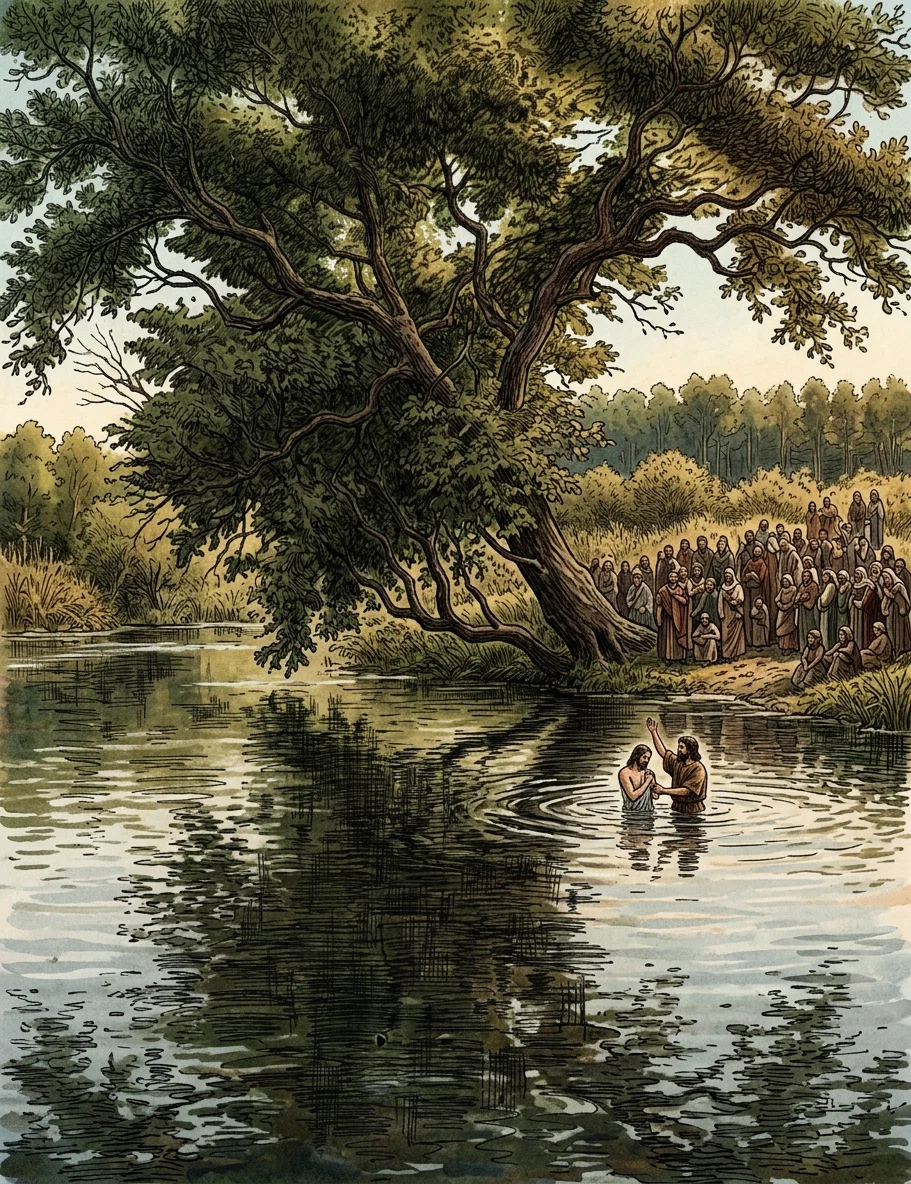
The Baptism of Jesus.— That time came at the river Jordan, where John was baptizing. From his home in Galilee, he came to the river Jordan to be baptized of John. John knew the sinless One, and wondered that he should come to him to be baptized. The record says that “John forbade him, saying, I have need to be baptized of thee, and comest thou to me?” John did not exalt himself, nor glory in his own estimation. He knew that his own burning and shining light was to be dimmed in the greater glory of Christ, and yet in that was his joy fulfilled. John 3:29, 30. Most Jews would have boasted, as does Josephus, of their lineage. John could have boasted of his honored ancestors in the priesthood, but he was content to be “the voice of one crying in the wilderness, Make straight the way of the Lord, as said the prophet Isaiah.” John 1:23. He knew that baptism indicated a change in life and purpose on the part of the receiver, and he knew, doubtless, that the life of Jesus of Nazareth required no change. Hence, his almost refusal.
To Fulfill All Righteousness.— But Jesus answered, “Suffer it now; for thus it becometh us to fulfill all righteousness.” (R. V.) While he had no sins of his own, he bore the sinner’s sins. He stood in the sinner’s stead, repenting for the sinner, doing for the sinner, living the life of God in sinful flesh that the sinner might live it after him in sinful flesh. Righteousness is the character of God as expressed in his law. Those who know righteousness are those who have God’s law in their hearts. Isa. 51:7. Says the psalmist, “My tongue shall speak of thy word; for all thy commandments are righteousness.” Ps. 119:172. So spake Christ through the psalmist, prophetically of his first advent: “Lo, I come; in the volume of the book it is written2of me, I delight to do thy will, O my God; yea, thy law is within my heart.” Ps. 40:7, 8. He came to do his Father’s will. It was his daily food so to do. John 4:34. “I have kept my Father’s commandments, and abide in his love” (John 15:10), he declared in the close of his earthly ministry. He did it all for man. It became him; it was fitting, proper, comely, for him to do it, that man might do it after him.
THE BLESSING OF ABRAHAM.
By Ellet Joseph Waggoner
The ultimate object of studying any book in detail is to be able to take in the entire book at one glance. So we may cover in a few words the three chapters that we have been studying. We may say that the first chapter, after the introduction and the laying out of the theme of the epistle, sets before us the condition of those who are known as heathen. The second chapter and the first portion of the third, give us the information that all men are in the same deplorable condition. Then comes the brighter side in the last part of the third chapter, in which the free grace of God is set forth in Christ as the Saviour of sinners. And now in the fourth chapter we have the final argument concerning justification by faith, made from
The Case of Abraham.
“What shall we say then that Abraham our father, as pertaining to the flesh, hath found? For if Abraham were justified by works, he hath whereof to glory; but not before God. For what saith the Scripture? Abraham believed God, and it was counted unto him for righteousness. Now to him that worketh is the reward not reckoned of grace, but of debt. But to him that worketh not, but believeth on Him that justifieth the ungodly, his faith is counted for righteousness. Even as David also describeth the blessedness of the man, unto whom God imputeth righteousness without works, saying, Blessed are they whose iniquities are forgiven, and whose sins are covered. Blessed is the man to whom the Lord will not impute sin. Cometh this blessedness then upon the circumcision only, or upon the uncircumcision also? for we say that faith was reckoned to Abraham for righteousness. How was it then reckoned? when he was in circumcision, or in uncircumcision? Not in circumcision, but in uncircumcision. And he received the sign of circumcision, a seal of the righteousness of the faith which he had yet being uncircumcised; that he might be the father of all them that believe, though they be not circumcised; that righteousness might be imputed unto them also. And the father of circumcision to them who are not of the circumcision only, but who also walk in the steps of that faith of our father Abraham, which he had being yet uncircumcised.” Rom. 4:1–12.
Questioning the Text.
What is the theme for consideration in this chapter?
What “Abraham our father, as pertaining to the flesh, hath found.”
What would Abraham have if he were justified by works?
“If Abraham were justified by works, he hath whereof to glory.”
But can he glory?
“Not before God.”
How is this proved?
By “the Scripture.”
“What saith the Scripture?”
“Abraham believed God, and it was counted unto him for righteousness.”
What was counted unto him for righteousness?
His faith.
How would the reward be reckoned if it were the reward of works?
Not “of grace, but of debt.”
How is it to him that worketh not?
“His faith is counted for righteousness.”
Whom does God justify?
“The ungodly.”
Who describes this blessedness?
“David also describeth the blessedness of the man, unto whom God imputeth righteousness without works.”
In what words?
“Blessed are they whose iniquities are forgiven, and whose sins are covered. Blessed is the man to whom the Lord will not impute sin.”
What important question arises here?
“Cometh this blessedness then upon the circumcision only, or upon the uncircumcision also?”
What gives rise to this question?
“For we say that faith was reckoned to Abraham for righteousness.”
How was it reckoned to him? when he was in circumcision, or in uncircumcision?
“Not in circumcision, but in uncircumcision.”
What did Abraham receive?
“He received the sign of circumcision.”
What was the value of this sign?
“A seal of the righteousness of the faith which he had.”
When did he have this righteousness of faith?
“Yet being uncircumcised.”
Why was his faith reckoned to him for righteousness when he was yet uncircumcised?
“That he might be the father of all them that believe, though they be not circumcised.”
Of whom else is he the father?
“The father of circumcision.”
To what circumcised ones is he the father?
“To them who are not of the circumcision only.”
What must the circumcised children of Abraham necessarily have in addition to their circumcision?
“That faith of our father Abraham, which he had being yet uncircumcised.”
As Pertaining to the Flesh.—Whether we read this phrase as though the question was as to what Abraham had found as pertaining to the flesh, or, as in the Revised Version, as indicating that Abraham was “our father as pertaining to the flesh,” the result is the same. The former reading, however, is undoubtedly correct. Abraham was not the father, or ancestor, according to the flesh, of all those to whom Paul addressed the epistle. The question under consideration is that of justification by faith. If now it can be shown that even Abraham received no righteousness through the flesh, but that it was only by faith, the case will be practically settled.
Glorying.—If in the plan of salvation there were any such thing as righteousness by works, then there would be provision made for boasting. For if one may be saved by works, then all men may be; and then those who were saved might boast of their superiority to others in like circumstances. But we have already learned that boasting is excluded. “God hath chosen the foolish things of the world to confound the wise; and God hath chosen the weak things of the world to confound the things which are mighty; and base things of the world, and things which are despised, hath God chosen, yea, and things which are not, to bring to naught things that are; that no flesh should glory in his presence.”
Glorying In, and Glorying Before.—If Abraham were justified by works, he might3glory; but the fact is that he can not glory before God; and the proof of this is found in the words of Scripture: “Abraham believed God, and it was counted unto him for righteousness.” The man who is justified by works, is not justified by faith. The only case in which a man can be justified by works is when it can be shown that he has done no wrong. In that case he needs no faith; his works speak for themselves. But Abraham was justified by faith, and therefore it is evident that he was not justified by any works. He who is justified only by the works of God, will glory only in those works. That is glorying in God, and is far different from glorying before God.
Paul and James.—Here is where nearly everybody quotes the words of James, “Was not Abraham our father justified by works, when he had offered Isaac his son upon the altar?” James 2:21. Unfortunately, this text is usually quoted as a disparagement of the words of Paul. It seems to be taken for granted that there is a contradiction between Paul and James; and sympathy naturally leans to James, because people like to believe that there is some merit in their own works, and they imagine that this is what James teaches. Indeed, there are some who hold that James wrote for the purpose of correcting Paul’s “extreme views” of justification by faith. We may well throw all such foolish and wicked ideas to the winds. No one need hope to come to an understanding of the Scriptures until he approaches them with the settled conviction that “all Scripture is given by inspiration of God.” The Holy Spirit does not at one time inspire words which must later on be corrected.
Faith Working.—The trouble with people who read the words of James is that they suppose that the apostle says that Abraham was justified by his own works, whereas he says that it was by the works of faith. “Seest thou how faith wrought?” That is ever the mark of living faith, as the apostle is showing. And that is just the statement of the apostle Paul. The last verse of the third chapter of Romans tells us that by faith we establish the law. Moreover, the very term “justification” shows that faith performs the requirement of the law. Faith makes a man a doer of the law, for that is the meaning of the term “justification by faith.” So in James we read that the works of Abraham simply showed the perfection of his faith. “And the Scripture was fulfilled which saith, Abraham believed God, and it was imputed unto him for righteousness.” The apostle James, therefore, teaches the same kind of justification that Paul does. If he did not, one or the other or both of them would be discredited as apostles. Justification by faith which works is the only kind of justification known in the Bible.
Debt and Grace.—“Now to him that worketh is the reward not reckoned of grace, but of debt.” It is necessary to keep in mind what the apostle is writing about. The subject is the means by which a man is justified. To him that works for justification, the reward of righteousness is not a gift of grace, but the payment of a debt. That is, it would be so if there were any righteous by works. In that case, the man would come to the Lord, and demand of him his due. But no man can put the Lord under obligation to him. “Who hath first given to him, and it shall be recompensed unto him again?” Rom. 11:35. If any one could do something for the Lord for which the Lord would be under obligation to him, then all things would not be from him. That is to say, the idea of justification by works is opposed to the fact that God is the Creator of all things. And, conversely, the recognition of God as Creator is the acknowledgment that righteousness comes from him alone.
Justifying the Ungodly.—God justifies the ungodly. No others need justification. But mark that he does not justify ungodliness. That would be to call evil good, and to deny himself. But he justifies or makes righteous the ungodly, and that is just what they need. He justifies the believing sinner by making him a new man in Christ Jesus, and this he can do and still be just. To make a new man in righteousness is perfectly in harmony with his own character as Creator.
Working Not.—“But to him that worketh not, but believeth on Him that justifieth the ungodly, his faith is counted for righteousness.” Bear in mind that justification is the subject under consideration. When the apostle speaks of not working, it is evident that he means not working in order to be justified. A man is not made just by works, but the just man works, yet always by faith. “The just shall live by faith.” It is faith that makes him continue to live justly. The reality of the works of faith is made more prominent in the latter part of this chapter.
The Blessedness Described.—The blessedness of the man unto whom God imputeth righteousness without works, is the blessedness of sins forgiven, and of freedom from the power of sin. God will not impute sin to the man who lives by faith in Christ, so that Christ’s works are his works. “As ye have therefore received Christ Jesus the Lord, so walk ye in him; . . . for in him dwelleth all the fullness of the Godhead bodily. And ye are complete in him.” Col. 2:6–10.
Blessings to Jew and Gentile.—This blessedness comes alike to the circumcision and to the uncircumcision. We have here a repetition of the truth set forth in the third chapter, namely, that there is no difference in the matter of justification. Abraham is the father of the Jewish nation after the flesh, but the blessing which he received was while he was uncircumcised, the same as any other gentile. Therefore he can be the father of both the Jews and the gentiles. His blessing was received by faith, and therefore “they which be of faith are blessed with faithful Abraham.” Gal. 3:9.
How the Blessing Comes.—We have some time ago seen that blessing came to Abraham through Christ. In another place the apostle Paul tells us that “Christ hath redeemed us from the curse of the law, being made a curse for us; for it is written, Cursed is every one that hangeth on a tree; that the blessing of Abraham might come on the gentiles through Jesus Christ; that we might receive the promise of the Spirit through faith.” Gal. 3:13, 14. Whatever was promised to Abraham, was all contained in the blessing which David described. God sent his Son to bless us in turning every one of us away from our iniquities. Acts 3:26. It is the cross of Christ that transmits the blessings of Abraham to us. Therefore they are all spiritual. None of the blessings promised to Abraham were merely temporal. And this further shows that the inheritance promised to Abraham and his seed is only to those who are the children of God through faith in Christ Jesus.
Circumcision Is Nothing.—The advantage of those who are circumcised was that to them were intrusted the oracles of God; but that did not come to them through circumcision. Circumcision was only a sign; it was not the thing itself. It was given to Abraham as a token of the righteousness by faith, which he already possessed. Therefore it could not signify anything more to anybody else. If any who were circumcised did not have righteousness, then their circumcision did not signify anything. “Circumcision is nothing, and uncircumcision is nothing, but the keeping of the commandments of God.” 1 Cor. 7:19. So Abraham was the father of the circumcised, provided they were not of the circumcision only, but had righteousness by faith, which is the one necessary thing.
Everything in Christ.—Speaking of Christ, the apostle says, “For how many soever be the promises of God, in him is the yea; wherefore also through him is the amen, unto the glory of God by us.” 2 Cor. 1:20. There is no promise of God to any man4that ever lived on earth, or that will ever live, except through Jesus Christ. The promises to Israel, especially, which most concern us are those that were first made to Abraham. But “he believed in the Lord; and He counted it to him for righteousness.” Gen. 15:6. Therefore “if ye be Christ’s, then are ye Abraham’s seed, and heirs according to the promise.” Gal. 3:29. So, then, the promises to Israel come through the cross of Christ; and none are Israel except those who have personal, saving faith in him. E. J. W.
"My Beloved Son": God's Approval and Anointing of Jesus
“My Beloved Son,”—This was the Father’s answer to the Son’s obedience: “This is my beloved Son, in whom I am well pleased.” And why not, when Jesus did the Father’s will or pleasure? And with that approval, God anointed him for his work by his Holy Spirit. The combination of the synoptic Gospels reads: “And Jesus, when he was baptized, went up praying, straightway from the water; and lo, the heavens were rent asunder and opened unto him, and he saw the Spirit of God descending in a bodily form, as a dove, and coming upon him.”—Interwoven Gospels. This made Jesus the Christ, the Messiah, the Anointed of God. “How God anointed Jesus of Nazareth with the Holy Ghost and with power; who went about doing good, and healing all that were oppressed of the devil; for God was with him.” Acts 10:38. Just here ended—A.D. 27—the sixty-nine weeks of Dan. 9:25 to Messiah, the Prince. Here began the wonderful life example for all men. Note how God’s Spirit and approval came—in submission to God’s will, submission to do, in doing, his will, and in answer to prayer. Sinner, what God did in the flesh of Jesus of Nazareth, he wants to do in you through Jesus. The Son of God became what he did, he did all that he did, that he might live his own blameless life in you, that you might be a son of God through faith in Christ. Will you let his mind be in you? You may have the privilege of being the bearer of God’s Spirit, the receiver of his life, and may have his approval, “Thou art my beloved Son;” and you may say, “Abba, Father.” Will you not accept him? Will you not let God’s will be wrought in you? Will you not follow the perfect Example?
Christ and the Church
Christ and the Church.—The relation between each individual and Christ, and therefore between the church and Christ, is illustrated by marriage. Christ is the husband; the believer, as well as the believing church, is the spouse. (See Rom. 7:4; Eph. 5:31, 32; 2 Cor. 11:2.) From Christ she receives her help, her power, her name, her character, her all. To leave his word for the theories or creeds of men is to bring confusion and make her Babylon; and to ask aid of earthly powers or to connect with them to obtain aid in the work of religion, is to reject Christ and to commit fornication with the kings of the earth. See James 4:4; Rev. 18:3. But this sad thing the church is doing when she asks aid of the state to “protect” or “promote” what she calls a Christian institution. Would God she might return to the Husband of her youth.
MEATS AND DRINKS.
We are receiving from time to time questions concerning the matter of food, diet and drink, and we are asked often to explain such texts as the following:—
“For one believeth that he may eat all things; another, who is weak, eateth herbs. Let not him that eateth despise him that eateth not; and let not him which eateth not judge him that eateth; for God hath received him.” Rom. 14:2, 3.
“For every creature of God is good, and nothing to be refused, if it be received with thanksgiving; for it is sanctified by the word of God and prayer.” 2 Tim. 4:4, 5.
There are other texts in the New Testament of like import. What we wish to do now is to express in general principles what we believe is taught in the word concerning the food and drink question, and so answer this class of queries once for all, at least, so far as this volume of the Signs is concerned.
1. God desires the physical health of his people. “Beloved, I wish above all things that thou mayest prosper and be in health, even as thy soul prospereth.” 3 John 2. The same thought is expressed in other scriptures: “Blessed art thou, O land, when thy king is the son of nobles, and thy priests eat in due season, for strength, and not for drunkenness!” Eccl. 10:17. “When thou sittest to eat with a ruler, consider diligently what is before thee; for thou wilt put a knife to thy throat, if thou be a man given to appetite. Be not desirous of his dainties; seeing they are deceitful meat.” Prov. 23:1–3, R. V., margin. From these scriptures we learn that God desires our physical health, and that temperate eating, in due season—regularly—of simple food, are necessary requisites to health. This is also shown in the beautiful record of Daniel and his followers, as found in the first chapter of his prophecy. Elsewhere still, gluttony and drunkenness are classed together as destructive sins, against which we are faithfully warned. (See Prov. 23:20, 21; Luke 21:34; Rom. 13:13, 14.)
2. Man’s original bill of fare was purely vegetable. By this we do not mean that he lived on what is now generally termed vegetables. The diet given was fruit and grains. “And God said, Behold, I have given you every herb bearing seed, which is upon the face of all the earth, and every tree, in the which is the fruit of a tree yielding seed; to you it shall be for meat.” Gen. 1:29. Man was originally a fruit and grain eater, a diet, by the way, which has always produced strong men. Would not the Lord’s plan be the better one now?
3. After the flood flesh food was permitted, even as later on God “gave them their request; but sent leanness into their soul,” and their lives were also materially shortened thereby. This permission is given in Gen. 9:3: “Every moving thing that liveth shall be meat for you; even as the green herb have I given you all things.”
4. And yet this permission was limited by still other instructions; the beasts, or living creatures, were divided into two classes, clean and unclean. Of the former Noah took fourteen of each species into the ark with him; of the latter, only a single pair of each species. See Gen. 7:2. His food on coming out of the ark could not have consisted of unclean beasts without making extinct the species. While we have not the law of separation, we learn in the division itself the fact, clearly established, that distinction between the two classes was defined by the Lord so that Noah knew the difference between the clean and unclean. Later on this distinction was clearly revealed in law to the church of God, the depositary and conserver of God’s truth. See Leviticus 11; Deut. 14:3–21.
“But,” some may ask, “did not the permission to Noah—every moving thing that liveth—include all things, clean and unclean?—No, it did not. General expressions are limited by specific declarations. In Deuteronomy, chapters 12 and 14, the children of Israel are told that they may eat “whatsoever thy soul lusteth after,” and “whatsoever thy soul desireth,” but this did not, of course, include the unclean animals positively forbidden in the same connection. So also the term “every day” of Ex. 16:4 did not include the Sabbath, expressly enjoined by specific command. See verses 25–27. The general expression meant everything of the kinds and classes permitted. Under this head would come the “all things” of Rom. 14:2, and the “every creature” of 1 Tim. 4:4, 5, limited by the expression, “sanctified [set apart] by the word of God.” The clean beasts were set apart, or permitted, under direction of God’s word as food for man.
Why did God make this distinction between clean and unclean?—Evidently for the good of his people, for the betterment of their health. Among the prohibited foods, for instance, was that of swine’s flesh, a prohibition in which medical science, experience, and inspiration are in concord. The restrictions of the Levitical law were doubtless in part ceremonial or typical, no unclean beast in the nature of things being a fit symbol of our Lord Jesus Christ and his work.
5. When the Levitical priesthood expired, the law which stood in “meats and drinks, and divers washings, and carnal ordinances” (Heb. 9:10), went with it. God knew that the Gospel would go to every nation, tongue, and people, living in every conceivable way. Many receiving the Gospel would be slaves, or so surrounded that they could not change their environment. They would be compelled to handle and eat ceremonially and essentially unclean food, or starve; and in his love and pity God would not place upon them such burdensome restrictions. To those who would accept the Gospel, he would give his good Spirit and his word, and instruct them in the right way. But the expiration of the ceremonial law did not change the essential nature of the unclean beasts. That is the same. They are still as unclean, as unwholesome, and as unfit for food as when God pronounced them unclean in the beginning, and better it would be for the race if their flesh were wholly discarded as food. More than this: It would be better for the race if man would return to his original God-given diet. Why do we believe this?—Because that was the diet given to man, and God knew best. Furthermore, flesh food is not what it once was. The brute kingdom has degraded with man. “The creature was made subject to vanity,” to disease, sickness, and death, by reason of man’s sin. (See Rom. 8:20.) Much of the flesh meats of the markets are from old, broken-down cows, “fattened up,” or young cattle kept and fed and fattened in unnatural conditions, with unnatural food and unhealthful surroundings. Large flocks of sheep, from which come the choice mutton, are proverbially diseased more or less. Beeves are troubled with tuberculosis, abscesses, and tapeworm. Not long since we saw a fine-looking lump of suet outwardly, cut open, and the cut disclosed a large, foul abscess three inches in diameter, with its more or less minute tendrils of disease ramifying to every part of the mass, and yet unnoticeable without. Dogged, chased, and heated, fatted in unhealthy pens, fed unnaturally, with little exercise, what wonder that the meat of the poor brutes is unwholesome, and that disease is increased by eating such food!
But it is not always wise for the flesh eater to make a radical change from a flesh to a vegetable diet exclusively. Some cases require more time than others. A few may be able to make a radical change; many constitutions demand that the change should be made gradually, but let it be made surely.
6. Of drinking of alcohol, tea, and coffee, and of the use of tobacco, we need not speak at length. Intoxicating liquors should never be used as a beverage. They are of no good, but always ill, with the danger of entailing fearful tendencies and diseases upon offspring, and landing the drunkard himself in a drunkard’s grave or criminal’s cell. Tea and coffee are unneeded stimulants at best, oftentimes feeders to stronger appetites. They excite and then benumb the finer faculties of the mind, deaden the conscience, cause irritability, excite passion, while they do no good. Tobacco is worse than tea and coffee in its benumbing, paralyzing, health-destroying influences. More than elsewhere (tho everywhere) these stimulants and narcotics are ruinous to the children and youth. Indulgent parents allow them, and then mourn their effects. “Know ye not that ye are the temple of God, and that the Spirit of God dwelleth in you? If any man defile [margin, “destroy”] the temple of God, him shall God destroy; for the temple of God is holy, which temple ye are. Let no man deceive himself.” 1 Cor. 3:16–18.
7. The rule of the Christian is thus stated by the apostle: “Whether therefore ye eat, or drink, or whatsoever ye do, do all to the glory of God.” 1 Cor. 10:31. God has5given man an excellent bill of fare from the pure fruits of the earth. He has permitted flesh food under certain limitations for certain purposes. He has positively declared other flesh food to be unclean, and hence unfit for food, which uncleanness must exist in the very nature of the creature itself. Let the child of God from the food given by his Father select that which will enable him to best glorify his Creator and Redeemer, which gives the healthiest, strongest body, the clearest thought, the purest mind and soul; and let him use that in praise to God.
8. But in this, as regards his fellows, let him bear in mind two things: (a) Even tho an article of food may be right for him, let him not use it if it will prove a stumbling-block to a weak brother. “But if thy brother be grieved with thy meat [food], now walkest thou not charitably. Destroy not him with thy meat, for whom Christ died.” “It is good neither to eat flesh, nor to drink wine, nor anything whereby thy brother stumbleth, or is offended, or is made weak. Hast thou faith? have it to thyself before God. Happy is he that condemneth not himself in that thing which he alloweth. And he that doubteth is damned if he eat, because he eateth not of faith; for whatsoever is not of faith is sin.” Rom. 14:15, 21–23. (b) If your brother does not eat as you think he should, do not stumble over that, or make that an excuse to lower your standard: “Let us not therefore judge one another any more; but judge this rather, that no man put a stumbling-block or an occasion to fall in his brother’s way.” “Let us therefore follow after the things which make for peace, and things wherewith one may edify [build up] another.” Rom. 14:13, 19. “For the kingdom of God is not meat and drink; but righteousness, and peace, and joy in the Holy Ghost. For he that in these things serveth Christ is acceptable to God, and approved of men.” Verses 17, 18. This is not license to lust, but liberty of truth, purity, and righteousness. Let us live to God’s glory and the building up of our fellow-men.