Your ShelfYour Projects

Signs of the Times, Vol. 27, No. 27.

PROCLAIM YE THIS AMONG THE NATIONS

Signs of the Times

Jul 3, 1901

Pacific Press Publishing Company · Oakland, California · Jul 3, 1901

“PROCLAIM YE THIS AMONG THE NATIONS.”
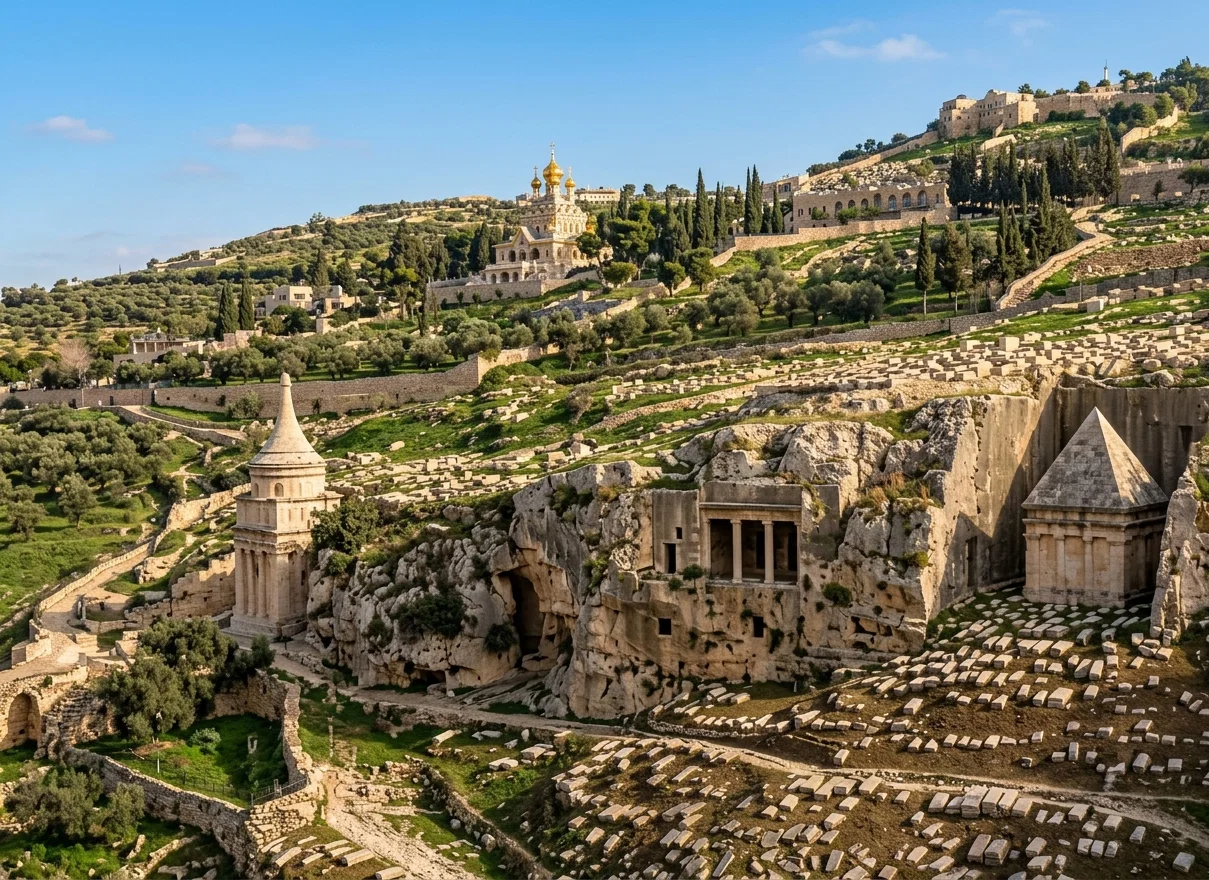
THE prophet Joel is the only Bible writer who mentions the Valley of Jehoshaphat. There is a Jewish burying-ground there, and tradition says that King Jehoshaphat and also King Absalom and the prophet Zechariah have their tombs in this valley. Our illustration on this page is a photograph of that part of the valley which is said to contain the tombs of Jehoshaphat and some of the other noted personages of Jewish history.
VALLEY AND TOMB OF JEHOSHAPHAT.
ONE of the scriptures that thrills the Christian with the deepest emotions of reverential delight and expectancy is that portion of the prophecy of Joel which speaks of the Jehoshaphat Valley. The words of the prophet are, “For, behold, in those days, and in that time, when I shall bring again the captivity of Judah and Jerusalem, I will gather all nations, and will bring them down into the Valley of Jehoshaphat; and I will plead with them there for My people and for My heritage Israel, whom they have scattered among the nations, and parted My land.” “Proclaim ye this among the nations: Prepare war; stir up the mighty men; let all the men of war draw near, let them come up. Beat your plowshares into swords, and your pruning-hooks into spears; let the weak say, I am strong. Haste ye, and come, all ye nations round about, and gather yourselves together; Thy mighty ones to come down, O Lord. Let the nations bestir themselves, and come up to the Valley of Jehoshaphat; for there will I sit to judge all the nations round about. Put ye in the sickle, for the harvest is ripe; come, tread ye; for the winepress is full, the fats overflow; for their wickedness is great. Multitudes, multitudes in the valley of decision! for the day of the Lord is near in the valley of decision. The sun and the moon are darkened, and the stars withdraw their shining. And the Lord shall roar from Zion, and utter His voice from Jerusalem; and the heavens and the earth shall shake; but the Lord will be a refuge unto His people, and a strong hold to the children of Israel. So shall ye know that I am the Lord your God, dwelling in Zion My holy mountain; then shall Jerusalem be holy, and there shall no strangers pass thru her any more.”
No ONE can read the foregoing scripture without having the fact impressed upon his mind that the judgment scenes are being presented by the prophet. And the words of the text give us a plain understanding of what will be some of the striking events in the world when this judgment-day is imminent. Men have been zealously teaching that the people are getting so good that there will be no more wars. These men have taught that there will be no further need for weapons of warfare, and so they will be beaten into pruning-hooks and plowshares. And right into the very midst of this false teaching the Lord thunders the proclamation of the real facts.
HE says: “Proclaim ye this among the nations; prepare war; stir up the mighty men; let all the men of war draw near, let them come up. Beat your plowshares into swords, and your pruning-hooks into spears; let the weak say, I am strong.” What is the condition in the world to-day? Are not the most unprecedented and the most undreamed of preparations for war going on? To all human foresight the time can not be long delayed when the whole world will be racked and torn by a turbulent, entangled, and furious war. It will not merely be one nation at war with another; but all the nations will be involved in the ferocious strife. And then in each one of these nations there are elements of internal revolution that may well cause the bravest to tremble.
THESE facts concerning the spirit of war in the world to-day are apparent to all. They are not things that have to be proven. Every one sees them and realizes them. God’s prophet shows us that they betoken the impending judgment-day, and you know, as you read this prophecy of Joel, that the sublimity and awe of that great assize right at hand fasten themselves unconsciously and irresistibly upon your mind. This is the action of God’s Spirit, uniting with His Word to impress you with the importance and the blessedness of being ready to stand in that great day.
THE time is at hand. It is getting late to ask you, What will you do about it? You are earnestly confronted with the question, What are you doing about it now? T.

THIS WORLD'S HISTORY.

NIMROD was the first man who wore a kingly crown. By him there was established among men the principle of human sovereignty. By him was begun kingship among men in this world: the rulership of man over man, and subjection of man to man; instead of the rulership of man over himself,—self-government,—and subjection of man to God only.
Nor was it only kingship that was by Nimrod begun; not merely kingship or sovereignty over a single city or territory, but kingship over kings, sovereignty over separate peoples and territories. For tho “the beginning of his kingdom” was the important cities and territories of “Babel, and Erech, and Accad, and Calneh, in the land of Shinar,” his ambition of kingly rule was not satisfied with these; but “out of that land he went forth into Assyria, and builded Nineveh, and Rehoboth-Ir, and Calah, and Resen between Nineveh and Calah.” Thus it was not only kingship, but kingship expanded into empire, that was begun by Nimrod in the world.
Thru a long period of ages, Nimrod’s example was followed, thru the rise and expansion into empire of Elam, Egypt, Assyria, Babylon, and Grecia. Then there arose a people who threw off and utterly repudiated all kingship and all idea of kingship; and established a republic—the republic of Rome—a government of the people, by the people, for the people.
This government of the people likewise expanded into empire, degenerated into monarchy and imperial despotism, then to such utter corruption that in terrible ruin it was swept totally from the earth.
From the tribes of barbarians who accomplished the destruction of Rome, there were established ten distinct kingdoms in the territory that had been Roman. Thus there was again established the principle of distinct kingship in government in the world.
Then again thru a period of ages, kingship expanded into empire in a succession of rises and falls, when in 1776 there arose another people who threw off and utterly repudiated all kingship and all idea of kingship; and established another republic—the republic of the United States—a government of the people, by the people, for the people.
And now this second great republic, which arose upon the repudiation of kingship, and upon the establishment of government of the people, has also expanded into empire.
Thus the whole history of this world from Nimrod’s day unto this year 1901 is expressed in two series of kingships expanding into empire, each followed by the total repudiation of kingship in the establishment of a republic—a government of the people, by the people, for the people—and each of these itself expanding into empire: the first, expanding into empire and irretrievable ruin; the second, expanding into empire and——what?
This is an interesting parallel. It is more than interesting: it is intensely suggestive, because the parallel stands, not only in the fact that twice in the world’s history has a long period of kingship been followed by the utter repudiation of kingship in the establishment of a republic, but the parallel likewise stands in the careers of these two republics—even to close details.
For this reason it is not only interesting but exceedingly important that the people of this republic of the United States should know the parallel, and how close it is, between these two republics; to know how far this parallel extends already, and to know how far it is likely yet to extend.
To this study the readers of the SIGNS OF THE TIMES and all who can be induced to become readers are invited, thru four or five numbers of the paper. Come; it will thoroly pay.
ALONZO T. JONES.

“THE TRIAL OF YOUR FAITH.”

GOD says of His people, “I will refine them as silver is refined, and will try them as gold is tried; they shall call on My name, and I will hear them; I will say, It is My people: and they shall say, The Lord is my God.”
By trial the Lord proves the strength of His children. Is the heart strong to bear? Is the conscience void of offense? Does the Spirit bear witness with our spirit that we are the children of God? This the Lord ascertains by trying us. In the furnace of affliction He purifies us from all dross. He sends us trials, not to cause us needless pain, but to lead us to look to Him, to strengthen our endurance, to teach us that if we do not rebel, but put our trust in Him, we shall see of His salvation.
Christ has given us no assurance that to attain perfection of character is an easy matter. It is a conflict, a battle, a march day after day. It is thru much tribulation that we enter the kingdom of heaven. If we sit with Christ on His throne, we must first be partakers with Him in His suffering. Individually we must experience that which was spoken of Christ, It became Him, “in bringing many sons unto glory, to make the Captain of their salvation perfect thru suffering.” “Tho He were a Son, yet learned He obedience by the things which He suffered.” Shall we then be timid and cowardly because of the trials we must meet as we advance? Shall we not meet them without repining or complaint? “In this world we shall have tribulation;” but the Lord Jesus will give us all the help that we ask, and believe that He will bestow.
By God’s mighty cleaver of truth we have been taken from the quarry of the world and brought into the workshop of the Lord to be prepared for a place in His temple. In this work the hammer and chisel must act their part, and then comes the polishing. Rebel not under this process of grace. You may be a rough stone, on which much work must be done before you are prepared for the place God designs you to fill. You need not be surprised if with the hammer and the chisel of trial God cuts away your defects of character. He alone can accomplish this work. And be assured that He will not strike one useless blow. His every blow is struck in love, for your eternal good and happiness. He knows your defects, and works to restore, not to destroy. He sends trials to you to make you strong to do and to suffer for Him.
During the march of the children of Israel thru the wilderness, God tried their faith, to lead them to trust in Him. Before they left Egypt, He began to give them these lessons, to lead them to look to Him as their Deliverer and Protector. The tribulations thru which they passed were a part of His great plan. It was not by chance that they came to Marah, where they could not drink of the water, “for it was bitter.” Thus God desired to teach them a lesson of trust. But they murmured and complained, crying out in distrust, “What shall we drink?” Do we not too often, like the Israelites, forget God, and by murmuring and complaining lose the blessing of the trial?
Remember that in every time of trouble Jesus is near you, seeking to impress His image upon you. He is trying to help you to carry the cross. He is close beside you, seeking to lead you to see how sorry He is that you make mistakes. He is always ready to clasp the hand stretched out for aid.
Christ’s love for His children is as strong as it is tender. It is a love stronger than death; for He died for us. It is a love more true than that of a mother for her children. The mother’s love may change; but Christ’s love is changeless. “I am persuaded,” Paul says, “that neither death, nor life, nor angels, nor principalities, nor powers; nor things present, nor things to come, nor height, nor depth, nor any other creature, shall be able to separate us from the love of God, which is in Christ Jesus our Lord.”
In every trial we have strong consolation. Istouched with the feeling of our infirmities? Has He not been tempted in all points like as we are? And has He not invited us to take every trial and perplexity to Him? Then let us not make ourselves miserable over to-morrow’s burdens. Bravely and cheerfully carry the burdens of to-day. To-day’s trust and faith we must have. But we are not asked to live more than a day at a time. He who gives strength for to-day will give strength for to-morrow. Let us take our sorrows to the Lord in prayer, saying, “My burdens are too heavy for me. Wilt Thou bear them?” Christ will say, “I will take them. With everlasting kindness will I have mercy upon thee.”
Nothing wounds the soul like the sharp doubts of unbelief. When trial comes, as it will, do not worry or complain. Silence in the soul makes more distinct the voice of God. “Then are they glad because they be quiet.” Remember that underneath you are the everlasting arms. “Rest in the Lord, and wait patiently for Him.” He is guiding you into a harbor of gracious experience, and He bids you, “Be still, and know that I am God.”
“Beloved, think it not strange concerning the fiery trial which is to try you, as tho some strange thing happened unto you; but rejoice inasmuch as ye are partakers of Christ’s sufferings, that when His glory shall be revealed, ye may be glad also with exceeding joy.” If you are patient, “the trial of your faith, being much more precious than of gold that perisheth,” will be found “unto praise and honor and glory at the appearing of Jesus Christ.”
Mrs. E. G. WHITE.

The Law of Exodus 20

REVIEW OF MR. GAMBLE’S BOOK.—NO. 2.

The Law of Exodus 20.

(Concluded from last week.)
AGAIN Mr. Gamble says: “I do not know of a book on the Sabbath question that correctly sets forth even the Bible teaching of the Sabbath, much less that gives a correct general survey of the field.”—Sunday the True Sabbath of God, p. 15.
Thus all the books and arguments which others have made for Sunday-keeping are ignored. This is the way it always is with opposers of the Word of God. The latest writer against the Bible always assumes that those who have gone before him have not succeeded in overthrowing it; hence the demand for another effort.
Mr. Gamble claims that the law of Exodus 20 was done away at the cross; so we do not have to keep the annual sabbaths. There would be no gain in doing away with that law for that purpose; for the Decalog of Exodus 20 makes no mention of those annual days. They were never commanded by it; but the weekly rest-day was. But if that law was done away at the cross, and another was given after the resurrection of Christ, notice the conditions: There would be a period of about three days when there would be no law against murder, theft, adultery, etc.; for one law perished at the cross, when Christ died on Friday; the other did not begin to come into effect till after His resurrection. And when it did come, it was against the same acts as the one abolished, and according to Mr. Gamble, does not even differ on the Sabbath question; for he claims the seventh day is the Sabbath, and that is just what the old Decalog said.
This author says the commandments were the covenant God made with Israel. This is a great mistake. Deut. 4:13 says it is God’s covenant which He commanded them. The covenant He made with them was an agreement on their part to keep these commandments, and on God’s part to bless them. Moses says it was “made with you concerning all these words.” Ex. 24:8. Under the new covenant the law is to be written in the heart. The covenant or contract is new, but the law is the same. Heb. 8:10; 10:16.
On page 187 of Mr. Gamble’s book he says, when speaking of the parable of the wicked husbandmen, “When Christ in the above parable said, ‘The kingdom of God shall be taken away from you,’ He clearly intimated that He would take away their church, with its Sabbathand sacraments.” Then the Sabbath belonged to the kingdom; the kingdom was the vineyard in the parable. It (the kingdom) was taken away from that people and given to another people. It was the same vineyard the wicked men had that was given to another people.
Still commenting on the parable, Mr. Gamble says, page 188, “Christ taught the removal of their Sabbath and the institution of another.” Having said that the Sabbath belonged with the kingdom that was given to them, he next has a different Sabbath. This would be a change in the kingdom; whereas the kingdom was not changed, but those who had it in charge were changed. We read, “They say unto Him, He will miserably destroy those wicked men, and will let out his vineyard unto other husbandmen, which shall render him the fruits in their seasons.” Matt. 21:41.
Reference is made on page 186 to Psalms 118; and after mentioning the prophecy of Christ as the Corner-stone, these words are quoted: “This is the day which the Lord hath made; we will rejoice and be glad in it.” He argues that this applies to the resurrection day. Admit that it does, and all his Sabbath sacredness is taken away from it. There is no intimation of rest, to say nothing of command. It reads, “We will rejoice and be glad in it.”
Commenting on the prophecy of the second chapter of Hosea, especially verse 11, which reads, “I will also cause all her mirth to cease, her feast days, her new moons, and her sabbaths, and all her solemn feasts,” Mr. G. says, page 175, “So if He shall abolish that law of commandments, He certainly will not do so until He is ready to have it followed by another and better one.” It seems as if Mr. Gamble must have overlooked the reason why God was going to take all these away from His people. Verse 4 says it was because “they be the children of whoredoms.” In verse 3 the Lord says of them, when threatening to take away these things, that it will “strip her naked.” The fault was not with what God was going to take away; but the people were not fit to have these blessings. They were to be taken away because of their sin. Mr. Gamble says the Lord was going to take them away and give the people something better.
According to this, God takes from the sinner what He gave him before he sinned, and gives him something better. If this were true, the more men sin the better it is for them. This doctrine, though unreasonable, if not blasphemous, is by no means new. It was taught in Eden. The serpent told Eve that if she would eat of the forbidden fruit—sin against God—the old conditions would be changed; she would be wise, and have things much better.
Again he says, page 177, “God does not move backward, but forward. Each dispensation is an advance upon the preceding one.” But according to his theory, God gave man the “Sunday-Sabbath” in Eden, then permitted it to be lost, and now has restored it again for the Christian age. Where is the advance? They have the same day. If a man loses a piece of money for years, and then finds the piece again, is he better off? Has he gained by it?—Nay, but he has been a loser; for he has no more money, and has been deprived of the use of it all the time it was lost. So if the Sabbath was lost for many centuries and then found, man has not gained, but the church is the worse for having been deprived of its blessings.
But his reasoning (?) is even worse than that; for when the patriarchal dispensation passed away, at the time of Moses, God, according to Mr. Gamble, but not according to the Lord’s Word, gave the people annual sabbaths in the place of the Edenic Sabbath. This would prove that the annual ones were better than the other; for he says that each change is for the better,—“Each dispensation is an advance upon the preceding one.”
May the Lord open the blind eyes, and help all to see clearly His Word of eternal truth, and then give strength to walk in it.
God is not an experimenter; man is. God always does the right thing—the best thing—the first time. He gave the holy Sabbath, the seventh day, in Eden; and He never changed His mind, much less His rest-day. He would need to create the world over, and rest on another day, to do that. At Sinai God repeated the Sabbath law, and began by saying, “Remember,” which shows that they had had previous knowledge of it. Here God gave other laws, and among them were those for the annual days of rest. But His Moral Code, the Ten Commandments, went on just the same. As a nation the Israelites had ceremonies and laws peculiar to themselves. But the Ten Commandments were applicable for all time, to all people, and can not be changed.
The Sabbath is always the same. It is the day on which God rested from the creation of the world, and is to keep ever before His people the great truth that our God is the Creator. It was given in Eden, and was kept by the patriarchs, and by the Israelites before and after reaching Sinai. It was especially marked in the wilderness, and the true day pointed out, by withholding the manna on it for forty years.
From that time till the present the Jews all over the world have carefully preserved the reckoning of the Sabbath time. But in Heb. 4:6 we are told that they have not entered into its rest because of unbelief. In verse 2 we read, “Unto us was the Gospel preached, as well as unto them.” In verse 9 it is declared, “There remaineth therefore a rest to the people of God.” The same Gospel that was preached to them is preached to us; and the same rest that was taught to them is given to us. It is not a new rest, but a rest that “remaineth;” that is, it continues from them, and will ever continue, without change. W. M. HEALEY.

THE TEMPLE CLEANSING.

The sanctuary of the wilderness merged into the temple built by Solomon. The object of both these buildings was to teach the people the willingness of God to dwell among them. Ex. 25:8; 1 Kings 6:13, 14. Since the people did not fully comprehend how God could dwell in sinful human flesh, some educational system was necessary by which that truth might be taught in forms of worship. These forms could best be carried out thru the work of the priesthood, in a building devoted to that purpose. All these forms of worship centered in one great ultimatum,—that of cleansing the building of God from sin’s impurity, in order to render it a proper dwelling-place for Him whose creation it was. But as this work must depend on divine power for its accomplishment, the entire sanctuary and temple work pointed to Christ, first, as the true temple of God (John 2:19–21), second, as the sacrifice for sin (John 1:29), and third, as the High Priest who should minister blood in behalf of the sinner (Heb. 8:1–5).
The cleansing thus done by Christ was in order to teach the necessity of preparing the heart of man as the dwelling of Jehovah. John 14:17, 23. This was to constitute man God’s temple (1 Cor. 3:16, 17; 6:19, 20), even as he is a partaker of the Lord Jesus, who is, first and foremost, the living temple of God. So, then, while the services of the tabernacle sanctuary were typical of cleansing services in the great heavenly sanctuary, they were also designed to direct the minds of the worshipers to the heavenly cleansing of the fleshly temple of man, whom God created for His own dwelling-place.
In the earthly tabernacle the work for sinners was carried on daily, but there was a final service by which all the sins forgiven day by day were, once for all, taken out of the account, by sending them, in figure, out of the camp. This occurred on the closing day of each religious year. Ex. 30:10; Heb. 9:7. The final offering by which the sanctuary, or God’s dwelling-place, was cleansed of sin preparatory to the restoration of its purity, was a young goat. Lev. 16:5. Two of these were provided, and were made to stand alive before the door of the tabernacle. After the high priest had made an offering of a bullock in his own behalf, lots were cast upon the two goats to determine which of them should serve to represent the sacrifice of the Lord Jesus. Tradition says this was done by a chosen person holding above his head a small box containing two golden cards. On one card was inscribed in Hebrew la Jehovah,—for the Lord,—and on the other la Azazel,—that is, for the evil one, meaning Satan. Another man appointed for the purpose, upon designating one of the goats for which he was about to draw a lot, then reached his hand into the little box, and drew forth one of the golden cards. The name it contained determined the part each goat was to act in the ceremony.
The goat whose lot it was to represent the Lord, was then slain, and the high priest took his blood inside of the sanctuary, where a portion of it was sprinkled upon, and in front of, the mercy-seat. Coming out into the first apartment again, the vessels there were hallowed after the same manner as the mercy-seat. By thus passing thru the sanctuary it was cleansed from the polluting effect of the sins which had been taken there from sinners during all the year.
But this was not the end of the sins, by any means. Having thus purified the Lord’s dwelling-place, the high priest in figure placed all the confessed sins on the head of the living goat, which was then conveyed away into the desolate wilderness by the hand of one chosen for this service. Lev. 16:15–22.
The tenth day of the seventh month, on which this service was performed, was called the day of atonement. Verse 29. The reason for this was that by this cleansing of God’s dwelling-place,—this blotting out in type of the sins of the people, which had been transferred from them into that place,—the people and place were reconciled to God; that is, were in harmony with His sinless Being, hence were placed in at-one-ment with Him.
This was a day of the deepest interest to all the house of Israel. Inasmuch as to have an atonement between God and His people, required that their sins should be conveyed by the scapegoat into the wilderness, into a land of forgetfulness, it followed that if any did not confess his sins beforehand, and so have them placed on the scapegoat, he must bear his own sins, and, like the live goat of that occasion, be banished with his own sins out of the camp, and away from the house of Israel. This was perpetual separation from God’s chosen people. It was therefore a typical day of judgment, on which the people must humble their hearts and afflict their souls,—a type of the final judgment. Lev. 23:27–32.
In the great antitype, Christ enters the most holy place of the sanctuary, once for all, in the closing days of earth’s history, that He may close up the great world atonement for His people. Heb. 9:23–26. The angel of the Lord clearly stated to the prophet the time when that work was to begin. He said, “Unto two thousand and three hundred days; then shall the sanctuary be cleansed.” Dan. 8:14. When Daniel sought to know the meaning of these words, the angel said, “Understand, O son of man; for at the time of the end shall be the vision.” Verse 17. As tho it were not enough for the prophet to know that this sanctuary cleansing was to be at the “time of the end,” he soon after called on Daniel to consider the vision again, and then told him how he might know when the 2300 year-days began. Dan. 9:23–27. This, however, will be considered in a-following study.
J. O. Corliss.

NOT TIME - SETTERS.

[By Judge C. C. Holbrook, 12th Judicial District, Colorado, in the Alamosa (Colo.) Independent Journal of May 16, 1901.]
EDITOR INDEPENDENT JOURNAL:—
I SEE in your last issue a clipping from the Hooper Press, as follows, to-wit:—
The Adventists are expecting to see the destruction of the world this year, and are patiently waiting the crack of doom.—Prospector.
When the “crack” comes, the 12th judicial district will, in all probability, have a judge who will hold court on Saturday.—Hooper Press.
It is true that the first day, or Sunday-keeping Adventists, the Guinnessites, the Dimblebyites, the Tottenites, the Rossites and others, all Sunday-keepers, or supporters of first-day sacredness, are time-setters, and have set various times for the second coming of the Lord.
But the above clipping is so worded as to lead the readers of the paper to believe that Seventh-day Adventists have also set the time, which is utterly false. The observers of the fourth commandment, or seventh-day keepers, have never been time-setters. From the day of the organization of the Seventh-day Adventist church, it has steadily opposed the time-setting theory. It has always been the doctrine of the Seventh-day Adventist church that no man can know more about the time when the Saviour is to come again to this earth than God has revealed in His Word; as, for instance, when the disciples, on Mount Olivet, just prior to the crucifixion, asked the Saviour, “What shall be the sign of Thy coming and of the end of the world?” Christ answered the question by telling them of many important events that should transpire in the world, all of which have since been fulfilled, as shown by the pages of history, in the exact order in which He mentioned them. He then told them of certain last-day signs, and added, “When ye shall see all these things, know that it is near, even at the doors,” or, as some translators render it, “Know that He is near, even at the doors.”
Living, as we are to-day, in the time of the fulfilment of the last sign mentioned by the Saviour in that interview, we know that the time “is near, even at the doors,” but how much time the Lord calls “near, even at the doors,” He has not revealed unto man. It may be years. Suffice it to say, that the end can not occur in this year; for there are unfulfilled prophecies which, according to Scripture, will require longer time for their fulfilment.
All the great international alliances which have been taking place since August, 1897, and all the great combinations of capital which we have witnessed of late, and many other things recently in evidence, are all fulfilments of prophecies of the Bible for the last days; yet the end can not occur in this year, for the reason that there are prophecies to be fulfilled after this year.
If the Hooper Press wants to keep Sunday or any substitution for God’s Sabbath, it may do so without fear of interference by the district judge or any other reasonable person.
After all efforts to induce the people of England and Scotland to change from the observance of the seventh day to the new sabbath had failed, Eustace went from Normandy over to England in A. D. 1201, and carried with him a roll, certified by certain ones in high authority to have come “from heaven to Jerusalem,” “upon the altar of Saint Simeon, in Golgotha, where Christ was crucified for the sins of the world.” This roll supplied the authority for the change of the Sabbath, which authority God had, in some way, neglected to put into the Bible. This roll commanded, “that no one, from the ninth hour on Saturday until sunrise on Monday, shall do any work except that which is good,” adding severe temporal punishment as a penalty for the violation of this new command. In the same year, A. D. 1201, the church in England, deeming the evidence sufficient, changed from the observance of the seventh day to obedience to the new command. Two years later,at a church council held in Scotland, the same evidence was produced, was deemed sufficient, and upon that evidence the same change was made in Scotland. Since that the portion of Saturday and the portion of Monday have been gradually dropped, and the new sabbath limited to Sunday, without the authority of another roll from heaven upon Saint Simeon’s altar or any other altar.
The Hooper Press may, without the slightest danger of interference, observe the new sabbath as established by the new command found upon Saint Simeon’s altar, or it may, with like freedom, observe it in its present amputated form with both ends cut off. This is a free country, in which every individual may keep the amputated sabbath, or any other sabbath, or no sabbath at all, according as conscience may dictate. We inherited the new sabbath from across the water, both headless and tailless, and every one who wishes to observe it is at perfect liberty to do so.
Respectfully,
C. C. HOLBROOK.

EXPENDITURES FOR WORSHIP.

CHRISTIANS sometimes feel that they are too often called upon for means to support the worship of God. If they would reflect upon the vast expenditure for the worship of false gods, the waste of effort and of means for the support of institutions that are against the Gospel of Jesus Christ, they would realize that the calls for His cause are comparatively very light. A little comparison with the enormous expense of heathenism would demonstrate the words of Christ, “My yoke is easy, and My burden is light.” A little thought on this line would convince the most skeptical that Christ’s burden is “light,” even from a financial view, altho the covenant is one of sacrifice. A sacrifice that yields an abundant return is truly but an investment. “Lay up for yourselves treasures in heaven, where neither moth nor rust doth corrupt, and where thieves do not break thru nor steal. For where your treasure is, there will your heart be also.”
History is prolific of accounts of enormous expenditures for the support of heathen worship, both by States and by individuals. Notable in the way of temples was that of Diana at Ephesus, to which contributions were made by all the provinces of Asia. The Mohammedan, Buddhist, and Hindu religions are especially noted for extravagant drafts upon the people and governments which sustain them, for financial support. And Catholicism, in those countries where the State is under the control of the church, is equally extortionate in its demands for contributions.
“Where the Spirit of the Lord is, there is liberty.” While the Christian must realize that he is “bought with a price”—an enormous price, even the blood of the Son of God—and therefore his obligation can not be estimated, his offerings are to be voluntary, and not to be demanded or in any wise extorted by any earthly power. Every servant is amenable only to his master (Rom. 14:4), and every child of God is the servant of God. “So then every one of us shall give account of himself to God.” Verse 12.
Among the vast expenditures for the support of heathenism is a structure in the island of Java—the temple of Borobodo. This great domed structure is erected on an elevated site. The “American Encyclopedia” says:—
It is a connected series of terraced walls, composed of seven tiers, one above another, and all surmounted by a triple circle of 72 towers surrounding the dome. It is 620 feet square, and rises to a height of about 100 feet. The walls are profusely ornamented with sculpture. Wallace says that the amount of human labor and skill expended on the great pyramids of Egypt sinks into insignificance when compared with that required to complete this sculptured hill temple in the interior of Java.
To this it adds that “the temples on the mountain of Gunong Prau are reached by four flights of stone steps from different directions, there being more than a thousand steps in each flight.” And this is but an instance in a small East India island. Yet the so-called Christian nations can far outdo this in extravagant waste of means, tho it be not for the expense of formal worship. When we are pointed to the expense of Christian worship, which is a far lower ratio than that of false religions, we may retort by referring to the waste of means on foolish and hurtful lusts. For instance, the well-known expenditure for intoxicating liquors and tobacco, in all the professed Christian nations, is far beyond the combined outlay for food and clothing.
It is a fact beyond dispute that “willful waste makes woful want.” It is also true that selfish waste involves more want than all other causes combined. Waste is expenditure for that which brings no return, either in health, wealth, or wisdom. But treasure invested by faith in the cause of true religion has its reward in joy and peace and happiness in this life, and in the end a crown of eternal life.
“Wherefore do ye spend money for that which is not bread? and your labor for that which satisfieth not? hearken diligently unto Me, and eat ye that which is good, and let your soul delight itself in fatness.” Isa. 55:2.
G.
Continue reading: THE STORY OF A BIBLE