Pacific Press Publishing Company · Oakland, California · Aug 25, 1898
OUR WORK.
By Ellen G. White
The Lord has given to His church a work of personal service. He has intrusted the knowledge of the truth of redemption to every converted soul. This knowledge we are to give to others. A responsibility rests upon us to work for all, our friends, our acquaintances, those who are bound up with the world and alienated from God.
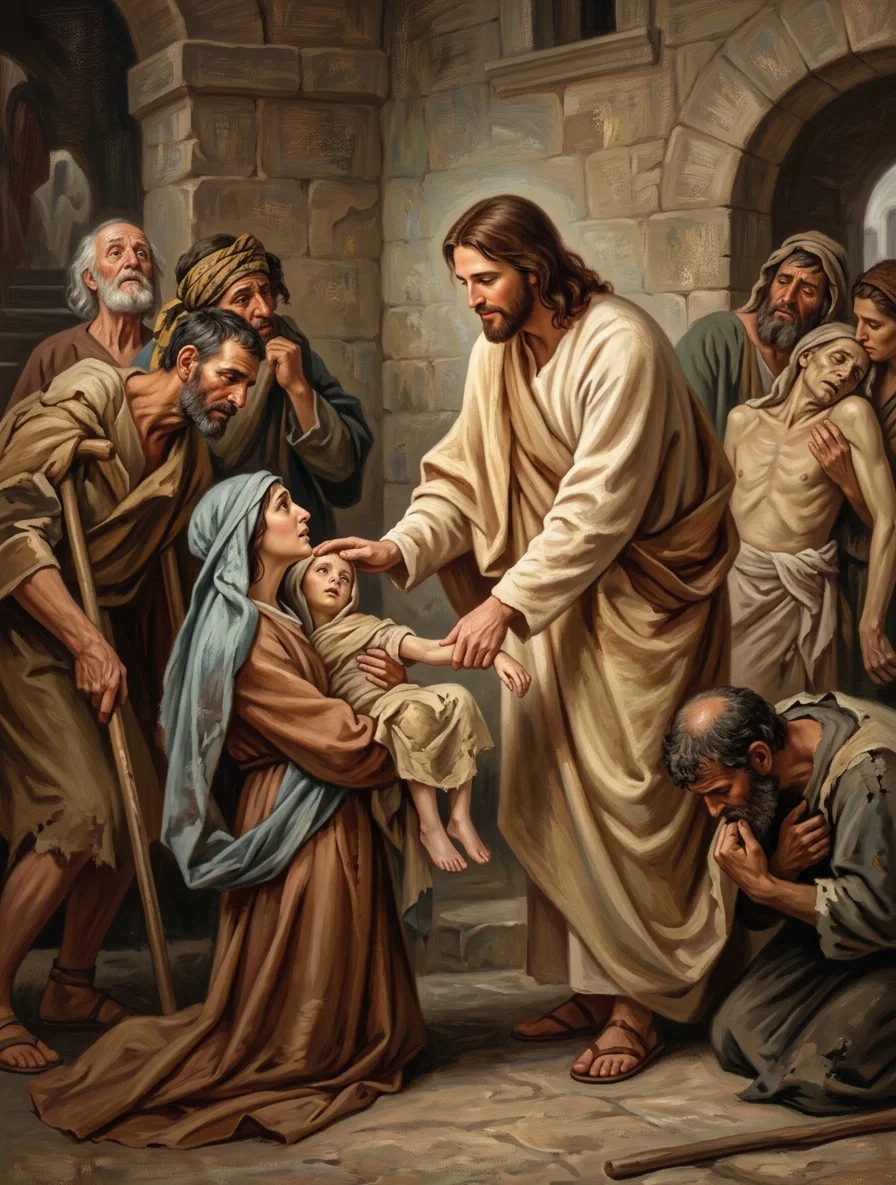
“All they that had any sick with divers diseases brought them unto Him; and He laid His hands on every one of them, and healed them.” Luke 4:40.
How earnestly and untiringly Christ, our great Example, labored to reach all, the most lowly, as well as those in higher positions! His heart was ever touched by human woe. Constantly He walked and worked in the cities, inviting the weary to come to Him, crying: “Come unto Me, all ye that labor and are heavy laden, and I will give you rest. Take My yoke upon you, and learn of Me; for I am meek and lowly in heart; and ye shall find rest unto your souls. For My yoke is easy, and My burden is light.”
Christ is the mighty Healer of all spiritual and physical maladies, and He employed every means to arrest the attention of the impenitent. He longed to break the spell of infatuation upon those who were deceived and deluded by the enemy. He longed to give the sin-polluted soul pardon and peace.
How tender and considerate were Christ’s dealings with all! Look upon the sympathetic Redeemer. With the eye of faith behold Him gathering the weak and weary to Himself. Helpless, sinful human beings crowded about Him. See the mothers with their sick and dying little ones in their arms, pressing through the crowd that they might come within reach of the Saviour’s notice. Watch them urging their way to Him, pale, weary, almost despairing, yet determined and persevering, bearing in their arms their burden of suffering. As these anxious ones are crowded back, Christ makes His way to them, step by step, till He is close by their side. Tears of gladness and hope fall freely, as they catch His attention, and look into the eyes which express such tender pity and love for the weary mother as well as for the suffering child. He invites her confidence, saying, What shall I do for thee? She sobs out her great want, “Master, that thou shouldest heal my child.” She has shown her faith by urging her way to Him, tho she did not know that He was making His way to her; and Christ takes the child from her arms. He speaks, and at His touch and word disease flees. The pallor of death is gone; the life-giving current flows through the veins; the muscles receive strength.
The Saviour speaks words of comfort and peace to the mother; and then another case just as urgent, presents itself. A mother asks help for herself and her children; for they are all sufferers. With willingness and joy Christ exercises His power, and the mother and her children praise and glorify Him who doeth all things well.
No frown on Christ’s countenance spurned the humble suppliant from His presence. The priests and rulers sought to hinder the suffering from going to Him, saying that He healed the sick by the power of the enemy. But His way could not be hedged up. He was determined not to fail or become discouraged. Suffering privation Himself, He traversed the country, scattering blessings wherever He went, and seeking to reach obdurate hearts.
At one time Christ found Himself in a desert place, surrounded by a multitude who had followed Him to hear His words. “When He saw the multitudes, He was moved with compassion on them, because they fainted, and were scattered abroad, as sheep having no shepherd.” The Redeemer’s soul was drawn out in heartfelt compassion for the weary people. Their physical weakness and suffering excited His deep interest and sympathy. He longed to relieve the hunger and thirst that made some faint and fall by the way. There was no thought in that heart of infinite love of indifferently passing by, without helping those who needed help.
The compassionate Saviour, who drew hearts to Him by being touched with the feeling of their infirmities, saw a still greater need than bodily suffering. He saw symptoms of a deeper illness. Outward affliction is the result of a diseased heart; and the physical suffering of the people suggested to the Saviour the cause that produced this effect. It was this soul-trouble that led the great Physician to come to the earth as a restorer. The sufferings of the body excited His pity, but He was moved to a still greater compassion by the needs of the soul.
Christ’s sympathy for outward necessities was followed by ministry for the soul. Many in that multitude never forgot the experiences of that day. While they were rested, fed, and healed of physical infirmities, their slumbering senses were aroused. They felt their spiritual need, and commenced to live a new life.
So it must be in the work which we as children of God are to do for suffering humanity. While ministering to the physical needs of those who need our help, we are to show them that2their hearts must be cleansed from defilement.
The compassion Christ manifested as He looked upon the multitude was not a strange thing to Him; for this love and compassion dwells in the heart of the Father. “God so loved the world, that He gave His only-begotten Son, that whosoever believeth in Him should not perish, but have everlasting life.” It was compassion that brought Christ from heaven. It was compassion that led Him to clothe His divinity with humanity, that He might touch humanity. This led Him to manifest unparalleled tenderness and sympathy for man in his fallen condition.
To-day there is a multitude to be reached. The world is full of suffering and distress, of disease of every stripe and type. There is constant need of deep, Christlike sympathy. This sympathy should be manifested at all times and in all places.
God could have sent angels to work for man’s reformation, but He did not do this. Humanity must work for humanity. God uses those who are willing to be used. The church is His instrumentality, and if the church had cherished a sense of her responsibility, fervent, earnest messengers would have carried the truth to countries far and near. God’s living Word would have been preached in every corner of the earth.
There are heathen at our doors; but there is infidelity in our churches, and this infidelity palsies the working element. The work of saving souls is so limited that the advancement of the kingdom of God is slow. A backslidden church is the sure result of a neglect by the church to use her talents in the work of co-operating with Jesus to restore the moral image of God in man.
What was Christ’s last commission to His disciples?—Lifting up His hands, He blessed them, and said, “Go ye into all the world, and preach the Gospel to every creature.” He who has been truly converted, who loves God supremely and his neighbor as himself, can not rest content with doing nothing. He has a longing to save the souls who are out of Christ, and he goes forth proclaiming, “Behold the Lamb of God, which taketh away the sin of the world.” As he comes to Christ Himself, his whole soul breathes out for Christ. The Holy Spirit molds his heart, and the light that shines into his mind can not be shut in. He receives the knowledge that the Lord gives to every true seeker to impart to others.
It is a most fatal mistake to suppose that the work of saving souls depends alone on ordained ministers. It is by the Spirit’s power that souls dead in trespasses and sins are quickened to hear the Word of life. And the command to work unselfishly and earnestly, rests upon every soul. All who are ordained unto the life of Christ are ordained to work for the salvation of their fellow-men. Whatever their work, whatever their business, their first interest should be to seek for the kingdom of God and His righteousness, and by precept and example, in word, spirit, and action, show their earnest zeal for Christ. “The Spirit and the bride say, Come. And let him that heareth say, Come. And let him that is athirst come. And whosoever will, let him take the water of life freely.”
Mrs. E. G. White.
REVIVAL OF TRUE SABBATH OBSERVANCE.
By F. M. Wilcox
WILL the minds of men ever again be turned back to the true Sabbath of the Lord? As one traces the history of the Sabbath institution from its origin at the close of creation week down through its varied experiences in the Jewish dispensation, the reformation attending it at the first advent of Christ, the decline in its observance in the first few centuries, and its almost utter extinction in the Dark Ages, the question as to whether the minds of men will ever again be turned back to its observance is one which involuntarily forces itself upon every thoughtful student.
In the beginning this institution formed a part of God’s great purpose. Will He permit His purpose to be thwarted? Sin has turned it aside, and the enemy of all righteousness has hindered its execution; but will this be forever?—Nay, verily. No word uttered by the Lord is meaningless. No design will remain unexecuted. No purpose will be thwarted. Sin and the hosts of evil may for a little time turn aside the arrows of God’s truth, but those arrows will eventually reach their destined mark. From its abasement, its servitude, and all the obloquy and opprobrium heaped upon the rest day of the Lord during the recurring centuries of this earth’s history, it will come out triumphant in the end.
The Word of God plainly declares that in the last days there will be a revival of true Sabbath observance. This revival of the Lord’s day rest will be a part of the great work of reform which shall sweep over this earth preparatory to the second coming of Christ. That the coming of Christ is near, even at the door, multiplying evidences on every side clearly indicate. And in the very nature of the case, considering the condition of professed Christianity to-day, a message of reform is a necessity in order that the true may be distinguished from the false, the genuine from the counterfeit, the chaff from the wheat. It is the crisis in religious experience that distinguishes the metal. And so in the last days there is destined to be a great crisis in the religious world.
The church has become corrupt. Every form and species of iniquity abound under the garb of Christianity. The churches have departed from their simplicity, and have become great social organizations. Politics have entered the realm of religion, and the church seeks to make up its lack of spiritual power by employing the strength of civil authority. The Lord might leave the world to its downward course, and permit the impending judgments of the last day to fall upon a careless and indifferent church. But this He can not do in His infinite love and pity. The church of God demands a reformation, even as greatly as in the sixteenth century.
This reformation is due, and is even now going to earth’s remotest bounds, and it embraces in its scope a reform in every line. It proclaims the coming of the Lord and the standard of life necessary to constitute a preparation for that event. And as a component part of that reformation the attention of the minds of men is called to the law of God, and with special directness to the one commandment above all others being violated by the Christian church,—the commandment requiring the observance of the only and true Sabbath of the Lord.
In the seventh chapter of Revelation is brought to view a company who are to be translated, as was Elijah, without seeing death, at the second coming of Christ. The seal of God placed in the foreheads of this company is the true Sabbath of the Lord. This constitutes God’s distinguishing mark. In all ages has it been the sign of sanctification of the true Israel. Ex. 31:17. In the fourteenth chapter of Revelation and first verse, the same company is brought to view, and there the seal of God in their foreheads is said to be the Father’s name. The Father’s name indicates the Father’s character. Thus the seal of God embraces more than mere outward Sabbath observance. It is a sign of the possession of the character of God.
In this same chapter, Revelation 14, is brought to view another company, having not the mark of God but the mark of anti-christ, the “mark of the beast.” These represent those who are to be destroyed by the brightness of Christ’s power at His second advent. And possessing, as they do, the mark of the beast, it indicates also that they will possess a character of which the mark is only the outward indication. This mark is the false sabbath which has been set up by the influence of the beast in opposition to the true Sabbath of the Lord.
Other scriptures, such as Isaiah, chapters 56 and 58, show further that in the last days true Sabbath reform will constitute a part of the great closing message. And to-day, by land and sea, through the agency of tongue and pen, in the words of living preachers and in the pages of silent printed messengers, is the truth of God being heralded to the world.
On the other hand, in proportion as the Lord reveals His truth, we see a corresponding effort put forth by the powers of evil to enforce the claims of the counterfeit. The advocates of the false sabbath, unable to make any appeal to the Word of God or the moral sense of the people, from the lack of divine precept, appeal to the power of the civil arm to foist upon men this papal institution.
Thus is the conflict deepening. It is not a conflict having its origin in this century nor in the last. It is the culmination of the great conflict of the ages. Since sin entered has the war been on betwixt the true and the false. And now the hosts of evil are marshaling to make a last great assault upon the citadel of divine truth. Finding illogical argument of no avail, recourse will be had to the civil power, and persecution will follow, as in the Dark Ages, to those unwilling to submit their consciences to the dictation of their fellows. See Revelation 13, where it is plainly stated that the mark of the beast, the false sabbath, will be forced upon men, and all who will not admit its claims shall neither buy nor sell, and eventually will the attempt be made to take from them even life itself.
But God will most gloriously vindicate the right. Clouds may lower, darkness enshroud, the hosts of evil may press around on every side, and it may seem to those who have dedicated their all to God that only destruction and oblivion await them and the principles for which they stand. But the power of the oppressor shall be broken, and glorious victory turn on the side of the Lord’s Israel. At the time when all seems lost, the Lord will appear to take His people home. And then in the earth made new and in the righteous nation redeemed from earth’s long history, the purpose of God will be carried out in its original design. From one new moon to another, and from one Sabbath to another, shall all flesh come up to worship before the Lord of hosts. Isa. 66:22, 23.3
Thus the Sabbath of the Lord, like a grand triumphal arch, spans the abyss of sin, reaching from Paradise lost to Paradise restored; or like a golden thread interwoven with strands of closest fabric, so the Sabbath of the Lord winds its way through the meshes of superstition and sin, sometimes quite if not entirely lost to view, but finally emerges in all its resplendent glory and all its original purity and brightness, reflecting all the more radiance from the contrast with its associations and environments.
Thus in the beginning God designed one universal Sabbath, and while Satan has sought to thwart this holy purpose, it will eventually succeed, and throughout the endless ages of eternity will the Sabbath be observed by the children of men in commemoration of their creation, and as a sign of their sanctification and redemption through the Lord Jesus Christ.
F. M. WILCOX.
On Reading Valueless Books
“LIFE being very short and the quiet hours of it few, we ought to waste none of them in reading valueless books.”
God’s Comfort in Grief
GOD is a shower to the heart burned up with grief; God is a sun to the face deluged with tears.—Joseph Roux.
“WHERE IS BOASTING?”
By W. N. G.
This is the nineteenth century, and these are the United States. It is not necessary to call attention to the proverbial boastings about the advancing civilization and the growing brilliancy of the enlightenment of this age, and especially of this country. That is patent to the majority of people. But the following extracts from an article in the Catholic Mirror, probably the most American of Catholic journals, speak for themselves:—
Much interest has lately been excited by the permission given a photographer to reproduce for the first time the sacred Winding Sheet, in which the body of Christ was wrapped when taken from the cross, and prepared for burial in the holy sepulcher.
This precious relic has for many years been preserved in the Cathedral of Turin, and at intervals exposed to general veneration. The last occasion of its exhibition to the general public was at the great exhibition held in Turin from May 23 to June 2, and it was then the ecclesiastical authorities were prevailed on to allow photographs to be taken of the sacred sheet.
The first copy, printed on fine linen, brought to this country, is to be presented to His Eminence, Cardinal Gibbons. . .
The facsimiles reproduce on a small scale the original with faithful exactness and display the rich embroidery design which incloses the original. There are three of these sheets in existence, the one which is at the Cathedral of Turin and the others at the Cathedrals of Compiegne and Besancon, France.
The winding cloths kept in the Cathedrals of Compiegne and Besancon, in France, do not impair the genuineness of this, as the Gospel itself is authority for the statement that when the apostles entered the sepulcher, they found ‘linen cloths lying on the floor.’ . . .
An account of the winding sheet says that it presents a distinct semblance of the Redeemer after the lapse of centuries. This semblance is reproduced in the facsimiles, which were prepared with ecclesiastical approval.
Thirty years have passed since it was previously seen by the public. It was shown on the occasion of the marriage, in 1868, of Prince, now King, Humbert with the Princess Margaret.
It is known as the most holy “Sindone”—the word used in the Latin Gospels for a winding sheet. There are stains of the blood of Christ and of the ointments which were used for His burial, and which form faint figures of the back and the face of the body which it enwrapped.
It was photographed by electric light. When the plate was put into the bath, and the photograph began to develop, a strange fact became evident. There appeared on the plate what is described as “the perfect and complete design of the sacred face, of the hands, of the limbs, as if, instead of depicting the sheet in which it was wrapped, the divine Martyr was depicted directly. The Sindone was then an exact negative, although apparently undecipherable, of the bleeding corpse which had been placed within it.” This strange impression of Our Lord’s body on the Winding Sheet was never noticed before. It may have been there, but it was too indistinct and faint to be perceived by the naked eye. . .
The dimensions of the sheet are: length about 9 feet, and breadth about 3 feet, and the semblance of the Redeemer is about 5 feet 6 inches long.
Mr. Schiaffino has secured from the fortunate photographer the exclusive rights to any reproduction of the photograph in this country. He has made arrangements with the Catholic Mirror to act as his agents.
The foregoing is a sample of the superstition of probably the most advanced section of the church which has a greater direct influence with this government than any other religious body or combination. It is the only religious organization that has influence enough to maintain diplomatic relations with the government, and secure political concessions. This the Roman Church has been able to do under the administrations of both the great political parties, yet it is under the influence of such vagaries as here cited from its leading American organ. Surely there is little room for boasting over past ages, or of the future prospects of religious liberty in the United States. W. N. G.
WHITHER ARE WE DRIFTING?
By C. M. Snow
Never has there been a time in the history of this world when great events were rushing in upon one another with such accelerated speed as at the present time. Never was there a time when crises ripened so rapidly as they are ripening now. We have hardly time to-day to take the revelations of God by faith before we are compelled to view them in the light of past events.
And this country, the cradle of liberty, this country, which has outrun all others in the inventions which its subjects have sought out, is now outrunning them also in the preparations which she is making for co-operation in the last great act of plunging the whole world into its eternal ruin. She is forging the weapons for this last great contest with an alacrity never before seen and never anticipated.
The present war with Spain has added energy to a zeal already unsurpassed, and opened avenues for the accomplishment of the designs of papal conspirators and their false Protestant coadjutors. It was a long step in advance of anything heretofore recorded when Archbishop Ireland presented his credentials from the papal Secretary of State to the Secretary of State of the United States, and was received by him as the official representative of the papal power. It was another long step in advance of former conditions when the American fleet passed Corregidore Island, and launched America on the sea of international politics.
There has been considerable joking among the newspapers over what is termed America’s poor shooting in this war, she having, as it is expressed by them, “aimed at Cuba and hit the Philippines.” But however poor a shot America has been in this thing, she has made a center shot in the target of her own undoing. Not but what America’s moral aim was good enough in freeing the Cubans, in liberating the Porto Ricans from their oppressive rulers, or in breaking the fetters of the Philippines, if that is what her object is in the Orient; for I am not criticising, nor have I any disposition to do so. But in “blowing Spain out of the water” in Manila Bay, on May 1, America has blown herself into the vortex of that great international catastrophe which the student of God’s Word expects so soon to see.
In striking that blow, Admiral Dewey solved the problem of how America could become entangled with the powers of the Old World. Such an event was not foreseen—it could not have been—but the shot struck home, and the trap was sprung which threw around the “great republic” the interminable meshes of foreign complications—and not simply complications with the regularly recognized powers of the Old World, but also with that intriguing foreign power which, sitting a prisoner in the Vatican, has imprisoned in a greater or less degree under the bolts and bars of ignorance and superstition the subjects of every nation under heaven.
That battle afforded the opportunity for the presentation of those papal credentials by a papal minister plenipotentiary. The door was opened, and Rome stepped in—into the inner council chambers of this republic, that she might there wield the scepter of her invisible power. So it has come to be a fact that Rome has a hand in influencing the affairs of this nation.
In connection with this achievement, which forms a precedent for future acts of similar import, the work of the Lord’s Day Defense Committee becomes an interesting study. A combination of all the elements which have hitherto been favorable to religious legislation, is the slogan of its hosts. The education of the masses in harmony with its aims is the preliminary work cut out for its promoters; and the most startling and far-reaching of its plans of work is an image of the inquisitorial work of Rome. I quote section 7 of its constitution:—
The Investigating Committee [which should have been named the Inquisitorial Committee], appointed by the secretary and known only to himself, may consist of four or eight. The first (or first two) shall on the first Monday of each month, the second on the second, and so on, report in writing and in detail to the secretary from careful personal observation made the previous day whatever Sunday work or dissipation was discovered. Or the whole city may be divided into small districts, and one or two be appointed in each district to investigate every Sunday and report every Monday. These facts the secretary shall report early in the week to the proper civil officer, usually requiring him to secure his own evidence through the police or otherwise. The secretary shall also report these facts at the general monthly committee meeting, as the diagnosis through which cures of these evils may be wisely applied. The press committee shall report these facts, so far as it is wise, in the press once a month, showing progress or decline. As of old an unjust judge was aroused to justice by importunity, so many an executive officer may be driven from habitual perjury to the observance of his oath, if the record of his neglect is persistently set before him and the public month after month.
Thus we have in this Sunday Defense Committee532, in rejuvenated form, the unholy and unpatriotic Spanish Inquisition. Its secret servants, “known only to” the secretary, are to busy themselves in the minutest details of their neighbors’ Sunday doings; and the civil officers to whom reports of Sunday work or amusement are made are to go through the form of securing their own evidence, in order that a religious society may not be looked upon as the instigator of the prosecution which it has instigated.
Section 14 of its constitution requires the boycotting of creameries and cheese factories which will not close on Sunday.
Now, with such an organization as this, established and beginning its active operations for religious legislation and religious persecution, and with a papal plenipotentiary in the council chambers of the government to assist in Romanizing the republic; with an inquisition established among us to hunt out and turn over to the uncivil civil power those who refuse to yield obedience in matters of faith to man-made institutions; with our country entangled with that inharmonious concert of the powers,—have we not a right to believe and know that we are now dealing with the events which immediately precede the personal appearing of the Son of God? We are farther along in these things than many of us are aware.
C. M. Snow.
THOUGHTS
By C. F. Ladd
LOVE begets love.
Watching is waiting.
Tell the old, old story.
The Christian is never alone.
We shall see Him as He is.
To doubt is to dishonor God.
Are you one of Christ’s epistles?
Do not wait for invitations. The command is, “Go.”
Are you ready to be what He wants you to be?
Watching and waiting mean seeing and doing the little things.
If we are caught sleeping, we must suffer the penalty—death.
We should not spend our time gazing. Rather let us be about our Father’s business.
Jesus was continually “doing” and “teaching.” Instant in season and out of season.
We must keep awake if we would know what is going on about us.
While we may approve of the Gospel, it is of no effect unless we live it. Do you?
C. F. LADD.
EVIDENCES OF GOD.
By D. E. Scoles
Walk abroad over the earth; behold her varied forms; tread her grass-carpeted and flower-decked prairies and plains; quaff the sparkling water from her bubbling springs; roam through her beautiful forests; wander by her crystal rivers; float upon her silvery lakes; sail over her boundless seas; climb her majestic mountains, which lift their eternal snows until they are lost in the ethereal blue; and view in all these things the handiwork of Him who weighed the hills and mountains in a balance, and measured the seas in the hollow of His hand, and stretched out the heavens as a curtain; then hearken to the voice of the soul in its cry after God, and you can but acknowledge that there is a great all-wise Master-builder—Saviour, God—controlling the universe.
It is the fool who has said, “There is no God.”
“The Gospel is the power of God unto salvation.” The power that hung the earth upon nothing, balanced the clouds, gave the sea its commandment not to pass over, and established the orbits for the planets, takes man just as he is, gilded sinner of the metropolis or poor heathen from the jungle, white or black, learned or ignorant—the Gospel takes Him and reveals the deadly leprosy of the soul—sin—in him, and offers the cleansing fountain,—the blood of Jesus Christ,—and the healing balm,—the divine Son of God,—to all. From a position of slavery to appetite and passion, this power elevates man to a place of freedom, enlightenment, peace, and happiness. No human power can do this.
Another evidence is prophecy, which is history recorded before it transpires. To foretell the end from the beginning—to note in minute detail the history of a nation, the vicissitudes and final end of cities, the name and conduct of individuals—all this is beyond the knowledge of man. It proves the existence of a great God who reads the future as tho in the past, unto whom eternity is as present.
There is a prophecy made concerning the Jews (Deut. 28:64, 25, 37; Num. 23:9), saying that they should be scattered into all the world, that they should be a proverb and a by-word among the nations, yet they should remain a separate and distinct people. Let any other people be scattered among the nations and a few generations suffice to lose their identity, and they become amalgamated with that people. But not so with the Jews; while scattered to the four winds of heaven, in every habitable part of the globe, they remain separate and alone, as a nation. They were hoary-headed and ancient when Babylon reached the zenith of her glory. They witnessed her downfall, and saw Medo-Persia rise upon her ruins, flourish for a while, and, like a flower, wither and die. They saw the star of Grecian splendor blaze for a time in the political sky, then go out in darkness, as Rome arose in her might and took the throne of the Cæsars, the proud mistress of the world. Like silent sentinels the Jews stood unmoved and unchanged while they beheld the ever-shifting panorama in the vicissitudes of the Roman Government until it was swallowed up of the barbarians. Thus this strange and wonderful people have witnessed the rise and fall of nations and kingdoms, the setting up and overthrow of empires and thrones, and yet, after the lapse of centuries and ages, the Jews remain as distinct in physical outline and character as they were thirty-three hundred years ago, when Moses wrote of them in the Pentateuch, and Shishak recorded on the Sun Temple at Karnac his invasions of their land. They stand as a living testimony to the fact that there is a God.
Another prophetic statement is that Babylon, “the glory of kingdoms,” shall be as “when God overthrew Sodom and Gomorrah”—desolate and uninhabited. Isa. 13:19-21. This city, with its mighty walls, its brazen gates, its magnificent temples and palaces, and hanging gardens, was one of the wonders of the world, but to-day its ruins are not inhabited by a living human being. The prophecy has been definitely and literally fulfilled.
So we might go on indefinitely showing that prophecy after prophecy has been fulfilled in the most absolutely certain manner—as the fate of Tyre; the history of Egypt; the line of the Saviour’s ancestors; the time, place, and circumstances of His birth; incidents in His life; time and manner of His death, etc. In all these the wisdom of an infinite mind, even the mind of God, is shown.
Everywhere there are evidences of a supreme Being, whose power, wisdom, and love are ever manifest to us in the works of nature around us. In our bodies we find mysteries so great, mechanism so infinitesimal, and plans so stupendous, that we are awed at the traces of the divine workmanship in us; and as we see His wisdom, we reverently declare, “I am fearfully and wonderfully made.”
This power knows no limits; and whether the work be the tiny animalcules (millions of which would not equal a grain of sand in bulk, yet each one possessed of the power of locomotion, digestion, and reproduction), or rolling orbs like Alcyone (which floods the interstellar spaces with floods of light equal to twelve thousand suns like ours), the same care and perfection are witnessed. The star-eyed daisy of the meadow and the mighty monarch of the forest alike bear record of His wisdom. In the pencilings of the rose and lily, and the painting of the heavens in the gorgeous sunset, we see the skill of the Almighty displayed, but, lo! these are but parts of His ways. “The universe is God’s name writ large;” and we may climb by His wonderful works as up shining golden stairs, until, if pure enough, we may catch the “music of the spheres,” and behold the glory of the eternal One. Looking away from our own world, we find suns and planets swinging through space, hung upon nothing, rushing ever onward at a speed incomprehensible to the human mind, yet oscillating in graceful curves in their orbits, never a second out of time nor an inch out of place. Such complicated mechanism, infinitely beyond the most intricate works ever made by man, was not arranged by chance. Some power started this wonderful machinery; some power still upholds the rolling spheres.
No definition of matter allows it to originate force. We may go back with our correlations through worlds, suns, constellations, revolving fire-mists, nebulae, and concretionary vortices, and beyond all this is the supreme Mind—God.
Go stand alone upon some mountain crag when the day is done, and the shades of twilight are softly falling, and the hush of night is over all the world; then gaze upon the glittering dome of the star-spangled heavens, and view the marshaled hosts of blazing suns and worlds in their swift, never-varying, eternal round of order and perfection, and he must be a madman who denies that there is a God; for here we behold the handiwork of the Ancient of Days, who inhabiteth eternity, “by whom all things consist,” and “because that He is strong in power not one faileth.” And He is God. D. E. SCOLES.
WHAT IS TRUTH?
By M. C. Guild
No QUESTION asked to-day is heard more frequently than the above, and never were so many different answers given. Many theories, each one contradicting the other, have led to such confusion that people are earnestly asking, “What is truth?”
Instead of giving our own opinions in regard to truth, we should give some statement from God’s Word that will enable every honest soul to come into possession of this priceless treasure, truth. In John 17:17 we read, “Thy Word is truth.” Here there is a sure foundation on which to build. “But,” says one, “since there are so many different interpretations of the Bible, how am I to know which is right? If I only could know the right way, how gladly I would walk in it!” Since we are so prone to make mistakes in finding and keeping the way of truth, it is evident that we need some one who knows the truth to guide us. Happily, such a Guide is provided, and can be had by all who will accept Him. “Howbeit when He, the Spirit of truth, is come, He will guide you into all truth.” John 16:13.
If we take some man for our guide, we shall be very apt to go astray; for even the best of men are fallible and liable to make mistakes. How glad we ought to be for a Guide who will teach us all things, and guide us into all truth!
How thankful we should be that our heavenly Father will “give the Holy Spirit to them that ask Him.” Luke 11:13. Since the Word of God was written by the direction of the Holy Spirit (2 Sam. 23:2; 2 Peter 1:21), the man who is fully guided by that Spirit will never be led to walk contrary to God’s written Word. The Word and the Spirit are in sweet accord. 1 John 5:7.
We may be sure that any spirit that would lead us to evade or disobey the plain requirement of God’s Word, is a false guide, which it is not safe to follow. Leading off from the main way to the heavenly city are many by-paths and diverging roads, and tried and tempted souls are often sorely perplexed as they come to a turning-point “where two ways meet.” It is fortunate that at every such place there is a Guide-book, plainly written, and all5who will heed it may easily keep the “highway of holiness.”
To every soul who asks with Thomas of old, “Lord, how can we know the way?” Jesus saith unto him, “I am the way, the truth, and the life.” To every troubled soul His word comes, “Follow thou Me.” All that is necessary to find and keep the pathway of truth is to meekly follow the instructions given, for “the meek will He teach His way.” Ps. 25:9. All such are able to say, “He leadeth me in the paths of righteousness for His name’s sake.” Ps. 23:3. Lest any should be deceived by the false guides who are waiting at every turn to lure souls to destruction, the Lord has given a test that will enable us clearly to distinguish the false from the true: “To the law and to the testimony; if they speak not according to this word, it is because there is no light in them.” Isa. 8:20.
This is a true test, for we read in Ps. 119:142, “Thy law is the truth.” The man who walks in the way of His commandments will have a good understanding of the truth, and be kept from going astray. “Through Thy precepts I get understanding; therefore I hate every false way.” Ps. 119:104. All such will finally hear the welcome words, “Open ye the gates, that the righteous nation which keepeth the truth may enter in.” Isa. 26:2. “We want the truth on every point; we want it, too, to practise by.” M. C. GUILD.