Much has been said during the early part of April from various pulpits and in various religious newspapers on the resurrection of Christ, more than in all the year beside. Why is this? Does the resurrection pertain to special seasons? Is it more important at one time of the year than another? What is its lesson? What does or should the resurrection of Christ mean to us? How should the great event be celebrated? How should it be remembered before the world? These are important and vital questions to every child of God, nay, more, to all people.
Why a Resurrection?—When Jesus was taken down from the cross, he was dead. That is one of the great facts of the Gospel. In order to live he must have a resurrection. Death comes in consequence of sins. But Jesus Christ did not die because he himself was a sinner. He kept the Father's commandments, and abode in his love. John 15:10. He “did no sin, neither was guile found in his mouth.” 1 Peter 2:22. He “gave himself for our sins.” Gal. 1:4. God “made him to be sin for us, who knew no sin; that we might be made the righteousness of God in him.” 2 Cor. 5:21. And so he died, and hence the necessity of his resurrection.
Righteousness and Life.—He died because of our sins; he was raised because of his righteousness, or the righteousness of God in him. For “in the way of righteousness is life; and in the pathway thereof there is no death.” Prov. 12:28. He died, “the Just for the unjust,” to bring us to God; he lives, the Prince of righteousness and life. The power which raised him from the dead was the power of God manifest in a righteous life in sinful flesh. The law in him was not “the law of sin and death,” but “the law of the Spirit of life.” Rom. 8:2. And “the Spirit is life because of righteousness.” Verse 10. And as Christ was absolutely righteous, God “loosed the pains of death; because it was not possible that he should be holden of it.” Acts 2:24. Death can hold forever only those who are identified with sin. Christ identified himself with sin, but not for himself nor in himself; it was solely for others that he died. He lives because death cannot hold the righteous. The resurrection is, therefore, the demonstration of the power of God triumphant over finished sin,—death,—even as it had been triumphant in a flesh of sin in his life.
The Power.—The power by which he was raised is the power of God, the same power that is in the Gospel; “for it [the Gospel] is the power of God unto salvation to every one that believeth. . . . For therein [in the Gospel] is the righteousness of God revealed from faith to faith; as it is written, The just shall live by faith.” Rom. 1:16, 17. The power of God in the Gospel is, therefore, the power which enables the child of faith to live the righteousness of God. This is the power of the eternal Spirit by which Christ was enabled to offer himself without spot, and by which his children fulfill or keep the righteousness of the law. Heb. 9:14; Rom. 8:4. It is the power of the life that Christ lived while on earth, and which he lives in every one who will have faith in him. Gal. 2:20. It is the power by which we are “born from above,” are made new creatures in Christ Jesus, “created” “unto good works,” “in righteousness and true holiness.” (See John 3:3–5; 2 Cor. 5:17; Eph. 2:10; 4:24.) This is the power of God, the power of his “endless life,” the power of his “eternal Spirit,” the power manifest in Christ’s life over sin, the power triumphant over death.
That Power in Us.—That same power must be in us, and will be in us, unless we receive the grace of God in vain; for “if any man have not the Spirit of Christ, he is none of his.” Rom. 8:9. It is this power that the Spirit prays through the apostles that we may possess—“that ye may know . . . what is the exceeding greatness of his power to usward who believe, according to the working of his mighty power, which he wrought in Christ, when he raised him from the dead, and set him at his own right hand in the heavenly places, far above all principality, and power, and might, and dominion, and every name that is named, not only in this world, but also in that which is to come.” Eph. 1:18–21.
The Gospel Memorials or Symbols.—The death, burial, and resurrection of Christ are the three great facts of the Gospel. This the apostle Paul sets forth in 1 Cor. 15:1–4; after saying that what he declared to the believers was the Gospel, which they had received, wherein they stood, by which they were saved, he thus recapitulates:—
“For I delivered unto you first of all that which I also received, how that Christ died for our sins according to the Scriptures; and that he was buried, and that he rose again the third day according to the Scriptures.”
Certainly, these great events, the death of the eternal Son of God, his burial and resurrection, should be remembered, should be kept before the world, should be proclaimed that others might receive it and be saved, even as did the Corinthians. Has God given us such memorials?—He has: “As often as ye eat this bread, and drink this cup, ye do show the Lord’s death till he come.” 1 Cor. 11:26. The bread and wine of communion are a reminder of the death of Jesus Christ, which is continually and forever effectual—an occasional symbol of a continual spiritual feast of feeding on the word and life of God. (See 1 Cor. 10:16, 17; John 6:54–56, 63.) It is not on Good Friday, or once a year, that Christ’s death should be remembered, but “always bearing about in the body the dying of the Lord Jesus, that the life also of Jesus might be made manifest in our body.” 2 Cor. 4:10.
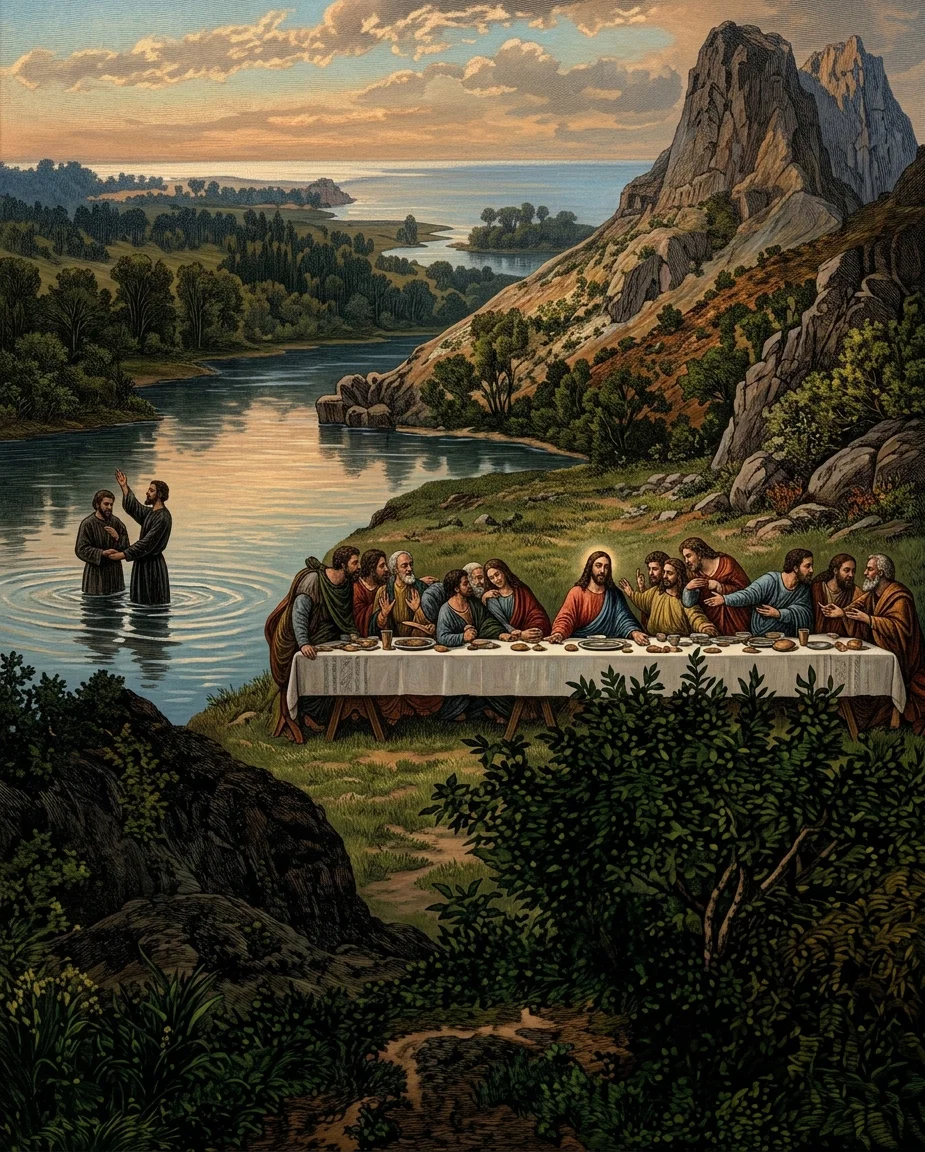
The Burial and Resurrection of Christ is symbolized by baptism. Says the same apostle:—
“Know ye not that so many of us as were baptized into Jesus Christ were baptized into his death? Therefore we are buried with him by baptism into death; that like as Christ was raised up from the dead by the glory of the Father, even so we also should2 (274)walk in newness of life. For if we have been planted together in the likeness of his death, we shall be also in the likeness of his resurrection; knowing this, that our old man is crucified with him, that the body of sin might be destroyed, that henceforth we should not serve sin.” Rom. 6:3–6.
But the careful reader will observe that it is not in the naked ceremony of baptism that the memorial is revealed. There is the likeness—the going down into the water, the whelming, immersion, burial, and the rising again. All this is of value only as it represents faith in the facts of the Gospel and the power of God. If the faith is genuine, it should mean a funeral and a wedding to all beholders. It says that the old man, the old life of sin, is dead, and we bury him forever; and that the new man is married to Christ, the One also raised from the dead, and whose life is in the believer. (See Rom. 7:4.) The ceremony of baptism itself is, therefore, but a symbol of the new life that is to be. It declares that the believer has forever renounced the world and sin, “that henceforth we should not serve sin.” Such a life should bring forth the fruits of righteousness unto the glory and praise of God.
The Value of Such Witness.—The value of Christianity is in its power, its life. If it be only the mere forms, the ceremonies, the ritual, the days, it is no better than paganism. Its reality is in the power of the individual life over sin and in righteousness, of which the simple Christian ceremonies are but symbols. What a witness it is to the power of God to see a sinner, one who loved sin, who bore its varied corrupting loathsome fruit, a curse to himself and a disgrace to his family and neighborhood, transformed by the power of God to a righteous man, whose life bears the fruit of righteousness, peace, and joy in the Holy Ghost! But this is no fancy picture. There are many such transformations yet, praise God. There would be many more if his professed people only knew him and knew his power. If they knew him, they would not need the recurrence of a spring pagan festival to bring the power of his resurrection to mind. They would not supplant his Sabbath by another pagan festival day in memory of a new event, a day never appointed of God. The power of Christ’s resurrection, the witness of that resurrection, is manifest in the righteous life of the believer, not for one day in the week, but every hour of every day. “Christ is risen!” Christian brother or sister, does your life show it? Are you “risen with Christ”? This is the vital question. What is his resurrection to you? Sinner, Christ desires to live his life in you. From beyond the tomb he sends the glad message to all, “I am he that liveth, and was dead; and, behold, I am alive forevermore, Amen; and have the keys of hell and of death.” He has power to save you. He will live the same life in you that he lived while on earth—a life triumphant over sin. Will you let him do this? If you have his power in your life, the resurrection to life and immortality awaits you.
“If ye then be risen with Christ, seek those things which are above.” Col. 3:1.
“PRESENT WITH THE LORD.”
To those who love the Lord with all the heart there can be no more desirable condition than to be in his presence; for in his “presence is fullness of joy.” This the apostle preferred to being present in the body here. See 2 Cor. 5:1–8. What is meant by the expression “present with the Lord”? and where will it be realized?
1. Present with the Lord means more than having the presence of his Spirit here; for this the apostle had in his daily life. But being present with the Lord is being personally present in Christ’s personal presence. Not only does the child of God desire this, but the Lord desires it. He prayed, “Father, I will that they also, whom thou hast given me, be with me where I am; that they may behold my glory, which thou hast given me.” John 17:24. He promised: “In my Father’s house are many mansions; if it were not so, I would have told you. I go to prepare a place for you. And if I go to prepare a place for you, I will come again, and receive you unto myself; that where I am, there ye may be also.” John 14:2, 3. To be present with the Lord is therefore to be with Christ in glory, a most blessed and desirable condition truly.
2. When will the people of the Lord be with him? This is answered in the text last quoted—when Christ comes again. But we are asked by honest inquirers: “Does not this mean at death? Was it not at death when the apostle expected to be with the Lord? Did he not prefer that to life?” The word of God reveals but one time when saints enter into bliss, when the Lord’s people shall be with him, and that is at his second coming. But his second coming is not death but life to his people. Death is an enemy which Christ came to destroy, and which will be destroyed from among his people at Christ’s coming. The following scriptures show conclusively that the people of the Lord will be with him at his coming the second time in glory, and this only by a resurrection from the dead. They base all upon the resurrection of the dead, and upon Christ’s second coming.
“For if the dead rise not, then is not Christ raised; and if Christ be not raised, your faith is vain; ye are yet in your sins. Then they also which are fallen asleep in Christ are perished.” 1 Cor. 15:16–18.
“Behold, I show you a mystery: We shall not all sleep, but we shall all be changed. In a moment, in the twinkling of an eye, at the last trump; for the trumpet shall sound, and the dead shall be raised incorruptible, and we shall be changed. For this corruptible must put on incorruption, and this mortal must put on immortality. So when this corruptible shall have put on incorruption, and this mortal shall have put on immortality, then shall be brought to pass the saying that is written, Death is swallowed up in victory.” Verses 51–54.
“For the Lord himself shall descend from heaven with a shout, with the voice of the Archangel, and with the trump of God; and the dead in Christ shall rise first; then we which are alive and remain shall be caught up together with them in the clouds, to meet the Lord in the air; and so shall we ever be with the Lord. Wherefore comfort one another with these words.” 1 Thess. 4:16–18.
“For the Son of man shall come in the glory of his Father with his angels; and then he shall reward every man according to his works.” Matt. 16:27.
These scriptures prove conclusively that the hope of the Christian centers in Christ’s coming in glory and the resurrection from the dead. This the apostle calls “the blessed hope” (Titus 2:13), and it was to that day he looked for the “crown of righteousness,” not only for himself, but for all those who “love his appearing” (2 Tim. 4:8).
3. The time between death and the resurrection is a sleep, a time of unconsciousness, of negation of being, so far as man is concerned. The dead live only in God’s purpose; they live in fact only by a resurrection. The following texts will clearly prove this:—
“Men and brethren, let me freely speak unto you of the patriarch David, that he is both dead and buried, and his sepulcher is with us unto this day.” Acts 2:26.
“For David, after he had served his own generation by the will of God, fell on sleep, and was laid unto his fathers, and saw corruption.” Chapter 13:36.
“For David is not ascended into the heavens.” Chapter 2:34.
“The dead praise not the Lord, neither any that go down into silence.” Ps. 115:17.
“For in death there is no remembrance of thee; in the grave who shall give thee thanks?” Ps. 6:5.
“Put not your trust in princes, nor in the son of man, in whom there is no help. His breath goeth forth, he returneth to his earth; in that very day his thoughts perish.” Ps. 146:3, 4.
“For the living know that they shall die; but the dead know not anything, neither have they any more a reward; for the memory of them is forgotten. Also their love, and their hatred, and their envy, is now perished.” Eccl. 9:5, 6.
These, and other texts which might be adduced, show conclusively that the condition of death is a state of silence and unconsciousness, in which the man is without thought or action, the thought perished.
With these conditions before us, it is easy to understand what the apostle says in 2 Cor. 5:1–8. Let the reader note especially that the apostle speaks not of two entities, not of soul and body, but of the Christian in the three conditions, namely, this present life, the condition between death and the resurrection, and the glorified state which the saints will reach by a resurrection or translation. With this understanding let us read the text:—
“For we know that, if our earthly house of this tabernacle were dissolved [if we lose this life], we have a building of God, a house not made with hands, eternal in the heavens. For in this [present life] we groan, earnestly desiring to be clothed upon with our house which is from heaven [made immortal at Christ’s coming, see Rom. 8:23]; if so be that being clothed we shall not be found naked [or in the condition of the dead]. For we that are in this tabernacle do groan, being burdened; not for that we would be unclothed [not that we would die], but clothed upon, that mortality might be swallowed up of life [at Christ’s coming, see above, 1 Cor. 15:51–54].
“Now he that hath wrought us for the selfsame thing is God, who also hath given unto us the earnest of the Spirit [God created us that we might live with him, immortal]. Therefore we are always confident, knowing that, whilst we are at home in the body, we are absent from the Lord (for we walk by faith, not by sight); we are confident, I say, and willing rather to be absent from the body, and to be present with the Lord [‘at home with the Lord,’ E. V., when Jesus comes].”
What Paul longed for was not death, but life. He did not wish to be found naked, or unclothed, having no conscious existence; he wished rather translation to heaven, and a home eternally with Christ. This is the hope which the Lord holds out before us. Titus 2:13. Death is an enemy, “the last enemy that shall be destroyed.” 1 Cor. 15:26. He3who is rewarded by death, is he who receives the “wages of sin.” Rom. 6:23. God gives his children eternal life and immortality at his coming.