THE typical service began at the gate of the Garden of Eden, where our first parents brought their offerings and presented them before the Lord. Abel showed his faith in the promised Saviour by bringing an animal. He not only presented the shed blood of the sacrifice, but he also presented the fat to the Lord, showing faith in the Saviour, and a willingness to put away his sins. Gen. 4:4; Heb. 11:4. The service was simple before the people of God went into Egypt. The old patriarchs lived near the Lord, and did not need many forms or ceremonies to teach them the one grand truth that sin could only be atoned for by the death of a sinless, innocent one. They needed only a rough altar and an innocent lamb to connect their faith with the infinite sin Bearer.
As the patriarchs journeyed from place to place, they set up their altars and offered their sacrifices, and God drew near to them, often showing His acceptance of their offering by sending fire from heaven to consume their sacrifices.
Abraham's Test
Of all the sacrifices recorded in the book of Genesis, none comes so near the great antitypical Offering as when God called Abraham to offer his only son. The test of faith was not simply the fact that Isaac was his only legitimate son; but Abraham understood that through Isaac's posterity the long-promised Messiah was to come, and in offering Isaac, Abraham was cutting off his only hope of salvation as well as that of the world. But his faith wavered not. He believed that the same God who had performed a miracle in giving him a son, could bring him from the dead to fulfil His promise. Gen. 22:1-19; Heb. 11:17-19. The Lord chose the spot for the offering of Isaac. He said to Abraham, "Get thee into the land of Moriah; and offer him there for a burnt offering upon one of the mountains which I will tell thee of." Gen. 22:2.
Upon this very spot where God tested Abraham, was the thrashing-floor of Ornan the Jebusite, where the angel of the Lord appeared to David. The prophet of the Lord told David to erect an altar upon the thrashing-floor, and there David made a special consecration to the Lord; and a few years later, the temple of the Lord was erected, without sound of hammer, on this same plot of land. God had conquered, and He designed that the place should ever be hallowed by His presence. Jer. 17:24-27. But His people were unfaithful; and when the Lord of Light came to His own temple, He was despised and crucified, and the holy city and the sacred site of the beautiful temple passed into the hands of the Gentiles. Upon this spot, Mount Zion (Moriah), made sacred by the consecration of God's chosen people, God's glorious, everlasting city will be placed, nevermore to fall into the hands of the enemy. God says, "I will set My sanctuary in the midst of them forevermore." Eze. 37:26-28; Rev. 7:15.
Having briefly outlined the subject from Eden lost to Eden restored, we will go back to the time Israel came out of Egypt.
“And let them make Me a sanctuary; that I may dwell among them.”
"That I May Dwell Among Them"
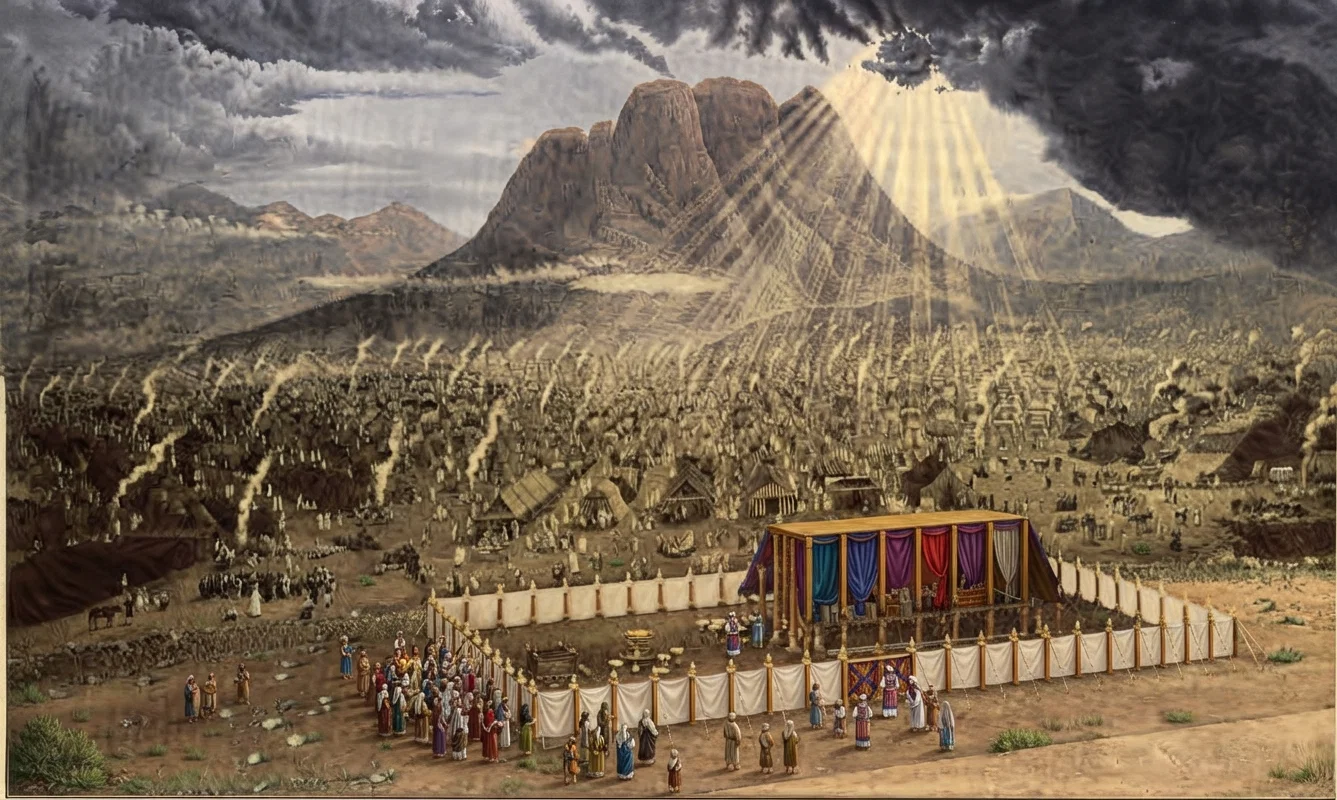
Subjected to a life of incessant toil, and surrounded by heathen darkness, the children of Israel lost sight of the significance of the simple sacrifices. On account of their servitude, they were deprived of the privileges enjoyed by the ancient patriarchs, of spending much time communing with God; and they drifted very near to Egyptian idolatry. When God brought them out of Egypt, He proclaimed His law from Sinai, and then gave them the same system of worship the patriarchs had followed. But God dealt with them as children; and just as we would illustrate to children by kindergarten methods, because they could not grasp, without the simple illustrations, a lesson which adults could easily comprehend, so God gave in kindergarten form to the children of Israel, the same system of worship that Abraham, Isaac, and Jacob had followed. They had drifted so far away that they could not comprehend how God could live with them, being invisible; so God said, "Let them make Me a sanctuary; that I may dwell among them." Ex. 25:8.
The pillar of cloud above the tabernacle, and God's visible presence manifested within, helped the Israelites to comprehend more easily the real abiding presence of the Lord with them. This sanctuary was a shadow of the heavenly sanctuary, and the service was so planned by the Lord that the work was a type or symbol of the work the Son of God would do on earth and in heaven for the redemption of the lost race. It was the most wonderful object-lesson ever given to mankind.
The sanctuary was completed while Israel encamped at Sinai, and during their forty years' wanderings in the wilderness the Israelites carried it with them. When they reached the promised land, it was set up in Gilgal for a few years (Joshua 5:10, 11),7and then removed to Shiloh (Joshua 18:1; 19:51), where it remained for many years. When David was fleeing from Saul, the tabernacle was in Nob (1 Sam. 21:1-6), for there the priests set the showbread before the Lord each Sabbath day. It was next set up in the high place at Gibeon. 1 Chron. 16:39; 21:29. The tabernacle remained in Gibeon until removed by Solomon to Jerusalem. Josephus tells us that Solomon had "the tabernacle which Moses had pitched, and all the vessels that were for ministration to the sacrifices of God, removed to the temple." (Book 7, chapter 4.)
The Temple of Solomon
David desired to build a house for the Lord; but on account of the many wars he had engaged in, the Lord directed that his son should build the house. When Solomon was established on his throne, he built a magnificent structure, and dedicated it to the Lord. God showed His acceptance by His glory filling the temple. Solomon did not plan the temple himself; God revealed the plan of the temple to David, as He had revealed the plan of the tabernacle to Moses. David was not to see it built; but when he delivered the plan for the building to Solomon, he said, "The Lord made me understand in writing by His hand upon me, even all the works of this pattern." 1 Chron. 28:11-19.
Vicissitudes of the Temple
The history of Solomon's temple is really a history of the religious experiences of the children of Israel. When they departed from the Lord, the temple was neglected and sometimes even suffered violence. It was pillaged by Shishak, king of Egypt. 1 Kings 14:25, 26; 2 Chron. 12:9. At the instigation of Jehoiada, it was repaired by Jehoash (2 Kings 12:4-14; 2 Chron. 24:4-13), who himself afterward robbed it of its treasures to propitiate the Syrians (2 Kings 12:17, 18). Ahaz, a little later, not only robbed it of its treasures, but also defiled its holy precincts. 2 Kings 16:14-18; 2 Chron. 28:20, 21. Under the reign of the good king Hezekiah, the temple was purified and its worship restored (2 Chron. 29:3-35); but even Hezekiah robbed it of its treasures to procure a treaty with the Assyrians (2 Kings 18:13-16). Again it was polluted by the idolatrous worship of Manasseh. 2 Kings 21:4-7; 2 Chron. 33:4, 5, 7. The "good king Josiah," when but a youth of eighteen, repaired and purified the temple, and again restored its worship. 2 Kings 22:3-7; 23:4-7, 11, 12; 2 Chron. 34:8-13. Finally, on account of the unfaithfulness of the chosen people of God, the holy temple was burned to the ground, and its treasures were carried to Babylon. 2 Kings 25:9, 13-17; 2 Chron. 36:18, 19.
It was seventy years before the rebuilding of the temple by Zerubbabel was completed and the temple dedicated with great rejoicing. Ezra 6:16-22. Herod spent forty-six years in repairing Zerubbabel's temple, until in the days of Christ it was a magnificent structure. John 2:20; Mark 13:1.
The Earthly Temple Forever Destroyed
God's presence abode with His people in the dwelling-places they prepared for Him, from the tabernacle erected in the wilderness, all the way down through the varied history of their spiritual wandering until that memorable day when the types celebrated for four thousand years met their Antitype on the cross of Calvary. Then with a great noise the glorious veil of Herod's magnificent building was rent from the top to the bottom as the Lord forever left the temple. Previous to this, the services were directed of God; henceforth they were but a hollow mockery. God had departed from the temple. The temple remained standing until 70 A.D., when it was destroyed by the Romans. To-day the sacred spot is covered by a Mohammedan mosque.
The Temple on Earth a Type
The epistle to the Hebrews shows that the leading apostle clearly taught the antitypical fulfilment of the types and shadows celebrated for so many years. It should not be forgotten that the gift of the spirit of prophecy and the Sabbath of the Lord were always connected with the sanctuary service. We have no reason to doubt that during the early history of the Christian church, the subject of the sanctuary and the antitypical work of Christ in heaven was clearly understood by Christians; but when we come to the time when the Bible was taken from them, the Sabbath of the Lord was hidden, and the voice of the spirit of prophecy was no longer heard directing the church, they lost sight of the beautiful antitypical work taught by the ancient sanctuary service.
But the time arrived for the opening of the great judgment in heaven; and the Father and the Son, with Their retinue of holy angels, passed in state into the most holy place of the heavenly sanctuary. No earthly pageant could in any way compare with that wonderful event. God designed that it should be recognized on earth; and He caused the first angel's message to be proclaimed to the inhabitants of earth, directing their attention to the movements of the Son of God. The attention of a large company was centered on the Saviour; but they did not understand the antitypical work, and expected the Saviour to come to the earth. Instead of coming to the earth, He went into the judgment. This company which had been gathered out by the message of the first angel, loved their Lord; and in their longing desire to find why He had not come to the earth, they drew so near that He, in answer to their earnest prayers, directed their attention to the heavenly sanctuary. There they saw the ark of God's testament, containing His holy law, and they acknowledged its claims upon them, and began to keep holy the Sabbath of the Lord. The sanctuary service, the Sabbath, and the spirit of prophecy were ever united in olden times; and when light from the antitypical sanctuary service came to the people of God, He gave them the spirit of prophecy in their midst, to open up to their minds the beautiful truths in regard to Christ's ministry in the heavens, that otherwise they would not have comprehended.
Summary
THE TABERNACLE
Built by Moses in the wilderness.
Stored in Solomon's temple.
THE TEMPLE
Built by Solomon.
Destroyed by the Babylonians.
Rebuilt by Zerubbabel.
Repaired by Herod.
Forsaken by the Lord.
Destroyed by the Romans.