"Let the Revelation speak and tell what is truth. . . . Uplift Jesus as the center of all hope."
(FOR ARTICLE, SEE PAGE 6)
IX. Philadelphia
PHILADELPHIA — "brotherly love," a blessed condition; for brotherly kindness is one of the climactic Christian virtues. 2 Peter 1:5-7. Surely, the Philadelphia condition is a desirable one.
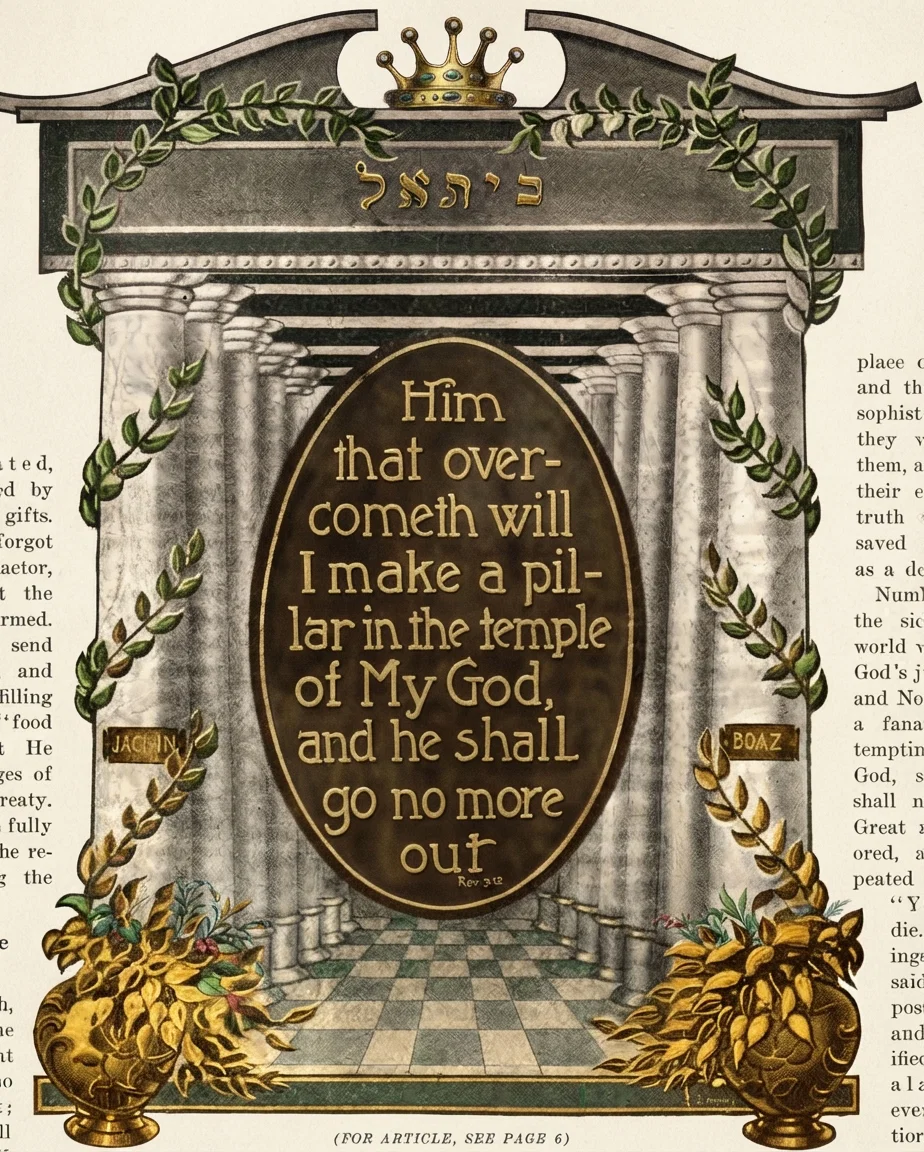
The name of the literal city did not, however, mean that to its people; it was built by King Attalus Philadelphus, from whom it was named. It fell into the hands of the Romans in B.C. 133. The city lay about 100 miles due east from Smyrna, about 80 miles a little north of east of Ephesus. Down to the Byzantine age it was a city of strength and importance, and of all the towns of Asia Minor it withstood the Turks the longest. It was taken by Bajazet I in A.D. 1392. It still exists, as Allah Shehr, "city of God," or High-town. It fronts one of the most extensive and beautiful plains in all Asia Minor. Its present population is estimated at 10,000, consisting mostly of Turks. There are five Christian churches in the town, and a score of others too old or too small to use. One of the Turkish mosques is believed to be the church used by the primitive Christians. Ruins are scarce, but in one place there are four strong marble pillars which once supported the dome of a church now fallen. "One solitary pillar of high antiquity has been often noticed, as reminding beholders of the remarkable words in the Apocalyptic message to the Philadelphian church: 'Him that overcometh will I make a pillar in the temple of My God, and he shall go no more out.'"—Arundel.
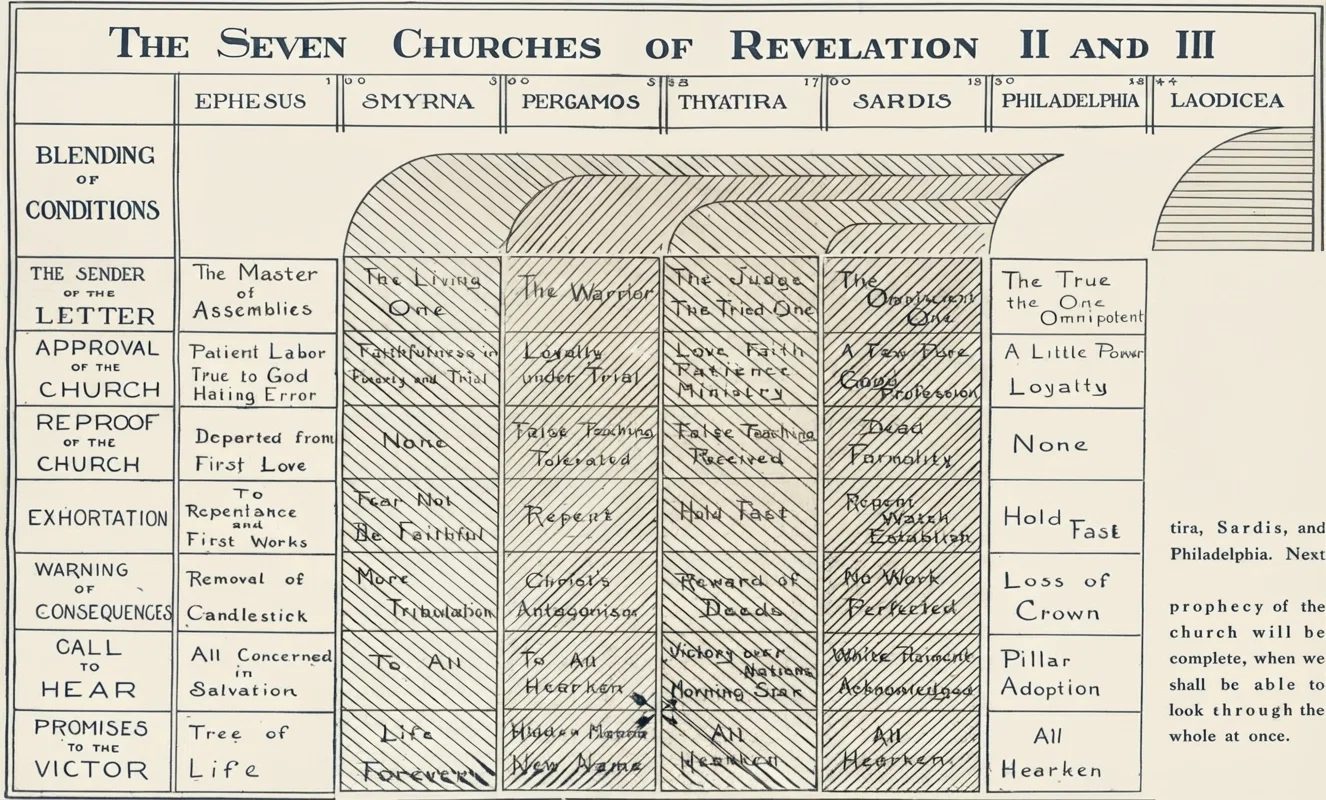
Philadelphia as a type brings us down to a remarkable and great world-wide movement, dating from about 1830, reaching a climax in 1844, and extending to the end.
The Answer of the Text
[The answers to the questions are from the American Revised Version. Omitting questions, and disregarding sometimes the capital at the beginning and the period at the close of an answer, the text may be read continuously. In notes and comments both versions are used without designation.]
1. In what way does our Lord address Himself to the church in Philadelphia?
And to the angel of the church in Philadelphia write: These things saith He that is holy, He that is true, He that hath the key of David, He that openeth and none shall shut, and that shutteth and none openeth.
2. Of what did He assure them?
I know thy works (behold, I have set before thee A DOOR OPENED, which none can shut), that thou hast a little power, and didst keep My word, and didst not deny My name.
3. What did He say of their enemies?
Behold, I give of the synagog of Satan, of them that say they are Jews, and they are not, but do lie; behold, I will make them to come and worship before thy feet, and to know that I have loved thee.
4. What conduct did the Master approve, and what promise did He give?
Because thou didst keep the word of My patience, I also will KEEP thee from the HOUR OF TRIAL, that hour which is to come upon the whole world, to try them that dwell upon the earth.
5. What exhortation does our Lord give?
I come quickly: hold fast that which thou hast, that no one take thy crown.
6. What is the promise to the overcomer?
He that overcometh, I will make him a pillar in the temple of My God, and he shall go out thence no more: and I will write upon him the name of My God, and the name of the city of My God, the New Jerusalem, which cometh down out of heaven from My God, and Mine own new name.
7. How does our Lord show His regard for all men?
He that hath an ear, let him hear what the Spirit saith to the churches.
Note and Comment
1. He that is holy, . . . true.—Not simply that He, our Lord, has a true and holy character, but He is the essentially holy, essentially true One. "There is no unrighteousness in Him." He is the Truth, and the One through whom all truth is given. Surely, then, He can not play His children false. Key of David.—The royal keys of the kingdom, of which God built David a sure house in his Seed Jesus Christ. 2 Sam. 7:16, 25-29. "And the Lord God shall give unto Him [Christ Jesus] the throne of His father David." Luke 1:32, 33. He that openeth, . . . and that shutteth.—The keys of the kingdom are His. He has abdicated to none other. His throne is not vacant. He has no especially appointed vicar or council or body to legislate concerning entrance into that kingdom. His word alone opens, His word alone closes. He appoints men to speak that word with its all-potency; they can go no farther. They are bidden to speak to a rebellious world the conditions on which the Master of the keys opens or closes the door to applicants, but the decision rests with Him. Jer. 1:10. His word is, "Come unto Me;" and He adds to that, "Him that cometh unto Me, I will in no wise cast out." Apostle and preacher may declare the conditions and point the soul to Jesus; but when that soul goes, they may not hinder or obstruct the way to his exercise of faith. Christ has appointed no cordon of ecclesiastical guards, no bodies of men, no earthly vicars, to stay the soul or close the door. Christ has swung it wide open to every hungry, burdened, weary, sin-sick soul; and He shuts it against all the self-sufficient, self-appointed agents of self-salvation. He opens; none can shut; He closes; none can open. He is both Door and Shepherd. Let us go boldly; for He died that we might enter.
2. A door opened.—Not the great general open door of salvation for all, but an opened door which had been closed, which marks a stage in the great progressive Gospel work toward its climax, His coming. What is that opened door? In brief, let us reply what has many times been set forth in detail in this journal:
(a) The typical offerings and priests of the Levitical dispensation in each year's round of service prefigured the offering and the service of our Lord as priest, to take away sin "once for all." He is the Lamb of God who beareth away the sins of the world (John 1:29); the Lamb slain from the foundation of the world (1 Peter 1:18, 19; Rev. 13:8), in type in that ancient time, in reality on Calvary.
(b) The ancient typical priests served in an7earthly sanctuary of which the heavenly was the pattern. Ex. 25:40; Heb. 8:5; 9:11-14.
(c) That service in the earthly sanctuary was performed in the Holy Place every day in the year save one, when the high priest entered into the Most Holy Place, before the ark of God, containing the holy law, over which was the mercy-seat, to complete their service by making atonement, by cleansing the sanctuary of all remembrance of sin, and to acquit every soul who had availed himself of God's mercy to the end. This yearly round of service was a complete service, closing with a judgment work. See Leviticus 16; Heb. 9:1-7.
(d) As prefigured in the type, in the fulness of time, our Lord enters upon His closing work in the sanctuary on high. He first ministered in the Holy Place; in the close of His ministry He enters into the Most Holy to cleanse the sanctuary from all remembrance of sin, to acquit His faithful people, to finish the mystery of God, so that when He comes, His own will be raised from the dead and changed to immortality. Heb. 9:8-12; 23-26.
(e) This time of the cleansing of the heavenly sanctuary from the remembrance of sin is revealed in Dan. 8:14, explained in Dan. 9:24-27. The twenty-three hundred typical days, or years, began in B.C. 457, in the restoration under Ezra and Zerubbabel, and ended at the beginning of God's last reformation in A.D. 1844, when the closing work of Christ's antitypical priesthood began before the ark of the covenant, or testament, and the "mystery of God should be finished, as He hath declared to His servants the prophets;" then goes to the world the Gospel message, "The hour of His judgment is come." Rev. 10:6, 7; 14:6, 7.
(f) When about the year 1829 was reached, men began to study the prophetic Word. Scores of books were written on unfolding prophecy in the next thirty years. Hundreds of men in the Old World and the New preached that Christ's coming was at hand. Many, among them William Miller and his associates, looked for that event in 1844, and many others at about that time. It was a mighty, melting message. It united men of all beliefs and races. Thousands of infidels were converted. Property was laid on God's altar; brotherly love prevailed.
But disappointment came, many turned back; some waited. They would not disown the Word. They had made no mistake regarding the time; they did not understand the event. They did not see the work of reformation yet to be wrought on earth, nor the finishing of Christ's work on high before God's holy, immutable law disclosed in the Most Holy Place. Rev. 11:19. To the faithful ones Christ says, "Behold, I have set before thee a door opened." There is still work to do, as will be explained on Revelation 10. As the priest in the earthly sanctuary opened the door on the last day of his ministry into the presence of God's law in the Most Holy Place, so Jesus Christ then entered into the last work of ministry and reform, in which God's law is the center, of which it is the standard. Before the church at this time God set an open door, a new work, a larger ministry. Men may sneer or reject; God has set the door open, and none can shut it. His work must be done. What that work is we will better learn as we pursue our studies.
3. Jews and are not.—We have before learned that the true Jew is a true follower of Christ. See Rom. 2:28, 29. Those who have persecuted the faithful of God are professed Christians who have demonstrated that they are not true. Sometime those scoffed at because of their faith in a coming Christ will be honored and their detractors humbled. See the same thought in Micah 7:15-17.
4. The word of My patience.—So God's children—many of them—did keep His word of patience, of endurance, amid scoffing, scorn, contumely, vilification, detraction, abuse, and calumny. They trusted God. The doctrine of the second coming of Christ is less believed now than then; and he who steadfastly adheres to "the blessed hope" must rely on the Word of God. And he who thus proves faithful will be kept by the power of God in that last awful hour of trial such as God's church has never seen, when all the powers of hell will be united to crush her. Five times that hour is mentioned in the Revelation. We shall study it more fully when we reach the 17th and 18th chapters. But the thing which will keep the child of God then will be God's Word of truth. Ps. 91:4, 9, 10.
5. I come quickly.—The Philadelphia condition reaches to the second coming of Christ. That no man take thy crown.—Eternal characters are written in the Book of Life. To each one belongs the crown fitted to the character, the new name indicative of the character, the inheritance appointed of God. Each soul is called to some one character, name, crown, inheritance. God will give the sufficiency for the victory if we hold fast. If we will not, to some one else will be given the opportunity, and, if faithful, the crown we might have won.
6. A pillar in the temple.—A tower of strength in God's work. In the ancient temple were two pillars: Jachin—"He shall establish;" Boaz—"in it there is strength." 1 Kings 7:21. So God establishes in strength those who overcome. Men may have cast them out of worldly organizations, but none shall cast them out of God's great spiritual temple. Name of thy God, the Father's name, which stands for eternal righteousness. Ex. 34:6, 7. Name . . . New Jerusalem.—"Jerusalem that is above . . . is our mother." Gal. 4:26. The city whose "Builder and Maker is God" (Heb. 11:10); the "continuing city" (Heb. 13:14); not Babylon or Nineveh or Tyre or Hiliopolis, or Athens or Rome or London or New York, is our mother, even tho we were born in one of them. If Christians, we are heaven-born, and shall bear the name of the mother that waits for her children. Mine own new name.—Christ the conqueror's name. The One who conquered sin for us, and conquers sin in us, is our everlasting Father (Isa. 9:6), and we shall bear His name, as one of His earth family; and the Father's name as a member of the heavenly family. Eph. 3:14, 15. Blessed relationship and heritage; who could ask more?