THE SANCTUARY

2%

Publishing Committee · Battle Creek, Mich. · May 29, 1860

FromReview and Herald, Vol. 16, Nos. 1 & 2.

Read the full edition

THE SANCTUARY.

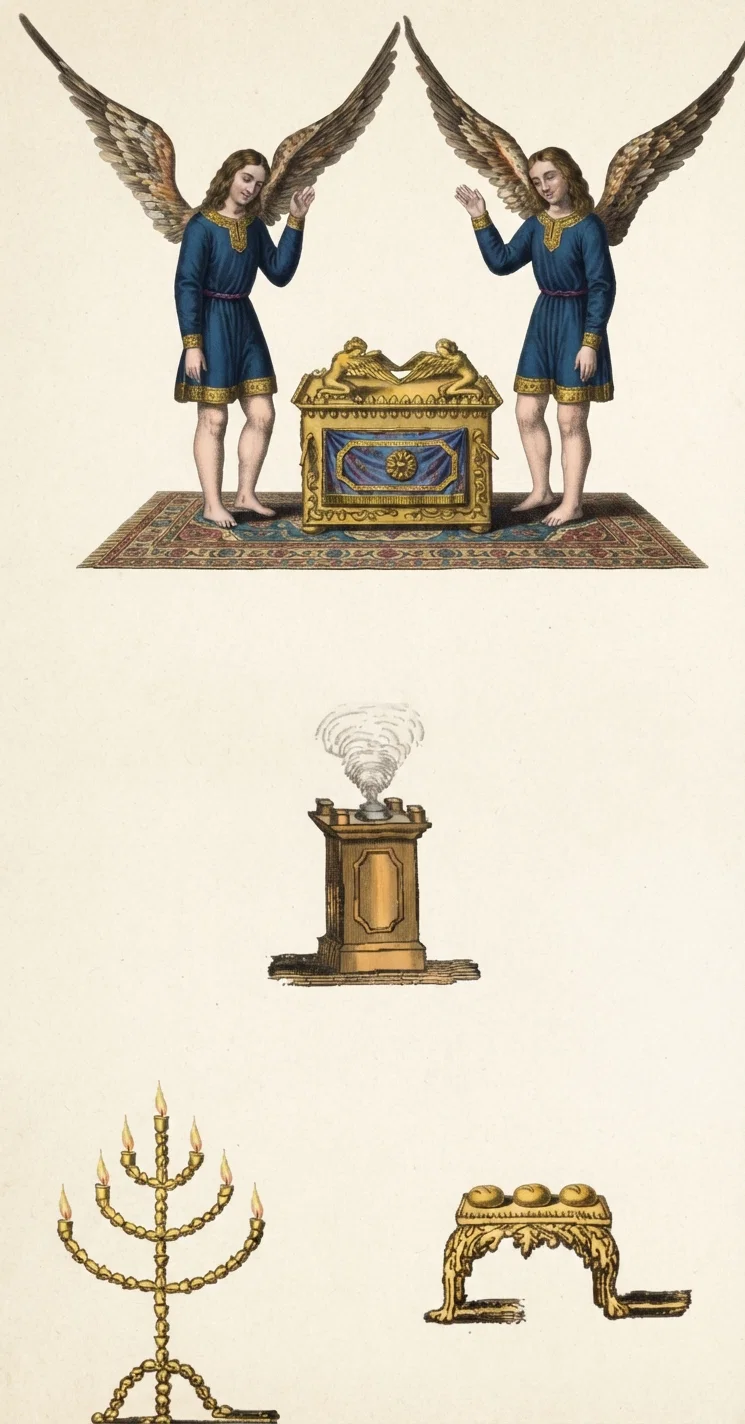
SECOND VAIL. HOLY PLACE.
1. SANCTUARY is defined to be a holy or sacred place. It is a dwelling-place for the Most High. Ex. xxv, 8.
2. It cannot therefore be the earth; for the earth will not bear one of the above definitions; and of the 146 times of the occurrence of the word sanctuary in the Bible, it is not once applied to the earth.
3. It is not the land of Canaan. Substitute "the land of Canaan" for "the earth," and read the above. See also Josh. xxiv, 26. For an explanation of Ex. xv, 17, see Ps. lxxviii, 53, 54, 69.
4. It is not the church; if it is, who are the "host," or worshipers that are invariably connected with it. Dan. viii, 13. Compare Dan. ix, 26, with Matt. xvi, 18.
5. It was built by the children of Israel. Ex. xxv, 8, 9; xxxv-xl; 2 Chron. xx, 8.
6. It had two apartments—the holy place and the most holy place. Ex. xxvi, 33, 34; Lev. xvi, 2. In the first apartment were the candlestick, the table of shew-bread, and the altar of incense. In the second, were the ark which contained the tables of the covenant, and the cherubim. Heb. ix, 1-5. That the covenant here referred to is the ten commandments, see Ex. xxxi, 18; xxxii, 15, 16; xxxiv, 28; Deut. iv, 13; ix, 9-11; x, 4.
8. The transgressor confessed his sin over the head of his victim, thus transferring his guilt to it. The victim was slain and the blood bearing that guilt was sprinkled by the priest within the sanctuary. From these sins, thus transferred to it, the sanctuary had to be freed once a year; and this service was called its cleansing. Lev. i, 4, 5; iv, 6; xvi, 16, 33; Heb. ix, 7; Eze. xlv, 18.
10. This sanctuary was not an original building, but was made after the pattern of a greater and more perfect tabernacle, which must therefore be the great antitype of this earthly building, and must take its place when the latter has served its purpose. Ex. xxv, 9, 40; xxvi, 30; Acts vii, 44; Heb. viii, 5. When the tabernacle of Moses gave place to the temple of Solomon, it was still according to the pattern. 1 Chron. xxviii, 10-13, 19.
11. This was the sanctuary of the first covenant [Heb. ix, 1], and was destroyed by Titus in A. D. 70. Dan. ix, 26. For a historical record of this event, see Josephus' Wars, Book vi, chap. iv, sec. 5.
12. This was a type or figure of the sanctuary of the New Covenant, WHICH IS IN HEAVEN. Heb. viii, 1-5; ix, 23, 24; Ps. cii, 19.
The heavenly sanctuary resembles the earthly in that,
1. It has two holy places. Heb. ix, 24. See also verses 8 and 12, and chap. x, 19, in each of which texts the words rendered "holiest," and "holy place," are plural in the original, and should be so rendered, holy places, as they are in many translations. Compare also Ex. xxvi, 31-35, and xxx, 1, 6, with Rev. iv, 1, 2, 5; viii, 3-5; xi, 19.
2. It contains the law (covenant or testament). Rev. xi, 19. Here is brought to view the ark, in the temple or sanctuary in heaven; and the ark was used as the depository of the tables of the covenant or ten commandments. Ex. xxv, 21, 22; xxvi, 33, 34; xl, 20, 21; 1 Kings viii, 6-9; Heb. ix, 1-4.
3. It has a service of priesthood. Heb. vi, 19, 20; viii, 1-5; ix, 24; x, 19-21.
4. Christ bore our sins in his own body on the tree [1 Pet. ii, 24]; and through his ministration our sins when we confess them to him, are transferred to the sanctuary above, rendering it in this sense only impure. Nothing less can be argued from the type.
5. It is therefore to be cleansed. Dan. viii, 14. This text must refer to the heavenly sanctuary; for the earthly was destroyed only 526 years after the 2300 commenced. This cleansing of the heavenly sanctuary is accomplished with blood. Heb. ix, 11, 12, 23, 24.
6. When the glory of the Lord filled the tabernacle, or temple, in the type, there was no ministration. Ex. xl, 34, 35; 1 Kings viii, 10, 11. So it will be in the antitype. Rev. xv, 8.
7. The most holy place in the type was entered only on the day of atonement. Lev. xvi, 2, 12-15, 29, 30; Heb. ix, 7. So it is in the antitype. Rev. xi, 19. Cleansing the sanctuary, and making the atonement, are identical works.
From the foregoing testimony we see that we were only warranted to expect from the declaration, "Then shall the Sanctuary be cleansed," [Dan. viii, 14], that at the end of the days our great High Priest, in the heavenly sanctuary would enter within the vail into the most holy place, to perform before the ark of ten commands, the last act in his ministration. Having since his ascension, ministered in the first apartment of the heavenly sanctuary as foreshadowed by the ministration of the priests in the earthly tabernacle, we believe that at the end of the days in 1844, he entered the most holy place, and commenced, according to the prophecy, that work which is called the cleansing of the sanctuary.
What more befitting than that a work of such momentous importance, the last ministration of mercy by our great High Priest, the closing up of the work of salvation for the world, should be introduced by the termination of a great prophetic period? What point of more thrilling interest and importance could be made known than the commencement of the great though brief period of examination and decision of the characters of men? When this is finished the great decree of Rev. xxii, 11, will go forth: "He which is filthy let him be filthy still, and he that is holy let him be holy still."

REVELATION XII & XIII.

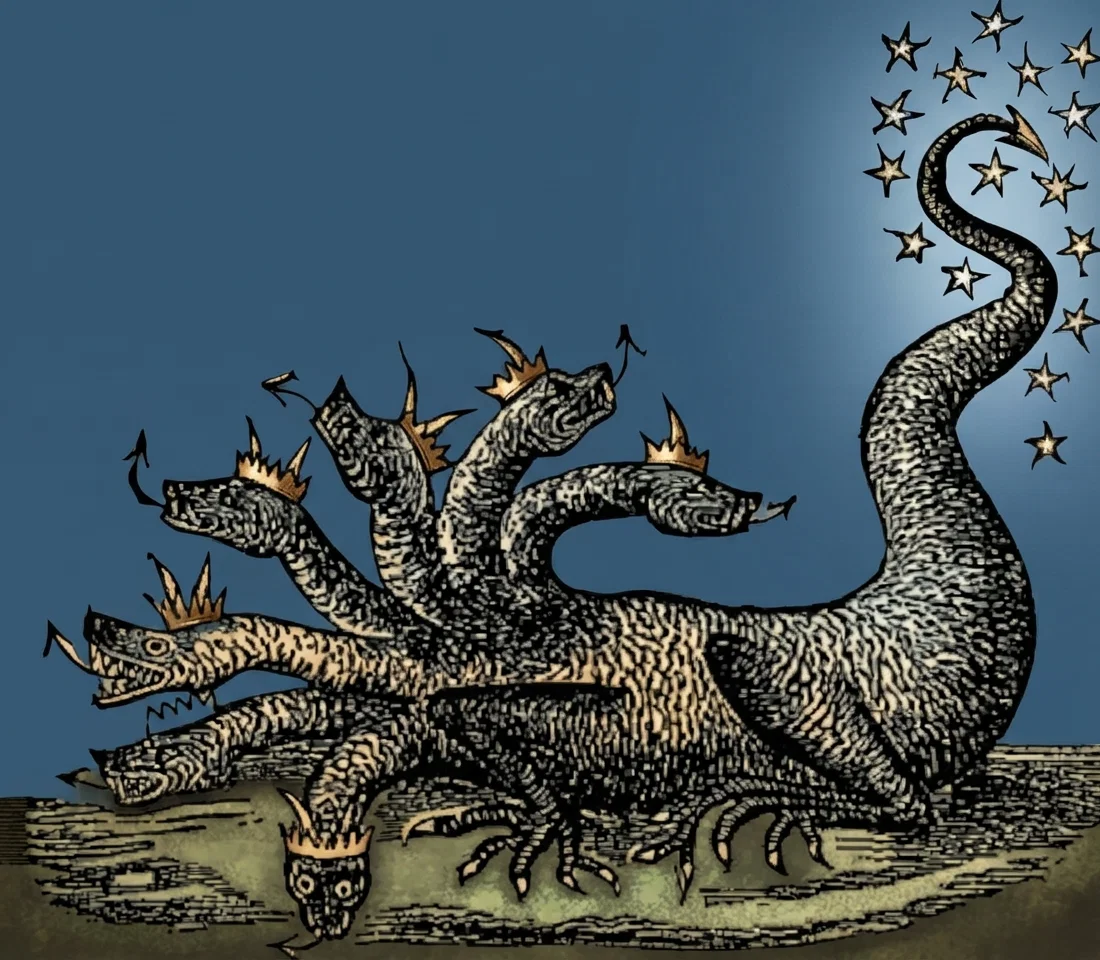
In the book of Revelation we have the fourth kingdom of Daniel's visions brought to view under different symbols. The three preceding kingdoms having passed away when John lived, he commences with ROME IN ITS PAGAN FORM. Chap. xii, 3, 4. "And there appeared another wonder in heaven, and behold a Great Red Dragon, having seven heads and ten horns, and seven crowns upon his heads."
PAGAN ROME,
PAGAN ROME,

PAGAN ROME.

The seven heads of the dragon denote the seven forms of government in the Roman empire. These are commonly enumerated as follows:
1. The Kingly. 2. The Consular. 3. The Decemvirate. 4. The Dictatorial. 5. The Triumvirate. 6. The Imperial. 7. The Papal. See Ency. Americana. John lived under the 6th form. Five had fallen, and one was "not yet," in his day. "And the dragon [Rome Pagan] stood before the woman [the church], to devour her child [Christ] as soon as it was born." See Matt. ii.
NOTE.—The Devil is also called a dragon, in verse 9. His has been the master spirit, actuating more or less all the beasts of Daniel's and John's visions. Preeminently was this the case with Pagan Rome; hence the earthly power, as the outward medium, here takes the symbol of the being who inspired its action.
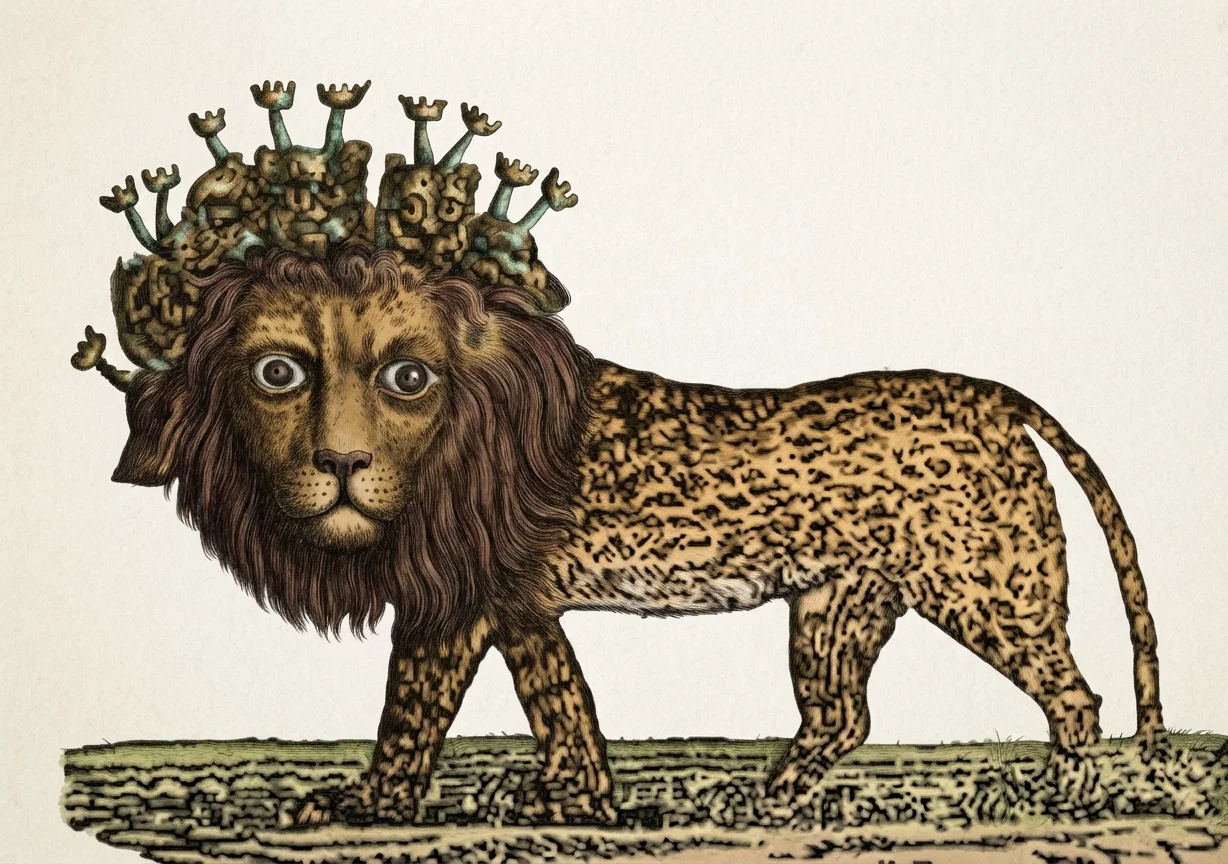
In Rev. xiii, we have another symbol brought to view; namely, a beast with the body of a leopard, feet of a bear, and mouth of a lion, having seven heads and ten horns, and upon his horns ten crowns.
PAPAL ROME.
PAPAL ROME.

PAPAL ROME.

Verse 12. To this beast the Dragon gives his seat, his power and great authority. To whom did Pagan Rome give its seat [the city of Rome], and power and great authority? Ans. To the PAPACY. This beast is further shown to represent the Papacy, from its being identical with the little horn of the fourth beast of Dan. vii.
1. The little horn was a blasphemous power. "He shall speak great words against the Most High." Dan. vii, 25. So also does the beast of Rev. xiii, 6, do the same. "He opened his mouth in blasphemy against God."
2. The little horn made war with the saints and prevailed against them. Dan. vii, 21. This beast also [Rev. xiii, 7] makes war with the saints and overcomes them.
3. The little horn had a mouth speaking great things. Dan. vii, 8, 20. So had the beast of Rev. xiii. Vs. 5.
4. Power was given to the little horn of Dan. vii, 25, for a time, times, and the dividing of time—1260 years. To the beast also, power was given 42 months—1260 years.
5. At the end of that specified period, the dominion of the little horn was to be taken away. Dan. vii, 26. At the end of the same period, the beast of Rev. xiii was himself "to be led into captivity." Verse 10. Buonaparte fulfilled both in his capture of the Pope. Who can fail to see their identity?

PROTESTANT AMERICA.

At this point of time, John beheld another beast coming up, having two horns like a lamb. This beast is for a while cotemporary with the one above; for he exerciseth all the power of the first beast before him [enopion, in his presence]. We understand this to be a symbol of these United States, from the following specifications:
1. Its location. All Europe is occupied by the first beast and his ten horns. We cannot look there for another beast. Whatever power arises there, must be a part of the first beast, or one of his horns. Consequently we must look for the two-horned beast to another continent.
2. The time of its rise. At the time of the captivity of the Pope (1798), there was no other notable power "coming up," except these United States.
3. The manner of its rise. It comes out of the earth; that is, in a quiet, peaceable manner; unlike the other beast which came up out of the sea—arose through wars and commotions.
4. Its character. It has two horns like a lamb. The lamb feature is a fit emblem of the profession and incipient acts of this government. But it speaks like a dragon—a fit emblem of the practice of this hypocritical nation. Look at the Declaration of Independence and the Constitution; and then look at Slavery, look at the religious intolerance, the corruption and oppression existing throughout the land. A further development may be expected in the future.
5. The form of its government. There are no crowns upon its horns, which shows that the government is not monarchical. Verse 14 [Rev. xiii] shows it to be republican: "Saying to them that dwell on the earth, that they should make an image to the beast," &c. This is not the language of a government, the power of which is vested in a supreme and absolute head. It is the voice of a nation, in the government of which the people participate—fixing it again to these United States.
6. It is a government which tolerates Slavery; for it embraces within its jurisdiction "both free and bond." Verse 16. All the great powers of the earth have now abolished Slavery, except the United States.
7. Its acts. "It doeth great wonders," &c. We need but refer here to the astonishing application of steam power to various purposes, the wonderful discoveries concerning electricity, and its application to the magnetic telegraph, &c.; but more especially the wonders and mysteries of modern Spiritualism, all of which have emanated from this country, and arrested the attention of the nations of the earth.
Its two horns fitly denote the two great branches of power that exist in this Republic, commonly designated, Ecclesiastical and Civil, Religious and Political, Protestantism and Republicanism, or Church and State.
It will be seen by comparing Rev. xiii, 14, with chap. xix, 20 that the two-horned beast is the same as the false prophet. His doom is to be cast alive with the beast into a lake burning with fire and brimstone. Rev. xix, 20.