Conducted by MILTON C. WILCOX
Professor of Biblical Exegesis of the Faculty of the College of Medical Evangelists
Loma Linda, California
NOTE.—This department is for the purpose of helping Bible students. Answers must of necessity be brief, often only suggestive, never exhaustive, never infallible only as they agree with the infallible Word. Such questions only will be answered as seem to the editors to minister to the mission of the paper. Questions of the same import can not be answered repeatedly in the same volume. Name and address must be given, not for publication, but as evidence of good faith and to insure reply by letter if thought best. It is well always to enclose stamp, not stamped envelope, unless answer is desired by letter alone.
39—THE WORSHIP OF GOD
Kindly give me through the SIGNS OF THE TIMES your views on Rev. 14:7, latter part, which reads, "And worship Him that made heaven, and earth, and the sea, and the fountains of waters," in connection with Rev. 22:18, 19, the former being in the fourth commandment. Rev. 14:12 reads, "Here is the patience of the saints: here are they that keep the commandments of God, and the faith of Jesus." Have not those who are observing the first day of the week instead of the Bible Sabbath taken away from the words of the prophecy of this book? H. T.
Rev. 14:6-12 is one great unified prophecy. It is the everlasting gospel in three different messages, the first containing the positive part of the message; the second containing the lamentation that men did not accept the message and let it do its work. God would have brought healing to Babylon if Babylon had been willing to be healed (Jer. 51:9); but Babylon was not healed, and consequently the proclamation of the fall of Babylon. Falling away from God, men turned to tradition,—not only turned to tradition, but tried to enforce that tradition upon others; and consequently we have the beast and his image, and the tyrannical laws that grow out of the combination. Against this the third part of the message warns. But as before remarked, the positive part of the message is found in verse 7, "Fear God, and give Him glory"—not give glory to man. "The hour of His Judgment is come" is a last-day message. It does not speak of a Judgment to come, but one that is already ending. The rule of that Judgment is God's holy law. James 2:8-12; Eccl. 12:13, 14.
God demands worship—not merely songs of praise, not merely prayer, but service. Our Lord Himself has told us, in the clearest words, just what worship means. When Satan said, "All these things will I give Thee, if Thou wilt fall down and worship me," Jesus responded, "It is written, Thou shalt worship the Lord thy God, and Him only shalt thou serve." Matt. 4:9, 10. The truest worship is faithful service, and the truest service is doing just what the Master says; and so Jesus asks, "Why call ye Me, Lord, Lord, and do not the things which I say?" Luke 6:46.
We are to worship, too, the Creator—the One who "made heaven, and earth, and the sea, and the fountains of waters"; the One who created the world for man, and placed man upon it; the One who gave the Sabbath as the memorial of that creation. And consequently the development of that message in its fulness brings before us the Sabbath and the restoration of the Sabbath and the last message. The class developed by the everlasting gospel, develops as that gospel goes out to all nations, and it is composed of those who "keep the commandments of God, and the faith of Jesus."
Now regarding the last question, "Have not those who are observing the first day of the week instead of the Bible Sabbath taken away from the words of the prophecy of this book?" we would say, That depends wholly upon the motive of those who are observing the first day of the week. What God demands more than anything else is a true heart, and the true heart is in His sight more than great knowledge and mighty pretensions. There doubtless are thousands who are observing the first day of the week who are endeavoring to do God service and are living according to all the light that shines upon them. There are others who are observing it simply and solely through custom without thinking very much about it.
There are, of course, among the professed followers of Christ in ages past and at the present time, those who are determined to carry through traditions of men, and substitute them for God's commandments, even to the usurpation of authority and the enactment of laws compelling the tradition. Such as these might be said to "take away from the words of the book of this prophecy." They are demanding what God does not demand. They are teaching determinedly and purposely what God does not teach. But as to who they are must be left with God to judge. We are not to do that. We are to leave all judgment with God. Jesus said, "If any man hear My words, and believe not, I judge him not: for I came not to judge the world, but to save the world." And He adds, "The word that I have spoken, the same shall judge him in the last day." John 12:47, 48.
There is one text among many others: "The eyes of Jehovah run to and fro throughout the whole earth, to show Himself strong in the behalf of them whose heart is perfect toward Him." Not, whose minds are perfect; not, who may understand truth remarkably—the devil does this; but, whose hearts are to do the Lord's will as they see it. Such as these could not be said, whatever they are doing, to take away from the prophecy. Sooner or later, God will bring to them all the light.
SYSTEMATIC BIBLE STUDY
By Editor
IT is our work to continue to read the Bible. We ought to have the resolution definitely fixed, to read some portion of it every day. Following the plan upon which we are working in our systematic Bible study, we will read the Bible through at least once a year.
God impresses our minds by His Spirit, through His word. If His word is not in our minds, the medium through which He works upon them is crippled. The more we have of His word stored in the mind, the better opportunity our heavenly Father has for working in us and through us. The importance of this needs to be continually emphasized.
Read three chapters each week-day, and five on the Sabbath.
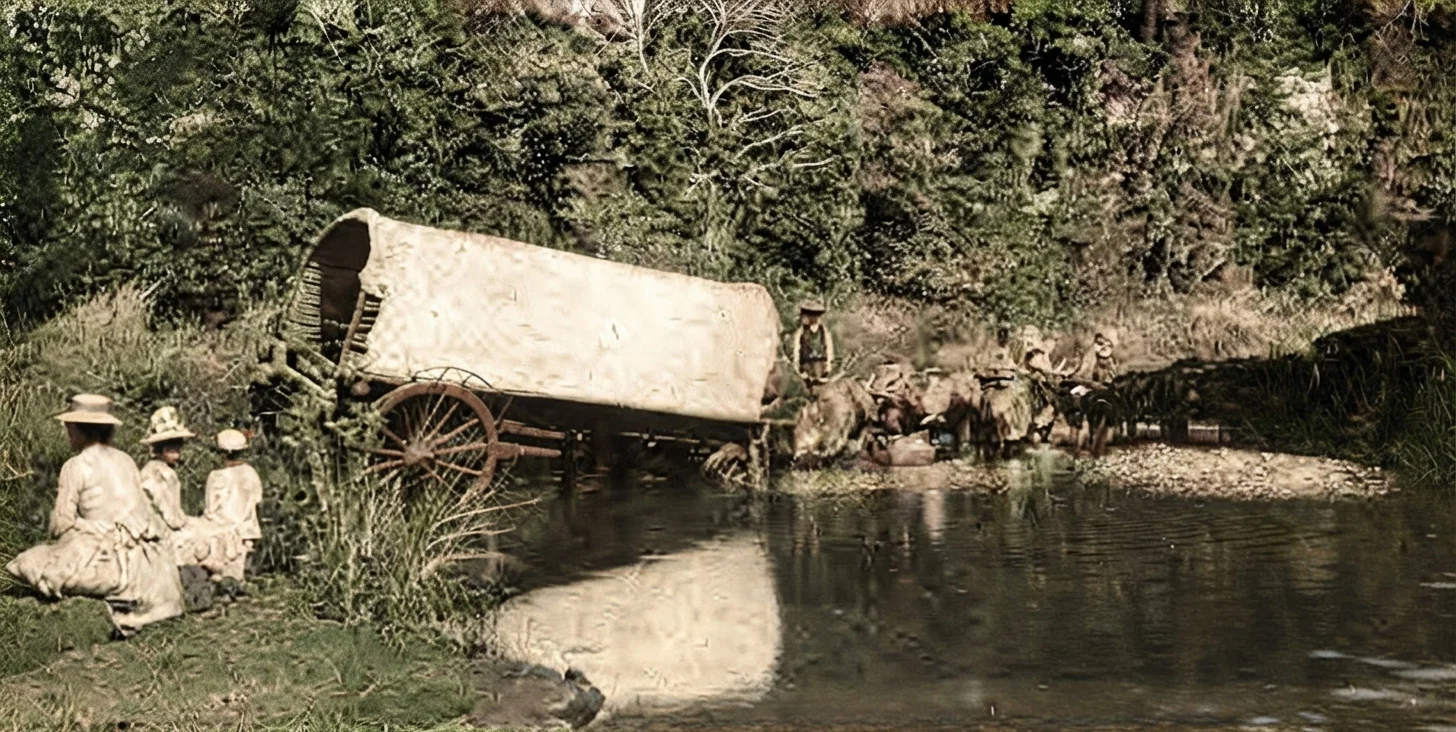
MODE OF TRAVEL USED BY OUR MISSIONARIES IN SOUTH AFRICA
“He Shall Give His Angels Charge Over Thee”
By W. C. Dunscomb, M. D.
The Missionary with the Wild Beasts of Africa
Remarkable Deliverances
By W. C. DUNSCOMB, M. D.
“HE shall give His angels charge over thee, to keep thee in all thy ways.”
As we have been visiting our mission stations in Africa, we have been strongly impressed with the loneliness of the situation. The mission farms are usually many miles from the nearest white neighbor. One wonders that, under these conditions, he rarely hears any expressions of worry or fear. As we listen to some of the experiences of the missionaries, we can understand how it is that the weak may become strong, and faint hearts stout.
When Brother Campbell was on his way to visit an outstation about forty miles from the Barotse Mission, he noticed, in the tall grass about twenty-five yards away, an animal that looked like a wild hog, but he could see only its back through the grass. He raised his gun and pulled the trigger, but it missed fire. He quickly threw in another cartridge, and again pulled the trigger, but again it missed fire. The gun never missed fire before nor since. Just then the animal sprang to its feet, and it proved to be a large lion. In another second the lioness bounded into view, and the two beasts disappeared in the tall grass together.
A wounded lion at short range is very dangerous, and usually kills the hunter. If the one animal is wounded or killed, its mate comes on, full of rage. Brother Campbell was alone at the time, as he had walked on ahead of his native carriers. He could well believe that his guardian angel was at his side, and directly interposed to save his life.
Once when Brother Anderson was on a similar visit to the outschools, he lay down at night beside the fire. As he was about to fall asleep, the oxen suddenly jumped up in alarm. He took the rifle, and had a good look around, but could see nothing, so he lay down and slept soundly. In the morning, as they were yoking the oxen to move onward, one of his native boys pointed out to him a lion’s tracks beside the spot where his head had been as he lay asleep. The tracks of the two fore paws were together, and had left a deep imprint in the soft ground, showing that the lion had been standing by the head of our sleeping brother, ready to spring upon him, but that the angel of the Lord had closed the lion’s mouth.
Again, when Brother Robinson was stationed at this mission, he went down to a water hole one day to drink. After satisfying his thirst, he turned around to retrace his steps, and came face to face with a lion, which evidently had been following him. He was quite alone, and unarmed. It was a terrifying situation. It was no use to attempt to run away, so our brother faced the lion, singing a hymn. Without any apparent reason, the lion turned and ran off through the tall grass.
To our missionaries on the frontier, and to our people throughout the world in the more troublesome times soon to overtake us, God will be a very present help in time of trouble. If we look to God in faith and trust, there is no need for fear or anxiety. The ninety-first psalm applies, I believe, particularly to these latter days.
“I Will Make You Fishers of Men”
World-Wide Fulfilment of the Promise — Consecrated
Christians in All Parts of the World Obey
the Command to Go
“FOLLOW Me, and I will make you fishers of men.” “Go ye therefore, and make disciples of all the nations. . . . teaching them to observe all things whatsoever I commanded you.”
IN reporting the closing of the men’s school in China, Elder Westrup writes, “I never before received so much light and strength from the study of the book of Revelation as I have this winter.” Such is
“I never before received so much light and strength from the study of the book of Revelation as I have this winter.”
Such is commonly the experience when an attempt is made to help others,—the giver receives indirectly as much as the receiver gets from him.
THE general meeting in the Fukien district concluded with the baptism of fourteen. The torrential rains toward its close failed to break up the interest, though attendance was somewhat diminished. The Chinese brethren show their zeal for the message by leaving their work to go out into the villages and urge the country people to come in.
DR. LAW KEEM, working in Wu Chow, Kwangsi, China, had an unenviable experience with the floods there. The water rose steadily for nearly a week, and attained a level eighty feet above the normal, flooding their courtyard to a depth of ten feet, and forcing them to take refuge up-stairs. The losses throughout the district were of course enormous, but the mission property was mostly saved. All communication was by boat. For water supply they took from the surrounding flood, boiling it by burning drift wood that could be picked up. Their books and other belongings were floated out into the court in a sudden night rise of the water, but were rescued by means of a raft made of the doors. In spite of these trials, they reported that they were of good courage, and that there were prospects of baptizing about fifteen on the next visit to outstations.
IN a recent tour through Hunan province, Elder R. F. Cottrell organized four new churches, making a total of twelve in the province.
IT is good news to us that our workers in China have secured a rest home at a summer resort in the Lu San range. Only those who know the heat of the tropical plains in summer can realize the importance of this for the health of the mission forces.
THE book “Bible Readings” in the Mandarin dialect is now ready. This work has had a circulation of over 2,000,000 copies in the original English. This new edition is well printed on good paper, and illustrated.
AFTER an exciting trip through the gorges of the Yang-tse, during which there were frequent close calls in the rapids, Elder Allum and party have arrived at Chung-king, Szechuen, and established themselves as the western outposts of our missions in China. This is on the borders of Tibet, and we may expect a beginning in that land before long. They have already a Sabbath-school of fifty members in Chung-king, and three weekly Bible classes.
DURING August the subscription list of the Chinese Signs of the Times increased from 81,000 to 88,000, with no indication that the rate of increase would slacken.
THE Japanese Mission has definitely decided upon a workers’ training school.
A REVIEW of the Korean Mission work in connection with the general meeting held last spring, gives these encouraging figures for the year: The attendance at the meeting was 180. Out of more than four hundred who had commenced during the year to keep the Sabbath, 139 had been baptized. The Sabbath-school enrolment was 1,100. Tithe from native sources supplied one eighth of the mission expense, including school and668publications. Those present at the meeting carried home 18,100 tracts to use in missionary work.
SEVENTEEN missionaries were due to sail from Seattle September 26, four for India, and the rest mostly for China.
NINE believers have been baptized in Bombay since the last report.
FOUR workers, two returning from furlough and two fresh recruits, arrived in India in July.
REPORTING from Manila, Elder Finster states that he has appointments to officiate at the baptism of sixty-nine persons at various points in the country around. The first Adventist tract in the Cebuian language is just off the press, and an Ilocano tract is also finished.
“He has appointments to officiate at the baptism of sixty-nine persons at various points in the country around.”
WE have been receiving copies of our Tagalog monthly, Patnubay ng Katabusan. We do not know what the title means, but we can see it is a good paper. It is a neat 32-page magazine size; and in recognition of the native desire to learn European languages, it is made up with four pages of Spanish and two of English, along with twenty-six of the Tagalog.
IN New Zealand, the translation of “Bible Readings” into the Maori language has just been completed.
IN our Singapore Sabbath-school the lesson is taught in five languages.
SPEAKING of the willingness of people to study, a worker in Singapore writes: “We do not have to go and search for them. The Lord sends them to us before we hardly have time to get settled and look around.”
“We do not have to go and search for them. The Lord sends them to us before we hardly have time to get settled and look around.”
A MAN in German New Guinea got the address of the Java Mission in a Malay tract, and is now an interested student of the Bible by correspondence. A large number of tracts have also been sold by persons unconnected with our work, in Ambon and other small islands between New Guinea and Java.
Two lepers in the asylum of an islet off the coast of Aitutaki, Cook Islands, have requested church fellowship of one of our workers. A man and wife on the island itself are also seeking instruction. W. H. S.
People Are Asking Questions
By Editor
A STUPEFIED WORLD
"Writers who can tell a stupefied world what this fearful portent means, who can throw light on the great fundamental problems of the race, and can give some hint as to its destiny, will have an attentive and even anxious hearing."—Springfield Republican.
Men Said the world was growing better, the arming of the nations insured peace; and now some say perpetual peace will follow the present European war.
The Bible Says the world will grow worse and worse; there shall be "wars and rumors of wars"; Armageddon will be fought before the Lord's second coming.
The masses are losing confidence in their former leaders of thought. They have found their opinions to be unreliable, valueless. Such persons will now gladly give "an attentive and even anxious hearing" to writers who can throw light on present-day conditions. They want the truth; they wish to know.
Signs of the Times
WILL ANSWER THEM
During the next six months the SIGNS OF THE TIMES will be all that its name implies — a "Signs of the Times Series." From the great prophecies of Ezekiel, Daniel, Joel, Amos, the Gospels, and the Revelation, it will answer conclusively, and to the satisfaction of all open-minded readers, those physical, moral, social, and political questions of the day which uninspired man has proved himself unequal to.
In addition, the publishers will thoroughly cover other important though little understood subjects, such as the Sure Word of Prophecy, the Coming of the Lord, the Law of God, the Sanctuary, the Sabbath, the Nature of Man, the Angels, Spiritualism, and kindred subjects.
This journal has correspondents in England, Germany, Switzerland, and others of the European countries. They will furnish our readers with fresh and reliable articles on conditions and developments in their respective countries. Arrangements have also been made for the latest and best pictures from these war-stricken countries, for illustrating purposes.
It will be the earnest endeavor of editors, contributors, correspondents, and printers to make this series the very best ever issued.
SPECIAL RATE FOR THE SERIES
For One or More Copies - - - 60 Cents Each
Our depository in your state (see page 15) will give prompt attention to orders sent through them.
SIGNS OF THE TIMES
Mountain View, California
INNOCENT VICTIMS OF HEART-BREAKING CRUELTIES
By Adelaide Bee Evans
Women and Children Who Suffer—Living Experiences in One of the Most Beautiful Cities of the Nation—Is There No Relief?
By ADELAIDE BEE EVANS
"LIQUOR won't hurt you if you let it alone," says the defender of the liquor traffic. "Regulation, not prohibition," is the great cry. But is it true? Does liquor harm only those who drink it? Look around you, in your own town, your own pleasant street, perhaps, and there read the answer.
Fairview is a temperance suburb of what loyal Americans like to call "the most beautiful city in the nation"; and many who have traveled far, and seen the noblest cities of distant lands, declare it to be the loveliest in the world. There are plenty of saloons in the beautiful city, along with its marble buildings, its parks, its splendid monuments, and its tree-lined avenues. It is no unusual thing to see two or three policemen assisting a well-dressed man "under the influence" into a waiting automobile, to be taken home or to the police station, as the case may be.
WHILE THE CHARTER HOLDS
But to the honor of the founders of Fairview be it recorded that as long as its charter holds, it is written that there shall be no saloons in that suburb. The wisdom of this restriction is clearly seen. The town is filled with pleasant homes. Its streets are clean and smooth, the schools are overflowing, the churches are well filled, and a general air of prosperity is apparent everywhere.
The suburb is not so large but that the neighbors take a friendly interest in newcomers; so when, three or four years ago, young Mr. Eddy took a bungalow on Flower Avenue, and established his little family therein, the other residents of the quiet street were quick to offer the hospitality that is characteristic of the place.
Mr. Eddy, it was soon learned, was a government clerk, with a salary that seemed large to Flower Avenue. His wife's friendly ways won all hearts, and much sympathy was expressed for the little daughter, who, it was whispered about, had tuberculosis. A pitiful little thing she was to see—great dark eyes, sunken in the delicate face, wasted limbs of almost unbelievable frailness, and a hollow little chest and stooped shoulders. However, her case was not hopeless, the mother said; and great improvement was hoped for the child from the country air and the shaded lawn.
STRANGE RUMORS AFLOAT
But it was not long before strange rumors began to float about the neighborhood. Often Mrs. Eddy left for the city as soon as her husband was off, staying till late at night, and leaving the baby, neglected, often not even dressed, in the care of a slatternly maid or a shiftless house boy. Once when the child, looking particularly forlorn and neglected, sobbed out that she was hungry, a venturesome woman opened the door, determined to find food and warm garments. What a sight met her shocked eyes! The mother, half clothed, was lying drunk on the floor, with an empty bottle by her side.
Not many weeks later, another baby girl came into this sad home—a little shadow of Lillian, who was scarcely more than a shadow herself. Patiently the young husband worked; generously he provided the money that ought to have fed and clothed his family, and furnished a comfortable and decent home; frequently he forgave, hoping against hope for the time when the repentant promises of the sobered wife and mother would be kept. But all in vain. Drearier and more dilapidated grew the home. Outside, the lawn was littered with papers, boxes, tin cans, and broken toys; inside, the house looked utterly barren and desolate. It came to be a common sight to see the children, even in cold weather, playing about the yard or on the sidewalk, often at evening wearing only a coat or a sweater over the clothes in which they had slept the night before. "Drunk again," the neighbors said, and sighed with the pity of it. Beautiful garments were occasionally provided for the children; but beauty and neglect do not long travel together, and in spite of all the father could do, the little girls soon came to look, the typical children of a drunkard.
MUST FIND ANOTHER HOUSE
At last the mother's condition became so notorious that for the sake of the neighborhood, and in spite of the sympathy felt for the father, he was told that he must find another house. Just before the family moved away, Lillian, for once made clean and shining by some friendly hand, but looking pitifully pinched and old, was on her way to the kindergarten. "I love my teacher," she said, expanding into rare friendliness under the wholesome influence of cleanliness—"I love my teacher—and Mary does too. But Mary couldn't come. She's been sick two, free days. And mama," she added, "is asleep. She gave Mary medicine out of a big bottle, and now Mary's asleep, too."
"Asleep"! Poor, deeply wronged babies! What can ever make up to them in this life for the loss and injury they have received at the hand of the terrible business of which, in their youth and innocence, they do not even know the name?
FOUND BY THE ROADSIDE
There is a widow in the temperance suburb. A few months ago, her husband was found early one morning lying by the side of the road, the ants covering his face. When "himself," this man was a loving husband and a kind father. Because of his devotion to his family, he had finally resolved to break the bonds that held him a slave to alcohol. But the liquor traffic had paid for the right to tempt this weak man to drink. Outside the limits of Fairview the "First Chance" saloon invited him in, to quench the thirst that consumed him. He fell; and returning home late at night with his drunken companions, he stumbled by the roadside, and was left by them to die alone. Often he had been warned that his heart would give way if he did not stop drinking; and now that weakened organ succumbed to the strain of his last debauch. The broken-hearted widow, the fatherless children, are the victims of the traffic that they loathed and shunned. They had nothing to do with liquor, but liquor had something to do with them.
THE INNOCENTS HAD TO SUFFER
Last winter, in the beautiful city, a man who had quarreled with his family returned home drunk one night, and entering the house, killed his wife and seriously injured her little brother. The child had let drink alone, but it did not let him alone.
Nor did his tender years and his innocent heart save the life of another child of this same city,—a happy, loving little lad, too young to know that papa had "bad times,"—who joyously ran to meet his father as he returned from his day in the office. "Papa, papa!" he cried. They were his last words; for his father, made a demon by drink, seized the boy, and savagely dashed out his brains against the wall.
The lovely city hides many such horrors. Within the past few months, another father tried to murder his two little sons, with himself, by asphyxiation, but failed. "I was drunk," he said, in his prison cell. Had the liquor business anything to do with those children—their mother dead, their father imprisoned, and themselves thrown upon the care of some institution?
DEFORMED BY CRUELTIES
And what shall be said of the deformed children, born into the world to bear a lifelong burden of physical infirmity as the result of the cruelty and blows of drunken fathers; of the mentally deficient, many of whom must become the wards of the state; of the epileptics, who form a hopeless, deplorable, unwanted, "unfit" army, whose ranks are constantly swelling? One such the writer knew—a lad of twelve years. In spite of the terror that had him by the throat, in spite of the dreadful paroxysms that made him loathsome to behold and shut him off from healthful association with other boys of his age, there still burned in the heart of this afflicted child an ambition to study, to succeed, to become a man among men.
"Why do I have these spells?" the child asked. "Why am I different from other boys?"
The kind-hearted woman who had been caring for him a few weeks was "sorry" for him, but she could not keep him in her home; so in spite of his pleading and tears, he was sent back to the institution from which he had been taken. "His father670drank, and his mother is dead,"—that was the summing up of the case.
DIED OF BROKEN HEART
A few years ago, a brilliant lawyer had a large business in the city. He had a good income, a splendid home, a Christian wife, and three beautiful little girls,—Esther, Ruth, and Naomi. But he had the liquor appetite; and wherever he went, the "business" reached out its tentacles, drawing him ever downward. The mother died broken-hearted; the children became half-welcome dependents in the homes of relatives; and in a few brief years the lawyer closed his career as a common drunkard.
What can be done to protect the children from this cruel and merciless traffic?
Wine Grapes and Prohibition
By G. D. BALLOU, M. D.
What Shall We Do with Our Grapes if Prohibition Carries? — Some Common Sense Suggestions on the Point
By G. D. BALLOU, M. D.
WHAT shall become of the grape juice? The real question is, What ought to be done with it? It is one of the most valuable medicinal foods. There is nothing better, unless for a few cases it might be apple juice. Each glass of grape juice contains as much force element as an ordinary meal of common foods. Besides, the anti-septic properties and the lack of bone-making material make it indispensable in the cure of chronic catarrh of the bowels, sprew, and arthritis deformans. Fruit juices are an absolute cure for the last named disease in its early stages, and there is no other remedy. The grape cure has become so popular in Europe that many people go annually to the south of Germany and live for weeks on grapes alone. Many chronic ailments are permanently relieved in this way.
THE PROHIBITIVE PRICE
The only thing that stands in the way of making a sale for ten times the present supply of grape juice, even if none were left to ferment into wine, is the price at which it is retailed at soft drink stands.
California produces about 50,000,000 gallons of fresh grape juice annually. All the rest of the United States produces not far from 15,000,000 gallons. This would make less than three quarts of fresh pure grape juice per capita for the entire country.
Now, if you want to get a good, cold drink of pure grape juice at any of the places where it is sold, you will have to pay ten cents for a glass that holds from one half to two thirds as much as an ordinary table glass.
If you want a quart of it, you will pay from thirty-five to fifty cents for what is termed in commerce a "short" quart, five of which make a gallon.
This pinched system of measurement gives about twenty-five drinks to the gallon, which, at ten cents each, equals at retail $2.50 a gallon. This is absolutely prohibitive for the common people, as either a necessity or a luxury.
WINE GRAPES AND UNFERMENTED WINE
The ordinary table glass holds one half pint, making sixteen to the full gallon. If this were sold at five cents a glass, it would retail at eighty cents a gallon — quite a change from present prices.
The present supply of unfermented wine is chiefly made from the Concord grape. But there is no reason whatever why the juice of our wine and table grapes can not be made as palatable for the great majority of tastes, by the addition of a little lime or lemon juice, as the Concord juice now is, in the way it is prepared. There is more force and food element in the California grape juice than in the Eastern Concord, and all it needs for the most fastidious is some slight flavoring with other fruit juice.
The impression prevails that the Concord grape can not be grown successfully in southern California. The writer desires to say that he has in his yard here in Los Angeles the absolute proof that the Concord grape is a success in southern California, or anywhere in this locality.
Spreading out over about two hundred square feet of trellis is a five-year-old Concord vine that will produce this year, at the least calculation, two hundred and fifty pounds of the finest flavored fruit ever eaten.
The unfermented juice from last year's crop will bear diluting with one third its bulk of distilled water, and then have a higher, more delicious flavor than any Eastern Concord grape juice in the market.
ELIMINATE THE LIQUOR LEAGUE
We have had about fifty years of intelligent experience in preserving fruit for health drinks; and we do not hesitate to declare that if the influence of the California Liquor League were eliminated from the present controversy, and that greed which stimulates the liquor dealer to produce almost every kind of wine from poor whisky by artificial processes were trampled under foot, within a year our wineries would be putting their fresh grape juice in sealed gallons and quarts and disposing of it at a better profit than they now make.
To produce the demand, all that is necessary is to supply the soft drink stands, so that it can be had at the liberal rate suggested in this article.
THE WINE PRODUCERS CRUSHED
The wholesale liquor interests who are working through the "Liquor League" and the "Grape Growers' Protective Association" are so greedy for gold that they have almost ground the life out of the real wine producers. I am informed, on good authority, that wine is sold in small quantities at the wineries from fifteen to twenty-five cents a gallon in all parts of this state.
Just popularize grape juice by offering it at all the soft drink stands at a popular price, and the wine producers will be won over readily by a price from twenty to one hundred per cent higher than they are now getting. Add to the present wine supply about one fifth, which is lost in evaporation during fermentation, and you have a most remarkable inducement to grape growers to make unfermented instead of fermented wine.
NOT HALF ENOUGH
Pure grape juice is more attractive to the average palate than the flavored waters that are so commonly dispensed. There is not enough grape juice produced to supply one half the demand that will exist in less than three years from the time it shall be offered at the fair rate of five cents for a half-pint glass.
The dealers who are not satisfied with the profit that could be made at this rate had better give place to scores of others who would be fully satisfied with a hundred per cent profit. And there is not a thing on earth to-day that will deal heavier blows to the perverted appetites that now clamor for strong stimulants, than the grape and other fruit juices that could be so easily provided if those who produce them were disposed to do it.
There is a blessing in the new wine. "Destroy it not."
Heathen Are the Prize in the Contest
By W. H. S.
A FRENCH trader recently visited Elder Parker's community on Atchin, New Hebrides, and sold to the natives a large quantity of grog, with which they became drunk that night, and disgraced their humanity in a wild spree, after the usual manner of the intoxicated.
Our missionary determined to teach the natives a lesson, and show them, and incidentally the trader himself, what is the attitude of Christianity toward the liquor traffic. He refused to the trader the ordinary friendly treatment which white men expect of each other in the East, and, explaining to him the reason for his action, refused to allow him even to set foot on the mission premises.
At the first opportunity, he called the natives together, and explained to them the deceitful nature and awful effects of liquor, and asked them to talk the matter over among themselves, and decide whether they would admit liquor to the island. They withdrew to counsel, and shortly sent back a party to tell him they would not buy any more. When the trader came on his next trip, he bought a large quantity of copra, but not a gill of the liquor would they take in exchange, all his sarcasm and flattery notwithstanding, and on a third voyage he was still unable to shake their resolution. May God help these heathen to continue firm!
W. H. S.
The Cost of the Rumseller’s Flowers
"THERE is not a flower in the hat of the rumseller's wife but it costs a rose from the cheek of some other man's wife."
Consumers Pay the Saloon License Fee
"REMEMBER that the consumer and his family, not the saloon-keeper, pay the license fee."