Your ShelfYour Projects

Signs of the Times, Vol. 30, No. 13.

A PERFECT IDEAL

Signs of the Times

Mar 30, 1904

Pacific Press Publishing Company · Oakland, California · Mar 30, 1904

A PERFECT IDEAL.

BY MRS. E. G. WHITE.
MAN has fallen. God's image in him is defaced. By disobedience he is depraved in inclination and weakened in power, unable, apparently, to look forward to anything but tribulation and wrath. But God, through Christ, has wrought out a way of escape, and He says to every one, "Be ye therefore perfect." It is His purpose that man shall stand before Him upright and noble, and He will not be defeated. He sent His Son to this world to bear the penalty of sin, and to show man how to live a sinless life.
CHRIST is our ideal. He has left a perfect example for childhood, youth, and manhood. He came to this earth, and passed through the different phases of human experience. In His life sin found no place. From the beginning to the close of His earthly life, He preserved unsullied His loyalty to God. The Word says of Him, "The Child grew, and waxed strong in Spirit, filled with wisdom, and the grace of God was upon Him." He "increased in wisdom and stature, and in favor with God and man."
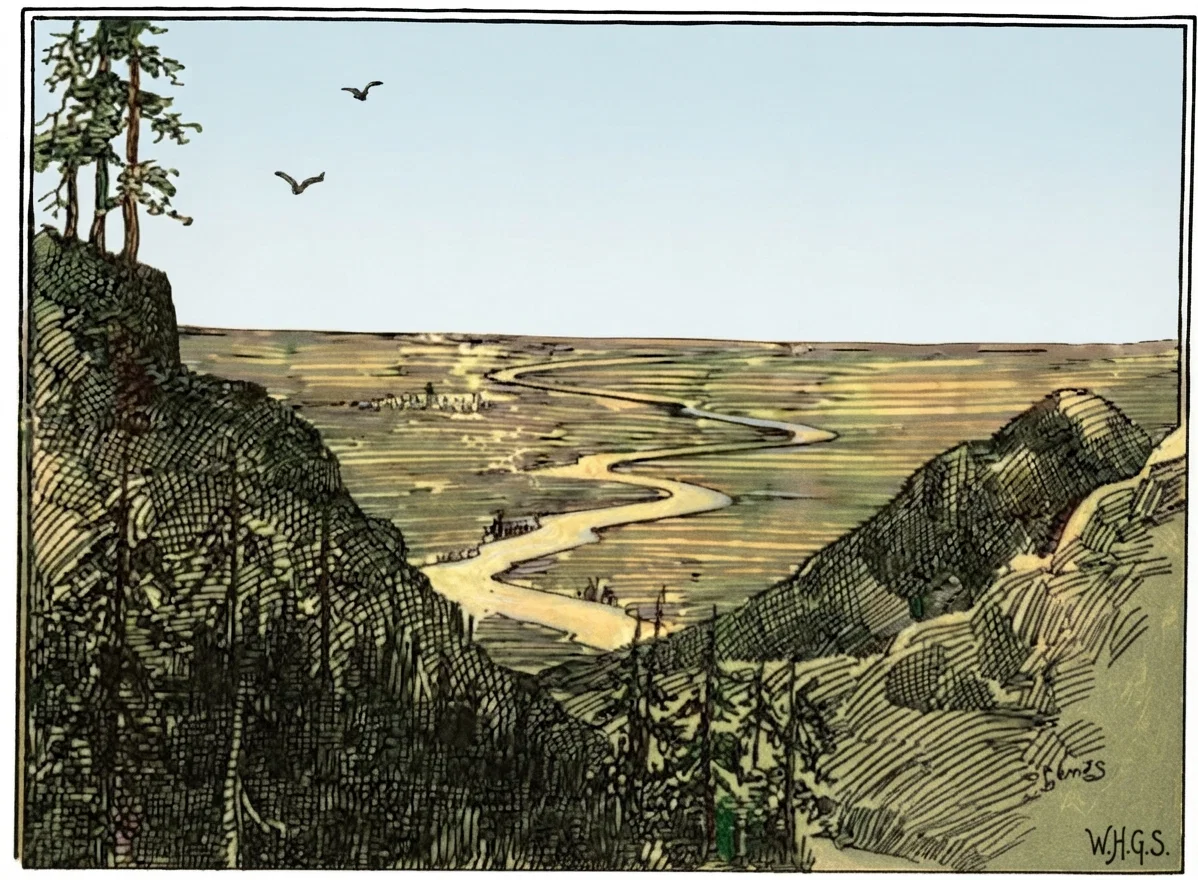
In the Beautiful Valley of the Grande Ronde River, Oregon.
THE Saviour lived not to please Himself. We read of Him that He went about "doing good." He spent His life in loving service, comforting the sorrowful, ministering to the needy, lifting up the bowed down. He had no home in this world, only as the kindness of His friends provided Him one, yet it was heaven to be in His presence. Day by day He met trials and temptations, yet He did not fail or become discouraged. He was always patient and cheerful, and the afflicted hailed Him as a messenger of life and peace and health. His life held nothing that was not pure and noble.
GOD'S law is the echo of His voice, saying to us, "Holier, yes, holier still." Desire the fulness of the grace of Christ; yea, long—hunger and thirst—after righteousness. The promise is, "Ye shall be filled." God has plainly stated that He expects us to be perfect, and because He requires this, He has made provision that we may be made partakers of the divine nature. Only thus can we be partakers of the divine nature. Only thus can we gain perfection. The power is given by Christ. "As many as received Him, to them gave He power to become the sons of God."
GOD'S promise is, "Ye shall be holy; for I am holy." Holiness is the reflection of God's glory. But in order to reflect this glory, we must co-operate with God. Heart and mind must be emptied of all that leads to wrong. The Word of God must be read and studied with a sincere desire to gain from it spiritual strength. This Word is the bread of heaven. Those who receive it, and make it a part of their lives, grow strong in the strength of God. Our sanctification is God's object in all His dealing with us. He has chosen us from eternity, that we may be holy. Christ declares, "This is the will of God, even your sanctification." Is it your will, also, that your desires and inclinations shall be brought into conformity to the divine will?
HE who would build up a strong, symmetrical character, he who would be a well-balanced Christian, must give all and do all for Christ; for the Redeemer will not accept divided service. Daily he must learn the meaning of self-surrender. He must study the Word of God, getting its meaning, and obeying its precepts. Thus he may reach the highest standard of Christian excellence. There is no limit to the spiritual advancement that may be made by the one who is a partaker of the divine nature. Day by day God works with him, perfecting the character that is to stand in the day of final test. Each day of his life he ministers to others. The light that is in him shines forth, and stills the strife of tongues. Day by day he is working out before men and angels a vast, sublime experiment, showing what the Gospel can do for fallen human beings.
LET us not spare ourselves, but carry forward in earnest the work of reform that must be done. Let us crucify self. Unholy habits will clamor fiercely for the victory, but in the name and through the power of Jesus we may conquer them. To him who seeks daily to keep his heart with all diligence the promise is given, "Neither death, nor life, nor angels, nor principalities, nor powers, nor things present, nor things to come, nor height, nor depth, nor any other creature, shall be able to separate us from the love of God, which is in Christ Jesus our Lord." Living the life of the Saviour, overcoming every selfish desire, fulfilling bravely and cheerfully our duty to God and to those around us,—this makes us more than conquerors. This prepares us to stand before the great white throne free from spot or wrinkle, having washed our robes of character, and made them white in the blood of the Lamb.

OUR BURDEN BEARER.

GOD is ready to carry the little burdens as well as the great ones. He knows what makes up human life, and how galling the little worries are to the spirits of men. The one who has no strength can not bear up under the smallest of loads. We have absolutely no strength of our own. He gives all we have; and it is misusing His gifts and distrusting His comforting presence to shut Him out of any experience that comes in life.

GOD'S PURPOSE IN CREATION.

BY WILLIAM COVERT.
NO being of intelligence works without a plan. Builders think and construct their work in harmony with their thoughts. The psalmist, while writing of providential care, exclaimed, "All Thy works shall praise Thee, O Lord; and Thy saints shall bless Thee." Ps. 145:10. Of the purposes fulfilled, he declares, "Whatsoever the Lord pleased, that hath He done, in heaven and in earth, in the seas and in all deeps." Ps. 135:6, R. V.
The beloved and venerable John had been exiled from home and friends to a lonely island of the sea, and thus situated, he was wrapped in vision on the Sabbath day, and heard the choir of heaven sing. In holy joy they proclaimed, "Thou art worthy, O Lord, to receive glory and honor and power; for Thou hast created all things, and for Thy pleasure they are and were created." Rev. 4:11. The singing announced the reason of heaven's blessedness. God's pleasure, moving upon the hearts of those who inhabit the holy court, expresses the true joy of the place. Nature, unaffected by sin, constantly utters the Lord's praises.
When Robert Fulton applied steam power to machinery, and caused it successfully to propel a boat on the Hudson, that achievement became his glory.
When Morse harnessed electricity, and taught men to make it a swift servant of humanity, that became a source of glory to Morse.
As Edison and others have studied the power of electricity, and have made it to lift and to pull, to sing and to talk, their praises have been spoken in all lands.
Elias Howe gave to the world that useful invention, the sewing-machine, and, therefore, his name has become a household word, and his praises are sounded as far as civilization has reached.
But God, who is infinite in wisdom and power, has enabled men to do these things. Therefore praise Him. "Let not the wise man glory in his wisdom, neither let the mighty man glory in his might, let not the rich man glory in his riches; but let him that glorieth glory in this, that he understandeth and knoweth Me, that I am the Lord which exercise loving-kindness, judgment, and righteousness, in the earth; for in these things I delight, saith the Lord." Jer. 9:23, 24.
If man is glorified by men, because he can make an intricate machine or a beautiful house, out of material prepared to his hand, what should be the praises rendered to Him who created the world, and then by His own life formed man into flesh from the dust, and made him breathe and hear, feel and smell, see and think, talk and eat, walk, work, and bear responsibilities, and then multiplied him into millions?
As all things were created for God's pleasure, it is clear that in the beginning a man must have been made whom the Creator could enjoy. He was made capable of doing what was for his best good, and of appreciating his environments. God placed the highest type of man in the earth. He gave him dominion over the fish of the sea, over the fowl of the air, "and over every creeping thing that creepeth upon the earth." Gen. 1:26.
A special and direct impartation was required to fit him for such responsibilities. It was necessary that he should know the habits and the homes of all the creatures he was to control. The Bible shows that he had this knowledge at the earliest dawn of history. He was then required by his Maker to name the beasts and the birds as they were called before him. He gave them names that were expressive of their nature and habits. "And whatsoever Adam called every living creature, that was the name thereof." Gen. 2:19. He made no mistake, because the Infinite Mind enlightened his thoughts as he looked upon the Maker's handiwork. He understood the animals not only by direct endowment, but by the open book of nature, which taught him the ways of the Lord. Every object that greeted his eyes served as an illustration to the volume which he studied.
To Adam and Eve in their Eden home, the grass, the foliage, and the flowers proclaimed God's praises. The heavens above declared His glory, and the firmament in all its appointments spake of His infinite power.
Bethel, Wis.

TWO LAST MESSAGES OF MERCY.

BY H. A. ST. JOHN.
Two LAST messages of mercy to the last generation of people on the earth! How can there be two last messages of mercy to the same generation of people?—On this wise: One is a last message of mercy to the remnant church as a church; and the other is to all the world. Not only can this be, but it will be, for the Word of the Lord declares it. Yea, more: Both these messages are already being given, the Third Angel's Message of Revelation fourteen, combined with the two messages preceding, constitute the last message of mercy to a sinful world. It is already well under way. It must yet go, however, with mighty power and glory, to all nations, kindreds, peoples, and tongues. All who reject it will receive the unmingled wrath of the last judgments of God upon incorrigible sinners.
The other message is to the remnant, or Laodicean church, upon whom the Lord depends to carry the last message of mercy to a perishing world. They have begun the proclamation, but a lukewarm and drowsy spirit has come over them, and the message is delayed. Abounding iniquity in the world has encroached upon His people—yea, it has permeated the church to whom has been committed the everlasting Gospel, and this iniquity in their very midst has caused the love of many to wax cold. This condition of things makes it necessary for the Lord to send to the remnant church a last message of mercy, while they themselves have committed to them the last message of mercy to the world. For years that last message has been coming to that people; but as yet it has never been half heeded. It is now being renewed and revived, and this may be the very last opportunity.
No marvel that the world is not stirred, not half heeding the last message to them, when the bearers of that message are so heedless of the last message the same Lord is sending to them.
The faithful and true Witness says to this remnant church, who are called to be the forerunners of the second glorious appearing of Jesus: "I know thy works, that thou art neither cold nor hot; I would thou wert cold or hot. So then because thou art lukewarm, and neither cold nor hot, I will spew thee out of My mouth." This will be the fearful fate of all those who do not heed this last message of mercy to the church. All such will then be numbered with the rejectors of the last message to the world, and share their destiny.
The message to the remnant church further says: "Because thou sayest, I am rich, and increased with goods, and have need of nothing; and knowest not that thou art wretched, and miserable, and poor, and blind, and naked; I counsel thee to buy of Me gold tried in the fire, that thou mayest be rich; and white raiment, that thou mayest be clothed, and that the shame of thy nakedness do not appear; and anoint thine eyes with eyesalve, that thou mayest see. As many as I love, I rebuke and chasten: be zealous therefore, and repent. Behold, I stand at the door, and knock; if any man hear My voice, and open the door, I will come in to him, and will sup with him, and he with Me." Rev. 3:17-20.
Sometimes we sing— "O, how I long to see that day When the redeemed shall come To Zion, clad in white array— Their blissful, happy home!"— but, dear reader, just now we want to be longing to see that day when we shall all come up "to the help of the Lord against the mighty,"—when we shall fully heed the last message of mercy to us individually and collectively,—when we shall, by a strong grasp of faith, believe all the faithful and true Witness says about our condition, and thus believing, zealously repent.
Reader, do you not hear Jesus, standing at the door of your heart, uttering this solemn message of revelation, warning, counsel, love, mercy, and promise? If you will hear and heed by zealous repentance, you will thus open the door of the heart to Jesus, and then you may constrain Him to come in, and sup with you, and you with Him. Wonderful Guest; glorious feast! O, let the dear Saviour come in!
When Jesus shall have thus entered, and taken up His abode in the hearts of His children, He will quickly subdue all things in that living temple unto Himself, that all its members will be members of righteousness unto holiness, and every thought be brought into captivity to Christ. Then, and not till then, will that soul and that church be in condition to receive the refreshing from on high—the latter rain. Then will come the mighty outpouring of the Spirit of God—the pentecostal baptism of power. Then will begin, in very truth, the loud cry of the Third Angel's Message, which will be quickly consummated in all the world; for the mighty angel, having great power, whose coming lightens the earth with his glory, will thus and then have joined the third angel.
The Lord will at that time rain righteousness upon His children and church, and thus will He cut short His work in righteousness. For a short work will the Lord make on the earth. Then we will see the redeemed of the Lord come to Zion clad in white array, and, praise be to His holy name, we may not simply see them, but be numbered with them in glory.

TIME'S ROSARY.

BY MAIDIE E. BARNITZ.
Upon the rosary of life, The years as pearls I see, Strung on the thread of time, which joins Unto eternity.
Slow slipping down the chain they come, Each in his time and place, In aspect all the same, and yet Each with its special grace.
So many years all unrevealed, So much I can not see, Yet each one good since 'tis a link 'Twixt Thee, dear Lord, and me—
A simple link, a common thing, Yet leading to a sign Which signifies Thy blessed life, And renders all divine,
For when the full extent is traced, Whate'er the way may be, Even tho it may be through a cross, We are at last with Thee.
Berkeley, Cal.

THE BUILDERS

(Continued.)

THE room to which we are now going is called Love. You notice that it is a double room, with a large archway between the apartments. On the arch is written, 'If ye love Me, keep My commandments.' In these rooms there are no windows, but ten large doors, four in the first apartment and six in the second. Over the four doors is the motto, 'Love the Lord with all thine heart;' and over the six, 'Love thy neighbor as thyself.' Matt. 22:37-40.
These doors are made of a substance which transmits light (Prov. 6:23); so that this room is beautifully illuminated, and by this light we see clearly our relation to God and to man, and by these doors we go in and out before God and the people. On the lintels are written, 'Duty to God,' 'Duty to man.' These doors are openings to a pathway for our feet which is the highway of holiness. Isa. 35:8. And do you see these footprints in the sills? They were made by the feet of my Master, for He trod this way before me, and in His steps I find written these words, 'I have kept My Father's commandments, and abide in His love.' John 15:10.
THE BUILDERS
THE BUILDERS
"O, with what joy we can pass in and get through these doors, when we know that we are stepping in the footprints of Jesus!"
"Yes," said the neighbor, "it must be a great pleasure to you; but do you know that some of the people have omitted these doors altogether, and say that they are not necessary? Others have changed some of them. In our house the doors are much like these, excepting the fourth one in the first room. We were thinking of making ours like this one, but some of our neighbors said that it was too old in style; that it was all out of date; that no one used it now, excepting a few old fogies and the Jews; and so we were persuaded to put in a new style of door, a very pretty one. Sunday It has a beautiful, large panel, on which is seen a picture of the resurrection of the mighty One. I like it very much, but I must confess that when I read the Guide-book I feel just a little uneasy about that door. And now, having seen this one, I realize that it corresponds much more nearly with the description given in the Book than does mine."
"Yes, my friend, I have tried to follow the Book exactly in all things. But let us notice this door more closely, and then I will relate a personal experience. You see in this door there are three panels, a large one on each side and a smaller one across the center, connecting the other two. On the panel to the right you see at the top the word 'Creation;' at the bottom, the words, 'Father and Son.' On the one to the left you see at the top the word 'Redemption,' and at the bottom, 'Father and Son.' On the middle panel is the word 'Memorial.' Do you see what a dark shadow there is on the right-hand panel? and there are also six dim pictures on it. But you will notice that the longer you look at them, the darker grows the shadow, and the more indistinct the pictures."
"On the left-hand panel there are also pictures, indistinct at first, but as you look at them the light grows stronger and the pictures brighter. The memorial panel gives out a steady light; were it not for this fact, the pictures on the creation panel would be lost to view."
"But I must relate my experience. I came into this room one day, and seated myself in this chair, which is so arranged that when leaning upon this arm called History, you can look straight through the Creation panel, and when leaning on the other arm, called Prophecy, you get the best view through the Redemption panel."
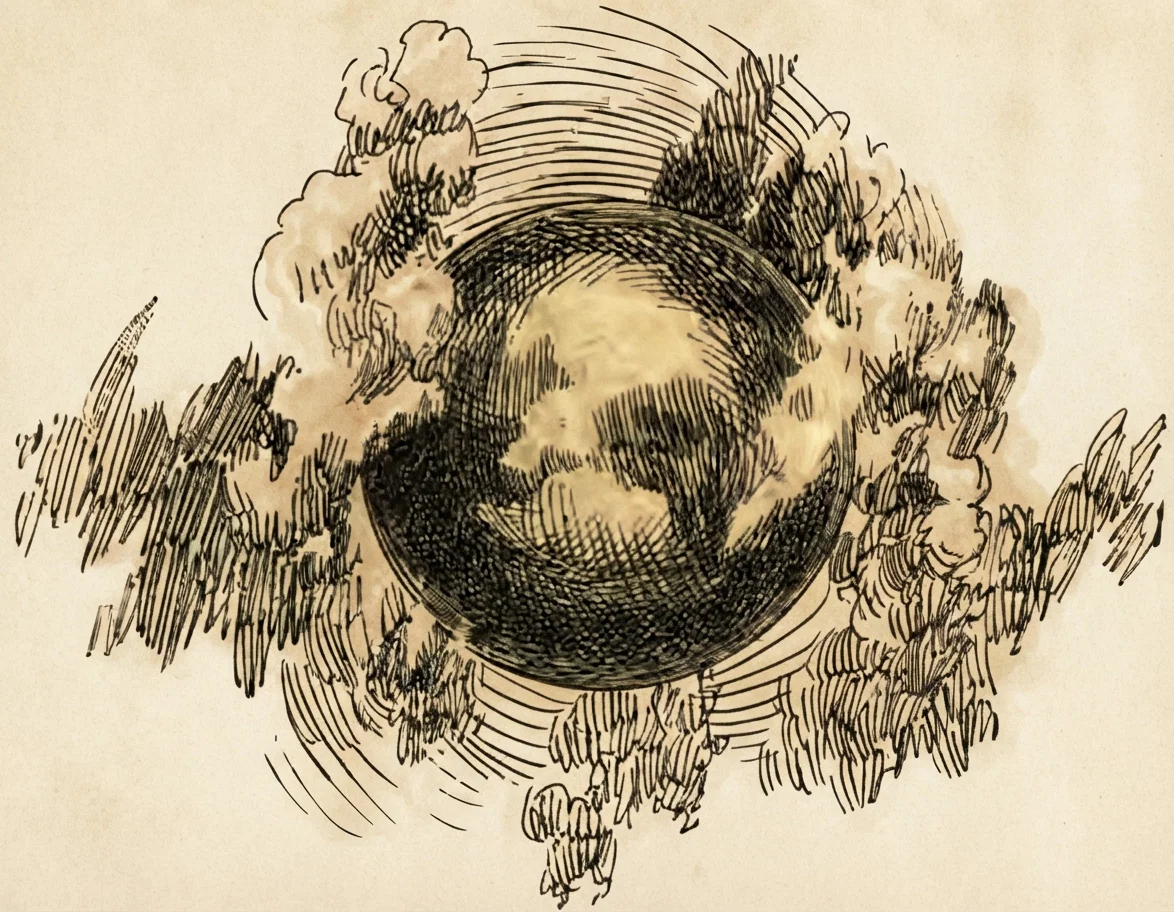
"I placed the pillow, Faith, under my elbow upon the History arm of the chair, and began to read the first part of my Guide-book. When I began to read, there appeared before my eyes a great expanse of space—an empty void. Then I heard a voice, and immediately there appeared a dark, mysterious-looking mass. Again the voice spoke, saying, 'Let there be light,' and out of that darkness there sprang a wondrous light. By the light I saw that the mass was pliable, yielding, and that it had no fixed form. Again that voice was heard, and the mass began to rotate, assuming the form of a globe. Again the voice was heard, and the light gathered to one side, and there appeared the first picture upon my panel—a world, rolling in space like a ponderous ball, one-half radiant with light, the other shrouded in darkness. Then a voice said, 'The evening and the morning is the first day.'"
"I looked again, the surface of the globe seemed clear as crystal, and underneath this transparency of air appeared another surface of" water on the one side, clear but sparkling in the light, and on the other side, clear but darkening in the shadow. And the voice said, 'Let there be a firmament in the midst of heaven;' and immediately a volume of water was lifted up, forming a vast canopy above the air, which passed between the waters, thus forming the firmament, and separating the waters from the waters. The second picture on my panel was completed, and I heard a voice saying, 'The evening and the morning is the second day.'
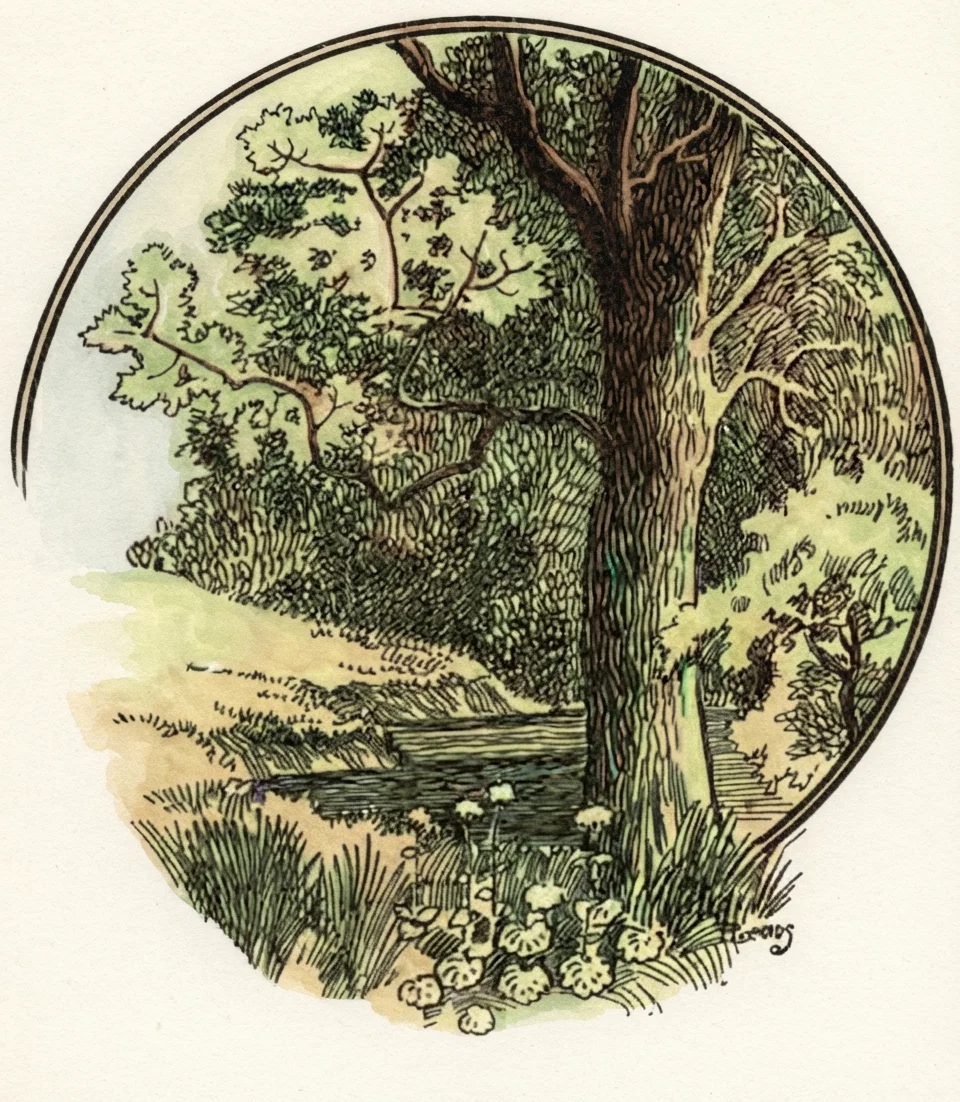
Grass and trees and flowers
"I now began to look upon the waters which were under the firmament, and I heard the voice say, 'Let the waters that are under the firmament be gathered together, and let the dry land appear.' Gen. 1:19. O, what a moving was there! The land arose and came to view, the waters fell away from sight, filling the vast reservoirs of earth's interior. When the commotion had subsided, what a picture was there!—the vast expanse of land, composed of broad, beautiful valleys, surrounded by lofty mountains which towered in graceful slopes. Vales, skirted by hills, arose in varied but pleasing forms. Plains sloped away to shores of seas beyond."
"Water was distributed in seas, lakes, and ponds; in rivers, brooks, and rills; each gleaming like a sparkling jewel or a thread of silver upon the bosom of the earth."
"As I viewed this pleasing picture, the voice spake again, saying, 'Let the earth bring forth grass' (verse 11), and herbs, and trees. Over the face of nature there spread a carpet of green of varied shades, bestudded here and there with clumps of herbage of blending colors, while from the midst of it all, to grace the slopes of mountains and of hills, there arose the trees, from the lofty cedar of Lebanon or the spreading oak of Bashan to the pale quaking-asp or the swaying willow by the brook. And the voice said, Let each one bear seed in itself, after its kind, and lo! upon the blades of the grasses, upon the sprigs of the bushes, and upon the twigs of the trees, there burst forth flowers of wondrous beauty, to sway to and fro, and to fill the air with their fragrance. The third picture was complete, and the voice said, 'The evening and the morning is the third day.'"
Valleys and mountains and plains

True Sabbath Keeping

ONE can no more be forced truly to keep the Sabbath (for it is a heart service primarily) than the juice can be forced into an orange by an outside agent, or the exquisite coloring of the delicate apple blossom be painted into it. As these come from the trunk of which the branch is a part, so also the right heart comes from “abiding in the Vine.”

The Cleansing Fire

If eternal torment, as represented by some, were true, it would indicate that God, like the wicked, had “conceived a device which” He is “not able to perform.” Ps. 21:11. Unthinkable! But thanks be to God, there is to be a cleansing fire which will leave neither root nor branch. Mal. 4:1.

SEARCH THE SCRIPTURES

BY F. D. STARR.

Introductory.

THE quotation given above comes from the highest source in the universe, and upon its obedience hangs the destiny of each individual who hears this instruction. To comply with this command involves the reading and careful study of the Word. Reading the Bible through by course is not as common a practise as it once was. And, indeed, how could we expect it to be when the practise is so much discounted? It is quite common, when allusion is made to the practise of reading the Bible through by course, to hear some one speak of it as a useless practise, or at least of but little benefit, that the right way is to study the Bible by subjects, or some other way.
While it is true that the Scriptures should be studied by topics, yet in what way would we treat any other book in which we were deeply interested and of whose contents we desired a correct understanding? Would we read a paragraph here, a sentence there, and a page somewhere else? Would we not rather commence at the beginning and read through carefully, page after page, being careful not to skip any part of it lest we should lose the connection? That is the proper and almost invariable way of reading human productions.
But is the Bible a book put together in correct consecutive order? Or is it, as some seem to suppose, a jumbled mass of literature, with each part disconnected from the other, so that there is no reason for perusing it in regular order from commencement to close?
Can we suppose the Infinite Mind, the God of order and not of confusion, would allow His representative Oracles to be thus compiled? It seems far more evident that there is correct order and system in the arrangement of the sixty-six books of which the Bible is composed. Does not the Book begin at the commencement of human history, and end with the introduction into the eternal state, thus spanning the six thousand years of earthly events from commencement to close?
In nearly every case one part seems to call for the one that follows, so that in order to get the proper connection, one needs to treat the Book in the way he would treat any other volume, by reading through by course from beginning to end. While study by subjects and comparison of one part of Scripture with another should be practised, yet this can not take the place of consecutive reading of the Word. In the language of our Lord, on another matter, we may say, “These ought ye to have done, and not to leave the other undone.”
Without question, there are portions that demand much more study and attention than some other portions, but none are to be overlooked. All are “profitable for doctrine, for reproof, for correction, for instruction in righteousness.”
Many say they read the New Testament, but do not read the Old, because that is, in their opinion, no longer authority on matters of duty. But, remember, the things that were written aforetime, the ancient Scriptures, were written for our benefit. See Rom. 15:4. One case will illustrate this point. A colporteur, who was employed in selling religious literature, said he did not read the Old Testament. Something was said about Balaam’s ass speaking with man’s voice. “What!” said the gentleman, “Is there any record of that?” The Book was opened to Numbers 22, and this representative of religious work read eagerly, for the first time, the wonderful occurrence. He could not, however, have been a very careful student of the New Testament, or he would have found allusion to the incident in 2 Peter 2:15, 16.
But neglect of the Old Testament naturally begets disrespect for the New, and those who do thus neglect to read that part which comprises three-fourths of the entire Word little realize what valuable information they are losing.
A clergyman of one of the largest denominations in the country remarked the other day: “People do not read the Bible any more, as they did when I was a boy. They read the daily papers instead, and that, too, on the sabbath.” Shall that be true of God’s remnant people also in these last days?
It is with gratitude, not with self-complacency, that I remember having read the Bible through for the third time when eighteen years of age, and of reading it through each year for more than twenty years since. Like no other book in existence, it seems newer every time it is read. It is well to read different versions. Besides reading the Bible through in the Revised Version, I have had the privilege of reading it through in Greek, German, French, and Spanish, and the New Testament also in Latin and Hollandish. Words can not express the delight and rapture experienced in seeing the divine thought, as expressed by different translators. The theme of redemption will be the science and the song of immortal beings in the kingdom of God. Is not the Book containing that science worthy of our study in this mortal state of existence? In fact, what else is worthy of our limited time but this Book and those helps that bring to us a better understanding of the Blessed Volume?
Continue reading: CRITICISM