Your ShelfYour Projects

Signs of the Times, Vol. 33, No. 36.

The Third Angel's Message

Signs of the Times

Sep 4, 1907

Pacific Press Publishing Company · MOUNTAIN VIEW, CALIFORNIA · Sep 4, 1907

The Third Angel's Message

And the third angel followed them, saying with a loud voice, If any man worship the beast, and his image, and receive his mark in his forehead, or in his hand, the same shall drink of the wine of the wrath of God, which is poured out without mixture into the cup of His indignation; and he shall be tormented with fire and brimstone in the presence of the holy angels, and in the presence of the Lamb; and the smoke of their torment ascendeth up forever and ever; and they have no rest day nor night, who worship the beast and his image, and whosoever receiveth the mark of his name. Here is the patience of the saints: here are they that keep the commandments of God, and the faith of Jesus. . . . And I looked, and behold a white cloud, and upon the cloud One sat like unto the Son of Man, having on His head a golden crown, and in His hand a sharp sickle. Rev. 14:9-14.

With Our Inquirers

"If ye will inquire, inquire ye."
[All questions to this department will be answered which to the editors will seem to minister to the good of the readers and to the mission of the paper. The same question can not be answered repeatedly in the same volume. The name and address must accompany question, not for publication, but as an evidence of good faith, and that answer may be made by letter if deemed advisable. It is well always to enclose a stamp for reply.]

2203.—The Unpardonable Sin.

Can you tell us what is meant specifically by the unpardonable sin?
O. O. P.
The unpardonable sin is the unrepentable sin. In one specific instance mentioned in the New Testament, certain Jews attributed to Beelzebub the miracles wrought by the Spirit thru Jesus. They declared that Christ cast out demons by Beelzebub, the prince of demons. Matt. 12:22-32; Mark 3: 22-30. There are two agencies by which God saves men: the atonement of Jesus Christ, and the power of His Spirit manifest thru His word and the miracles of His grace. When men persist in treading underfoot the blood of the covenant and doing despite to the Spirit of grace, there is no other means by which God can reach them. Heb. 10: 26-30. They place themselves where they can not repent and where God can not save them. Their unrepentable sin becomes the unpardonable sin.

2200.—Wipe Away All Tears.

Rev. 21:4 seems to teach that it is after the thousand years that God wipes away all tears; but does not Isa. 25:8, 9 indicate that the tears are wiped away at Christ's coming?
Sometimes the coming of Christ embraces all that results from it, the judgments and the rewards, including the thousand years. It seems reasonable to believe that when the saints sit in judgment with Christ (1 Cor. 6:1, 2; Rev. 20:4), there will be tears shed as they see perhaps their own mistakes and how God's goodness has been slighted. But when that judgment is over and God's justice is vindicated by His mercy, all sorrow shall be banished forevermore.

2201.—Mortal or Immortal.

(1) Was man or angel created mortal or immortal? If immortal, when did man lose that condition? (2) "This mortal shall have put on immortality." 1 Cor. 15:54. When is this condition bestowed upon man and angels? G. W. B.
1. Man was created neither mortal nor immortal, but a candidate for immortality. God certainly did not create a dying man or one subject to death. He certainly did not create an immortal being whose character was untested. Man was created so that he could become immortal by perfecting an incorruptible character. He became mortal when he sinned.
2. Man in Christ will be made immortal at the last trump, when Christ shall come. See 1 Thess. 4:15, 16. The righteous dead are raised immortal and the living righteous changed. God gives the incorruptible character an incorruptible body. It was bestowed upon angels, if it has yet been bestowed when they passed the great test of character and proved true to God.

2202.—Eternal Life and Immortality.

Because John 5:24 says he "that believeth on Him . . . hath everlasting life" some argue that immortality is bestowed upon the Christian now. Are the terms "eternal life," "everlasting life," and "immortal," the same?
G. W. B.
"Everlasting life" and "eternal life" are the same, and come from the same Greek words. Immortality is an altogether different thing. The life of God is eternal life, given in harmony with His righteous law or will. He who yields to that law in Christ Jesus, or in other words, believes in Christ, has eternal life. 1 John 5:11-14. But this life is not absolute; it is held by faith. God gives His children the life that they may have the power to overcome. To the overcomer is given the deathless condition immortality. The life is given that we may overcome while clothed with mortality. The immortality is given because we have overcome and are fitted for eternal existence. Then, in that immortal state, eternal life will be ours absolutely for there will be no more sin. It is God's response to our faith now in order that we may perfect the incorruptible character and be given the incorruptible body.

2204.—The Third Angel's Message.

How much does the “third angel's message” embrace?
Technically and strictly God's warning against yielding to apostate powers, and rendering homage to them instead of to Himself. Rev. 14:9-11. It is often used as embracing both the preceding messages in verses 6 to 8. Used in that sense, it embraces every saving truth of God. The class of people developed by this Threefold Message (the better term) “keep the commandments of God, and the faith of Jesus.” Verse 12.

2205.—Closing Scenes of Sin and Sinners.

Please explain Rev. 20:10-15.
The passage is too long for an extended explanation in this column. When Christ comes the breath of His mouth kindles the earth and consumes the beast and false prophet, the organized earthly powers. Isa. 30:33; 2 Thess. 2:9; Rev. 19:20. At the close of the thousand years the wicked shall perish the same way in the fires of a burning world. The city of God descends from heaven on a place prepared for it. Zech. 14:4. Satan and his hosts will endeavor to possess it. God's throne will appear, and all creation marred by sin shall pale before Him. First of all, all the world appear before God in the records of their lives in the books of heaven. This occurs during the thousand years. Rev. 20:4, 12. Then at the close of the thousand years, all appear before God for the execution of their sentences. Verse 13. Then Death and Hades, the abode of the dead, this great earth of graves, will be purified by fire. 2 Peter 3:10-13. Those who suffer this fate will perish forever in the second death. See Mal. 4: 12; Matt. 3:12. From that death there will be no resurrection. "Tormented forever and ever" is fully explained in the tract by that name, No. 111, in "Bible Students' Library." Price, two cents. See also editorial on page 8.

2206.—The Worm and the Fire.

Kindly explain Mark 9:44, "Where their worm dieth not, and their fire is not quenched."
Jesus was pointing to the ultimate punishment of sinners. To show how effective that punishment was, He used for an illustration a fact perfectly familiar to His hearers. Outside of Jerusalem was a valley which was used for the worship of Moloch and for other horrible rites. It was degraded and made a dumping-place for the offal and decay of Jerusalem. Upon this worms constantly preyed, and constant fires were kept burning to consume what the worms did not eat. The object of both worm and fire was utterly to destroy forever the refuse. So God declares the worm shall eat the wicked, and they shall be utterly burned with fire. See Isa. 51:6, 7; Matt. 3:12, and many other passages. Jerusalem, because of her wickedness, was burned with fire which God declared should never be quenched. Jer. 17:27. This meant that it should not be quenched till it did its work. See the fulfilment of this in 2 Chron. 36:19-21. The name in Hebrew of this valley was the "valley of the son of Hinnom." See Jer. 7:31-33; 19:4-6. In Greek this is "Gehenna," translated "hell." It was a figure of utter destruction.

2207.—What Did He Mean? John 14:2.

What did Christ mean in John 14:2 when He said, "I go to prepare a place for you"? Can we reasonably conclude from 1 Thess. 4:17 that Jesus will come on this earth made over and cleansed after it has been burned up, and receive His people unto Himself? or will they be caught up together in the clouds to meet the Lord in the air, and accompany Him to the place which He promised He would go and prepare?
When Jesus went away, He went to "the third heaven" where God dwells. There the capital city of the new earth, the New Jerusalem, will be prepared, with mansions for all God's children. John 14:1-5; Revelation 21. When He comes the second time, His children will meet Him in the air, and go to those mansions and that city He has prepared. After the thousand years of judgment and its execution, that city and the saints will descend to this earth, the earth will be cleansed, and the new earth with its glorious capital will be the abode of the people of God forever. So, then, while it is true that "the meek shall inherit the earth," and "dwell in it forever," it is also true that in heaven we have also "a better and an enduring substance." Heb. 10:34. Read the tract, "The Great Day of the Lord." Price, post-paid, five cents.

2208.—What Killed Jesus?

Did what the soldiers did to Christ kill Him? T. J. R.
What they did to Him would have resulted in His death. Acts 2:23; 3:13-15. But Jesus would have lived much longer in the natural course of events. The death by crucifixion was cruel but lingering. This is why the legs of the malefactors were broken. Pilate marveled that Jesus died so soon. Mark 15:44. What hastened His death?—He died of a broken heart. "He poured out His soul unto death, and was numbered with the transgressors." Isa. 53:12. He gave His own life, yet to all intents and purposes was killed by the Roman soldiers as guilty of sedition.

2209.—Habakkuk and Labor-Troubles.

Does not the book of Habakkuk refer to the conflict between capital and labor, and also to the labor unions? H.
That short prophecy refers primarily to the oppressions of the proud and rich in his own day, and the Holy Spirit uses those conditions as a prophecy of later and similar conditions culminating in the last days. It draws a graphic picture of last-day conditions, the intemperance, the grasping after wealth, the disregard of the poor. It also predicts that then will many rise up against these spoilers and with mighty wrath execute vengeance. The Scriptures speak of these forces in general terms; they may take various forms. The character of movements and men are portrayed in the Bible, not generally specific forms. It is the duty of God's children to be patient and serve Him whatever man may do. James 5:1-8 refers to this very time.

2210.—A Sabbath Day's Journey.

We live ten miles distant from our church. Are we violating the Sabbath commandment by traveling so far on the Sabbath, when the Bible tells us a Sabbath day's journey is less than a mile?
L. B. S.
There is no Bible rule for a Sabbath day's journey, nor has any such instruction been given us. The Jews' tradition was that it was about three-fourths of a mile. That term is used once in the Bible, not to teach any duty, but to indicate distance. We can see no wrong in going ten miles to join in the worship of God if we have only His glory in view. The Sabbath hours could be spent in a much worse way in idleness. Let the ride be cheered by sacred song and conversation.

2211.—The Black Race.

Can you tell me the origin of the black race of people?
The black race are descendants of Ham. Gen. 10:6-20. Centuries of environment and inbreeding have doubtless had the effect of deepening their color of skin.

Primitive Christianity

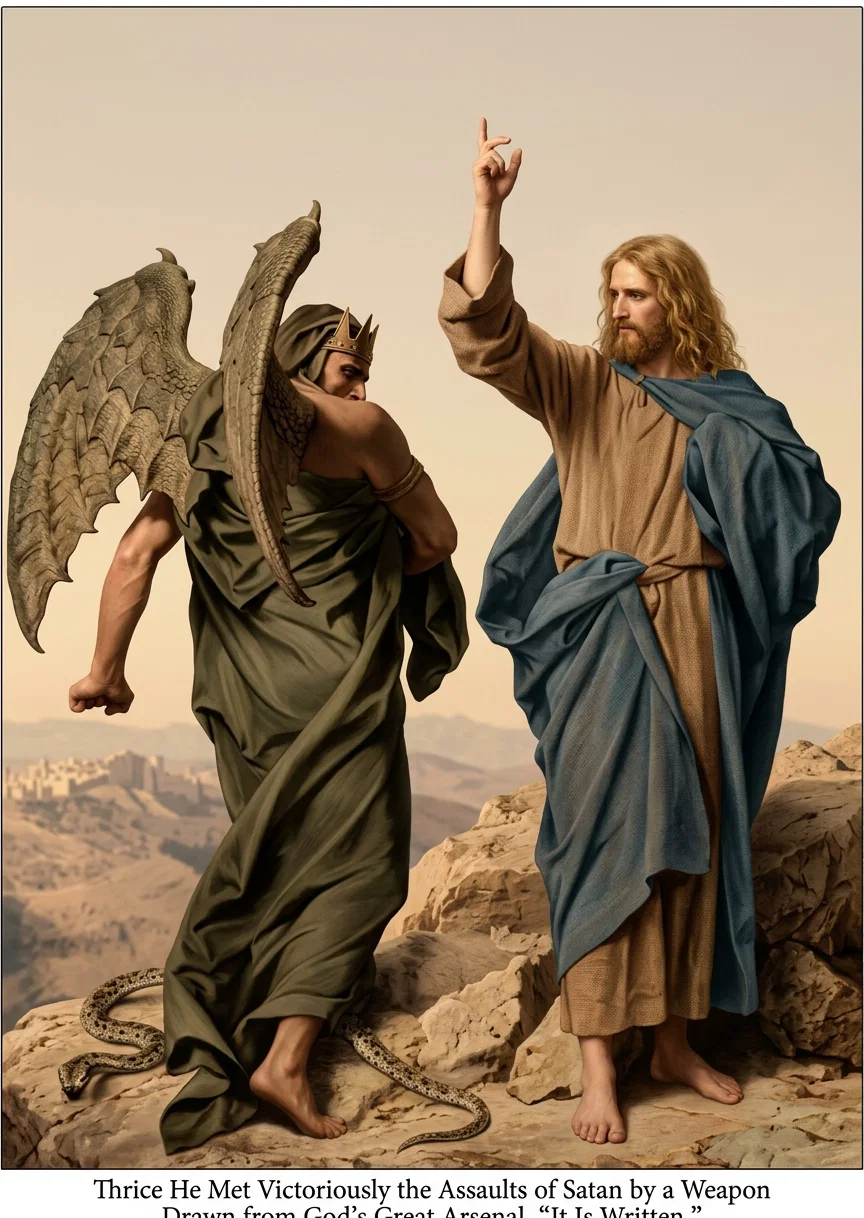
Thrice He Met Victoriously the Assaults of Satan by a Weapon Drawn from God's Great Arsenal, "It Is Written."

The Doctrines It Held

By Milton C. Wilcox
THERE are many who are dissatisfied with present religious conditions. They recognize the lack of power, and long and pray for the power manifest in "primitive Christianity," or the Christianity of Christ and the apostolic church. It is worth while to consider some of the fundamentals held by that early church. Their study may be practical. If we wish to reap the results, we must be willing to comply with the requisites. Among many characteristics of primitive Christianity we note the following:
1. Primitive Christianity respected the Scriptures. Said its Author, "The Scripture can not be broken." John 10:35. Thrice He met victoriously the assaults of Satan by a weapon drawn from God's great arsenal, "It is written." Matt. 4:3-11. He declared of the Scriptures: "They are they which testify of Me," and therefore should be searched. John 5:39.
Paul, Christianity's great apostle to the Gentiles, declares that the "Holy Scriptures" "are able to make thee wise unto salvation thru faith which is in Christ Jesus," and continues of them: "All Scripture is given by inspiration of God, and is profitable for doctrine, for reproof, for correction, for instruction in righteousness; that the man of God may be perfect, thoroly furnished unto all good works." 2 Tim. 3:15, 16. Peter declares of those who wrote the Scriptures, that the Spirit of Christ testified thru them, that "holy men of God spake as they were moved by the Holy Spirit," and that that word is the Gospel which he preached. 1 Peter 1:9-11, 24, 25; 2 Peter 1:16-21.
Even so did primitive Christianity regard the Holy Scriptures of what we call the Old Testament.
2. Primitive Christianity had respect to the great moral law of Ten Commandments. Hear its Author again: "If thou wilt enter into life, keep the commandments." Matt. 19:17. "Think not that I am come to destroy the law or the prophets; I am not come to destroy, but to fulfil. For verily I say unto you, Till heaven and earth pass, one jot [the smallest letter in the Hebrew alphabet] or one tittle [a little distinguishing point of a letter] shall in nowise pass from the law, till all be fulfilled." Matt. 5:17-19. The prophets will not all be fulfilled till eternity is in the past; and God's commandments are founded forever. Ps. 111:7, 8.
Declares the apostle Paul: "By the law is the knowledge of sin." "Nay, I had not known sin, but by the law; for I had not known lust, except the law had said, Thou shalt not covet." Rom. 3:20; 7:7. He declares that the Jews possessed the outward form of the truth in the law, but did not know the law in the heart (Rom. 2:17-23), while faith in Christ placed that same true form and righteous law in the heart. "Do we then make void the law thru faith? God forbid; yea, we establish the law" (Rom. 3:31). Another declares that whosoever

Primitive Christianity.

(Continued from Page 3.)
shall "keep the whole law, and yet offend in one point" is "guilty of all," because one God gave it all and he concludes: "So speak ye, and so do, as they that shall be judged by the law of liberty." James 2:8-12.
The beloved disciple declares: "This is the love of God, that we keep His commandments; and His commandments are not grievous." 1 John 5:3. And as Jesus kept the commandments of God (John 15:10), so John enjoins: "He that saith he abideth in Him, ought himself also so to walk even as He walked" (1 John 2:6).
Even thus primitive Christianity regarded the holy law. Why do men who profess to be seeking primitive Christianity trample it under their feet? "Blessed are they that do His commandments." Rev. 22:14.
Primitive Christianity believed and taught the second coming of Christ, declaring that when that event was near, the children of light would know it.
"For the Son of Man shall come in the glory of His Father with His angels; and then He shall reward every man according to his works." Matt. 16:27.
"WHEN the Son of Man shall come in His glory, and all the holy angels with Him, THEN shall He sit upon the throne of His glory." Matt. 25:31.
"Behold, He cometh with clouds; and every eye shall see Him, and they also which pierced Him; and all kindreds of the earth shall wail because of Him. Even so, Amen." Rev. 1:7.
"But ye, brethren, ARE NOT IN DARKNESS, that that day should overtake you as a thief. Ye are all the children of light, and the children of the day; we are not of the night, nor of darkness." 1 Thess. 5:4, 5.
"And there shall be signs in the sun, and in the moon, and in the stars; and upon the earth distress of nations, with perplexity; the sea and the waves roaring; men's hearts failing them for fear, and for looking after those things which are coming on the earth; for the powers of heaven shall be shaken. And THEN shall they see the Son of Man
COMING IN A CLOUD with power and great glory. And when these things begin to come to pass, then look up, and lift up your heads; for your redemption draweth nigh.
"And He spake to them a parable: Behold the fig-tree and all the trees; when they now shoot forth, ye see and know of your own selves that summer is nigh at hand. So likewise ye, WHEN YE SEE THESE THINGS COME TO PASS, KNOW YE THAT THE KINGDOM OF GOD IS NIGH AT HAND. Verily I say unto you, This generation shall not pass away, till all be fulfilled. HEAVEN AND EARTH SHALL PASS AWAY, BUT MY WORDS SHALL NOT PASS AWAY." Luke 21:25-33.
And in the closing words of the Book are these:
"He which testifieth these things saith, Surely I come quickly; Amen. Even so, come, Lord Jesus." Rev. 22:20.
Primitive Christianity believed and taught that the hope of the Christian centered in the literal resurrection of Christ, and in the resurrection of the dead by virtue of Christ's resurrection.
"Now if Christ be preached that He rose from the dead, how say some among you that there is no resurrection of the dead? But IF THERE BE NO RESURRECTION of the dead, THEN IS CHRIST NOT RISEN; and if Christ be NOT risen, then is our PREACHING VAIN, and YOUR FAITH is also VAIN. Yea, and we are found false witnesses of God; because we have testified of God that He raised up Christ; whom He raised not up, if so be that the dead rise not.
"For if the dead rise not, then is not Christ raised; and if Christ be NOT raised, YOUR FAITH IS VAIN; ye are yet in your sins. THEN THEY ALSO WHICH ARE FALLEN ASLEEP IN CHRIST ARE PERISHED. If in this life only we have hope in Christ, we are of all men most miserable. But now is CHRIST RISEN from the dead, and become the first-fruits of them that slept. For since by man came death, by man came also the resurrection of the dead." 1 Cor. 15:12-21.
"For if we believe that Jesus died and rose again, even so them also which sleep in Jesus will God bring with Him. For this we say unto you by the word of the Lord, that we which are alive and remain unto the coming of the Lord shall not prevent them which are asleep. For the Lord Himself shall descend from heaven with a shout, with the voice of the archangel, and with the trump of God; and the dead in Christ shall rise first: then we which are alive and remain shall be caught up together with them in the clouds, to meet the Lord in the air; and so shall we ever be with the Lord. Wherefore comfort one another with these words." 1 Thess. 4:14-18.
Primitive Christianity believed and taught the vicarious atonement and salvation of men thru the substitution and death of Jesus Christ.
"Surely He hath borne our griefs, and carried our sorrows; yet we did esteem Him stricken, smitten of God, and afflicted. But He was wounded for our transgressions, He was bruised for our iniquities; the chastisement of our peace was upon Him; and with His stripes we are healed. All we like sheep have gone astray; we have turned every one to his own way; and the Lord hath laid on Him the iniquity of us all." Isa. 53:4-6.
"Even as the Son of Man came not to be ministered unto, but to minister, and to give His life a ransom for many." Matt. 20:28.
"Moreover, brethren, I declare unto you the Gospel which I preached unto you, which also ye have received, and wherein ye stand; by which also ye are saved, if ye keep in memory what I preached unto you, unless ye have believed in vain. For I delivered unto you FIRST OF ALL that which I also received how that CHRIST DIED for our sins according to the Scriptures; and that He was buried, and that He rose again the third day according to the Scriptures." 1 Cor. 15:1-4.
"But God commendeth His love toward us, in that, while we were yet sinners, Christ died for us. Much more then, being now justified by His blood, we shall be saved from wrath thru Him. For if, when we were enemies, we were reconciled to God by the death of His Son; much more, being reconciled, we shall be saved by His life." Rom. 5:8-10.
"And all things are of God, who hath reconciled us to Himself by Jesus Christ, and hath given to us the ministry of reconciliation; to wit, that God was in Christ, reconciling the world unto Himself, not imputing their trespasses unto them; and hath committed unto us the word of reconciliation. Now then we are ambassadors for Christ, as though God did beseech you by us; we pray you in Christ's stead, be ye reconciled to God. For HE HATH MADE HIM TO BE SIN FOR US, WHO KNEW NO SIN; THAT WE MIGHT BE MADE THE RIGHTEOUSNESS OF GOD IN HIM." 2 Cor. 5:18-21.
Primitive Christianity did not believe that man possessed eternal life or immortality in himself, but that they are the gifts of Jesus Christ, the former now by faith, the latter absolute at His coming. Now God "only hath immortality." 1 Tim. 6:16. The righteous put it on at Christ's coming. 1 Cor. 15:51-54. While in this world, they are to seek for immortality, and God gives them His life to enable them to obtain it. Rom. 2:7. Only in Christ and character is there continuance in the life to come. All centers in the Master and our acceptance of Him.
Primitive Christianity believed and taught union and unity, not thru federation nor creed nor resolution nor political action, but life union thru the truth and Spirit of God. Here is the prayer of the Master and the exhortations of His apostles:
"And this is life eternal, that they might know Thee the only true God, and Jesus Christ whom Thou hast sent. . . . They are not of the world, even as I am not of the world. Sanctify them thru Thy truth; Thy word is truth. As Thou hast sent Me into the world, even so have I also sent them into the world. And for their sakes I sanctify Myself, that they also might be sanctified thru the truth.
"Neither pray I for these alone, but for them also which shall believe on Me thru their word; that they ALL MAY BE ONE; AS THOU, FATHER, ART IN ME, AND I IN THEM, THAT THEY ALSO MAY BE ONE IN US; that the world may believe that Thou hast sent Me. And the glory which Thou gavest Me I have given them; that they may be one, even as We are one: I in them, and Thou in Me, that they may be made perfect in one; and that the world may know that Thou hast sent Me, and hast loved them, as Thou hast loved Me." John 17:3-23.
"Now I beseech you, brethren, by the name of our Lord Jesus Christ, that ye all speak the same thing, and that there be NO DIVISIONS AMONG YOU; but that ye may be perfectly joined together in the SAME MIND and in the SAME JUDGMENT." 1 Cor. 1:10.
"If there be therefore any consolation in Christ, if any comfort or love, if any fellowship of the Spirit, if any bowels and mercies, fulfil ye my joy, that ye be likeminded, having the same love, being of ONE ACCORD of ONE MIND." Phil. 2:1, 2.
Primitive Christianity neither had union with the State nor sought its power. It depended wholly on the power of the weapons not carnal. All union of the Church and the world constitutes spiritual fornication and alienation from Christ.
"And Jesus came and spake unto them, saying, All POWER IS GIVEN UNTO ME in heaven and in earth. Go ye therefore," etc. Matt. 28:18-20.
"Then said Jesus unto him, Put up again thy sword into his place; for all they that take the sword shall perish with the sword." Matt. 26:52.
"Jesus answered, My kingdom is not of this world; if My kingdom were of this world, then would My servants fight, that I should not be delivered to the Jews; but now is My kingdom not from hence." John 18:36.
"Not for that we have dominion over your faith, but are helpers of your joy; for by faith ye stand." 2 Cor. 1:24.
"Knowing therefore the terror of the Lord, we PERSUADE men; but we are made manifest unto God; and I trust also are made manifest in your consciences." 2 Cor. 5:11.
"Ye adulterers and adulteresses, know ye not that the friendship of the world is enmity with God? whosoever therefore will be a friend of the world is the enemy of God." James 4:4.
"For tho we walk in the flesh, we do not war after the flesh; (for the weapons of our warfare are not carnal, but mighty thru God to the pulling down of strongholds); casting down imaginations, and every high thing that exalteth itself against the knowledge of God, and bringing into captivity every thought to the obedience of Christ." 2 Cor. 10:3-5.
Such was primitive Christianity. Such will be the Christianity of the renewed, reformed, regenerated church which greets her Lord at His coming. Of that church it is said; "Here is the patience of the saints: here are they that keep the commandments of God, and the faith of Jesus." Rev. 14:12.
Reader, are you in doubt, perplexity, fear? Why not come back to the true, tried word of God? Jesus said: "If any man willeth to do His [the Father's] will, he shall know of the teaching, whether it is of God" (John 7:17); and, "Every plant, which My heavenly Father hath not planted, shall be rooted up" (Matt. 15:13). Why not leave the poisonous upas-trees of error, the exotics of a day, and find shelter and sustenance in God's tree of life?

Result of Babylon's Fall

THOSE who read last week's issue of this paper understand the prophetic significance of the word "Babylon." Ancient Babylon fell, not because her mighty walls crumbled in decay or because her soldiery was the less valiant. The mystic handwriting appeared on the wall, "Thou art weighed and found wanting. Thy kingdom is given to the Medes and Persians." Not because in times of peace she had failed to provide herself for war, but because her iniquity arose as a stench to heaven, and God could no longer endure her. No nation ever fell because of its physical weakness. Its first fall is a moral fall. Righteousness is the strength of a nation. "The throne is established by righteousness." Prov. 16:12. It is a sad short-sightedness of moral vision that relies on armies and navies.
There seems to be a dim consciousness of this fact, or a clear consciousness with a very dim conception of its bearings, in the minds of many religious persons to-day. For, flying to the opposite extreme, they conclude that governments should directly support religion if not enforce some of its precepts. We do not impugn their sincerity or their patriotism; but the age is such as to freight this sentiment with consequences dangerous to government and destructive of true religion. Let us reflect on the situation.

International Apprehension.

On the one hand we have everywhere national apprehension. There is no genuine international faith or comity. The nations are angry. Rev. 11:18. What nation, as a government, do we trust as influenced by justice instead of by selfish policy?—Not one. What nation does England, France, Germany?—Not one. Every government is suspicious of every other. Each one is straining every resource to arm and equip itself to fight.

Domestic Apprehensions.

Then, added to this fear of things from without, there is everywhere apprehension concerning domestic evils. What with terrorism, labor troubles, socialism, political corruption, increase of crime, drunkenness, lynching, divorce, factional strife and the rest, thoughtful men are at their wits' end. It is times like these that have driven despairing men and women into monasteries and convents in hope of finding a calm and peaceful refuge from the troublous times.

Religious Decline.

Over against this dread of impending national disaster, or, perhaps, concomitant with it, there is on all hands religious decline. Old faiths and creeds have almost ceased to hold or restrain men. A false species of science has been laboring for years to destroy the old religious concepts. And it has quite succeeded. Not that there is not much that might as well be let go forever; but along with the useless has gone the foundations of true religion. When, for instance, there is no ultimate end or basis of morals than social utility, when this life is practically the be-all and end-all of existence, we may be sure that no very strong cords will bind men's consciences. When, along with some exploded religious notions foisted on the Bible in dark ages, there goes the belief that it is only a book among books, instead of a revelation of God to men, we may as well make up our minds that lawlessness will rule society. The fact is, our very system of public education has assumed the work of leading the rising generation to reject the Bible as man's rule of faith and practise, to regard it as of no more authority than Homer's Iliad or the Vedas of India. A little over a week ago the writer received a letter from a young lady attending one of the higher institutions of public instruction in Boston. She was very much puzzled to know what to do. For months one of her teachers has been laboring as if it were his duty to bolster up the theory of evolution with supposed evidences from every possible source—embryology, morphology, paleontology, comparative anatomy, rudimentary organs, and so forth.

The Consequences.

Now this sort of thing is not the exception in our public schools; it is the rule. The result is that society is rapidly approaching the state of mind and morals where it has absolutely no religious foundation. The consequences are already manifest—"Men's hearts failing them for fear, and for looking after those things that are coming on the earth." Luke 21:26. The reign of violence, crime, lawlessness, and passion is appalling. In this extremity men turn to their leaders in religion for help. What do they find?—Vagueness, speculation, higher criticism, drifting—confusion—Babylon.

The Bible Foretells It.

Long ago the Book that is being rejected as an antiquated volume of moral maxims, would have told us that all these things are signs that the course of evil has reached its climax, that to prolong the course of time would be to perpetuate iniquity to no purpose. The final warning, based on the infallible word of God, is now being given. But will Babylon heed? Will the apostate Christianity of these perilous times turn from her worldliness, her pride, her vanity, her self-sufficiency? Will she listen to the message? She has already rejected it. And what is the result? Something must be done. Everybody admits that. If the churches are powerless, what hope is there for the age?

The Two Sources of Power.

We are not left in uncertainty as to how Babylon will attempt to meet the emergency. The things written aforetime for our learning, again instruct us clearly. If the churches are powerless, they must have power. There are two ways of seeking this; one is to get it from God; the other is to get it from man.

The Lesson of Prophecy and History.

Now prophecy and history coincide in teaching us that just in proportion as religion has lost the power of God, it has sought the aid of civil government. And of all the abominations in God's sight, the Scripture reveals this to be one of the worst.
Ages ago the prophet of the Most High made known how He regards the act of His followers looking to the civil arm for aid: "Wo to the rebellious children, saith the Lord, that take counsel, but not of Me; and that cover with a covering, but not of My Spirit, that they may add sin to sin; that walk to go down into Egypt, and have not asked at My mouth; to strengthen themselves in the strength of Pharaoh, and to trust in the shadow of Egypt! . . . Now go, write it before them in a table, and note it in a book, that it may be for the time to come forever and ever; that this is a rebellious people, lying children, children that will not hear the law of the Lord." Isa. 30:1-9.

The Cause of the Apostasy.

Here the cause of this apostasy is made plain: it is the rejection of the law of God. Do we see this to-day?—We certainly do. For years the definite call has gone forth for the Lord's people to return to His law by keeping His Sabbath—the seventh day. His people have refused. Babylon is fallen. Deserted of God, she seeks worldly power to enforce a false sabbath—Sunday.
Of His church, the Lord says: "Thy Maker is thine husband; the Lord of hosts is His name." Isa. 54:5. He uses the dearest relation that mankind knows to illustrate His tender love for His people. "Turn, O backsliding children, saith the Lord; for I am married unto you." Jer. 3:14. And when His church joins itself to another, the Scriptures call her a harlot. Read the third chapter of Jeremiah. Again, the church is likened in its purity to a chaste virgin. The purity of chaste womanhood is probably the mightiest force in society outside of the Bible. It is not the nun's religious garb or the sacred sanctions of her church that give her immunity anywhere. It is her vow of purity. When a vestal virgin despised her oath, the Romans showed their abhorrence by burying her alive. So it seems God expresses His repugnance to the illicit connection between the church and the world—both in adopting its ways and in seeking its aid—by using the strongest symbol of shameless perfidy and lewdness which language knows. Well may men stand mute with terror when their course calls forth the denunciation so awful in its plainness, "Babylon the great is fallen, is fallen, and is becomethe habitation of devils, and the hold of every foul spirit, and a cage of every unclean and hateful bird. For all nations have drunk of the wine of the wrath of her fornication, and the kings of the earth have committed fornication with her. . . . Come out of her, my people, that ye be not partakers of her sins, and that ye receive not of her plagues. For her sins have reached unto heaven, and God has remembered her iniquities." Rev. 18:2-5. Let God's people seek the power of their God, and have nothing to do with the unholy demand for State aid in enforcing religious dogmas.
Continue reading: The Beast and His Image