Your ShelfYour Projects

Signs of the Times, Vol. 34, No. 5.

Christ the Teacher and Healer

Signs of the Times

Jan 29, 1908

Pacific Press Publishing Company · Mountain View, California · Jan 29, 1908

Christ the Teacher and Healer

By Mrs. E. G. White

Delivered from the Power of Satan.

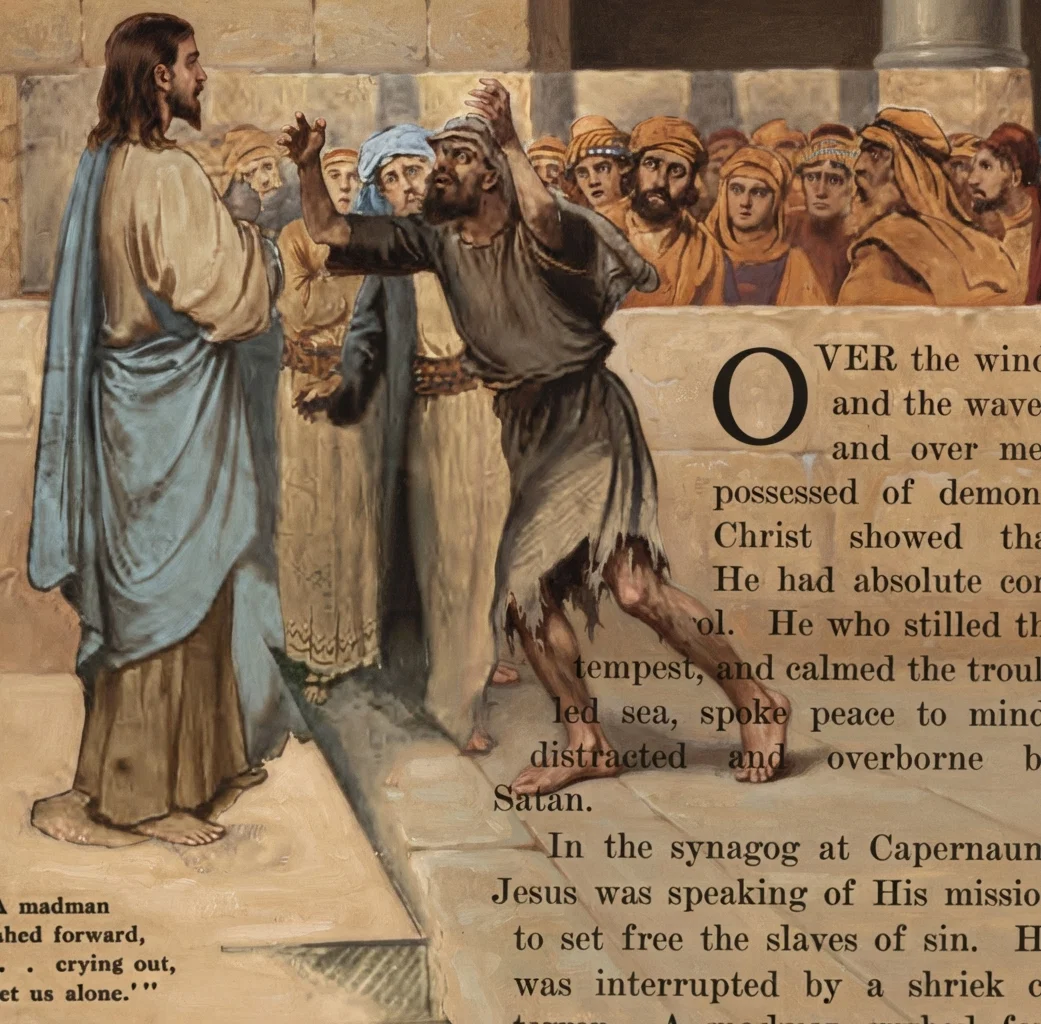
OVER the winds and the waves, and over men possessed of demons, Christ showed that He had absolute control. He who stilled the tempest, and calmed the troubled sea, spoke peace to minds distracted and overborne by Satan.
"A madman
rushed forward,
. . . crying out,
'Let us alone.'"
"A madman rushed forward, . . . crying out, 'Let us alone.'"
In the synagog at Capernaum, Jesus was speaking of His mission to set free the slaves of sin. He was interrupted by a shriek of terror. A madman rushed forward from among the people, crying out, "Let us alone; what have we to do with Thee, Thou Jesus of Nazareth? art Thou come to destroy us? I know Thee who Thou art, the Holy One of God."
Jesus rebuked the demon, saying, "Hold thy peace, and come out of him. And when the devil had thrown him in the midst, he came out of him and hurt him not."
The cause of this man's affliction also was in his own life. He had been fascinated with the pleasures of sin, and had thought to make life a grand carnival. Intemperance and frivolity perverted the noble attributes of his nature, and Satan took entire control of him. Remorse came too late. When he would have sacrificed wealth and pleasure to regain his lost manhood, he had become helpless in the grasp of the evil one.
In the Saviour's presence he was roused to long for freedom; but the demon resisted the power of Christ. When the man tried to appeal to Jesus for help, the evil spirit put words into his mouth, and he cried out in an agony of fear. The demoniac partially comprehended that he was in the presence of One who could set him free; but when he tried to come within reach of that mighty hand, another's will held him; another's words found utterance thru him.
The conflict between the power of Satan and his own desire for freedom was terrible. It seemed that the tortured man must lose his life in the struggle with the foe that had been the ruin of his manhood. But the Saviour spoke with authority and set the captive free. The man who had been possessed stood before the wondering people in the freedom of self-possession.
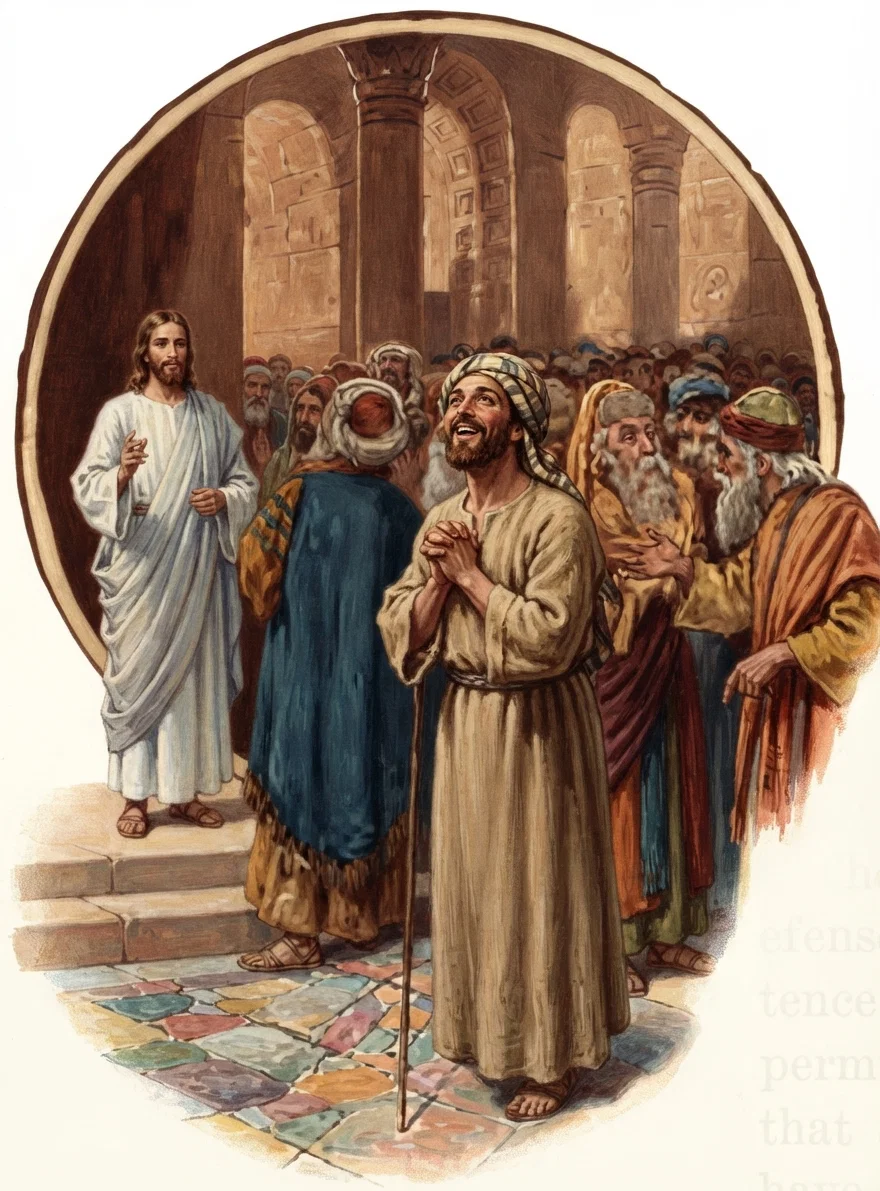
With glad voice he praised God for deliverance. The eye that had so lately glared with the fire of insanity now beamed with intelligence, and overflowed with grateful tears. The people were dumb with amazement. As soon as they recovered speech they exclaimed one to another, "What is this? a new teaching! with authority He commandeth even the unclean spirits, and they obey Him."
There are multitudes to-day as truly under the power of evil spirits as was the demoniac of Capernaum. All who wilfully depart from God's commandments are placing themselves under the control of Satan. Many a man tampers with evil, thinking that he can break away at pleasure; but he is lured on and on, until he finds himself controlled by a will stronger than his own. He can not escape its mysterious power. Secret sin or master passion may hold him a captive as helpless as was the demoniac of Capernaum.
Yet his condition is not hopeless. God does not control our minds without our consent; but every man is free to choose what power he will have to rule over him. None have fallen so low, none are so vile, but that they may find deliverance in Christ. The demoniac, in place of prayer, could utter only the words of Satan; yet the heart's unspoken appeal was heard. No cry from a soul in need, tho it fail of utterance in words, will be unheeded. Those who consent to enter into covenant with God are not left to the power of Satan or to the infirmity of their own nature.
"Shall the prey be taken from the mighty, or the lawful captive delivered? . . . Thus saith the Lord, Even the captives of the mighty shall be taken away, and the prey of the terrible shall be delivered; for I will contend with him that contendeth with thee, and I will save thy children."
Marvelous will be the transformation wrought in him who by faith opens the door of the heart to the Saviour.
The twelve apostles, and the seventy disciples whom Christ sent forth later, received supernatural endowments as a seal of their mission. When the work of the seventy was completed, they returned with joy, saying, "Lord, even the devils are subject unto us thru Thy name." Jesus answered, "I beheld Satan as lightning fall from heaven."
Henceforth Christ's followers are to look upon Satan as a conquered foe. Upon the cross, Jesus was to gain the victory for them; that victory He desired them to accept as their own. "Behold," He said, "I give unto you power to tread on serpents and scorpions, and over all the power of the enemy; and nothing shall by any means hurt you."
The omnipotent power of the Holy Spirit is the defense of every contrite soul. No one who in penitence and faith has claimed His protection will Christ permit to pass under the enemy's power. It is true that Satan is a powerful being; but, thank God, we have a mighty Saviour, who cast out the evil one from heaven. Satan is pleased when we magnify his power. Why not talk of Jesus? Why not magnify His power and His love?
"With glad voice he praised God for deliverance."
The rainbow of promise encircling His throne is an everlasting testimony that "God so loved the world, that He gave His only-begotten Son, that whosoever believeth in Him should not perish, but have everlasting life." It testifies to the universe that God will never forsake His children in the struggle with evil. It is an assurance of strength and protection while the throne itself endures.

Christian Science in the Light of Reason and Revelation

By R. A. Underwood

VI. Christian Science, Pantheism, and Spiritualism Compared.

CHRISTIAN Science is pantheism and Spiritualism combined under a new name. A careful study of pantheism, Spiritualism, and Christian Science shows a marked similarity. The principal doctrines are about the same, with slight modifications. When any of these are tested by the word of God, it will be seen that they all emanate from the same source of darkness, and are all under the control and guidance of fallen angels. In this article I will note a few of the doctrines taught by Spiritualists, and the reader will readily recognize the similarity in their fundamental teachings to that of Christian Scientists.

A Power above the Natural.

There is a power attending all these movements beyond and above the natural power of man. Dr. W. F. Barrett, professor of Experimental Physics in the Royal College of Dublin, says of Spiritualism: "It is well known to those who have made the phenomena of Spiritualism the subject of long and careful inquiry in the spirit of exact and unimpassioned scientific research, that beneath a repellent mass of imposture and delusion, there remain certain inexplicable and startling facts, which science can neither explain away nor deny."—"Automatic or Spirit Writing," page 11.
Again, in "Automatic Writing," page 14, he says, "I am in possession of a respectable body of facts that I do not know how to explain except on the theory that I am dealing with some invisible intelligence."
The Bible does not leave us in doubt with reference to what this intelligence is. We are admonished, "There shall not be found among you any one that maketh his son or his daughter to pass thru the fire, or that useth divination, or an observer of times, or an enchanter, or a witch, or a charmer, or a consulter with familiar spirits, or a wizard, or a necromancer; for all that do these things are an abomination unto the Lord." Deut. 18:10-12. "Regard not them that have familiar spirits, neither seek after wizards, to be defiled by them: I am the Lord your God." Lev. 19:31. "A familiar spirit is one that comes at a call."—Webster.
Of this ancient Spiritualism, which is only another form of pantheism, the apostle Paul gives warning concerning its reappearance in the last days in these words: "Now the Spirit speaketh expressly, that in the latter times some shall depart from the faith, giving heed to seducing spirits, and doctrines of devils." 1 Tim. 4:1. Of this same power and working, John on the Isle of Patmos says: "For they are the spirits of devils, working miracles, which go forth unto the kings of the earth and of the whole world, to gather them to the battle of that great day of God Almighty." Rev. 16:14.
These are evil spirits, fallen angels, who disguise themselves, claiming to be the spirits of dead persons. Many are entrapped and thereby deceived, and led to deny their hope in Christ.

Some of the Leading Doctrines of Spiritualists.

The following statements, showing some of the leading doctrines of Spiritualists, will be of interest in connection with the study of Christian Science. Spiritualists deny the Christian doctrine of salvation thru Jesus Christ. "What is the meaning of the word 'Christ'?—It is not, as is generally supposed, the Son of the Creator of all things. Any just and perfect being is Christ. The miraculous conception of Christ is merely a fabulous tale."—Spiritual Telegram, No. 37.
Another authority among Spiritualists says: "Man is his own saviour, his own redeemer. He is his own judge, in his own scales weighed."—"Healing of the Nations," page 74.
The Banner of Light, of Oct. 9, 1886, a Spiritualist paper, says: "Spirits do not accept the theory of the divinity of Jesus Christ. They do not believe that He was crucified for mankind in the accepted understanding of that term."
W. F. Jamieson, a Spiritualist medium, in Banner of Light, April 12, 1871, says: "I do not believe in a personal God." A. J. Davis, medium and writer, in "Nature's Divine Revelation," page 521, says: "Sin, indeed, in the common acceptation of that term, does not really exist." Again, J. S. Loveland (Ex-M. E. minister), in Banner of Light, says: "Crime does not displease God. God is in the darkest crime as in the highest holiness. He is equally pleased in either case."
A. J. Davis, Spiritualist medium, in a lecture on philosophy of reform given in New York City, makes the following statement: "In the Hebrew and Christian Scriptures, it is affirmed that sin is the transgression of the law, but by an examination of nature, the true and only Bible, it will be seen that this statement is erroneous. It gives a wrong idea of both man and law. . . . It will be found impossible for man to transgress a law of God."

The Doctrine Founded on the Immortality of the Soul.

It is hardly necessary for me to quote from Spiritualist authors or other sources to show that they found their teaching upon the doctrine of the natural or inherent immortality of the soul. Spiritualists, as well as Christian Scientists, regard man as a part of God. Hence they reason that he can not sin. If the opinion of John Milton, the celebrated author of "Paradise Lost," as expressed in his treatise on "Christian Doctrine," vol. 1, pages 250, 251, were
accepted, it would be a cure, not only to the doctrines of Spiritualism, but also to those of Christian Science. He says: "Man is a living being, intrinsically and properly one individual, not compound and separable, not, according to the common opinion, made up and formed of two distinct and different natures, as of body and soul; but the whole man is soul, and the soul man. That is to say, a body or substance, individual, animated, sensitive, and rational."
While the Bible uses the terms "soul" and "spirit" in the aggregate seventeen hundred times, it does not affirm in any instance that either the soul or the spirit is immortal, does not ever apply to them the terms "eternal," "deathless," "never-dying," or any word that bears the meaning of possessing immortality. However, it does say that God "only hath immortality." 1 Tim. 1:17; 6:16. Man is exhorted to earnestly seek for immortality thru Christ, and is promised, if faithful, that he shall receive this boon of an endless life when "this corruptible must put on incorruption, and this mortal must put on immortality" at the resurrection of the just. Rom. 2:7; 6:23; 1 Cor. 15:51-54; Luke 14:14.

The Similarity to Christian Science.

To show the reader the similarity of the teaching of Christian Science to the doctrines of Spiritualism, I will again quote from "Science and Health with Key to the Scriptures," edition 1905, by Mrs. Mary Baker G. Eddy, touching the question of salvation thru Jesus Christ: "One sacrifice, however great, is insufficient to pay the debt of sin. The atonement requires constant self-immolation on the sinner's part. That God's wrath should be vented upon His beloved Son is divinely unnatural. Such a theory is man-made." Page 23.
"Jesus' students, not sufficiently advanced to fully understand their Master's triumph, did not perform many wonderful works until they saw Him after His crucifixion, and learned that He had not died." Pages 45, 46.
"Science and Health," page 115, giving the scientific translation of immortal mind, defines it as follows: "God; Divinity; Principle; Life; Truth; Love; Soul; Spirit; Mind." These are all used as synonyms. Again it says: "Continuing our definition of man, let us remember that the harmonious and immortal man has existed forever. . . . The soul, the mind, of man is God." Page 302. "The immortal soul makes man immortal." Page 306. "Two essential points of Christian Science are that neither life nor man dies." Page 349.
Again the reader will note a striking similarity in the teaching of Christian Science to that of Spiritualism with reference to sin. "To get rid of sin thru science is to divest sin of any supposed mind or reality, and never to admit that sin can have intelligence, power, pain, or pleasure. You conquer error by denying its verity." Page 339. "All that mind, God, is, or hath made, is good, and He made all. Hence in reality there is no evil. . . . It exists only so long as the material illusion of mind in matter remains. It is the sense of sin, and not sinful soul,which must be lost." Page 311. "Soul can not sin, for sin is not eternal verity of being." Page 468.
Christian Scientists may deny any connection with Spiritualism or pantheism. However this may be, the facts remain unchanged that ancient Spiritualism or necromancy, pantheism, modern Spiritualism, and Christian Science are all off-shoots of the old philosophy and doctrine first advocated in Eden by the serpent; namely, that man can not die. Gen. 3:4. It was belief in this doctrine that led to the ancient pretended communications with the departed dead. It also developed the doctrine of pantheism.
The same old doctrine was revived under the name of modern Spiritualism, which found millions of followers in the years 1844 to 1865. During this time of the rapid growth of Spiritualism, some of the leading Spiritualists advocated "free love," which led to the breaking up of many families, and brought the doctrines of Spiritualism under great reproach.
At that time (1866) the master of deception changed his tactics, and with slight modifications, under a new and taking name, launched anew his old doctrine in the present movement of Christian Science. Millions from all classes of people to-day are accepting this same old doctrine, which denies the existence of sin and death, and thereby deceives man and destroys his only hope of salvation thru the Gospel of Christ.
Dear reader, stop and consider well before you abandon your only hope of salvation thru the death of the Son of God.
"Wicked spirits gather round thee, Legions of those foes to God, Principalities most mighty Walk unseen the earth abroad. They are gathering for the battle, Strengthened for the last great strife. Christian, arm! Be watchful, ready; Struggle manfully for life."

The Rule of Faith and Practise.

“THE Scriptures of the Old and New Testaments, having been given by inspiration of God, are the all-sufficient and only rule of faith and practise, and judge of controversies.
“1. What is meant by saying that the Scriptures are the only infallible rule of faith and practise?
“Whatever God teaches or commands is of sovereign authority. Whatever conveys to us an infallible knowledge of His teachings and commands is an infallible rule. The Scriptures of the Old and New Testaments are the only organs thru which, during the present dispensation, God conveys to us a knowledge of His will about what we are to believe concerning Himself, and what duties He requires of us.
“7. In what sense is the completeness of the Scripture as a rule of faith asserted?
“It is not meant that the Scriptures contain every revelation which God has ever made to man, but that their contents are the only supernatural revelation that God does now make to man, and that this revelation is abundantly sufficient for man’s guidance in all questions of faith, practise, and modes of worship, and excludes the necessity and the right of any human inventions.”—Rev. A. Alexander Hodge, in his “Outlines of Theology.”

The Hidden Spring.

A TRAVELER, in telling the tales of his adventures, mentions among the high mountains of a certain range a tiny, hidden spring. Altho many visitors to that place seek for this spring, it is only after diligent search that they find it and drink of its sparkling waters. They know it is there, for the results of its silent work are evident in the greensward and the freshness of the vegetation.
So in this world there is a hidden spring, at which all may be refreshed. Not one, whatever his lineage, whatever his station, is debarred from drinking at this fountain of life-giving water. New streams run from it in many directions, quietly making the ground green and reviving the drooping and withering flowers.
Many have sought in vain, not so much for the one true spring as for the results which obtain from the pure, sparkling water found therein.
Have you guessed the name of this hidden fountain? Yes, it is that for which man has been seeking thruout the ages—the spring of happiness, which finds its source in the great Master Mind of the universe.
For centuries man has been trying to create a spring of happiness which might center in himself. He has tried science, philosophy, psychology, metaphysics, pantheism, new thought, Christian Science, higher criticism, hypnotism, and a score of others—but all in vain. Real, true happiness is not to be found in these. Knowledge, wisdom, learning, are well and good, and we pity the man who has little or no desire to possess them, who has not the laudable ambition to become a scholar of worth and ability—but all the knowledge this world can give is vain if not directed in the right channels.
Is happiness of heart or peace of mind to be found in self? Is it to be found in science? in philosophy?—Never. In vain has man endeavored to find it there. "Vanity of vanities," says the wisest human preacher this world has ever known, "all is vanity and vexation of spirit," unless—unless we have found the true joy which comes by drinking at the life-giving spring of happiness, the great fountain of living water, and letting that life, that happiness, flow out to water and refresh the hearts and souls of those about us.
Are you happy? Then make others so. Are you unhappy? You need not be. It is your privilege to be happy whatever your circumstances. Forget self, live for others, draw long, deep drafts from the great Fountain of living truth, that your own soul may be watered and in turn water others.
Of all persons in this dark world, Christians should be most happy. They should carry the light of a beautiful soul upon their countenances, a radiance shining from within. It would banish the darkness and dispel the gloom from the faces and hearts of others. Such a happiness ennobles, purifies, and uplifts the character, and helps to make the lives of those around us brighter and sweeter and nobler.
KATHRINA BLOSSOM WILCOX.

Obedience Entire.

[The following excellent paragraphs are selected from Rev. Charles G. Finney’s lecture on “Obedience Entire.” We regret that our space will not permit the publishing of the lecture in full, for the paragraphs that we quote are but a sample of the excellence of the whole production.]
THE government of God accepts nothing as virtue but obedience to the law of God.
But it may be asked, Why state this proposition? Was this truth ever called in question? I answer that the truth of this proposition, tho apparently so self-evident that to raise the question may reasonably excite astonishment, is generally denied. Indeed, probably nine-tenths of the nominal church deny it. They tenaciously hold sentiments that are entirely contrary to it and amount to a direct denial of it. They maintain that there is much true virtue in the world, and yet that there is no one who ever for a moment obeys the law of God; that all Christians are virtuous, and that they are truly religious, and yet not one of earth obeys the moral law of God; in short, that God accepts as virtue that which, in every instance, comes short of obedience to His law. And yet it is generally asserted in their articles of faith that obedience to moral law is the only proper evidence of a change of heart. With this sentiment in their creed, they will brand as a heretic, or as a hypocrite, any one who professes to obey the law, and maintain that men may be, and are pious, and eminently so, who do not obey the law of God. This sentiment, which every one knows to be generally held by those who are styled orthodox Christians, must assume that there is some rule of right, or of duty, besides the moral law; or that virtue, or true religion, does not imply obedience to any law.
God has never proclaimed any other rule of duty, and should He do it, it could not be obligatory. The moral law did not originate in His arbitrary will. He did not create it, nor can He alter it, or introduce any other rule of right among moral agents. Can God make anything else right than to love Him with all the heart, and our neighbor as ourselves?—Surely not. Some have strangely dreamed that the law of faith has superseded the moral law. But we shall see that moral law is not made void, but is established by the law of faith. True faith, from its very nature, always implies love or obedience to the moral law; and love or obedience to the moral law always implies faith. As has been said on a former occasion, no being can create law. Nothing is, or can be, obligatory on a moral agent but the course of conduct suited to his nature and relations. No being can set aside the obligation to do this. Nor can any being render anything more than this obligatory. Indeed, there can not possibly be any other rule of duty than the moral law. There can be no other standard with which to compare our actions, and in the light of which to decide their moral character.

The Everlasting Covenant

Created in Christ Jesus.

1. When the earth was prepared for the home of man, what did Jehovah say? "Let US make man in OUR image, after Our likeness." Gen. 1:26.
2. To whom did the Creator speak? "In the beginning was the Word, and the Word was with God, and the Word was God." John 1:1. "But to us there is but one God, the Father, of whom are all things, and we in Him; and one Lord Jesus Christ, by whom are all things, and we by Him." 1 Cor. 8:6.
3. In whom then was man chosen even before sin entered? "Who hath blessed us with all spiritual blessing in heavenly places IN CHRIST; according as He hath CHOSEN US IN HIM BEFORE THE FOUNDATION OF THE WORLD." Eph. 1:3, 4.
4. When man sinned, what did God do? "For God so loved the world, that HE GAVE HIS ONLY-BEGOTTEN SON, that whosoever believeth in Him should not perish, but have everlasting life." John 3:16.
5. What part had the Son in this? "Who GAVE HIMSELF FOR US, that He might redeem us from all iniquity, and purify unto Himself a peculiar people, zealous of good works." Titus 2:14.
6. Has God changed in His purpose respecting man? "I am the Lord, I CHANGE NOT." Mal. 3:6. "With whom is no variableness, NEITHER SHADOW OF TURNING." James 1:17.

Freedom of Choice—Faith.

7. What awful power does He give man? "I have set before you life and death, blessing and cursing; therefore CHOOSE life, that both thou and thy seed may live." Deut. 30:19.
NOTE.—The awful responsibility of freedom of choice God gives to all His reasoning creatures, and God Himself will not enter that sacred circle of personal responsibility and free choice without the consent of man's free will. And this is most reasonable; for God demands of man righteous character; but righteous character demands freedom of choice. Compulsory righteousness is a contradiction of terms. God demands love, but love must render willing service.
8. How alone could man choose character, life, and salvation? "But WITHOUT FAITH it is IMPOSSIBLE to please Him." Heb. 11:6.
NOTE.—Faith is not a power to be exercised by man since sin entered only. It is a foundation of character in all ages of human history and conditions. Man had no power to please God apart from faith before he sinned. Had he been able to lead a righteous life of himself, he would have given himself all the glory, and so a race of selfish, differing ones would have been developed. But faith in the Infinite would have developed truest love for the ways of the Infinite. The finite creature would have ever developed toward the infinite God, and would thus progress as in no other way. All would seek God's glory and all would be bound by the law of His life. So life and right-living and character can only be perpetuated by faith, the open channel between the soul and God.

The Everlasting Covenant. The Father of the Faithful.

9. By what term has the Lord expressed His pledge and purpose of saving men? "My covenant;" "the everlasting covenant." See Gen. 6:18; 9:9, 16; 17:7, 19; 1 Chron. 16:16, 17; Heb. 13:20.
10. With what typical person was this covenant established in his age? "And I [Jehovah] will establish My covenant between Me and thee [Abraham] and thy seed after thee in their generations for an everlasting covenant, to be a God unto them, and to thy seed after thee." Gen. 17:7.
11. How much did God's covenant to Abraham include? "By Myself have I sworn, saith the Lord, for because thou hast done this thing, and hast not withheld thy son, thine only son, that in blessing I will bless thee, and in multiplying I will multiply thy seed as the stars of the heaven, and as the sand which is upon the sea shore; and THY SEED shall possess the gate of His enemies; and in thy SEED shall all the nations of the earth be blessed; because thou hast obeyed My voice." Gen. 22:16-18.
12. By what means did Abraham come into this covenant relationship? "He believed the Lord; and He counted it unto him for righteousness." Gen. 15:6; Gal. 3:6; James 2:23.
13. What did it lead Abraham to do? "Abraham obeyed My voice, and kept My charge, My commandments, My statutes, and My laws." Gen. 26:5. "Faith wrought with his works, and by works was faith made perfect." James 2:22.
14. How much is embraced in the inheritance promised? "The promise that he [Abraham] should be the HEIR OF THE WORLD, was . . . thru the righteousness of faith." Rom. 4:11. "Thy Seed shall possess the gate of His enemies." Gen. 22:17.
15. Who is this Seed thru whom all the covenant blessings come? "Now to Abraham and his Seed [posterity] were the promises made. He saith not, And to seeds [posterities] as of many; but as of one, and to thy Seed, which is CHRIST." Gal. 3:16. "And if ye be Christ's, then are ye Abraham's seed, and heirs according to the promise." Gal. 3:29.

Establishing the Covenant.

16. How was the covenant established to Noah? By promise and covenant token: "I establish My covenant with you, and with your seed after you." "And the bow shall be in the cloud; and I will look upon it, that I may remember the everlasting covenant." Gen. 9:9, 16.
17. How was it established to Abraham? By promise and oath: "For when God made PROMISE to Abraham, because He could SWEAR by no greater, He sware by Himself, saying, Surely blessing I will bless thee, and multiplying I will multiply thee. And so, after he had patiently endured, he obtained the promise. For men verily swear by the greater: and an oath for confirmation to them an end of all strife. Wherein God, willing more abundantly to show unto the heirs of PROMISE the immutability of His counsel, confirmed it by an OATH: that by two immutable things, in which it was impossible for God to lie, we might have a strong consolation, who have fled for refuge to lay hold upon the hope set before us." Heb. 6:13-18.
18. When was that everlasting covenant forever confirmed or ratified? "For this is My blood of the new testament ["covenant," the same word in the Greek], which is shed for many for the remission of sins." Matt. 26:28. See also Heb. 9:14, 15.
NOTE.—The covenant is also called a testament, or will, because it is expressive of God's great loving purpose for His children. It is called the "new" covenant, because it was confirmed later by the death of Christ. All God's blessings of all the ages were the blessings of the covenant. As before a man's death he can give of his estate to his children, in harmony with his general purpose, so God, by virtue of Christ's offering and His own love, has ever bestowed His covenant blessings upon His children in harmony with His great and everlasting purpose. When Christ died upon the cross that unchangeable purpose was ratified by His blood for the benefit of His children forever, that they might know the surety of His promises. Unchangeable in love and wisdom was God's purpose before its confirmation by the death of Christ; that death fixes it unchangeable forevermore. When Christ died, that man might never question God's covenant of justice, mercy, wisdom, and love, it was sealed forever by the death of Christ. Heb. 9:16, 17. "Tho it be but a man's covenant, yet if it be confirmed, no man disannulleth or addeth thereto." Gal. 3:15. Whatever was in that covenant prior to Christ's death abides forever. Whatever man has endeavored to introduce into that covenant, even tho it be but a secondthis side of His death, is false and fraudulent, whether it be called "Lord's day," or infant baptism, or any other perversion of truth. Christ on the cross forever fixed God's immutable law and Gospel.

The Old Covenant.

19. How is this "new covenant" contrasted with the "old covenant"? "But now hath He obtained a more excellent ministry, by how much also He is the Mediator of a BETTER COVENANT, which was established upon BETTER PROMISES. For if that first covenant had been faultless, then should no place have been sought for the second. For FINDING FAULT WITH THEM, He saith, Behold, the days come, saith the Lord, when I will make a new covenant with the house of Israel and with the house of Judah: NOT ACCORDING TO THE COVENANT that I made with their fathers, in the day when I took them by the hand to lead them out of the land of Egypt; because they continued not in My covenant, and I regarded them not, saith the Lord." Heb. 8: 6-9.
NOTE.—The making of the "old covenant" between God and Israel is recorded in Ex. 19: 3-8. In it God declared that if they would obey HIS VOICE and keep HIS COVENANT (See Deut. 4: 13), by faith, of course, they would then be His peculiar treasure, a kingdom of priests, and a holy nation. These things were told to the elders of the people, and they declared: "All that the Lord hath spoken we will do." Then God came down upon Mount Sinai, spoke to them His voice, declared His law, His will, and their sin-filled hearts trembled; but instead of pleading that God would come in and take away their sin, they pleaded that He would not speak to them any more. Ex. 20: 19. Yet when they again had heard the conditions of the covenant, after Moses had written them all out in a book, and read them to the people, they declared, "All that the Lord hath said will we do, and be obedient." Then the book and the people were sprinkled with blood and Moses said, "Behold, the blood of the covenant, which the Lord hath made with you CONCERNING ALL THESE WORDS," that is, the words of God's voice which they promised to obey. Ex. 24: 3-8. We know the sequel: Israel failed. They SHOULD have learned—and we MAY learn—two great lessons: (1) That man is utterly powerless to do God's will in his own strength, or apart from faith. (2) That a covenant made with a whole people can not save individuals. Those apart from Christ, trusting in their own righteousness, are still striving and failing as did Israel; and every attempt to make righteousness by vote or promise is a demonstration that the world has not learned the second lesson. Used in either way, it "gendereth to bondage." Gal. 4: 24. Yet in God's providence it did serve a purpose; it helped to hold together that people in one nation till Christ came according to the flesh; but it saved no one.
20. Wherein lay the fault of the first covenant? "Finding fault WITH THEM." Heb. 8: 8.
21. Wherein is the everlasting covenant superior to the old? It "was established upon BETTER promises." Heb. 8: 6. NOTE.—The difference between the two covenants is the difference between the weak, puny promises of sinful men, trusting in their own strength, afraid of God's voice, and the infinite promises of God, asking only simple faith and submission on the part of His children.

What the New Covenant Does for Man.

22. What will the new covenant do for him who by faith yields to its claims? "For this is the covenant that I will make with the house of Israel after those days, saith the Lord; I will put MY LAWS INTO THEIR MIND, and WRITE THEM IN THEIR HEARTS: and I will be to them a God, and they shall be to Me a people: and they shall not teach every man his neighbor, and every man his brother, saying, Know the Lord: for all shall know Me, from the least to the greatest. For I will be merciful to their unrighteousness, and their sins and their iniquities will I remember no more." Heb. 8: 10-12; Jer. 31: 31-34.
23. What would the life of this covenant relation cause man to do? "A new heart also will I give you, and a new spirit will I put within you: and I will take away the stony heart out of your flesh, and I will give you a heart of flesh. And I will put My Spirit within you, and CAUSE YOU TO WALK IN MY STATUTES, and ye shall keep My judgments, and do them." Eze. 36: 26, 27.
24. In what condition does that covenant relation place the sinner? "There is therefore now NO CONDEMNATION to them which are in Christ Jesus." Rom. 8: 1.
25. What sets us free? "For the LAW OF THE SPIRIT OF LIFE IN CHRIST JESUS hath made ME FREE from the law of sin and death." Verse 2.
26. Why could not the law alone do this? "It was weak thru the flesh." Verse 3.
27. What does the new covenant do? "God [saved by] sending His own Son in the likeness of sinful flesh, and for sin, condemned sin in the flesh; that the RIGHTEOUSNESS OF THE LAW ["the requirement of the law," A.R.V.] MIGHT BE FULFILLED in us, who walk not after the flesh, but after the Spirit." Verses 3, 4.
28. What mind only hates God's law? "Because the carnal mind is enmity against God; for it is not subject to the law of God, neither indeed can be." Verse 7.
29. How does the new-covenant mind regard God's law? "For this is the LOVE OF GOD, that we KEEP HIS COMMANDMENTS; and His commandments are NOT GRIEVOUS." 1 John 5: 3.
30. With whom is the new covenant made and confirmed? "The house of Israel." Heb. 8: 10. "Who are Israelites; to whom pertaineth the adoption, and the glory, and the covenants, and the giving of the law, and the service of God, and the promises." Rom. 9: 4.
31. What do those Gentiles become who embrace Christ? "Now therefore ye are no more strangers ["from the covenants of promise," v. 12] and foreigners ["from the commonwealth of Israel," "having no hope, and without God in the world," v. 12], but fellow citizens with the saints, and of the household of God." Eph. 2: 19.
32. What is one of the covenant blessings which God gives to Israel? "Wherefore the children of Israel shall keep the Sabbath, to observe the Sabbath throuout their generations, for a perpetual covenant." Ex. 31: 16.
33. What is said of God's remnant people of "the everlasting covenant" brought into covenant relationship thru "the everlasting Gospel"? "Here is the patience of the saints; here are they that keep the commandments of God, and the faith of Jesus." Rev. 14: 12. "And if ye be Christ's, then are ye Abraham's seed, and heirs according to the promise." Gal. 3: 29.

What John Wesley Taught.

"It was not the design of Christ to revoke any part of the law. It can not be broken. Every part of it remains in force upon all men in all ages. Neither time, place, nor circumstances make it liable to change."
Continue reading: Truth and Error