Signs of the Times, Vol. 43, No. 30.

Squaring with Destiny

Signs of the Times

Aug 1, 1916

Pacific Press Publishing Association · Mountain View, California · Aug 1, 1916
Squaring with Destiny

The Carving of Turkey Bound Up in the Present Mighty Conflict — This Partition Will Bring on the Fatal Crisis, in Which the Age Will Perish

By Louis H. Christian
"IT is the last Judgment. Every one has handed in his account. Now we have to get square with destiny." Thus spoke a high Russian official early in the war to an American author. To him destiny meant the fate and future of each nation.
"The fate of the world is bound up in the Eastern question." With these memorable words, the learned Dr. Dollinger began one of his historical lectures. For more than a century, this Eastern question has been the great unsolved and unsolvable world problem.
Concerning this, Clarence Barton writes in "The Audacious War": "Now who in Washington knows anything about Mesopotamia and the Bagdad railway? Yet here is the key of the most far-reaching problem in any peace proposals. It is because this matter can now be settled that the plunging of Turkey into the war by Enver Bey has made all Europe rejoice. The Germans think Turkey is another 16½ howitzer or 'Jack Johnson' spreading black smoke over the British Empire. For the first time, the Turkish problem can be really settled instead of patched."

To Be Driven Out of Europe

For many years, the publishers of the SIGNS OF THE TIMES have called the attention of their readers to the Bible prophecies concerning the Eastern question. They have studied the eleventh chapter of Daniel, as well as the predictions in Revelation, where the fate of the Turk is clearly portrayed. Again and again, competent and conservative writers have shown that "the king of the north," spoken of in the latter part of Daniel eleven, is Turkey. They have ventured to assert that according to this prophecy, sooner or later the sultan will be driven out of Europe, bag and baggage, and will transfer his seat of government from Constantinople to the Holy Land — there ultimately to meet his doom. On the strength of plain Bible statements, they have emphasized that this ending of Turkey is the last great political event mentioned in prophecy, before the setting up of Christ's kingdom.
One of these divine predictions reads as follows: "And he [the king of the north, the sultan] shall plant the tabernacles of his palace between the seas in the glorious holy mountain; yet he shall come to his end, and none shall help him. And at that time shall Michael stand up, the great Prince which standeth for the children of thy people; and there shall be a time of trouble, such as never was since there was a nation even to that same time." Dan. 11: 45; 12: 1.
The unfolding of events in the present war has demonstrated beyond doubt that the exposition of Daniel's words which has been given in the SIGNS is correct. The fact is becoming moreand more evident that the carving of Turkey in the vital issue in this conflict, and that this partition will bring on the fatal crisis in which this age and civilization will perish. In the many articles dealing with the Eastern question and the present war as a link in fulfillment of prophecy, the quotations used have been largely from American or British authors. Possibly it might be well to consider the Eastern question and the present war as presented in books by German or at least by pro-German writers. To do this will but further establish the conclusions of the SIGNS concerning the fulfillment of Bible prophecies in the war of to-day.

Germany and the Balkan Imbroglio

DURING the life of Luther, the Turkish forces were repeatedly at the gates of Vienna, and threatened to overwhelm all Europe. In the following two hundred years, there were continual wars between the Teutonic races and the Turks. Step by step, the armies of Austria forced the Mohammedans back toward Asia, whence they had come.
In course of time, Russia became the great opponent of the Turks. During the nineteenth century, Austria and the German states did not take a very active part in the Turkish wars, while England and France became the great champions of Turkey and the opponents of Russia. The Teutons seemed to withdraw somewhat from the constant struggle over Constantinople. As late as 1875, Bismarck said: "What may happen in the Balkans does not concern Germany, but only Russia, Italy, Austria, and England. It has always been my aim to keep out of this. For this reason, we put a stipulation into our treaty with Austria, that we are not obligated in any way in Balkan affairs."
"Bismarck even stated that he would have no objection to Russia's taking Constantinople, and thought that with the possession of this gate to the Black Sea, she would be even less dangerous to Germany than at present. Of course, he knew that this would endanger England's possession of Egypt and the Suez Canal — both of which she needs as much as her daily bread." — Dr. George L. Schurger, in "What Would Bismarck Say?"

Russia's Century-Old Ambition

THIS policy of Bismarck has now been completely changed. The German states, which for centuries waged a relentless warfare against Turkey, are to-day the allies and protectors of the sultan, while England and France, especially England, are at his throat, with the avowed purpose not only of driving Mohammedanism from Europe, but even of ending the Turkish dominion in Asia and Africa. Russia wants Constantinople and a free outlet to the sea. England plans to take all of Arabia, Palestine, and southern Mesopotamia, hoping to build and protect a railroad from Alexandria to the Persian Gulf.
We quote from an address by Dr. Paul Rohrbach to the Protestant Union of Hamburg: "The present war has three roots: (1) The one we can dispatch quickly. That is the French. For more than forty years, France has expressed the desire to renew the combat with us. (2) As Germany became politically engaged in the Orient and in Turkey, her interests began to conflict with those of Russia. (3) In the year 1898, when the German emperor was in Jerusalem, and gave utterance to the dramatic words regarding his friendship with entire Islam, when German diplomacy supported the plan of the Bagdad railway, the chief interest of Germany and England was that the railway cut through Asia Minor, passed over the Taurus, reached Aleppo, made connections with the Syrian and Mecca railways, and extended to a point within 300-400 kilometers of the Suez Canal. The English believed that the German emperor desired to establish a basis of attack against England in anterior Asia, which was inevitable as a result of economic developments in Germany. This was a misapprehension — Germany planned no attack upon England."
Another writer, Prof. H. C. G. von Jagerman, says: "Russia's ambition for more than a century has been to extend her dominion over the Balkans and to win Constantinople. She might probably have done so long ago had this been in accordance with the designs of England and France. In order to win Constantinople, Russia must first dominate the southern Slavic states, Servia and Bulgaria; and she has for a long time arrogated to herself the part of their patron and protector. That Russia has a firm right to this position, Austria does not admit; for she is a Slavic power, and her commercial interests demand an open route to the sea and to the Orient, as much as Russia. Indirectly Germany's interests are at stake, for through Austria lies Germany's land route to the Orient."

Removing the Disturbing Factor

THE reader will notice that, these writers make plain that the partition of Turkey is the cause of this war. We quote from another who calls himself a pro-German and a personal friend of the kaiser: "For some time, Germany had been looking upon the Turkish empire in Asia as a new and profitable region for trade; and in1898, the German emperor made his famous visit to Constantinople, Damascus, and Jerusalem. The German idea was that instead of following any further the expensive and destructive and immoral policy of dismembering the Turkish empire, it would be more economical, constructive, and humane to maintain its integrity, and to seek its regeneration by bringing it into close contact with Europe.
"The German idea was prompted not only by the desire to extend German trade, not only by the desire to help on the development of the inhabitants of the Turkish empire, and not only by the conviction that the Turks were the best fitted among all the races of the empire to govern, but also by the desire of removing the Turkish question — that is, the question of the partition of Turkey — as the great disturbing factor of Europe, from the arena of European politics. Great Britain, on the other hand, evidently did not understand the German idea, or did not trust the German intentions. Her statesmen appeared to apprehend that the intentions of Germany were territorial acquisition in the Turkish empire, and naval hostility to Great Britain.
"An understanding between Russia, Germany, and Turkey in the Asiatic question could, to the British mind, mean just one thing; namely, the shunting of Russia away from Constantinople and from the Bay of Alexandretta, and her advance from the Transcaucasus through Persia to the Persian Gulf. Here Russia would at last reach the open sea and have an ice-free port. But she would then flank India. This mortal danger to the British Empire must at any cost be averted."

The Key to the Present Situation

"IT is to this task that the British diplomacy of the years between 1901 and 1914 has addressed itself. The plan of the British government then found and now pursued by force of arms is the acquisition of the vast territory lying between Egypt and the Levant on the west and lower Persia on the east, the connecting of the same with Egypt and the ports of the Levant by a railroad leading from Alexandria to the Persian Gulf, and the establishment, probably at Mecca or Cairo, of a new caliphate of the Mohammedan believers under the control of the British government. This would defend the British possessions of India, and it might open the way some day for the acquisition of all Mohammedan North Africa by the British Empire."—"The European War of 1914," by Dr. John William Burgess, pages 57, 58, 60, 61.
The Turkish problem does indeed hold the key to the present world situation and the future destiny of nations. The divine word regarding the solution of this problem will not fail. The statement of Dr. Burgess that "the plan of the British government" is "the establishment, probably at Mecca or Cairo, of a new caliphate of the Mohammedan believers under the control of the British government" reminds one of the prophecy that the sultan "shall plant the tabernacles of his palace between the seas in the glorious holy mountain." While the nations are trying to get square with destiny, God is working out His own divine will. "The kingdom of heaven is at hand."

Signs of the Coming End

To Be Recognized and Proclaimed, as Truly as the Outrunners Announced Christ's Triumphal Entry into Jerusalem

By BENJAMIN G. WILKINSON
THE signs of history tell their story, and cause to burn bright in the hearts of Christ's followers the hope of His soon return. Likewise the promised signs in heaven begin to appear. The Saviour has said: "But in those days, after that tribulation, the sun shall be darkened, and the moon shall not give her light, and the stars of heaven shall fall, and the powers that are in heaven shall be shaken. And then shall they see the Son of man coming in the clouds with great power and glory." Mark 13: 24-26.
The same is said under the sixth seal: "And I beheld when He had opened the sixth seal, and, lo, there was a great earthquake; and the sun became black as sackcloth of hair, and the moon became as blood; and the stars of heaven fell unto the earth, even as a fig tree casteth her untimely figs, when she is shaken of a mighty wind. And the heaven departed as a scroll when it is rolled together; and every mountain and island were moved out of their places. And the kings of the earth, and the great men, and the rich men, and the chief captains, and the mighty men, and every bondman, and every freeman, hid themselves in the dens and in the rocks of the mountains; and said to the mountains and rocks, Fall on us, and hide us from the face of Him that sitteth on the throne, and from the wrath of the Lamb; for the great day of His wrath is come; and who shall be able to stand?" Rev. 6: 12-17.
You will note that Mark says, "In those days, after that tribulation." Those days, according to other scriptures, as we have before shown, ended in 1798. While the peace of Westphalia, and the teaching of Roger Williams about 1650, diminished the intensity of the tribulation, yet the persecution continued for some time afterwards. Now did there begin to appear, sometime between 1650 and 1798, such great signs as a mighty earthquake, darkening of the sun, turning of the moon to blood, and the falling of the stars? — Certainly there did. To name the events that would seem to fulfill the prediction of the sixth seal, is to be met frankly with the question: "How do you know that the earthquake, the darkening of the sun and the moon, and the falling of the stars, which you point out under definite dates, are the ones predicted under the seventh seal, and by the writers of the three Gospels? Have there not been other fallings of stars, and other darkenings of the sun?" — Yes; but we might ask the same question concerning the prophecy in Zech. 9: 9:
"Rejoice greatly, O daughter of Zion; shout, O daughter of Jerusalem: behold, thy King cometh unto thee: He is just, and having salvation; lowly, and riding upon an ass, and upon a colt the foal of an ass."
One Sunday morning, which we now call Palm Sunday, the Saviour rode triumphantly into Jerusalem. The shouting crowds, the waving branches, the spread garments, were accompanied by the cries which said that this was the event to fulfill Zech. 9: 9. Now had not many a man ridden into Jerusalem on an ass, accompanied by "a colt, the foal of an ass"? — Most surely; but you will notice that this event was definitely located by two supporting reasons: first, it fell exactly in its place as one link in a chain of many events; and secondly, there was a people raised up by God to note it and to proclaim it. Matthew found no difficulty in recognizing Christ's triumphal entry into Jerusalem as the fulfillment of this prophecy. So today there is a people, one hundred twenty-five thousand strong, who, scattered all over the world, recognize definite signs in the heavens, as well as in history, as proclaiming clearly to them the thrilling news that Christ is soon to return.

Ruined from Top to Bottom

THE first of these signs was a great earthquake. Did any remarkable earthquake occur in the period of time set forth above? — Yes; the great earthquake of November, 1755, which, though called the earthquake of Lisbon, extended to the greater part of Europe, Africa, and America.
Its unusual importance is thus recognized by Vivienne de St. Martin, in his "Geographical Dictionary": "In 1755, an earthquake, the most famous in history, practically destroyed the city. Lisbon, the admiration of strangers, as much because of her exceptional situation as because of the beauty of her monuments, suffered a terrible shock, when the two earthquakes of 1755 ruined it from top to bottom. November 1, at nine o'clock in the morning, was felt the first upheaval. Subterranean crashings sounded forth; temples and housesshattered to pieces; and six seconds were enough to destroy the monuments and almost forty thousand individuals. The number of persons who were crushed in the houses and in the streets was not to be compared to the people who were buried in the churches."
Of the extent of the earthquake outside of the city of Lisbon, Larousse says: "The earthquake of Lisbon was felt over a surface of area computed as four times the surface of Europe. It was in Portugal, Spain, and in the northern part of Africa, that the first shock was the most violent. The port of Setubal, some distance from Lisbon, was submerged by an enormous wave. At Cadiz, high walls near to the banks were carried away by the sea, which rose to more than sixty-five feet above its ordinary level. In Morocco, many villages were devastated. At Algeria and at Fez, more than ten thousand human victims could be counted. On the western slope of the Atlantic, in the Lesser Antilles, where the tide is not high, the water suddenly became entirely black, and rose higher then twenty-two feet. At the same moment, the lakes of Switzerland and of Sweden, and the ocean which bathes the shores of Norway, became violently agitated. It is reported also that Vesuvius, then in motion, suddenly grew quiet the moment of the earthquake."—Article "Earthquake."
One of the great signs of the soon-coming Saviour as outlined in the series under the sixth seal is past. Three more great signals in the heavens were to occur before the people would be raised up to announce the second coming, as were the outrunners on Palm Sunday to welcome the first advent.

How Old Is Man?

A Protest Against the Popularizing of the "Bestial Origin"—The Gulf Between Fancy and Fact

By Prof. George McCready Price
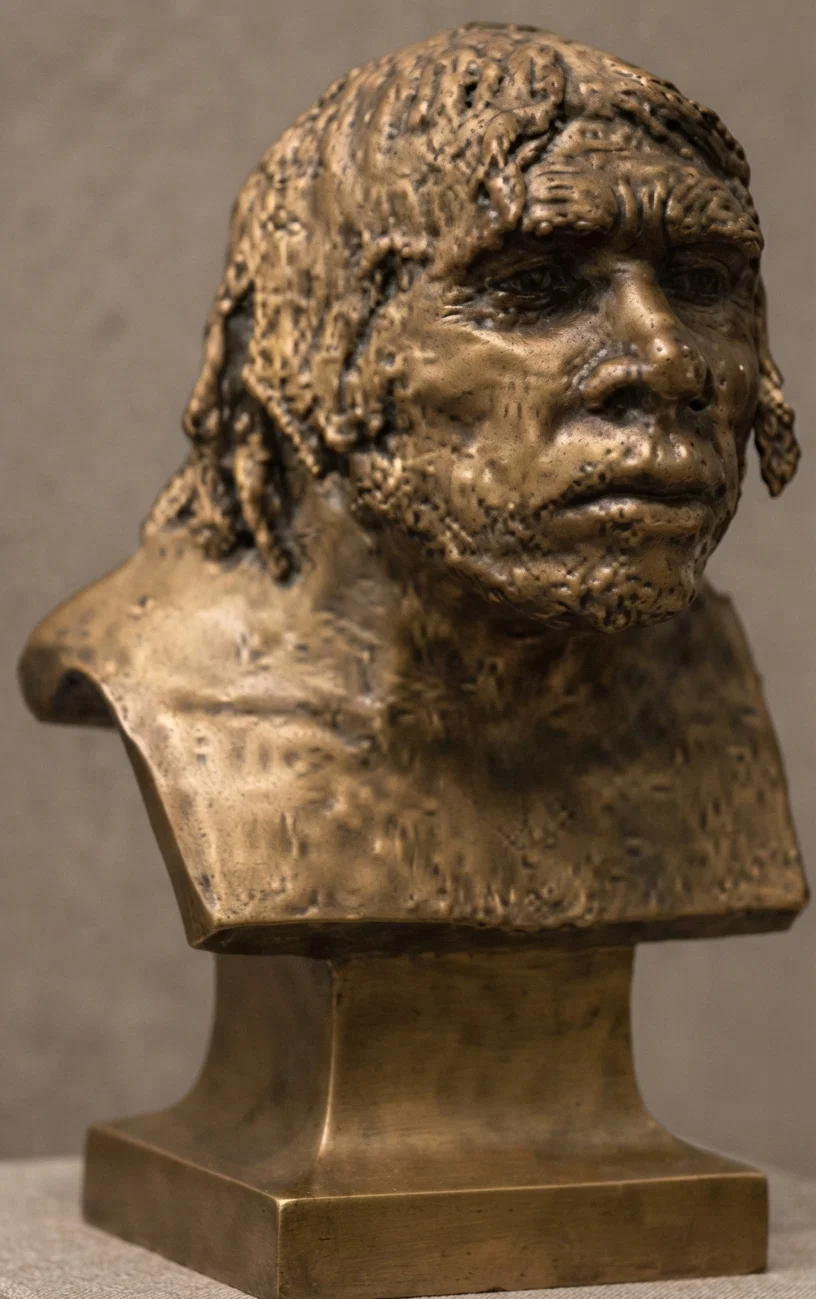
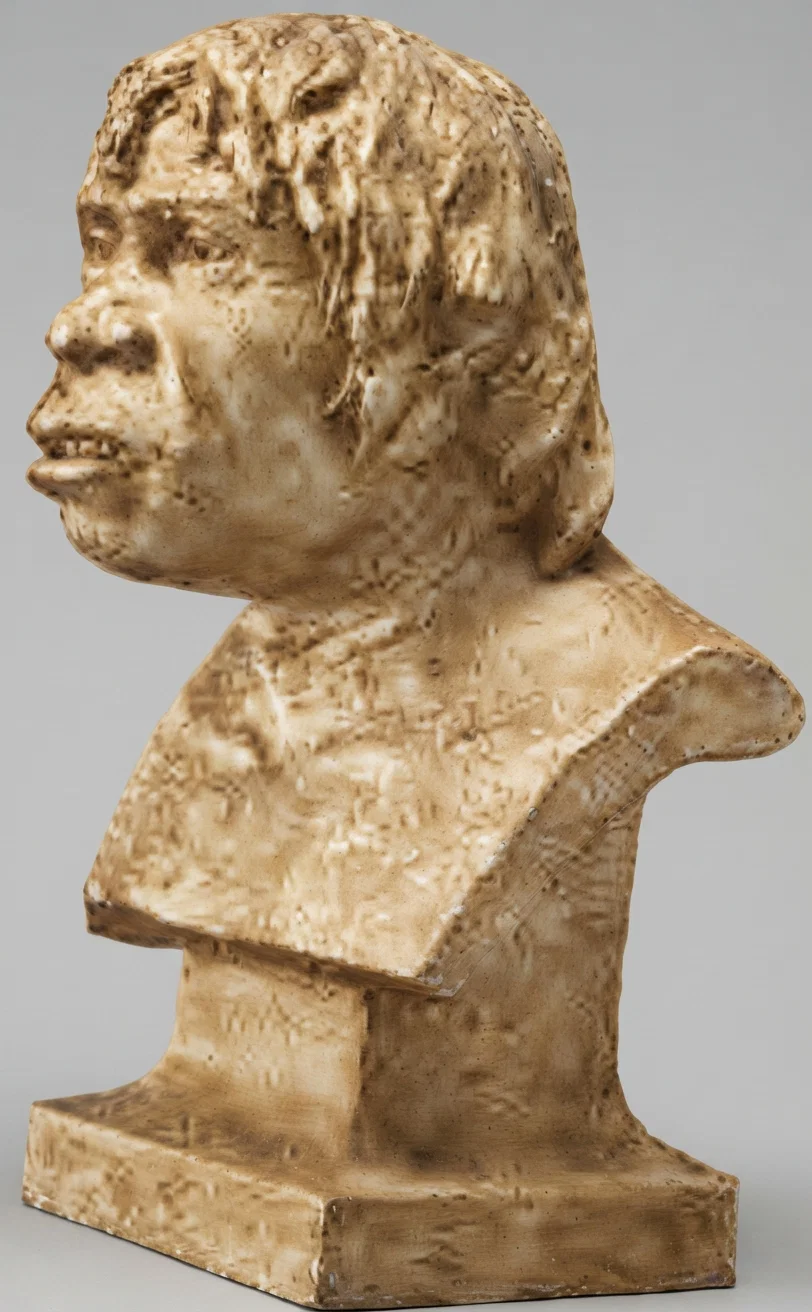
The Neanderthal man, a race that is supposed to have lived in caves of central France many thousands(?) of years ago.
A head reconstructed on the Piltdown skull, found in Sussex, England; believed to have lived there 100,000 to 300,000(?) years ago.
WHEN an ex-president of the United States has an inclination to indulge in literary work, he can at once command an audience. And when this same individual has already acquired a considerable reputation as a hunter, a naturalist, a patron of scientific work, almost as himself a scientist, we may be sure that people will listen to his pronouncements on scientific matters with great interest if not with absolute reverence. And such an effect will be increased, if possible, when the writing of such an author, on such a subject, appears in a publication of a technical or a semi-technical character.
All these specifications are combined in an article by Theodore Roosevelt, which appeared in the National Geographical Magazine for February, 1916, under the same title as stands at the head of the present one. The article mentioned is really a review of a recent book — "Men of the Old Stone Age," by Henry Fairfield Osborn — which is a professedly scientific work, written by one who stands very high among scientists in this country. And the very outspoken attitude of the colonel toward this book may be judged by his statement that "it is the most important work on the evolution of our own species that has appeared since Darwin's 'Descent of Man.'"
In this sentence, we have Professor Osborn described as the continuator of Darwin's work and theories; while the article by Colonel Roosevelt may be called an effort to popularize these teachings by boosting this latest and most authoritative book on the subject. With the book itself we shall have nothing to do at present; but the article to which reference is made contains so many astonishing characteristics that it well deserves some consideration.

Popularizing the Bestial Origin

IN the first place — as might be expected from its being printed in the Geographical Magazine — the article is elaborately illustrated. But these illustrations take the form of photographs of what profess to be "restorations" of models of ancient men and animals found as fossils, with several maps of Europe during various stages of the so-called "glacial period," when — according to the maps — the British Isles were joined to the continent of Europe, with an extension of this land mass reaching past Iceland into the arctic regions. The first cut is a half-tone with the following legend below it: "The Ape Man of Java, a Prehuman Creature Who Lived Probably 500,000 Years Ago." Another illustration shows us the features of "a head reconstructed on the Piltdown skull, found in Sussex, England: Eoanthropus dawsoni," who the author assures us is believed to have lived 100,000 to 300,000 years ago. Still another is that of the Neanderthal man, "a race which lived in caves of central France 50,000 years ago."
From these titles of a few of the illustrations accompanying the article in question, the reader can get an idea of some of the reasons why I feel justified in saying that the publication of such an article, with such illustrations, is much to be deplored; for it is an example of methods of "popularizing" the theory of the bestial origin of man, methods which partake of the character of the "science" one expects to find in the Sunday supplement of the daily paper, but which were supposed to have been discarded by reputable scientists long ago — and have been discarded by all writers on strictly scientific subjects when dealing with any other subject than this of the ape origin of man.
My reasons for such strong remarks are almost obvious. There are no facts whatever known to modern science which justify any such representations. These photographs are made from "reconstructions" supposed to represent these ancient men; but in most cases, these "reconstructions" have been made from only one or two bones, while the geological "age" in which they lived, and the character of the creatures when alive, cannot be proved to justify even partially the absurd statements made in connection with them.

Indulges Theoretical Propensities

IN other words, these pictures of ancient men, and, indeed, the whole article accompanying them, can be called "scientific" only by a greatly modified use of this much abused word. The first quality of a truly scientific mind is the ability to keep facts and theories separate and distinct from each other. Theories are all right in their place; but their place is in the warehouse or the basement, and not in the show window. No scientist can get along without theories, and plenty of them. But when a man shows a manifest incapacity for distinguishing between real facts and very highly questionable theories, and when, moreover, he indulges a propensity for exhibiting his unproved theories in his show window, along with what the public have a right to regard as objective realities, he thereby shows that he is sadly lacking in the prime essential of a scientific mind.
To drop the figure, and to speak in plain language: Colonel Roosevelt's article puts forward as absolute facts what are mere theories, and theories that are by no means universally received among modern scientists; and these theories are advanced with all the air of being the only view held by anybody to-day. The rawest and most highly questionable theories, which are received by only one extreme faction of the educated world as even possible, are put forward as incontrovertible facts, and the existence of any other views is merely ignored with lofty scorn.
Let me explain what I mean, by the help of some facts regarding the first picture given in the article; namely, that of "the ape man of Java." This specimen is usually dignified with a Latin specific name, to mark it as a distinct species of animal; and I cannot do better than to give here a portion of an article found in the last edition of "Encyclopædia Britannica":

From Two Bones and Two Teeth

"Pithecanthropus Erectus (erect ape man), the name given by Dr. Eugene Dubois, of the Dutch army medical service, to the imaginary creature which he constructed from fossilized remains found by him in Java. These fragments consisted of a thigh bone, two teeth, and the upper part of a skull, and were unearthed in 1891-1892 on the left bank of the Bengawan River near Trinil. The skull appears to have been low and depressed with strong supraciliary ridges; the teeth are very large, and the femur is quite human. The teeth and skull were found together, the femur a few yards away a year afterwards. The discoverer, however, stated it as his belief that the fragments were portions of the same skeleton and belonged to a creature half way between man and the higher apes and of the Pleistocene age. Much discussion followed the 'find,' and many authorities have given an opinion adverse to Dr. Dubois's theory. The prevailing opinion is that the bones are human."—Volume 21, page 665.
From information gathered elsewhere, we learn that these bones were found under a bed of volcanic ash; and the "age" of this rock deposit is variously given as Pleistocene, Pliocene, or even as Miocene. But the "age" of the rock in which these bones were found does not prove that the bones themselves are necessarily very old — perhaps not even antediluvian. The reputed age of these bones is one of the weakest points in the whole argument that would seek to make this "ape man" represent one of our direct ancestors. But this point cannot be considered here; it must be reserved for another time.
A further fact to be remembered regarding these bones is that the roof of the skull was very "imperfect" when found. That is, not all of it was recovered. Hence the cubic contents of the skull could be estimated only approximately. The size of this person's brain has been usually estimated at from 900 to 1000 cc., or about two thirds that of an average modern man, or to quote the words of a recognized authority, it "stands at the level of the smallest which have been occasionally found among the reputedly lowest savage peoples."

Manifestly That of an Idiot

BUT it should be distinctly remembered that many first-class authorities regard this piece of a skull as manifestly that of a degenerate or an idiot. That is, they say it is a pathologic specimen, not a normal one by any means; and why should such a pathologicrelic be paraded as representing the normal condition of the race contemporary with him? By evolutionists, this particular specimen is regarded as the very oldest relic yet found of the direct ancestors of the human species — regarded as oldest, of course, chiefly because it is so low and bestial in type. But not another specimen has yet been found that is by any one even claimed to be contemporary with him. Then how absurd to say that this one specimen represents the normal character of a whole race!
This was essentially the argument of the great Rudolf Virchow, the highest authority in Germany on such matters, when these bones were first discovered. Virchow is called the "father" of the modern science of pathology, and he doubtless knew more about the pathologic changes that take place in the human body than any other man before or since. Not only so, but he was also the foremost authority in Germany on anthropology. Indeed, he occupied somewhat the same position in scientific circles on the continent of Europe that Colonel Roosevelt himself now occupies in American politics. But Virchow unhesitatingly pronounced not only this skull from Java but also the Neanderthal skull to be manifestly pathologic; that is, the peculiarities of each were the result of disease. Hence he protested, in his vigorous way, against the scientific use of such specimens as in any way representing the normal human being, Homo sapiens, in those periods of long ago.
It was ten years after the discovery of these bones in Java, or in 1902, that the great Virchow declared before an illustrious assembly of scientists in Vienna:

Virchow's "Perverse Ingenuity"

"THE attempt to find the transition from animal to man has ended in a total failure. The missing link has not been found, and will not be found. Man is not descended from the ape. It has been proved beyond a doubt that during the past five thousand years there has been no noticeable change in mankind."
Colonel Roosevelt cannot, of course, altogether ignore the testimony of such a world famous champion of the conservative views. But he speaks of him in the following language with reference to the Neanderthal skull:
"The perverse ingenuity of the great anatomist Virchow, who, with wrong-headed insistence, declared its peculiarities to be pathologic, delayed for a generation the full understanding of its importance." — Geographical Magazine, page 125.
But it was exactly as a pathologist that Virchow made these strong statements; and we must remember that he was head and shoulders above his contemporaries in this very subject of pathology — that, in fact, he was the founder and developer of the science of pathology. Further, it should also be remembered that multitudes of other eminent scientists agreed with Virchow in these respects, and just as many still agree with him. To-day Professor Osborn and Colonel Roosevelt have no light on these matters that was not known to these masters in pathology and anatomy ten or twenty years ago. Why, then, should these men be so sure of their theories regarding these bones, that they can give us photographs of just what these degenerates looked like, can quietly assume, contrary to the highest authorities on the subject, that these bones represent the normal characteristics of their contemporaries, and can confidently teach their innocent and unwary readers who may have had few opportunities of informing themselves on these matters, that these photographs represent what our ancestors looked like half a million years or so ago?
The colonel himself has more than once been very severe on some people whom he accused of "nature faking," because he thought they were not altogether accurate in their statements regarding important facts of natural history. But in view of the facts given above, we are almost forced to ask: Who is now doing the "nature faking"? Or why should such doubtful and highly questionable assertions be allowed to pass without a protest on the part of those who demand facts instead of theories in their science?
The reputed "age" of these deposits is just as weak a point in the general theory of these evolutionists; but it is quite another matter, and must be left over for consideration in another article. But I think that when the facts along this line also are presented, the statements about the age of these bones will appear even more inaccurate and more unscientific than the assertion that these bones belonged to normal representatives of the men of the long ago.
Continue reading: The Way of Prayer