Is Immortality Bestowed upon the Believer Conditionally, or Absolutely?
By Lucas A. Reed
We wish to emphasize the fact that while we quote from certain ministers to explain why the world is obsessed with the idea of man's inherent immortality, we do this with no intention of casting any reflection upon the character of the men from whom we quote. We believe, for example, that Mr. Moody did a vast amount of good in the world during his lifetime. In many things, he exalted the word of God, and held it forth as the true standard of Christian living. Nevertheless, in reference to man's nature and his condition in death, Mr. Moody followed the current teaching of the day. Thus in his sermon on heaven, he said:
"There is a class of people who say that the soul becomes unconscious, and sleeps until the resurrection. I cannot believe that." Then, to prove that we shall know each other there, he quotes, "I shall be satisfied, when I awake, with Thy likeness."
Put these two statements together — Mr. Moody's and the one he quotes from the Bible. One moment, he says he does not believe that the soul becomes unconscious, and sleeps until the resurrection; in another statement, he declares, "I shall be satisfied, when I awake." Let us put them still closer together: I do not believe that the soul sleeps, for the Bible says I shall be satisfied when I awake. Do you not see the inconsistency of the reasoning? If we are to be satisfied when we awake, it is plain that we must have slept.
Over and over again in the New Testament, the death of God's chosen is called a sleep,—a sleep because they are to awake on the morning of the resurrection. As Paul says, "We shall not all sleep, but we shall all be changed." That is to say, there will be some alive when Jesus comes. These will be changed, though they do not sleep and need a resurrection.
Considered an Unanswerable Argument
SPEAKING of the scripture, "He that believeth on the Son hath . . . life," Mr. Moody said: "It doesn't say that I am going to get eternal life when I die, nor at the general resurrection. 'He that believeth on the Son hath . . . life.' I have not got to wait. 'He that believeth on the Son hath . . . life,' h-a-t-h — present tense."
Mr. Moody thought this an unanswerable argument for immortality. We have no doubt whatever that the person who believes in life at death, will say, as he reads these words from that good man, Now, there is an argument that settles the matter. But we ask you to wait a minute. Let us look into this. Just previous to the words that we have quoted, Mr. Moody said:
"If a man receive eternal life when he is converted — and that is what God says he receives — how are you going to bury eternal life in the grave?"
Yet Mr. Moody knows that a man who is converted, and receives this eternal life to which he refers, can backslide. He has preached sermons on the prodigal son, the lost sheep, and the lost piece of money. He knows that, as the Bible teaches, a man can turn away again to the beggarly elements of the world — as Peter puts it, return like a dog to his vomit, "and the sow that was washed to her wallowing in the mire."
“He has preached sermons on . . . the lost piece of money.”
When the man was converted, and received eternal life, he must have had it in such a way that it could be lost, else we are face to face with the situation of once converted, always converted; and this we know is utterly untenable, according to the Bible.
Absolutely, or by Faith — Which?
If the scripture means that we really receive eternal life at conversion, when we accept Christ,—receive it in the absolute sense,—then the argument should be that we will never die, but like Elijah and Enoch, will be translated without seeing death. But every one knows that this is not true of Christians generally.
Then in what way do we receive eternal life when we are converted? The answer is this: We receive it by faith, just the same way that we receive Christ. Christ abides in our hearts by faith, and He is the life, and so we have His life by faith. Over and over again in the Bible, we are told that this life will be given to the saints on the morning of the resurrection. Notice the way in which Christ makes the promise; for this is the way in which we must receive the promise. Notice in what way Christ has granted eternal life; for in whatever way He has granted it, in that very way we must receive it. We quote Christ's words:
"Verily, verily, I say unto you, He that heareth My word, and believeth on Him that sent Me, hath everlasting life, and shall not come into condemnation; but is passed from death unto life. Verily, verily, I say unto you, The hour is coming, and now is, when the dead shall hear the voice of the Son of God: and they that hear shall live." John 5: 24, 25.
Christ very plainly, in this, bids us hope in a resurrection from the dead. He says, "The hour is coming" — that is, the future resurrection — "when the dead shall hear the voice of the Son of God: and they that hear shall live." He says the hour "now is"; for at His resurrection, many of the saints came forth from their graves in a partial resurrection. Matt. 27: 52, 53. And some of the dead that were in their graves heard His voice; and they that heard, lived.
To show even more clearly how we receive this eternal life, note the following scripture: "And this is the record, that God hath given to us eternal life, and this life is in His Son." 1 John 5: 11. According to this text, only those who have Christ have life. "He that hath the Son," the scripture concludes, "hath life; and he that hath not the Son of God hath not life." Verse 12. In whatever way, then, we have Christ, that is the way in which we have life. The veriest novice in Christian doctrine knows that Christ dwells in our hearts by faith. "That Christ may dwell in your hearts by faith." Eph. 3: 17. See also Gal. 3: 26 and Rom. 5: 1.
Immortality Bestowed at Resurrection
THAT life eternal, or everlasting life, is a matter of faith, is stated in Christ's own words: "He that believeth on the Son hath everlasting life: and he that believeth not the Son shall not see life; but the wrath of God abideth on him." John 3: 36. He says in another place, "And this is the Father's will which hath sent Me, that of all which He hath given Me I should lose nothing, but should raise it up again at the last day." John 6: 39. Here Christ intimates that one might think that those who had died were lost; but He tells us that it is the Father's will that these should not be lost; and the reason why they are not lost is not that they did not really die, but that He will raise them up — resurrect them — at the last day. Again He says, "And this is the will of Him that sent Me, that every one which seeth the Son, and believeth on Him, may have everlasting life: and I will raise Him up at the last day." John 6: 40.
On the occasion when Nicodemus came to Christ, the Lord told him the two alternatives: "For God so loved the world, that He8
IS DEATH A SLEEP?
(Continued from page 7)
gave His only-begotten Son, that whosoever believeth in Him should not perish, but have everlasting life.' John 3: 16.
Thus you see it is evident that only through faith can one escape ruin. Christ declares that the person who does not possess Him shall not see life, but the wrath of God abides on him. Only the one who has Christ has hope of immortality; and this immortality is to be given on the day of the resurrection. This is the uniform teaching of the Bible.
Before concluding, we wish to call attention to a decided inconsistency in Mr. Moody's argument. He says:
'Death has had its hands on Jesus Christ once; he never will have his hands on Him again. He tasted death once. He conquered death. He bound him hand and foot. He went down into the grave and overcame him.'
There is no question whatever that Christ had eternal life, and He held it in a sense in which no one of His followers could possibly hold it; for He tells us that He has this eternal life in the same way that God has it: 'For as the Father hath life in Himself; so hath He given to the Son to have life in Himself; and hath given Him authority to execute judgment also, because He is the Son of man. Marvel not at this: for the hour is coming, in the which all that are in the graves shall hear His voice, and shall come forth; they that have done good, unto the resurrection of life; and they that have done evil, unto the resurrection of damnation.' John 5: 26-29.
Quoted Only Part of the Text
CHRIST had immortality. He possessed it in Himself. Yet He died. He was buried in the grave. He was actually dead. Otherwise, only the human died, and we have only a human sacrifice for sins. Christ, the Eternal One, died. How could that be? — Because He voluntarily laid down His life. 'Therefore doth My Father love Me, because I lay down My life, that I might take it again. . . . This commandment have I received of My Father.' John 10: 17, 18.
Thus every argument that Mr. Moody offers from his 'h-a-t-h, hath,' falls to the ground.
One time, in Minneapolis, some years ago, a prominent minister accepted the doctrine of the Bible as we believe it — that only through Christ are we to have eternal life, and that on the resurrection morning. Practically all the popular churches of the city set apart a Sunday on which sermons were to be preached against this doctrine — which, as it happens, is the doctrine of the Bible; and I recall that one of the preachers who was attempting to show immortality for all, and eternal life begun at the grave, broke out in his sermon with these words: 'Why not believe the words of Christ, 'He that believeth on the Son hath everlasting life'?' At this point, the minister hesitated, quoted no more of the scripture, but went on with his sermon, attempting to refute what he considered the fallacy of life only in Christ. Yet had he quoted all of that text, he would have proved that the minister who had accepted and was teaching the doctrine of eternal life through Christ only, had the absolute truth. The whole text is as follows: 'He that believeth on the Son hath everlasting life: and he that believeth not the Son shall not see life; but the wrath of God abideth on him.'
In Beautiful Jamaica
By William A. Spicer
An Encouraging Report of the Gospel's Triumphant March Among These Dusky Islanders
By William A. Spicer
Pastor N. J. Aalborg and wife, whom we found working in the mountain districts of west central Jamaica
One way of visiting the churches. E. C. Boger, president of the Jamaica Conference and Mrs. Boger, with their motor.
THE prettiest of the West Indies, so far as I have seen, is Jamaica. At every visit, one wonders at the mountain scenery in an island so small, and at the rivers that come rushing down to the sea.
One falls back always on Columbus's old method in trying to describe it. When he told Queen Isabella of the beauties of Jamaica, it is said, he crumpled up a sheet of paper, then partially stretched it out, saying, "The island is like that." It is all mountains and valleys, save for a few level strips along the coast.
Thirteen years ago, I visited parts of it by horse and carriage — a slow method up and down these mountains. On a recent trip, I found the times had indeed changed. Things have been speeding up in all the world in the last decade. There is a call for haste in doing things, and gospel work is hastened on by the new methods. Otherwise I hardly see how our work in populous Jamaica could be administered so successfully. First, Elder E. C. Boger, the president of the Jamaica Conference, made his rounds by motor bicycle, Mrs. Boger often joining in visiting the churches by means of the side car.
For all weathers and roads, however, the more recent plan of using an automobile has proved the best method. "I can reach any church in the island," Elder Boger told me, "in one day's run from the Kingston conference office."
Two Thousand Dusky Believers
WITH fifty-nine companies of believers and over two thousand members in the island, it is good that the day has developed the means by which close supervision and administration of the work may be maintained. On our recent trip among the churches, we were able to hold meetings in from one to three places a day, the longest day's run being 143 miles.
On the mountains and in the valleys I found the little churches; and everywhere, one could see signs of growth. One church on a mountain top — meeting in a fine stone chapel — is near the wild maroon country, and they have taken the burden of bringing the truth to the maroons. The maroons are descendants of the runaway slaves of the old Spanish and planter days, who found refuge among the dens and rocks of the wild cockpit country, still little known.
Pleasing experiences and kindest hospitality one meets among the believers in the Jamaica circuit. When we reached one mountain church for a ten o'clock week-day appointment, it was raining. But there was a congregation gathered for the brief forty minutes' stop. As the visiting ministers entered, we were greeted by the song:
"Welcome, thrice welcome,
Ye loyal host of God!
Welcome, thrice welcome,
From near and from abroad!
Though changing years pass swiftly by,
Our cause is still the same;
And thus we gladly greet you in
Our Master's conq'ring name."
The welcoming hymn had a ring that really warmed the hearts of the visitors as it sounded out that misty morning in the mountains.
The Acme of Belief
HERE is the testimony borne by a country woman in another meeting, on the north side of the island. It illustrates the manner in which the Spirit of the Lord flashes the truth into simple hearts.
"I had heard," she said, "that Seventh-day Adventists did not believe in Christ. One Saturday, going to market, I met Brother ——, who said to me, 'Good morning, sister!' I thought, Why does he call me sister? I said to him, 'Why do you call me sister, when you do not believe in Jesus?' 'I do believe in Jesus,' he said. 'Do you?' I asked. 'Yes,' he replied; 'and if you believed in Him as I do, you would not break His Sabbath.' There for a few minutes he told me about the Sabbath and the coming of Jesus. I went on to the market, but I could not buy a thing. I went home, and told my husband: 'I cannot go to market any more on the Sabbath; I must follow Jesus in Sabbath keeping too.' And I do thank God for what this truth is to my soul, and for the blessed hope of seeing Jesus when He comes."
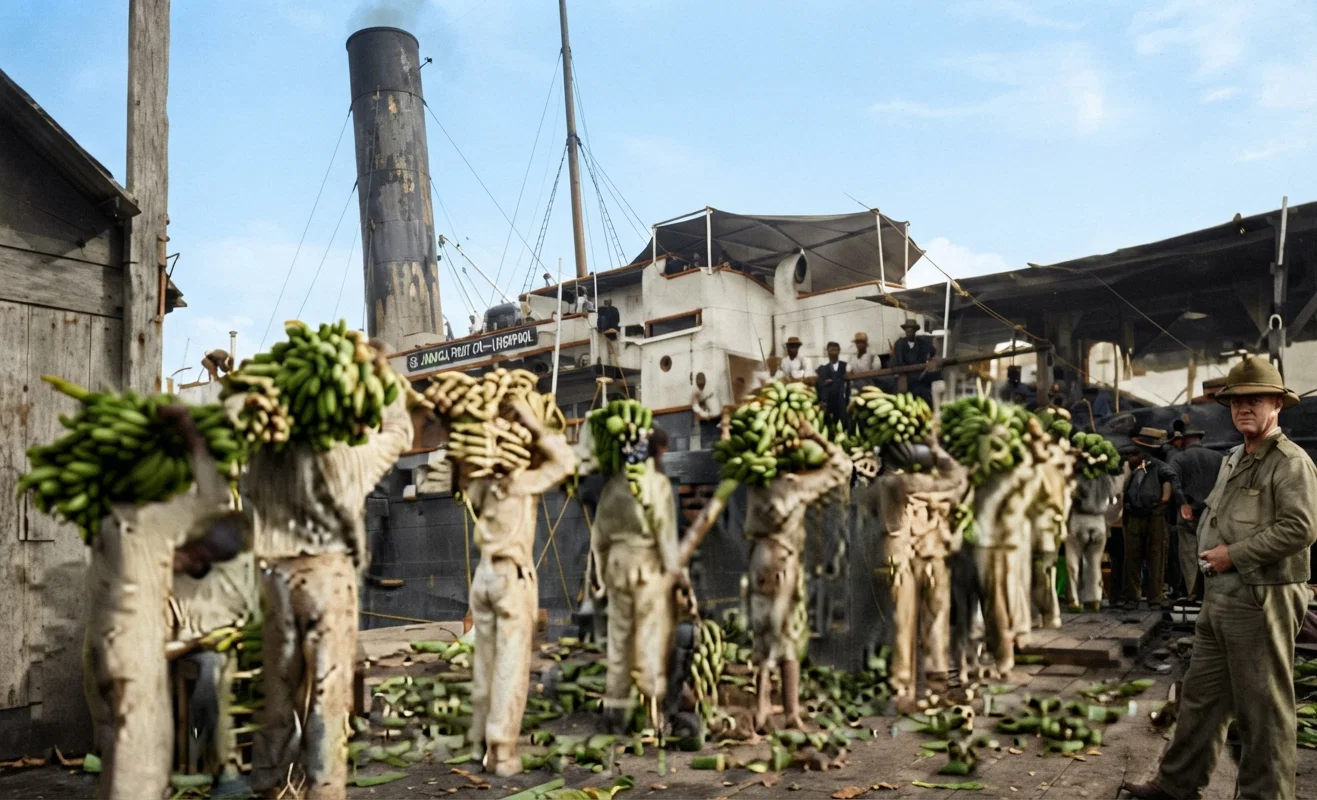
LOADING BANANAS ON THE STEAMER — JAMAICA
So up and down beautiful Jamaica the message of preparation for the coming of the Lord is making its way. And lives are transformed by it. Drink and tobacco are put away. There is a reformation where the message of reform goes. The truth appeals to all classes and to those of all faiths. The Lord is coming. That is the great and overwhelming fact. Whether one is Protestant or Catholic, believer or unbeliever, the message of prophecy fulfilling before our eyes in token of Christ's soon coming is a word that appeals.
"Last season, we held a tent meeting in Kingston," said Elder Boger. "About forty took their stand for the truth; and of these, half were Roman Catholics." To-day there is no apparent difference. All are made one in taking the stand upon the platform of Christ and the apostles, "the commandments of God and the faith of Jesus."
In Jamaica I found the printing headquarters of the West Indian work, under the management of an old SIGNS office worker, A. F. Haines.
A SMOLDERING VOLCANO OF VIOLENCE
By G. B. T.
Things Not Always What They Seem—Days of Violence and Bloodshed Await the World
It pains our hearts to refer to present-day conditions in some directions. We prefer not to do so, and often hesitate; but on more sober reflection, we dare not wholly refrain. We look out upon the beauties of nature, on the calm and peaceful things about us. We see quiet peasantry on farm and countryside places. We hear the innocent prattle of beautiful childhood on every side. Churches lift their spires heavenward, and summon the people to come and worship God as their conscience dictates. We visit the galleries of art and science, and sit amid the silence of libraries; and the quietude that reigns is often most impressive. Men talk of peace and a good time coming.
These things all appeal to our hearts; and naturally we would be glad to believe that what our eyes see, and our ears hear, is a correct interpretation of the state of things in the earth after six millennia of sin. But our minds go back over history. We recall that men were pursuing, uninterrupted, the regular business of life, when the heavens were getting ready for the Deluge. The day before, the dark, angry clouds, muttering thunders, appeared as precursors of the destruction that was to sweep the earth with the besom of destruction. The sun shone as brightly as on any day since God brought light out of darkness.
A SUBMARINE RISING TO THE SURFACE. WITH AIRCRAFT, ONE OF THE MOST MODERN BRANCHES OF NAVAL POWER
Obliterated by a Tornado of Fire
THE day before, every appearance was against the terrible tornado of fire and brimstone which came from heaven and put an eternal period to the pleasure and shocking filthiness of Sodom and Gomorrah. Earthquakes take place when least expected. No one knew that Martinique was doomed that day.
So, as we scan with unbiased mind the situation about us, aided by the certain forecast of God's book, we are led to believe that the future will not be so lamblike and peaceful as some things indicate, or as some people would have us believe. Rather, a volcano seems to be muttering beneath us, and an eruption is imminent. The pen of an inspired man has told us that in the last days men would be "fierce." 2 Tim. 3: 1-5. This is a strong word, betokening a ferocity like that of untamed and bloodthirsty animals.
The Saviour has drawn this picture of the days immediately preceding His second coming: "And as it was in the days of Noe, so shall it be also in the days of the Son of man. They did eat, they drank, they married wives, they were given in marriage, until the day that Noe entered into the ark, and the Flood came, and destroyed them all. Likewise also as it was in the days of Lot; they did eat, they drank, they bought, they sold, they planted, they builded; but the same day that Lot went out of Sodom it rained fire and brimstone from heaven, and destroyed them all. Even thus shall it be in the day when the Son of man is revealed." Luke 17: 26-30.
This is indeed a dark picture, a cloud with no silver lining. Of the days of Noah, when the earth was corrupted by the wickedness and debasing passions of sin, we read: "The earth also was corrupt before God, and the earth was filled with violence. And God looked upon the earth, and, behold, it was corrupt; for all flesh had corrupted his way upon the earth. And God said unto Noah, The end of all flesh is come before Me; for the earth is filled with violence through them; and, behold, I will destroy them with the earth." Gen. 6: 11-13.
Notice that the earth then was "filled with violence." The victims of rage, greed, and lust could be found everywhere. We deplore the fact that similar excesses are fast filling the earth. The press chronicles the most shocking details of crime, vice, and sensual debauchery, driving men in retaliation to the most inhuman deeds of lawlessness and disorder. The following, from an editorial in the Independent of May 29, 1916, is a sample of many others, and reflects the savage brutality and violence existing in the earth:
"In the town of Waco, Texas, last week, a crowd of 15,000 persons watched a human being burned to death. It was no accident, but deliberate intent. A Negro boy of eighteen had criminally assaulted and killed a white woman seven days before. He had been arrested, indicted, tried, convicted, and sentenced to death in astonishingly brief space of time.
"Then the mob seized him, and burned him to death in the public square, while men, women, and children looked on. It was a peculiarly atrocious case of lynch law. It had none of the usual circumstances that are offered in palliation. The offender had been convicted, and would have been put to death legally in due course. There could be no contention that justice might be cheated. His lynching was simply an orgy of mob brutality and savage lust.
"The young Negro's crime was a horrible one. The crime of the people of Waco was more horrible and a deeper stain upon the fair name of Texas."
The deed of this inhuman monster, standing on the threshold of manhood, is shocking in the extreme. The vengeance visited upon him startles us and unstrings our nerves. If the multiplication of these cold-blooded deeds does not indicate that beneath the surface, a volcano of violence and cruelty is smoldering, in fulfillment of the word of the Most High God, what would? The elements betoken the end, and the approaching vengeance of God, whose wine cup of wrath will destroy sinners out of the land.
Then look at the awful conditions occasioned by the war raging in Europe. Such scenes of carnage, judging from the published reports, are awful in the extreme. They seem never to have been equaled in any age. Every means of slaughter is used. A writer who was present on one occasion, says they were "surprised by a gas attack, and with their eyes streaming, their lungs torn by the knife-like stabs which accompany every effort to breathe, they retired."
Appalling Conditions Face Us
SPEAKING concerning the wounded lying on the battle field, where sharpshooters made it impossible to render them help, the same writer says concerning their sufferings:
"A few of our boys lived through the broiling hot day, with sun pouring down on them, heaps of dead around them, the stink of decaying flesh in their nostrils, and their throats parched with thirst. Yes, a few of them lived, but, oh, it was a pitiful few!475
"In the afternoon, I saw one poor fellow who had been worming his way in inch by inch. He probably went mad, for he suddenly staggered to his feet, faced the trenches, and started shrieking curses at the top of his voice. The words died in his throat, and he went down riddled with bullets. During the day, many of them managed to get a weapon in their hands, and did the deed themselves."
The conditions that face us in the world are truly appalling. We look out upon a sea of violence and bloodshed similar to that predicted in Holy Writ. The sign of the day of God is here. It is time to prepare for the coming of Christ, who will establish a kingdom of peace. Lord, hasten this glad day.
G. B. T.