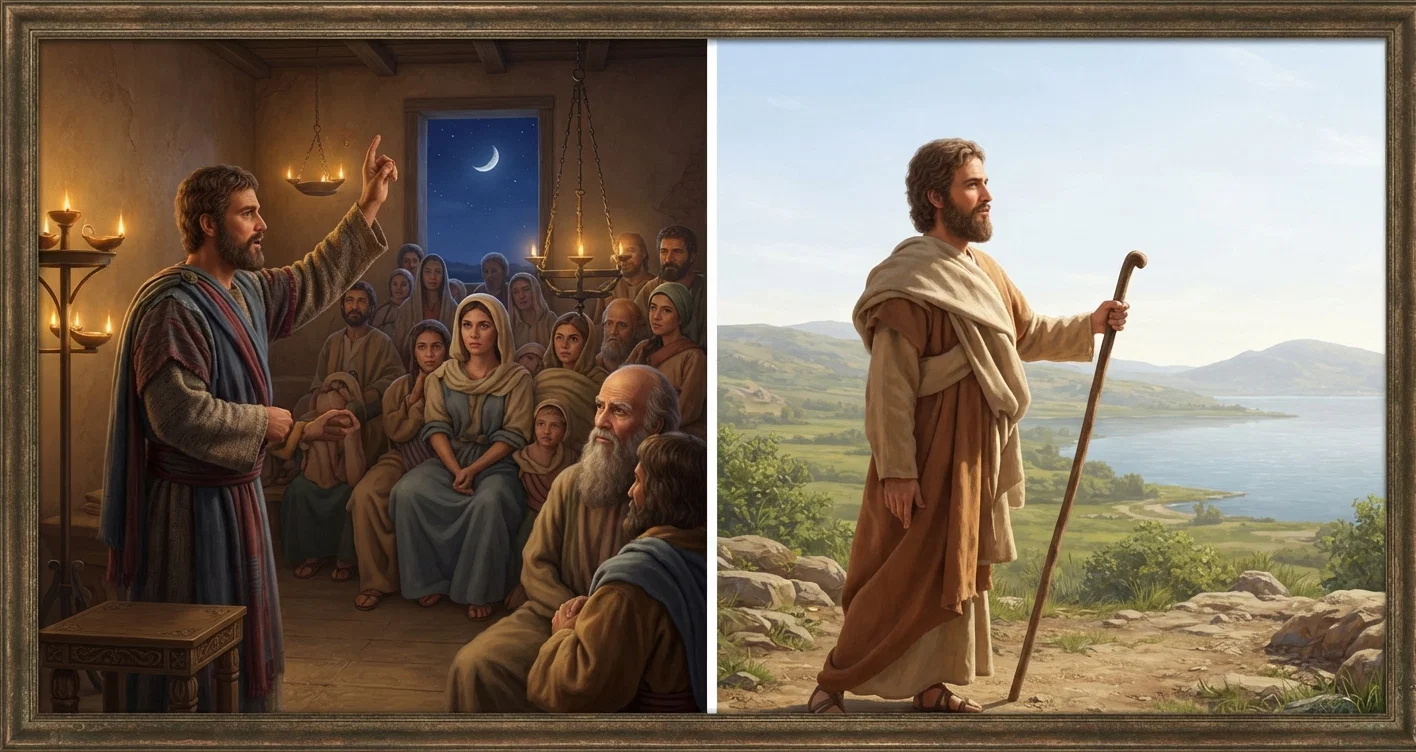
JESUS was the Man of prayer. God's blessed Son, the lover of sinners, was a constant practitioner in the art of prayer. He believed in prayer, taught prayer, lived prayer.
Prayer was the delight of His soul. It was rest and refreshment, quietness and repose, inspiration and revelation.
His hours of prayer were the oases that gladdened and recuperated Him as He pressed on through the desert of His earthly sojourn. They were the storehouses of righteousness, the stations for spiritual repair, the recesses of blessed uplift.
A Mighty Soul Struggle
WHATEVER other thought relative to the Lord Jesus we may entertain, we are constrained to hold this,—that He was one who wrestled with God. Prayer in His experience was a mighty soul struggle. He "offered up prayers . . . with strong crying and tears." And Heaven bowed in obedience to His faith. He was never denied. He could say to His Father, "I knew that Thou hearest Me always."
Inspiration has been brief in its record; but sufficient is told to enable us to know that early and late, and sometimes all night, He shut Himself away from men, in communion with God. The privilege of petitioning was more to Him than life itself; and hours were but as moments to His soul as He strove to reach up through the clouds which sought to obscure the skies of His humanity, that He might find miraculous recognition. All other needs were forgotten while the need of power pressed His soul.
We sometimes wonder why God's only Son should have been so terribly in earnest in this matter of prayer. Why need He, the pure, the holy, the divine Man of men, pray in agony, pray until His very blood oozed from His flesh? Was it not impossible for Him to sin? Was not His divine nature a sufficient guarantee that He should forever triumph?
Took the Place of the Lowest
AH, dear brother, sister, friend, please walk softly here, and walk slowly. Has it ever come to you, fully and clearly, that Jesus assumed human nature with all its liabilities to sin? Have you comprehended that He took upon Him fallen human nature, and became sin in our behalf? Have you entered into the secret place of His gospel experience, and ascertained that He made every interest of ours identical—absolutely identical—with His own? Has God whispered into your soul that Jesus voluntarily took the place of the lowest of His lost ones, and shouldered the responsibility of seeing that the human race should have salvation?
Stop, please, and reflect upon this: Not only did He take upon his heart the load of human helplessness and hopelessness, but He promised God to lift that load as a man only. He covenanted to exercise no power except such as any other one of God's human family might know. He would make His sole trust the Father's promise, His only refuge that of faith.
In the light of this remarkable condescension, this sublime humiliation, we may find the secret of His soul anguish. Having lowered Himself into the pit of world wickedness and horror, having become man for man's sake, His humanity made prayer necessary to His very existence. Yes, and away beyond this, it made prayer necessary to our5existence; for having taken the sum total of human weaknesses into and upon Himself, His failure would have meant ruin to the whole race. No wonder that He poured out His soul! No wonder that He stormed the very battlements of heaven in His superhuman effort to bring man from a state of rebellion into reconciliation with God!
Jesus prayed. Prayer was the largest part of His life. His wonderful mission for men was accomplished chiefly on His knees, in secret. The healing of disease, the casting out of evil spirits, the lifting up of the fallen, the encouraging of despair-driven men—these and all other miracles of mercy were but the fruitage of those seasons when His soul, in prayer, mounted to the very summit of the mountain of God, and there listened to the counsels of the Eternal. He bore the great world with Him into the presence of the Lord of hosts.
Listened to Counsels of the Eternal
OH, how I should like to have been with Him as He presented before God the longings of His life! What pleading I should have heard, what sympathy expressed, what anxious inquiry, what intense asking!
You will remember the night in the upper room, and Peter's self-confidence. You will recall that Jesus looked upon His weak and erring disciple, and, foreseeing all the shameful denial which lay just before, tenderly said to him, "Satan asked to have you, that he might sift you as wheat: but I made supplication for thee, that thy faith fail not."
When had He made supplication for him? Where? The exact time and place have not been revealed; but sometime, somewhere, He had held Peter up before God, and held him until He knew deliverance would be given.
He had prayed and wept, He had struggled and toiled, He had interceded and invoked, until it pleased God to send Him assurance that Peter would not be given over to Satan.
The Boldness of the Lover's Love
HE is in the secret place of the desert. No human ear is permitted to listen while the Lover's love breathes forth its pathos and tenderness, yet in holy boldness and power, for the man who shortly will deny His name, even with cursing. Ah, how His heart bleeds as He reminds the Ancient of days that He has taken Peter's place, and must meet Peter's needs! Listen while He pleads the tremendous issues at stake, and what it will mean to the very throne of God itself if failure overtakes Him. "Oh, My Father, My Father, give to Me this one, and give him to Me now! Thou canst not say No. I give My life for him, because I love him. And Thou dost love him. O My God, let the angels come now, just now, and shield him from overtemptation. Bring him repentance, and give him a heart to understand Thy love, that he may flee to refuge and be saved."
No wonder He could say, "I made supplication"! Why, He had gone to the cross for him. He had prayed His very life away, that that same poor man might be rescued from himself. And Peter was saved—marvelously saved. The prayer was answered.
Such was the prayer life of Jesus. It was thus He prayed for poor Mary of Magdala. Not once, nor twice, nor thrice; but again and again and again and again He prayed, until He saw her safely footed in the way of life. And one day, we shall see of His soul travail, for we shall meet Peter and Mary in the better world.
Deliverance Through "Travail"
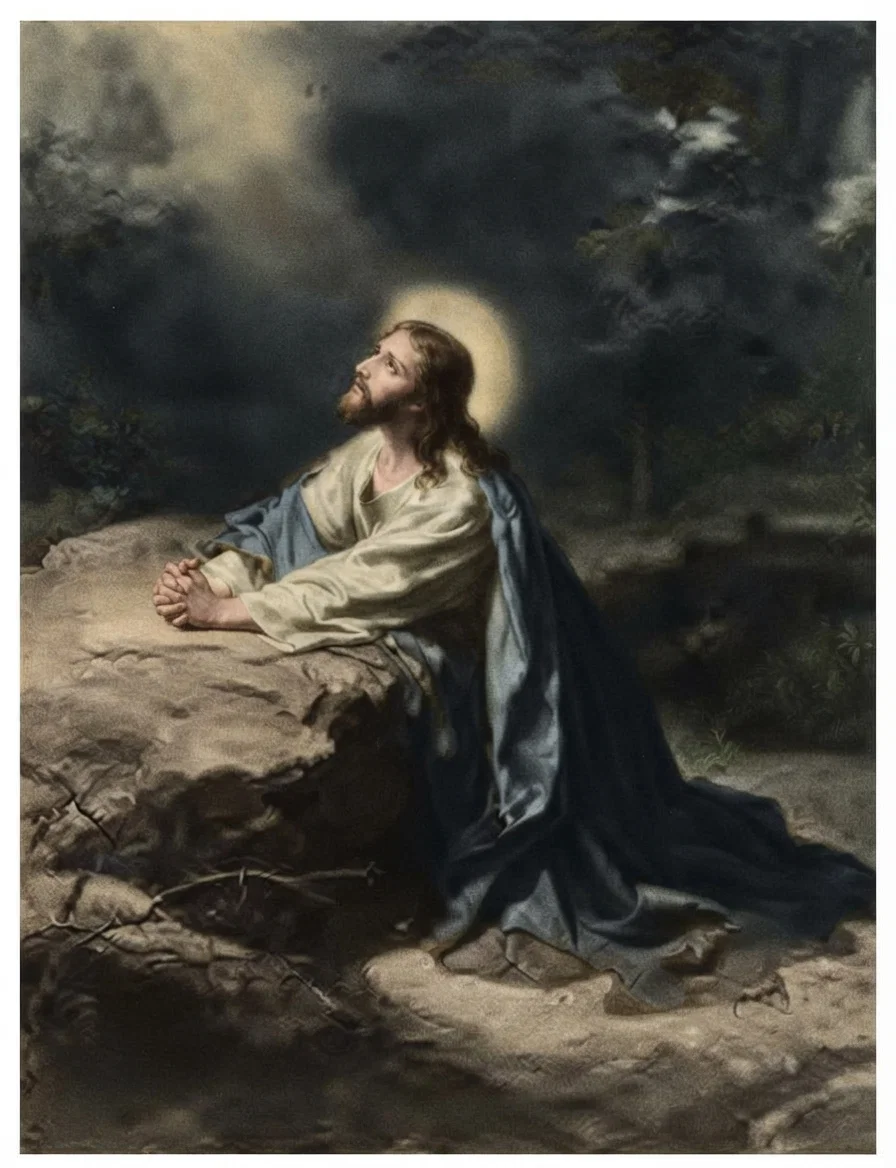
MARK that word "travail." It is a Bible word, and is used to express the experience of Him who died for mankind. And nowhere did Jesus know travail for His earthly kindred more than while He prayed. His prayers were birth throes. In Gethsemane, He knew the anguish of ten thousand deaths, while the bitter cup was pressed to His lips. Yes, in truth, a new world and a new race were born that night in the secret and awful heart suffering of the Son of man. That night, He decided that He would allow God to banish Him, if that was necessary to man's salvation.
Yes, Jesus prayed the unselfish prayer of the one who gives himself for others, of the one who takes the place of the lost. Thus Paul prayed. Rom. 9: 1-3. Thus Moses prayed. Ex. 32: 32. And thus should all soul winners pray.
Prayer commands angels. "Thinkest thou that I cannot beseech My Father, and He shall even now send Me more than twelve legions of angels?" And angels are the forces that work for the deliverance of men. Heb. 1: 14. They encamp round about the children of God, and deliver. Ps. 34: 7. The true soul winner is he who finds in prayer the sweetness and blessedness of angel ministration, and who is able, by their powerful persuasive force, to attract men to the good.
Prayer and the Soul Winner
THE praying man is one who draws men. The lost will come to him, even as to Jesus, drawn by a something which they themselves do not understand.
Wonderful plan—the prayer plan! But wonderful to those only who in utter self-abandonment throw themselves into the breach, and actually take the responsibility of lifting men up to God! Wonderful to those only who have so fully devoted themselves that their souls cry out in them, and tears flow, and hearts bleed, and life ebbs away, because men are lost!
O Jesus Christ, if Thou didst pray and have untold anguish, and if, through prayer, Thou didst break the hold of sin upon the tempted and tried, why may we not follow Thee? Come, Master, and lead us in the prayer way of soul winning. "Teach us to pray."
Defying the Fiat of Heaven
By Percy T. Magan
"AGAINST this infinite fiat that the earth should be divided into a number of kingdoms, which should never be united, have been hurled, each in its time, with titanic force and herculean effort, the clans of Clovis, the legions of Charlemagne, the flower of knighthood under Charles V, the dragoons of Louis XIV, and the battalions of Napoleon. The world reeled under the fierce charges of these world-empire-grasping warriors; but the word of the Lord stood fast, and Europe has remained divided."
Defying the Fiat of Heaven
By Percy T. Magan
THE iron monarchy of Rome was the last of the so-called universal empires. Of the four — Babylon, Medo-Persia, Greece, and Rome — she, the last, was by far the greatest. Every acre of Rome's vast territory had been bought with blood. The brutal cut and thrust of conquest hewed its way through everything, from peaceful Carthage to sunny Gaul, in whose behalf the brave Vercingetorix made his mighty fight. The battle of Actium, B. C. 31, was followed by the last conquest of Egypt. And says the eloquent De Quincey:
"That conquest rounded and integrated the glorious empire. It was now circular as a shield — orbicular as the disk of a planet. The great Julian arch was now locked into the cohesion of granite by its last keystone. From that day forward, for three hundred years, there was silence in the world. No muttering was heard. No eye winked beneath the wing. Winds of hostility might still rave at intervals: but it was on the outside of the mighty empire; it was at a dream-like distance; and like the storm that beat against some monumental castle, and at the doors and windows seemed to call, they rather irritated and vivified the sense of security than at all disturbed its luxurious lull. She could suffer only by the wrath of Providence; and so long as she continued to be Rome, for many a generation, she only of all the monarchies has feared no mortal hand."
The world monarchy of Rome was anything but a merciful government. The world at large suffered much under the gross misrule of the Roman Senate. And when at last the foreign wars of Rome were ended, then Roman unsheathed sword against Roman, and the men and women of the unhappy empire learned anguish still keener during the three civil wars of the great Julius against Pompey, and the authors of the Triumvirate against Brutus and Cassius, and of Octavius against Mark Antony. Truly was the little finger of Rome thicker than the loins of the three universal kingdoms in whose wake she followed.
Governed by Brute Strength
SUCH were the workings of the "iron rule" of Rome. The "Eternal City," risen from a bog once situate between the Tiber and the Anio, had become the metropolis of the earth, and that band of robbers whose keep had been the Mons Palatinus had become le vainqueur des vainqueurs de la terre.
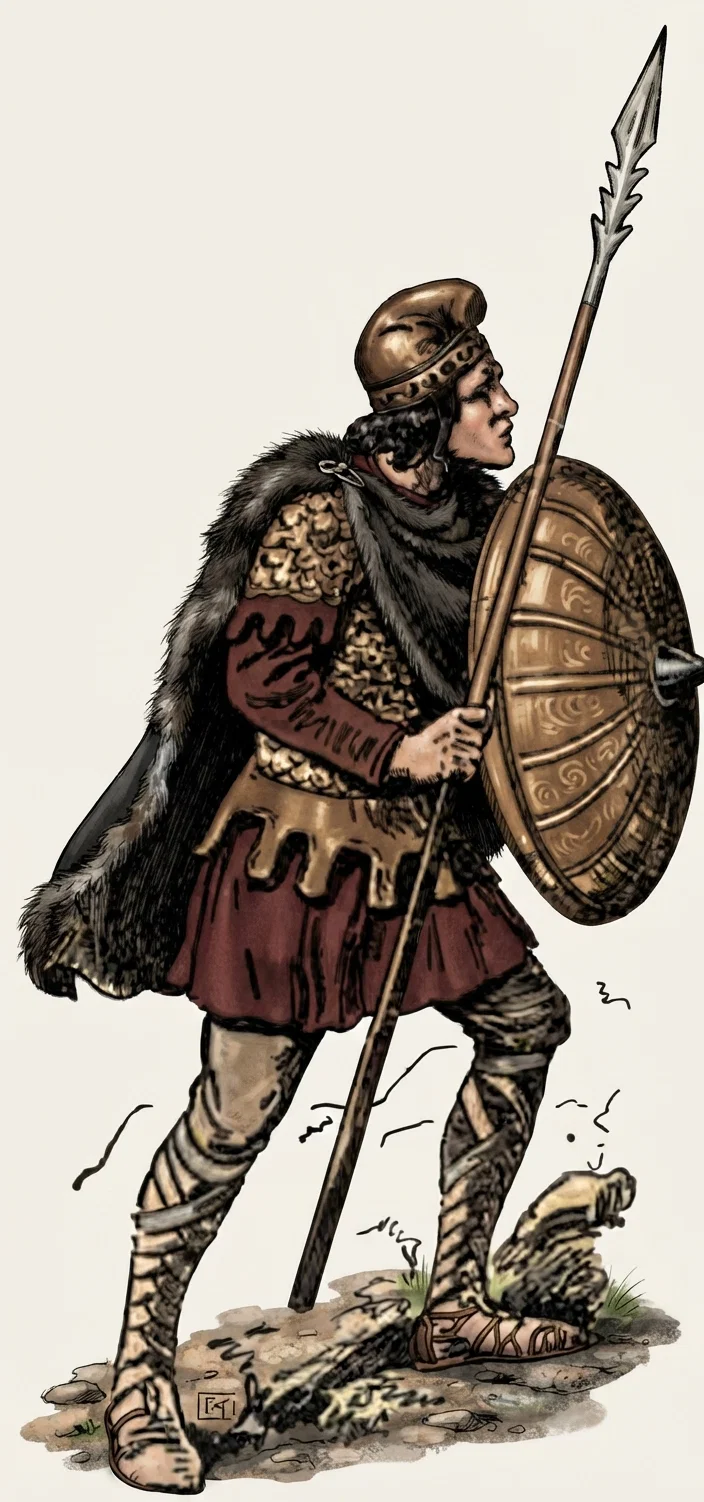
There is a deeply significant thought in the very idea of an "eternal city" and empire. Curious it is that the early memorials of Rome appear to be Greek in their origin. That name, "Rome," was Grecian in its genesis, and literally interpreted, means "Brute Strength." And "Brute Strength" correctly describes the foundation upon which the entire edifice was reared. Brute strength was what their woof and warp was woven from. And brute force is the intrinsic, the ultimate thought which is and ever has been mantled beneath that word "Rome," from the founding of the Urbs Aeterna in the misty gray days of the dawn of history, down to these, its twilight hours. In Rome, both pagan and papal, brute force has ever been the great, the last resort. By this one weapon did that genuinely heathen nation seek to bring the world beneath her yoke, and by that same sword has the great pseudo Christian church sought to enforce her sway.
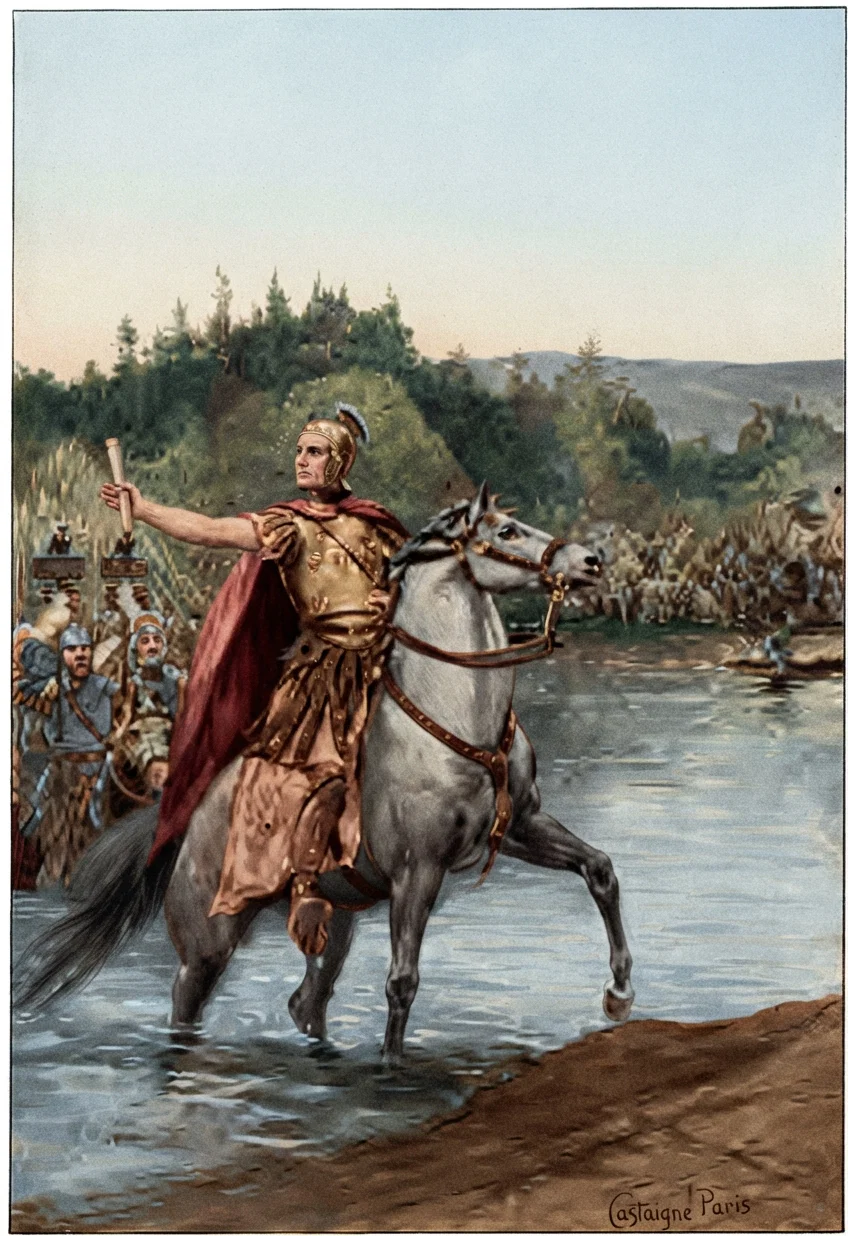
CAESAR CROSSING THE RUBICON
It was brute force that gave to Rome her territory. That vast and fruitful domain brought forth her riches, riches bred luxury, and luxury gave birth to those most wretched of all twin sisters — corruption and vice.
Now the rule and ruin of Rome was foretold in the sacred Scriptures. Daniel the prophet, himself a statesman of renown, speaks of "the fourth kingdom," which "shall be strong as iron: forasmuch as iron breaketh in pieces and subdueth all things: and as iron that breaketh all these, shall it break in pieces and bruise. And whereas thou sawest the feet and toes, part of potters' clay, and part of iron, the kingdom shall be divided; but there shall be in it of the strength of the iron, forasmuch as thou sawest the iron mixed with miry clay. And as the toes of the feet were part of iron, and part of clay, so the kingdom shall be partly strong, and partly broken. And whereas thou sawest iron mixed with miry clay, they shall mingle themselves with the seed of men: but they shall not cleave one to another, even as
iron is not mixed with clay. And in the days of these kings shall the God of heaven set up a kingdom, which shall never be destroyed: and the kingdom shall not be left to other people, but it shall break in pieces and consume all these kingdoms, and it shall stand forever. Forasmuch as thou sawest that the stone was cut out of the mountain without hands, and that it brake in pieces the iron, the brass, the clay, the silver, and the gold; the great God hath made known to the king what shall come to pass hereafter: and the dream is certain, and the interpretation thereof sure." Dan. 2: 40-45.
The Dragon's Supreme Effort
THE twelfth chapter of the book of Revelation opens with a view of a woman clothed with the sun, and the moon under her feet, and on her head a crown of twelve stars. Of her it is written that she brought forth a man child who was to rule all nations with a rod of iron; and her child was caught up to God on the throne. Without question, the man child was Christ, and the woman can be nothing else than a symbol of the Christian church. Luke 24: 51; Mark 16: 9; Rev. 12: 3-5.
And there stood before the woman a great red dragon, "to devour her child as soon as it was born." And now the question arises: What instrumentality, what power, did Satan — the original "dragon" of the Bible — use in his attempt to devour the Child Christ Jesus as soon as He was born?
Ah, he had a world power, strong as iron, all ready for his undying purpose of annihilating the truth of God in the earth. That world empire, which for this very purpose he had planned at Babel, which he had accomplished in part in Babylon — "the hammer of the whole earth" — which he had tried again in Medo-Persia and Greece, he had accomplished as near to the full as the confusion of tongues would permit in the giant Roman Empire.
There can be no question but that Satan had indeed timed nicely that such an empire, with such an emperor over it, ruled the earth when the Son of God was born in Bethlehem. For truly when the Son of God was on earth was the all-crucial day in the history of redemption. If Satan could destroy the power of Christ, or annihilate Him, he knew that his hellish principles would triumph. And so it was that he marshaled a world empire, under the master hand of the imperial Cæsars, absolutely controlling all things religious as well as all things civil. Never in the history of the world before that time were his forces better prepared for the battle.
Slain by Roman Authority
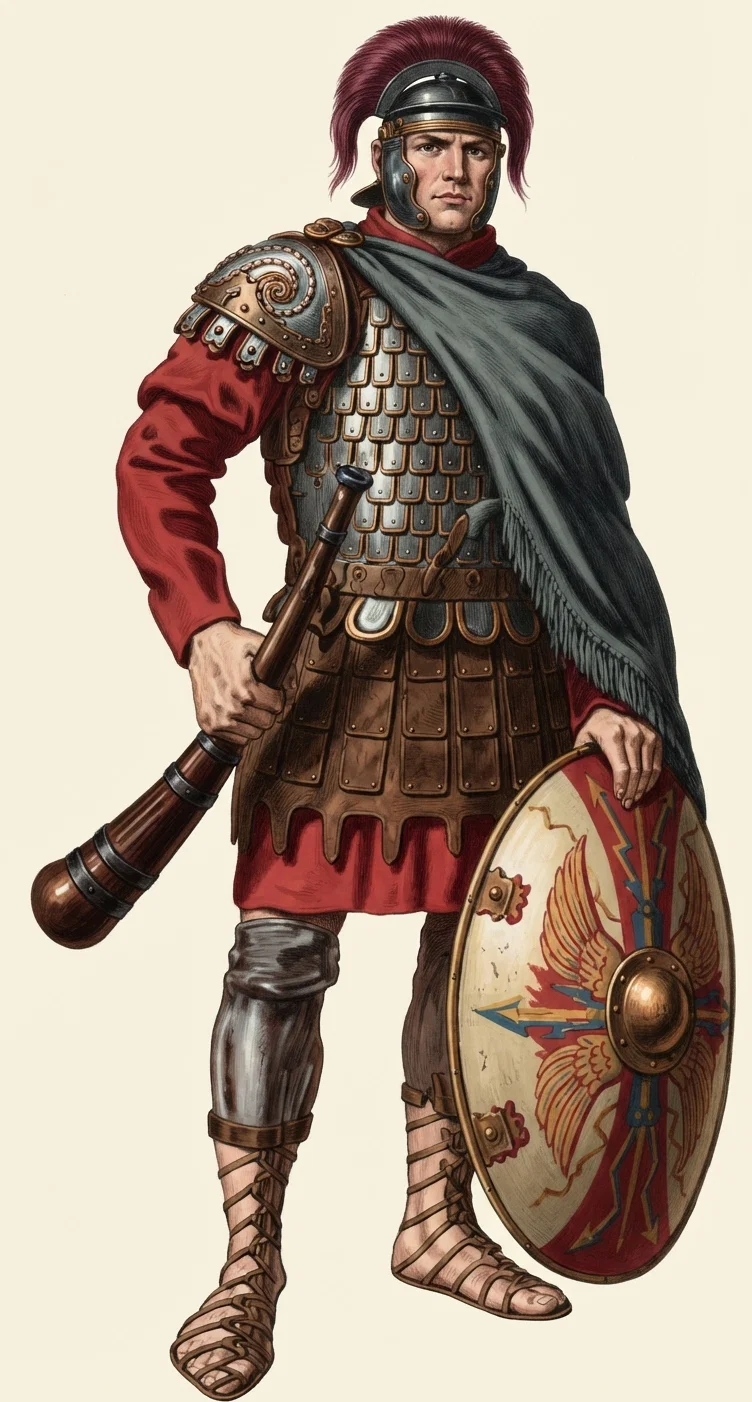
ROME, the world empire of the dragon, lost no time in her endeavor to put to death Christ, the Man Child born of the woman. First came the decree of Herod that every male child should be put to death. Herod was king of Judea, king by decree of the Roman6Senate. Satan had sought the life of Christ when he inspired the decree that all the male children of the Jews were to be killed. Christ had escaped him, but he was not to be halted by this. He never rested until Pilate, a Roman governor, sentenced Christ to death; till Roman soldiers nailed Him to a cross; and till a Roman seal sealed Him in a tomb, over which a detachment of Roman soldiers mounted guard.
And then, as if the whole gigantic scheme which Satan had with such master cunning perfected were as a mere nothing for God to deal with, He sent one angel from heaven — the stone was rolled away, the guard of Roman soldiers became as dead men, and Christ arose to life.
In all this, God had met Satan, as it were, at his own time and under his own circumstances, and triumphed over him then and there; for the "man child" "was caught up unto God, and to His throne."
The Mirror of Satan's Mind
AND to the last day that the Roman Empire remained, she remained as Satan's instrumentality; and he used her to persecute the church, until the measure of the great empire's iniquity was filled, and the decree went forth, as against "the hammer of the whole earth" before her, "It is time to thresh her." Then that dragon empire, the mirror of Satan's mind in civil and religious government, was crushed to pulp and ground to powder beneath the heel of the barbaric tribes of ancient Germania.
The prophet Daniel had stated of this kingdom that it should be divided into ten parts. Seven of these, according to the Scripture, were to remain until the end of time, when the God of heaven is to set up a kingdom that shall never be destroyed. Therefore any attempt on the part of any of the great powers at the present time to set up a world monarchy is bound to be in vain, for the division of the earth into a number of kingdoms is to stand until Christ shall come and set up the everlasting kingdom of God. Out of the present war there will never — there never can — come one overshadowing world power.
But against this infinite fiat that the earth should be divided into a number of kingdoms, which should never be united, have been hurled, each in its time, with titanic force and herculean effort, the clans of Clovis, the legions of Charlemagne, the flower of knighthood under Charles V, the dragoons of Louis XIV, and the battalions of Napoleon. The world reeled under the fierce charges of these world-empire-grasping warriors; but the word of the Lord stood fast, and Europe has remained divided.
Did Paul Preach on Sunday?
By Carlyle B. Haynes
An Examination of the Only Record in the New Testament of a Religious Meeting on the First Day of the Week
By Carlyle B. Haynes
THE seventh mention of the first day of the week, in the New Testament, is in the book of Acts: "And we sailed away from Philippi after the days of unleavened bread, and came unto them to Troas in five days; where we abode seven days. And upon the first day of the week, when the disciples came together to break bread, Paul preached unto them, ready to depart on the morrow; and continued his speech until midnight. And there were many lights in the upper chamber, where they were gathered together." Acts 20: 6-8.
There is no doubt that this passage contains the record of a religious meeting on the first day of the week. And in this it is unique, for it is the only passage in the Bible which does contain such a record. Because of this, it is worthy of close study.
At this meeting, Paul was preacher. And it was a special meeting, a farewell meeting to Preacher Paul. Paul and his company had stopped at Troas on their way to Jerusalem. Acts 20: 16. At the time this meeting was held, they had been at Troas for seven days (verse 6), and now the last meeting of their stay was called; and while Paul tarried to conduct it, his companions, having already made their farewells, were on their way by boat to Assos, Paul intending to walk to the same city, after this last meeting was ended. Acts 20: 13, 14.
The meeting was held at night, for Paul wished to get an early start in the morning. "There were many lights in the upper chamber, where they were gathered together." Paul was "ready to depart on the morrow," and "he continued his speech until midnight." Unquestionably this was a night meeting.
A Saturday Night Meeting
Now, according to Bible reckoning of the days, there is but one night to the first day of the week, and that is Saturday night. The Bible days begin and end at sunset, while by our present reckoning, the days begin and end at midnight. The first day of the week of the Bible begins when the sun sets Saturday night, and ends when the sun sets on Sunday night. Therefore this meeting which Brother Paul conducted at Troas, being held during the night of the first day of the week, was held on what is now known as Saturday night. That is, this meeting was a first-day meeting, but not a Sunday meeting; for our Sunday is not the same as the Bible first day, Sunday being from Saturday night at midnight until Sunday night at midnight, and the Bible first day being from Saturday night at sunset to Sunday night at sunset.
Affords No Comfort
HENCE this verse affords no comfort to those who cite it as proof that the apostles kept Sunday. This meeting, while it extended over into Sunday morning, was in reality and properly a Saturday night meeting, beginning after the Sabbath had already passed.
Composed of Parts of Two Days
IT may be well, in this connection, to point out that those who now observe Sunday are not observing any one day at all, but parts of two days. By beginning the observance of Sunday at midnight, they observe a part of the first day of the week; and by continuing its observance until Sunday at midnight, they observe a part of the second day of the week, for the Bible second day begins at sunset Sunday night. In addition to this, none of the time observed, on either the first or the second day, is holy time.
Not a Collection
THE eighth instance of the mention of the first day of the week, in the New Testament, is in the book of 1 Corinthians: "Now concerning the collection for the saints, as I have given order to the churches of Galatia, even so do ye. Upon the first day of the week let every one of you lay by him in store, as God hath prospered him, that there be no gatherings when I come. And when I come, whomever ye shall approve by your letters, them will I send to bring your liberality unto Jerusalem. And if it be meet that I go also, they shall go with me." 1 Cor. 16: 1-4.
There is no doubt that this passage contains the record of a religious meeting on the first day of the week.
This passage has been made the basis of the claim that the early Christian churches were accustomed to hold their services on the first day of the week, and take up a collection at these weekly meetings. But the passage itself says no such thing. Paul does not here give instruction to hold a weekly meeting. Instead of holding a meeting on the first day of the week, "every one" was to "lay by him in store." They were not to put their gifts into a public collection, but to lay them by "in store," at home; and when Paul came, these were to be gathered and sent to Jerusalem for the relief of "the saints" there, who were suffering want. It was a special relief fund, not a regular weekly offering. It was made up on the first day of the week, when the brethren all returned to their work after their observance of the Sabbath, and had opportunity to cast up their accounts,
and see how the Lord had "prospered" them. Then they were to "lay by" themselves, at home, or at their places of business, the amount they decided to give, and keep it "in store" until Paul came to Corinth.
There is in this passage no evidence at all of Sunday sacredness, or that the early churches held weekly meetings on the first day of the week. In fact, the evidence all points in the other direction.
First Day Mentioned Eight Times
AND now our task of studying every passage in the New Testament that mentions the first day of the week is completed. There are no other texts that speak of this day. It is mentioned eight times in the New Testament. And in these eight passages, there is no command to keep it; there is no record of its being appointed as a Sabbath; there is no account of the placing of any blessing upon it; there is no account of its being made holy; there is no record that any sacredness was attached to it; there is no promise of blessing for its observance; there is no threat of punishment for its nonobservance; it is never once called the Sabbath, nor is any sacred title given to it; there is no record that the apostles kept it, or commanded it to be kept; there is no record that the early Christian churches observed it; in fact, there is nothing—absolutely nothing—in all the Bible that gives the slightest hint of a Sunday institution. The observance of Sunday is a practice for which there is not a shadow of Bible authority, and it is therefore a practice that should be immediately discarded by all Bible Christians.
The Glorious Resurrection Day
"THE church through all the ages has been singing of the glorious day when every sleeping child of God shall be brought forth from the grave to enjoy the bliss of endless life, and to experience the substantial realities of eternity. The church in past ages has had to content itself with the prospect of participating in the blessedness of these resurrection scenes at some distant future time; but now the day is at hand, the hour is almost here, the Lord has caused the guiding tokens to be charted by which we may know it."
The Sabbath, a Divine Plant
By E. H. M.
EVERY truth, as well as every error, springs from a seed planted in the heart. Christ said, "Every plant, which My heavenly Father hath not planted, shall be rooted up." Matt. 15:13. The Sabbath is a divine plant from the Garden of Eden. Any and every weed which seeks to supplant it, shall be rooted up. The rooting up process implies the destruction of the individual who cherishes and cultivates the weeds. Matt. 13:29, 30. E. H. M.