Your ShelfYour Projects

Signs of the Times, Vol. 24, No. 47.

LOYALTY TO PRINCIPLE

Signs of the Times

Nov 24, 1898

Pacific Press Publishing Company · Oakland, California · Nov 24, 1898

LOYALTY TO PRINCIPLE.
The history of the race, so far as recorded, furnishes but few examples of men of real principle and integrity. Among these, standing out in bold relief against the prevailing wickedness of his time, is the prophet Daniel. His rich qualities of character were early manifested, thus showing that these principles of truth and integrity had been instilled into his mind from tender years. His refusal to violate his religious scruples by partaking of the king’s meat, as recorded in the first chapter of the book that bears his name; his fearless interpretation of Nebuchadnezzar’s dreams, as given in the second and fourth chapters; and his fearless revelation to profligate Belshazzar of the mystic characters written on the wall of the palace, show that he did not count the cost of right-doing. The pomp and glory of the royal court did not deter him from his purpose; nor did the fear of incurring the royal displeasure lead him to soften the message of God, or abate one iota from its pointedness.
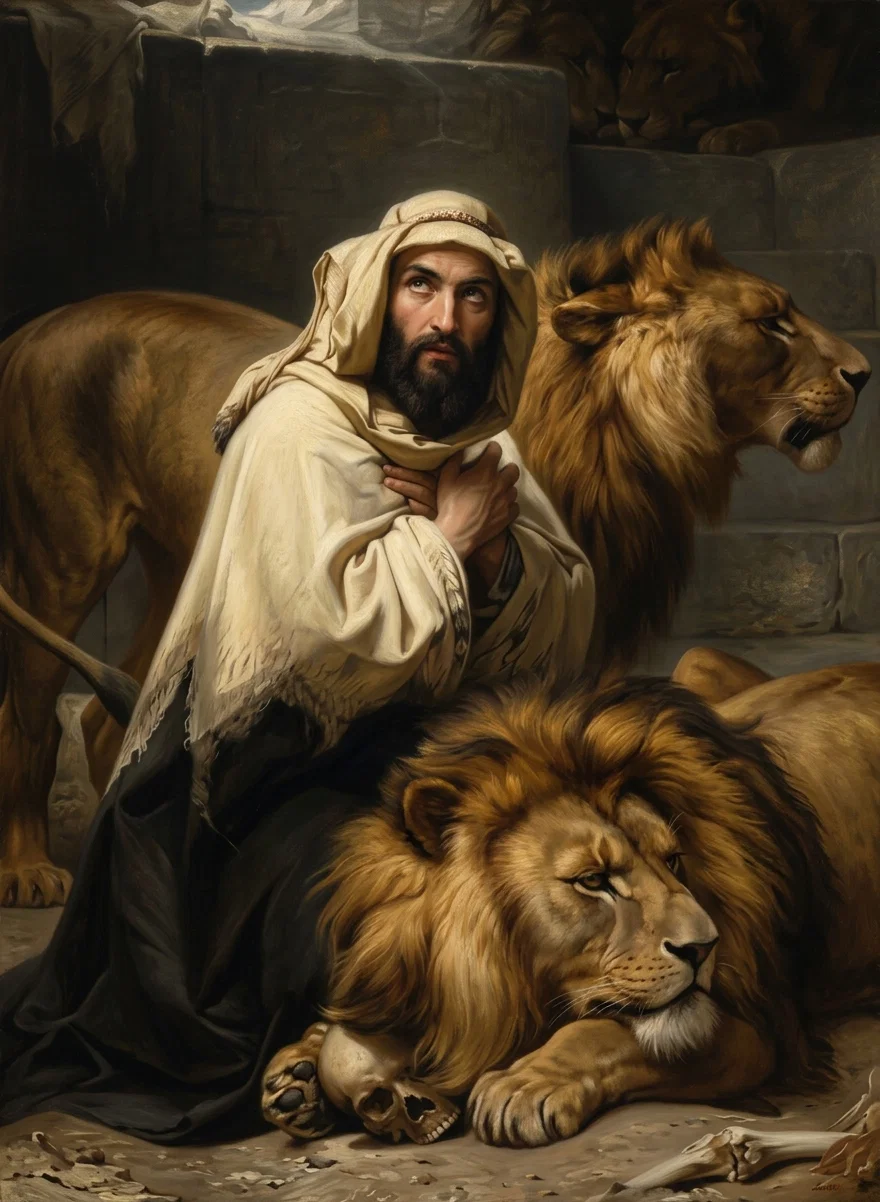
DANIEL IN THE LIONS' DEN.
It was reserved for the times of Darius, after the Babylonian Kingdom had given place to Medo-Persia, to bring the great test of his life to the prophet of God. Daniel, on account of his sterling qualities, his honesty, his discernment, had been set over the affairs of the kingdom. This aroused the enmity and jealousy of the native rulers; to think that a captive, and especially an Israelite, should be preferred before them, was a constant source of irritation and annoyance. That there was no fault in the administration of public affairs in the hands of Daniel, is evidenced from the testimony of his enemies. They admitted, “We shall not find any occasion against this Daniel, except we find it against him concerning the law of his God.” Hence the religion of the prophet became the special point of their attack.
With craft and policy they proceeded to the execution of their diabolical scheme. They went to the unsuspecting Darius, making a proposition which naturally would please his pride and minister to his vanity. The king, in accordance with their request, promulgated a decree that if any one in his realm should make a petition of any god or man for thirty days, save of the king only, he should be cast into the den of lions. The proclamation is published, and now the enemies of the prophet begin to dog his footsteps. They did not expect to find occasion in his public acts, for Daniel did not parade his religion before the gaping multitude. If violation could be found, it must be sought in the private devotions of their rival, hence they set a watch upon his house. Lo! at the stated hour for prayer, they saw Daniel, in harmony with his usual custom, open his window, and, kneeling with his face toward Jerusalem, as did all the captive Israelites, send up his petition to the God of Abraham, Isaac, and Jacob. Doubtless his enemies had known of his custom in this respect, and so had made provision in the proclamation for the apprehension of Daniel upon this charge. It would have been easy for Daniel to vary his custom, in deference to the king’s decree; but had he done this, a lack of real principle and integrity would have been manifested. It was his God-given right to worship the Creator of heaven and earth as he saw right and fit. His devotions could not disturb the king in his palace, nor any other member of the king’s realm. In pursuance of his God-given right, he changed not one iota from his usual custom.
The discovery of Daniel’s enemies is enough. The snare has been warily laid, and the desired prey has been caught in the net. They make haste to the palace of the king; and, calling to their aid an old tradition of the empire, they first inquire of the king if it is lawful for any of the decrees of the Medes and Persians to be altered or abated. The king, without knowledge of their purpose, assures them that the royal mandate is unalterable, and thus unwittingly doubly commits himself to the execution of the plot against his chief minister. The king is then informed that the proclamation he had issued but a short time before, has been violated by Daniel, and the visitation of the penalty upon the prime minister is decidedly demanded. The king sees with surprise and horror the fearful work to which he has been committed. Most gladly would he save the life of Daniel; but he feels that his own authority is at stake, and, rather than violate the traditions of his government, he gives command for Daniel to be cast into the den of lions. Altho himself an idolater, Darius, in the execution of the decree, showed a respect for the God of heaven which the influence of Daniel had instilled into his life; and “the king spake and said unto Daniel, Thy God whom thou servest continually, He will deliver thee.”
After the mouth of the den was sealed, and Daniel was left alone with his grim companions, the king went to his palace and passed a sleepless night in fasting and bewailing the fate of his trusted counselor. Early the next morning he went in haste to the den of lions. With a voice of lamentation he cried, “O Daniel, servant of the living God, is thy God, whom thou servest continually, able to deliver thee from the lions?” With solemn, eager expectancy the king awaits response. With an influence that thrills his heart, and sends a tremor through every fiber of his being, the tones of his servant issue from the loathsome prison-house: “O king, live forever. My God hath sent His angel, and hath shut the lions’ mouths, that they have not hurt me; forasmuch as before Him innocency was found in me; and also before thee, O king, have I done no hurt.” The anxious sorrow of Darius gave place to joy, and he commanded that Daniel be taken out of the den; and the record is that “no manner of hurt was found upon him, because he believed in his God.” Then the king commanded that the men who had been instrumental in bringing Daniel into this plight should themselves be cast into the den of lions. In their case the restraining power of God was not exercised over these ferocious beasts, and these evil-workers fell a ready prey to the hunger and rapacity of the lions.
In this experience we see a vindication of the right on the part of God, even tho the course Daniel pursued, as in the case of his three companions in refusing to worship the golden image, was contrary to the command of the powers of earth. God has circumscribed the limits of the authority of civil government. It is for the governments of earth to regulate the affairs of their subjects in civil matters alone. When government oversteps this boundary, it invades the relation between God and the individual, a relationship in which God has reserved to Himself alone the exercise of authority.
The same stand was taken by Peter and the apostles when commanded not to preach in the name of Christ. They replied, “We ought to obey God rather than men.” Acts 5: 29. This was the answer in the stand taken by Daniel, and this will be the answer in the stand taken by the disciples of the Lord in all ages who are moved by principle alone. In our own day, when the governments of earth are legislating upon religious questions, and seeking to coerce the consciences of men, the noble stand taken by Daniel must be duplicated in the lives of Christ’s true followers.
To-day, as then, God calls for men of principle; men who will stand true when others are false; men who will do right when all others do wrong; men who will sacrifice their worldly interests, property, reputation, and even life—for the sake of truth and righteousness. Men and women are wanted to-day to represent the God of righteousness, who can not be intimidated by fear, cajoled by flattery, or bribed with gold; men who will do right, not for policy’s sake, but for the truth’s sake, and because they are actuated in so doing by the spirit of truth that dwells within them.
From such lives will go forth a leavening power and influence; and such disciples of the Lord will stand as beacon lights in the midst of the prevailing darkness, and as mighty bulwarks against the tide of sin and wickedness in the world. May the integrity of principle that possessed the life of Daniel possess the lives of both writer and reader in all the conflicts of to-day and the trials of the future through which the church of God may pass. Such a stand may bring persecution here, but the glorious results achieved will more than compensate for the trials endured. F. M. Wilcox.

Chapter I: 1–5.

“Paul, an apostle (not of men, neither by man, but by Jesus Christ, and God the Father, who raised Him from the dead); and all the brethren which are with me, unto the churches of Galatia: Grace be to you and peace from God the Father, and from our Lord Jesus Christ, who gave Himself for our sins, that He might deliver us from this present evil world, according to the will of God and our Father; to whom be glory forever and ever. Amen.”
The best introduction to the Bible is the Bible itself; so the only introduction necessary to this present study is to begin at once on the Epistle. One thing only would the writer say, and that is, Do not let these articles be considered as a substitute for the study of the Scripture itself. They are designed only as suggestive, to lead the student into some of the glories revealed in the sacred text. The Epistle to the Galatians is short, and as but few verses will be covered in any one lesson, it is hoped that many will study the Scripture text so carefully that they will have the entire epistle well in their minds when the studies are ended. Then they will find themselves well equipped for a thorough study of the book, which they will then feel that they have just begun. We will now proceed to read:—
Christ’s Divinity.—The very first verse shows the divinity of Christ. Paul declares himself to be an apostle, “not of men, neither by man, but by Jesus Christ.” That is just as strong Bible proof of the divinity of Christ as is the statement, “In the beginning was the Word, and the Word was with God, and the Word was God.” John 1:1. It is true that this truth is stated incidentally, in Gal. 1:1, since the subject is Paul’s apostleship; but that simply shows how the fact of Christ’s divinity is the basis of all the Scriptures. They are not written to prove the divinity of Christ; no, they are written for the benefit of men. Because Christ is divine, a thing which carries its own proof to every one who makes his acquaintance, the Scriptures point men to Him. He is “the Christ, the Son of the living God.”
A Good Commission.—An apostle is one who is sent. Paul was an apostle of Jesus Christ, and of God the Father, who raised Him from the dead. He had good backing. A messenger’s confidence is in proportion to the authority of the one who sends him, and to his confidence in that authority and power. Paul knew that he was sent by the Lord, and he knew that the power of God is the power that raises from the dead. Now “he whom God hath sent speaketh the words of God.” John 3:34. Thus it was that Paul spoke with authority, and the words which he spoke were the commandments of God. 1 Cor. 14:37. So in reading this epistle, or any other in the Bible, we have not to make allowance for the writer’s personal peculiarities and prejudices. It is true that each writer retains his own personality, since God chooses different men to do different work solely on account of their different personality; but it is God’s Word in all, and nothing need be taken off from the authority of the message, and set down to the score of natural bias or prejudice.
One Mind.—In the writing of this epistle, we have an example of what the apostle in another epistle exhorts us all to be: “Now I beseech you, brethren, by the name of our Lord Jesus Christ, that ye all speak the same thing, and that there be no divisions among you; but that ye be perfectly joined together in the same mind and in the same judgment.” 1 Cor. 1:10. Paul wrote the Epistle to the Galatians, but all the brethren who were with him were concerned in it, because they were led by the same Spirit. While there can be no doubt as to the fact that all were united in agreeing with what Paul wrote, it may well be that the mention of the brethren refers specially to the greeting. They all sent greeting. Of course the substance of the epistle came direct from Paul’s own heart and mind, prompted by the Holy Ghost.
Grace and Peace Be to You.—This is the word of the Lord, let it be remembered, and therefore means more than man’s word. The Lord does not deal in empty compliments. His word is substantial; it carries with it the thing which it names. God’s word creates, and here we have the very form of the creative word.
God said, “Let there be light; and there was light,” and so on through the whole creation, “He spake, and it was.” So here, “Let there be grace and peace to you,” and so it is. “The grace of God hath appeared, bringing salvation to all men.” Titus 2:11. “Peace I leave with you, My peace I give unto you.” John 14:27. “Peace, peace, to him that is far off, and to him that is near, saith the Lord.” Isa. 57:19. God has sent grace and peace, bringing righteousness and salvation to all men—even to you, whoever you are, and to me. When you read this third verse of the first chapter of Galatians, do not read it as a sort of complimentary phrase,—as a mere passing salutation to open the realmatter at hand,—but as the creative word that brings to you personally all the blessings of the peace of God, that passeth all understanding.
The Gift of Christ.—This grace and peace come from Christ, “who gave Himself for our sins.” “Unto every one of us is given grace according to the measure of the gift of Christ.” Eph. 4:7. But this grace is “the grace that is in Christ Jesus.” 2 Tim. 2:1. Therefore when we are told that “unto every one of us is given grace according to the measure of the gift of Christ,” we know that it means that Christ Himself is given to every one of us. The fact that men live is an evidence that Christ has been given to them, for in Christ is life, and the life is the light of men, and this life-light “lighteth every man that cometh into the world.” John 1:4, 9. In Christ all things consist (Col. 1:17), and thus it is that, since God “spared not His own Son, but delivered Him up for us all,” He can not do otherwise than with Him freely to “give us all things” (Rom. 8:32). “His divine power hath given unto us all things that pertain unto life and godliness.” 2 Peter 1:3. Christ has by the grace of God tasted death for every man (Heb. 2:9), so that every man in the world has received the “unspeakable gift” (2 Cor. 9:15). “The grace of God, and the gift by grace, which is by one Man, Jesus Christ, hath abounded unto many,” even to all; for “as by the offense of one judgment came upon all men to condemnation; even so by the righteousness of One the free gift came upon all men unto justification of life.” Rom. 5:15, 18.
God in Christ.—“God was in Christ, reconciling the world unto Himself.” 2 Cor. 5:19. “When God made promise to Abraham, because He could swear by no greater, He sware by Himself.” Heb. 6:13. This oath of God was in Christ. Gal. 3:16, 17. So in the gift of Christ, God Himself is given, and “of Him, and through Him, and to Him, are all things.” Rom. 11:36. Christ is “the shining of the Father’s glory, and the very impress of His substance, and upholds all things by the word of His power.” Heb. 1:3. Therefore, since the whole universe depends on Christ, it is evident that in giving Himself for our sins, the entire universe has been pledged to man’s salvation. Sometimes people think that they are too poor, and insignificant, and worthless to be saved; well, they may be poor and worthless, but the fact is, nevertheless, that when it comes to the matter of salvation, God counts a single soul equal in value to the universe. It would perish sooner than a single soul who trusts God’s word.
An Individual Gift.—“God so loved the world, that He gave His only-begotten Son, that whosoever believeth in Him should not perish, but have everlasting life.” John 3:16. The love embraces the whole world, but it singles out each individual. Christ, by the grace of God, tasted death for “every man.” Heb. 2:9. The whole of the gift of Christ is to each one personally. “Unto every one of us is given grace according to the measure of the gift of Christ.” Eph. 4:7. Christ is not divided, any more than Paul was crucified for sinners. 1 Cor. 1:13. Some people seem to have the idea that as Christ was given for all the world, He has to be divided up among all the persons in the world, each one getting only a portion. Not so; every individual gets the whole of Christ. To illustrate: Christ is the light of the world, the Sun of righteousness. But light is not divided among a crowd of people. If a room full of people be brilliantly lighted, each individual gets the benefit of all the light, just as much as tho he were alone in the room. So the life of Christ lights every man that comes into the world, and in every believing heart Christ dwells in all His fulness.
Our Sins Purchased.—Christ “gave Himself for our sins.” That is to say, He bought them, and paid the price for them. This is a simple statement of fact; the language used is that commonly employed in referring to purchases. “How much did you give for it?” or, “How much do you want for it?” are frequent questions. “I gave a guinea for it,” may be the reply. And when we hear a man say that he gave so much for a certain thing, what do we at once know?—We know that that thing belongs to him, because he has bought it. So when the Holy Spirit tells us that Christ gave Himself for our sins, what should we be equally sure of?—That He has bought our sins, and that they belong to Him, and not to us. They are ours no longer, and we have no right to them. Every time we sin we are robbing the Lord.
Deliverance.—Christ has not only paid the price for our sins, but He has accepted the goods. He has taken the sins all on Himself. He “bare our sins in His own body on the tree.” 1 Peter 2:24. He bears the sins of the world. John 1:29, margin. “He is the propitiation for our sins; and not for ours only, but also for the sins of the whole world.” 1 John 2:2. He “gave Himself for our sins, that He might deliver us,” and since He did not die in vain, He has delivered us. He has wrought deliverance for every soul; whether all will accept it and rejoice in it, is in their own hands. He comes proclaiming “liberty to the captives, and the opening of the prison to them that are bound.” Isa. 61:1. His commission was to “say to the prisoners, Go forth; to them that are in darkness, Show yourselves.” Isa. 49:9. Herein is the comfort of the Gospel of salvation: The Lord has taken all our sin upon Himself, having purchased it, so that we do not need to bear it. It was for our sins,—yours and mine,—that He gave Himself. “Our sins” means not simply those things that we have done, but the evil things that we are accustomed to do. He has bought our wicked dispositions, so that we do not need to be burdened with them. The absence of sin is righteousness; therefore in purchasing and taking our sins, the Lord has given to us all the righteousness of God. It is much easier to bear than sin; why not accept and stand to the transaction?
“This Present Evil World.”—He gave Himself for our sins, “that He might deliver us from this present evil world.” The text indicates that our sins constitute “this present evil world.” Of course, for there is no evil in this world except our sins. This present evil world is composed of “the lust of the flesh, and the lust of the eyes, and the pride of life.” 1 John 2:15, 16. Christ said to the Father, “I pray not that Thou shouldest take them out of the world, but that Thou shouldest keep them from the evil.” John 17:15. Men and women have gone into cloisters and convents, and have lived in deserts and in caves as hermits, in order to be separate from the world, that is, from “this present evil world;” but every one has found that the world went along. It was present, always present; they could not get rid of it, because it was within them. It is not our associates that cause us to sin, but the evil that is within us. No man can escape from this present evil world until he escapes from himself, and Christ gave Himself for our sins, to deliver us from ourselves. This He has done, and every soul can say, if he will, “O Lord, truly I am Thy servant, I am Thy servant, and the son of Thine handmaid; Thou hast loosed my bonds.” Ps. 116:16. Having been delivered from himself, and realizing it, he can henceforth say, “Not I, but Christ.”
He Has Bought Us Too.—This follows from the fact that He has purchased our sins, to deliver us from ourselves. Our sins are part of ourselves; nay, they are the whole of us, for our natural lives are nothing but sin. Therefore Christ could not buy our sins without buying us also. Of this fact we have many plain statements. He “gave Himself for us, that He might redeem us from all iniquity.” Titus 2:14. “Ye are not your own; for ye are bought with a price.” 1 Cor. 6:19, 20. “Ye were redeemed, not with corruptible things, with silver or gold, from your vain manner of life handed down from your fathers; but with precious blood, as of a lamb without blemish and without spot, even the blood of Christ.” 1 Peter 1:18, 19.
The Question of Acceptance.—This is forever settled by what we have already learned. Christ has bought us, together with our sins, and has paid the price. Therefore there is no room for the question, “Will He accept us?” He has already accepted you. Why does a man buy an article at the shop?—Because he wants it. If he has paid the price for it, having examined it so as to know what he was buying, does the merchant worry lest he will not accept it?—Not at all; the merchant knows that it is his business to get the goods to the purchaser as soon as possible. And here there is no room for any one to object, “But I am so sinful and unworthy.” That makes no difference; a man will accept what he deliberately purchases, especially if he has paid a great price for it; and Christ “gave Himself for our sins.” There is nothing in the whole universe that God desires so much as us and all the sins we have. We have only to praise “the glory of His grace, wherein He has made us accepted in the Beloved.” Eph. 1:6.
“Thy Will Be Done.”—What has this petition to do with the text before us?—Very much. We have read of what a wonderful deliverance Jesus has purchased for us, and now we read that all this is “according to the will of our God and Father.” “This is the will of God, even your sanctification.” 1 Thess. 4:3. He “worketh all things after the counsel of His own will.” Eph. 1:11. God wills our salvation; if our will coincides with His, or, better still, if we accept His will as ours, nothing in the universe can hinder our salvation. Therefore we have only to pray from the heart, “Thy will be done.”
To God Be the Glory.—Not simply, “To Him be glory,” as in the common version, but, “To whom be the glory,” as in the Revision. “Thine is the kingdom, and the power, and the glory.” All glory is God’s, whether men acknowledge it or not. To give Him the glory is not to impart anything to Him, but to recognize a fact. We give Him the glory by acknowledging that His is the power. “It is He that hath made us, and not we ourselves.” Ps. 100:3. “Give unto the Lord, O ye kindreds of the people, give unto the Lord glory and strength.” Ps. 96:7. Power and glory are the same, as we learn from Eph. 1:19, 20, which tells us that Christ was raised from the dead by the exceeding greatness of God’s power, and from Rom. 6:4, where we learn that “Christ was raised up from the dead by the glory of the Father.” Also when Jesus by His wondrous power had turned water to wine, we are told that in the performance of the miracle “He manifested forth His glory.” John 2:11. So when we say that to God is the glory, we are saying that the power is all from Him. We do not save ourselves, for we are “without strength;” but God isthe Almighty, and He can and does save. If we confess that all glory belongs to God, we shall not be indulging in vain-glorious imaginations or boastings, and then will God be glorified in us.
Thus we see a little of the comprehensiveness of Paul’s salutation by the Spirit. Instead of being the mere compliments of the day, it embraces the whole Gospel of God’s glorious grace. It presents to us man’s need, God’s willingness to save, and Jesus Christ as the power of God, by which deliverance is wrought. With such an introduction, what else can we expect to find in the epistle itself than that it contains the Gospel in the clearest and most striking form that it is possible to state it? Even so shall we find it as we proceed in our study.
E. J. WAGGONER.

THOU ART WITH ME.

'Tis sorrow’s hour, yet have I cheer divine; Tho thick bereavements crowd this path of mine, And tho dark shadows dim the stars that shine, Yet have I solace from this word of thine, Thou art with me.
No fleeting phantom, nor a shadowy wraith, No transient sentiment of groundless faith, Not an emotion, gladdening while it stay’th; This comfort hath foundation. Thy Word saith Thou art with me.
'Twere easy in the pastures green to say: “My Shepherd’s with me in this pleasant way. Beside the waters cool I rest to-day. Because He leadeth, all my soul is May. Thou art with me.
Yet ’neath bright skies His form I dimly trace. The flowers stand up between me and His face, And half my cheer is in the green grown place, And I can sing, tho He steps on apace, Thou art with me.
But through the valley and the shadow’s gloom, Through rugged paths that have no hint of bloom, Ah, I must come still nearer, let no room Crowd me from Him, who bids me closer come! Thou art with me.
And this assurance to my soul is bloom, This comfort lighteth up the path of gloom. How sweet thy garments are with love’s perfume, Out of thy fragrant ivory palace room! Thou art with me.
I know Thy heart, Thou knowest mine. O love, Thy gentleness is tender as the dove!. And I’m made great by faith partaking of, And in this valley know the joys above. Thou art with me.
FRANCES E. BOLTON.

THE GREAT SALVATION.

The value of a gift is proportionate to its adaptability to the needs of perishing souls. When Christ gave Himself, He opened up a spiritual fountain of divine influence, that by faith in Him, man might partake of the divine nature. In Christ is gathered all the glory of the Father. In Him is all the fulness of the Godhead. He is the brightness of the Father’s glory and the express image of His person. The glory of the attributes of God are expressed in His character. Every page of the New Testament Scriptures shines with His light. Every text is a diamond, touched and irradiated by the divine rays. The Gospel is Christ unfolded, and Christ is the Gospel embodied. We are not to worship the Gospel, but Christ, the Lord of the Gospel. The Gospel is glorious because it is made up of Christ’s righteousness. Our Saviour is a perfect representation of God on the one hand, and a perfect representation of humanity on the other. Thus He has combined divinity and humanity.
That we might have eternal life, God’s only-begotten Son suffered the deepest humiliation and agony, and died a shameful death on the cross. This precious salvation is presented to those for whom this sacrifice was made, but many refuse to accept it. “Can a maid forget her ornaments, or a bride her attire?” God asks. “Yet My people have forgotten Me days without number.” Yet in Me is found salvation, the pearl of great price.
Is it not wondrously strange that the perversity of the human heart makes poor souls ignorant of what is worth seeking for? They think themselves possessed of superior wisdom. They set more value on gold and silver than on the crown of glory, that fadeth not away. Many a woman adorns herself with rings and bracelets, and thinks that she will be highly esteemed because of these ornaments; but she does not seek for the pearl of great price. It is not of as much value in her sight as the jewels with which she adorns her poor mortal body. The one jewel of inestimable value has no worth in her mind.
Our estimate of the value of salvation is being tested. The precious jewels of truth are being presented to us. But many listen with weariness to the presentation of the most precious and important truths. Their countenances do not glow with animation. They are listless and uninterested. Who would believe that such realized that by their life practise they were deciding their eternal destiny? They should be wide-awake, earnestly seeking for the kingdom of God and His righteousness. But do they look like people to whom a priceless gem is being presented?
At this time the warning comes to us, Take heed lest in seeking for the pearl of great price, you are deceived into accepting the spurious for the genuine. To all who truly believe in Christ, He is precious, but many refuse to accept Him; and so there are two classes in our world, the obedient and the disobedient. Christ brings every one to the point, saying: “If ye love Me, keep My commandments. . . . He that hath My commandments, and keepeth them, he it is that loveth Me; and he that loveth Me shall be loved of My Father, and I will love him, and will manifest Myself to him. . . . If a man love Me, he will keep My words, and My Father will love him, and We will come unto him, and make Our abode with him.”
The test is plainly defined: “He that loveth Me not, keepeth not My sayings; and the word which ye hear is not Mine, but the Father’s which sent Me.” “If ye keep My commandments, ye shall abide in My love, even as I have kept My Father’s commandments, and abide in His love. These things have I spoken unto you, that My joy might remain in you, and that your joy might be full.”
In the Sermon on the mount, our Lord compared the truth to pearls, and He warned His disciples to beware how they threw away truth of the highest value on those who would not appreciate it. “Give not that which is holy unto the dogs,” He said, “neither cast ye your pearls before swine, lest they trample them under their feet, and turn again and rend you.”
Satan’s power is wholly destructive; God’s power is constructive. The kingdom of God is a kingdom of continual progress. If we follow on to know the Lord, we shall know that “His going forth is prepared as the morning.” It is like the sun, which in the morning sheds its mild beams in the east, and keeps on increasing in strength until it reaches the perfect day. How much need, then, is there for us to keep a sharp watch unto prayer, and be earnest and zealous in our efforts to secure the great salvation! When this is held up before us, we should be intensely anxious to secure it, lest we lose the opportunity offered us.
The world estimates a man by the amount of money he has, by the value of his residence and its furniture, or by the number of acres in his estate. Christ places a different estimate upon His people. He calls those who obey His commandments His jewels. “Then they that feared the Lord spake often one to another; and the Lord hearkened, and heard it, and a book of remembrance was written before Him for them that feared the Lord, and that thought upon His name. And they shall be Mine, saith the Lord of hosts, in that day when Imake up My jewels; and I will spare them, as a man spareth his own son that serveth him.”
“For Zion’s sake will I not hold My peace, and for Jerusalem’s sake I will not rest, until the righteousness thereof go forth as brightness, and the salvation thereof as a lamp that burneth. And the Gentiles shall see thy righteousness, and all kings thy glory; and thou shalt be called by a new name, which the mouth of the Lord shall name. Thou shalt also be a crown of glory in the hand of the Lord, and a royal diadem in the hand of thy God.” “And the Lord their God shall save them in that day as the flock of His people; for they shall be as the stones of a crown, lifted up as an ensign upon His land.”
Those here represented have found Christ, the gift of God, for whom the world should be surrendered. Those who seek for peace and rest will be unsuccessful unless they find Him, the One of whom John said, “Behold the Lamb of God, which taketh away the sin of the world.” But the soul that finds Jesus feels that all his wants are satisfied. In Him the words are fulfilled, “A new heart also will I give you, and a new spirit will I put within you.” This is the reward of obedience.
Christ is not changeable. He is the same yesterday, to-day, and forever. He is our salvation, the treasure for which all may seek, and be successful in their search. Those who find this gem do not need to be told how valuable it is; for they appreciate it and will sell all they have to possess it, saying, I count all things but loss that I may win Christ.
MRS. E. G. WHITE.

CALLED TO REPENTANCE.

“I came not to call the righteous, but sinners to repentance.”—Jesus.
What comfort and encouragement for every straying child of Adam are contained in the above assurance! No one is so low that the grace of God may not reach him, no one so hardened that the love of God may not soften him.
But what is the first thing to which the sinner is called?—Repentance. To repent is defined: “To feel such sorrow for sin as leads one to turn from it and seek forgiveness.” Thousands have passed through this experience, and have realized the joy of forgiveness and the God-given strength which has enabled them to triumph over their besetments. They have had the love of sin uprooted from their hearts, and the love of God so placed there that it has become their greatest desire to do His will. Nor did they have to wait until they had formed perfect characters before counting themselves “heirs according to the promise.”
Nevertheless, I do believe that the Gospel is sometimes presented in such a way that its office is not properly comprehended by its hearers.
I speak of what I know when I say that children and older people have listened to the preaching of certain evangelists, and professedly obtained a Christian experience, while repentance was left entirely out of the question. Such persons have openly expressed the sentiment, “It is no matter what I do now; I am saved anyway; we are all sinners, and one sin is just as bad as another;” and this theory has been followed by a rapid declension in morals.
Is this the legitimate fruit of the Gospel? Are not these poor souls deluded, and leaning upon a false hope? Has not the first step in the Christian life been omitted? Should any person who has arrived at the age of accountability be encouraged to hope in Christ without having at least a desire to depart from evil? Perhaps the force of wrong habit may cause many a stumble; the moral perceptions may be naturally weak, and paralyzed by inaction: time may be required to arouse them; yet in every soul truly born of God, is there not an earnest striving after the perfect Pattern, a desire to keep from sinning against God or man?
The legality which leads one to try to become good enough to be saved and prevents his rejoicing in hope because he still sees defects in himself, is a divergence on one side of the cross; while the idea that the Gospel means license to sin, is as widely a divergence on the other side. Between these two paths lies the straight and narrow way which leads to life.
The Gospel is the same to-day that it was 1,800 years ago; and no doubt it has been both correctly and incorrectly presented all the way along. Great patience should be exercised, and much delicate discernment shown, by those older in experience, toward those entering the Christian pathway, lest the smoking flax be quenched; yet this indulgence should not be exercised in a way to strengthen “the hand of the wicked, that he should not return from his evil way, by promising him life.” May God grant that every earnest soul may “feel such sorrow for sin as leads one to turn from it and seek forgiveness,” which is easily and readily obtained from Him who came to seek and to save that which was lost.
* * *
Continue reading: LIFE'S MIRROR