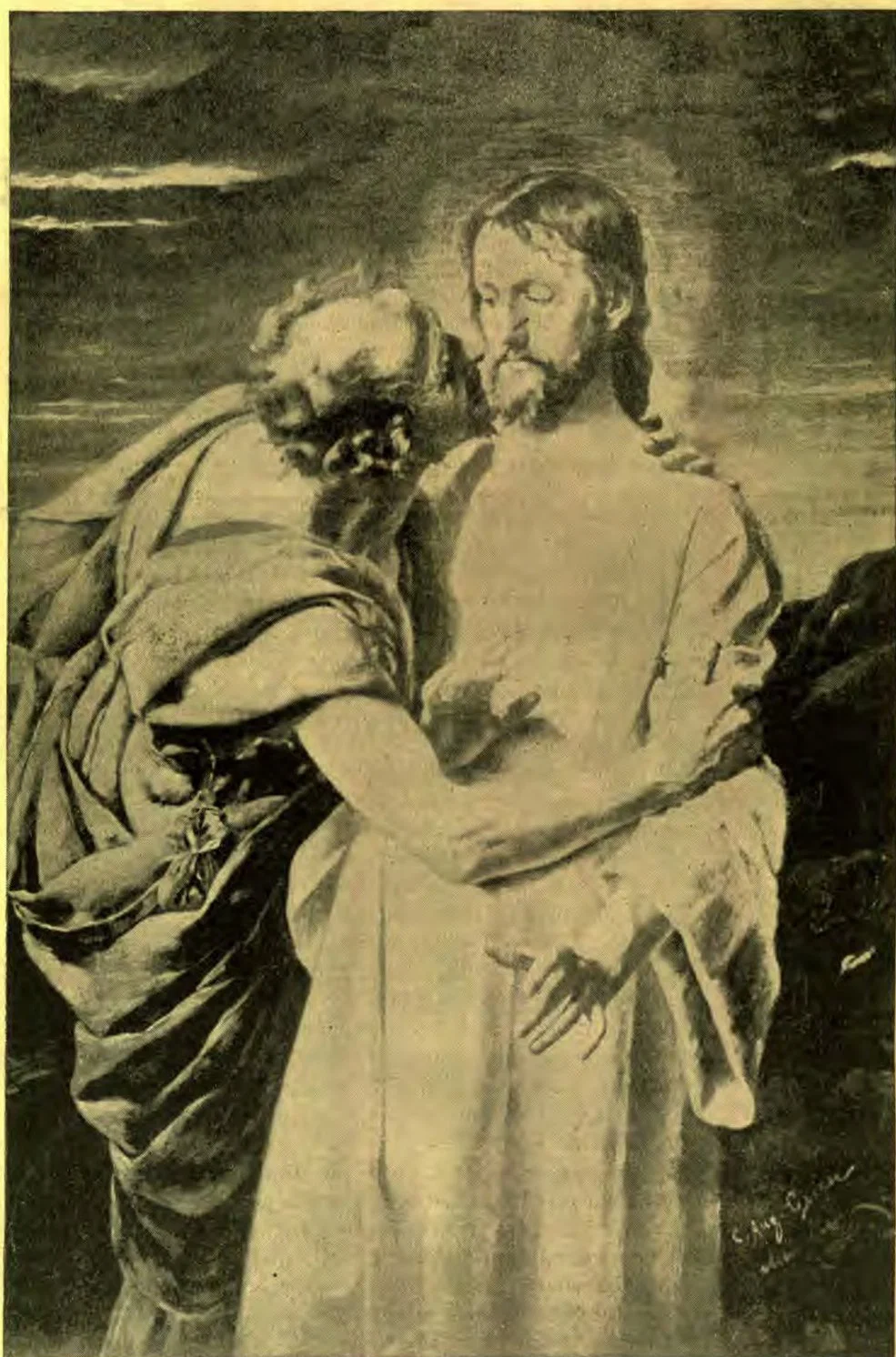
The Story.—The account of the betrayal of Jesus by Judas is found in all four of the Gospels, the fullest in John and Matthew. Together they tell us that the Garden of Gethsemane was one of the favorite resorts of the Master; that Judas knew the place; that he conducted thither a band of soldiers, furnished by the priests, to whom he had sold his Lord; that, when they came to apprehend Jesus, Judas designated Him by saluting Him as "Rabbi," and kissing Him much; that Peter, to defend his Master, drew his sword, and cut off the ear of Malchus, the high priest's servant; that Jesus healed the ear, and rebuked His impetuous disciple with words which were vibrant with lessons for the ages; and that He permits Himself to be taken, and drinks the bitter cup for the sake of humanity. All this, and more, is told in this story of base betrayal and everlasting faithfulness.
The Central Figure.—The central figure in the drama to both friend and foe is Jesus Christ. The one calm person in all that midnight assembly was the One purchased and sought that He might die. Seemingly the One with the greatest interest at stake, who is knowingly about to suffer untold agony, yet is He the least disturbed. The secret of His calmness, His placidity, His strength of character, was the Gethsemane, the pleading with God, the submission to the Father's will. There—alone with God—the great struggle took place, the mighty Agonizer won by yielding, and He was prepared for whatever might await Him. This is a lesson for us all. We never prepare ourselves for the great conflicts of life by waiting till the conflict comes. We always prepare for all conflicts by meeting every duty as it comes. Dark as Gethsemane may be, the right use of it, the yielding to God, gives a noble foundation for victory in coming trials. For all true, permanent victory lies in the operation of God's will, and we win by yielding to that will. Note, also, the absolute unselfishness of our Lord: "If therefore ye seek Me, let these [the disciples] go their way." He gave His life for others.
The Betrayer.—Judas is a fitting type of cherished sin. His nature was selfish. His sin was overweening covetousness. Christ in mercy associated him with Himself, placed before him constantly the teaching of His own wondrous life and ministry of unselfish love, that Judas might receive it, overcome his covetousness, and live. He was one of those who followed Christ for worldly gain. As treasurer he had stolen the scanty contributions given to the disciples, instead of using the money for the purposes for which it was given. He had found fault because costly balm had been used upon our Lord—and all because of the covetousness his heart had cherished. Winding its tendrils about every affection, enthralling every noble and unselfish impulse, his cherished sin at last leads him, for a few paltry pieces of silver, falsely to betray his Lord, whom he had said he would follow to prison and death. He doubtless reasoned that Jesus would, by His mighty power, release Himself from His enemies, and he, Judas, would be a few sheckles the gainer. Poor, mistaken man—duplicated so often in the lives of others since—he was selling, not his Lord, but his own soul. He had rejected the last warning, had refused the last reproof; he had chosen sordid gain, and with it death, dishonor, and eternal infamy. It is not safe to cherish one known sin for one moment. It will prove a traitor within the heart's walls, which opens its gates to a legion of other and worse sins. Its presence darkens the mind, stupefies the conscience, hardens the heart, and ruthlessly destroys every high and holy and unselfish thought and aspiration. Let Christ cleanse the heart by His word of reproof and forgiveness. Let Him abide there in all His purity, and by His presence "keep thy heart with all diligence; for out of it are the issues of life."
"Not by Might, nor by Power."—The betrayal has for us another important lesson in the course of another disciple. He was not one who betrayed his Master; he would have2died for Him then and there. Bold, impetuous Peter wanted Christ delivered, but he wanted it in his way, by the force of human might and power. Before this, Jesus had said repeatedly that the way of victory was the way of betrayal, suffering, the cross, the grave. Peter could not have it so. He desired earthly triumph. He wanted his Master to triumph as do earthly conquerors. His proud heart could not brook the humiliation; and he carried out what the others asked, "Lord, shall we smite with a sword?" Peter smote, and from his graciously loving Master received a rebuke, which is an eternal truth,—"All they that take the sword shall perish with the sword." A man is no stronger than his means of defense. If the church trusts to the sword, with the sword shall she perish. If she trusts to the arm of flesh, she will reap the inevitable curse of the trust; the arm of flesh will fail in the most trying hour. Israel trusted in Assyria and Egypt, and both Assyria and Egypt failed her, and spoiled her. They were as a staff upon which one leans, which breaks and pierces him who depends upon it for support. It has been so with the Christian church in the past. To-day the Christian church is living over the life of apostate Israel. In the demand for law, civil law, and civil penalties for Sunday "desecration" and the like, the church is appealing to the sword instead of to God, and showing by her appeal that she has no sure faith in God, that she has not learned the lesson of Christ. It looked dark at Christ's betrayal, and Peter thought something should be done, and done then. He tried in his way, and failed. Many look at the ever-increasing wickedness, and it seems as tho the kingdom of Christ—their ideas of His kingdom—would never materialize, and something must be done; and therefore Sunday laws, and the help of the civil power. God does not need such help. Pitifully He heals the wound which the unholy zeal causes, but He rebukes the zeal. He has all heaven's power at His command; He could wipe out all wickedness; but love, divine, eternal love must first be permitted to plead with men, even tho love's Keeper, for the time, dies. But love does not die. Righteousness can not perish. "Truth crushed to earth will rise again." In His own intrinsic worth, Christ, and all of Christ, will triumph. Let the rash hand of force sheathe its blade; let God's will be done. Not by army or power will He conquer, but by His Spirit in the hearts of men. Not by human power will His kingdom enter; "the zeal of the Lord of hosts shall perform this." Whenever force has been used in connection with Christ's cause or to advance its interests, it has always been at the expense of suffering to the innocent and irresponsible, and the ultimate defeat, and sometimes the eternal loss, of those who have chosen the force of flesh for the love of God. Reader, where do you stand? Will you learn these lessons of the betrayal? or, will you, sooner or later, betray or deny your Lord?
JESUS SAVES.
One man says he believes he can live such a good life that he needs no Saviour; he believes that he can save himself. Another man makes no attempt to live a good life, but realizes, at its close, his miserable failure and the hopelessness of himself; he cries out that he needs a Saviour, and commits himself to Christ. There is no question here of belief or disbelief in something called an "atonement." It is a question between supreme confidence in one's self, and supreme confidence in a Saviour outside of self. Horace Bushnell once defined faith as "that act by which one person, a sinner, commits himself to the care of another person, a Saviour." This is very different from intellectual belief in a doctrine. Doctrines do not save; Jesus alone saves. Let the "objector" referred to in the New York letter bear one thing in mind: neither he nor any other man living believes that he can save himself. Men may bolster themselves up with knowing talk about their futures not depending on what they believe or do not believe. All men know in their hearts that they are miserably insufficient of themselves, both here and in the world to come. To such men, "moral" or immoral, full of good works or full of evil works, the Saviour's offer of salvation is extended. They may take it, or they may reject it.—S. S. Times.
LOOKING AT THE MISTAKES OF OTHERS.
By Mrs. E. G. White
BY MRS. E. G. WHITE.
THERE are those who say, "I might have been a Christian could I have seen in the lives of professing Christians anything better than I have seen in the lives of those making no profession." They endeavor to excuse their own defects by pointing to the defects of others.
To such ones I would say, Do not keep your eyes fixed on the defective example of professing Christians. You will, of course, see in their lives things that are wrong. But if you keep looking at their faults, you will become like them. Look instead at the life of Jesus. There you will see perfection, goodness, mercy, and truth. Take the Saviour as your example. It is in looking at the mistakes of others, instead of to Christ, that you have made your great mistake.
Christ came to this world, subject to His Father's will, to show men and women what God desires them to be, and what, through His grace, they may be. He came to develop for man a perfect character. It is His purpose that we shall gain perfection,—not by keeping our eyes fixed on the defective lives of professing Christians, but by constantly beholding Him, the Sent of God, who in this world and in human nature lived a pure, noble, perfect life.
Do not allow yourselves to think that you are justified in sinning because others sin. It is your privilege to place yourself where you may reach the highest point of Christian excellence. Remember that in your life, religion is not to be an influence among others. It is to be an influence dominating all others. Resist every temptation. Make no concessions to the wily foe. Listen not to his suggestions. You have a victory to win, you have nobility of character to gain; but this you can not gain while you are looking at the faults of others. You gain nothing when you attempt to excuse your own defects by pointing to the defects of others.
As we move forward in obedience to Christ's commands, His light shines on our way, and His strength sustains us. Thus we go on from strength to strength, from grace to grace, by obedience becoming more and more Christlike.
We are not to follow human leading. Christ is our leader. At all times and in all places we shall find Him a present help. Because there are professing Christians who dishonor Christ in thought, word, and deed, we are to give plainer evidence than ever before of our completeness in Him. We are to walk in the light of His countenance. We are to show that He is light, and that in Him is no darkness at all. If we will submit to His guidance, He will lead us from the low level on which sin has left us, to the loftiest heights of grace. And as we strive for the crown of immortal life, praying that we may be made strong in the strength of Him who is invincible, we can help those who seem to have no power to escape from the snare into which they have fallen.
DEATH AND RESURRECTION.
By W. A. Sweany
BY W. A. SWEANY.
WHEN lust hath conceived, it bringeth forth sin; and sin, when it is finished, bringeth forth death.” Jas. 1:15. “For the wages of sin is death.” Rom. 6:23. “Wherefore, as by one man sin entered into the world, and death by sin; and so death passed upon all men, for that all have sinned.” Rom. 5:12. Hence, “man that is born of a woman is of few days, and full of trouble.” “Man dieth, and wasteth away; yea, man giveth up the ghost, and where is he?” Job 14:1, 10. “Man being in honor abideth not; he is like the beasts that perish. . . . Like sheep they are laid in the grave; death shall feed on them.” Ps. 49:12–14.
Six thousand years sojourn in the way that leads only to the grave has so fearfully emphasized the foregoing solemn truth, that “the living know that they shall die.” Eccl. 9:5. Reader, it is true of you, as David said of himself, “There is but a step between me and death;” and you know not how soon you may be called to take that step. See 1 Sam. 20:3. Therefore “set thine house in order; for thou shalt die, and not live.” Isa. 38:1. But man is slow to yield to the inevitable, and all the wisdom, genius, science, skill, power, and wealth, of the world, have been employed to disprove the decree, to change the sentence, or to avert or postpone its execution. Yet it is all in vain, for the procession continually moves along toward the open grave. But, tho compelled to yield and submit to the execution of the death decree, the human mind, influenced and inspired by the arch deceiver, has from time immemorial sought to parry its force and nullify its object by persuading men that “death is the gate of endless joy;” that “there is no death; what seems so is transition,” etc.
Would that the living, who “know that they shall die,” might also learn from the same scripture, that “the dead know not anything.” Eccl. 9:5. “The dead praise not the Lord, neither any that go down into silence.” Ps. 115:17. “His breath goeth forth, he returneth to his earth; in that very day his thoughts perish.” Ps. 146:4. In view of all this, how important is the admonition, “Whatsoever thy hand findeth to do, do it with thy might;3for there is no work, nor device, nor knowledge, nor wisdom, in the grave, whither thou goest.” Eccl. 9:10.
Since only the living can praise the Lord (Ps. 115:17, 18; 146:2–4; Isa. 38:16–19); and all must die, it is plain that, unless there shall come a resurrection, the experience of humanity must forever end at the grave. David realized this when he cried out, “Return, O Lord, deliver my soul; O save me for Thy mercy’s sake; for in death there is no remembrance of Thee; in the grave who shall give Thee thanks?” Ps. 6:4, 5. Paul also understood the situation when he declared, “If the dead rise not, . . . your faith is vain; . . . then they also which are fallen asleep in Christ are perished.” 1 Cor. 15:16–18.
Mortals would more fully appreciate the assurance of the resurrection if they could but realize that it is their only door of escape from eternal extinction, and their only hope of life beyond the grave. Knowing that his Redeemer lives and would call him forth at the “set times,” Job calmly faced the fate against which the faithless and fearful vainly strive, and laid down to pass his appointed time in the quiet unconsciousness of the grave. See Job 3:11–19; 14:13–15; 17:13–16; 19:23–27. “David is not ascended into the heavens,” but “is both dead and buried.” Acts 2:29–35. He was laid in his grave to wait until called forth to behold in righteousness and satisfaction the face of his Redeemer. See Ps. 16:8–11; 17:15. Paul fearlessly faced the grim enemy in sure and certain hope of the resurrection which he had so often preached to others, “with the Holy Ghost sent down from heaven.” 2 Tim. 4:6–8; Acts 24:14, 15; 1 Cor. 15:20–23; 1 Thess. 4:13–18. “This is a faithful saying, and worthy of all acceptance, that Christ Jesus came into the world to save sinners.” 1 Tim. 1:15; Matt. 1:21. And so “if we confess our sins, He is faithful and just to forgive us our sins, and to cleanse us from all unrighteousness.” 1 John 1:9. And “if we walk in the light, as He is in the light, we have fellowship one with another, and the blood of Jesus Christ His Son cleanseth us from all sin.” Verse 7.
But all this will not keep the forgiven one from dying; for death claims the good as well as the evil. See Eccl. 9:1–6. Then it is evident that a resurrection is necessary in order to complete the redemption and eternal salvation of those who have been forgiven, cleansed, and saved from their sins. “The grace of God that bringeth salvation hath appeared to all men, teaching us that, denying ungodliness and worldly lust, we should live soberly, righteously, and godly, in this present world.” But this will not suffice; we must also look for “that blessed hope, and the glorious appearing of the great God and our Saviour Jesus Christ.” Titus 2:11–13. So Christ was once offered to bear the sins of many; and unto them that look for Him shall he appear the second time without sin unto salvation.” Heb. 9:28. He came once to save sinners; He is coming again to save saints. See Isa. 25:8, 9; 26:19–21; Luke 21:25–28.
The importance of the resurrection is plainly apparent, and must be recognized and acknowledged as soon as we realize that on it depends the future existence and destiny of every mortal. And this being evident, it is to be expected that the whole of Satan’s power will be directed and exerted against that doctrine. His first scheme was to convince man that the warning against disobedience was an idle threat. “Ye shall not surely die” (Gen. 3:4) was his bold declaration. But with that swift and inexorable certainty with which effect follows cause, “death passed upon all men, for that all have sinned.” Had it not been for the assurance given, when sentence of death was passed, that eventually the enemy should be destroyed and his work stopped and undone (Gen. 3:15), despair must have settled down upon the dying race.
(Concluded next week.)
LOVE'S SPIRIT.
By Helen Hunt
When Love is strong,
It never tarries to take heed,
Or know if its return exceed
Its gift; in its sweet haste no greed,
No strifes belong.
It hardly asks
If it be loved at all; to take
So barren seems, when it can make
Such bliss, for the beloved's sake,
Of bitter tasks.
—Helen Hunt.
“And he had power to give life unto the image of the beast, that the image of the beast should both speak, and cause that as many as would not worship the image of the beast should be killed.” Rev. 13:15.
I wish especially to consider the death penalty with which this verse closes. The chronology of this text brings us into stormy times. As the Gospel closes its mission, the angel of peace flies away.
The two-horned beast is the power under consideration, and his acts are recorded in our text. The nation here symbolized is drunk with the knowledge of its own power and greatness. Its flag, instead of being a symbol of protection guaranteeing the safety of its citizens, has been so prostituted and changed, that the death penalty follows the exercise of God-given, religious liberty.
“As many as would not worship the image of the beast should be killed.” At this time, too, the seven last plagues are impending, and the world is soon to feel the judgments of God. Public sentiment has become terribly cruel and bitter, else a law of this nature would never be enacted.
The whole power of the judiciary and of the masses is, at that time, exerted in favor of idolatry. It is easy to understand that at this time, the angel receives his commission, “Thrust in thy sharp sickle, and gather the clusters of the vine of the earth; for her grapes are fully ripe.” Rev. 14:18. Those that are loyal to God are under the death sentence; yet, amid all this awful idolatry, God still reigns. Ps. 2:1, 2: “Why do the heathen rage, and the people imagine a vain thing? The kings of the earth set themselves, and the rulers take counsel together, against the Lord, and against His anointed.” “Then shall He speak unto them in His wrath, and vex [margin, “trouble”] them in His sore displeasure.” Verse 5. In this it seems direct reference is made to the plagues that are to follow. Thank God, the death penalty is never to be carried out. It will disgrace the statute book, and exist in the wills of the persecutor, but God comes in before its execution. “And at that time shall Michael stand up, the great Prince which standeth for the children of thy people; and there shall be a time of trouble, such as never was since there was a nation even to that same time; and at that time thy people shall be delivered, every one that shall be found written in the book.” Dan. 12:1. Incidents are not lacking where God has thwarted the vengeance of man. Read Exodus 15. This is at the crossing of the Red Sea. Pharaoh and his host determined to destroy where they could not rule; to kill where they could not enslave. “The enemy said, I will pursue, I will overtake, I will divide the spoil; my lust shall be satisfied upon them; I will draw my sword, my hand shall destroy them” (verse 9), but not one perished, and they sung the song of Moses on the further shore. In the notes of rejoicing, I hear: “In the greatness of Thine excellency Thou hast overthrown them that rose up against Thee; Thou sentest forth Thy wrath, which consumed them as stubble.” Verse 7.
To-day, saint and sinner are closely commingled, in the same home, in social and business relations, and in a thousand other ways. If the plagues were poured out now, could it be said to the righteous, “No plague shall come nigh thy dwelling”? Ps. 91:10. But imagine the effect when this law passes pronouncing the death penalty upon God’s loyal ones. Suppose the statute book contains the death penalty with this addition: “And be it enacted that this law shall become operative and go into effect Jan. 1, 1905.” There would be a sudden separation between those who had made the law and those who would suffer from it. How quickly would those who were under the ban leave the cities, where mob violence was the most bitter. As a measure of safety, they would go to quiet places where there was less probability of the law being enforced; and, consequently, when the plagues desolated the great centers, the righteous would all have fled.
Among the plagues that are coming on the ungodly, when men shall seek death and shall not find it, is that remorseless destroyer, famine. But of him who is sheltered by the Almighty it is declared: “He shall dwell on high; his place of defense shall be the munitions of rocks; his bread shall be given him; his water shall be sure.” Isa. 33:16. I do not know how God will feed them. In Israel, a type of those “upon whom the ends of the world are come,” men were fed “angels’ food” (Ps. 78:25), manna. It may be that God will feed His people in the same way in the antitype. One thing is certain, if He does, none of them will go out on the Sabbath to gather it, as did ancient Israel. The reason that they enjoy His protection is because they are “keeping the commandments of God;” and one of them says: “The seventh day is the Sabbath of the Lord thy God; in it thou shalt not do any work.” And so, on the seventh day God will not rain any down, because He is the “Lord of the Sabbath,” and they will not look for any in the field, for the law of God is in their hearts. Then, is it a hardship, or a mercy, that separates them from those who shall suffer from the judgments of God?
When Christ foretold the destruction of Jerusalem, He said, “Then let them which be in Judea flee into the mountains: let him which is on the housetop not come down to take anything out of his house, neither let him which is in the field return back to take his clothes.” Matt. 24:16-19. They were to consider their personal safety before property or anything else. They obeyed the Saviour’s words; and during the horrors of famine they were secure. When Jerusalem ran with blood and eleven hundred thousand perished, not one of the disciples suffered. Was not God’s way the best?
So in the end of the world, when He shall “gather out of His kingdom all things that offend, and them which do iniquity” (Matt. 13:41), the saints that were driven out by a cruel law will be safe from the destruction that comes upon the world. The need of protection in that trying time is plainly shown in the following: “Thou shalt not be afraid for the terror by night; nor for the arrow that flieth by day; nor for the pestilence that walketh in darkness; nor for the destruction that wasteth at noonday. A thousand shall fall at thy side, and ten thousand at thy right hand, but it shall not come nigh thee. Only with thine eyes shalt thou behold and see the reward of4the wicked.” Psalm 91. Read the promise in verses 10 and 11: “There shall no evil befall thee, neither shall any plague come nigh thy dwelling. For He shall give His angels charge over thee, to keep thee in all thy ways.”
Do not deceive yourselves by saying that public sentiment is too liberal to use extreme measures. The present trend of public education is to drive the weak to the wall. See the spirit that actuates the masses during a strike. See the feeling toward “strikebreakers.” Look in the faces of a mob, and then imagine what it will be when turned against a “scab” religion, for the man who has no religion will fight for it far quicker than the man who has conscience and principle. The great lesson for us to learn from this, is, that we can only be sure of deliverance by having our names written in the Lamb’s book of life. We can only be sure of God’s protection by giving up all for Him. God help us each to make this consecration.
THE RECORD OF TWO KINGS.
By Alexander McLaren
[Alexander McLaren, D.D., in Sunday-School Times.]
JEROBOAM'S son and successor was killed by Baasha; Baasha's son and successor was killed by Zimri, who reigned for a week, and then burned the palace and died in the flames. A struggle for the throne followed between Omri, the commander-in-chief, and Tibni. “Tibni died, and Omri reigned.” So, in fifty years, the kingdom that was to relieve Israel from oppression staggered through seas of blood, and four kings, or would-be kings, died by violence.
Omri's dynasty lasted about as long, namely, through the reigns of four kings, and was then swept away like the others, in blood and fire. The lesson gives a meager outline of the reigns of himself and his son Ahab, of which perhaps the meagerness is the most significant feature. The only fact told of the father is that he built Samaria, and his whole reign is summed up in the damning sentence that he walked in the way of Jeroboam. We learn from the Moabite stone that he waged successful war against that country, and that it was tributary to Israel for forty years. In Micah 6 : 16, mention is made of the statutes of Omri, as if he had given edicts for idolatry. The reign of Ahab is similarly summarized. His marriage with Jezebel, and the flood of Baal worship which that let loose over the land, are told with horror in preparation for Elijah’s appearance, like a dark background that throws up a brilliant figure.
The lessons to be drawn from these severely condensed records, cut down to the bone, as it were, are plain. The first of them is, that, when a life is over, the one thing which lasts, or is worth thinking about, is the man’s relation to God and His will. Here are twelve years’ reign in the one case, and twenty-two in the other, all boiled down, so to speak, into half a dozen sentences, and estimated according to one standard only. What has become of all the eager strife, the joys and sorrows, the hopes and fears, that burned so fiercely for awhile? All died down into a handful of gray ashes. And what lies in them like a lump of solid metal that has been melted out of the huge heap of days and deeds that fed the fire?—The man’s relation to God. That abides; that is recorded; that determines everything else about him. Waving forests, that once had sunshine pouring down on their green fronds, are represented in a thin seam of coal.
Our lives will all come down to this at last. How did he stand toward God and His will? is the final question that will be asked about each one of us, and the answer to it is the only thing that concerns the dead—or the living either. Men write voluminous biographies of each other. How little their judgments matter to the dead men! Praise or blame are of equal indifference to them. But what matters it whether God will have to record of us what is recorded of these two wretched kings, or whether He will recognize that the main drift of our poor lives was to serve Him and do His will. He was a great scholar; he made a huge fortune; he rose to be president; she was a noted beauty, a leader of fashion, a queen of society—what will all such epitaphs be worth, if God’s finger carves silently below them, “He did that which was evil in the sight of the Lord?”
Another lesson from these two reigns is the certain widening of the smallest departure from God. Jeroboam professed to retain the worship of Jehovah, and to introduce only a small alteration in setting up a symbol of Him. He would vehemently have asserted that he was no idolater, and would have shuddered at the very notion of bowing down to the gods of the nations, but in less than fifty years a temple to the Sidonian Baal rose in Samaria, and his worship, with its foul sensuality, was corrupting all Israel. However acute the angle of departure, the line has only to be prolonged, and the distance between it and that from which it diverged will be the distance between heaven and hell.
Let no man say: “Thus far and no farther will I go.” There is no stopping at will on that course, any more than a man sliding down a steeply-sloping sheet of smooth ice can pull himself up before he plunges over the edge into the abyss below. That is true as to all departures from God and His law, but it is eminently true as to every tampering with the spirituality of worship. Jeroboam’s symbolism led straight to Ahab’s unblushing pagan worship of the hideous Sidonian Baal. The craving for symbolical and sensuous accessories of worship, which is strong in most churches in this esthetic generation, is perilous. Material aids to worship there must be, so long as we are in the flesh, but the fewer and simpler they are the better, for they are aids which very swiftly become hindrances.
Another lesson from Ahab’s reign is the need of detachment from entangling alliances, if we would keep ourselves right with God. It was Israel’s calling to be separate from the nations. It was Israel’s temptation either to mix with them or to keep aloof from them in contempt and hatred. Ahab’s marriage with Jezebel was, no doubt, thought by his father a clever bit of policy, assuring them of an ally. But it flooded the nation with the cruel and lustful cult of Baal, and that finally ruined Ahab and his house. God’s servants can never mingle themselves with His enemies without harm, unless they mingle with them for the purpose of turning them into His servants. If we prefer the company of those who do not love Jesus, our love to Him must be faint, and will soon be fainter. If Ahab takes Jezebel for his wife, Ahab will soon take Jezebel’s foul god for his god.
THE SURE WORD OF PROPHECY.
By J. L. Shuler
BY J. L. SHULER.
FOR we have not followed cunningly devised fables, when we made known unto you the power and coming of our Lord Jesus Christ, but were eyewitnesses of His majesty. For He received from God the Father honor and glory, when there came such a voice to Him from the excellent glory, This is My beloved Son, in whom I am well pleased. And this voice which came from heaven we heard, when we were with Him in the holy mount.” 2 Peter 1:16–18. That this refers to the transfiguration, is shown by Matt. 17:1–5.
In order to prove that he was not following fables in telling of the coming of the Lord, Peter declared that he had been an eyewitness of the transfiguration, which was a miniature representation of that glorious event. In human affairs, the testimony of a visible witness is deemed the best proof that we can have for any event. To see anything for one’s self is an end of controversy. But Peter goes on to say immediately after this reference to the transfiguration:—
“We have also a more sure word of prophecy; whereunto ye do well that ye take heed, as unto a light that shineth in a dark place, until the day dawn, and the day-star arise in your hearts.”2 Peter 1:19.
Thus Peter declares that prophecy is “more sure” than human eyesight. Prophecy is that which it is in the purpose of God to bring to pass, and therefore can not fail. Our eyes at best may deceive us, but the Word of God “liveth and abideth forever.” 1 Peter 1:23. Prophecy has in it nothing of the human; it is wholly of divine origin. None of man’s weakness5can enter into it, because it comes direct from the Holy Spirit, “the Spirit of truth.” “The prophecy came not in old time by the will of man; but holy men of God spake as they were moved by the Holy Ghost.” 2 Peter 1:21.
In the parable of the rich man and Lazarus, Jesus instructed the people that “If they hear not Moses and the prophets, neither will they be persuaded, tho one rose from the dead.” Luke 16:31. If the hearing of the prophetic word would not persuade them, they would not be persuaded by seeing with their own eyes even one that had risen from the dead. In view of this fact it behooves us to understand and take heed to the prophecies.
When Christ rode into Jerusalem amid the joyful shouts of “Hosanna” from His disciples, the Pharisees asked Christ to rebuke them. But He said, “I tell you that, if these should hold their peace, the stones would immediately cry out.” And why?—Because the prophecy relating to His entry into Jerusalem (Zech. 9:9), had to be fulfilled, even should the stones be caused to fulfil it. This incident is the assurance that the prophecies will certainly be fulfilled. Christ said, “Heaven and earth shall pass away; but My words shall not pass away.” Luke 21:33. And David testifies, “Thy word is true from the beginning.”
We have evidence enough from the prophecies that have been fulfilled that all the prophecy of the Bible will be fulfilled; because it is written “Thy word is truth,” and it was impossible for God to lie, and “The Lord is not slack concerning His promise.” The prophecies are indeed a “sure word.” They are also our basis of a hope “both sure and steadfast.” Therefore we “do well” to “take heed” to them.
OPPORTUNITY—A PARABLE.
"A thousand years a poor man watched
Before the gates of Paradise;
But while one little nap he snatched,
It oped and shut. Ah! was he wise?"
The Fortune of Complaint
"The usual fortune of complaint is to excite contempt more than pity."
THE MINISTRY OF CONVERSATION.
By Rev. J. F. B. Tinling
BY REV. J. F. B. TINLING.
DISPARITY of opportunity is not so great as it seems, and those who chafe at limitations fail to see that the best kind of influence is possible to all. Consecrated speech is constant ministry, and it tends directly to the best results in the storing of minds, and the forming of character. Here at least the women of civilized countries enjoy equality of opportunity with men, and the wide and wise use of this will surely bring about the recognition of all other rights.
The conversation even of well-meaning people is largely lacking both in care and in conscience. It is so easy to speak somehow that we are apt to form the habit of speaking anyhow, and of separating ill-formed and colorless observations by silences suggestive of vacuity. Matter or motive may be wanting in such cases, as usually in “smart” society, where money's worth is the only recognized utility. On the other hand, matter and motive may both be satisfactorily present, but restrained by conventional habit or constitutional timidity.
The highest possibility of conversation is that of the winning of individuals for God. Testimony to Christ, explanation, application, and persuasion mean far more between two souls, of whom one is in the enjoyment of salvation, than they ordinarily do between the able and faithful preacher and his congregation. Here love seems to be almost the sum of gifts, for, rich in it and in nothing besides, humble friends of Jesus have astonished the church by their phenomenal success; yet that success may be shared by any who will fulfil the conditions of consecration and compassion, with faith that claims the co-operation of God.
—Union Signal.
REASON AND FAITH.
By Ian Maclaren
IT remains, however, after we have fully appreciated the faculty of reason, and have vindicated its proper function in the sphere of religion, that we must join with one heart in thanking God for the revelation of Jesus Christ. As there can be no conflict between reason and faith, since they have different functions, so there can be nothing but harmony between reason and Christ, because Christ is the answer and fulfilment of reason. What the light is to the eye, Christ is to human reason. He reveals that perfect image of God and of man, and that perfect rule of life and character, after which the human mind by many sages and saints has been earnestly seeking, and which in the words and work of Christ it recognizes and welcomes. If human reason be the dim shadow of the divine reason, then Christ, who is the Logos of God, by virtue of His deity, is also the supreme reason of man, by virtue of His humanity, and in Christ reason, divine and human, meet and blend. Christ becomes therefore to us the standard of thought in religion, not by the imposition of God, but by the constitution of our nature.
He only thinks rightly who thinks with Christ. He who commits his mind as a docile disciple to the Spirit of Christ is delivered from the bondage of error, and brought into the liberty of truth, and the highest point of religious certitude is reached when the Christ within the Bible speaks to a man and is answered by the Christ within the man. While apart from Christ—
“The intellectual power through words and things
Went sounding on a dim and perilous way.”
Since the true Light has shined, it is our duty, our wisdom, our salvation, to follow Him till every thought be brought into captivity to the obedience of Christ, to whom with the Father and the Holy Ghost, one holy and undivided Trinity, be glory, “as it was in the beginning, is now, and ever shall be, world without end. Amen.”—Ian Maclaren.