A Specific Period for the Event—Remarkable Darkening of Sun and Moon—A Great Earthquake Also Answered the Prediction
By Calvin P. Bollman
"BUT in those days, after that tribulation, the sun shall be darkened, and the moon shall not give her light." Mark 13: 24.
It is necessary only to remind the reader that "those days" were the twelve hundred and sixty years of papal supremacy, beginning in 538 and ending in 1798; while "in those days, after that tribulation," meant between the close of the tribulation, or persecution, and the end of the days. As in the case of the parts of this prophecy that have already been examined, we shall find this part fulfilled to the letter.
PERSECUTION HAD CEASED
As shown last week, owing to the combined influence of the Reformation, the discovery and settlement of America, etc., there was little persecution of note after the middle of the eighteenth century; and May 19, 1780—"in those days, after that tribulation"—the sun was supernaturally darkened over all New England, parts of New York, Pennsylvania, and Canada,—the very region where, a few years later, would arise the message that would stir the world as it had not been stirred by any preaching or by any message since the days of John the Baptist and of our Lord Himself.
THE SUN AND THE MOON WERE DARKENED
Two or three quotations on this point will suffice: Webster's “Unabridged Dictionary,” edition of 1883, article “Dark Day,” says: “Dark Day, The, May 19, 1780, so called on account of a remarkable darkness on that day, extending over all New England. In some places persons could not see to read common print in the open air for several hours together. . . . The true causes of this remarkable phenomenon are not known.”
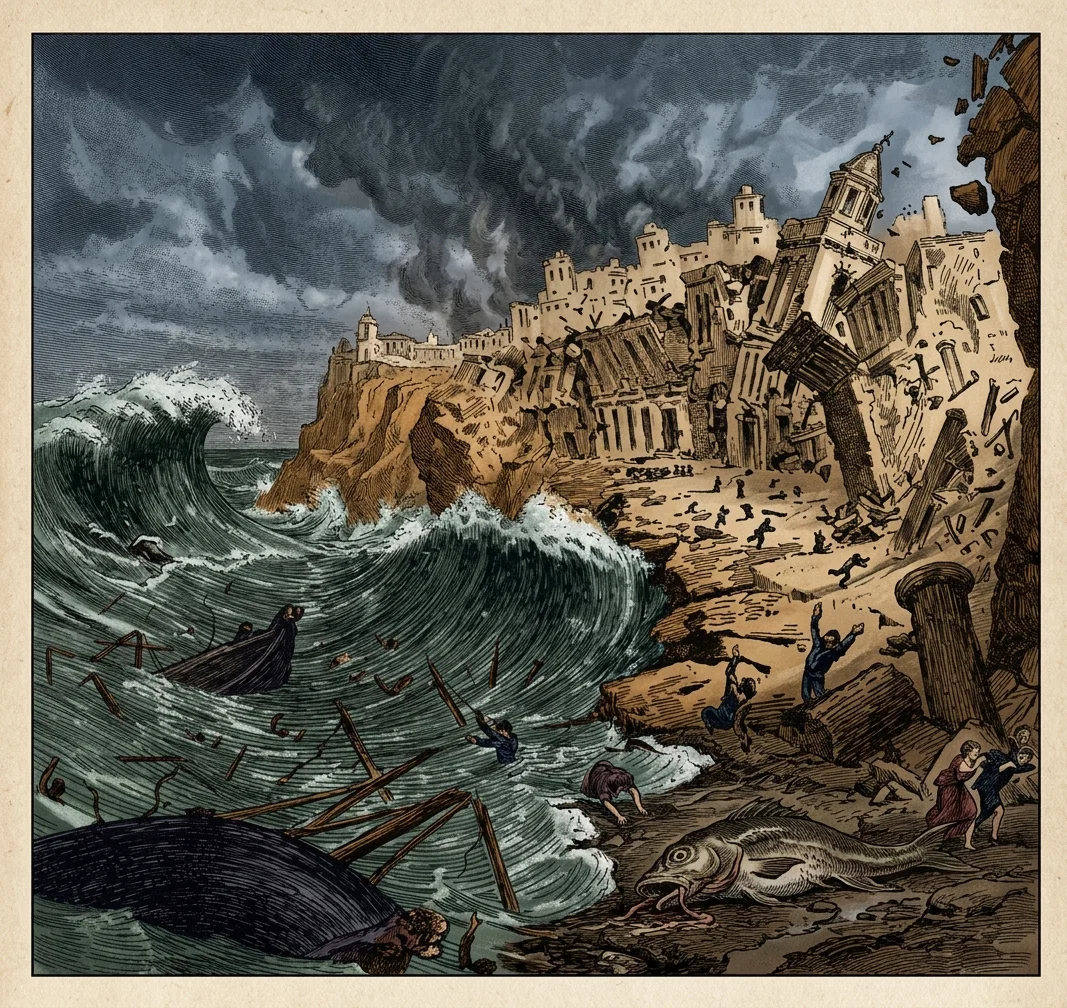
The greatest earthquake that has ever occurred within historic times.
In a sermon preached nine days later—that is, on May 28, 1780—the Rev. Elam Potter, who was himself an eyewitness of the phenomenon, said: “But especially I mention that wonderful darkness on the nineteenth of May inst. Then, as in our text [Matt. 24: 29], the sun was darkened; such a darkness as probably was never known before since the crucifixion of our Lord. People left their work in the house and in the field. Travelers stopped. Schools broke up at eleven o'clock. People lighted candles at noon-day, and fires shone as at night. Some people, I have been told, were in dismay, and thought whether the day of Judgment was not drawing on. A great part of the following night also was singularly dark. The moon, though in the full, gave no light, as in our text.”
Many efforts have been made to account for this remarkable darkness. But even if a satisfactory explanation could be given, the fact would still remain that it was foretold by the Saviour eighteen hundred years before it occurred, and that it came at just the time He said it would come; namely, “in those days, after that tribulation.” Even if some natural cause could be assigned, it would not prove the occurrence to have been any less a sign of the coming of the day of God.
It may be objected that this sign was given nearly 135 years ago, and the end has not yet come. But what of that? Did not Noah preach the coming of the Flood for one hundred and twenty years? And must it be thought incredible that God, in His providence, began to give warning of the still greater and more terrible destruction by fire, even a longer time before the event?
Again, did not the angels sing, “On earth peace, good will toward men,” nearly a third of a century before Christ actually entered upon His ministry? And did not John Huss, “the morning star of the Reformation,” do his work, and die for his faith, and apparently die in vain, a hundred years before Luther's time?
Yea, verily; all these things were even so. God is not limited as to time, and is “long-suffering to usward, not willing that any should perish, but that all should come to repentance.” He prepares His agencies centuries in advance. He hangs out His warning signs decades and even centuries before the event, that men may have ample time to make choice between His service and eternal life, or the service of this world and the wages of sin. No man putting his hand to the plow and looking back is worthy of the kingdom of heaven. Only he who endures to the end has the promise of the everlasting reward.
OTHER PROPHETS SAW IT
This same event—the darkening of the sun and of the moon—was foretold also in Rev. 6: 12: “And I beheld when He had opened the sixth seal, and, lo, there was a great earthquake; and the sun became black as sackcloth of hair, and the moon became as blood.”
THE GREAT LISBON EARTHQUAKE
The sixth seal was ushered in by the earthquake of Lisbon in 1755, when ninety thousand lives were lost in a few minutes of time, and when parts of four continents felt the mighty heavings of the sin-cursed earth. This was unquestionably the greatest earthquake that has ever occurred within historic times. No other ever wrought so great destruction. None before nor since affected so great a part of the earth's surface.
Following the great earthquake, there came, in 1780, the darkening of the sun and of the moon. Though the moon was at the full, it gave no light until late in the night, and then it had the appearance of blood.
Milo Bostwick, describing some years later the occurrence, and the impression it made upon the minds of his parents, said: “My father and mother, who were pious, thought the day of Judgment was near. They sat up that night, during the latter part of which, they said, the darkness disappeared, and then the sky seemed as usual, but the moon, which was at its full, had the appearance of blood.”
Thus in a single event was fulfilled not only our Lord's prophecy of Matt. 24: 29, but likewise the still older prediction of the prophet Joel: “The sun shall be turned into darkness, and the moon into blood, before the great and the terrible day of the Lord come.” Joel 2: 31.
Faith That Saves
By H. M. Kelley
By H. M. KELLEY
THE great apostle to the gentiles declared: “I am crucified with Christ; nevertheless I live: yet not I, but Christ liveth in me: and the life which I now live in the flesh I live by the faith of the Son of God, who loved me, and gave Himself for me. I do not frustrate the grace of God: for if righteousness come by the law, then Christ is dead in vain.” Gal. 2: 20, 21.
“Crucified with Christ”
Christ was crucified to put an end to sin, in the individual, in the world, and in the universe; but He has left it with the individual to say when the end shall come so far as he is concerned. The end of sin in the individual cannot come until “the old man, which is corrupt according to the deceitful lusts,” is dead, and the “new man, which after God is created in righteousness and true holiness,” is alive. Eph. 4: 22, 24. And the life of the one must succeed the death of the other. The “new man” cannot live to God until the “old man” is dead to sin.
The crucifixion took place when Christ died on the cross, “who His own self bare our sins in His own body on the tree, that we, being dead to sins, should live unto righteousness.” 1 Peter 2: 24. But the atonement246becomes effective upon the consideration that we accept its merits through faith. Faith in the Lamb of God is the weapon that puts the “old man” to death. Until the heart is given completely to God, and faith has absolute control, the death agonies must continue.
There can be no permanent peace while the “old man” is dying. “Wherefore remember, that ye being in time past gentiles in the flesh, who are called uncircumcision by that which is called the circumcision in the flesh made by hands; that at that time ye were without Christ, being aliens from the commonwealth of Israel, and strangers from the covenants of promise, having no hope, and without God in the world: but now in Christ Jesus ye who sometimes were far off are made nigh by the blood of Christ. For He is our peace.” Eph. 2: 11-14.
When Jesus drove the Jews out of the temple with a scourge, they asked Him this question: “What sign showest Thou unto us, seeing that Thou doest these things?” or in other words, What is Your authority? “Jesus answered and said unto them, Destroy this temple, and in three days I will raise it up.” John 2: 18, 19.
The Scriptures had foretold that He should die that others might not die, and that He would be raised—that all the faithful might live eternally. He believed that He would die and afterward live, and He gave as His authority His faith in these promises.
We too are made “alive unto God” through faith in Him who has promised us eternal life, and the faith we have in Him is our authority for being Christians. In this we “do not frustrate the grace of God,” for we acknowledge that righteousness does not come by the law, but through faith in Jesus Christ.
The Future of Mankind
By F. W. Paap
God's Plan Concerning It—Sinners Are Not Immortal—They Must End in Destruction—Immortality Given at the Resurrection
By F. W. Paap
WHAT is God's great plan concerning man? This is a question in which every mortal is more or less interested. I say “mortal”; and if the expression were fully understood, there would be no doubt, no speculation.
A correct answer to the above interrogation would save us from a thousand snares of the enemy. And to the end that we might know and enjoy the fullest and most blessed satisfaction possible to mortals, our great Creator, the Author of the plan of salvation, the Saviour of mankind, has given us the fullest information, in His holy word.
The Divine Lamp of Light
The Bible is a lamp to our feet, and a light to our path. Ps. 119: 105. It is a tried word. It is authoritative, and that is what we need in these times when every wind of doctrine is blowing. To get this great question before the mind of the reader, in a simple form, with the idea of arousing the interest, and stimulating an honest inquiry, the writer would make the following statements, supported by Scripture references:
Man was placed on trial, and yielded to temptation. Genesis 3.
As a consequence of sin, “death passed upon all men, for that all have sinned.” Rom. 5: 12.
Because of the fall, “it is appointed to men once to die.” Heb. 9: 27.
A way of escape has been provided through faith in Jesus Christ, and He is able to save all who “come unto God by Him, seeing He ever liveth to make intercession for them.” Heb. 7: 25.
Those who reject Him will finally be cast off. Matt. 7: 21-23. The large majority turn a deaf ear to every entreaty of the Spirit of God. Matt. 7: 13, 14.
The necessary information as to who are cast off will not be available until after the Investigative Judgment, which closes just prior to the second personal, literal coming of Christ. Luke 14: 12-14; Rev. 22: 11, 12; 2 Tim. 4: 1.
Between death and the resurrection, all are perfectly insensible; they know nothing. Eccl. 9: 5.
They are in their graves, in the land of forgetfulness. They go down into silence. Eccl. 9: 10; Ps. 115: 17.
They have no thought, they know nothing regarding anything that is going on. They are asleep. Job 14: 10-15, 21; Ps. 146: 4.
When God made man, He breathed into his nostrils the breath of life, and man became a living soul, not an immortal soul. Gen. 2: 7.
Man has no more an immortal soul than has any other animal. Gen. 7: 21, 22.
When man dies, this breath, or spirit, goes forth. James 2: 26, margin.
Man has the same spirit of life, breath, as other animals. Eccl. 3: 19, 20.
In the resurrection, when God makes man again, He opens the grave, brings bone to bone, brings flesh upon these bones, covers them with skin, puts breath in them, and they live, and stand up, “an exceeding great army” of the redeemed. Eze. 37: 1-14.
To this true Israel, immortality will be given, and they will die no more. 1 Cor. 15: 51-55.
God only has immortality. He counsels us to seek for it, through the gospel. If we obey Him, we shall know what it means to be the happy possessors of immortality. Rom. 2: 7; 2 Tim. 1: 10.
Tried to Frustrate the Plan
In a thousand ways, the great enemy of our souls has striven to frustrate the plan, and blind the minds of men to its simplicity. He has suggested many changes of God's ways. But there is to be none.
The introduction of that conjunction “if” has thrown many a poor soul off his guard. “If thou be the Son of God.” Matt. 4: 3, 6. “Now if Christ be preached that He rose from the dead, how say some among you that there is no resurrection of the dead? But if there be no resurrection of the dead, then is Christ not risen: and if Christ be not risen, then is our preaching vain, and your faith is also vain. Yea, and we are found false witnesses of God; because we have testified of God that He raised up Christ: whom He raised not up, if so be that the dead rise not. For if the dead rise not, then is not Christ raised: and if Christ be not raised, your faith is vain; ye are yet in your sins. Then they also which are fallen asleep in Christ are perished. If in this life only we have hope in Christ, we are of all men most miserable.” 1 Cor. 15: 12-19.
We are glad for the definiteness of God's word. Verses 20-23: “But now is Christ risen from the dead, and become the first fruits of them that slept. For since by man came death, by man came also the resurrection of the dead. For as in Adam all die, even so in Christ shall all be made alive. But every man in his own order: Christ the first fruits; afterward they that are Christ's at His coming.”
“If one went unto them from the dead, they will repent.” Luke 16: 30. Hearken to the reply: “They have Moses and the prophets; let them hear them. . . . If they hear not Moses and the prophets, neither will they be persuaded, though one rose from the dead.” Verses 29-31. There will be no change in the plan. “The word of our God shall stand forever.”
The Dead Have No Light for Us
The dead have no light for the living. All that pretends to come from that source is of the devil, and serves only to defile, to lead away from the word of God. Lev. 19: 31. The great God has spoken. “Precept upon precept; line upon line; . . . here a little, and there a little,” His plan is made clear. He has no pleasure in the death of the sinner. He “gave His only-begotten Son, that whosoever believeth in Him should not perish, but have everlasting life.” All who refuse, will be classed among the wicked, and destroyed.
Our hearts should greatly rejoice to know that there is still an opportunity. The door of mercy is still ajar. The sweet voice of mercy still lingers. “The Spirit and the bride say, Come. And let him that heareth say, Come. And let him that is athirst come. And whosoever will, let him take the water of life freely.” Rev. 22: 17.
Has Given Us All
God created man a free moral agent. He gave him the power of choice. God set before man life and death, and said, “Choose ye this day whom ye will serve.” With this bestowal of power to decide, and power to obey, the loving Creator invited all to come to Him. He held out every inducement. Life, with all its attendant blessings, was brought within the reach of man.
Nothing has God withheld from those who put their trust in Him. “He that spared247not His own Son, but delivered Him up for us all, how shall He not with Him also freely give us all things?” Rom. 8: 32. “The wicked shall perish, and the enemies of the Lord shall be as the fat of lambs: they shall consume; into smoke shall they consume away.” Ps. 37: 20. But the righteous shall shine forth as the sun in the kingdom of our Father. They shall inherit the land and delight themselves in the abundance of peace. Matt. 13: 43; Ps. 37: 11.
There will be two classes. Destruction will overtake the wicked. “Nevertheless we, according to His promise, look for new heavens and a new earth, wherein dwelleth righteousness,” or, “where the righteous shall dwell.” 2 Peter 3: 13.
Shall we not study the plan, and conform to all its requirements, that we may at last hear the gracious words, “Well done, thou good and faithful servant: . . . enter thou into the joy of thy Lord”?
Greeted the Whole Human Family
By Rufus A. Underwood
The Helpless May Have Help—“Blessed Are the Poor in Spirit”
The Disease of Sin May Be Cured
By Rufus A. Underwood
This is the first of several short articles by Elder Underwood, setting forth the fundamentals of the gospel. The articles are based on the first part of the fifth chapter of Matthew. Each one may be profitably read alone; but persons who read them all, will have the far richer feast.
EDITOR.
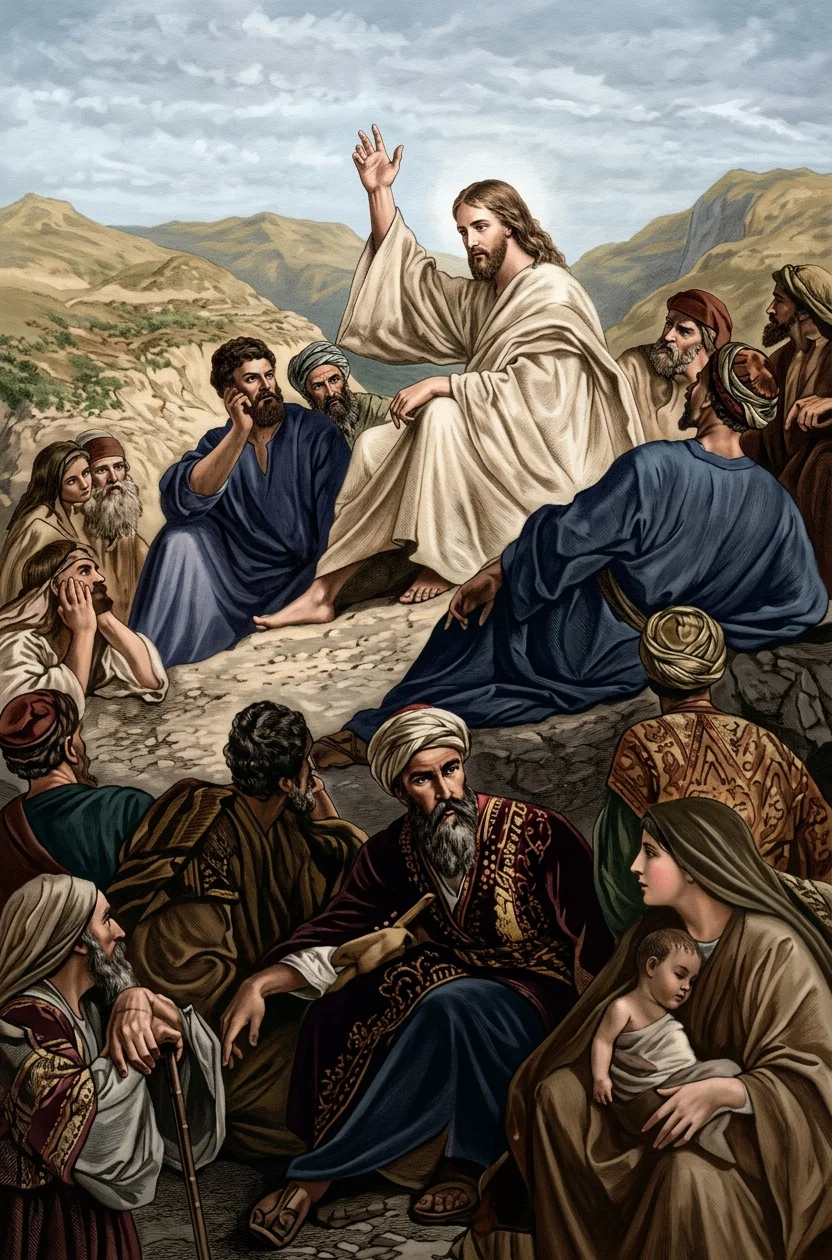
A STUDY of Christ's sermon upon the mount shows it to be the greatest exposition of gospel truths of all time, and applicable to all people. It is the purpose of the writer to notice, in a few brief articles, some of the most precious gospel truths the Bible contains, which are clearly set forth in the opening part of the Sermon on the Mount.
“And seeing the multitudes, He went up into a mountain: and when He was set, His disciples came unto Him: and He opened His mouth, and taught them.” In this opening statement, or Matthew's preface to Christ's sermon, we have a glimpse of Christ as He taught, not the multitudes that had followed Him for healing only, but the vast multitudes of the unborn millions of all time in a sin-cursed world. His precious words, freighted with hope, come ringing down even to our day.
Christ Greets the Whole Human Family
Another has said: “The beatitudes are Christ's greeting to the whole human family. He seems to have forgotten for a moment that He is in the world and not in heaven, and He uses the familiar salutation of the world of light.”
Christ, the world's greatest teacher and preacher, presents in this, His opening sermon to the disciples, the essential steps that must be taken on the part of a lost soul to be transformed from sin to salvation. He begins with the A B C of the gospel, and shows the successive steps that must be taken if the soul of man attains to the high excellence of character essential to pass from this world into the kingdom of glory. The simplicity and science of the process in changing the character of man, filled with darkness and selfishness, into that of light, love, and righteousness, is worthy of the best attention that man can give.
Man's Need of Salvation
“Seeing the multitudes, . . . He opened His mouth, and taught them, saying, Blessed are the poor in spirit: for theirs is the kingdom of heaven.” This promise brings to the lost soul a gleam of hope,—to all who have felt their need of a power outside of themselves to bring deliverance, and who are ready to accept the proffered help.
The contrast is made between those who say, “I am rich, and increased with goods, and have need of nothing,” and the “poor in spirit.” The first class is well represented by the Pharisee who could stand and pray to himself, “I thank God that I am not like other men,” and boast of his deeds; while the poor publican, represented by those who are “poor in spirit,” could smite his breast, and ask God to be merciful to him a sinner.
“He seems to have forgotten for a moment that He is in the world and not in heaven, and He uses the familiar salutation of the world of light.”
The publican felt his poverty and need. To all such, heaven stands ready to respond. There is no promise to the self-righteous, who feel that their superior excellence is able to save them. None of this class are permitted to enter into the audience chamber of Christ, where the inexhaustible riches and wisdom of the great Teacher are dispensed.
It was at the entrance door of Christ's kingdom of grace that Saul, a poor, lost man, saw himself bound limb to limb, hand to hand, and face to face to the putrid body of sin, with no power in himself to deliver his soul. In this condition he cries out, “O wretched man that I am! who shall deliver me from this body of death?” Saul of Tarsus found that he was sold a slave under sin, and doomed to eternal death unless he could find a power that could deliver him. “Ye have sold yourselves for naught,” are the words of inspiration.
Can the Leopard Change?
Thus it is, dear reader, with every child of Adam. No human effort alone is able to cure the disease of sin. The question involved in the change of life in a regenerated soul is raised by the prophet in these words: “Can the Ethiopian change his skin, or the leopard his spots? then may ye also do good, that are accustomed to do evil.” Jer. 13: 23. No, this cannot be done; but the poor sinner who feels his need and calls for the great Physician, has the promise that there is nothing too hard for Him to undertake (Jer. 32: 17), and the assurance is given that “ye shall be redeemed without money,” and “theirs is the kingdom of heaven.”
A Word to Aged Pilgrims
By E. Hilliard
By E. HILLIARD
THE aged pilgrim whose faith has been in daily exercise along the journey of life, is better prepared to meet trials and temptations than are those who begin the Christian life in advanced years. But the latter class can thank God and take courage when they remember the cheering promise, “As thy days, so shall thy strength be.”
The outward man may become feeble; but living faith connects the inward man with divine power, and the spiritual life is renewed. The deterioration of the mental powers may weaken the memory; but the Lord has promised in the hour of trial, through the aid of the Comforter—the Holy Spirit—to bring all things whatsoever He has said, to our remembrance. John 14: 26.
He knows our weakness. He remembers that our frames are but dust. He sees the feeble step, from which the elasticity of youth has disappeared; and He pities the trembling form. But He also knows His power to strengthen, and His wisdom to guide.
He brought the greatest test upon Abraham when his form was bowed with the weight of years. The patriarch was told to offer his only son upon the altar of burnt offerings. Isaac was his great dependence in the affairs of life, and the father’s affection was centered in him. Abraham fully understood the heart-piercing command to offer his beloved boy for a burnt offering. He could not plead an acceptable substitute for implicit obedience. The demand was imperative.
The faith of the aged pilgrim responded to the infinite call, and all ended well. Because of that father’s fidelity, careworn and aged Christians of subsequent generations have been encouraged to trust in the patriarch’s God.
Not only Abraham was tested in advanced life, but the apostle Peter experienced his severest test when old. Christ said to him: “When thou wast young, thou girdedst thyself, and walkedst whither thou wouldest: but when thou shalt be old, thou shalt stretch forth thy hands, and another shall gird thee, and carry thee whither thou wouldest not. This spake He, signifying by what death he should glorify God.” John 21: 18, 19. When enfeebled with age, the apostle Peter was taken to the cross, and, it is affirmed, was248crucified with his head downward. This was by his own request. He declared himself unworthy to suffer in the same posture as did his Lord, because of his denial of Him at the crucifixion.
As the eyes dim with age, and the form totters with the burden of years, the feeble ones should lean more heavily upon the divine arm that supported the patriarch Abraham and the apostle Peter, and with David pray to God, “Cast me not off in the time of old age; forsake me not when my strength faileth.”
The Cup of Incarnation
By H. A. St. John
By H. A. ST. JOHN
ONLY one person drank this cup, and that one was the Son of God. He drank it all alone. The time required was the entire period of His humiliation, from His lowly birth in the stable in Bethlehem to His ignominious death on Calvary's cross.
The Father and the Son unitedly prepared this cup in heaven; and Jesus well knew all it contained, and gladly accepted it, before He left glory and humbled Himself as a man. He gladly accepted it, and drank it, because of the joy set before Him of thereby becoming the Redeemer of a lost world. It was the price required to redeem a sinful race.
Jesus began to drink this cup when He laid aside His royal robe and crown, and left His Father, and all the blessed associations of heaven. In the first part of this cup, it was not all bitterness and suffering, but a mixture of joy came to His holy soul as He witnessed the happiness that so many experienced who had been sorely afflicted and oppressed by the devil, but whom He healed of their maladies, and pardoned their transgressions.
But the time hastened for Him to drink the dregs of the cup. His crowning act of humility was performed in the early part of the night of His betrayal. As a servant of servants, He humbled Himself and washed His disciples' feet. Then He gave to them the bread and the wine as emblems of His broken body and spilt blood. Thus we see that the Lord's Supper is ever to be observed by His church as a divinely appointed memorial of the cup of Jesus' incarnation, by which our redemption is made possible.
Jesus then offered His last prayer with and for His church, and in that prayer He said to His Father, “I have finished the work which Thou gavest Me to do.” His joy and peace He gave to His followers, and then went forth to drink the dregs of the cup.
Soon He was in Gethsemane, staggering to the place of prayer. He cried, “My soul is exceeding sorrowful, even unto death.” Soon in bloody tears of anguish He cried, “Father, if it be possible, let this cup pass from Me: nevertheless not as I will, but as Thou wilt.”
An angel strengthened Him to finish drinking the cup. Soon the mob appeared. He was arrested, bound, and led away to be tried. When Peter attempted His release with a sword, He told him to put up his sword. “The cup which My Father hath given Me, shall I not drink it?”
Then He was led from trial to trial, shamefully abused in every disgraceful way possible, wounded for our transgressions, bruised for our iniquities, chastised for our peace, and crucified.
At the end of six hours of untold agony of soul and body on the cross, He cried, “It is finished,” bowed His head, and died. He thus finished the dregs of the cup. He rested one Sabbath in the sepulcher, then His Father called Him, and He was soon exalted to His Father's throne, and is now our almighty Saviour.
Humility
By Eliza H. Morrow
IT is the ripe wheat that bows its head, while the tare stands upright. He who has a humble spirit does not exalt self. God desires His people to serve Him with all humility of mind. Acts 20:19.
A certain renowned scientist once attended a meeting of royal personages; and as he entered the room, they all rose to do him honor. He whispered to a friend: “Did the king’s son just come in? And was this demonstration in his honor?” He did not dream that he himself was worthy of the tribute of respect. The Christian esteems others better than himself, hence has no envy. Phil. 2:3. ELIZA H. MORROW.
Georgia Prohibition Ten Thousand Times Better
This is the way the Atlanta Georgian puts it: “Prohibition in Georgia is not what it should be, but it is ten thousand times better than it was before the law was passed.”
Praying to the God of Elijah
By W. A. S.
The Heathen King's Challenge — The Missionary Must Meet It — The Miraculous Deliverance
Acting on no mere impulse of his own, but under the direction of the Spirit, Elijah prayed God for the rain which should assure the people of Israel that Jehovah and not Baal was the true God and the Giver of every good gift. Some years ago, on the African Kongo, a missionary band was driven to ask the God of Elijah for another such sign.
We Would Not Command the Lord
It is not that the human agent can command the Lord, or expect the Almighty to act upon man's suggestion. That would be merest presumption. Faith must always say with the Author of faith, “Nevertheless not my will, but Thine, be done.” But ofttimes, in the conflict of truth and error in the dark places of the earth, the missionary has been put where the Spirit of God manifestly indicated the preferring of requests for divine interventions which would show to darkened minds that there is indeed a living God in the heavens who can do things on earth.
“Elijah prayed God for the rain which should assure the people of Israel that Jehovah and not Baal was the true God.”
The Heathen Danced for Rain
In her book, “On the Kongo,” Mrs. Fanny E. Guinness tells of a time of threatening famine in the villages. The rainy season was passing, but there was no rain. The missionary one evening heard unusual drum-beating in the villages.
“He asked what it meant, and was told that the people were to assemble that night and dance for rain.”
“The missionary said to the lad, ‘But you know that will not bring rain, don’t you?’”
“O, yes, teacher, it will.”
“Nonsense! How can beating a drum and dancing make the rain fall? If God wants it to rain, it will, but not otherwise.”
“Ah, well, teacher, you will see. Just notice now if it does not rain before to-morrow morning.”
Even the Mission Boys Under the Spell
Everything looked dark to the missionary. Even the mission boys were under the spell of primitive superstition. “O God,” groaned the missionary, “forbid that Thy rain should fall in apparent response to the invocation of devils.” That night passed, and many nights; still no rain fell. Suspicion grew, in the native minds, that the missionary was driving away the rain god. What the missionary had said to the school lad came to the ears of the king, who sent word that the people believed the missionary was responsible for the withholding of rain.
The Heathen King Challenges
“The missionary replied that it was not he, but the people themselves.”
“How was that?”
“Just this way: God owns all the clouds, for He made them. Season by season He has sent the rain to you unasked, and you have had plenty to eat in all your towns. But who among you have ever once thanked Him? Instead of doing that, you have done that which He abominates, in praising and thanking your rain fetish.”
“What then shall we do, white man?”
“Here was a most practical question. How ought it to be answered? There seemed to be but one way, and that to take up the challenge of the heathen chief in God’s name.”
“‘Tell Kangampaka,’ replied the missionary, ‘to appoint a day for all the people to come together, and wait upon God to give them rain; and if they come to Him with sincere hearts, and put away their fetishes, He will hear them.’”
The King Appoints To-morrow
“The answer came back very soon: ‘The words of the white man are good. The king appoints to-morrow.’”
“The morrow came, and the people flocked in large numbers to the little church, which was full to overflowing. Chiefs and people from all the adjacent towns were there. After some exhortation, prayer was offered, and the people dispersed.”
“All through the rest of that day, the missionaries agonized in prayer to God; and toward evening the answer seemed to be at hand, for thick, black clouds rolled overhead, but, alas, dispersed again.”
Their Prayers Were Answered
“It was a sore trial of faith; but still they prayed on, and gave the Lord no rest. Through that night, they watched and prayed; and before dawn of the next day, the clouds came overhead again, and this time did not disperse until a glorious, refreshing shower had fallen upon the thirsty land.”
But material mercies alone are insufficient. There must be instruction of the mind in divine things by the word of God, and conviction of soul. It was not long until the rain dances were on again in the villages. But many hearts had received a conviction of the true God; and the missionaries, in their isolation and helplessness before the walls of heathen superstition, knew that God, in their extremity, had sent them a sign that He was within sound of their cry, to help and to deliver. W. A. S.