Signs of the Times, Vol. 42, No. 16.

Determined to Have Constantinople

Signs of the Times

Apr 20, 1915

Pacific Press Publishing Association · Mountain View, California · Apr 20, 1915

Determined to Have Constantinople
Russia’s Designs for Centuries—Are Her Dreams About to Be Realized?—What Will the Overthrow of Turkey Signify?
By E. T. Russell
© Boston Photo News Co.
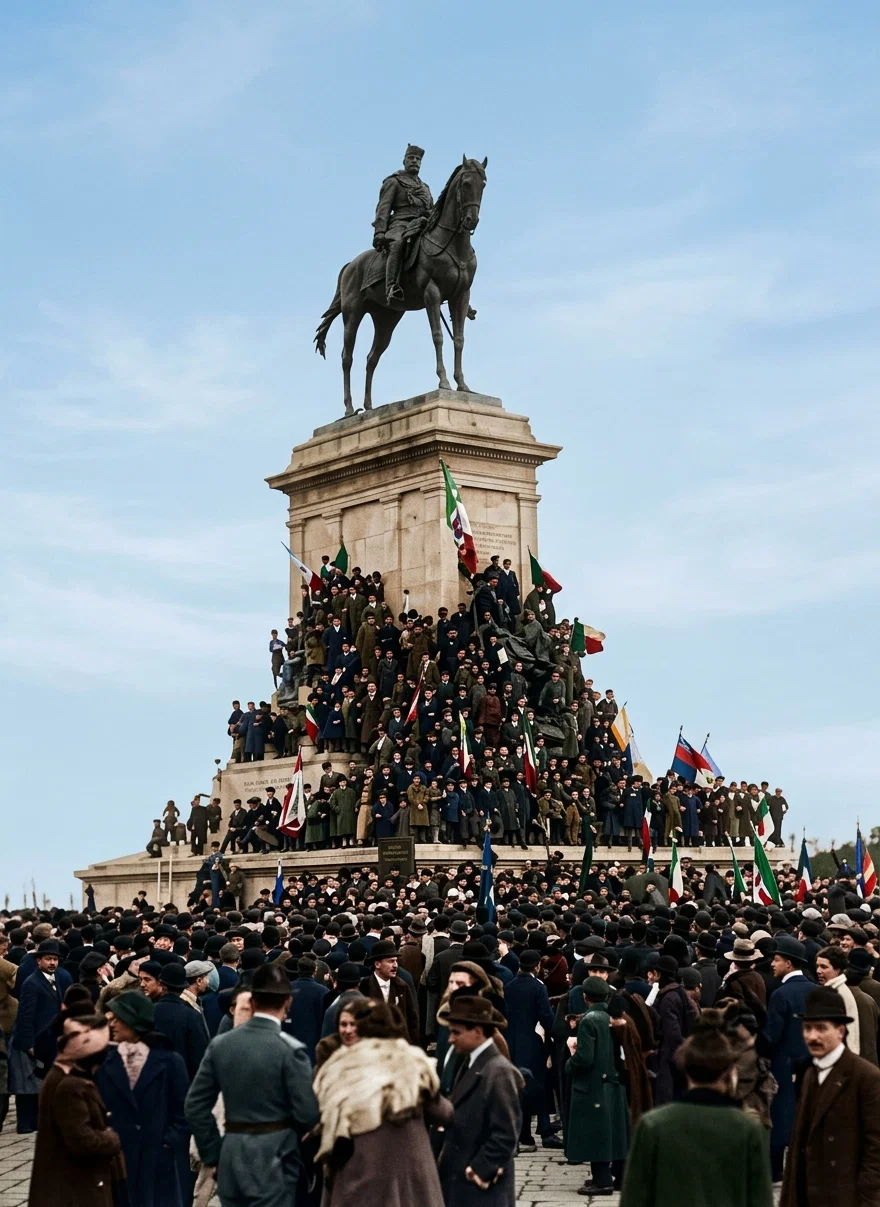
WAR DEMONSTRATION IN ITALY
© Boston Photo News Co. WAR DEMONSTRATION IN ITALY
Last week Elder Russell told of the series of war explosions, following one another in quick succession, as the European conflict belched forth. This week he continues the subject by presenting Russia’s designs on Constantinople, and what is to come next in the field of prophecy after the overthrow of Turkey in Europe.
EDITOR.
The object of some of the nations engaged in the present struggle is to gain control of seaports near the Bosporus and the Dardanelles. From the Outlook, March 17, 1915, we quote: “The conflicting lusts of Russia and Austria for Turkish territory in the Balkans constitute one of the underlying causes of the present war.”

Russia’s Determined Plans

For centuries, Russia has had a strong desire to gain possession of Constantinople, and thus open to herself commerce through the Black Sea to the ports of the world. While we have presented some of the causes that have had a part in bringing about this, the world’s greatest scourge, the present European war, we will now call attention to that which we consider the most important cause—the purpose to drive the Turk from European soil, and control his capital.

In the Glorious Holy Mountain

Dan. 11:45: “And he shall plant the tabernacles of his palace between the seas in the glorious holy mountain; yet he shall come to his end, and none shall help him.” The power to which reference is made in this text is Turkey, which is termed, in Daniel 11, verse 40, the king of the north.
Turkey became the king of the north through the division of the kingdom of Grecia after the death of Alexander the Great, it being divided into four parts, and what is now the territory of Turkey comprising the northern division.
In the commentary of Dr. Adam Clarke, printed in 1825, he took the view that the Ottoman empire was the king of the north. Dr. Martin Luther said, “If you beat back the Turk, the prophecy of Daniel will be fulfilled.”—“Martin Luther,” by Gustav Freytag, page 11. Luther understood the power mentioned in Dan. 11:45 to be Turkey.
If it refers to the Turkish capital, where will it finally be located? Let the prophet answer: “Between the seas in the glorious holy mountain.” By the “holy mountain” is meant Mount Moriah, nestled within the environs of “Jerusalem, the holy city,” which lies between the Mediterranean Sea and the Dead Sea.
For centuries, Constantinople has been the capital of Turkey. In 1453 the followers of Mohammed gained a strong foothold in Europe. In fact, at that time they controlled two thirds of Europe, not including Russia. That power was a scourge to all who were not followers of Islam. As Turkish prestige waned, those nations which at one time bitterly opposed her came to her support—not, however, because they had learned to love Turkey, but for fear that if she should be removed, some other power might gain control of her European possessions, the Bosporus and the Dardanelles, and thus become a menace to the welfare of Europe.
As has been heretofore stated, Russia greatly desires to gain control of Constantinople. She feels that it is hers by right. Ivan III of Russia, who reigned 1462–1505, married Sofia Paleologus, niece of Manuel II, the last of the Byzantine emperors, whose capital was Byzantium—what is now known as Constantinople. After she became the empress of Russia, she still retained the title of empress of the Byzantine empire, and brought with her the double eagles that formed the Byzantinecoat of arms, and they became part of the seal of Russia.

Russia Has Often Struck for Constantinople

Peter the Great of Russia, who reigned 1672–1725, gave instruction to his successors “to take every means of gaining Constantinople.” The pages of history show that they have been zealous in trying to carry out his will; for at least half a score of times during the past two centuries, Russia has attempted to gain control of Constantinople, and in every instance Providence seems to have ordered otherwise.
In 1709 Russia attempted to reach Constantinople by the way of the Black Sea, and was defeated.
ITALIAN SOCIALISTS DRILLING FOR WAR
In 1730 Russia, with the help of Austria, tried to reach Turkey through the Balkans.
In 1768–1774 Russia invaded Turkey, and destroyed Turkish shipping in the Black Sea. She would then have taken Constantinople, but the fates seemed against her, as the black plague broke out in the Russian army, and Constantinople was again spared.
In 1787 Catherine the Great met Emperor Joseph of Austria in the Crimea, and they agreed on the division of Turkey in Europe, Austria to take the western division, and Russia the eastern, including Constantinople; but their plans failed.
In 1788 Russia attacked Turkey along the Danube, and penetrated as far as the southern boundary of Bulgaria, when Turkey sued for peace.
In 1810 a Russian army invaded Turkey, but had to abandon the campaign on account of disease and a lack of provisions.
In 1828–9 Russia again invaded Turkey, and proclaimed that she was headed for Constantinople. But the plague broke out, and again the Moslem capital was saved.
In the war of the Crimea of 1854–6, Russia again declared her objective to be Constantinople; but she was doomed to disappointment, as England and France and Sardinia came to the rescue of the Turk, and Russia was forced to surrender the territory of Roumania to Austria.
In 1877–8 Russia declared herself to be the champion of Christendom, but again the goal toward which she was headed was Constantinople. She penetrated Turkish territory until it seemed her hopes were to be realized, when England sent a fleet through the Dardanelles to the relief of Constantinople. Disease among the Russian troops, and the threatenings of the English, again saved the capital of Turkey from being seized by the Russians.
In 1908 the minister of foreign affairs of Russia and the minister of foreign affairs of Austria met in a castle in Moravia and agreed on a division of Turkey in Europe, Austria to take the western division, and Russia the eastern, including Constantinople. When other powers were approached, they would not give their consent to such a plan, and again the much coveted city escaped.

Russia Now Confident

Russia is now pressing on to the goal, and the allied powers are helping her, as their fleets are now hammering the fortifications of the Dardanelles. The Russian Black Sea fleet is also approaching Constantinople from the east, and the sultan is taking up temporary quarters at Brusa, south of Constantinople, in Asiatic Turkey. Russia is certain that the city of Constantinople is to be her portion.
Great Britain, which has often opposed Russia in her desire to gain control of Constantinople, is now “in entire accord with her doing so.” Sir Edward Grey, in addressing the British Parliament, said that England was “in sympathy” with Russia’s gaining access “to the sea.”
So confident is Czar Nicholas of success in gaining the coveted prize, that he has already named Constantinople Czargrad—Czar’s City. In a manifesto to his people, the czar stated, “We believe, and the whole Russian people believe, that the ill-advised interference of Turkey in the present struggle will not only hasten the progress of events that for her will be fatal, but will open for us a way to the solution of the historic problems connected with the Black Sea, which we inherited from our ancestors.” The present sentiment in Russia is, “On to Czargrad.” Many view the final solution of the struggle for Constantinople optimistically, and have visions of a “syndicate of nations” and “the federation of the world.”

The Picture of the Future

The prophet presents no flattering picture of the future so far as this wicked world is concerned. After the capital of the Turk is planted in the “holy mountain” at Jerusalem, the time will come when without help “he shall come to his end.” “And at that time shall Michael stand up; . . . and there shall be a time of trouble, such as never was since there was a nation.” Then God’s people “shall be delivered,” and the resurrection of the dead take place. See Dan. 11:45; 12:1, 2.
With Holy Writ agree the words of Louis Kossuth, who said, “In Turkey will be decided the fate of the world.” Turkey also realizes that her stay in Europe is about ended, and that she will soon have to return to Asia. Sir Winifred Blunt, in “Future of Islam,” page 95, says: “Ancient prophecy and modern superstition alike point to the return of the Turks into Asia as an event at hand. . . . The feeling of a coming catastrophe is so deeply rooted and so universal.”

Turkish Capital Must Be Moved

Dr. Jesperson, for some years a missionary in Palestine, said: “During the Balkan war, I talked with different Turkish officers stationed at Jerusalem; and they were free to state that the capital of Turkey would have to be moved from Constantinople, and in event that it should be, it would no doubt be located in Jerusalem.”
How remarkably the words of Dr. Martin Luther agree with the declaration of the prophet: “If you beat back the Turk, the prophecy of Daniel will be fulfilled and the end at hand. Then the day of Judgment is surely at our doors.”
Albert Bushnell Hart, professor of history, Harvard University, makes the following statement: “In case of victory, the Russians will certainly demand Constantinople, which means that the Turk would be finally shoved out of Europe.”
Truly we are living in a history-making age, and in the most solemn period of the world’s history. We are standing face to face, as it were, with the solemn realities of the Judgment. Therefore, now is the most opportune time we will ever have to bring our lives into harmony with the divine will.

The Difference in Men

Once upon a time a thoughtful but plain and unpretentious man took his boy from their rural home to the halls of a great university. On his return, his neighbors chaffed him about the kind of appearance he had probably made among the sages and savants of the great school.
One of them made bold to inquire how he felt in the presence of men who were supposed to know about all that was knowable. In reply he said:
“I didn’t try to compare what I knew with what they knew; but when I compared what I didn’t know with what they didn’t know, there wasn’t enough difference to cause any uneasiness.”
When a human being takes that self-respecting view of the difference in men, he gives the highly developed man all that is due him without degrading himself. There is indeed a difference in men; but that difference should never degrade the one or inflate the other.— Liberty Bell.

Animals

THE dumb animals are God's creatures, brought forth for the service of mankind. Because man has power over them, has he any right to mistreat them? What do the Scriptures say?—“A righteous man regardeth the life of his beast: but the tender mercies of the wicked are cruel.” Man is accountable for his treatment of these dumb creatures, which are helpless, and cannot express their feelings.
God's “tender mercies are over all His works.” Do men realize that their cruelty will ever be known? “A record goes up to heaven, and a day is coming against those who abuse God's creatures.”
H. E. Sawyer-Hopkins

The Pleasures of Duty

“Duty has pleasures which know no satiety.”

The Riotous Youth Returns

He Finds a Warm Welcome—The Father Forgives and Forgets His Past—Is Reinstated in His Once Happy Home
By Mrs. E. G. White
THE parables of the lost sheep, the lost coin, and the prodigal son, bring out in distinct lines God’s pitying love for those who are straying from Him. Although they have turned away from God, He does not leave them in their misery. He is full of kindness and tender pity toward all who are exposed to the temptations of the artful foe.
In the parable of the prodigal son is presented the Lord’s dealing with those who have once known the Father’s love, but who have allowed the tempter to lead them captive at his will.
“A certain man had two sons: and the younger of them said to his father, Father, give me the portion of goods that falleth to me. And he divided unto them his living. And not many days after the younger son gathered all together, and took his journey into a far country.”
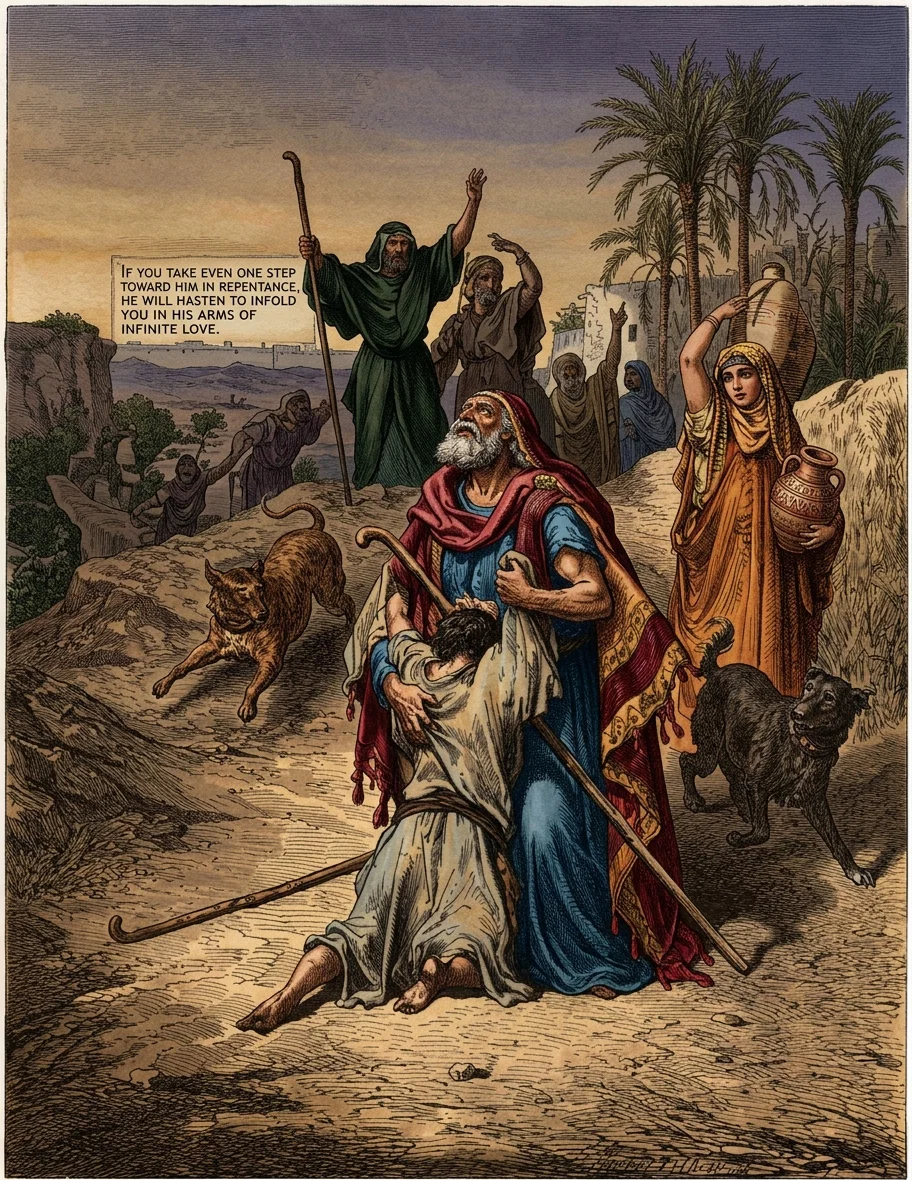
The Prodigal Son in the Arms of His Father

Wearied by Proper Restraint

This younger son had become weary of the restraint of his father’s house. He thought that his liberty was restricted. His father’s love and care for him were misinterpreted, and he determined to follow the dictates of his own inclination.
Having obtained his patrimony, he goes into “a far country,” away from his father’s home. With money in plenty, and liberty to do as he likes, he flatters himself that the desire of his heart is reached. There is no one to say, Do not do this, for it will be an injury to yourself; or, Do this, because it is right. Evil companions help him to plunge ever deeper into sin, and he wastes “his substance with riotous living.” The precious years of life, the strength of intellect, the bright visions of youth, the spiritual aspirations—all are consumed in the fires of lust.

Becomes a Swine Herder

A great famine arises, he begins to be in want, and he joins himself to a citizen of the country, who sends him into the field to feed swine. To a Jew this was the most menial and degrading of employments. The youth who has boasted of his liberty, now finds himself a slave. He is in the worst of bondage,—“holden with the cords of his sins.” Prov. 5:22. The glitter and tinsel that enticed him have disappeared, and he feels the burden of his chain.
Sitting upon the ground, in that desolate and famine-stricken land, with no companions but the swine, he is fain to fill himself with the husks on which the beasts are fed. Of the gay companions who flocked about him in his prosperous days, and ate and drank at his expense, there is not one left to befriend him. Where now is his riotous joy? Stilling his conscience, benumbing his sensibilities, he thought himself happy; but now, with money spent, with hunger unsatisfied, with pride humbled, with his moral nature dwarfed, with his will weak and untrustworthy, with his finer feelings seemingly dead, he is the most wretched of mortals.
What a picture here of the sinner’s state! Although surrounded
with the blessings of His love, there is nothing that the sinner, bent on self-indulgence and sinful pleasure, desires so much as separation from God. Like the ungrateful son, he claims the good things of God as his by right. He takes them as a matter of course, and makes no return of gratitude, renders no service of love. As Cain went out from the presence of the Lord to seek his home, as the prodigal wandered into the “far country,” so do sinners seek happiness in forgetfulness of God.
Whatever the appearance may be, every life centered in self is squandered. Whoever attempts to live apart from God, is wasting his substance. He is squandering the precious years, squandering the powers of mind and heart and soul, and working to make himself bankrupt for eternity.

Still Yearns over the Wanderer

The love of God still yearns over the one who has chosen to separate from Him, and He sets in operation influences to bring him back to the Father’s house. The prodigal son in his wretchedness “came to himself.” The deceptive power that Satan had exercised over him was broken. He saw that his suffering was the result of his own folly, and he said: “How many hired servants of my father’s have bread enough and to spare, and I perish with hunger! I will arise and go to my father.”

Decides to Confess All

Miserable as he was, the prodigal found hope in the conviction of his father’s love. It was that love which was drawing him toward home. So it is the assurance of God’s love that constrains the sinner to return to God. “The goodness of God leadeth thee to repentance.” Rom. 2:4. A golden chain, the mercy and compassion of divine love, is passed around every imperiled soul. The Lord declares, “I have loved thee with an everlasting love: therefore with loving-kindness have I drawn thee.” Jer. 31:3.
The son determines to confess his guilt. He will go to his father, saying, “I have sinned against heaven, and before thee, and am no more worthy to be called thy son.” But he adds, showing how stinted is his conception of his father’s love, “Make me as one of thy hired servants.”
The young man turns from the swine herds and the husks, and sets his face toward home. Trembling with weakness, and faint from hunger, he presses eagerly on his way. He has no covering to conceal his rags; but his misery has conquered pride, and he hurries on to beg a servant’s place where he was once a child.

A Great Lesson in the Contrast

Little did the gay, thoughtless youth, as he went out from his father’s gate, dream of the ache and longing left in that father’s heart. When he danced and feasted with his wild companions, little did he think of the shadow that had fallen on his home. And now as with weary and painful steps he pursues thehomeward way, he knows not that one is watching for his return. But while he is yet “a great way off,” the father discerns his form. Love is of quick sight. Not even the degradation of the years of sin can conceal the son from the father’s eyes. He “had compassion, and ran, and fell on his neck” in a long, clinging, tender embrace.

No Contemptuous Mockery Permitted

The father will permit no contemptuous eye to mock at his son’s misery and tatters. He takes from his own shoulders the broad, rich mantle, and wraps it around the son’s wasted form, and the youth sobs out his repentance, saying, “Father, I have sinned against heaven, and in thy sight, and am no more worthy to be called thy son.” The father holds him close to his side, and brings him home. No opportunity is given him to ask a servant’s place. He is a son, who shall be honored with the best the house affords, and whom the waiting men and women shall respect and serve.

Bring Forth the Best Robe

The father said to his servants, “Bring forth the best robe, and put it on him; and put a ring on his hand, and shoes on his feet: and bring hither the fatted calf, and kill it; and let us eat, and be merry: for this my son was dead, and is alive again; he was lost, and is found. And they began to be merry.”
In his restless youth the prodigal looked upon his father as stern and severe. How different his conception of him now! So those who are deceived by Satan look upon God as hard and exacting. But he whose eyes have been opened by the love of Christ will behold God as full of compassion. He does not appear as a tyrannical, relentless being, but as a father longing to embrace his repenting son. The sinner will exclaim with the psalmist, “Like as a father pitieth his children, so the Lord pitieth them that fear Him.” Ps. 103:13.
In the parable, there is no taunting, no casting up to the prodigal of his evil course. The son feels that the past is forgiven and forgotten, blotted out forever. And so God says to the sinner, “I have blotted out, as a thick cloud, thy transgressions, and, as a cloud, thy sins.” Isa. 44:22. “I will forgive their iniquity, and I will remember their sin no more.” Jer. 31:34.

Assured of Forgiveness

What assurance here, of God’s willingness to receive the repenting sinner! Have you, reader, chosen your own way? Have you wandered far from God? Have you sought to feast upon the fruits of transgression, only to find them turn to ashes upon your lips? And now, your substance spent, your life plans thwarted, and your hopes dead, do you sit alone and desolate? Now that voice which has long been speaking to your heart, but to which you would not listen, comes to you distinct and clear, “Arise ye, and depart; for this is not your rest: because it is polluted, it shall destroy you, even with a sore destruction.” Micah 2:10. Return to your Father’s house. He invites you, saying, “Return unto Me; for I have redeemed thee.” Isa. 44:22.

Do Not Wait to Be Better

Do not listen to the enemy’s suggestion to stay away from Christ until you have made yourself better—until you are good enough to come to God. If you wait until then, you will never come.
Arise and go to your Father. He will meet you a great way off. If you take even one step toward Him in repentance, He will hasten to infold you in His arms of infinite love. His ear is open to the cry of the contrite soul. The very first reaching out of the heart after God is known to Him. Never a prayer is offered, however faltering, never a tear is shed, however secret, never a sincere desire after God is cherished, however feeble, but the Spirit of God goes forth to meet it. Even before the prayer is uttered, or the yearning of the heart made known, grace from Christ goes forth to meet the grace that is working upon the human soul.
He will bring you into His banqueting house, and His banner over you shall be love.

The Law Magnified by Christ

He Is the Creator—Therefore He Is the Lawgiver—He Magnified the Law in His Life by Throwing Contempt on the Traditions of Men
By A. C. Gilbert
CHRIST, the Son of God, was the agent in the creation of all things “that are in heaven, and that are in earth, visible and invisible, whether they be thrones, or dominions, or principalities, or powers: all things were created by Him, and for Him: and He is before all things, and by Him all things consist.” Col. 1: 16, 17. See also Heb. 1: 1-3; John 1: 1-3, 10.

World-Maker and Statute-Maker

But the Lord is not only a world-maker, He is also a statute-maker. Isa. 33: 22, margin. He is not only a world-maker and a statute-maker, but He is a law- or statute-giver (Isa. 33: 22; James 4: 12) for the thrones, dominions, and principalities that He created.
It is evident, from the Scriptures, that in all the created works of the Godhead, there is represented the fullness of grandeur, dignity, and perfection that fully accords with the character of the supreme Creator. See Ps. 145: 17; 104: 34; 139: 14. The magnificence and unsurpassed glory of the innumerable worlds (Heb. 1: 1-3; Gen. 2: 1; Ps. 33: 6; Isa. 40: 26) that course their way through unmeasured space, the laws that govern them, the various forms of life upon them, all have their original source in the “Fountain of life” (Ps. 36: 9), who is the “high and lofty One that inhabiteth eternity” (Isa. 57: 15), the statute-maker and law-giver.
“And God saw everything that He had made, and, behold, it was very good.” Gen. 1: 31. Since God and His Son, Jesus Christ, created all things, it is natural to expect that They would uphold the works of Their hands, and also uphold the laws ordained to govern these works and the moral beings for which They became responsible by creation.

A Perfect Standard for a Perfect Man

God made man a perfect being in the beginning (Gen. 1: 26, 27; Eccl. 7: 20), and ordained a perfect standard or law for his guidance, to define his relationships both to his Creator and to his fellow beings. As the Lord, who is perfect and unchangeable (Matt. 5: 48; Mal. 3: 6; Heb. 13: 6), will accept nothing less than perfect obedience from His moral creatures, it remains therefore that He has not changed and cannot change His perfect moral standard, even though sin has been permitted to obtrude itself into His plan, and marred the original nature of man. Since the Lord made man originally a moral being (Gen. 1: 26, 27; 2: 16, 17), and recognizes him still as a moral and responsible being, it truly follows that the Godhead must recognize the same laws that previously governed man’s moral nature; for divinely established moral relationships are unchangeable.

A Law Prophecy

We have briefly studied the attitude of Christ toward His laws by virtue of His being the Son of God and the Creator of all things. Now let us notice what His attitude is as a prophet toward the law that He ordained as the rule of conduct for the beings who were endowed with the power of choice. In inspiring the prophets, He foretold clearly what would be His feelings for His law when He should be manifested in the flesh to live a life that was to be a perfect example for man. We read: “The Lord is well pleased for His righteousness’ sake; He will magnify the law, and make it honorable.” Isa. 42: 21.

He Found Disrespect for Law

This prediction implies at least two things: first, that when Christ should be revealed as the Son of man, He would find His holy law belittled and dishonored by the professed Christian church at that time; second, that in His public ministry, He would elevate the law to its proper place, remove the reproach that had been cast upon it, and restore to it its befitting dignity.
Were the expressed and implied facts of the above-mentioned prophecy found to be true in the days of Christ’s public ministry? Was the law found to be humbled and misrepresented? Did the Lord restore it to its rightful place while here on earth, as the prophecy said He would do?
The psalmist said, “It is time for Thee, Lord, to work: for they have made void Thy law.” Ps. 119: 126. To make a law void is to pursue such a course of action toward it as to cause it to lose its power and effect. In Christ’s first public address, we find that He strikes directly at the prevailing evils of His time, which were greed, uncharitableness, pride, hypocrisy, injustice, impurity, tumultuousness, wavering, retaliation. Matt. 5: 1-16.

Not a Destroyer of Law

As He laid the ax at the root of the tree by declaring the fundamentals of true religion, the scribes and the Pharisees perceived at once that He was a reformer, and that His message was no ordinary synagogue chant, but that it was decidedly reformatory. They saw that such teaching would undermine their elaborate forms of church service and the security of their traditions. They suggested that this man who spoke withmuch authority would probably seek to subvert the law and the prophets, for which they affected great reverence. But He imperatively assured them of His high regard for the moral law and the prophets, in the following words: “Think not that I am come to destroy the law, or the prophets: I am not come to destroy, but to fulfill.” Verse 17.

Had Spoiled It by Traditions

However, in His future instruction, He pointed out how they had covered the law of God—the Ten Commandments—with their traditions until they had “made the commandment of God of none effect.” Matt. 15: 6. Their worship had so degenerated that it was naught but dry intellectualism and barren orthodoxy, and called forth from the Master the stern rebuke: “This people draweth nigh unto Me with their mouth, and honoreth Me with their lips; but their heart is far from Me. But in vain they do worship Me, teaching for doctrines the commandments of men.” Verses 8, 9.
In Christ’s sweeping denunciation of Jewish tradition, in His unmasking of their hypocrisy, He proclaimed the unlimited scope of the law. He illustrated its application to the thoughts of the heart as well as to the overt act. He declared that if a person should teach that any one of the commandments, even the least, is done away, that person would be reckoned by the authorities in heaven as among the least, and, of course, unworthy a place at last in the kingdom with the redeemed. But those who would esteem the commandments as eternal principles to regulate the moral conduct of their lives, would be “called great in the kingdom of heaven.” Matt. 5: 19.

Denounced Tradition and Magnified Law

The Saviour exposed the weakness and unprofitableness of the traditions which the Jews had heaped over the law of the Ten Commandments. By doing so, and by denouncing these traditions, He magnified the law (Isa. 42: 21), so that all might see its original beauty and design, and be impressed to confess: “O how love I Thy law! it is my meditation all the day.” “My tongue shall speak of Thy word: for all Thy commandments are righteousness.” Ps. 119: 97, 172. And as if to reassure the Jews that He had not come to abolish the law, He said, “For verily I say unto you, Till heaven and earth pass, one jot or one tittle shall in no wise pass from the law, till all be fulfilled.” Matt. 5: 18.
The life of Christ on earth constitutes the most powerful argument in behalf of the immutability and binding obligation of the moral law—the Ten Commandments. Christ knew, all heaven knew, that the law could not be changed, “abolished,” “done away,” in order to meet man’s fallen condition. If this could have been done, there would have been no necessity for the death of Christ to rescue man from death, which is the required penalty of the broken law.

Its Eternal Character Emphasized

In the blending of the condescension, sufferings, death, and resurrection of Jesus, was perfected the strongest “magnifying glass” (Isa. 42: 21) in all the plan of God by which the Christian church is to see distinctly the eternalness, the beauty, the perfection, the binding obligation, of the Ten Commandments. “The law of God is a divine law—holy, heavenly, perfect. . . . There is not a command too many; there is not one too few; but it is so incomparable that its perfection is proof of its divinity.” —Spurgeon’s “Sermons,” page 280.
There is a growing tendency, in these days, to depreciate the force of the law of God. And it is this tendency that is largely responsible, as in the time of Christ, for the laxity of morals in the professed Christian church. Traditional teaching, church creeds, human opinions, have constructed a sort of “magnifying glass” which distorts the object to be investigated, and brings into the field of vision things which are wholly foreign.

It Is Time for the Lord to Work

For illustration: When the law of God, the Ten Commandments, is to be examined by many to-day, it is represented as inferior, narrow, in need of substitution, too limited for this progressive age. It is bombarded with foreign expressions, such as “done away in Christ,” “fulfilled,” “Jewish,” “antiquated,” “in need of revision,” etc. Thus to-day, as in the time of the Saviour’s first advent, is the law of God made of “none effect” by the teachings of men. Surely again “it is time for Thee, Lord, to work: for they have made void Thy law.” Ps. 119: 126.
May the love of God which was in His Son Jesus, and enabled Him to magnify His law in the sight of men,—that law of which He is Author and Exponent,—rule our lives, and enable us to magnify these precepts, and say with the beloved apostle John: “By this we know that we love the children of God, when we love God, and keep His commandments. For this is the love of God, that we keep His commandments: and His commandments are not grievous.” I John 5: 2, 3. “If ye love Me, keep My commandments.” John 14: 15. “Love is the fulfilling of the law.” Rom. 13: 10.
Continue reading: Signs in the Sun and in the Moon