Your ShelfYour Projects

Review and Herald, Vol. 89, No. 42.

A Prayer for Remembrance

Review and Herald

Oct 17, 1912

Review and Herald Publishing Association · Takoma Park Station, Washington, D. C. · Oct 17, 1912

A Prayer for Remembrance

Marion B. Craig
God of the Heart and Hand, Teach me to understand!
I have forgotten in the long, long years All of my little childish hopes and fears; It is so very, very long ago Since I was in the world the children know, I have forgotten what I used to play And dream and do in that far yesterday,— All the wide wonder of my childish eyes Since I have grown so old and worldly wise. Yet now there come, with faces raised to mine, These little ones. Dear Father, they are Thine. Teach me to lead them to Thine own pure light; Help me to guide their little feet aright.
God of the Heart and Hand, Teach me to understand!
I know so little of the thought that lies Back of the shining of those childish eyes; I guess so little of the wonder there Under the curling of the sunny hair; It is so very, very long ago Since I, too, knew the things that children know. Yet hast Thou given them to me to lead. Out of Thy wisdom grant me all I need,— Patience of purpose, faith, and tenderness, Trusting Thy perfect love to lead and bless. Help me remember,—ah! for this I pray, Make me again the child of yesterday.
God of the Heart and Hand, Teach me to understand!
— Sunday School Times.

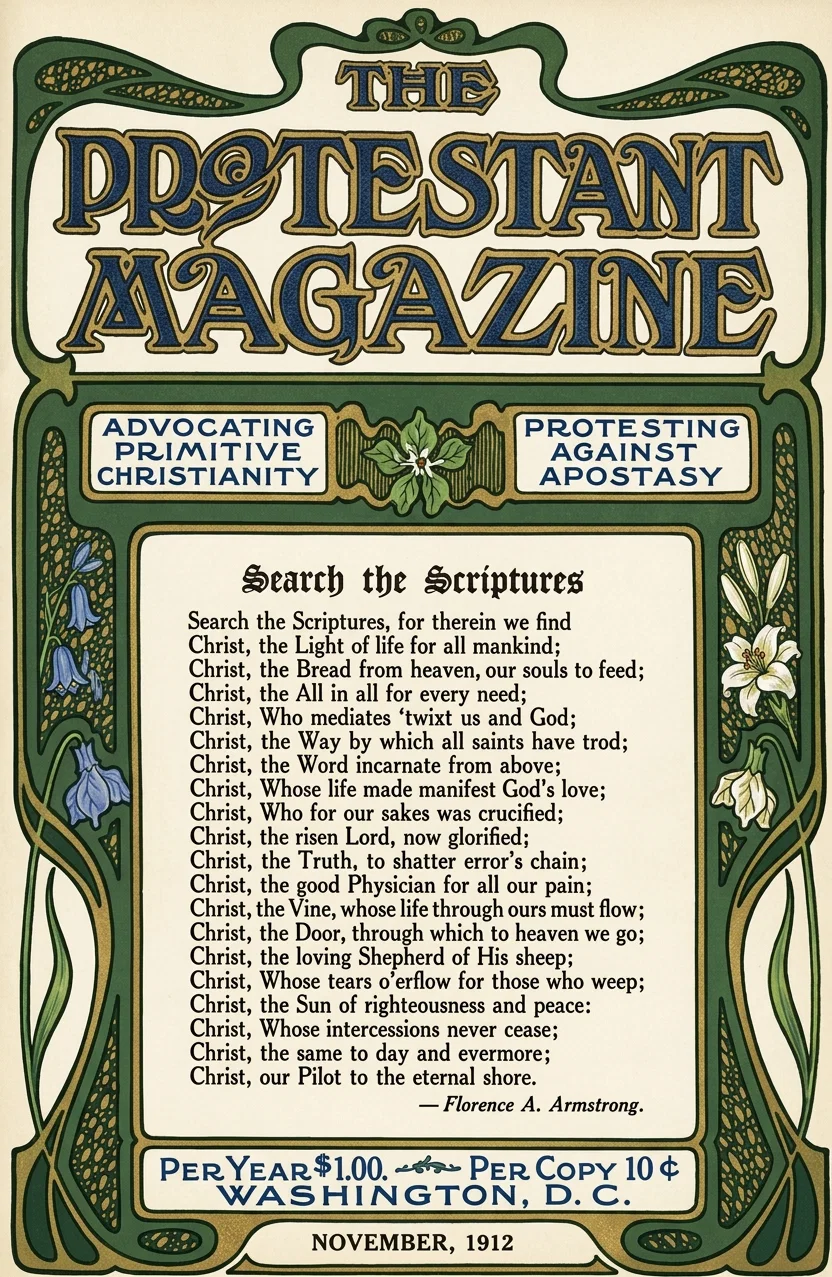
"Rome and Temperance" and "Apostolic Delegate" Number

NOW A MONTHLY MAGAZINE!
$1.00 A YEAR                                                     10 CENTS A COPY

NOVEMBER FEATURES

Double Frontispiece: Photographs of "Archbishop Bonzano, Apostolic Delegate to the United States," and of "Official Catholic Advertisements of Whisky"
Search the Scriptures
Mediation of Christ—Its Perversion by Rome
Catholic Encyclopedia vs. the Bible
Christ to the Hypocrites
Reply to Attack of "Catholic Truth Society"
Catholic Spain's Fight With the Papacy
Editor's Reply to "Catholic Standard and Times"
Presbyterian Assembly's Report on Romanism (Concluded)
Gladstone on Papal Infallibility
St. Louis “Mirror” Attacks “Guardians of Liberty”
Romanism and Paganism
Rome's Attempt to Control the Press
“Holy Water” Analyzed by Spanish Physician
“Romanism a Menace to the Nation”—Shocking Revelations in Mr. Crowley's New Book
Notes and Extracts—Latest News on Rome

SPECIAL OFFER ON FIVE, ONE YEAR

Five copies, one year, to one address or to five separate addresses, only $3.00, or 60 cents each. Sender may include his own name. Or, send $1.50 for five copies six months. This number should be placed in the hands of every editor, attorney, clergyman, city and county official, and public-school teacher. We can furnish the names and addresses.

ORDER THROUGH OUR NEAREST AGENCY

If you don't know the address of our Agency, ask “Protestant Magazine,” Washington, D. C.
PRICES, POST-PAID
PRICES, POST-PAID
Yearly subscription         -     -     -     -     $1.00
Six months         -     -     -     -     -     .50
(Subscriptions for less than six months not accepted)
Three years (or 3 subs. 1 yr.)     -     -     2.00
Five years (or 5 subs. 1 yr.)     -     -     3.00
Five copies, one year, to one or more addresses     -     -     -     -     3.00
NO EXTRA CHARGE ON FOREIGN SUBSCRIPTIONS

“Physical Culture” and “Good Teeth” Number

OTHER FEATURES: “Infantile Paralysis,” “Immodest Dress,” “Pellagra,” “Bright’s Disease,” “Medicines,” and “Meatless Thanksgiving.”

BEAUTIFUL “AUTUMN” COVER

A FEW NOVEMBER ARTICLES

Infantile Paralysis—Prevention of Prevention of Tooth Decay Japanese Taller Through Physical Culture Immodest Feminine Dress Cause of Skin Diseases Prevention of Asthma Cause of Pellagra Making Physical Culture Interesting The Liquor Traffic and Health Alcohol and Insanity Buttermilk and Cottage Cheese as Foods A Meatless Thanksgiving Dinner Why Eat Less Meat? Dangers of Patent Medicines Treatment of Bright’s Disease A Tobacco Sermon Foods to Increase Weight Two or Three Meals—Which? Many Other Valuable Articles
QUESTIONS AND ANSWERS (14 questions answered).—In this popular department the editor replies to questions asked by subscribers. Subscribe now. Send $3.00 for five years; $2.00 for three years; $1.00 for one year. Single bound volumes, 1908-11, half leather, each, $1.75.

ORDER THROUGH OUR NEAREST AGENCY

If you don’t know the address of our Agency, ask “Life and Health,” Washington, D. C.
PRICES, POST-PAID
PRICES, POST-PAID
Yearly subscription     -   -   -   -   $1.00 Six months               -   -   -   -   .50 (Subscriptions for less than six months     not accepted) Three years (or 3 subs. 1 yr.)    -   -   -   2.00 Five years (or 5 subs. 1 yr.)     -   -   -   3.00 Five copies, one year, to one or more     addresses                       -   -   -   3.00 NO EXTRA CHARGE ON FOREIGN SUBSCRIPTIONS

There Shall Be Signs

MAX HILL
The Saviour’s voice comes down to us, “ There shall be signs.”
In heaven and in earth displayed, There shall be signs; The sun to blackness turned at noon, To blood be changed the midnight moon, The falling of the stars shall be, The heavens shaken mightily,— There shall be signs.
And then shall awful deeds be told,— There shall be signs; For earth shall wax as garments old,— There shall be signs.
Then shall it quake by temblor fierce, The lightning’s flash the darkness pierce, In tidal wave the sea shall roar, In awful shakings more and more,— There shall be signs.
And men shall show the time is near,— There shall be signs; Their vile hearts failing them for fear,— There shall be signs.
Then wars and pestilence shall be, And crime be rife, and peace shall flee; Then riches grow, oppression rise, And wails of torture reach the skies,— There shall be signs.
But soon shall come our Saviour King,— These be the signs; His voice throughout the earth shall ring,— These be the signs.
The dead in Christ shall then arise To meet their Master in the skies; Then shall all sorrow flee away, Earth’s midnight be eternal day,— These be the signs.
Sanitarium, Cal.

A Flood of Crime

Cause and Effect

J. S. WASHBURN
“It is time for thee, Lord, to work: for they have made void thy law.” That time has come; that hour has struck. A flood of lawlessness is sweeping the land. Anarchy, murder, and divorce have increased to such a frightful extent that they even the hearts of worldly men are failing them for fear, and for looking after those things that are coming on the earth.
One twelfth of the marriages of this country end in divorce. Wives murdered by husbands, husbands murdered by wives, judges murdered in court, suicides, burglaries, lynchings, cold-blooded assassinations, and but few criminals punished,—these things are becoming so common that the prospect for the future is sickening, horrifying. “Judgment is turned away backward, and justice standeth afar off: for truth is fallen in the street, and equity can not enter.”
“We look for judgment, but there is none; for salvation, but it is far from us.” Read the graphic description of the very days and conditions in which we live, as given in Isaiah 59, and remember that this follows the fifty-eighth chapter, in which the breach in the law of God is spoken of. See verses 12, 13.
A people are seeking to build up the breach in the law of God,—the Sabbath commandment,—and men, even ministers, in order to avoid the eternal, unchanging claims of the Sabbath commandment, seek to sweep away the whole ten commandments. The logical result of the failure to accept the Sabbath reform foretold in Isa. 58:12-14 is the rejection of the whole law of ten commandments. This brings the terrible condition of lawlessness foretold in Isaiah 59. The connection between the two chapters, Isaiah 58 and 59, is logical. It is the connection of cause and effect; compare them.
The fearful condition of lawlessness described in Isaiah 59 is the natural and inevitable result of the teaching that Christ nailed the whole law of ten commandments to the cross. “The earth also is defiled under the inhabitants thereof; because they have transgressed the laws, changed the ordinance, broken the everlasting covenant. Therefore hath the curse devoured the earth, and they that dwell therein are desolate.” Isa. 24: 5, 6. “Will ye steal, murder, and commit adultery, and swear falsely, and burn incense unto Baal, and walk after other gods whom ye know not; and come and stand before me in this house, which is called by my name, and say, We are delivered to do all these abominations?” Jer. 7:9, 10. When ministers of the gospel teach that Jesus, the world's example, abolished the ten commandments, of which “Thou shalt not kill” and “Thou shalt not commit adultery” are parts, what wonder that murder and adultery increase?
“The passing days are eventful and full of peril. Signs of a most startling character appear in floods, in hurricanes, in tornadoes, in earthquakes, in casualties by sea and land. The judgments of God are falling on the world, that men may be awakened to the fact that Christ will come speedily.”
“Why are these things so? Why is there such a spirit of lawlessness in the social world, and such a medley of strange doctrines in the church? Is it not because among the great mass of professed Christians, the grievous sin of transgressing the law of God is not understood? Even ministers in the pulpit ‘make void’ that law. The result is a general weakening of the bonds of righteousness, a far-reaching tendency to lawlessness, to crime of every sort. Nor can we wonder. When men are not taught that they must obey the law of God, how can they be expected to obey the laws of men?”
This fearful condition of lawlessness is realized by the editors of political papers more fully than by many of the ministers of the gospel. In a leading editorial in the Memphis Commercial Appeal, appeared the following truthful words: “The law is the boundary line between civilization and barbarism. On the one side stand peace, protection, prosperity, and progress; on the other are lined up, always in sullen battle array, murder, arson, and all the other ills that make for individual and community degradation.”
In another number of that journal, under the title “Stop Killing and Stop Lynching, Lest We Ourselves Perish,” appeared the following: “Shall we have mob-rule or law-rule all over the South and all over the United States? . . . We have got finally to answer for this whole miserable business. . . . “We must not permit for any cause a suspension of the forms of the law. We can not excuse one crime, though itis caused by another crime. We can not accept the philosophy of Christ to-day and the promptings of the devil to-morrow. If, when it suits us, we cast aside the rule that comes from heaven, and substitute the law of hell, it will be only a short time until we shall have a hell on earth. . . . If we do not make the law the dominant force, we shall soon be lost in the wreck of our own civilization.”
These are words of terrible truth, worthy of study by the ministers of the gospel who teach that Christ abolished the law. These men are casting aside “the rule that comes from heaven,” and the result appears even to men of the world as a hell on earth.
Sow the teachings of lawlessness, and reap a harvest of fearful crime. A divine and terrible retribution follows closely on the teaching that Christ abolished the ten commandments. Sow lawlessness, and reap murder and anarchy. Sow the wind, and reap the whirlwind.
Memphis, Tenn.

Shall We Throw Away the Old Testament?

I. A. CRANE
The idea seems to prevail among a large class of people who take the name Christian, that the Old Testament Scriptures are a dead letter, in some ways positively injurious to those who read them.
How often do we hear such scriptures as 2 Cor. 3:13-15 used in the endeavor to prove that those who read the Old Testament and keep the ten commandments, are blinded by a confusing veil, which destroys their Christian experience and imparts through them a dangerous influence.
It would seem that a doctrine so far reaching as this, annulling the force and fulness of by far the greater portion of God's revelation to man, should be examined at least with caution—yes, even with suspicion.
There are some striking contrasts between the belief and practise of the disciples who were “called Christian first at Antioch” (Acts 11:26) and many who take that name to-day. For convenience let us place some of these differences in parallel columns.
Christians of A. D. 30-50
Some “Christians” of 1912
Were converted under preaching from the Old Testament. (It was more than twenty years after the day of Pentecost before any part of the New Testament was written.) Peter on Pentecost proved from Joel the promise of the Spirit. From Psalm 16 he proved the resurrection, and from Psalm 110 the ascension.
Refuse to receive the Old Testament, believing that there is no salvation found there.
Their preachers taught nothing but what Moses and the prophets did say. Acts 26:22.
Their preachers do not preach from Moses and the prophets, and condemn those who do.
They believed all things which the prophets and Moses taught. Acts 24:14.
Claim only the New Testament, and say the Old is abolished.
Continued to produce Scripture evidence from the Old Testament all those years. See Acts 3:21-24; 4:25-27; 8:32-35; 26:22, 23; 28:23.
Continue to say the Old Testament is abolished, even in the face of prophecies not yet fulfilled. (Isa. 66:15, 16, tells of Christ's coming. Hosea 13:14, Isa. 25:8, and Eze. 37:12 tell of the resurrection.)
Preached that salvation through Christ was taught by the Old Testament Scriptures, and that believers in Christ were found in the old dispensation as well as the new. Acts 10:43; John 8:56; Gal. 3:16; Heb. 11:26. (Christ's blood saves some from Egypt, Babylon, Media, yes, from every nation and tongue. Rev. 5:9.)
Preach that believers in Old Testament times were saved by the law, and knew nothing of salvation in Christ.
Took heed to the prophecies as to a light. Acts 24:14, 15; 2 Peter 1:19.
Believe the prophecies can not be understood.
Kept the seventh day according to the commandment, and went to work on the first day. Luke 23:56; 24:1.
Reject the Sabbath of the commandment, and keep the first day of the week.
There were prophets in the early church, and they expected the gift of prophecy to continue forever. Acts 11:27-30; 13:1; 21:9; John 16:13; 14:16; 1 Thess. 5:20.
Teach that there are no prophets since Christ. That those who claim to be such are false.
It seems quite clear that the words of Christ in John 5:46, 47, apply with full force to-day. If one believes Moses, he will believe Christ and the apostles; but if he does not believe Moses, he can not believe the words of Christ. We can readily see this must be true. It was the Spirit of Christ, the Holy Ghost, that moved the writers of the Old Testament to write their story of the fall, and of the hope for man in Christ alone. 1 Peter 1:10, 11; 2 Peter 1:21; Acts 1:16, etc. This is the “Spirit of truth.” He tells the same true gospel story through Moses as through Matthew; through David and Isaiah as through Peter and Paul. There can be no disagreement nor contradiction among the inspired writers of God's Word. Be the writer a prophet, priest, shepherd, king, physician, or fisherman,—in time of exodus or exile, in peace or persecution,—God's Spirit guides the hand that writes his message of hope or warning. His word abides forever. It is “the truth.”
It was the unbelieving Jews whose minds were blinded and whose hearts were veiled with unbelief, who were unable to see Christ as the hope of salvation. They stumbled over him in their blind and despairing attempt to be justified by their own works. 2 Cor. 3:14, 15; Rom. 9:32, 33. Because of carelessness or blindness, people sometimes stumble over things in plain view. “Even unto this day, when Moses is read, the veil is upon their [the unbelieving Jews] heart.” Every Sabbath day they read in Moses what he said of Christ. They actually fulfilled the very words they read when they rejected Christ. Acts 13:37.
How dense was the veil which covered their hearts! Yet the word for them was, “If they abide not still in unbelief—;” “when it [their unbelieving heart] shall turn to the Lord, the veil shall be taken away.” Rom. 11:23; 2 Cor. 3:16. Truly, in their time as well as in our own, only a mind darkened by unbelief could read the Old Testament and see no Christ, no free salvation, no gospel. This is true of both Jews and Christians.
Waurika, Okla.

Duty of the Congregation on the Day of Atonement

S. N. HASKELL
God expected his ancient people to serve him faithfully every day in the year, and he accepted their service; but on the day of atonement special requirements were enjoined upon them, and a failure to observe these would cut them off from the congregation of the Lord.
God has accepted the service of his people down through the ages; but during the antitypical day of atonement, when the investigative judgment is taking place in the heavenly sanctuary, God expects the antitypical congregation on earth to fulfil their part of the antitype just as faithfully as Christ, our High Priest, fulfils his part in the heavens. Anciently the congregation was not accepted as a whole; it was an individual work. Lev. 23:29, 30. So today each one answers for himself before God. We can not content ourselves by doing just as our fathers did, who passed away before the judgment opened in the courts of heaven.
God requires special service of his people now. Their cases are to be decided in heaven while they are still living, and Satan brings to bear upon them—a people who are weaker physically than any previous generation—all the wisdom he has gained in a six thousand years' warfare. Those who are accounted worthy in the investigative judgment will live for a time without a mediator. Their experience will be different from any other company that has ever lived upon the earth. God in his infinite mercy has enjoined special duties upon the last generation, that they might be more strongly fortified against the attacks of the enemy, and not be overthrown by his devices.
In the ancient service if an individual failed to observe the day of atonement as God directed, his sins were not confessed over the scapegoat by the high priest; but he was cut off from among the people of God. Lev. 23:28-30. The individual who, during the antitypicalday of atonement, the investigative judgment, thinks that Christ will plead his case while he himself is ignoring the work God has enjoined upon the antitypical congregation, will find at last that his name will be blotted out from the book of life. We are saved by faith in our High Priest, but faith without works is dead. James 2:17. If we have a living faith, we shall gladly do as the Lord directs.
Four things were required of each individual member of ancient Israel on the day of atonement, as follows:— 1. “It [the day of atonement] shall be an holy convocation unto you;” (2) “ye shall afflict your souls,” (3) and “offer an offering made by fire unto the Lord;” (4) “ye shall do no work in that same day.”
These were required for the twenty-four-hour period of the typical work of atonement, and were an “example and shadow” of the real work. That day was to be an holy convocation. The people were to assemble for religious worship. Paul gives the following exhortation to individuals who live in the days when the High Priest is soon to come forth from the heavenly sanctuary: “Having an High Priest over the house of God; let us draw near with a true heart in full assurance of faith, having our hearts sprinkled from an evil conscience. . . . Not forsaking the assembling of ourselves together, as the manner of some is; but exhorting one another: and so much the more, as ye see the day approaching.” Heb. 10:21-25. He who takes no pleasure in meeting to worship God with those of like faith, has an “evil conscience,” and has lost faith in the near coming of our High Priest from the heavenly sanctuary. There is a special blessing in worshiping with others. God promises that where even two or three are gathered in his name, he will meet with them. Matt. 18:19. This first requirement is a spiritual thermometer by which every Christian can test his spiritual condition. If Christians absent themselves from the worship of God because they take no pleasure in it, their spirituality is very low.
Each individual was to afflict his soul, search his heart, and put away every sin, spend much time in prayer, and abstain from food. Fasting was so forcefully impressed upon the minds of ancient Israel that even at the present day the Jews, although they have rejected Christ and many desecrate the Sabbath, always fast upon the tenth day of the seventh month.
The individual who realizes that the judgment is going on in the heavenly sanctuary, and that his name will surely be presented before that great tribunal, will search his heart and pray earnestly that God will accept him. We need to meditate often upon the work of our High Priest in the heavenly sanctuary, lest by having the mind filled with earthly thoughts, we, like the foolish virgins, find when too late that the door is shut, the work finished, and we have no part in it. In the typical service the congregation in the court listened for the tinkling of the golden bells on the robes of the high priest, and in that way followed him in his work. Our High Priest has given signs in the heavens and in the earth and among the nations to mark the progress of his work, and has said that when we see these signs fulfilled, we are to know that he is near, even at the door. Luke 21:25-33; Matt. 24:29-35, margin.
The antitypical day of atonement is a period of years. The type was twenty-four hours. A fast for one day was a complete control of the appetite, and a type of controlling the appetite during the antitypical period of years. God designs that his people shall be masters of their appetites, and shall keep their bodies under. 1 Cor. 9:27.
Satan would have people give loose reins to the appetite, letting it control them. In spite of the fact that an army of faithful workers are doing all in their power to withstand the flood of intemperance, Satan is working with such power that drunkenness and crime are increasing in the earth at an alarming rate. In 1844, when the investigative judgment opened in the heavens, generally speaking only men were slaves to tobacco; but now masses of children are being destroyed by it, while thousands of women are chained to the filthy habit. Wineries and breweries are increasing in the land, and intoxicating beverages are served in thousands of homes.
God calls upon his people to be masters of their appetites instead of slaves to appetite, that they may have clearer minds to comprehend divine truth and follow the work of their High Priest in the heavenly sanctuary. How few are willing to deny themselves the things their appetites crave, even when they know the claims of God!
The prophet Isaiah, looking down through the ages, refers to this state of things as follows: “In that day did the Lord God of hosts call to weeping, and to mourning, and to baldness, and to girding with sackcloth: and behold joy and gladness, slaying oxen, and killing sheep, eating flesh, and drinking wine.” What a vivid picture of the present condition! God calls his people to afflict their souls, control their appetites, partake of food that will furnish good blood and a clear mind to discern spiritual truths; but instead of obeying, they engage in “eating flesh, and drinking wine.” The prophet gives the final result of this course: “It was revealed in mine ears by the Lord of hosts, Surely this iniquity shall not be purged from you till ye die, saith the Lord of hosts.” Isa. 22:12-14.
The Saviour gave special warning against the evil of giving loose rein to the appetite in the period of time when the records of the lives were being examined, and individuals were accounted worthy or unworthy to stand before the Lord when he appears. “Take heed to yourselves, lest at any time your hearts be overcharged with surfeiting, and drunkenness, and cares of this life, and so that day come upon you unawares. . . . Watch ye therefore, and pray always, that ye may be accounted worthy to escape all these things that shall come to pass, and to stand before the Son of man.” Luke 21:34-36. The Saviour warns against surfeiting—overeating, eating injurious food—and drunkenness. In other words, he designs that his people during the antitypical day of atonement shall take heed to both the quantity and the quality of food. One can becloud the mind and ruin the health by overeating of the best of food. The glutton and the drunkard are classed together: “Be not among wine-bibbers; among riotous eaters of flesh: for the drunkard and the glutton shall come to poverty.” Prov. 23:20, 21.
Our first parents failed on the test of appetite. Gen. 3:1-6. Where they failed, Christ triumphed (Matt. 4:3, 4); and it is possible for a Christian with the indwelling Christ in the heart to be a complete master of his appetite,—to abstain from all food that is injurious, however much the natural appetite may crave it, and not overeat of good food. The Saviour was tested upon appetite as he entered upon his earthly ministry, but from childhood he had been taught to control it.
In speaking of Jesus' childhood, Isaiah says, “Butter and honey shall he eat, that he may know to refuse the evil, and choose the good.” Isa. 7:14, 15. His manner of eating developed in him spiritual discernment to discern between good and evil. Many who have gone into drunkards' graves have eaten “butter and honey;” but Jesus ate them in a way to develop spiritual strength. He ate according to the Bible rule. We have three texts which give a rule for eating honey, and the same rule will apply to all food that is good. They read as follows: “My son, eat thou honey, because it is good.” Prov. 24:13. “Hast thou found honey? eat so much as is sufficient for thee.” Prov. 25:16. “It is not good to eat much honey.” Prov. 25:27. The individual who follows the above instruction, and eats none but good food, and only “so much as is sufficient,” will have good health and a clear mind. God wishes his people to enjoy good health, with souls free from condemnation. 3 John 2. Satan delights in beclouding the brain and destroying the health. All who will fulfil the antitype will be masters of their appetites, that they may prepare to meet the Saviour when he comes to the earth as King of kings and Lord of lords.
The third requirement enjoined upon the typical congregation on the day of atonement was to “offer an offering made by fire unto the Lord.” The offerings made by fire were consumed upon the altar. In the antitype we do not offer burnt offerings of bullocks and rams; but God expects us to fulfil the antitype of the offering consumed upon the altar. He desires that the “whole spirit and soul and body be preserved blameless unto the coming of our LordJesus Christ” (1 Thess. 5:23), that the entire life of the Christian be laid upon the altar ready to be used as the Lord directs. None can do this who does not daily accept Christ as his sin-offering, and know what it is to be “accepted in the Beloved.”
The day of atonement was kept as a ceremonial sabbath by the ancient congregation. Lev. 23:31. All work was laid aside, and the entire thought given to seeking God and serving him. God's work was given the first thought during the entire day. That was the type. It does not mean that on the antitypical day of atonement no one should attend to personal business, for God never intended his people to be slothful in business. Rom. 12:11. He promises to bless them in temporal things if they fulfil the antitype by keeping his work and service first and temporal interests second. Matt. 6:31-33. This was beautifully taught by the Saviour's words: “Take heed to yourselves, lest at any time your hearts be overcharged with . . . cares of this life, and so that day come upon you unawares.” Luke 21:34. Satan will entrap more well-meaning people in this snare than in any other of his many deceptions. He persuades good people that the daily cares of the household are so important that they have no time to study God's Word and pray, until, for lack of spiritual food and communion with God, they become so weak spiritually that they accept the doubts and unbelief Satan constantly presents. When the time comes that they think they have time to study their Bibles, they have lost all relish for God's Word.
God is testing the great antitypical congregation. Who will fulfil the antitype,—not forsaking the assembly of God's people, keeping a clear mind by a control of the appetite, and a pure heart by prayer and deep heart searching, laying his all upon God's altar to be used for his glory, never letting “cares of this life” crowd out God's work or a study of his Word? Over such the High Priest will say, “He that is righteous, let him be righteous still: and he that is holy, let him be holy still.” Rev. 22:11.
Type Antitype
Lev. 23:27. “It [the day of atonement] shall be an holy convocation unto you.” Heb. 10:25. God's people should not forsake assembling together as the end draws near.
Lev. 23:27, 29. In the type all were to afflict the soul, spending the day in “prayer, fasting, and deep searching of heart.” Luke 21:34-36; Isa. 22:12-14. When the judgment is deciding who is worthy and who is unworthy, the admonition is, “Watch, . . . and pray always,” and avoid surfeiting and drunkenness.
Lev. 23:27. “Offer an offering made by fire,” an entire consecration. 1 Thess. 5:23; Rom. 12:1. The whole spirit and soul and body are to be fully consecrated to God.
Lev. 23:27, 30. All personal work was to be laid aside. Matt. 6:32, 33. The cares of this life are not to come in and crowd out God's work.

The Love of God

L. N. MUCK
“God so loved the world, that he gave his only begotten Son, that whosoever believeth in him should not perish, but have everlasting life.”
PEN can not portray nor language express the love of God. It is beyond human comprehension. It is only when we seek to come in touch with the divine Redeemer and give him full control of our lives and all that we have, that we can enter in a measure into the fulness of God’s love. Think of the great sacrifice that was made for sinful man. When we were aliens from God, he sought us, and gave heaven’s richest gift to ransom us from the cruel hands of the enemy. What love! what goodness!
We can not measure God’s love by the human standard. We can not understand the suffering on Calvary. The same love that constrained Jesus to suffer for sinful man, should constrain us to a life of unselfishness. The standard for Christian living is a life of sacrifice. The standard that Christ holds out to us is a sinless life. If our lives are free from sin, we shall be able to influence others to follow Christ.
He that hungers and thirsts after righteousness shall be filled. We shall be satisfied only by drinking at the fountain of God’s love. We shall be satisfied when we awake in his likeness. We can not get away from God. “If I ascend up into heaven, thou art there: if I make my bed in hell, behold, thou art there. If I take the wings of the morning, and dwell in the uttermost parts of the sea; even there shall thy hand lead me, and thy right hand shall hold me. If I say, Surely the darkness shall cover me; even the night shall be light about me. Yea, the darkness hideth not from thee; but the night shineth as the day: the darkness and the light are both alike to thee.” He is with us in darkness and in light. When we sorrow, he is there to dry our tears. He understands our suffering. All that is good and beautiful in man comes by the love of God working in the heart.
No man can live to himself. He is living either for truth and righteousness or against it. We are called of God to live out his truth in this world of sin and sorrow, and to exercise the same kind of love that he exercises; for it is love that constrains men and women to forsake sin. Pure, unadulterated love comes from God. Look to Calvary and behold the Lamb of God paying the penalty for sin. He was led to the slaughter as a sheep to its shearers, and yet he opened not his mouth. In the midst of the storm, his gentle, loving voice stills the waves. When the ship at sea is tossed about, he says, “Peace, be still.”
This same love that constrained Jesus to die that the world might be redeemed, is the kind of love that each of us should have in order that we may accomplish that for which we are called. Jesus is able to still the stormy sea of our lives, and to speak peace to our troubled souls. To be partakers of this love is to share the reward of the saints. We must lay aside the sin that doth so easily beset us, and run with patience the race that is set before us. “Behold, what manner of love the Father hath bestowed upon us, that we should be called the sons of God.”
College View, Nebr.

Home and Heaven

JOHN FRANCIS OLMSTED
A HAPPY home is heaven here While in this world of woe; It cheers the life and lifts the heart In crowded street or busy mart, Regardless of the show The world at large may have or give To help or hinder while we live Beside our friend or foe; So look upon the good and true, Appreciate the faithful few Whose home is heaven here, And strive to make a better home Beneath the shining vaulted dome, E'er filled with love and cheer.
The hope of every Christian sage E'er points to plans divine, And from the cares of busy life Amid the thoughts of earthly strife There is the thought sublime Of heaven’s high, exalted throne For him who stands, perhaps, alone, Accepted child of thine; Then courage take and faith renew, For heaven is a place for you, Filled with its glories rare, Where all the faithful ones of earth, Regardless of a humble birth, Shall all its blessings share!
Columbus, Ohio.

The Making of Friendship

FRIENDSHIP, it seems to me, is like happiness. She flies pursuit; she is shy, and wild, and timid, and will be best wooed by indirection. Quite unexpectedly, sometimes, as we pass in the open road, she puts her hand in ours, like a child. Friendship is neither a formality nor a mode; it is rather a life.
It is not the substance of what we say to one another that makes us friends, nor yet the manner of saying it, nor is it what you do or I do, nor is it what I give you, or you give me, nor is it because we chance to belong to the same church, or society, or party that makes us friendly. Nor is it because we entertain the same views or respond to the same emotions. All these things may serve to bring us nearer together, but no one of them can of itself kindle the divine fire of friendship. A friend is one with whom we are fond of being when no business is afoot nor any entertainment contemplated. A man may well be silent with a friend. “I do not need to ask the wounded person how he feels,” said the poet, “I myself became the wounded person.”—David Grayson.

Gratitude and Ingratitude

“GRATITUDE is one of the least of virtues, but ingratitude the worst of vices.”
Continue reading: Editorial