Your ShelfYour Projects

Signs of the Times, Vol. 23, No. 18.

Editorial

Signs of the Times

May 6, 1897

Pacific Press Publishing Company · Oakland, California · May 6, 1897

Editorial

"Faith cometh by hearing, and hearing by the Word of God." Rom. 10:17.
"Behold, his soul which is lifted up is not upright in him; but the just shall live by his faith." Hab. 2:4.
"Without faith it is impossible to please him; for he that cometh to God must believe that he is, and that He is a rewarder of them that diligently seek him." Heb. 11:6.
"For ye are all the children of God by faith in Christ Jesus." Gal. 3:26.
"For in Jesus Christ neither circumcision availeth anything, nor uncircumcision; but faith which worketh by love." Gal. 5:6.
"Hast thou faith? have it to thyself before God." Rom. 14:22.

The Actualities of Faith.—

Genuine faith is the connection which the soul makes with the living God through his living Word. The mere exercise of a belief of itself alone is nothing. It might be exercised toward a cloud, a tree, an idol, a snake; but this would bring no more power, for there is no power in these objects that does not exist in higher form in man. But belief exercised toward God, believing God's Word, yielding completely and absolutely to what that Word says in precept or promise, submitting to let that Word work in us the will of Him who gave it,—this is faith.

Faith Not an Emotion.—

Faith is not, therefore, an emotion or imagination. Sometimes when the child of God rejoices that he has the Spirit of God, that he has the life of God, eternal life, that he has Christ dwelling in him, that he is redeemed and saved, he is met by the cold remark that he does not have these actually, but by faith. We are not now considering as to whether we may lose them, but inquiring, Do we have them truly, actually? Do we not actually have what we have by faith? Or are we deceived into believing that we possess certain things which we do not possess that sometime when we are good enough we will have them, but not now; "for now we only have them by faith."

All in Christ.—

But all these things are in Christ; for "it pleased the Father that in him should all fulness dwell." If, therefore, we have Christ, we have all things in him. We may not be able to grasp them all, but they are ours, bestowed in actuality, sufficient for our needs, and according to our faith. At the close of a record of the wonderful words and miracles and life of Jesus, John writes: "These are written, that ye might believe that Jesus is the Christ, the Son of God; and that believing ye might have life through his name." John 20:31. Now is this life actual that comes in the believing?—Yea, verily, as actual as the signs and miracles which Jesus wrought.

Real Things through Faith.—

Jesus spoke to the leper, "Be thou clean;" faith grasped the words, and the leper was actually healed of the dread plague. He said to the blind, "Receive thy sight," and the faith of the sightless formed a channel for the power in the words to bring seeing.
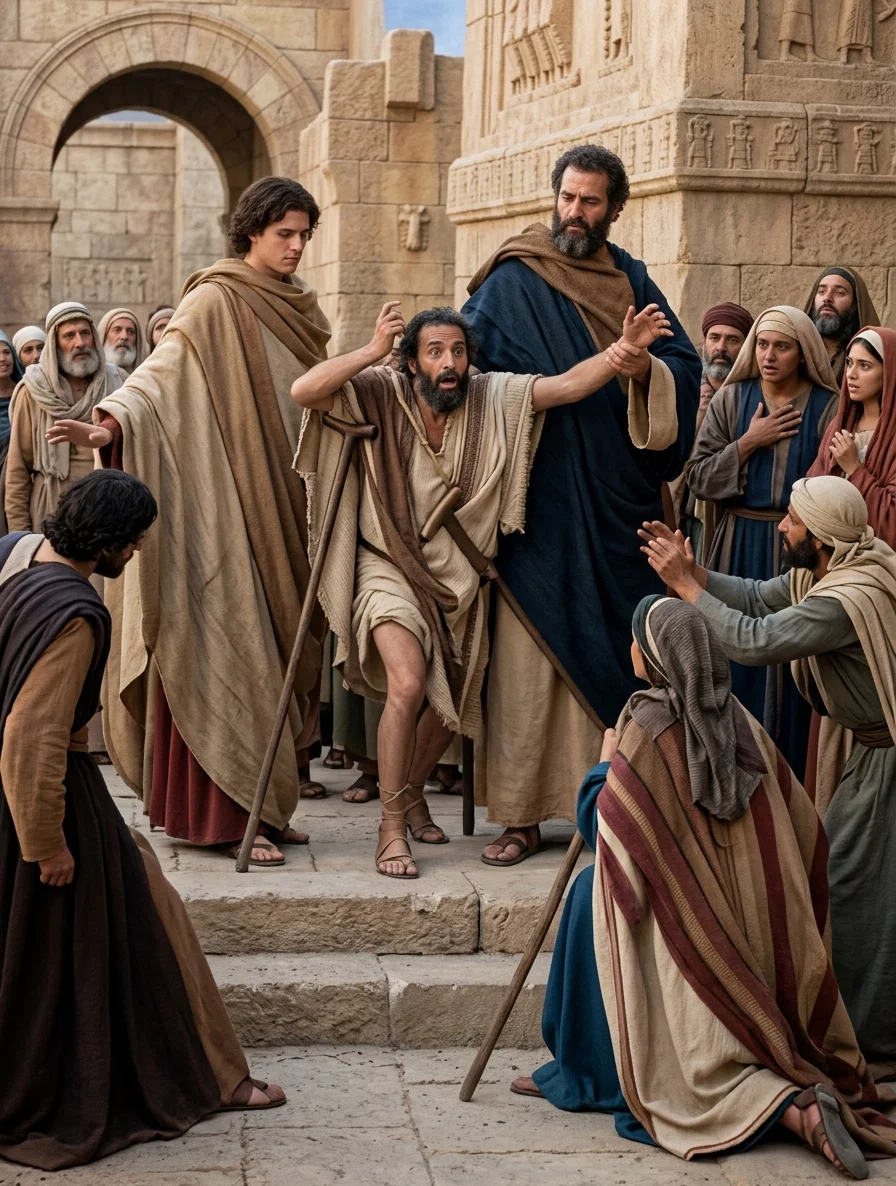
In our illustration is pictured the impotent (powerless) man, at the Beautiful gate of the temple. For forty years he had had no power to walk. But God spoke the word through his apostle; the man's faith received the word in himself, and the life of God made him whole. Was not the healing actual, real? Why, the man leaped up, "stood, and walked, and entered with them into the temple, walking, and leaping, and praising God." Acts 3:8. And the Spirit of God said through Peter: "Be it known unto you all, and to all the people of Israel, that by the name of Jesus Christ of Nazareth . . . doth this man stand here before you whole?" "And his name through faith in his name hath made this man strong, whom ye see and know; yea, the faith which is by him hath given him this perfect soundness in the presence of you all." Acts 4:10; 3:16.

For You.—

Reader, such faith may be yours. By faith in the Word of God you may be cleansed from sin (John 15:3; 1 John 1:9); you, powerless in yourself, so that you can not do the things that you would, may find all power in Jesus Christ (Col. 1:11); you may have the righteousness of God and the Spirit of God (Rom. 3:22; 8:9, 10); and having the Spirit of God, you have the life of God, eternal life (2 Cor. 4:10, 11; 1 John 5:11-13); and having faith in his Word, you may know that he "hath saved us, and called us with an holy calling" (2 Tim. 1:9); and "hath delivered us from the power of darkness, and hath translated us into the kingdom of the Son of his love" (Col. 1:13, margin). All this we may know and have by faith in the Word of God, actually, really have them. If Christ is not ours now, when will he be? We can only live in the now. If we are not saved now, what assurance have we that we will ever be? If thespotless robe of righteousness is not ours now, by living faith, yes, actually, when will it be? If we have not eternal life now, the life of the "eternal Spirit," what assurance have we that we will ever have it? True, we have not reached heaven; we are not made immortal; we are not beyond the confines of danger and trial and conflict; of this the Word assures us, and tells us that the heavenly home and immortality will come, and the trial will be over, at the appearing of our blessed Lord. But these other blessings, God gives them to us now that we may reap the larger, fuller, riper blessings by and by. We do not have them absolutely, but we have them by faith as actually as the impotent man had healing, as the leper cleansing, as Bartimeus sight. Let not unbelief cheat us of the riches of God's grace which he with open hands holds out to us. Let simple faith say, "They are mine."

Publishers and Terms

(Entered at the Post-office in Oakland.)
For Publishers and Terms, see page 15.

Rise Up and Walk

"In the name of Jesus Christ of Nazareth rise up and walk." Acts 3:6.

"WHAT MUST I DO TO BE SAVED?"

IT is a Bible question; it admits of a Bible answer and no other. It was a sinner that asked the question, "What must I do to be saved?" It was the legate of Jesus Christ that answered him: "Believe on the Lord Jesus Christ, and thou shalt be saved." Acts 16:30, 31. "For God so loved the world," says the great Teacher, "that he gave his only-begotten Son, that whosoever believeth in him should not perish, but have everlasting life." John 3:16. This is all that is necessary, belief, faith, in Jesus Christ.
"But," says one, "I thought that you people who observe the seventh-day Sabbath taught that more than faith is necessary." We do not; that is, no well-instructed Christian so teaches. Why should we teach otherwise from what is taught by our Lord and his apostle?
"But why," persists the questioner, "do you keep the seventh day? Is not that a denial of faith? Is it not returning to old Jewish customs for justification?"
Let us ask a question: Do you believe in Christ for salvation? The answer of course is, "Yes, most assuredly." But do you worship idols, take God's name in vain, dishonor your parents, steal, commit adultery, covet, etc.? And you reply with warmth, "Certainly not." But again we ask, Is it not returning to old Jewish customs to keep the commandments which forbid these things? For all the truth of the Bible came through the Jews. The God of the Bible has proclaimed himself to be the God of Israel. The prophets were Jews, the apostles and New Testament writers were Jews, and Jesus after the flesh was a Jew. More, he himself declares to one of another nation, "Salvation is of the Jews." John 4:22. Then if it be going back to Jewish customs to keep one of the Ten Words which God gave to the world through the Jews, is it not doing the same thing to keep other commands of that same law, given in the same way?

What Is Bible Belief?

But what is it to believe? It is not to give mere assent to a thing. Thus it is that the demons believe, and many people who are yet in their sins. The apostle tells us, "With the heart man believeth unto righteousness." Rom. 10:10. Righteousness is right-being and right-doing. The belief, the faith, which stops short of right-being and right-doing is spurious, and he who trusts to it will be deceived.
The righteousness to which belief has respect is the righteousness of God. "But now the righteousness of God without the law manifested, being witnessed by the law and the prophets; even the righteousness of God which is by faith of Jesus Christ unto all and upon all them that believe; for there is no difference." Rom. 3:21, 22. The righteousness is God's righteousness. It is given through faith in Christ. It is the same righteousness that is taught by the law and by the prophets; for the law and prophets witness to its genuineness.
It is the righteousness wrought out by the obedience of Christ, for "by the obedience of One shall many be made righteous." But to what was Christ obedient?—To the Father's commandments. John 15:10. He kept God's law, every one of the Ten Words of the Decalogue in their fulness, and so fulfilled or filled up in himself God's righteousness, that he might fulfil the same in others. Jesus Christ obeyed God; he did it in every particular. "Who did no sin, neither was guile found in his mouth." "Sin is the transgression of the law." 1 John 3:4. "Nay, I had not known sin, but by the law; for I had not known lust, except the law had said, Thou shalt not covet." Rom. 7:7. The law which says, "Thou shalt not covet," is the Decalogue. Therefore if Jesus Christ "did no sin," he did not transgress the law that pointed out sin; and therefore he must have kept that law, as he assuredly did. His enemies accused him of breaking the Sabbath day, but he said that the good works that he did on that day were "lawful," according to the Sabbath law. Matt. 12:12. Then the obedience of Christ by which the believer is made righteous is obedience to the Decalogue.
God imputes to us through faith the righteousness which Jesus wrought out. For our love of self is imputed his love to God. For our covetousness he gives his unselfishness. For our Sabbath-breaking is imputed his Sabbath-keeping. That is, if we by faith yield to God, God grants all this for Christ's sake. He not only forgives past sins by imputing to us his righteousness, but he changes the heart, puts a new spirit within us, even his own Spirit, and thus makes us righteous. Before this work is wrought through faith the carnal mind reigned, and "the carnal mind is enmity against God; for it is not subject to the law of God, neither indeed can be. So then they that are in the flesh can not please God." Rom. 8:7, 8. But here is expressed the change after the carnal mind has been taken away, and the mind of Christ is given: "But ye are not in the flesh, but in the Spirit, if so be that the Spirit of God dwell in you. Now if any man have not the Spirit of Christ, he is none of his. And if Christ be in you, the body is dead because of sin; but the Spirit is life because of righteousness." Verses 9, 10. "There is therefore now no condemnation to them which are in Christ Jesus." Verse 1. And all this comes simply because we believe with all the heart, believe unto righteousness, or right-being. Christ makes the tree good.

"The Obedience of Faith."

But does not the Christian work? Will he not do good works? Of what use to save him if he did not? Jesus "gave himself for us, that he might redeem us from all iniquity, and purify unto himself a peculiar people, zealous of good works." Titus 2:14. These works are the results of his faith. They are the right-doing of the right-being. The right-being, the tree, must be first; the right-doing, the fruit, follows, or else the tree will be cut down as a cumberer of the ground. "Let no man deceive you; he that doeth righteousness is righteous, even as He is righteous." 1 John 3:7. And being made righteous, the believer bears "the fruit of righteousness." His faith is the "faith which worketh by love." Gal. 5:6. His love is that which keeps the commandments of God, "and his commandments are not grievous." 1 John 5:3. "That the righteousness of the law [not a part of it] might be fulfilled in us, who walk not after the flesh, but after the Spirit." Rom. 8:4. Now these works are not wrought to earn salvation. They are not performed that we may have faith; they are the fruits of genuinefaith, of belief "unto righteousness." And he who thinks he has faith which does not produce works is deceived; his faith is dead, being alone. The works which God requires, the obedience which he demands, are a test of our faith. They are given in mercy and love, to develop faith and to save us from deception. "If ye love Me, keep My commandments." "Ye are My friends, if ye do whatsoever I command you." "He that saith, I know Him, and keepeth not His commandments, is a liar, and the truth is not in him." "He that saith he abideth in Him ought himself also so to walk, even as He walked." "For whosoever shall keep the whole law, and yet offend in one point, he is guilty of all."
These, reader, are the words of Inspiration. God has commanded the fourth commandment as truly as the first or sixth. Genuine faith will obey every one without question. If it does not obey, it is not the faith of Jesus. He kept, in the obedience of faith, every precept; if we have the same mind and same faith, we will follow him. Our right-doing will be his right-being in us.

INFIDELITY: WORSHIPING SELF.

SUPPOSE I say that I believe the Word of God; but here is a text that I can not believe. Yet this text is a part of what is declared to be the Word of God. If I doubt this, how am I to determine that any other portion is the Word of God? If reason determines it, I am simply worshiping the result of my own reason, and this is idolatry. Therefore if I do not believe that this is the Word of God, do I really believe that any other word is the Word of God?—No; for it is all the same Word.
If I think I believe another portion, then it is only my reason in which I believe. I can understand one portion, and what I can understand I will believe. Is not that a denial of God? It is saying that there is no being in this universe greater than I am; that I will not believe anything greater than my comprehension. If I believe one portion because it looks reasonable, and doubt another because it doesn't look reasonable, then reason is the guide of my life, and I am sitting in judgment on God. I am virtually saying that there is nothing of God that is greater than my reason.
Then my faith in the Word of God is shown by my faith in any one text of that Word. If I do not believe that Word, I do not believe any of it. I may think I believe something else, but in that which I think I believe, I am simply putting myself in the place of God, and worshiping myself. I am putting my understanding in the place of God's, and what I think is God is only myself. This is a fact.
This sort of thing is very common in the world, among professors of Christianity. One believes a text because it looks reasonable, and he can understand it, but that other he can not see. And yet he thinks he is not an infidel. "See what a large portion I do believe;" and yet he can not go beyond the range of his reason. That is to say that there is no God in the universe who can speak words beyond the range of his reason. His reason is held to be equal to God's, and even above it, because he sits in judgment on what God says. This is putting self above God. So, let us state it again: When we thought we believed the Bible, and doubted a portion of it, and thought we believed in God, who was the god we were really worshiping, thinking it was the true God?—Only self. That is the Papacy, pure and simple.
E. J. W.

Sacrifices

Sacrifices.—There is only one sacrifice in the Christian religion, and that was made by Christ. We have never made a sacrifice. God does not call us to make sacrifices, but to accept the sacrifice that he has made. True, we have to give up all things that pertain to self, but giving up self is simply taking Christ.
Suppose a poor beggar comes to us, with ragged clothing, and a few coppers in his pocket, and we say to him, "Take off these rags, and we will give you a new suit; and give up the coppers, and we will fill your pockets with sovereigns." Would he begin to mourn, or talk about the great sacrifice he was called upon to make in giving up his rags and the coppers he had in them?
Of course we give up something, but what sacrifice is it, when we get ten thousand times as much, and infinitely more? God wants us to give up our miserable ways, and take his ways; our narrow, circumscribed thoughts, and take his thoughts; our poverty, and get his riches; our gross ignorance, and get his wisdom; our wickedness, and get his righteousness. E. J. W.

BANISHED FROM EDEN.

"So HE drove out the man; and he placed at the east of the Garden of Eden cherubim, and a flaming sword which turned every way, to keep the way of the tree of life." Gen. 3:24. Ruined by disobedience, cast out from the Eden home, doomed to a life of toil and hardship, with the sentence of death hanging over them as a dark shadow, what a contrast to the former blessed existence! But God in his infinite mercy has given them a door of hope; the Seed of the woman shall bruise the serpent's head. Gen. 3:15. As we in the light of the Gospel revelation look backward, it seems impossible that man could realize all which is implied by this promise, but we know not how much God graciously revealed to them. They believed the promise, and through faith entered upon their henceforth hard life of toil, and conflict with sinful human nature, and the temptations of Satan.
The Bible history of our first parents is very briefly recorded. Sons were born to them; an altar of sacrifice was erected, calling for the blood of innocent victims representing the merited punishment of sin and prefiguring the sufferings and death of the Redeemer as an expiation for the sins of the world. We see how the first son of Adam fell, how the enemy watched for his soul as a wild beast "croucheth at the door." Through faith in the promised Saviour, Cain should have ruled over sin, but he yielded. Through envy he rose up and slew his brother, and with bold defiance answered his Maker, "I know not: Am I my brother's keeper?" Gen. 4:9.
O, the bitter consequences of that first sin in Eden! Every son and daughter of Eve is a victim to the snares of Satan. "The lust of the flesh, and the lust of the eyes, and the pride of life" (1 John 2:16), all conspire to render us an easy prey. The "prince of this world" (John 14:30) knows well our every weakness; for his own wicked nature rests upon us. He would captivate us by the pleasures and allurements of the world, "All these things will I give thee, if thou wilt fall down and worship me." Matt. 4:9. He would fill our hearts with hatred toward God and our fellow-beings, for well he knows the law, "Whosoever hateth his brother is a murderer." 1 John 3:15. Again, he would lull us to sleep through self-indulgence, and on the other hand would arouse in us every evil passion. Read that fearful catalog of the works of the flesh contained in the fifth chapter of Galatians. "They which do such things shall not inherit the kingdom of God." Gal. 5:21.
Just here may be found the motive which actuates the enemy of souls. Satan is himself banished from heaven and the presence of God. Certain destruction awaits him, and he is exerting all his evil powers to draw man down to that same terrible fate. O, how many have been hurried into the grave by sinful indulgence! How many, tho living, are yet "dead in trespasses and sins"! Eph. 2:1. Look at the inmates of prison and penitentiary; look at the haunts of vice in all our large cities; look within your own heart and see the constant warfare against every holy desire and Godlike aspiration; see how the old Adam within you asserts his sway! Said the apostle Paul: "I delight in the law of God after the inward man; but I see another law in my members, warring against the law of my mind, and bringing me into captivity to the law of sin which is in my members." Rom. 7:22, 23. And whoever sets his face onward and upward toward holiness and heaven finds this same contest going on within. How often have we cried out with shame and grief, "The good that I would, I do not; but the evil which I would not, that I do," and in our moments of despair we are ready to exclaim with Paul, "O wretched man that I am! who shall deliver me from the body of this death?" Rom. 7:19, 24.
But, praise to the mercy of God, we may also exult with the apostle, "Thanks be to God, which giveth us the victory through our Lord Jesus Christ." 1 Cor. 15:57.
"With tearful eyes I look around; Life seems a dark and stormy sea; Yet, 'mid the gloom, I hear a sound, A heavenly whisper, 'Come to me.'"

REDEMPTION IN THE BOOK OF RUTH.

"Deliver him from going down to the pit; I have found a ransom." Job 33:24. Ever since man lost his inheritance through sin it has been true with God, that "I have found a ransom." But, as the connection in which our text is found indicates, it is necessary that there be a messenger to show unto man God's uprightness. God has sought in every way to interpret this fact to the human family. Through type and symbol, through sacrifice and offering, through prophet and priest, he has sought to manifest the plan of redemption to man.
The book of Ruth, which is considered by many a kind of sentimental story, sets forth this redemption very plainly. The ceremonial law provided that if a person lost his possessions through poverty, one of near kin might redeem his inheritance. Lev. 25:49. And in case of the death of a man having a wife, and no children to occupy the inheritance, the nearest of kin should take her for his wife, and the first-born son should succeed in the name of the husband that died; thus the family name and inheritance was secured. Deut. 25:5, 6.
Elimelech of Bethlehem for some reason lefthis inheritance, and went to dwell in a land of strangers, who did not know the true God. His wife and two sons went with him. These sons formed an unholy alliance with that people, and took wives of that idolatrous nation. Bitterness and sorrow seem to have followed. Elimelech and both of his sons died in this heathen country, and the mind and heart of Naomi, Elimelech's wife, turns back to the inheritance which they had left in Bethlehem many years before. But she is old and without a son to hold the inheritance, and her poverty makes it necessary that this inheritance be sold, to all human appearance lost, and with her death the family name must perish. But Naomi returns to her old home in Bethlehem, and Ruth, her daughter-in-law, chooses to go with her. This choice of Ruth afterward revives a last ray of hope for Naomi, for she still has kinsmen in Bethlehem.
There is only one that can redeem the inheritance, and raise up the name of the dead upon his inheritance, and the wife of the dead has the right, according to the law, to demand that this nearest of kin build up the name of the dead upon the inheritance. A refusal to do this exposes him to the utmost contempt. Deut. 25:7-10. Boaz recognizes all this, and gives himself for this purpose, and marries the Moabitess. All his wealth becomes hers; his own inheritance is "marred," and his name is merged in the house of Elimelech; but that family name is preserved. There is no need now of parting with the inheritance, but with his wealth added to it, it becomes all they need. "And the women said unto Naomi, Blessed be the Lord, which hath not left thee this day without a redeemer, that his name may be famous in Israel. And he shall be unto thee a restorer of thy life." Ruth 4:14, 15, margin.
How beautifully this illustrates our redemption in Christ. Man, in departing and partaking of the forbidden fruit, lost his life. The decree was carried out, "In the day that thou eatest thereof thou shalt surely die." This can not refer to natural existence, but the Spirit which is life, and the Holy Seed which God intended should ever remain in man, by sin was lost. Man was spiritually dead, and, so far as human prospects were concerned, the inheritance was lost; the name, sons of God, was lost, and all must perish.
Yet there was One, and only One, who could restore what was lost in Adam,—his Elder Brother, the rightful heir of all things. Life, name, and inheritance, all were his by right. Infinitely superior in every respect to Boaz, yet he stooped to marry the lost race. And by so doing "marred" his own inheritance. "Who, being in the form of God, thought it not something to be held onto; but made himself of no reputation, and took upon him the form of a servant, and was made in the likeness of men." He actually gave himself to them, that every one who would enter into the marriage relation with him might have his wealth, his inheritance, his name, and his life, and thus become members of his body, his flesh, and his bones. And like as the widow under the ceremonial law had a right to demand her redemption of her nearest of kin, so we have a right to come with boldness unto our Redeemer, knowing that he will perform the kinsman's part. This redemption is not so much the paying off of a mortgage supposed to be held by Satan upon the human race, as it is being delivered from sin and its results by becoming one with Christ. Neither is it the paying of a sum to God to cancel a debt, and thus make satisfaction with God; for God can only be satisfied with righteousness, and this we all may find in our Redeemer.
"Turn, O backsliding children, saith the Lord, for I am married unto you." Jer. 3:14. "And it shall be at that day, saith the Lord, that thou shalt call me Ishi [that is, my husband]." Hosea 2:16.
"Husbands, love your wives, even as Christ also loved the church, and gave himself for it; that he might sanctify and cleanse it with the washing of water by the Word, that he might present it to himself a glorious church, not having spot, or wrinkle, or any such thing; but that it should be holy and without blemish."

The Light of God.

Sometimes the morals of these times are compared with those in past centuries to show how the world has advanced. But past centuries did not have the advantages of education and access to the Source of truth through the Word as at present. God holds men responsible not only according to their deeds, but according to the light used or rejected. At the beginning of this century, the cheapest Bible cost over one dollar, and a New Testament twenty-eight cents, while throughout the greater portion of the world the Book was entirely unknown. Now the British and Foreign Bible Society provides a whole English Bible for sixpence (twelve cents), a New Testament for a penny (two cents), any one of the four Gospels for a half-penny (one cent), while it gives every year thousands of copies, without money and without price, to all who can not pay for it. No century of earth ever had the light as has this century. How has it been used?

General Articles

"Christ Jesus, who of God is made unto us wisdom, and righteousness, and sanctification, and redemption."

CREATION.

On the morn of creation, the voice of the Lord Brought out from confusion the dawning of light; In infinite wisdom Omnipotence wrought, And marvels revealed, by the arm of His might.
God spake and the sunlight gleamed over the world; By His wonderful power the darkness had fled; Where chaos once reigned through limitless space Glad rays of sweet sunshine were peacefully shed.
And thus the dark shadows of nature's new birth Receded in silence, and splendor was there. The touch of the Master bedecked the new earth, And grasses and blossoms made fragrant the air.
Again spake the Mighty, the all-wise Creator, And Luna arose in her grandeur on high; He uttered His voice, and stars in the heavens Shone sweetly like jewels that spangled the sky.
From the mosses and ferns and the tiniest spray, The dewdrops of morning "grew diamond and gem," And the cloudlets were bathed by the orb of the day, As a halo of glory gleamed brightly from them.
At the mandate of God came the beasts of the plain, And the light finny tribes, which play in the sea, The prairie, the forest, the vast rolling main, And the beautiful birds with their sweet melody.
As the sun was reclining o'er ocean and land, At the voice of the Master in beauty man stood, In innocent gladness he came from His hand, And all that God made He pronounced "very good."
MRS. ALICE A. HARPER. Lansingburg, Mich.

DAVID'S SIN.

Its Practical Lessons.

PERHAPS there is no Bible writer whose character has been so assailed as that of the prophet David. Infidels have referred to his sin in the matter of Uriah the Hittite, as a reason why they can not accept the plan of redemption set forth in God's Word. It is true that David did commit a terrible sin. He says so himself. Hear his penitent prayer, "Deliver me from blood-guiltiness, O God, thou God of my salvation." Ps. 51:14. God himself declares the sin to be a great and grievous one. He full well knew what the effect would be on future generations; for he said through his prophet Nathan, "By this deed thou hast given great occasion to the enemies of the Lord to blaspheme." 2 Sam. 12:14.
Now suppose instead of showing mercy to David he had refused to pardon his guilt, would the infidels of that and succeeding generations, who have pointed the finger of scorn at the penitent patriarch, have believed the Bible or been any more ready to accept the plan of salvation?—Not one. If an infidel obtains the right view of the plan of redemption, he will recognize at once that it is for the purpose of pardoning sin. If he gains a view of the exceeding sinfulness of his sins, he will greatly desire to be forgiven. He will be thankful that God forgave David and placed it on record. Whoever finds fault with God's pardoning of David's sins of murder and adultery, finds fault with the plan of salvation. Had it been planned according to their narrow ideas, it would have been a very limited affair indeed, and conducive of very little, if any, good.
Every infidel must acknowledge that the Bible sets forth pardon for all manner of sins, except the sin against the Holy Ghost. Now this being the case, why should not David have been pardoned, provided that he met the conditions, as well as any one in the world? Why find fault with God's mercy? Why not rejoice in it, hope in it, and avail ourselves of it, before it is too late?
No one who has a just conception of the far-reaching influence of sin, can fail to see the enormity of David's sin. The prophet sinner held the high position of king, and his influence was far-reaching. The terrible influence of his awful guilt did not die when the patriarch finished his course, and was laid away to rest. For nearly three thousand years he has been unconsciously sleeping in his grave; and yet the story of his fall is repeated by the infidel scoffer to reflect shame on the Scriptures. It is also held up by the faithful teacher of God's Holy Word to encourage the transgressor to hope in God's mercy.
That class of people who look to the pardon of David's guilt, must be careful not to overlook David's repentance. If heartfelt repentance ever fell on the ear of a sin-pardoning Redeemer, it was from the mouth of David. Hear his words: "When I kept silence, my bones waxed old through my roaring all the day long. For day and night thy hand was heavy upon me; my moisture was changed as with the drought of summers." "I acknowledge my transgressions; and my sin is ever before me." Ps. 32:3, 4; 51:3, R. V.
Think of it. He whose conscience smote him for cutting off a piece from the cloak of Saul, had so fallen that he murdered one of his most valiant soldiers to cover his shameful violation of the seventh commandment. But, notwithstanding all of this, God sent him close, cutting reproof, brought him to repentance, forgave him, and whoever enters heaven will meet the man whose psalms have been read and sung for generations. Praise the Lord for the plan of salvation that cleanses the foulest sinner! If infidels would repent, instead of finding fault with God for pardoning David's sins, they too might be saved. E. HILLIARD. Tonga, Friendly Islands, South Pacific.
Continue reading: GOD'S CARE FOR HIS CHILDREN