Does life's way seem to thee
Up-hill and rough?
And is love's oil of joy
Still not enough?
Seek that thy soul may know
God's truth outweighs
The heaped up measure of
Earth's fullest days.
Behold the morn's gray mist
Burned into fire
Of red and gold; for, lo,
The sun mounts higher!
The yielding day unfolds,
Receives the light,
And, trusting, casts aside
The garb of night.
So may our souls expand
In truth revealed,
If, seeking, we find light,
And, finding, yield
Our all to Him who came
To set us free
From all fear's doubts, and give
Soul liberty.
Obedience is the test.
God bids us seek,
Not with a feeble faith
And courage weak,
But with an open heart,
A yielding will,
And empty vessels held
For Him to fill.
O, ye who hope in God.
Be strong and brave;
Fear not earth's beating storms,
Fear not the grave.
Not hopeless pilgrims we,
Earth's ways to roam,
But children of that light
Which leads us home.
— Annie Wall.
Heaven a Place
Of course heaven is a place. God's people are to have future existence, and it is impossible to live without having location. As long and as surely as we are individuals, we are to have a locality in which our individual existence is to be experienced. If people become too vague and misty to conceive of locality in connection with the heavenly life, they are liable to become unbelieving and uncertain as to the continuance of their own personal identity. We believe that God is to continue His people in self-conscious identity, and that He is to give them assurance of their continued personality in a real and delightful environment.—Herald and Presbyter.
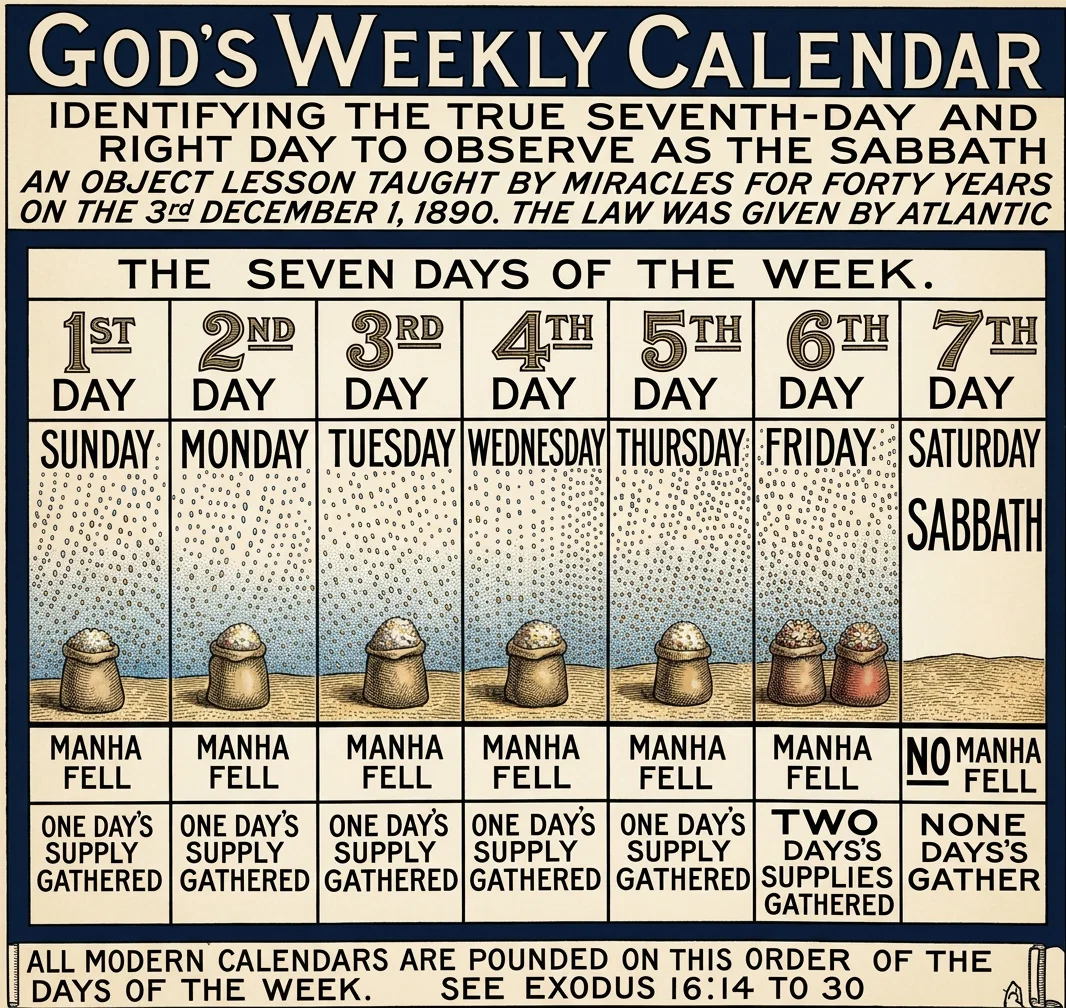
The Sabbath—The Day—The Duty
The Sabbath Law
1. What Sabbath law has God given us?
“Remember the Sabbath day, to keep it holy. Six days shalt thou labor, and do all thy work: but the seventh day is the Sabbath of the Lord thy God; in it thou shalt not do any work, thou, nor thy son, nor thy daughter, thy man servant, nor thy maid servant, nor thy cattle, nor thy stranger that is within thy gates: for in six days the Lord made heaven and earth, the sea, and all that in them is, and rested the seventh day: wherefore the Lord blessed the Sabbath day, and hallowed it.” Ex. 20:8-11.
NOTE.— Mark the position of the Sabbath law in the middle of the Decalogue, that recognized compendium of all morality. If it were placed at the beginning or end of the law, man might say that it formed no part of that wonderful document; that it was added by men, was ceremonial in its nature; that it did not stand on the same basis as the other nine precepts, etc. But Divine Wisdom, anticipating all these attempts to belittle the Sabbath, placed it in the very heart of that law; therefore before the impious hands of sacrilege can reach it, three moral walls guarding our duty to God on the one side, and six moral laws guarding our duty to humanity on the other side, must be broken down. It, like all the others, is eternally moral.
Questions on the Law
2. What shows that the Sabbath is not at this time a new institution?
“Remember the Sabbath day.”
3. What are we to remember?
“The Sabbath day.”
4. For what purpose are we to remember it?
“To keep it holy.”
NOTE.— It is therefore evident that the day, the DAY of the REST—for “Sabbath” means “rest”—is not made holy by man’s keeping. Man’s keeping does not make it holy; man is to keep holy that which God has made holy.
5. What day of the septenary cycle, or week, is the Sabbath?
“The seventh day.”
6. Whose Sabbath is the seventh day?
“The seventh day is the Sabbath of the Lord [Jehovah] thy God.”
7. What made it the Sabbath, or rest, of Jehovah?
“In six days the Lord made heaven and earth, . . . and rested the seventh day.”
8. When did God thus rest?
“Thus the heavens and the earth were finished. . . . And on the seventh day God ended [‘finished,’ A.R.V.] His work which He had made; and He rested on the seventh day from all His work which He had made.” Gen. 2:1, 2.
NOTE.— It is said that God finished His work on the seventh day, because the making of the Sabbath was the rounding out of that week’s work for man. God’s rest on that day was a part of His week’s making. His rest upon that day of the cycle made that day of the cycle His rest day to all eternity; for the fact of the rest could not be set aside. The rest was a step which Divine Wisdom felt necessary in the institution of a holy rest day.
9. What did He do after resting?
“Wherefore the Lord blessed the Sabbath day, and hallowed it.”
“And God blessed the seventh day, and sanctified it: because that in it He had rested from all His work which God created and made.” Gen. 2:3.
NOTE.— God “hath blessed; and I can not reverse it,” said a prophet of old. Num. 23:20. He blesses, that the thing blessed may be a blessing. Gen. 12:2. So will God’s Sabbath prove to him who receives it. “Sanctify” means to set apart to a holy or sacred use, to separate from the common. The sons of Aaron were flesh and blood like their brethren; but God sanctified them, set them apart, separated them from the other tribes, to the priesthood. Ex. 28:41. Mount Sinai was composed of rock and earth like other mountains; but God separated it to Himself, and made it holy. Ex. 19:23, 12, 13. This sanctifying the Lord did by command; so also He sanctified the Sabbath. Note that it is THE DAY, ever the DAY, not one day in seven, not a seventh part of time, but the seventh DAY.
Note that it was made 2,500 years before there was a Jew, and given to generic man, the head of the race, and hence was for all the race, even as the earth was for all the race.
Memorial and Sign
11. Of what, then, is the Sabbath a memorial?
“He hath made His wonderful works to be remembered.” Ps. 111:4.
12. How long shall His memorial remain?
“Thy name, O Lord, endureth forever; and Thy memorial, O Lord, throughout all generations.” Ps. 135:13.
NOTE.— If men had ever been mindful of God’s Sabbath, earth would never have known an idolater. The Maker of heaven and earth would have been kept in constant remembrance.
13. Of what, then, did the Sabbath become a sign?
“And hallow My Sabbaths; and they shall be a sign between Me and you, that ye may know that I am the Lord [Jehovah] your God.” Eze. 20:20.
14. Of what else is it a sign?
“Moreover also I gave them My Sabbaths, to be a sign between Me and them, that they might know that I am the Lord that sanctify them.” Eze. 20:12.
NOTE.— The only power which can make holy and save the sinner is creative power; therefore the Sabbath becomes a sign of redemption as well as a memorial of creation. God created mankind; He redeems His Israel, His people, out of Egyptian bondage. Therefore to the redeemed the Sabbath comes as a twofold token of creation and of redemption. Compare Ex. 20:11 with Deut. 5:15. The power of redemption is creative power. Eph. 2:10; 2 Cor. 5:17. Even so God made known to His people the fulness of the Sabbath on Mount Sinai. Neh. 9:13, 14.
Jesus and the Sabbath
15. How did Jesus regard the law of which the Sabbath is a part?
“Think not that I am come to destroy the law, or the prophets: I am not come to destroy, but to fulfil. For verily I say unto you, Till heaven and earth pass, one jot or one tittle shall in no wise pass from the law, till all be fulfilled. Whosoever therefore shall break one of these least commandments, and shall teach men so, he shall be called the least in the kingdom of heaven: but whosoever shall do and teach them, the same shall be called great in the kingdom of heaven.” Matt. 5:17-19.
“It is easier for heaven and earth to pass, than one tittle of the law to fail.” Luke 16:17.
NOTE.— A “jot” is the smallest letter of the Hebrew alphabet. A “tittle” is a distinguishing point of a letter. To fulfil a moral law is to do it. Gal. 6:2. Christ kept the law and died that we might be redeemed to keep it.
16. What works did He say were allowable on the Sabbath?
“It is lawful [according to the Sabbath law] to do well on the Sabbath days.” See Matt. 12:1-12.
17. How did He spend the Sabbath day?
“As His custom was, He went into the synagogue on the Sabbath day.” Luke 4:16.
18. How did His teaching and example affect the women who accompanied Him, even after His death?
“They returned, and prepared spices and ointments; and rested the Sabbath day according to the commandment.” Luke 23:56.
19. Who is set before the Christian as an example?
“He that saith he abideth in Him ought himself also so to walk, even as He walked.” 1 John 2:6.
NOTE.— Read all these texts. Mark that these scriptures were written all the way from thirty to sixty years after the resurrection, not one of them calls the first day of the week the Sabbath, or a holy day, or the Lord’s day, nor are we told to observe it as a sacred day or in memory of anything. The first six texts refer to the same first day, the one on which Jesus rose from the dead. The seventh text, Acts 20:7, is part of a record of a meeting held on what would be our Saturday night—for the day began at evening; and the next morning Paul spent the light part of that first day in travel. The last text, 1 Cor. 16:2, is instruction from the apostle not to take a public collection in the meetings, but that each one was to lay BY HIMSELF, at home, what he could afford to give, that it might be ready when the apostle came. There is an entire absence of Sabbath atmosphere or precept about these scriptures, but rather the opposite.
Jesus died to save men from sin, from the transgression of the law. Matt. 1:21; Titus 2:14. He therefore died to make men law-keepers, Sabbath-keepers, worshipers and servants of God.
23. How did His disciples regard the first day of the week?
“They came unto the sepulcher, bringing the spices.” “Two of them went that same day to a village called Emmaus, which was from Jerusalem about threescore furlongs” (seven and one half miles). Luke 24:1, 13.
24. In any of their gatherings, did they meet to celebrate His resurrection?
“And they, when they had heard that He was alive, and had been seen of her, believed not. After that He appeared in another form unto two of them, as they walked, and went into the country. And they went and told it unto the residue: neither believed they them. Afterward He appeared unto the eleven as they sat at meat, and upbraided them with their unbelief and hardness of heart, because they believed not them which had seen Him after He was risen.” Mark 16:11-14. See also Luke 24:36, 37, 41.
25. Why did they come together (John 20:19) at the close of this day?
It was the common “abode” of “Peter, and James, and John, and Andrew, Philip, and Thomas, Bartholomew, and Matthew, James the son of Alphaeus, and Simon Zelotes, and Judas the brother of James.” Acts 1:13.
The Lord’s Day
26. How many times does “the Lord’s day” occur?
“I was in the Spirit on the Lord’s day.” Rev. 1:10.
NOTE.— This is the only time that the term “Lord’s day” occurs in the Lord’s book.
Neither that text nor its context tells us what day is the Lord’s day. We must learn that from other scriptures.
27. What day does the Lord call His?
“If thou turn away thy foot from the Sabbath, from doing thy pleasure on My holy day.” Isa. 58:13.
28. What day is the Sabbath?
“The seventh day is the Sabbath of the Lord thy God.” Ex. 20:10.
29. Of what day does Christ call Himself Lord?
“The Son of Man is Lord also of the Sabbath.” Mark 2:28. (According to the Lord’s book, then, what day is the Lord’s day?)
The Teaching of the Apostles
30. What is sin?
“Sin is the transgression of the law.” 1 John 3:4.
“Nay, I had not known sin, but by the law: for I had not known lust, except the law had said, Thou shalt not covet.” Rom. 7:7.
“Whosoever shall keep the whole law, and yet offend in one point, he is guilty of all. Now if thou commit no adultery, yet if thou kill, thou art become a transgressor of the law.” James 2:10, 11.
31. For what did Christ come?
“And ye know that He was manifested to take away our sins; and in Him is no sin.” 1 John 3:5.
“This is the love of God, that we keep His commandments; and His commandments are not grievous.” 1 John 5:3.
33. What, then, will faith do in our hearts?
“Do we then make void the law through faith? God forbid: yea, we establish the law.” Rom. 3:31.
34. What will God’s people do in that world to come?
“For as the new heavens and the new earth, which I will make, shall remain before Me, saith the Lord, so shall your seed and your name remain. And it shall come to pass, that from one new moon [month, Rev. 22:2] to another, and from one Sabbath to another, shall all flesh come to worship before Me, saith the Lord.” Isa. 66:22, 23.
The Greatness of Being Gentle
By William Covert
DAVID, writing for Christ and prophetically of Christ, said, “Thy gentleness hath made me great.” Christ in human flesh manifested the greatness of His strength by walking in the power of heaven’s gentleness.
When the prophet in vision beheld His incarnate life as He went forward against the adversary of man, he said, “Who is this that . . . is glorious in His apparel, traveling in the greatness of His strength?”
When the question was asked, the answer given was, “I that speak in righteousness, mighty to save.” In the contest which He was waging against the ruler of this world’s darkness, He used the almighty power of gentleness. No dart that the adversary hurled could pierce the shield of gentle love which composed the armor that He wore. The enemy tried with all his satanic power to break through that shield of gentleness, but it could not be torn nor broken.
Since gentleness in the power of the Holy Spirit made Christ invincible, it is evident that the same mode of warfare would make His followers mighty in their contest with the same adversary. Christ wreaked vengeance upon Satan by simply walking in the might of His holiness; and His people can conquer by fighting as their Lord fought. Let this gentleness be not intermittent, but perennial, and constant as the power of that life which makes it grow; and if so, their defense will never be broken.
Christ took no offense at abuse, nor was the gentleness of His spirit disturbed by torture. He meekly prayed for the men who scourged Him, while they applied the cruel, stinging lash; and while His nerves quivered8with pain, His soul was drawn out in love for His tormentors. It was the mighty power of His gentleness, seen and approved by all beholding intelligences, that won for Him the victory over every foe of righteousness.
WILLIAM COVERT.
The Commandments of God and the Faith of Jesus
By F. A. Bower
By F. A. Bower
In contradistinction to a class of people who receive the mark of the beast, as recorded in the fourteenth chapter of Revelation, the seer of Patmos calls attention to the “saints” who “keep the commandments of God and the faith of Jesus.”
Upon those who receive the mark of the beast is to be poured out the unmingled wrath of God, which, we see by referring to the sixteenth chapter, is made up of the seven last plagues.
The three angels of Rev. 14: 6-9 represent three messages, or rather one great threefold message, due the world at a certain time. The first part of that message is to be preached to every nation, kindred, tongue, and people; and as the second and third angels followed the first, they must necessarily go to every nation, kindred, tongue, and people.
Those who preach the first message, have the “everlasting gospel,” which is the gospel of salvation through Jesus Christ; but the time point of that message is, “The hour of His judgment is come.”
It is evident, from these plainly stated facts, that this message goes primarily to those who profess to be followers of Jesus, and through them to others, that they may accept Jesus and this message. Rev. 1:1 shows clearly that this entire book of Revelation is given to God’s servants, or those who are Christians. Is such a message going to the world? We answer, Yes. It began in 1844, and sailors tell us that they know of no port where this very message is not preached.
But God’s people, divided as they were into so many sects, each having some error mixed with the saving truths of God’s word, and each thinking themselves right and the others wrong, were blinded to the real beauty and force of the message, and few of them have heeded it.
Then the second angel’s message followed the first. “Babylon is fallen, is fallen,” Rev. 14: 8. The very last phase of this is given in Rev. 18: 4: “Come out of her, My people, that ye be not partakers of her sins, and that ye receive not of her plagues.”
Since the plagues constitute the wrath of God that is to be poured out upon those who receive the mark of the beast, and Babylon receives the plagues, we must conclude that the professed Christian world, which rejects the great threefold message, receives the mark of the beast.
Now what is the difference between those whom God accepts and those whom He rejects? There are those on both sides who profess to be followers of Jesus, claim to keep the commandments. But when the individual who is not honest at heart is brought face to face with the fourth commandment, which says the seventh day is the Sabbath of the Lord thy God, a doubt springs up in the mind as to whether God means what He says.
When Jesus was tempted by the devil, in the wilderness, on the pinnacle of the temple, and on the exceeding high mountain, He showed implicit faith in the written word of God, and met the tempter with “It is written.” He believed the word of God with all His heart, and brought His life into perfect harmony with it. “And the Word was made flesh, and dwelt among us.”
Many people do not realize that they are breaking God’s commandments, because they do not feel that they are doing wrong; but in this they are pitting their feelings against the word of God.
“The just shall live by faith.” “O Israel, thou hast destroyed thyself; but in Me is thine help.” Hosea 13: 9. “Here are they that keep the commandments of God, and the faith of Jesus.”
Wenatchee, Washington.
Moses and Herodotus—A Contrast
By G. W. Reeser
By G. W. Reeser
HERODOTUS is styled the “father of history.” This applies, of course, to profane history. If we were to select the earliest inspired historian, doubtless we would agree that Moses, who wrote the Bible account of creation, was the first. One of the convincing evidences that the pen of Moses was guided by inspiration, is found in a contrast of the writings of these two recognized historians, each the first in his class whose writings at all complete have come down to us.
It is said of Herodotus that he “was of a noble family,” and that “for wide vision, for manifold suggestiveness, for noble and yet liberal spirit, for serene wisdom, . . . the father of history may challenge all those who have come after him.”
With this brief introduction to Herodotus, let us observe how ridiculously his writings are at variance with science. While visiting in Egypt, he tried to account for the annual overflow of the Nile. Having overthrown, to his satisfaction, all the theories set forth, he says:
“Yet if, after I have found fault with the opinions advanced by others, it becomes me to declare my own concerning so obscure a question, I will describe what, in my opinion, causes the Nile to overflow in summer. During the winter season, the sun, being driven by storms from his former course, retires to the upper parts of Libya. This in few words comprehends the whole matter; for it is natural that the country which this god is nearest to, and over which he is, should be most in want of water. . . . For he attracts the water to himself, and having so attracted it, throws it back upon the higher regions. . . . I do not think, however, that the sun on each occasion discharges the annual supply of water from the Nile, but that some remains about him.”
Again, in speaking of the ocean he says:
“But the person who speaks about the ocean, since he has referred his account to some obscure fable, produces no conviction at all; for I do not know any river called the ocean.”
Moses spent the first forty years of his eventful life in the land where the Nile annually overflows its banks. Suppose that he had accounted for the mystery by telling us that the sun was driven south each recurring autumn by the cold north winds, and returned again to his summer station when the mild winds permitted him to come back without getting chilled. Suppose again that Moses had told us that he did not believe in the existence of the ocean, but thought that such a ridiculous idea must be a myth.
In contrasting these two historians, we should keep in mind the fact that Moses was born nearly eleven centuries before Herodotus, and therefore, if left to his own wisdom, would doubtless have written things as contrary to science and fact as did the father of profane history.
In making this contrast, I have no disposition to scorn Herodotus. Any man of his day would have made as great blunders as he if left to the wisdom of men. But the very fact that Moses wrote more than a millennium earlier than Herodotus, and yet not a single line from his pen is out of harmony with true science, proves that the “great lawgiver” was inspired for his work, while the “father of history” did not wield an inspired pen.
If any one desires to pursue this line of thought further, let him contrast the dignity, the sublime majesty, of the writings of Moses with those of Herodotus, and at the end thank God for an inspired Bible.
Test All by God’s Word
By J. W. Lowe
Be not deceived by vain sophistries, or the mere opinion of any man, no matter how well educated and talented and wise he may have the reputation of being; for a large share of false doctrines and theories has originated with persons of education and ability.
Test all philosophies and doctrines and theories and opinions that may be brought to your notice, by the word of God; and if they do not agree with “the law and the testimony,” you may know of a certainty that they are not of God, but false and pernicious and misleading.
No matter how innocent and beautiful and true any moral or spiritual claim may appear on the surface, do not accept it until you have subjected it to the Scriptural test laid down in God’s word. Considering the many conflicting doctrines in the world, this is the only safe course to pursue.
It is wise to remember also that error and truth are many times so interwoven as to render the mixture very deceptive. Satan knows, from personal experience, that he can more readily deceive by this method. Hence the necessity for a more rigid examination of all such claims presented, and the application of the infallible Bible test.
But on the whole, it is very unprofitable and unwise to spend valuable time studying error. We haven’t any too much time in which to study truth. It is far better and wiser to be so well grounded in the fundamental principles of truth, that we shall be able to recognize error when it appears. This is possible by a thoro and systematic study of the Holy Scriptures.
Then, too, by studying into error, we place ourselves on the enemy’s ground. And error and sin, from the very nature of things, are hypnotic, for they have back of them the evil one, whose policy is to deceive and even force. Test all things by the Word, but do not unnecessarily subject yourself to Satan’s snares. J. W. LOWE.