Pacific Press Publishing Company · Oakland, California · Apr 8, 1897
One Law, One Disease
By Editor
Editorial
God Is One.—Therefore his law is one. His character is not one thing to-day and another to-morrow. It is the same to all eternity. As “God is love” (1 John 4:8) his law is the law of love, and it can only be kept by love (Deut. 10:12; 1 John 5:3). The one law of love is the one law of life; for “in the way of righteousness is life, and in the pathway thereof there is no death.” “He that doeth these things shall live in them.” The commandment “was ordained to life” (Rom. 7:10), life ever and always to the doer.
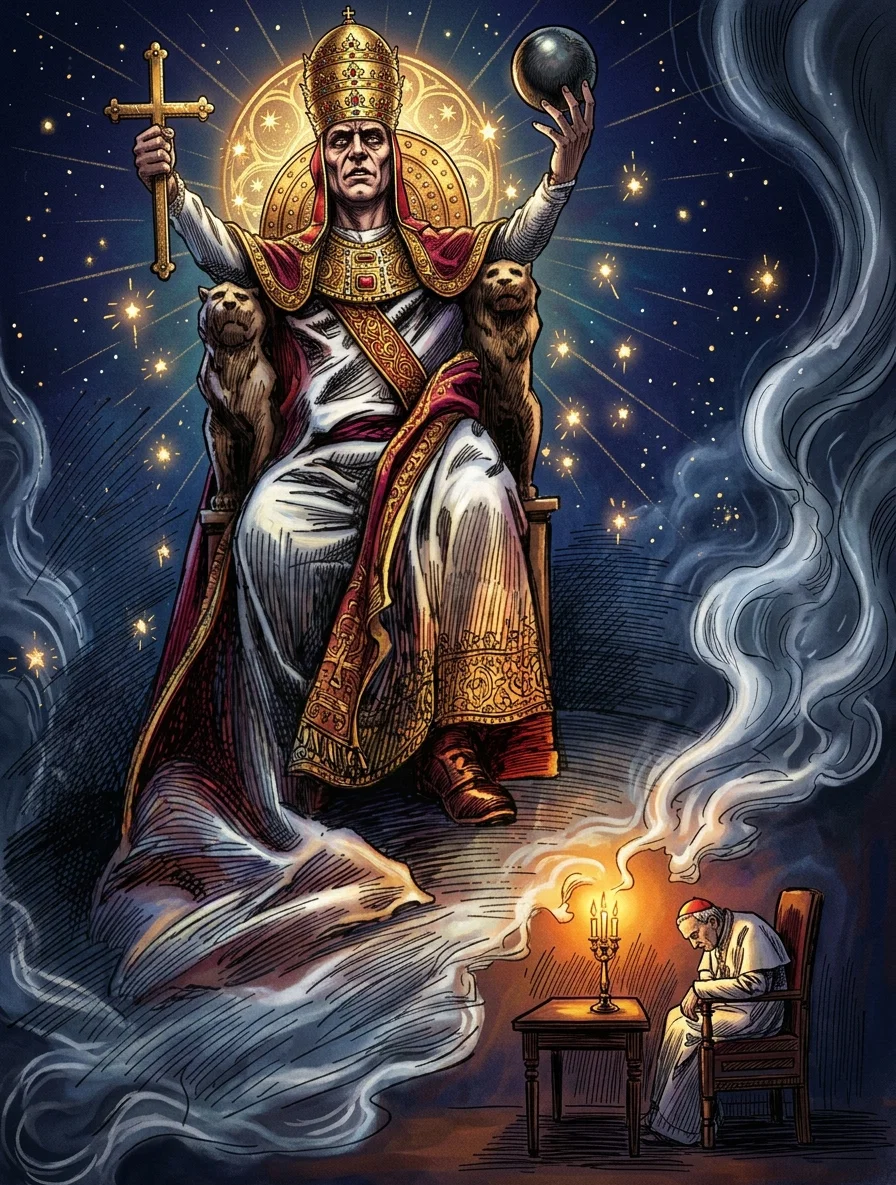
From the Christmas number of Leslie's Weekly, by permission of the publishers.
THE POPE'S DREAM.
The Disease Is One.—The reason why men do not do God’s will, do not walk in his law of love, is that they are sick. “The heart is deceitful above all things, and it is desperately sick; who can know it?” Jer. 17:9, R. V. “The whole head is sick, and the whole heart faint. From the sole of the foot even unto the head there is no soundness in it; but wounds, and bruises, and putrefying sores.” Isa. 1:5, 6. The disease is one disease, but with many forms and manifestations and symptoms; it is the leprosy of sin. Sin is responsible for it all. “By one man sin entered into the world, and death by sin,” and now the whole world is a lazar-house of disease, not primarily of many diseases, tho the moral physicians have numbered them by the scores and hundreds, but primarily one disease, sin; and “sin is the transgression of the law.” 1 John 3:4. All sin is the transgression of God’s law of love, summarily comprehended in the Decalogue. That law is righteousness; “all unrighteousness is sin.” 1 John 5:17.
The One Physician.—The one Physician able to save all, to heal the worst cases, the most hopeless paralytic, the most loathsome case of leprosy, is Jesus Christ. “Thou shalt call his name Jesus,” said the angel; “for he shall save his people from their sins.” Matt. 1:21. He “died for our sins.” He “bore our iniquities.” “With his stripes we are healed.” God “hath laid on him the iniquity of us all.” He “took our infirmities and bare our sicknesses.” His is the one only name whereby we may be saved. Acts 4:12. All other ways are human. They may promise salvation from floods that are in the past and which will never come again; but they will bury in their ruins those who have trusted in their vainly promised shelter.
The One Method.—There is but one method of applying the remedy, the life of Christ, and that is faith in the living Word of God. Faith means submission. It means saying with all the heart Amen to all that God says. Naturally we are at disagreement with God. That is sin. God says we are sinners, and how; we say, It is so, Lord. He tells us to turn from the sin and submit to him absolutely, unconditionally, and to that we respond Amen. We do so, and the Spirit, the life, the love of God, enter the heart. The sin is taken away. Its fetters are shattered. The broken heart is healed. The guilt is cleansed away. We are in harmony with God. His law is just and right and pure and good. We love its every precept; we delight ourselves greatly in his commandments. Jesus Christ is living in us the same life he lived on earth. All is unity and harmony; for God’s blessed Spirit reigns triumphant over the heart erstwhile a slave of sin. Blessed unity in God through Jesus Christ! Blessed law of love and life! Blessed Saviour and Healer! Blessed communion by the one faith into the one Gospel of the one Word! Who would not prefer it to all the Babylon of earthly creeds and schemes of men?
The Dream of the Pope.
BABYLON.
What Does It Mean?
THE human origin of the word “Babylon” is recorded in the brick volumes left by the early settlers in the plain of Shinar, in western Asia, and in the eleventh chapter of Genesis. The word was originally, Rawlinson, Geikie, and other scholars tell us, written Bab-il, the Gate of the God Il, or the Gate of God, or the Gate of Heaven. It was applied by those who had departed from God, to the city and town builded by them, by which they would preserve themselves from another flood, make to themselves a great name, and prevent themselves from being scattered abroad, the very thing that God commanded them to do. It was the first general scheme of man after the Deluge to save himself. It was the dream of man apart from God. See Gen. 11:3, 4.
The Gate of God, or Gate of Heaven, it will be seen, expressed man’s desire and purpose in himself for self-honor and self-salvation. The originator of all this daring assumption and blind rebellion was he whom Inspiration calls “the king of Babylon” (Isa. 14:4), whose original name was Lucifer, the light bringer,2 (210)now called Satan and Diabolus. He said: “I will ascend into heaven, I will exalt my throne above the stars of God; . . . I will ascend above the heights of the clouds; I will be like the Most High.” Verses 13, 14.
The Bible meaning of Babylon is God’s expression of just what man’s efforts apart from him amount to. Infinite Wisdom said that rebellious, selfish man’s “Gate of Heaven” meant “Babel,” “Babylon,” “Confusion,” utter and hopeless. (See Gen. 11:5–9.) This is forever true as regards both phases of the question. Man’s efforts and plans apart from God have always promised great things in his eyes. They have seemed to be great time-enduring monuments, mighty towers whose top reached to heaven, exalting man above the human. But God has forever said that all this is Babylon—Confusion.
Babylon, therefore, became the name not only of the great empire founded by the apostate Nimrod and his successors, but it became a comprehensive symbol of all those dreams and plans and schemes of men, however honest their promoters, which bring confusion into the work of God on earth. Babylon of old became the type of mystical Babylon in this dispensation.
Babylon Perpetuated.
Because those rebuked would not accept the reproof then given of God, confounded though their language was, they still perpetuated the principle of self-honor, self-salvation. They turned from God to earthly power and earthly government. They forsook God, their Father and Husband, and committed fornication with governments and organizations of earth, which they formed. That was the origin of all spiritual fornication; and therefore the prophet tells us that Babylon “made all the earth drunken; the nations have drunken of her wine; therefore the nations are mad.” Jer. 51:7. For in every nation since that time has been perpetuated and repeated on a lesser or greater scale the building of the towers and cities which men have called Gates of Heaven, Gates of God; but which the great God has denominated Babylon, daughters of Babylon—Confusion.
Cause of Confusion.
Confusion always exists where sin is, whether in Church or State, but this confusion is a hundredfold worse when and where Church and State unite; and it has been the aim of the devil, the king of Babylon, since the day that earthly government existed, to pervert the one by union with the other. Civil government is necessary and beneficial in its proper sphere in a sinful world to restrain evil-doers, to prevent incivility. A perversion always comes when men arrogate to themselves the office of God’s vicegerents, and assume to be teachers, dictators, rulers in a moral, religious, and spiritual realm. They may thus build great towers of folly, as did Babylon of old, Egypt, Pagan Rome, and other great empires, but God declares them to be Babylon—Confusion.
On the other hand, God designed that his church should be in the world, but not of the world, possessed of the normal life of God, preaching his Gospel, and ministering the life of Christ to dying mortals, gathering out those desiring a better life, even as the magnet gathers the particles of iron from among the grains of sand. Satan has ever sought to pervert that church by turning her eyes, her heart, her desires, and her hopes from Jesus Christ to the world and earthly governments. So he turned the daughter of Zion to Babylon, to Assyria, to Egypt, to Rome. He has deceived men into believing that if the State were ruled by the Church, instead of the Church by the State, as in the pagan empires, good would result; the one language would result in good; the great tower and city would prove the Gate of Heaven, and earth would become a paradise. But God has also in his prophetic word stamped such effort as Babylon—Confusion.
The Masterpiece of Satan.
This attempt, the Church dominating the State, was left by the arch deceiver till Christ had died and risen again, and his church, infused with new life, was strong against all opposition, so that the mightiest pagan empire of the world tottered before the cross of Christ, and hard hearts everywhere among the peoples of earth yielded to the love of the Crucified. “You see,” suggested the enemy, “the power of the church. You see her pure doctrines, her mighty influence; connect her with the State; let her rule in all things, religious and civil; let only Kings that will hear her voice sit on the thrones of earth, and triumph will be complete.” And he set himself to accomplish his purpose. Again the world was deceived. The brew of Babylon again made the world drunken. The wine of her fornication, the errors sown in the field of truth, bore abundant fruit, and the fourth century of the Christian era witnessed the erection of a mighty system far exceeding the brick tower of ancient Babylon.
The new Babylon was the old spiritualized. The bricks were the doctrines of pagan philosophy baked in the oven of a rapidly apostatizing Christianity. The slime for mortar was perverted Jewish and Christian teaching. The builders and leaders were “fathers” in the Catholic Church, many of whom still retained their paganism. The structure that they reared is called “the sheepfold of Christ,” “the spouse of Christ,” etc., but God has called it Babylon. (See Rev. 14:8; 17:1–8 and 18.) The masterpiece of this great spiritual structure is the Papacy, the head of which is the pope, who claims to be ruler in both Church and State, to be possessed by right of both temporal and spiritual power. But God’s Word calls the system Babylon.
Not against Men but Principles.
By this we would not be understood as directing what we may have to say against Roman Catholics. We have naught against a single soul of them. We take it for granted that they are sincere in their belief. Many of them have lived and died Christians, accepted of Jesus Christ, not because of the papal system, but in spite of it. Just as gleams of light and truth from God’s ineffable glory shine through a nature perverted by sin, so through a perverted gospel rays of light reach the soul longing for a Saviour that all the forms and ceremonies could never give. The Gospel came, was received not because of the ceremonies, the system, the ornate ritual, but notwithstanding all these things. God works over and above insuperable obstacles. The X rays of divine truth shoot many times through the opaqueness of error to the longing but darkened mind. But the light does not come because of the intervening body, but in spite of it. The light would have been clearer if the body had not intervened.
The Church of Rome counts within her fold many Christians and saints whom God may count otherwise. She claims to have done much for the conservation of light, learning, and liberty, for the preservation of the Scriptures, etc.; but the judgment will reveal that it was not the great papal system to which the credit was due, but to God’s providence overruling in spite of the system. Altho Darius commanded Daniel to be brought from the den of lions, he could hardly be said to have preserved him from their jaws.
The Claims of Rome.
Rome claims power in both the spiritual and temporal worlds. Said Gregory VII. to the bishop of Metz:—
We will demonstrate that Christ, in giving to the apostle power to bind and loose men, excepted no one. The Holy See has absolute power over all spiritual things; why should it not also rule temporal affairs? God reigns in the heavens; his vicar should reign over all the earth. The name of king was invented by human pride; the title of bishop was instituted by Christ.
Gregory’s power was demonstrated in the abject humbling of Henry IV. at Canossa. Again the same pontiff declared (Cormenin, vol. I, p. 377, quoted by R. W. Thompson, “The Papacy and the Civil Power,” p. 407):—
God is a Spirit; he rules matter; thus the spiritual is above the temporal power. The pope is the representative of God on earth; he should, then, govern the world. To him alone pertain infallibility and universality; all men are submitted to his laws, and he can only be judged by God; he ought to wear imperial ornaments; people and kings should kiss his feet; Christians are irrevocably submitted to his orders; they should murder their princes, fathers, and children if he commands it; no council can be declared universal without the orders of the pope; no book can be received as canonical without his authority; finally, no good or evil exists but in what he has condemned or approved.
The Pope’s Dream—The Arbiter of the World.
Pius IX. and Leo XIII. have builded upon the foundation of Gregory VIII. and other “illustrious predecessors.” While not now possessed of temporal power, it is still claimed, and the demand for its restoration is widespread and insistent. Nay, more, the Papacy is continually set before us as the arbiter and mediator of nations, the one court from which there should be no appeal, the Supreme Tribunal of the world. The pope claims this power spiritually now. All may not recognize it; but the Papacy claims it. The Papacy also claims by right, as did the popes of the Dark Ages, power to rule over kings, to set up or depose rulers,—those who will not submit to “the faith” to be excommunicated, and given over to the conquest of those rulers who do. The pope’s dream is to thus sway all power. By the cross, the perverted emblem of the spiritual power he exercises over the minds of men, and by the cannon-ball, the emblem of civil power, the aid of the State, he hopes to rule the world, a god upon earth.
This ambition, this dream, this purpose of the Papacy to rule the world, has been set forth so frequently by devout adherents to the system that we need not take space to quote from their writings. They believe it to be both its duty and destiny. This is well expressed3in the Catholic World, of New York, for March, 1894, in an article entitled “The Dawning of the Twentieth Century.” The period predicted had been preceded by a war which had eliminated Portugal from the map of nations, made Spain and Italy republics, and involved all Europe in internecine and fratricidal strife. The writer says:—
There was a war within a war. Not only was every country at war with its neighbor, but was at the same time waging a fierce internecine strife within its own borders. Anarchy made war upon government and society, while government endeavored to grapple with the foreign foe. The terrible character of this vast international conspiracy, more deadly in its working than cholera, or Black Death, was the fact which at last opened the eyes of the passion-blind combatants, and disposed them towards the peace which the Sovereign Pontiff, at the first moment that his voice could make itself heard amid the roar of battle, counseled. . . .
The word “arbitration” was upon every tongue, and all eyes were turned instinctively towards the illustrious occupant of the Vatican. His was the only voice in the whole world which would have a chance of being listened to in that pandemonium of passion and universal horror. The word was spoken, and was at length listened to. . . . The patrimony of the church has been restored, and the government of the city [Rome] and territory [States of the Church] is placed in the hands of commissioners chosen by the Holy Father. Florence is the capital of the republic [of Italy], and Rome once more the capital of Christendom. . . . The head of the Catholic Church is at last free to deal without let or hindrance with every portion of his wide-spreading domain. . . . The pope once more is free.
The “More Sure Word of Prophecy.”
It is not a wholly fancy picture, an empty dream. The “more sure word of prophecy” declares that Babylon the great, the mystical Babylon of the Apocalypse, the professed church of Christ, which has committed fornication with the kings of the earth, will again be given world-wide power and triumph, and received by a sin-blinded world as one worthy of worship.
1. That system in Revelation 13 is symbolized under the figure of a beast, which runs his career as a persecutor for 1,260 years. It then receives a deadly wound. But that wound is to be healed, and then all the world shall wonder after the beast and worship it. The Papacy was a persecutor from A.D. 538 to 1798. Then its persecuting power was broken, and has not since been possessed. But the prophecy declares that the deadly wound was healed. The Papacy will again be a dominant power.
2. In Revelation 17 the same fact is predicted. The beast, the persecuting union of Church and State, under the Papacy will again exist, and the deceived nations will again place the beast in control. Verses 8, 11–13.
3. In chapter 18 this great religious system, Babylon—the chief and leader of which is the Papacy—is represented as becoming again triumphant. Now the Papal Church mourns her widowhood. She is shorn of her temporal possessions, separated from the secular government; but in the light of the prophecy, the time will soon be here when she will say, as the powers of earth return to her again, “I sit a queen, and am no widow, and shall see no sorrow.” Verse 7.
There are still other prophecies which point out the seeming triumph of the Papacy, but these will suffice. God would call men back from the worship of the human, the human schemes, the glory of men, to “fear God, and give glory to him,” and to turn from the perverted worship of tradition to the true worship of the Creator of heaven and earth. (See Rev. 14:6, 7.) To heed this message would heal Babylon. It would eliminate her creed idols, banish her errors, destroy her pagan traditions and institutions, and exalt God in her midst. But while God would by his word have healed Babylon, she would not be healed. Jer. 51:9. And therefore she fell. Rev. 14:8. Then comes the last solemn message from God, warning men against her deadly errors, her enforced worship and dogmas, and calling them out of her midst. Rev. 14:9–11; 18:1–4.
The End of Human Effort.
But, blinded by sin, the deceived nations exalt once more in the place of God as arbiter of nations, the apostate Babylon, the pope of Rome, the self-assumed vicar of Christ. He sits enthroned once more above the nations. Babylon says, “I sit a queen, and am no widow, and shall see no sorrow.” The world cries, “Peace and safety.” But while Babylon exalts herself, while the deceived nations laud the great Babylon made with human hands, the voice of doom falls from heaven (Dan. 4:30, 31), the cry of “Peace and safety” ends in destruction (1 Thess. 5:3), and Babylon’s “plagues come in one day, death, and mourning, and famine; and she shall be utterly burned with fire; for strong is the Lord God who judgeth her” (Rev. 18:8).
Reader, which will you choose, the great Babels of men, or the simple Gospel of Jesus Christ? The choice you must make for yourself.
SPECULATION AND FAITH.
By Ellet Joseph Waggoner
SPECULATION is uncertainty. It is always a risk. A man ventures something, not knowing what the result will be. He thinks that a certain investment will be a safe one, and will yield large returns, but he is not sure. He has no means of being sure. If he could be sure of the result, it would not be speculation. Very often the man who feels the most confident of the good results of his investment is most sorely disappointed.
This element of uncertainty is that which wears out the speculator, and makes him prematurely old. His nerves are always in tension. He may have all his fortune at stake, and it is impossible for him to rest in perfect ease when he knows that a very little thing may dash it from him in a moment. No wonder that a man in such a condition often finds it impossible to sleep.
Faith is altogether different from this. Faith knows. It runs no risks. There is no element of uncertainty in it. Christ is the only object of faith, and he is “the same yesterday, and to-day, and forever.” He never fails. His power is almighty, and he loses nothing that is intrusted to him; no one can snatch anything from his hands. See John 10:28, 29; 17:12.
Christ is the “tried stone,” the “precious corner-stone,” the “sure foundation;” and “he that believeth in him shall not be confounded.” His ability to keep is shown in the fact that he upholds all things by the word of his power. Heb. 1:3. When the Lord would encourage us to put our trust in him, he says, “Lift up your eyes on high, and see who hath created these, that bringeth out their host by number; he calleth them all by name; by the greatness of his might, and for that he is strong in power, not one is lacking.” Isa. 40:26, R. V.
So it is as unto “a faithful Creator” that we are to commit the keeping of our souls to him. That which may be known of him, even “his eternal power and Godhead,” is clearly revealed in the things that he has made, so that all have ample opportunity to become acquainted with him. Therefore the language of faith is, “I am not ashamed; for I know whom I have trusted, and am persuaded that he is able to keep that which I have committed unto him against that day.” 2 Tim. 1:12, margin.
Faith knows nothing of worry. There is no straining of the nerves to the utmost pitch of anxiety, for fear of what may happen in the future. He who knows the Lord would as soon think of worrying lest a comet should strike the earth, or lest the earth should come into collision with some other planet, and thus be wrecked, as to worry lest at some future time the Lord might allow him to fall. His strength is in quietness and confidence. Under the shadow of the Almighty he abides secure, and is not afraid, knowing that nothing present or to come can separate the soul from that “everlasting love.” E. J. W.
JOSHUA'S LONG DAY.
Its Bearing on the Sabbath Question.
IN Josh. 10:1–14 is recorded the battle at Gibeon, at which Joshua and Israel defeated the five kings of Jerusalem, Hebron, Jarmuth, Lachish, and Eglon. The day was not long enough for Joshua to finish his work, and so he prayed to God that the day might be lengthened. Thus it reads:—
“Then spake Joshua to the Lord in the day when the Lord delivered up the Amorites before the children of Israel, and he said in the sight of Israel, Sun, stand thou still upon Gibeon; and thou, Moon, in the valley of Ajalon. And the sun stood still, and the moon stayed, until the people had avenged themselves upon their enemies. Is not this written in the book of Jasher? So the sun stood still in the midst of heaven, and hasted not to go down about a whole day.” Verses 12, 13.
Here we are told that the day was lengthened into two days, or nearly so, setting the Sabbath back a day. But, even tho it was a longer day, was it not one day? The next verse reads: “And there was no day like that before it or after it, that the Lord hearkened unto the voice of a man; for the Lord fought for Israel.” The sun rules the day. Gen. 1:14–18. That day was measured by the sun. Whether we hold to the Zetetic philosophy, and believe that the sun paused on its journey around the central pole, or whether we hold to the Copernican hypothesis, that the earth paused in its revolution, making the sun to appear to stand still, makes no difference; the day was one day, measured by the sun. If it was the third day of the week, the day previous was the second day, and the day after was the fourth day. If that day had been sixty clock hours long, it would have made no difference; it was one day still. It therefore did not in any way affect the Sabbath of the Lord, the seventh day of the weekly or septenary cycle.
It is well to remember that the Sabbath is never designated as a certain proportion, a seventh part of time; it is the seventh day of the seven, whether those days are longer or shorter. If the solar sixth day of the week were twice4as long in actual time as the seventh solar day, that would make no difference. If the seventh day were actually twice as long as the sixth, the succession of weeks and Sabbaths would not be thereby affected.
The theory that “Joshua's long day” made a change in the week, and therefore in the Sabbath, is devised to meet the need of erroneous tradition. The long day does not quite make up two days, we are told, so for seven centuries the old earth went limping along till Hezekiah's time, when the amount wanting to make the double day was supplied; the shadow went backward ten degrees upon the dial. (See 2 Kings 20:9–11.) What a fearful calamity it had been if Hezekiah had said, as the Lord told him he might, “Let the shadow go forward ten degrees”! But he said backward; the lameness of Joshua's long day was healed, but the week and the Sabbath were out of joint till the Crucifixion. There it is said our Lord set the cogged wheels aright, and the first day of the week became the seventh-day Sabbath!
Strange that for seven centuries between Joshua and Hezekiah none of the holy men knew how much out of tune the world was! Strange that from Hezekiah to the Crucifixion, the prophets, who reproved and admonished Israel concerning the Sabbath, did not know that their messages were all a mistake! Strange that Jesus Christ should spend thirty-three years of his life supposing that he was keeping a “lawful” Sabbath day, the day he made for man, and yet be mistaken till his resurrection! Strange that the beloved physician Luke, who wrote thirty years after the Crucifixion, should tell us by the Spirit that the holy women who followed Christ, and who kept the day before the first day of the week, “rested the Sabbath day according to the commandment!” Luke 23:56. All these things would be unaccountably strange if “Joshua's long day,” made by the Lord, so completely upset the Lord's own week. The foolish theory, if true, would make nonsense of the Word of God. But it has no basis save the wishes of men to prove by Hook or by Crook that the usurper Sunday has a right to the estate of the Lord's Sabbath. “Yea, let God be true, but every man a liar,” if what man speaks would tear up the everlasting foundations of truth. The seventh day is the Sabbath, yea, now and forever, is the Sabbath of the great I AM.
We make the following brief suggestions: “Let the woman learn in silence with all subjection. But I suffer not a woman to teach, nor to usurp authority over the man, but to be in silence. For Adam was first formed, then Eve.” Verses 11-13. God has given man the rulership, as being better adapted to that sphere. The woman's power is in her modesty, her devotion, her piety. Let her not destroy that power by being a brawler, or one who usurps authority. The proof given is that God indicated the relative place of man and woman in the creation. “And Adam was not deceived, but the woman being deceived was in the transgression.” Verse 14. See for a comment upon this “Patriarchs and Prophets,” pp. 53 to 57. Eve was deceived by the enemy. Adam was led astray by his love for Eve. Woman's ruling power is love, not strength. But tho she first sinned, “she shall be saved through the child-bearing, if they continue in faith and love and sanctification with sobriety.” Verse 15, R. V. She shall be saved through the Seed of the woman, Jesus Christ. Altho through her came sin and death, yet through the child-bearing of sorrow comes the One able to save.
No. 522. Wine Grapes.
DO YOU think it wrong to raise wine grapes to sell? M. L. P.
Such questions as these must be answered by every one for himself. If our querist is in doubt, let him give the Lord and a good conscience the benefit of the doubt. Are not the grapes good? Is not the wine, the pure, unfermented juice of the grape, good? Is it wrong to make, or to use, or to buy, or to sell these? However, these are individual questions of conscience for each one to decide. Here is a good rule: 1 Cor. 10: 31.
No. 523. Sunday and Early Christians.
IS IT not claimed that A.D. 321 was the first that Sunday was kept by Christians? A bishop says that it was kept in the first, second, and third centuries, and refers me to Mosheim's History, book 1, part 2, chapter 4, sections 4, 5, 8. J. M. H.
We know of no such claim. The first Sunday law on record was that given in A.D. 321 by Constantine, yet a heathen. The references above, save section 8, make no mention of Sunday. The whole chapter shows that the early church had already lost its simplicity, and had followed heathen customs and mysteries. Section 8 of the chapter above mentioned (McLaine's translation) tells us that the meetings of the early Christians “were on the first day of the week; and in some places they assembled also on the seventh, which was celebrated by the Jews. Many also observed the fourth day of the week, on which Christ was betrayed; and the sixth, which was the day of his crucifixion.” Neander, the greatest church historian, tells us that “the festival of Sunday, like all other festivals, was always only a human ordinance, and it was far from the intentions of the apostles to establish a divine command in this respect, and from the early apostolic church, to transfer the laws of the Sabbath to Sunday.”—Church History, translated by H. J. Rose, p. 186. Yes; Sunday was doubtless kept by professed Christians in the first centuries. Many of the Christians were formerly idolaters and sun-worshipers, and observers of the “wild solar holiday of all pagan times,” and other times and seasons forbidden of God. Lev. 19: 26; Deut. 18: 10; 2 Kings 21: 6. Half-converted heathen brought this custom into the Christian Church. When others became backslidden, they went back to the observance of these heathen times and seasons. Thus did the Galatians. See Gal. 4: 8-11. Such early apostasy is not to be wondered at. Israel turned from the law in sight of its glory, and made an Egyptian sun-god, Apis, in less than forty days after their vow to serve God. Ex. 32: 1-6. Paul said that the mystery of iniquity did already work in his day. 2 Thess. 2: 7. It is not what the church practised in any age of the world; but what does God's Word teach? What did Jesus Christ do?
It may have been weakness of vision, obliging him to employ an amanuensis, the effect of the blinding glory of Christ. See Acts 9: 8, 18, 19; and Gal. 4: 13-15.
No. 526. Cleansing the Sanctuary, 1844.
HOW is it known that Christ went into the most holy place in 1844? G. K.
We know from a study of the type and the ending of the 2,300 days of Dan. 8: 14. This period applies not to the earthly sanctuary, but the heavenly, which must also be cleansed. Heb. 9: 23. This is a work of judgment. See Rev. 10: 7; 14: 6, 7; also “The Sanctuary and 2,300 Days,” and “Christ Our Advocate,” works published at this office, at prices respectively, $1.00 and ten cents.