Your ShelfYour Projects

Signs of the Times, Vol. 23, No. 16.

THE RESURRECTION OF CHRIST

Signs of the Times

Apr 22, 1897

Pacific Press Publishing Company · Oakland, California · Apr 22, 1897

THE RESURRECTION OF CHRIST.

Easter.

At this season of the year, we read and hear abundant references to the resurrection of Christ. The great institution in most churches to call it to remembrance is the celebration of "Easter." It is not claimed generally that the custom either in law or practice is Biblical. In the musty tomes of the early "fathers" it connects both with the Passover of the Jews and the heathen festival to Ostera, or Easter, the Saxon goddess of spring; from the latter of which it derives its name, and the custom of celebrating with flowers, eggs, etc. In the Eastern Church it was celebrated on a certain day of the year without reference to the day of the week, but in the Western or Roman Catholic Church the celebration soon became fixed to "the venerable day of the sun."
Memorials are supposed to have some likeness or similarity in their celebration to the work or event they are designed to memorialize; but what likeness there is between the annual celebration of one day and the resurrection of Jesus Christ, it is difficult indeed for a Bible student to perceive.

What the Resurrection Means.

The word "resurrection" commonly means a rising again from the dead. He who thus rises has power over death; he is stronger than death. It is said of our Lord: "Whom God hath raised up, having loosed the pains of death; because it was not possible that he should be holden of it." Acts 2:24. Death could not lock nor bar the sepulcher of Jesus Christ. Why? The inquiry is both interesting and vital.
Death comes in consequence of sin. "Sin, when it is finished, bringeth forth death." James 1:15. "The soul that sinneth it shall die." Eze. 18:4. This is the testimony of Scripture. Of Jesus it is said, "For in that he died, he died unto sin once." Rom. 6:10. "For he [the Father] hath made him [the Son] to be sin for us, who knew no sin, that we might be made the righteousness of God in him." 2 Cor. 5:21. Jesus Christ, then, "died for our sins according to the Scriptures." God counted him a sinner in our stead, and he died for us.
But he "did no sin," he "knew no sin."
He was righteous with the righteousness of God; and having righteousness, he had life; for righteousness is life. "In the way of righteousness is life; and in the pathway thereof there is no death." Prov. 12:28. Righteousness and life is the Bible law of endless existence. Life comes through Christ because righteousness comes through him; for they that "receive" "the gift of righteousness shall reign in life by one, Jesus Christ." "By the righteousness of One the free gift came upon all men unto justification of life." And the apostle beseeches us that in us "might grace reign through righteousness unto eternal life by Jesus Christ our Lord." Rom. 5:17, 18, 21. "The Spirit is life [to the believer] because of righteousness." Rom. 8:10. It is everywhere the same vital truth, righteousness is life.
Jesus Christ "gave himself for us," for our sins, for our righteousness. But as in himself was no sin, death could not hold him; for death has no claim upon the righteous. The resurrection of Jesus Christ means, therefore, the power of a godly life, the power of righteousness, over sin and the grave. Had there been one sin upon his character, had he in any way been identified with iniquity in his own desire and purpose, he would still be locked in the prison-house of death, never to be released. But, praise God, he was righteous, and righteousness will ever prove triumphant. Right is might. This is the meaning of his resurrection. He arose a victor; he demonstrated the power of godliness, righteousness, obedience over sin, not for a day in a year or a day in a week, but forevermore.
He did it for us, as we have learned, "that we might be made the righteousness of God in him," "even the righteousness of God which is by faith of Jesus Christ unto all and upon all them that believe; for there is no difference." Rom. 3:22. While Jesus "was delivered [unto death] for our offenses," he "was raised again for our justification." Rom. 4:25. By faith we accept his death, die with him, and the same faith lays hold of his life, the resurrection life, the life of righteousness, the life of humble obedience to the will of God.

The Memorial of His Resurrection.

The symbol, the memorial of the death and resurrection of Christ, has been called Christian baptism. But the mere ordinance alone does not meet this. Baptism means more than a form of words and immersion in water. It means this, but unless it means more it is empty, and will prove a snare to him who trusts in it.
Christian baptism is the beginning of a new life, the divine marriage ceremony which unites before the world the believer to Jesus Christ; it is the outward profession that the believer is henceforth to be one with Jesus even as wife and husband are one. "The twain shall be one." These profoundly important truths are set forth in the following scriptures:—
"Know ye not, that so many of us as were baptized into Jesus Christ were baptized into his death [for sin, Rom. 6:10]? Therefore we are buried with him by baptism into death; that like as Christ was raised up from the dead by the glory [goodness, righteousness, character] of the Father, even so we also should walk in newness of life. For if we have been planted together in the likeness of his death, we shall be also in the likeness of his resurrection; knowing this, that our old man is crucified with him, that the body of sin might be destroyed, that henceforth we should not serve sin." Rom. 6:3-6.
"Wherefore, my brethren, ye also are become dead to the law by the body of Christ; that ye should be married to another, even to him who is raised from the dead, that we should bring forth fruit unto God." Rom. 7:7.
"Ye are all the children of God by faith in Christ Jesus. For as many of you as have been baptized into Christ have put on Christ." Gal. 3:26, 27.
"Buried with him in baptism, wherein also ye are risen with him through the faith of the operation [working] of God, who hath raised him from the dead." Col. 2:12.
Baptism, then, is the marriage ceremony by which we publicly put on Christ, take his name, and are made one with him, in death to sin, in life to righteousness. We accept by faith his death for us; he died unto sin. "Likewise reckon ye also yourselves to be dead indeed unto sin." Rom. 6:11. The dead have no desire, no purpose, to sin. We accept by faith his life for us, his life which "knew no sin," which in its righteousness had power over sin and death; and "He liveth unto God." Rom. 6:10. "Likewise reckon ye yourselves . . . alive unto God through Jesus Christ our Lord."

The Sign to the World.

What then is the sign to the world that Jesus has risen again? It is not the celebration of the vernal festival of a heathen goddess. It is not the observation of one day in the week, because he rose on a moment of that day. It is not a form of baptism. It is a new life in Jesus Christ unto God, beginning at baptism, bringing forth fruit unto God, walking in newness of life, separate from the world, one with Christ, living his life over again in us. "I am crucified with Christ; nevertheless I live; yet not I, but Christ liveth in me." Gal. 2:20. This is the meaning to the world of the resurrection of Christ. It means, or should mean, Christians walking "above the world and sin," "that they might be called Trees of righteousness, The planting of the Lord, that he might be glorified." Isa. 61:3.
If this is not the lesson the church of Jesus Christ is teaching to the world, if this is not the witness she is bearing of her risen Lord,—power over sin,—her mission is vain. Her elaborate rituals, her ornate trappings, her multitude of songs by paid and godless choirs, her aping of heathenism, her appeals to the sensuous, are all the veriest mockery. O, that the professed people of God would turn to him! O, that they would, by the power of God in righteous lives, every day of the year, every day of the week, and every hour and moment of the day, proclaim, "The Lord is risen indeed!" So Jesus came to bear witness unto God, to declare or reveal the Father. John 5:36; 1:18. And he says: "As thou hast sent me into the world, even so have I also sent them into the world. And for their sakes I sanctify myself, that they also might be sanctified through the truth." John 17:18, 19.
Reader, Christian friend, the question comes home to you as an individual, Is the power of Christ's life in you? Are you a witness to the resurrection of Jesus?

The Night.

The Night.—In the Word of God the night precedes the day. "The evening and the morning were the first day" "the second day," etc., is the record given us in the first chapter of Genesis of the creation week. There is not only a divine and blessed economy in this order as regards the natural day, but there are precious lessons in the fact to the weary children of earth and the pilgrims to the better land.
The Beginning of the Day, the complete cycle, is the sunset twilight. "At even, when the sun did set," "now when the sun was setting," "when the even was come," are scripture expressions of the beginning of the day. (See Mark 1:32; Luke 4:40; Matt. 8:16.) "From even unto even shall ye celebrate your Sabbath," was the law of the Lord through Moses. Lev. 23:32. The first day began to the primeval inhabitants of earth with the twilight glow of the setting sun in the western horizon. In this arrangement the children of earth may always greet the day at its coming as a new gift of God, to use to his glory. How unlike, and yet how much better than, the artificial days of man's division, in which the days come and go while the vast majority are locked in slumber.

The Twilight of Earth.—

Darkness, in the Word of God, is the symbol of sin, and night the time when sin reigns. Light is the symbol of righteousness, and day is the period when righteousness is triumphant. It was during the little period of the opening sunset twilight of earth's day that righteousness reigned. For a few moments, as it were, the innocent children of God, the beasts and birds, fields and flowers, grass and trees, lake and river, nature animate and inanimate, rested and reveled in peace, the fruit of innocence and righteousness. The impress of God's character was upon everything. From the gorgeous crimson and golden glow of the western sky, to the tiny flower, upon everything was written, "God is love." But not long did it continue. As the soft twilight glow fades to dusk, and the dusk to the dark of night, so did the blessed peace of innocence and joy, which ushered in the day of earth, soon give way to the darkness of earth's night of sin and sorrow.
Earth's Night of Weeping.—Nights, the nights of men, are more than the days, to a large class, the times of weeping and sorrow. The soul is more alone. The distracting business of earth, the whirling pleasures of sense, the surrounding influences of associates are in the majority of cases shut out, and the soul is alone with its woes, and troubles, and griefs. Many days see calm and smiling faces the previous nights to which witnessed pillows wet with tears, and heard groans of anguish and sighing. Alone in the darkness the feelings find unhindered vent, while in the day pride or self-sacrifice or grace holds them in restraint. To another class the night is a time of pleasure, revelry, debauchery, crime. Somehow mankind seems to feel that they can dowith impunity in the darkness what the light of day would forbid, remembering not the words of Inspiration, "Yea, the darkness hideth not from Thee; but the night shineth as the day; the darkness and the light are both alike to Thee." But the nights of reckless pleasure, revelry, debauchery, and crime are surely followed soon or late by other nights of regret, remorse, bitter weeping, and oftentimes despair. Such is our world since the day that sin entered and its lord yielded himself and his dominion to the author of sin. The greater part of its inhabitants are among the revelers, the debauchees, those who look only to the present till, faced with the fruit of their sowing, they enter the realms of despair, sorrow, pain, helplessness, hopelessness, or if hoping, hoping in vain, resting on the arm of flesh, the breath of man. The death trains of earth's night, ending at the funeral pyre, the sarcophagus, the mausoleum, or the narrow house, are myriad, and the majority of those who die and those who mourn, mourn in stony sorrow and despair.
Breaks in the Gloom.—And yet the night of earth's sorrow is not entirely black in its darkness. Its blackness of darkness is not yet come. God in his goodness from the very beginning has rent the dark pall by which Satan would overspread it, and flashed through the thickened gloom rays of light from above. He has kindled "burning and shining lights" in all the periods of the night, to light the way. He has given the sure lamp to the feet and the light to the path to every traveler who longs for the land of light. Nay, more, he has given his own Son in all these blessings to be the Sun of Righteousness, the Light of the world. Faintly it shines in some of the lands of earth, only the merest gleam of light, but it beats forth from the heart of the great central Sun of light, and he who welcomes it and follows its divine ray, will be led to the fulness of perfect day. Fellow-traveler, there is always light above. Do not look to the false lights of earth, the treacherous will-o'-the-wisps, kindled on the miasmatic marshes of false science, of reckless pleasure, of man-made religions, but look above, to Jesus, the Light of the world, to the Word of light and life he has given, to the torches lighted by the Light of heaven, which hold forth not themselves, but which shed light on the way of Jesus Christ. As God gives light, ask for more. Cry to him for light.
"Light of the world, we cry to Thee For light, more light to guide us all; The way is dark, we can not see; We think we stand, we know we fall; The world is darker than the night. Light of the world, more light, more light!"
Thus many weary, hungry hearts are praying. To such we wish to say, There is light, more light, yea, all light, in Jesus Christ. "For in him dwelleth all the fulness of the Godhead bodily. And ye are complete in him."
The Morning Cometh.—After the night, dawns the morning, the pledge of the coming day. Earth's night of evil will sometime be over. The time of sin, and suffering, and wo,and anguish, and misery, and heartache, and fraud, and swindling, and deception, and strife, and war, and murder, and hope deferred till the heart is sick with despair, will pass away. "Watchman," call the waiting, weary, mourning ones of earth, "what of the night?" The answer is, "The morning cometh!" The darkness of the eastern horizon lightens from blackness to gray. Streamers of light, the heralds of day-dawn, gild the mountain top. The Sun of Righteousness, with healing in his beams, is about to rise. Christ is coming. The Day is at hand. The intensity of the powers of darkness, like the last hour before the day, is a sign of night's coming collapse. The crumbling of mundane forces, the war, the strife, the deepening misery in the midst of earth's plenty, are omens of the breaking of the night. The reign of sin is nearly over; it has broken the earth by its burden; righteousness must rule or the earth perish. Even the very mockers who sneeringly ask, "Where is the promise of Christ's coming? Where is the evidence of a change in this earth?" are themselves an evidence, in that they fulfil the word of the Lord which predicted their infidelity. 2 Peter 3:3-7. Now, while the day begins, God pierces the gloom with its light, and invites men to become "children of light, and the children of the day." 1 Thess. 5:5. We may have walked in the darkness of this life, but now by faith we may be "light in the Lord." And while we mourn because of the darkness, because of the blindness of those who walk therein, because of the condition and eventual misery and hopelessness of the deceived ones of darkness, because of the loss or pain of loved ones, yet in it all we may have light, and may rejoice. "This then is the message which we have heard of him, and declare unto you, that God is light, and in him is no darkness at all. If we say that we have fellowship with him, and walk in darkness, we lie, and do not the truth; but if we walk in the light, as he is in the light, we have fellowship one with another, and the blood of Jesus Christ his Son cleanseth us from all sin." 1 John 1:5-7. Those who here choose the spiritual darkness of earth will perish with it before the glorious brightness of the coming dawn, destroyed by "the brightness of his coming" (2 Thess. 2:8), while those who walk in the light shall dwell in light and glory forever more.
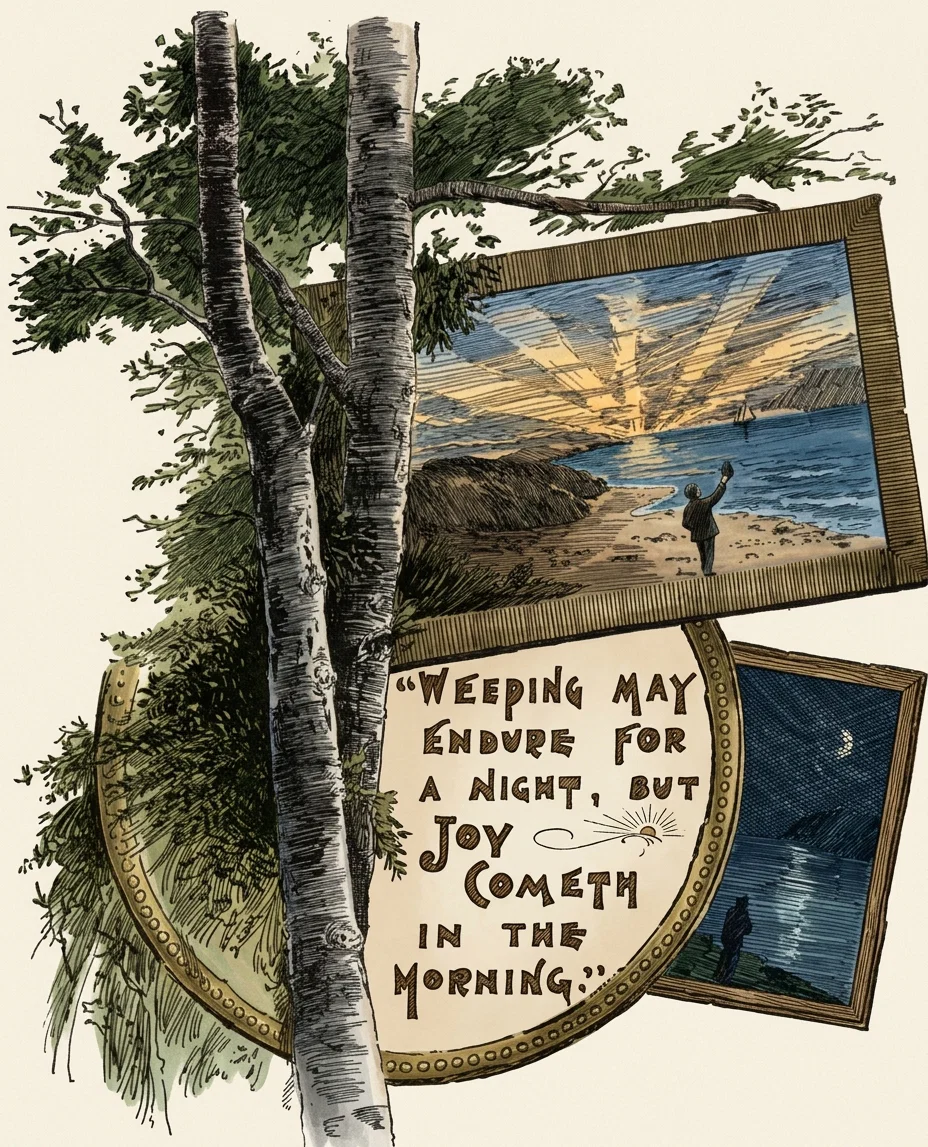
Day Is Coming.—Christian, rejoice. The long night of warfare is almost done. Watchman, weary of ceaseless vigil, the Master will soon relieve thy toil. Mourner, the dawning day will break the bolted doors of the cruel grave, and the dead in Christ shall live. Weary, struggling worker for Christ, the day of eternal and universal freedom is at hand. Its sun will know no decline, its day no end, its light will not be dimmed. "Weeping may endure for a night, but joy cometh in the morning." Do you not see its brightening rays? Stand ready to greet it.
"O, we see the gleams of the golden morning Piercing through this night of gloom! O, we see the gleams of the golden morning That will burst the tomb."

Mind Your Own Conduct

How MUCH trouble he avoids who does not look to see what his neighbor says, or does, or thinks; but only to what he does himself, that it may be just and pure.—Marcus Aurelius.

THE WORD OF GOD AND THE SABBATH.

"Seventh-day Adventism Refuted."

BEFORE us is a tract of four pages with the heading, "Seventh-day Adventism Refuted by Fifty-two Facts. By Revs. C. S. Gitchell, B. T. Roberts, D. M. Canright, J. S. T. Milligan, and Others," etc. It is one of a "Reform Series," and has received quite a large circulation. To the earnest Bible student who loves God's law it will pass as idle words. To those who take statements of men as "facts" a few words may be in place.
In the first place it does not matter much as to whether any ism is refuted or not; for no true Christian among Seventh-day Adventists stands on any human ism, but on the Word of God. These alleged "facts" do not come against a people, but against that day of which Jehovah himself said, "But the seventh-day is the Sabbath of the Lord thy God." We give a few samples of these "facts," which we number as in the tract, and give answer following. But before noticing these in detail we wish to call attention to these facts: (1) A mere negative in the face of a positive law proves nothing. It might be stated with great positiveness that nowhere does the Bible tell us that Eve, or Cain, her son, died, and yet we know they did; for they followed the general law respecting the existence of sinful man. (2) The Bible does not give a record of men's doings only so far as to show God's dealings with the race. When men obeyed God through grace, examples are given to show the power of grace over sin. The Lord gives us examples also to show the fruit of disobedience and God's mercy. (3) The book of Genesis is not a book of law; it is the record of God's providential dealing with the race, showing the development of his plan of mercy.
Here are the "facts" in smaller type, with the answers following:—
1. The Bible nowhere says that the Sabbath was a memorial of the creation.
It does not use the noun "memorial," but it uses the equivalent verb "remember." "Remember the Sabbath day, to keep it holy. Six days shalt thou labor, and do all thy work; but the seventh day is the Sabbath of the Lord thy God; . . . for in six days the Lord made heaven and earth, the sea, and all that in them is, and rested the seventh day; wherefore [for which reason] the Lord blessed the Sabbath day [the rest day], and hallowed it." See Ex. 20:8-11. Therefore the reason why we are to remember the Sabbath day is because of the manifestation of God's power in creation. "He hath made his wonderful works to be remembered." Ps. 111:4. How has he done this?—By the Sabbath that he ordained for that purpose.
This is the record which the Bible gives of the origin and institution of the Sabbath:—
"And on the seventh day God ended his work which he had made; and he rested on the seventh day from all his work that he had made. And God blessed the seventh day, and sanctified it; because that in it he had rested from all his work which God created and made." Gen. 2:2, 3.
"Sanctify" means to "set apart," to "appoint." See Joshua 20:7 and margin, where the word "appointed" comes from the same Hebrew word as "sanctified" in Gen. 2:3; also 2 Kings 10:20 and margin, where the same word is rendered "proclaim." The word "hallowed" in the fourth commandment comes from the same Hebrew word. God in the beginning appointed and proclaimed the seventh day to be the Sabbath. To whom did he appoint it and proclaim it? Our Lord answers, "The Sabbath was made for man." Mark 2:27. Not for the Jew man, for it was made 2,500 years before there was a Jew; but it was made for the man who was in the beginning, and through him to all his posterity.
5. Adam, Seth, Enos, Cainan, Jared, Methuselah, and Noah each lived over nine hundred years, and neither one kept a Sabbath.
It has been shown that God appointed and proclaimed his Sabbath day in the beginning. He therefore commanded it. It is said of Noah: "Noah was a just man and perfect in his generations, and Noah walked with God." The Lord said unto Noah, "Thee have I seen righteous before me in this generation." Gen. 6:9; 7:1. Noah therefore walked in God's way and kept the Sabbath day appointed of God. Because it does not expressly say that Noah kept the Sabbath is no evidence that he did not keep it. It does not say that Noah or Abraham or Enoch had no other gods before the Lord or that they honored their father or their mother. The Sabbath was made and appointed to man in the beginning; hence to all the race. It was therefore obligatory whether man kept it or not. But when the Lord says that these men were righteous, that means that they obeyed his commands.
7. The Bible tells us there was no law from Adam to Moses.
According to the Bible there was no written law, but it proves in the same passage that a law existed, because recognized sin existed; "for until the law [was given in its written form] sin was in the world; but sin is not imputed when there is no law." Rom. 5:13. "Where no law is, there is no transgression." Rom. 4:15. But the book of Genesis, and the first sixteen chapters of Exodus, show that every commandment of the Decalogue was transgressed, and men were accounted sinners on account of this transgression, before the Lord spoke the law from Sinai. For the record of a few of these transgressions see Gen. 35:2 (false gods); 9:22-25 (dishonor to parents); Ex. 16:4; 25-28 (breaking the Sabbath); Gen. 4:8 (murder), etc., etc. There was a law from Adam to Moses, and men were condemned when they transgressed it.
10. Moses makes no mention of any Sabbath being kept previous to this one.
Moses makes no mention of the first commandment, the third, the fifth, or for the matter of that, any other as such, but that does not prove the obligation to keep them did not exist. He does tell us that Enoch and Noah "walked with God," and that Abraham "obeyed my voice, and kept my charge, my commandments, my statutes, and my laws." Gen. 5:22; 6:9; 26:5. They therefore kept the Sabbath "appointed" of God.
13. If the Sabbath had been lost, Moses or some of the prophets, or Christ, would have given information of the fact.
Exactly; but the Sabbath was not lost, and therefore such mention in the book of Genesis was not necessary
15. God never blessed or sanctified the Sabbath. He gave to Israel and commanded them to sanctify it themselves.
But Gen. 2:2, 3, before quoted, proves that the Lord did sanctify that day of the seven on which he rested; and the fourth commandment expressly declares that the Lord "rested the seventh day; wherefore the Lord blessed the Sabbath day [the day of the rest], and hallowed [Heb. kawdash, sanctified] it." Ex.20:11. He requires that man shall sanctify in his own heart the Sabbath God has sanctified for man. So much for this "fact."
16. Christ never sanctified it.
But as God did all things through Christ (1 Cor. 8:6), as he was the one by whom the earth was created (Col. 1:16-19), he was also the one who made and gave the Sabbath (Mark 2:27, 28). The Sabbath, therefore, is the true and only Lord's day. Rev. 1:10.
17. It was never sanctified by divine authority, except the command for each one to sanctify it.
This "fact" is answered above.
20. No nation had a sabbath except the Jews, until the Christian sabbath, which included all nations.
The Sabbath was given to the father of all races and nations, and hence to them. The records of all eastern nations show that the Sabbath was once recognized among them. A "Chart of the Week," prepared by the late Rev. Wm. Jones, D.D., of London, England, shows that out of 160 ancient and modern languages and dialects, 108 know the seventh day by the name "Sabbath" or its equivalent.
22. Christ kept the Christian sabbath, or the first day of the week, after his resurrection, but did not once keep the old Jewish Sabbath. John 20:9-23, 26-29.
If the reader will turn to the passage cited—John 20:9-23, 26-29—and the other records of the same meeting, he will there learn that the disciples did not know that first day that Jesus "must rise again from the dead;" that their meeting was on the evening following that first day; that when Jesus met with them they were frightened, supposing him to be a ghost (Luke 24:36, 37); that Jesus reproved them for unbelief (Mark 16:14); that the next meeting was not the next first day, but "after eight days" from the first meeting, carrying it over to the second or third day of the week (John 20:26). The facts are, then, that the Gospels record but one meeting of Jesus with his disciples on the first day of the week, and that not until the very close of that day; that the disciples were not met together expecting him or to honor the day, because they did not believe he was risen.
26. Christ set apart the first day of the week by his resurrection, and met his followers on that day and the week following, namely, the first day, and after his ascension he and the Father ratified it by the Holy Spirit on Pentecost,—the first day of the week.
As before seen, Christ met on the evening following the first day, when the first day was merging into the second. He met the second time "after eight days" from that time, certainly not on the first day. He met the third time on a fishing occasion, and instructed his disciples how to obtain fish; this may have been on the first day; the record does not say. John 21:1-6. No other general meeting is recorded. There is absolutely no scriptural proof that Pentecost that year fell on Sunday. The day of the week is not named, and upon it scholars are divided. It was the antitype of Pentecost that was honored, not any particular day of the week. Acts 2:1.
42. The Christian Church was never known to meet for worship on the seventh day Sabbath during the lives of the apostles.
Read Acts 13:42, 44, where a record is given of two Sabbath meetings,—one with the Jews, the second with the Gentiles at their own request. See also chapters 16:13; 17:2; and 18:1-11. Paul nor any of the apostles were ever accused of Sabbath-breaking, and he said, "I have committed nothing against the people, or customs of our fathers." Acts 28:17.
43. The Christian Church met statedly on the first day of the week. Acts 20:7; 1 Cor. 16:1, 2.
The meeting of Acts 20:7 was simply the last of a series of meetings Paul held with the church at Troas, held on the evening after the Sabbath, the next day, Sunday, being spent in travel by the apostle. The meeting is mentioned chiefly because of the notable miracle of raising a man to life. 1 Cor. 16:1, 2, records no meeting at all, but directs that every one lay by himself in store. This is not putting into the contribution box of a church.
50. The Bible nowhere commanded men to keep as Sabbath the seventh day of the week. They add "of the week" to God's commands.
Advocates of the Bible Sabbath never add to the commandment "of the week;" but "the Sabbath day according to the commandment" was the day just before "the first day of the week." See Luke 23:56; 24:1; Matt. 28:1. What day of the week, then, according to the Bible, is the Sabbath? What day of the week comes just before "the first day of the week"?
We have space for no more of these "facts." Many of them are but repetitions in different words, of which 15, 16 and 17 are examples. The remaining "facts" are of the same order. Which will you take, reader, the statements of men, or the eternal verdict of the Word of God, which are yea and Amen in Christ Jesus. "Cursed be man that trusteth in man." "Blessed is the man that trusteth in the Lord, and whose hope the Lord is." Jer. 17:5, 7.

The Fruit of Patience

Patience is bitter, but its fruit is sweet.—Rousseau.
Continue reading: The Water of Life