THE Sabbath is a memorial of God's creative power. It is also a memorial of the redemption wrought by Christ. It was given at the close of the creation week. God completed the work of creation on the seventh day. In this He laid the foundation for the Sabbath. "And God blessed the seventh day, and sanctified it; because that in it he had rested from all His work which God created and made." Gen. 2:3. God placed in the day His own sacred rest. He then blessed the first seventh day which He had measured out of eternity. This blessing pertained to the seventh days that would follow, for the day upon which He rested was past. He also sanctified it or set it apart for a holy and religious use. Thus the Sabbath was made for man by God's first resting upon the seventh day; second, blessing it; third, setting it apart for a holy use.
The work of creation was the work of God through Christ; for God, Christ, angels, Adam and Eve were present when the first Sabbath of earth was instituted; for when He "laid the foundations of the earth, . . . the morning stars sang together, and all the sons of God shouted for joy." Job 38:4-7.
Two thousand five hundred years later, when Father and Son spoke the Ten Commandments, the Sabbath was placed in the very bosom of the Decalogue. Myriads of angels in glory were present. The very mount was sanctified. Thus Moses describes the scene: "The Lord came from Sinai, and rose up from Seir unto them; He shined forth from Mount Paran, and He came with ten thousands of holy ones; from His right hand went a fiery law unto them. Yea, He loved the people; all His saints are in Thy hand; and they sat down at Thy feet; every one shall receive of Thy words." Deut. 33:2, 3. Here again the Ten Commandments, with the Sabbath as the center of the law, were associated with God, Christ, angels, and His people whom He loved.
Another most remarkable Sabbath observance was at the death of the Son of God. After redemption's plan had been carried out, and Christ, in dying, had said, "It is finished," He was taken down and placed in Joseph's new tomb, where He rested the Sabbath day from the work of redemption. There was grief among those who loved Him on earth, but there was joy in heaven. The fate of Satan was sealed, and the promise of a restored creation was secured beyond a doubt. The salvation of a redeemed race was eternally secured. God and angels saw this, and ever after these events were to be indelibly linked with the observance of the Sabbath.
The disciples saw how His body was laid, and they returned and prepared spices, and while their Lord rested in Joseph's new tomb, they were in their homes and rested the Sabbath day according to the commandment. Here God, Christ, angels, and the disciples were in harmony in keeping the Sabbath. Thus the seventh day became a memorial of redemption as it was of creation. Christ became the Redeemer, because He was the Creator. "In whom we have redemption through His blood, even the forgiveness of sins." "For by Him were all things created, that are in heaven, and that are in earth, visible and invisible, whether they be thrones, or dominions, or principalities, or powers; all things were created by Him, and for Him; and He is before all things, and by Him all things consist." Col. 1:14, 16, 17.
The remnant of God's people are recognized as commandment keepers. "The dragon was wroth with the woman, and went to make war with the remnant of her seed, which keep the commandments of God and have the testimony of Jesus Christ." During the time between creation and the giving of the law on Mount Sinai, the importance of observing the Sabbath had been lost sight of; but the events that took place on Sinai's mount, the speaking of the law, placed the Sabbath in its proper relation and restored it to its proper place.
The failure of the fulfilment of the promise made to the Jews, of the city remaining forever if they would observe the Sabbath, shows that the true keeping of the Sabbath was lost. Jer. 17:21-27.
One object in the life of Christ was to restore the Sabbath, its original sacredness, and He left a company keeping the Sabbath according to the commandment.
We again pass over a period of nearly two thousand years, during which time the "man of sin" has thought to change times and laws. The seventh-day Sabbath has been replaced by a spurious day which God never blessed nor required man to keep, but the remnant of God's heritage is found observing the Sabbath, keeping all of God's commandments.
The prophet Isaiah, looking down through the Dark Ages through which the church passed, uttered the following prophecy: "Thus saith the Lord, Keep ye judgment, and do justice; for My salvation is near to come, and My righteousness to be revealed. Blessed is the man that doeth this, and the son of man that layeth hold on it; that keepeth the Sabbath from polluting it, and keepeth his hand from doing any evil. Neither let the son of a stranger, that hath joined himself to the Lord, speak, saying, The Lord hath utterly separated me from His people. For thus saith the Lord: . . . The sons of the stranger, that join themselves to the Lord, to serve Him, and to love the name of the Lord, to be His servants, every one that keepeth the Sabbath from polluting it, and taketh hold of My covenant, even them will I bring to My holy mountain, and make them joyful in My house of prayer." Isa. 56:1-7. "If thou turn away thy foot from the Sabbath, from doing thy pleasure on My holy day; and call the Sabbath a delight, the holy of the Lord, honorable; and shalt honor Him, not doing thine own ways, nor finding thine own pleasure, nor speaking thine own words; then shalt thou delight thyself in the Lord; and I will cause thee to ride upon the high places of the earth, and feed thee with the heritage of Jacob thy father, for the mouth of the Lord hath spoken it." Isa. 58:13, 14. God has honored His day; shall not we honor it?
A VITALLY IMPORTANT QUESTION.
By W.
ONE of the most important questions before the world to-day is the Sabbath question.
This statement may be ridiculed, but ridicule will not change the fact. Priest, preacher, publisher, and legislator may endeavor to keep the question in the background, but it continually thrusts itself upon the attention of all with ever-increasing persistency. It can not be set aside.
The Sabbath question is important because, among other things, it involves in its comprehensiveness,—
(1) The veracity, not to say infallibility, of Holy Writ;
(2) The authority of God's Word as against tradition and apostasy;
(3) The existence of Protestantism;
(4) The future of civil government.
1. As Regards the Veracity of Holy Writ.—Do the Scriptures speak the truth in the account given in Genesis as to the origin of the septenary cycle and the Sabbath? The Sabbath stands there, and in the Ten Words of Exodus 20, as God's memorial of creation, to call to the constant remembrance of His creatures His almighty power, manifest in speaking into existence and form in six literal days the things of Gen. 1:3-31. "He spake, and it was; He commanded, and it stood fast." "By the Word of the Lord were the heavens made." Is the Record true, or shall we believe the fanciful abstractions of evolution, which either deny the Word or explain away its creative power by its hopeless hypotheses? Did God then bring chaos into cosmos in six days by the mighty power of His Word, or did it "evolve" through countless ages?
The Sabbath is the sign between God and His people, that they may not only know that He is God, but that He is Jehovah that sanctifies them. Eze. 20:12, 20. But the Sabbath is nothing to the evolutionist. To hold it as God gave it would be a denial of His hypotheses.
Again and again God encourages the weak and sinful soul to believe that He is able to cleanse, save, and regenerate now, and He offers as the proof of this His power in speaking the world from chaos to cosmos. See John 1:1-12; Isa. 42:5; Col. 1:13-19; Isa. 45:17, 18, etc. Does He mean this? Jesus said: "If ye believed Moses, ye would believe Me; for He wrote of Me. But if ye believe not his writings, how shall ye believe My words?" John 5:46, 47.
2. The Sabbath Question Involves the Authority of God's Word as against the Tradition of Apostasy.—For only apostasy pleads for tradition; the true will be satisfied with nothing less than the original source. Now the only weekly Sabbath, or Lord's day, which the Bible knows is the seventh-day Sabbath. All Sabbath laws, precepts, promises, and blessings center in that. The Sabbath was constituted, by God's rest, blessing, and sanctification, by which He placed His own presence in the seventh day, a constant pledge of everlasting rest through the power and love of Jesus Christ. Gen. 2:2, 3. Its law is one of the immutable Ten Words spoken by God's voice, written by His own finger on tables of stone. Ex. 20:8-11; Deut. 5:22. It was observed by our divine Exemplar, Jesus Christ, by whose "obedience" to the holy law we are made righteous (Rom. 5:19), and by faith in whom the law is established in the heart (Rom. 3:31). "The seventh day is the Sabbath of the Lord thy God."
Opposed to this is a day which, in the position it occupies in the septenary cycle, could not be a Sabbath, could not be a memorial of creation. It has no authority in the Word of God. It is only by unwarranted inferences, hallowed by tradition, that it is made to seem to have any Biblical authority at all; and it is safe to say that if the professed people of God were not now keeping it, they would utterly reject as unworthy of a sabbath basis the insufficient and often contradictory evidence put forth in Sunday's behalf.
Upon the one side or the other of this question the world must choose. One is of God; the other is against Him, whatever it may have seemed or does seem to be to honest, tho uninstructed, thousands. A counterfeit bill never becomes genuine by passing as current money, tho it may have been used as such11by thousands of honest people. Error never becomes truth, however many honest people may have believed it. The Sunday-sabbath, or Lord's day, according to the Bible, God's great Detector, is a counterfeit, a hoary error; and Jesus tells us, "Every plant which My heavenly Father planted not, shall be rooted up." Matt. 15:13. Which shall it be,—the eternal Word of truth, or lying and perishing tradition?
3. The Sabbath Question Involves the Existence of Protestantism.—For Protestantism is founded on the Bible, and the Bible only; but when Protestantism knowingly comes face to face with truth, and rejects that truth for tradition, or holds to received tradition in the light of opposing truth, she, by so doing, as Dowling well says, steps down from the Protestant rock, passes the line which divides Protestantism from popery, and can give no valid reason why every doctrine of the Papacy should not be received on the same basis. In this Sabbath question now before the world Protestantism is facing the very question of its existence, and by it she stands or falls.
4. The Sabbath Question Involves the Future of Civil Government.—Why?—Because the friends of Sunday all over the world are under various pleas pressing upon the governments of earth, contrary to the teachings of Christ, the duty of the state to enforce the observance of Sunday by law. But Christ's "kingdom is not of this world." Control of conscience and of faith and religion belongs to God alone. Every government that has set itself against truth and liberty in the past has fallen. As long as civil government, however imperfect it has been, has progressed toward liberty, God has suffered it to continue. But when, in the face of light, government sets itself against God, or assumes to act in God's stead, its fall is certain.
By the pressure now being brought to bear upon civil governments, legislators, rulers, local, national, and international, decision must soon be made. Popular governments will go with the prevailing human influence, and this will probably be to enact sabbath laws. But to yield to such demand is death to any government; it is departing from the law of its life. This, in brief, shows the importance of the Sabbath question. O soul, on which side will you stand? Will it be with error, tradition, civil law, and death? or will it be with God and righteousness and truth and life?
SIN'S HARVEST.
By C. M. Snow
By C. M. SNOW.
The shades of sin are length'ning
Over the dark'ning land;
The sun of the day is setting,
The silently slipping sand
Runs lower each passing moment,
Sinks swifter in the glass—
We're viewing the last of the harvest
As the ominous moments pass.
The sun of the day is setting,
And silently, swiftly, soon,
They reap the last of the harvest
By the lingering harvest moon.
There'll be no other sowing,
No other planting year;
The old earth nears her Sabbath,
The harvest of God is here.
Six thousand years of sowing,
Six thousand years of sin,
Six thousand years of sorrow,
Bring all their reapings in.
The Books of God are closing
Their record of the years—
For some, a home in glory;
For others, bitter tears.
A SPIRIT-FILLED CHURCH
By Albion F. Ballenger
By ALBION F. BALLENGER
THE heat of the furnace was like the sevenfold-heated crucible of Nebuchadnezzar. Through the great air shafts there came a mighty, rushing wind, and it fanned the furnace flames into a fury. Tongues of fire darted through the great mass of limestone and coke and iron ore. Men were unloading into this fiery furnace a kind of rock in which they said was gold and silver. I picked up a glittering piece of ore, and thought I saw gold, but the guide said it was pyrites of iron. "It is not all gold that glitters."
Then we went below, to the base of the furnace. The mighty, rushing wind had fanned the furnace fires to smelting heat, and the coke, and the limestone, and the iron, and the quartz, and the copper, and the gold, and the silver were all a molten sea.
And then I saw a wonder. There were two outlets on different sides of the furnace. From the larger one there flowed a great fiery stream. They told me it was the limestone and coke and iron and quartz. From the smaller opening there ran forth a little stream of precious metals. Substances which had dwelt together for ages in the bosom of the earth, now ran away from each other with a haste that seemed to voice a mutual hate.
The little particles of precious metals that had been scattered through the ore and imprisoned in their rocky cells for centuries now ran together and embraced each other with a speed and sparkle that looked akin to joy. This was the miner's harvest-time.
As I thought upon the fiery furnace, which men call a smelter, and saw how easily they could separate the precious metal from the base, I remembered the precious children of God who are mingled with the base in the church and the world, and I sighed and said, "O, for a divine smelter!"
Then the Lord spake through His Word and said: "He shall baptize you with the Holy Ghost, and with fire; whose fan is in His hand, and He will thoroughly purge His floor, and gather His wheat into the garner; but He will burn up the chaff with unquenchable fire." Matt. 3:11, 12. "Behold, I will send My messenger, and he shall prepare the way before Me; and the Lord, whom ye seek, shall suddenly come to His temple, even the Messenger of the covenant, whom ye delight in; behold, He shall come, saith the Lord of hosts. But who may abide the day of His coming? and who shall stand when He appeareth? for He is like a refiner's fire; and like fuller's soap; and He shall sit as a refiner and purifier of silver; and He shall purify the sons of Levi, and purge them as gold and silver, that they may offer unto the Lord an offering in righteousness." Mal. 3:1-3.
The Holy Spirit is the Lord's smelting furnace. In it He separates the precious from the base. It purifies the gold and causes it to shine forth in all its heavenly lustre, while it burns up the hypocritical glitter of the dross.
These furnace fires were kindled on the day of Pentecost when the mighty, rushing wind came to the "upper room," followed by the tongues of fire. Into this furnace there was cast the new-born church of Jesus Christ; but the dross had already been burned out, and the pure gold only shone the brighter amid the glare of the furnace fires. Then the Lord cast into the furnace the Jewish Church, with its priesthood of pomp and pride, and then the whole Gentile world, with its tinsel and show. The mighty, rushing wind continued to blow, and the tongues of fire continued to burn, until the whole was a molten sea, and the pure was separated from the vile, and under God's furnace fires the world was separated into but two elements,—the precious and the base, martyrs and murderers.
This was God's early harvest-time, the first-fruits of the great last-day harvest. O, that the church had kept the furnace fires burning at smelting heat! But they were allowed to cool, and the precious and the base are to-day mingled in a mighty mass, awaiting the furnace fires which the Holy Ghost has again begun to fan to smelting heat.
Yes, it has begun. There is a movement toward the "upper room" among those who sigh and cry for all the abominations which are done in the midst of a backslidden church. There is a crying to God for "power from on high." There is a baptizing of the Holy Ghost. There is a running together of the "free gold,"—of those in whom the purging fires are burning, and from whose faces the Lord has wiped the wrinkling dross of sin. A nucleus is forming, like the nucleus that formed on the day of Pentecost. And soon again the whole church and the world will be in the baptistry of God's burning presence, in His latter-day furnace. Forth from its purifying flames will come the church of God, tho only a remnant, without spot or wrinkle or any such thing.
I said the furnace fires had begun to burn. How do I know?—Because I have felt the flame. And I am seeing thousands of men and women in the church to which I belong casting themselves into the purifying furnace of God's Holy Spirit; and I have seen the great Refiner of silver wipe from their darkened faces the wrinkling dross of sin, and leave them shining with holy consecration. And this holy shining is throwing its search-light upon those who are base and vile within the church, and they can not endure the glory; for the separating-time has come, because the Holy Ghost has come; "but who may abide the day of His coming?"
These two elements can not long dwell together under the smelting power of the Holy Spirit. They do not belong together. One is the tried gold of faith; the other is base unbelief; and under the baptismal fires of the Holy Spirit, the man of faith will flee from the Babylon of unbelief, even as Lot fled from Sodom, and there will be a baptized church; yes, a visible church. The Lord left a visible baptized church when He went away, and He declared that the gates of hell should not prevail against that church; and they will not. When He returns, He will find a visible church baptized with the Holy Ghost, without spot or wrinkle, awaiting His return.
There is an ever-increasing procession leading toward the "upper room." Reader, are you one of them? And just as the precious metals obeyed the divine law and left the lighter, baser metal, and ran together, so the gold that is mixed with the base in church and world, under the smelting heat of the Holy Ghost will yet hear the voice of God from heaven, saying: "Babylon the great is fallen, is fallen. . . . Come out of her, My people, that ye be not partakers of her sins, and that ye receive not of her plagues. For her sins have reached unto heaven, and God hath remembered her iniquities."
The furnace fires have begun to burn. God's latter-day harvest will soon be gathered. Reader, are you in the furnace? Are you being baptized with the Holy Ghost and with fire? Are you willing to be cleansed? If so, get into the furnace. "Receive ye the Holy Ghost."
IS IT, AND IS IT NOT, STRANGE?
Is it strange that men should believe God in respect to the Sabbath day? Is it strange that they should turn from past teachings and practises to keep the seventh day, when they know from His Word that God has enjoined the day? Is it strange that the Word of God should be considered of higher authority than the teachings of men? Is it strange that Christians should regard God's law as of more authority than the laws of state, or the dogmas of church? Is it strange that they should follow the example of their Lord in the observance of the seventh day?—Certainly these things should not be strange to the child of God.
But is it not strange that men who have been purchased with the blood of Christ should reject His allegiance? Is it not strange that men whose life has been filled with blessings from God, who have been preserved by God's love, redeemed by the sufferings of His Son, should refuse to obey His law of love, and keep His Sabbath that was made for man, for man's good? Is it not strange that Christians should refuse to walk in the footsteps of Christ? Is it not strange that they should refuse to observe the Sabbath observed by Christ and the good of past ages, when it is expressly commanded of God? Is it not even more strange that "Christians" should prosecute Christians for working and resting on the same day that Jesus did?—It is strange indeed, but all this we see in these our days. Says Jesus, "Ye are My friends, if ye do whatsoever I command you." Says John, "This is the love of God, that we keep His commandments; and His commandments are not grievous."
Despise Not Prophesyings
“Despise not prophesyings.”—Paul.
The Closing Days
By Rev. Samuel Garratt
WE are living in the very age toward which all eyes have been directed, as those of the closing days of the church's conflict, as long ago as the time of Luther.—Rev. Samuel Garratt.
HEBER, THE FIRST-BORN
By Hart Hall
A Story of Israel's Deliverance
By HART HALL
CHAPTER III.
"The Lord God of the Hebrews hath sent me unto thee saying, Let My people go, that they may serve me in the wilderness, and behold hitherto thou wouldst not hear. Thus saith the Lord, In this thou shalt know that I am the Lord. Behold, I will smite with the rod that is in mine hand upon the waters which are in the river, and they shall be turned to blood. And the fish that is in the river shall die; and the river shall stink; and the Egyptians shall loathe to drink of the water of the river."
The monarch sneered contemptuously at the prophet's words, but deigned no reply. Quickly Moses turned, and, with a gesture toward the river, spoke to Aaron. The other lifted his rod, and, stepping forward to the water's edge, smote the stream, then, turning this way and that, repeated the Divine malediction.
Instantly the deep, bluish-green river turned a crimson red, and soon a sickly smell was perceptible. The white bellies of the fish began to dot the stream as they floated, dead, to the surface.
The whole company were speechless and amazed, but, mindful of the experience of the day before, Pharaoh commanded the magicians to come forward and repeat the miracle.
With much difficulty some untainted water was secured, and the sorcerers, repeating over it their incantations, caused it to turn as red as the water of the river.
"It is magic," quoth the king, "It is magic," and, with a wave of his hand, bade the retinue of courtiers to proceed on its return to the city.
For seven days blood flowed in the streams and rivers of Egypt. The cisterns and pools were stagnant with the horrid pollution. In despair the Egyptians dug wells about the rivers, and from them carried water to their homes.
The eighth day, however, the streams were flowing with the clear, sweet waters from the snows of what is now Abyssinia. The return of the water brought peace to the Egyptians, but with the return of peace came the brother prophets to the palace.
Unbidden and unannounced as before, they appeared in the king's presence, and were received in the same manner. Already they were a harbinger of evil to the superstitious Copts, for truth rejected is a bane and a dread to the rejector.
Fearlessly the warning message came from the lips of the seer: "Thus saith the Lord, Let My people go, that they may serve Me. And if thou refuse to let them go, behold, I will smite all thy borders with frogs. And the river shall bring forth frogs abundantly, which shall go up and come into thine house, and into thy bed-chamber, and upon thy bed, and into the house of thy servants, and upon thy people, and into thine ovens, and into thy kneading troughs. And the frogs shall come up both on thee, and upon thy people, and upon all thy servants."
The king received the warning with contempt and ridicule, reviling them in a manner ill-fitting a king. The prompting came again to him to slay them, but he feared.
And again the men withdrew, and the court expectantly, tho unwittingly, awaited the fulfilment of the prophet's words.
They had not long to wait. Before the sun had reached the zenith the kingdom was filled with slimy, hopping frogs, that came from the rivers and pools and everywhere that water flowed; they filled the cisterns and water vessels, they appeared in all their obtrusiveness in the houses, in the palace, in the court; and from the royal kitchen came the complaint that the pest was invading the ovens and bread troughs. Doors seemed no obstacle to them, for they appeared everywhere.
The king called for the magicians to appear before him. "Canst thou do this thing also?" he demanded. The sorcerers began their weird incantations, and soon, to all appearances, caused frogs to appear.
Upon seeing this the king was well pleased, and, with much earnestness, demanded them to remove the frogs now with their magic. To his disappointment and chargin, they declared themselves unable.
Pharaoh was impatient to have the frogs removed, but they must not be destroyed, because the frog was regarded as sacred to certain gods. They were the symbols of deities; the bodily presence of the invisible prince or power.
CHAPTER IV.
Perhaps no intelligent Egyptian worshiped the bull or goat, but the theology of the land as formulated by the priests and philosophers indicated these animals as the best living embodiment of the gods to whom they were held sacred. For instance, to the gods Amun and Chunn, the ram was sacred; to Ptah the beetle; to Osiris the heron; to Ptah and Isis the vulture; to Ra and Horus the hawk and cat; to Thoth the ibis; to Anibus the ape; to Set and his later counterpart, Sebek, the crocodile.
Any offense to the beast was an offense to the god of whom the creature was a symbol; and in the miracles of the plagues we witness the Divine displeasure against the heathen deities. In that displeasure God would teach all the nations of that time, and to all time, the folly of Pantheism. But sin is blinding, and its influence debasing, so the lesson was to the great majority, and still is, unlearned.
As much as was possible for one in his position, Pharaoh was humbled. Calling an officer of the court he asks, "Canst thou name me the fleetest messenger?"
The man bowed low in deep reverence. "Yea, my lord, the king; it is the lad Heber." "Heber?" repeated the ruler. "That is a name of the Hebrews."
"Yea, my lord, chosen only because he is the swiftest of foot in the land."
"It is meet," quoth the king, "at this time; he will know where these Hebrew dogs abide. Send for them."
The officer bowed low and retired, and soon speeding away from the palace and the city, toward the land of Goshen, was the messenger, Heber, robed with the king's colors as passport, fleeing as on the wing of the wind. Moses and Aaron promptly started on their return in answer to the king's summons, and when they stood before him at last, he greeted them anxiously. "Entreat the Lord, that He may take away the frogs from me, and from my people; and I will let the people go, that they may do sacrifice unto the Lord."
In quiet deference Moses requested the king to name a time for the frogs to be removed.
"To-morrow," said the ruler, secretly hoping that the frogs would disappear of themselves in the meantime, and save him the humiliation of submitting to a Hebrew and a bondman.
"Be it according to thy word," was the reply, and the men withdrew.
The coming dawn revealed the frogs still in the land, but they were dead, and the disagreeable task remained to gather them together in heaps for removal from the houses. And with the stench from their putrid remains polluting the air, there was no opportunity for the ruler Rameses to attribute magic to this miracle.
But with the horror of the plague removed, the promise he had made seemed better broken than kept. Their bondmen should not be liberated whether or no, this was his decision in counsel with the wise men. He would have no more of the impostors, with their presumptuous claims, and strict orders were given that they should be kept from the king's ground. Thus was he secure.
The full corps of musicians were summoned to the court; the tables of the banquet hall were set for feasting; but while the preparations were in progress, the third plague made its appearance in a most revolting and unexpected form. It was unsparing and impartial in its attack, from the king on his throne, to the cattle in the fields. The very dust of the earth seemed alive with the horrible scourge of lice.13
In despair the monarch ordered the preparations discontinued and sent for the magicians. But their wailing incantations and frantic efforts produced nothing more than exhaustion in themselves and disgust in the spectators. They could not imitate the plague and finally declared to the king, "This is the finger of God."
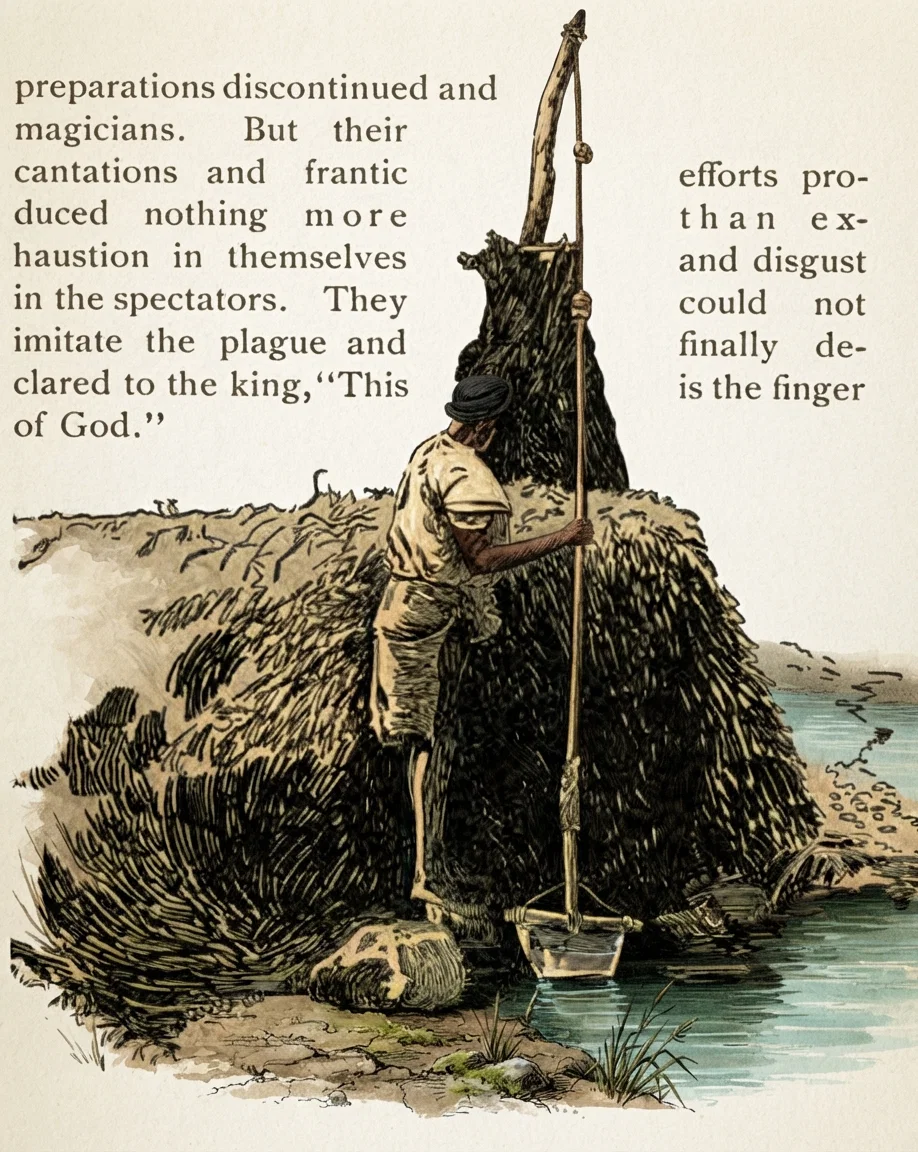
Drawing Water in Egypt
But even with this testimony the king remained obdurate, and betaking himself to the privacy of his chamber, where he could fight the plague and his convictions with greater liberty, he left the people of the court and kingdom to suffer as they might.