Pacific Press Publishing Association · Mountain View, California
CONTENTS
By Editor
Divinity in Humanity
Christ: Creator and Redeemer (poem)
Christ: Law-giver and Law-keeper
Perfection of the Law
The Royal Purple of God's Law
Christ Our Righteousness
Life and Immortality
The Sign of What Christ Is
Honor Accorded the Sabbath
How the Sabbath Has Been Dishonored
Blessings of Sabbath Observance
Ideal Church and Ideal State
Wealth and Wage
God's Message for This Time
What of the Dead?
A Spirit-filled Church
Heber, the First-born (a story)
The Sanctity of Marriage
MORE TO FOLLOW
By Editor
THIS is the second issue in a special series of the SIGNS OF THE TIMES. The next will be The Atonement—Judgment number. The oft-repeated question, “Was the Death of Christ necessary?” will be answered by R. C. Porter.
“The Hour of His Judgment Is Come,”
“The Judgment in Type and Antitype,”
“The Great Final, Fiery Test,”
“An Object Lesson in Redemption,”
“Creed Power and State Aid,”
“Transgression of the Law,”
“Necessity of the Resurrection,”
“Wealth and Wage,”
are other general articles that will appeal to the thoughtful reader. A beautiful poem has been contributed for the first page by Mrs. L. D. Avery-Stuttle, entitled “Christ My Judge.” An additional chapter of the story, “Heber, the First-born,” and several short articles on various Gospel themes will add to the interest of this number.
The person from whom you received this copy will probably be able to furnish you the rest of the series, but if not, address the publishers with twenty cents in stamps and it will be promptly sent.
The subscription price of the SIGNS OF THE TIMES is $1.50 per year. Address, SIGNS OF THE TIMES, Mountain View, Cal.
WHAT OTHERS SAY OF IT.
(The following came with a letter ordering four hundred and forty-two sets):
“I was on the safe side when mentioning two hundred and fifty sets as the number we could use. More orders will follow. The people are interested.”
E. H. HALL,
New York City, N. Y.
“We have received orders for four hundred and ten sets of the Gospel series of the SIGNS OF THE TIMES from our young people and think we will make it five hundred.”
H. H. HAYNES,
Oakland, Cal.
“The advance copy of the SIGNS special did not get here to-day, but I saw the one sent to Elder Burg, and wish to say I think the matter it contains is excellent. A strong effort will be made here in Portland for it. We hope to use two thousand sets.”
W. V. SAMPLE,
Portland, Ore.
“The Gospel series, No. 1, of the SIGNS OF THE TIMES has just reached me. It is neatly gotten up and contains valuable truth for this time. I trust it will have a wide circulation, and will do all in my power to that end.”
E. G. FULTON,
San Francisco, Cal.
BRIEF, CRISP STUDIES IN PROPHECY.
Do you know that there is no study so thrilling, so fascinating, so faith-producing, as that of prophecy, fulfilled or unfulfilled?
Would you know the meaning of the prophecy of Daniel 7—the significance of the four beasts there described? Of the “little horn” which destroyed “three of the first horns” (verse 8)?
Would you like to know the meaning of that “fourth beast, dreadful and terrible,” having “great iron teeth” (verse 7), and what nations were represented by the “ten horns”?
For a careful, historical, and logical answer to these, and numerous other questions concerning the symbols in this prophecy of Daniel the prophet, read our newly-revised, 16-page, illustrated tract, “Waymarks to the Holy City.”—Price one cent, or 70 cents per 100, post-paid.
What are the conclusive, Bible evidences of Christ’s second personal coming? Are there sure signs of this great event? What prophecies deal with this subject, and what say history and current events? Do you hear of “wars, and rumors of wars”? Have there been astronomical signs in the sun, moon, and stars—all verified by the voice of history and of science? Is crime increasing, with increasing knowledge? Have the prophecies in the books of Daniel and The Revelation anything to do with Christ’s second advent? How many of these prophecies have already been fulfilled? How many are even now being fulfilled? How many tell of events yet to come?
One of the best replies to these and other kindred questions is the new, envelope-size 24-page, illustrated tract, entitled “Heralds of His Coming.” Price only 1½ cents, or $1.00 per, 100 post-paid.
Which day of the week do you observe as the Sabbath? Does it matter which day is kept? Was Sunday always observed as the “Sabbath” of Christendom? If not, when was it introduced? What have Catholics and Protestant authorities to say on this subject—priests, popes, historians, and noted writers? If you feel that you would be interested in a brief, candid study of this thrilling question, send for our 16-page tract entitled “Who Changed the Sabbath?” Price only one cent, or 70 cents per 100, post-paid.
Every age has had its genuine Gospel. Ours, perhaps the most important of all ages, surely has, addressed to it, a Gospel message from divine inspiration.
That the world’s present condition—social, political, physical, economic—is alarming, to say the least, all intelligent people acknowledge. The ceaseless, desperate warfare between rich and poor, the countless murders, suicides, robberies, catastrophes on land and sea, political and social upheavals, wars, riots, etc., too plainly indicate the sure fulfilment of Bible prophecies announced ages ago. These conditions are but symptoms of earth’s many diseases.
The great, overshadowing questions of the hour are, “Have the Bible writers correctly diagnosed the case?” and “What is the only remedy?” Whence shall come deliverance and salvation, here and in the hereafter?
We are confident that the Scriptures discover the longed-for remedy. It will not take you long to ascertain the truth of this matter. Send for our new, 16-page tract entitled “The Gospel Message for Today.” Price only one cent, or 70 cents per 100, post-paid.
PACIFIC PRESS PUBLISHING COMPANY, Mountain View, California.
285 Salmon Street, Portland, Oregon.
18 West Fifth Street, Kansas City, Missouri.
306 San Pablo Ave., Oakland, California.
44 Crocker Building, San Francisco, California.
REVIEW & HERALD PUB. ASS’N. 222 N. Capitol Street, Washington, D. C.; Battle Creek, Michigan.
SOUTHERN PUB. ASS’N., 1025 Jefferson Street, Nashville, Tennessee.
The Greatest Battle
By Ellen G. White
The Christian life is a battle and a march. But the victory to be gained is not won by human power. The field of conflict is the domain of the heart. The battle which we have to fight—the greatest battle that was ever fought by man—is the surrender of self to the will of God, the yielding of the heart to the sovereignty of love. The old nature, born of blood and of the will of the flesh, can not inherit the kingdom of God. The old ways, the hereditary tendencies, the former habits, must be given up. . . . We can not overcome the mighty foe who holds us in his thrall. God alone can give us the victory.—Mount of Blessing.
DIVINITY IN HUMANITY.
By Ellen G. White
BY MRS. E. G. WHITE.
"Thus saith the High and Lofty One that inhabiteth eternity, whose name is Holy: I dwell in the high and holy place, with him also that is of a contrite and humble spirit, to revive the spirit of the humble, and to revive the heart of the contrite ones."
CHRIST dwells in him who receives Him by faith. Tho trials may come upon the soul, yet the Lord's presence will be with us. The burning bush in which was the Lord's presence did not consume away. The fire did not extinguish a fiber of the branches. Thus will it be with the feeble human agent who puts his trust in Christ. The furnace fire of temptation may burn; persecution and trial may come; but only the dross will be consumed. The gold will shine brighter because of the process of purification. Greater is He that is in the heart of the faithful, than he that controls the hearts of unbelievers.
Complain not bitterly of the trial which comes upon you, but let your eyes be directed to Christ, who has clothed His divinity with humanity, in order that we may understand how great is His interest in suffering humanity. He tasted the cup of human sorrow, He was afflicted in all our afflictions, He was made perfect through suffering, tempted in all points like as humanity is tempted, in order that He might succor those who are in temptation.
His love is perpetually flowing forth to make the weak strong, to make the faint-hearted firm, and give moral courage to the wavering. God works through Christ, and man may come unto the Father in the name of the Son. Our science and our song is, "Hear what the Lord hath done for my soul."
Who can comprehend the gift of Infinite Love? "When the fulness of time was come, God sent forth His Son, made of a woman, made under the law, to redeem them that were under the law, that we might receive the adoption of sons." God sent His Son into the world, not to pass sentence of condemnation upon a rebellious race, but to make manifest His love, and to hold out the hope of eternal life to those who should believe in His Son.
Here was love, and amazing grace that triumphed over justice. Retribution fell upon no less a personage than the Son of the Infinite God, and the universe of heaven rejoiced in the glory of God's benevolence and self-denial in giving the Prince of Heaven to our world. Such love was beyond the comprehension of heavenly angels. Christ came to the world to seek His lost pearl, and He had to go through the gates of death to recover His lost jewel. For "as Moses lifted up the serpent in the wilderness, even so must the Son of Man be lifted up; that whosoever believeth in Him should not perish, but have eternal life." All who look to Him in faith will be healed of their spiritual maladies. He is the Balm in Gilead, He is the great Physician.
Christ was the One who consented to meet the conditions necessary for man's salvation. No angel, no man, was sufficient for the great work to be wrought. The Son of Man alone must be lifted up; for only an infinite nature could undertake the redemptive process. Christ consented to connect Himself with the disloyal and sinful, to partake of the nature of man, to give His own life, and to make His soul an offering for sin.
In the councils of Heaven, the guilt of man was measured, the wrath for sin was estimated, and yet Christ announced His decision that He would take upon Himself the responsibility of meeting the conditions whereby hope should be extended to a fallen race. He understood the possibility of the human soul, and united humanity to Himself, even as the vine knits the grafted branches and twigs into its being, until, vein by vein, and fiber by fiber, the branches are united to the living Vine.
The Merchantman sold all to buy the pearl of lost humanity. The sinner also is to lay down his all in order to become a partaker of the divine nature, having escaped the corruption that is in the world through lust. He who unites with Christ has his life hid with Christ in God. Christ and the believing soul are joined by the bands of love, and the Lord calls this union continuing in His love. He says: "If ye keep My commandments, ye shall abide in My love; even as I have kept My Father's commandments, and abide in His love." "As the Father hath loved Me, so have I loved you; continue ye in My love."
Jesus takes man into co-partnership with Himself, and the unity and love between Christ and His Father bear the credentials to the world of Christ's divinity. Transformed in character, the believer presents the fact that Christ alone can reshape, purify, and ennoble the soul. The love that God has manifested toward man has no parallel. Jesus says, "Therefore doth My Father love Me, because I lay down My life" for the sheep. In this expression He would prove to man that the Father's love is so large, so unbounded, toward man, that He even loves the Son for the sacrifice which He made for the recovering of humanity.
God Himself suffered in the suffering of His Son. While Jesus walked the earth in the habiliments of humanity, He could say, "I and My Father are One." Having undertaken the work of redemption, the Lord spares nothing, however costly, which is essential to the completion of His design. He withholds not heaven itself, but continues to surround men with its favors, heaping gift upon gift, until the world itself is flooded with its boundless mercy and love. Jesus says, "These things have I spoken unto you, that My joy might remain in you, and that your joy might be full."
My Lord Is Love
CHRIST, CREATOR AND REDEEMER BY MRS. L. D. AVERY-STUTTLE
I stood at night 'neath the silvery light
Of the radiant moon on high,
And I watched each star as it shone afar
In the chambers of the sky.
And my heart was filled with a love that thrilled
My being through and through;
My bosom yearned and my spirit burned
With a joy that was strange and new.
For I heard a voice from the Father's throne
Where the many mansions be,
From the throne of light with its splendor bright
In the midst of the glassy sea:
"Thy Master's hand hath the glories spanned
Thou seest in earth and sky,
And the worlds which race through a boundless space
Are held by His tireless eye."
I know, my Lord, by Thy mighty word
The suns and the systems move;
But my heart beats high with a boundless joy
To know that Thy name is Love.
And I know—I know that as pure as snow
Thou wilt wash my sinful soul,
That the crimson stain shall be white again
While eternal ages roll.
Yes; I know Thy blood is a cleansing flood
That washeth my guilt away;
By Thy blessed grace I shall see Thy face
In the light of eternal day.
CHRIST, LAW-GIVER AND LAW-KEEPER
By F. C. Gilbert
By F. C. GILBERT
(A Converted Hebrew)
"Wherefore, holy brethren, partakers of the heavenly calling, consider the Apostle and High Priest of our profession, Christ Jesus." Heb. 3:1.
EVER since sin entered this world the knowledge of God had been constantly waning among men, until the time of Christ's advent. So few knew God even then, because they would not come to Christ; for "neither doth any know the Father, save the Son, and he to whomsoever the Son willeth to reveal Him." To know God is eternal life, and this life is manifest only in His Son. John 1:18; Matt. 11:27; John 17:3; 1 John 5:11, 12.
Even the disciples of Jesus did not know Him, and this because of their erroneous ideas concerning Him; and the same thing is equally true now.
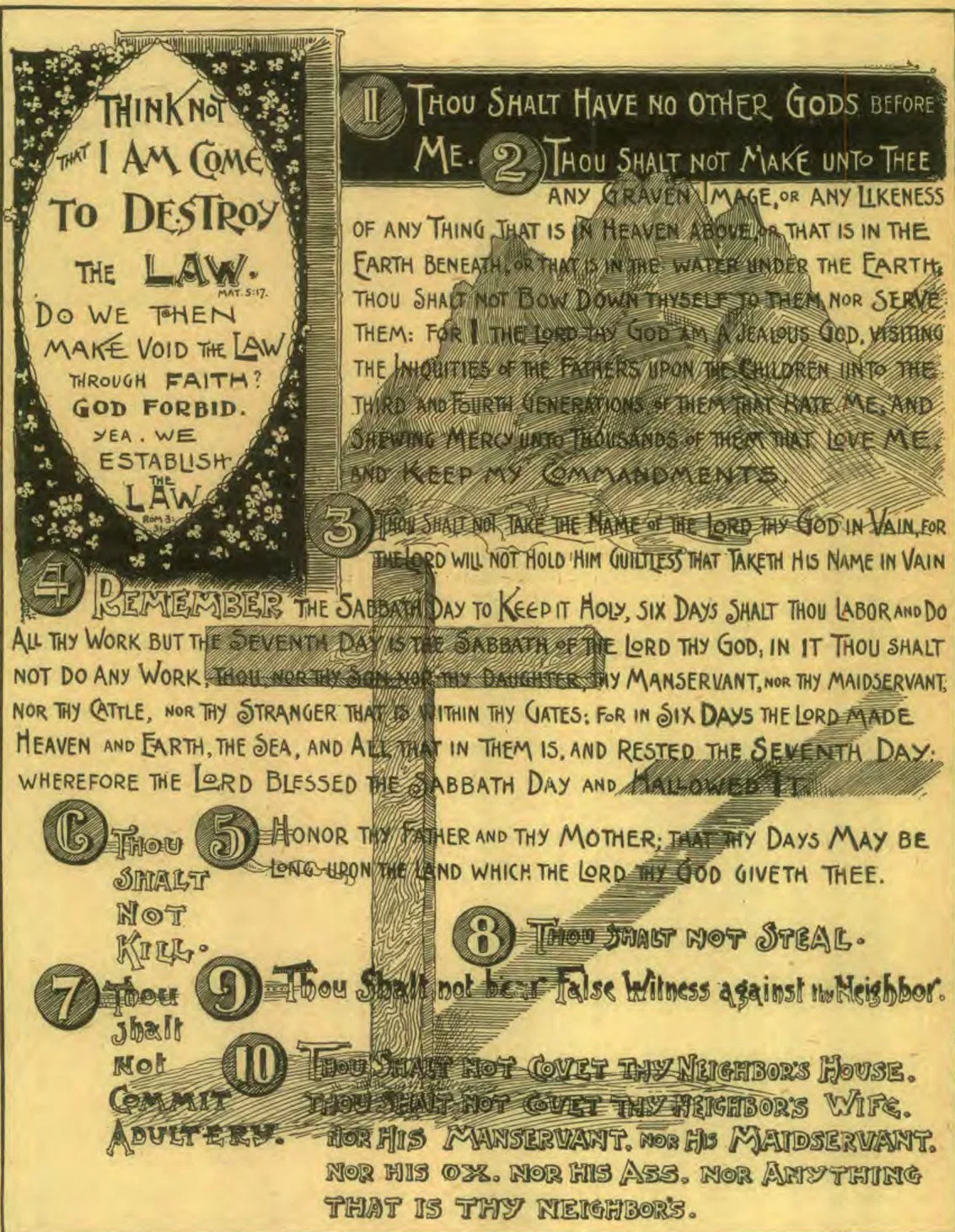
Perhaps in no way is Christ misunderstood more at the present time than in respect to His attitude toward God's law. When He appeared at His first advent the church then said, He has come to destroy the law and the prophets; to set aside what has been taught concerning the law for centuries. Nevertheless, the Saviour said repeatedly that He not only had not come to destroy the law and the prophets, but His mission on earth was to fulfil that law; for it is easier for heaven and earth to pass away than for one jot or tittle of that law to fail. Heaven and earth in their present state will eventually fail; but that law stands forever. Matt. 5:17, 18; Luke 16:17.
The church of to-day, however, declares that, despite the Saviour's teaching to the contrary, the coming of Christ annulled, set aside, abrogated, God's law, and the reign of grace entered. Therefore we are not under obligation, as Christians, to obey that law. So, practically the same conditions exist at the present time relative to the second coming of Christ and the law, as existed at His first advent in respect to Him and the law. The reason for this condition is due to the ignorance of the Bible teaching concerning Christ and the law. If this were better understood, Christ and the law would be better known and more greatly loved.
Christ, the Law-giver.
In order then to understand this subject better, let us ask ourselves, Who gave the law, and why was it given?
For a reply to these questions, let us turn to the Word of God. "There is one Law-giver, who is able to save and to destroy." James 4:12. "For the Lord is our Judge, the Lord is our Law-giver, the Lord is our King; He will save us." Isa. 33:22.
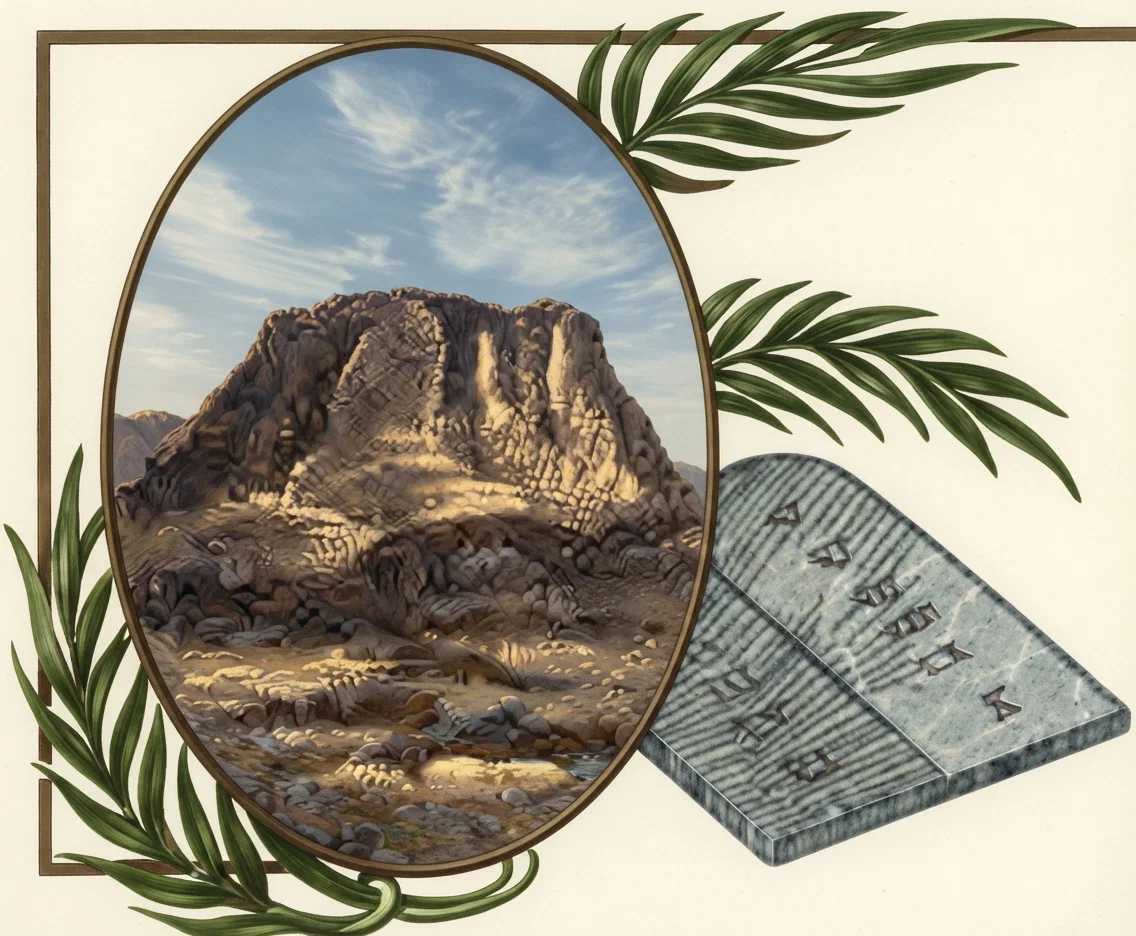
Here we are told that there is one law-giver, and this one law-giver is the Lord. And this is true, for we read that the Lord came down upon Mount Sinai, and there spoke the Ten Words of the Decalogue. Ex. 19:20; 20:1-17.
But both the scriptures above quoted declare that He who gave the law is the same also as the One who saves.
But who is He that saves? "Neither is there salvation in any other; for there is none other name under heaven given among men, whereby we must be saved." Acts 4:12. "I, even I, am the Lord; and beside Me there is no Saviour." Isa. 43:11. It is therefore evident that the One who saves us is the Lord Jesus Christ. For we read further that "He is able also to save them to the uttermost that come unto God by Him, seeing He ever liveth to make intercession for them." Heb. 7:25. And as the One who saves is the One who gave the law, for there is one Law-giver, it is clear that it was our blessed Lord Jesus Christ, who, upon the summit of quaking Sinai, uttered with His mighty, divine, majestic voice those immutable, eternal, and unchangeable precepts of the Decalogue.
Why did He give them?—Ah, because He longed to save the people at that time, even as He desires to save the people now, and as He has always desired to save them, from sin; and they could not be saved from sin until they realized that they were sinners; and they did not realize they were sinners until they knew the divine and eternal law of God. Yes, the same God who gave the people the law that would convict them of their sin, stood ready to save them from their sins, when they realized their need of a Saviour.
But the question will doubtless arise, "Did not God Himself, instead of the Son, give the law upon the summit of Sinai?" This question will easily be answered when we understand the relationship which exists between the Father and the Son. Jesus said, "I and my Father are One." John 10:30. And in Deut. 6:4 we read: "Hear, O Israel, Jehovah our Lord is One." (Translated from the Hebrew.) Yes, there is but one mind, one thought, one purpose between the Father and the Son, for all wisdom, all knowledge, all power, all understanding, the Father has given to the Son.
God's Son gave to men the law in order that they might know that the divine power to convict men of sin is the glorious power to save them from sin, and bring them back into the path of obedience, where they shall no more violate His blessed law.
But after the law was given to the very people who ought to have understood its blessedness, its preciousness, its spirituality, its perfection, its power, it had become so buried up with traditions, with the rubbish and philosophy of men, with the perverted ideas of human wisdom, that it needed to be seen in active life in order to be understood. It would have been to little purpose for God again to speak that law upon the summit of a mountain, for the people with a strong tenacity were averring that they were observing the law to the very letter, which had thus been spoken. So it needed more than words this time; it needed action, that men might see that law. Therefore God clothed His divine Son with the body of human flesh, and sent Him to earth to let Him live a man among men, and show them what He meant in those blessed and precious precepts that He gave to Adam in the beginning, the transgression of which brought wo and ruin upon a lost world. Hence, among the first teachings of Christ, we find Him explaining the meaning of that blessed law, and showing the people what it meant to observe and obey the law.
Christ, the Law-keeper.
That the divine Son of God would really be the ideal law-keeper was predicted centuries before He came to earth, for God was observing the tendency of men all through the ages, and saw the need of just such a revelation. Hence we read: "The Lord is delighted because of His righteousness; He will enlarge the law, and make it honorable." Isa. 42:21. (Translated from the Hebrew.) "Sacrifice and offering thou didst not desire; Mine ears hast Thou digged; . . . then said I, Lo, I come; in the volume of the Book it is written of Me, I delight to do Thy will, O My God; yea, Thy law is within My heart." Ps. 40:6-8. And since out of the heart are the issues of life (Prov. 4:23), the one great issue of Christ's life was not only to teach men the meaning of God's law, but in His life constantly to be an expounder of it. Hence, He asked the people who could accuse Him of sin?—no reply. He repeatedly stated that He had kept His Father's commandments; He had done the will of God; He had done always those things that pleased God. In other words, He wanted them to see that the one great thought and deed of His life was to live out in the flesh as man, what was meant by those sacred precepts of the Decalogue. To kill meant more than intentional taking of life as the rabbis taught. Unchastity meant more than the unlawful desire put into action. Theft meant much more than taking merely what belonged to some other person.3The law meant all that was contained in the letter, no deviation from the letter under any circumstance; it took hold even of the thought, the motive. But the deeds of His life magnified the letter of the law of God in human flesh. By His divine life and example its meaning was manifest.
If, then, the church of to-day could but see what was involved in the law of God, there would be a strong and earnest desire on the part of all to exalt, extol, and lift up the unchangeable precepts of the Decalogue. For to lift up the law is to exalt Christ; to depreciate the law is to exalt, and glorify, and perpetuate, sin. But, thank God, the law shall never be abolished; but sin shall. Hence we read that those who finally taste of the fruit of life's fair tree shall be those who keep the commandments, who have, in Christ, obeyed the law. Dear reader, are you a law-keeper or law-breaker?
Do you say it makes no difference whether you follow closely the law? Remember that God saw it was so important that He sent His own Son to earth, all the way from glory, and gave Him a body like yours, and had Him live for you the life that was intended in harmony with God's law. Then He gave up that life, shed His own precious blood, to show our eternal obligation to the law. By thus doing He destroyed sin, the transgression of the law, and declared the perpetuity of the law that you might live and be obedient.
"He that saith he abideth in Him ought himself also so to walk, even as He walked." 1 John 2:6.
THE ROYAL PURPLE OF GOD'S LAW.
By Edison Driver
BY EDISON DRIVER.
A CERTAIN king once sent to a weaver and said to him, "Make me a curtain for my palace, and let it be according to this design that I send."
The weaver was happy in receiving such a commission, and set about his task at once. But when he looked over the pattern and saw that the groundwork was purple, he was troubled. "The established custom," he said, "is to use red for groundwork, but this calls for purple. Now, of a truth, I don't think the king will notice the difference at all, and if he does, will think the red looks just as well; besides, it's cheaper and more convenient for me. So the red goes in for groundwork; the rest will go in just as the pattern indicates."
Imagine the poor fellow's consternation when the king utterly refused the tapestry at any price. "The stamp of royalty is lacking," was the explanation. "There is not a hint of the royal purple in it; your red doesn't mean anything, except, perhaps, that you have obeyed your own convenience instead of me. I hope your convenience will reward you well for your loyalty, fellow!"
Likewise imagine the surprise and consternation of those who have woven a substitute Sabbath into the great law of Jehovah, saying, It looks as well as the one He ordered, and is according to the custom.
The two cases are parallel. The Sabbath commandment is the seal of God's law. It marks Him as creator, and, consequently, king of all created things. It is the royal color He has chosen, and given as a sign between Him and His own. The king who ordered the purple in the curtain had reasons for so doing. The king who ordered the Sabbath in His law also had reasons for His order, and its change will be like changing the purple of the curtain. The stamp of royalty again is lacking, and disobedience is conspicuous.
TWICE WRITTEN.
GOD writes all His Word twice. He not only does not leave "Himself without witness" in the beneficent course of nature, but He leaves not His Word without witness. That Word is in general composed of historical, ethical, or moral, and prophetic writings.
The history records actual events which took place in connection with men and nations in their relations with God and with each other. They show the working out of principles of truth and the result of the rejection of those principles. They are prophecies of principles and of similar circumstances yet to rise. They show, and are designed to show, to those who follow that "whatsoever a man soweth, that shall he also reap;" that certain causes produce certain results; that he who transgresses God's law, the law of life and being, must certainly reap the sure result, deterioration, utter ruin, and death; and that the Most High ruleth in the kingdoms of men and giveth them unto whomsoever He will.
The moral portion of God's Word, interwoven with every other part, is in words the expressed character of God. It is a declaration of what God requires of men, a promise and prophecy of what God will make all who will yield to Him. All His holy precepts and requirements were gloriously fulfilled in the life of Jesus Christ, the true witness to God's character, and all will be in the true people of God through Christ. Every true Christian is a witness to the truth of God's Word. He, his life, is a visible manifestation to the world of the power of Christ over sin and sinful flesh.
The prophetic portion of God's Word is the history of the world, of nations, of peoples, of cities, of individuals, in advance. It is God telling beforehand just what will be true. When the time comes for its fulfilment, God, in His overruling providence writes it again, that all who know His prophecy may read again His word, may shun the dangers, and may find in Him salvation.
Do you wish to read God's word in the strange providences around you, in the characters on every hand, in the history of the world at the present time?—Study first of all God's Word. Be filled with it, saturated through and through. And in the trying times before us we shall be able to read God's word in the events of every-day life, in individuals, in nations. Laid up in the heart it will keep us from falling, make us wise unto salvation, and preserve us unto His heavenly kingdom.
The ROYAL LAW
By H. A. St. John
By H. A. ST. JOHN
The perfection of the moral law of God, the Ten Commandments, may be clearly seen from three points of view, namely, positive scripture statements, character of its Author, and Christ's estimation of the law. Let us briefly consider each separately.
1. Positive Scripture Statement.
Says the Psalmist, "The law of the Lord is perfect, converting the soul." Ps. 19:7. "Thy righteousness is an everlasting righteousness, and Thy law is the truth." "All Thy commandments are truth." Ps. 119:142, 151. "My tongue shall speak of Thy Word; for all Thy commandments are righteousness." Verse 172. "Wherefore the law is holy, and the commandment holy, and just, and good." Rom. 7:12.
These are by no means all of the clear attestations of the perfection of the law of God found in Holy Writ. Indeed, they are but a few of the many, but sufficient to establish the truth of the perfection of the law of God upon the basis of eternal truth.
2. Character of Its Author.
Jesus taught that His Father in heaven was perfect, holy, and righteous. The law, being an emanation from the divine mind, must necessarily be perfect, holy, and righteous also. Obedience to such a law will produce perfection, holiness, righteousness. Indeed, such obedience will render a person God-like, or godly. And in no other way is Godlikeness, or godliness, produced. And "godliness is profitable unto all things, having promise of the life that now is, and also that which is to come." Could anything short of a perfect law, abiding in the heart, and drawn out in the life, produce characters worthy of such rich blessings, both in time, and in eternity? "Be ye therefore perfect, even as your Father which is in heaven is perfect." Matt. 5:48.
3. Christ's Estimation of the Law.
There is no higher authority among men, than the authority of the Lord Jesus. In His blessed and perfect teaching when on earth, we have many luminous attestations of the perfection of His Father's law. He said He came not to destroy, but to fulfil, the law, and to fulfil the law of God is to keep it in letter, and spirit, also. He said He came to do His Father's will, that His Father's law was in His heart, and that He did not hide it there, but revealed it in His life and teachings. Ps. 40:7-10. He said that He kept His Father's commandments and thus abode in His Father's love. John 15:10. He taught that keeping the commandments of God was a necessary condition of entrance into eternal life. Matt. 19:16, 17. It was predicted of Him by the prophet Isaiah, "The Lord is well pleased for His righteousness' sake; He will magnify the law, and make it honorable." Isa. 42:21. This our Saviour did, in His teaching, in His life, and in His death.
Now, reader, if we would walk before God and be perfect, if we would show what is that good, and acceptable, and perfect will of God, we, too, must have the law of God put in our minds and written in our hearts, then we can imitate the example of the holy Jesus, and by so doing we may testify in the most effective way that the law of God is perfect, converting the soul.
Perfection belongeth unto God, and to His law, unto Christ, and to His example, and unto us to just that extent that we are like Christ, always lovingly loyal to our heavenly Father's government, or to His perfect law. Only such are having the eyes of their understanding opened, day by day, to behold wondrous things out of God's law. Only such are travelers in the path of the just, a path that shineth more and more unto the perfect day.
Happy the soul that can truly exclaim, with the sweet singer of Israel, "O how love I Thy law! it is my meditation all the day." Ps. 119:97.