Your ShelfYour Projects

Signs of the Times, Vol. 30, No. 45.

CONTENTS
Earlier text: HOW GOD HAS HONORED THE SABBATH

THE SANCTITY OF MARRIAGE.

BY MRS. L. D. AVERY-STUTTLE.
I AM quite aware that I am touching upon a subject which, to say the least, needs to be handled with care. Married people are exceedingly sensitive sometimes,—exceedingly fearful of being blamed for something by somebody. And I guess it has always been so. Indeed, they are so fearful of it, that they sometimes lay the blame onto each other.
Away back in the Garden of Eden it began. Adam was so afraid the Lord would blame him, that, altho he loved his wife very much, he speaks words of reproach against "the woman whom Thou gavest to be with me," and accuses her to save himself. "Not very gallant in Adam," you say;—no; and the ungallant Adams are not all dead yet.
The marriage relation is the most sacred of any on earth. Without it, there would be no home, no family, no government. Then, to undermine the marriage relation, undermines the home; and upon the individual homes of the people rests the government, the safety and the prosperity of the nation.
Show me a family where the husband and wife are devoted to each other, and I will show you a happy home,—a miniature of heaven. Show me a whole nation of such families, and I will show you a nation that lives in peace with the whole world, and with whom business or friendly intercourse would be a delight. But alas and alas! where shall we find such an one?
The divorce courts were never so crowded; and the divorce lawyer who gains his living by separating those who ought to have been sure that God had joined them together, is getting rich. The good old time has gone by when it was a rank disgrace to apply for a divorce. Now, almost any plea is considered sufficient, even to simple incompatibility! Why did not the couple whose marriage bonds have become hateful and galling, discover the incompatibility before the solemn marriage vow was taken?
O, there is the trouble! Young men and young women seem determined to hide and cover up, with the pretty cloak of mannerism, every odd or disagreeable trait in their character. Instead of banishing those traits and getting the mastery over them forever, they hold on to their pet evils and carefully cover them from the eyes of friend or lover until it is too late to repent. O, why is not the season of courtship made a season of getting acquainted with one another, instead of being deceived. Why not take time before marriage to find out if the young man with whom you are to spend all your life is a Christian or a pagan? whether he treats his mother and his sisters with love and tenderness, or whether he makes himself obnoxious to his friends, and a terror to every one about him? Why not find out beforehand whether the young woman is kind-hearted, gentle, and true?
"Well," says some pessimist, "since there is such a risk in marrying, it were far better to live alone, and so save trouble."
This is the opinion of the pessimist, mind you; but, before deciding in his favor, hear what the Almighty says: "It is not good for man to be alone." "Whoso findeth a wife, findeth a good thing, and obtaineth favor of the Lord."
Well, then; let no one pretend a greater wisdom than the Almighty, who made these wonderful bodies of ours, and gave us our reasoning powers and our minds.
"I came to you for advice, Aunt Hannah;" and the fair young face, pure and sweet, and unsuspicious, was turned gravely toward the stern-faced matron.
"Robert has asked me to be his wife, and I am afraid I can not make him happy; I do not feel that I am worthy of the love of so good a man; so I have not yet given him my answer."
"The idea! you unworthy of Robert Lane? You better let well enough alone. Robert is good enough—a Christian, and all that; but he's poor as a church mouse. He can't dress you as you have been accustomed to dressing. Besides, you can't tell anything about these men; most of them are no good. You better let well enough alone."
The sensitive lips quivered at the slur on "these men!" Why, Aunt Hannah! don't you think Uncle John is a good man? You ought to love your own husband, I'm sure. I know my father and brothers are good men.
"O yes, good enough, maybe; but I've been married a great many years, and I tell you, if you want to be happy, stay as you are. If you want to be miserable all your life, why then, get married!"
Now, this little dialogue is not imaginary. We have all heard similar ones. O shame! shame! I say; And yet, these "mothers in Israel," who seem to know so much more than the Almighty, are legion.
"But would you have us hasty and careless in this matter?"—Most certainly I would not. Ah, if there were less unseemly haste in this most important and solemn matter, there would be far less repenting at leisure, and fewer broken hearts. But let none scoff at this, the most sacred of human ties. My heart aches whenever I hear it. As well might we scoff at the blessed institution of the Sabbath. Both are Eden born.
Let us allow our imagination to wander back over the long centuries. The earth is young and fair,—fresh from the hand of Him who said, as He viewed His handiwork, "Behold, it is very good!" The man stands forth in all the strength and excellence of perfect manhood. The praise of the Creator is upon his lips,—but he is alone. To be sure, there are rare animals, and beautiful birds, and lovely flowers. But in all these there is no companionship. The happiness of the man is not complete. It is like a sunset without color, a rose without perfume. His beautiful home gives him only a limited pleasure; for he must enjoy it alone,—alone must he sing the songs of praise to his God.
Not so; a strange drowsiness creeps over him. The finger of Omnipotence touches him. He opens his eyes to behold a beautiful being like to himself, whose eyes beam with intelligence and love. The Creator brings her closer to the side of the man; and we listen with wonder and delight to the first marriage ceremony. "Therefore shall a man leave his father and his mother, and shall cleave unto his wife; and they shall be one flesh."
Nowadays it is different. Every day we hear this sacred relation scoffed at. Every little while some sensationalist feels called upon to write a book directing the attention of the people to the inconsistency and folly of the marital relation, and to the evils which result from it. "Confessions of a Wife" is read and commented upon most favorably by the public press. The accursed doctrine of free love—better termed "free lust"—is preached everywhere; until the sacred subject of marriage is made a jeer, a jest, and a by-word. The home is wrecked, and the very foundations of society and government are in danger.
[The next article in this series is entitled "Husbands and Wives."]

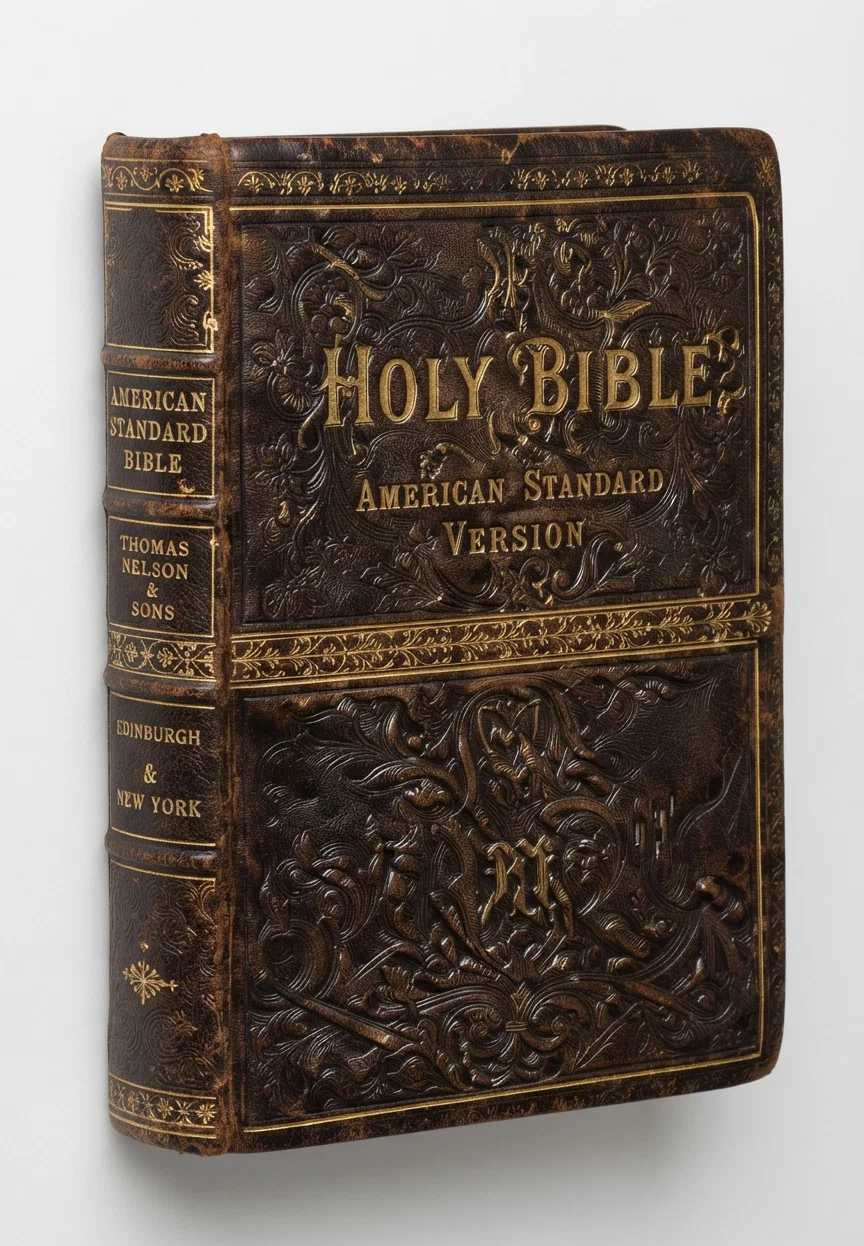
The American Standard

Obscure verses and difficult phrases are made clear, and the precise thought of the writers rendered plain.

The American Standard

Revised Bible

"The best translation of the Bible ever published in the English language."
Over 80 styles. This is the only edition authorized by the American Revision Committee, and their endorsement is on back of title page. Ask for Standard Edition, 35c. to $12.
Sold by all booksellers. Catalogue and specimen pages sent free. Address
Thomas Nelson & Sons
Publishers
37 E. 18th Street, New York

AIKAIN VARTIJA.

(Times) (Watchman)
WE wish to call the attention of our people in America to Aikain Vartija, a monthly publication for the Finnish speaking people. As there is no periodical in America carrying the Third Angel's Message to this people, we deem it our duty to make known to our brethren that here in Finland we have a paper in the Finnish language. Its subscription list during the past three years has come up from 300 to more than 3,000, and it is continually increasing. Those of our people, who have an opportunity to work for the Finns, should remember this paper. We send it to America for 50 cents a year.
This autumn we have published a special number containing the following general articles: "Watchman, What of the Night?" "The 2,300 Days;" "There Shall Be Time No Longer;" "The Law and the Gospel;" "God Made Manifest in Our Flesh." The Health, Home, and Mission departments have also some special articles.
This number should have a wide circulation in America, and it will be a help to introduce the paper, for those who will take yearly subscriptions.
Shall not our brethren living in Finnish communities take hold and do something for their neglected neighbors.
This special number will cost to America 5 cents, post-paid. Send all orders to Aikain Vartija, Jagaregatan 2, Helsingfors, Finland.

LLEWELLYN MORRISON'S POEMS.

HEART BELLS: A volume of poems, hymns, songs, lyrics, and descriptive verse, covering a wide range of subjects. 300 pages (10,000 lines) finely printed on toned paper with photo-engraving, bound in best English cloth, stitched binding. Specially suitable for a holiday gift book. Part of an edition, to clean out stock at cost. Fifty cents each by mail, prepaid, so long as the supply holds out. Address, Llewellyn A. Morrison, 106 Shuter Street, Toronto, Can.

Devotional Songs

ONE-HALF NEW SONGS THAT WILL NEVER GROW OLD. ONE-HALF OLD SONGS THAT WILL ALWAYS BE NEW.

Devotional Songs

By three famous composers, Doane, Kirkpatrick and Main.
256 pages, cloth, $25 per 100; 30c. each by mail. A returnable copy for examination will be mailed on request. Published by the publishers of the famous "Gospel Hymns." THE BIGLOW & MAIN CO., New York and Chicago.

CHRIST AND THE PROPHETIC WORD

By J. O. CORLISS
CHRIST is the "all in all" of every age. In the beginning He was the Word, through whom God's creative voice was heard. All things were created by Him and for Him. John 1: 1-3, 14; Col. 1:16, 17.
God, through Christ, walked and talked with man in Eden. Gen. 2:16, 18; John 1:18. But when sin entered through the first pair, Christ's subjects renounced Him, to their own loss, and His kingdom was greatly marred by the curse which rested on the earth. Because of this He set about to redeem His injured heritage from its sad condition, that He might return to it in person, and reign in glory with His ransomed people.
But sin has so deformed the image of God in man, and so enfeebled his moral faculties, that a simple promise of help could not do the work for those who not only had no power left in themselves to accept the proffered aid, but whose environments were wholly satanic. It was therefore necessary to leave with men some constantly prompting influence for good, which would not only offset man's evil surroundings, but draw him heavenward as well.
This Word, then, must not only contain a general warning against corrupt control, but to be entirely effectual, it must point out the distinctive nature of this agency in all its many phases. This would demand divine foresight, in accurate description, of all the evils to be met in different ages, in order that man might recover himself from all the diplomatic schemes of Satan's cunning.

Suffering and Glory.

All this being a part of the great plan of salvation, these prophetic words must reveal, not only the sufferings of Christ, but also His reign over the saints in glory, as the outcome of those sufferings. It was this view of the work of Christ which led the inspired writer to say that in the work done by the prophets, they "enquired and searched diligently" concerning man's salvation through Christ, when prophesying of the grace to come unto Him. 1 Peter 1:10.

The Spirit of Christ in the Prophets.

But there is another point in Peter's testimony concerning the prophets which is worth emphasizing here. He says that their "diligent" search of this salvation was specially directed by the Spirit of Christ which was in them, and that this same Spirit testified beforehand, through them, of the sufferings of Christ, and the glory to follow, in consequence of His sufferings. From this it is plain that the prophetic Word was inspired by Christ, and that it, as well as all other parts of the Bible, make Him the great central object of their existence.
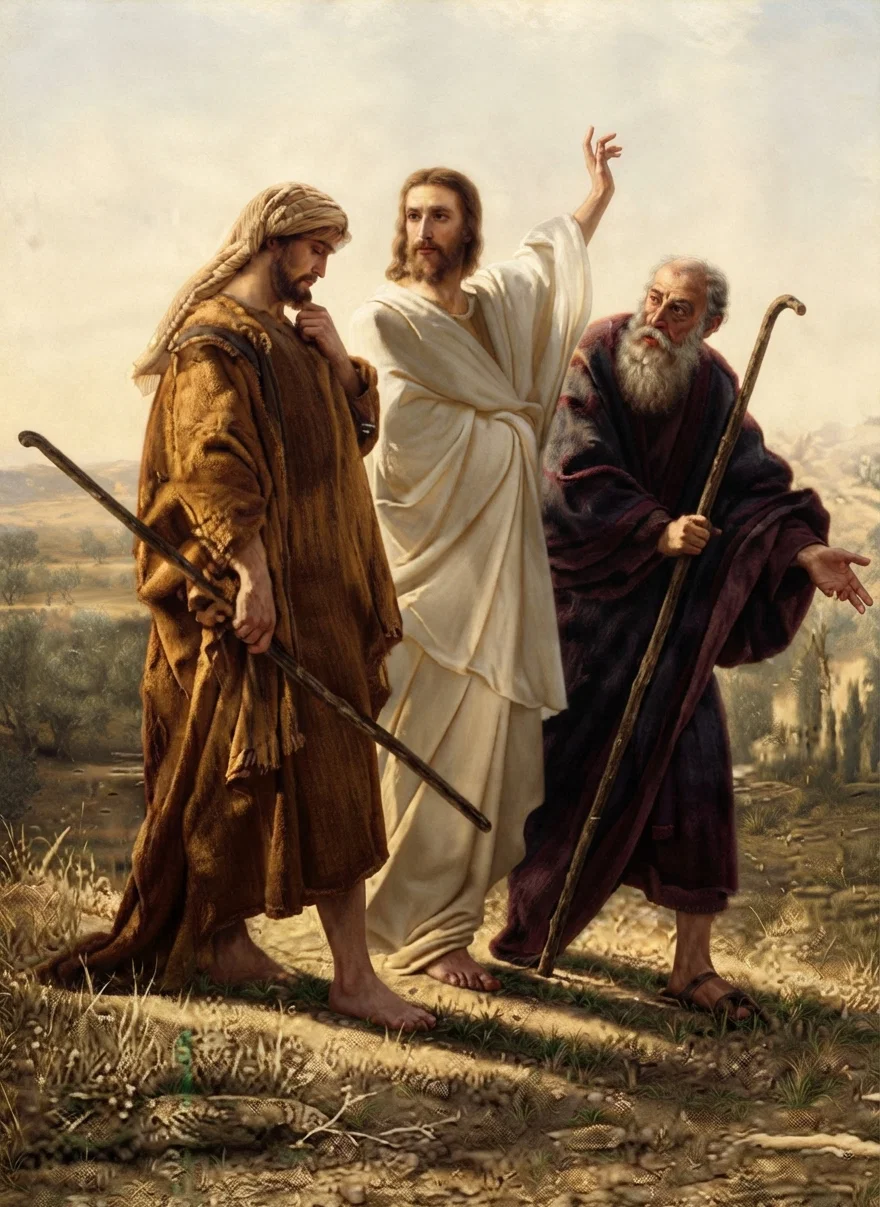
This thought having been so clearly stated by Inspiration itself, Christ's words of reproof for two of His disciples seem justly merited. These disciples were on their way from Jerusalem to Emmaus, near the close of Christ's resurrection day, and, when nearly there, were joined by their risen Lord. Thinking Him to be simply a fellow-countryman, in deepest sorrow they poured the fulness of their disappointed hopes into His ears. After listening to the end of their lamentation, Christ replied to them thus: "O foolish men, and slow of heart to believe after all that the prophets have spoken! Behooved it not the Christ to suffer these things, and to enter into His glory?" Luke 24:25, 26, A. R. V.
Had these professed disciples known the statements of the prophetic Word, they might have been saved their wail of unbelief, upon seeing Christ give up His life in agony on the cross. But as they had neglected this important study, it became necessary to administer balm to their wounded hearts. Christ Himself did this, by "beginning at Moses and all the prophets, He expounded unto them in all the Scriptures the things concerning Himself." This was satisfying enough to the disciples to make their "hearts burn" within them, while He talked with them about these things. Their sorrow also was turned to joy, as they discerned in the stranger their Master, who was risen according to the prophetic scripture, and they hastened back to Jerusalem to spread the good news of a living Saviour.

Prophetic Word for Us.

The fact that Christ Himself, and His apostles after Him, used the prophecies to reveal the work of Christ, and to establish His claim to the Messiahship, shows the prophetic Word to be absolutely reliable. More than this, it having been dictated by the Spirit of Him who is our common Saviour, and for the purpose of enlightening us relative to His sufferings and their object, that Word must be adapted to the needs of those for whom it was written. That is, it must be so exempt from secret intention that no one may possess the privilege of reading its mystery for himself alone. In other words, the interpretation of the prophecies has been absolutely delivered from "private" ownership, by the revelation of the Holy Spirit, freely distributed to every person. 2 Peter 1:19-21; John 16:13, 14.
All this being true, those who will may know the portent of the strange events which, in our day, crowd so strenuously upon the heels of their predecessors. That many of the scenes and incidents of the present time are startling, and almost unaccountable from natural causes, many are ready to admit, yet they do not know their meaning, because, like the two disciples on their way to Emmaus, they have not studied the prophetic Word, and so noted its reference to these things which were to be omens of the soon-coming Saviour to redeem His waiting people, and receive them into His glory. May such hasten to redeem the time, and so be prepared to receive the Master when He comes.

OLIVOLINE

is the Hygienic Cooking Oil of To-day
A Pure Vegetable Shortening. No Animal Fat. No Taste and No Chemicals.
Like Olive Oil, and Keeps in Any Climate
Price, F. O. B., Cash with order
5 gal. can, $3.50; 10 gal. can (75 lbs.), $6.75. Write for circulars on Bbl. and ½-Bbl. lots.
(Refined Cotton Seed Oil, 10 Gallons, $5.50)
Address O. C. GODSMARK
2005 Magazine St. LOUISVILLE, KY

The Second Coming of Christ

How MANY editors or preachers are writing or speaking of the second coming of Christ? It is a solemn and sublime truth; it was the constant utterance of Paul, and yet these good and wise men let it alone. Truly, religious people are asleep in relation to the momentous fact that He is coming. —Rev. George R. Cramer.

The Lord Is at Hand

The conviction that the time is short deepens in our souls. The sure Word of prophecy leaves little room to doubt this: The Lord is at hand.—Rev. Henry Grattan Guinness.

The Blessed Hope

THE Lord Himself is coming personally the second time to earth, not at death, but at the harvest-time—the end of the world. This is the good hope, the blessed hope, the hope that purifies, the hope of the church, the Scripture hope, and the great incentive to holy watching.—Rev. S. J. Austin.
INTERNATIONAL SERIES THE SUNDAY SCHOOL

LESSON 9.—NOVEMBER 27.—WORLD'S TEMPERANCE LESSON.

Lesson Scripture, Isa. 28: 1-13, A. R. V.
(1) "Wo to the crown of pride of the drunkards of Ephraim, and to the fading flower of his glorious beauty, which is on the head of the fat valley of them that are overcome with wine! (2) Behold, the Lord hath a mighty and strong one; as a tempest of hail, a destroying storm, as a tempest of mighty waters overflowing; will He cast down to the earth with the hand. (3) The crown of pride of the drunkards of Ephraim shall be trodden underfoot: (4) and the fading flower of his glorious beauty, which is on the head of the fat valley, shall be as the first-ripe fig before the summer; which when he that looketh upon it seeth, while it is yet in his hand he eateth it up. (5) In that day will Jehovah of hosts become a crown of glory, and a diadem of beauty, unto the residue of His people: (6) and a spirit of justice to him that sitteth in judgment, and strength to them that turn back the battle at the gate.
(7) "And even these reel with wine, and stagger with strong drink; the priest and the prophet reel with strong drink; they are swallowed up of wine, they stagger with strong drink; they err in vision, they stumble in judgment. (8) For all tables are full of vomit and filthiness, so that there is no place clean.
(9) "Whom will He teach knowledge? and whom will he make to understand the message? them that are weaned from the milk, and drawn from the breasts? (10) For it is precept upon precept, precept upon precept; line upon line, line upon line; here a little, there a little.
(11) "Nay, but by men of strange lips and with another tongue will He speak to this people: (12) to whom He said, This is the rest, give ye rest to him that is weary; and this is the refreshing; yet they would not hear: (13) Therefore shall the word of Jehovah be unto them precept upon precept, precept upon precept; line upon line, line upon line, here a little, there a little; that they may go, and fall backward, and be broken, and snared, and taken."
Golden Text.—"And even these reel with wine, and stagger with strong drink." Verse 7.

SUGGESTIVE QUESTIONS.

(1) Against whom does the prophet pronounce wo? For what reason? Verse 1. Note 1. (2) What chastisement did the Lord have in reserve? With what is this mighty instrument compared? Verse 2. Note 2. (3) What should befall their proud capital? Verse 3. (4) How suddenly will its glorious beauty be destroyed? Verse 4. (5) What gracious promise is given to Judah in that day? Verse 5. Note 3. (6) How closely would Israel's doom press upon the borders of Judah, the "residue"? Verse 6. (7) What was the cause of even Judah's imminent danger at this time? To what extent were even the priest and prophet affected by strong drink? Verse 7. Note 4. (8) To what extent did this evil prevail among the people? Verse 8. (9) What pertinent question does the prophet ask? Verse 9. Note 5. (10) How does the Lord impart His instruction to His people? Verse 10. (11) If Judah would not heed instruction by the Lord's prophet, by whom would He teach them? Verse 11. Note 6. (12) Looking back from this future result, of what are they reminded? Verse 12. (13) Then how does the instruction of chastisement come to them? To what extent? Verse 13. Note 7.

NOTES.

1. "Wo."—This expression was not that of a wish or a prayer for wo, but a warning that wo was coming. "The crown of pride" was the capital city, Samaria, which was situated on the crown of a conspicuous hill. "Ephraim" is specially designated because it was the leading tribe of the kingdom, and often spoken of as standing for the whole kingdom. Samaria overlooked the most fruitful of valleys, where grapes grew luxuriantly; and the people of the proud city had become drunkards through the excessive use of wine, to the manufacture of which the grapes had been extensively perverted.
2. The Lord was using the Syrians as an implement of chastisement for His recreant people. Palestine lay on the highway between the two greatest powers in the world at that time—Assyria and Egypt—which were always jealous of each other, and therefore always hostile. Palestine invariably suffered when active hostilities were going on between them. A great disaster was imminent upon the northern kingdom through an invasion by the Assyrians, and Samaria was threatened with the destruction that came three or four years later. As yet this was only discernible through the Spirit of prophecy, and Isaiah was giving the information to the people of Judah. It was a warning to them of the results of pride and riotous living as illustrated in the sister kingdom.
3. Verse 5 was a gracious promise to Judah if she would heed the warning voice of the prophet. Israel was doomed to overthrow, but there was still hope for Judah. Through repentance and faith, the oncoming scourge would be stopped before entering the kingdom of Judah. The battle would be stopped at the gate, as stated in verse 6.
4. The warning was timely, as there was urgent need for it in Judah, which was fast following in the footsteps of backsliding Israel. Drunkenness, which had so befogged the rulers of Israel, was also prevalent in Judah.
5. It is always a pertinent question, "Whom will He make to understand the message" of warning? The answer is clear, namely, Those who "despise not prophesyings;" for "surely the Lord Jehovah will do nothing, except He reveal His secret unto His servants the prophets." 1 Thess. 5:20; Amos 3:7. No, it will not be those who have turned away from the "milk," the "spiritual milk which is without guile." (The Common Version renders it "the sincere milk of the Word.") See 1 Peter 2:1, 2. The last warning message that goes to this sinful world is understood only by those patient ones who "keep the commandments of God, and the faith of Jesus." See Rev. 14:9-12.
6. The Lord must teach His people as little children, a little at a time and often repeated! But if they will not be taught in the Lord's way, they will necessarily have to be taught by the instrumentality of strangers, through bitter persecution.
7. Refusing to hear the Lord's prophet, they must, as a consequence, receive "precept upon precept; line upon line" of the instruction of chastisement until they were utterly subdued. And that was just what did come to pass in due time. It is better to be instructed by peacefully heeding the Word of God by His prophets, than through the judgments that He permits to come upon those who refuse such instruction. Will the Lord's people of to-day heed the warning lesson of Israel's drunkenness?

MACBETH, on a lamp-chimney, stays there.

My Index tells what chimney fits your lamp. If you use that chimney, you get perhaps twice as much light, and save a dollar or two a year of chimney-money.
I send it free; am glad to.
MACBETH, Pittsburgh.

THE NORTH-WESTERN LINE

RUSSIA-JAPAN ATLAS.

Send ten cents in stamps to R. R. Ritchie, No. 617 Market Street, San Francisco, for Russo-Japanese War Atlas, issued by the Chicago & North-Western Railway, three fine colored maps each 14x20, bound in convenient form for reference. The Eastern Situation shown in detail with tables showing relative military and naval strength and financial resources of Russia and Japan.

TOURIST CARS EAST

VIA

S. P. LINES

Personally Conducted Quickest Time Cheapest Rates
Your choice of a dozen routes
Through cars to— Portland Los Angeles Salt Lake City Omaha Denver Kansas City St. Paul Minneapolis Chicago St. Louis Louisville Cincinnati Memphis El Paso San Antonio Houston New Orleans Montgomery Atlanta Washington, D. C.
Remember these cars run through to above named cities without a change from Oakland or San Francisco. Our fast limited trains in connection with the above mentioned service.

C. T. FORSYTH

Div. Pass. Agent
12 San Pablo Ave., Oakland, Cal.
PHONE MAIN 543

"The Home Over There"

We have sung about it, but do we all know where it is to be? See what page seven of the "Scripture References" says about it.
The price of the pamphlet is 2 cents, or $1.40 per hundred.
ADDRESS PUBLISHERS OF THIS PAPER

Healers of the Breach.

Once God's people held His holy law in its integrity. Abel, Enoch, Noah, Abraham, Moses, Elijah, and all the prophets, even to Jesus Christ and His apostles, loved God's law and observed His Sabbath. They did not even question it; they ever affirmed its authority. But in the Christian age a change has come. "The foundations of many generations" have been, in the church of God, broken up; waste places have been made in the moral hedge; a breach has been opened in the Decalogue, and the sign of the Creator has been obscured by a day which the apostasy claims as the mark of its power. And yet God's law is the same, and is to be restored in His remnant church. Noble souls will seek out the truth, will turn from the errors of pagan apostasy, will "ask for the old paths, where is the good way" (Jer. 6:16), and will hold up to the world once more the banner of God's truth. Of this remnant, those who will break from every form of unholy tradition, the Lord says: "And they that shall be of thee shall build the old waste places; thou shalt raise up the foundations of many generations; and thou shalt be called, The repairer of the breach, The restorer of paths to dwell in." And a prime condition is, "If thou turn away thy foot from the Sabbath, from doing thy pleasure on My holy day; and call the Sabbath a delight, the holy of the Lord, honorable." Isa. 58:12, 13. In Rev. 12:17 it is said of this remnant people that they "keep the commandments of God, and have the testimony of Jesus Christ." Here also is predicted the persecution of those who observe the Sabbath of the Lord. It is said that "the dragon [the devil] was wroth with the woman, and went to make war with the remnant of her seed, which keep the commandments of God." The beginning of that wrath has been manifest the last few years in Maryland, Tennessee, and elsewhere.

What Is the Lord's Day?

The expression occurs but once in all the Bible, but the passage in question does not reveal the day of the week. It reads as follows: "I was in the Spirit on the Lord's day." Rev. 1:10. Now, according to God's Word, for this alone is authority upon this question, what day is the Lord's day? Three scriptures will answer this most conclusively:
"If thou turn away thy foot from the Sabbath, from doing thy pleasure on My holy day." Isa. 58:13.
"The seventh day is the Sabbath of the Lord thy God." Ex. 20:10.
"The Son of Man is Lord also of the Sabbath." Mark 2:28.
These texts conclusively show that the Lord's holy day is the Sabbath, and that the Sabbath is the seventh day, and that the seventh-day Sabbath is the day of which Jesus Christ is Lord. Therefore, according to the Lord's Word, the Lord's day is the seventh-day Sabbath. Could we ask clearer evidence?

Crowded Out

Crowded Out.—A sixteen-page paper has its limitations, and some of our important articles are crowded out, and must wait for future place. Among these is the second article in the series, "God's Message for This Time." We greatly regret that we could not print all that we prepared. We really felt they were needed. But we appeal to our readers to obtain future numbers, and read what is yet to be said. We are living in important times. Is it not worth while to give attention to divine things?

The Day

The Day.—We can desecrate that day alone which God has made sacred. We can profane that day alone which God has made holy. We can dishonor only that day which He has honored. On the other hand, we can hallow only that day which God has sanctified. We can keep holy only that day which God has made holy. He has hallowed or made holy but one day, namely, the seventh day of the seven. It is but will worship to do or to attempt to do what He has not commanded. Well may He say, "Who has required this at your hands?"

Is Your Foot on the Sabbath?

In Isa. 58:13 the Lord thus speaks to His people: "If thou turn away thy foot from the Sabbath, from doing thy pleasure on My holy day; and call the Sabbath a delight, the holy of the Lord, honorable; and shalt honor Him, not doing thine own ways, nor finding thine own pleasure, nor speaking thine own words." And then follow God's promises of rich inheritance to His returning people. Verse 14. Do you not wish to inherit these promises? Is your foot on the Sabbath of the Lord? Would it not be well to honor the Lord by doing as He says?

Not a Question of Days

Not a Question of Days.—The Sabbath question is not a mere question of days. Behind the Sabbath is God, the great Creator and Redeemer through our Lord Jesus Christ. It is the memorial of His creation, the sign of His redeeming, sanctifying, upholding, keeping power. Behind the Sunday—hidden tho they be by sacred memories and hallowed traditions of honest hearts—are a hoary pagan sun-worship and an apostate ecclesiasticism, the Papacy, which claims it as its mark or badge of authority. Honest men have passed the base, well-worn counterfeit in the past, but now the true light from God's Word shines upon it and reveals the imposture. Will they cherish it longer?

OUR NEXT ISSUE

Of this series is entitled, "Christ Our Judge." It will deal with His ministry as great high priest in the sanctuary above, and His closing work in the judgment. See second page of cover for some of the principal articles.

Its Importance.

There is more than mere theological importance to be attached to the doctrine of man's nature. Upon the claim of man's immortality or "immortal soul," of consciousness in death, Satan has reared the great superstructures of idolatry, saint worship, Mariolatry, eternal torment, Universalism, Christian Science, Modern Spiritism, and other soul-destroying doctrines. Given a knowledge of the Bible truth, that man is mortal, that his only hope of future life is through Jesus and the resurrection, and all these baleful errors are destroyed of themselves. This number of the SIGNS will be a help in that direction.

Immortal and Immortality

Immortal and Immortality.—Reader, did you know that the word "immortal" is found but once in the entire Bible? It is true, nevertheless. It is there applied to God, "Now unto the King eternal, immortal, invisible, the only wise God." 1 Tim. 1:17. "Immortality" is found five times, as follows: Rom. 2:7; 1 Cor. 15:53, 54; 1 Tim. 6:16; 2 Tim. 1:10. In every instance it is presented as an attribute of God, or a condition to be attained through faith; it is never referred to as an attribute which man now possesses. It is what man is enjoined to seek after; it is to be put on at the coming of Christ; it is brought to light by Christ through the Gospel, and only God is said to possess it. These words or kindred terms are never applied to mortal, fallen man except once, and that by Satan, in Gen. 3:4. Man is a sinner, subject to death, both soul and body. His only hope is Christ Jesus. Will you not accept Christ and life?

Soul and Spirit

Soul and Spirit.—The original terms from which these words come occur in the Hebrew and Greek an aggregate of about one thousand seven hundred times, and yet not once is soul or spirit said to be immortal, deathless, never-dying. All these expressions and the ideas they convey are anti-Biblical and anti-Christian. Life is found only in Christ. The soul without His life perishes forever. He is "the way, the truth, and the life." Let not Satan deceive you through a false and pagan philosophy which aims to exalt sinful man, and takes from Christ the honor that belongs to Him.

Christ, the World's Only Hope

The only hope for this world lies in the second coming of our Lord Jesus Christ to destroy Satan, sin, and all the results of sin, and bring in righteousness and peace and everlasting life. Through thousands of years men who have forgotten God have been seeking out ways of their own which have led only to soul-darkness and ruin. There has always been the one shining way, leading out of the quicksands of sin. That way is Christ. That way is open now. Press in.

The Rest of the Sabbath

The Rest of the Sabbath.—The rest of the holy Sabbath is not mere cessation from physical labor. "God is Spirit." "His law is spiritual." His rest was spiritual rest, refreshing and delightful. Ex. 31:17. He sanctifies and blesses by placing within the thing sanctified His own presence. 2 Cor. 3:16, 17. So the hallowed bread—the showbread—was literally the bread of the presence. Christ was the angel of God's presence, because God was in Him. So the Sabbath is "the holy of the Lord" (Isa. 58:13), "holy to the Lord" (Ex. 31:15). The rest of the Sabbath is, therefore, spiritual rest, the rest of Christ's presence in the Sabbath, which faith alone appropriates. Men came in contact with Christ, but saw and knew only the Man Jesus. But faith saw in Him the Lord of life, and drew from Him life-giving virtue. Many come in contact with the Sabbath; they see in it but a day as other days, or a day of casual rest, but faith sees in it the sign of the ever-living Creator and Redeemer, finds in it the presence of Christ, and appropriates the blessing God has promised. This is the rest of the holy Sabbath to the Lord. Then indeed is it "a delight."
Continue reading: Not Proportion of Time, but the Day