Review and Herald, Vol. 92, No. 2.

The Inspiration of the Bible
Earlier text: The Inspiration of the Bible

The Unity of God's Word

As a skillful musician, when he would execute a long score by himself, takes up by turns the funeral flute, the shepherd's pipe, the merry fife, or the trumpet that summons to battle; so did Almighty God, when he would make us hear his eternal word, choose out from of old the instruments which it seemed fit to him to inspire with the breath of his Spirit. He chose them before the foundation of the world, and separated them from their mothers' womb.
Has the reader ever paid a visit to the astonishing organist who so charmingly elicits the tourist's tears in the cathedral at Freiburg, as he touches one after another his wondrous keys, and greets your ear by turns with the march of warriors on the riverside, the voice of prayer sent up from the lake during the fury of the storm, or of thanksgiving when it is hushed to rest? All your senses are electrified, for you seem to have seen all, and to have heard all. Well, then, it was thus that the Lord God,mighty in harmony, applied, as it were, the finger of his Spirit to the stops which he had chosen for the hour of his purpose and for the unity of his celestial hymn.
He had from eternity before him all the human stops which he required; his Creator's eye embraces at a glance this range of keys stretching over threescore centuries; and when he would make known to our fallen world the everlasting counsel of his redemption, and the coming of the Son of God, he put his left hand on Enoch, the seventh man from Adam, and his right hand on John, the humble and sublime prisoner of Patmos. The celestial anthem, seven hundred years before the flood, began with these words, “Behold, the Lord cometh with the thousand of his saints, to execute judgment upon all;” but already, in the mind of God, and in the general harmony of his work, the voice of John answered to that of Enoch, and closed the hymn, three thousand years after him, with these words: “Behold, he cometh with clouds; and every eye shall see him, and they also which pierced him.” “Even so, come, Lord Jesus. Amen.” And during this hymn of thirty centuries, the Spirit of God never ceased to breathe in all his messengers.
You see, then, it was sometimes the artless and sublime simplicity of John; sometimes the impassioned, elliptical, rousing and logical energy of Paul; sometimes the fervor and solemnity of Peter; it was Isaiah's magnificent and David's lyrical poetry; it was the simple and majestic narratives of Moses, or the sententious and royal wisdom of Solomon,—yes, it was all this; it was Peter, it was Isaiah, it was Matthew, it was John, it was Moses; yet it was God.
“Are not all these which speak Galileans?” the people exclaimed on the day of Pentecost; yes, they are so; but the message that is on their lips comes from another country—it is from heaven. Listen to it; for tongues of fire have descended on their heads, and it is God that speaks to you by their mouths.—“The Plenary Inspiration of the Holy Scriptures,” by L. Gaussen, D. D., pages 50-53.

The Testimony of the Scriptures Concerning Themselves

The Word of God
1. How were the Scriptures given?
“All Scripture is given by inspiration of God.” 2 Tim. 3: 16.
2. By whom were the men directed who thus spoke for God?
“For the prophecy came not in old time by the will of man; but holy men of God spake as they were moved by the Holy Ghost.” 2 Peter 1: 21.
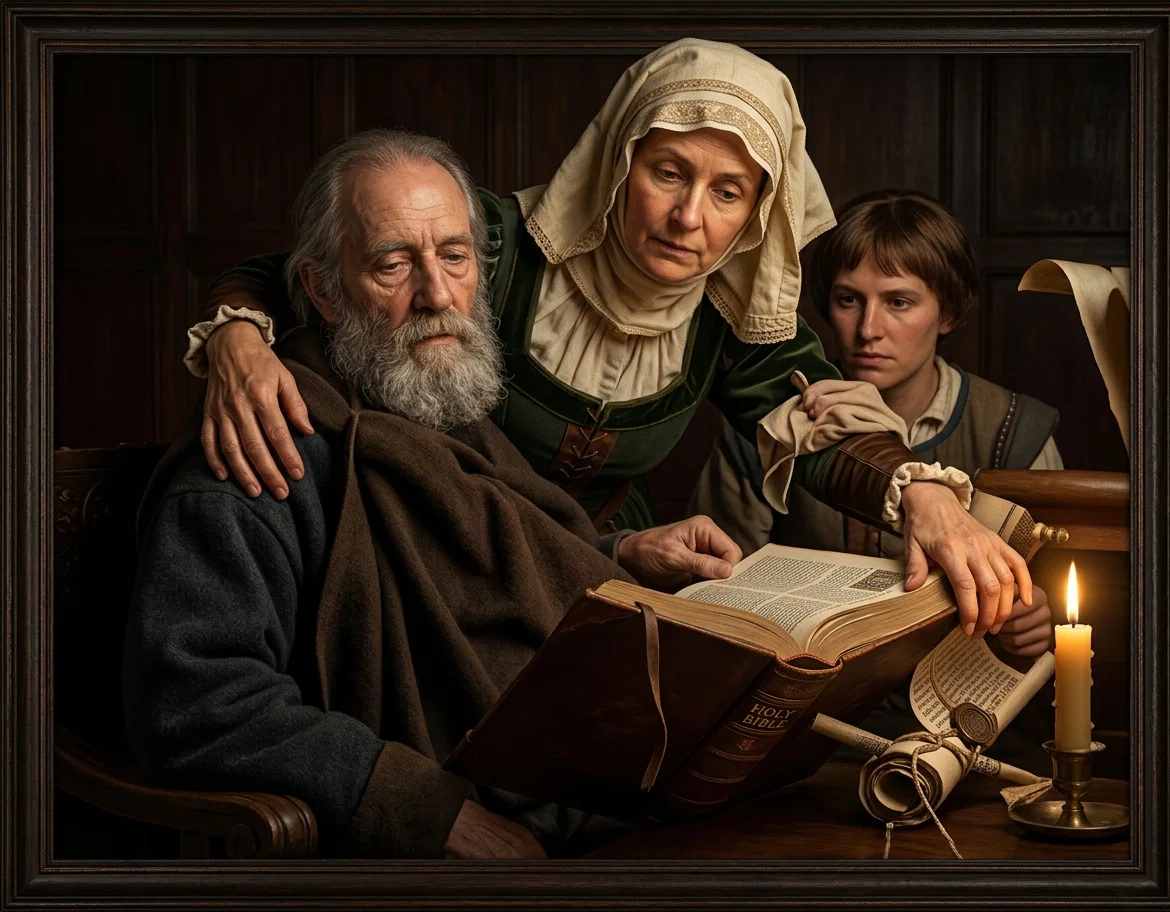
GOD'S HOLY WORD WAS PRIZED WHEN 'TWAS UNSAFE TO READ IT
3. What specific instance is mentioned by Peter?
“Men and brethren, this scripture must needs have been fulfilled, which the Holy Ghost by the mouth of David spake before concerning Judas, which was guide to them that took Jesus.” Acts 1: 16.
4. How does David express this same truth?
“The Spirit of the Lord spake by me, and his word was in my tongue.” 2 Sam. 23: 2.
5. Who therefore did the speaking through these men?
“God, who at sundry times and in divers manners spake in time past unto the fathers by the prophets.” Heb. 1: 1.
6. For what purpose were the Scriptures written?
“For whatsoever things were written aforetime were written for our learning, that we through patience and comfort of the Scriptures might have hope.” Rom. 15: 4.
7. For what is all Scripture profitable?
“All Scripture is given by inspiration of God, and is profitable for doctrine, for reproof, for correction, for instruction in righteousness.” 2 Tim. 3: 16.
8. What was God’s design in thus giving the Scriptures?
“That the man of God may be perfect, throughly furnished unto all good works.” Verse 17.
9. What is the character of God’s word?
“Sanctify them through thy truth: thy word is truth.” John 17: 17.
10. What test should therefore be applied to every professed teacher of truth?
“To the law and to the testimony: if they speak not according to this word, it is because there is no light in them.” Isa. 8: 20.
11. What does God design that his word shall be to us in this world of darkness, sin, and death?
“Thy word is a lamp unto my feet, and a light unto my path.” Ps. 119: 105.
12. How long will the word of God endure?
“The grass withereth, the flower fadeth: but the word of our God shall stand forever.” Isa. 40: 8. “Heaven and earth shall pass away, but my words shall not pass away.” Matt. 24: 35.

Christ in All the Bible

13. Of whom did Christ say the Scriptures testify?
“Search the Scriptures; for in them ye think ye have eternal life; and they are they which testify of me.” John 5: 39.
14. Of whom did Moses and the prophets write?
“Philip findeth Nathanael, and saith unto him, We have found him, of whom Moses in the law, and the prophets, did write, Jesus of Nazareth, the son of Joseph.” John 1: 45.
15. From whose words did Christ say the disciples ought to have learned of his death and resurrection?
“O fools, and slow of heart to believe all that the prophets have spoken: ought not Christ to have suffered these things, and to enter into his glory?” Luke 24: 25, 26.
16. How did Christ make it clear to them that the Scriptures testify of him?
“And beginning at Moses and all the prophets, he expounded unto them in all the Scriptures the things concerning himself.” Verse 27.
17. What did he say a little later to the eleven?
“These are the words which I spake unto you, while I was yet with you, that all things must be fulfilled, which were written in the law of Moses, and in the prophets, and in the psalms, concerning me.” Verse 44.

Power in the Word

18. Through what agency did God create the heavens?
“By the word of the Lord were the heavens made; and all the host of them by the breath of his mouth.” “For he spake, and it was done; he commanded, and it stood fast.” Ps. 33: 6, 9.
19. By what does Christ uphold all things?
“Upholding all things by the word of his power.” Heb. 1: 3.
20. In what scripture is it shown that creative power is exercised through the word of God?
“Let them praise the name of the Lord; for he commanded, and they were created.” Ps. 148: 5.
21. What change is wrought in one who is in Christ?
“Therefore if any man be in Christ, he is a new creature,” margin, R. V.; “old things are passed away; behold, all things are become new.” 2 Cor. 5: 17.
22. What is this new creation also called?
“Jesus answered and said unto him, Verily, verily, I say unto thee, Except a man be born again, he cannot see the kingdom of God.” John 3: 3.
23. Through what agency is this new creation, or new birth, accomplished?
“Being born again, not of corruptible seed, but of incorruptible, by the word of God, which liveth and abideth forever.” 1 Peter 1: 23.
24. Why were the people astonished at Christ’s teaching?
“And they were astonished at his doctrine: for his word was with power.” Luke 4: 32.

The Life Giving Word

25. What is the nature of the word of God?
“For the word of God is quick, and powerful, and sharper than any two-edged sword, piercing even to the dividing asunder of soul and spirit, and of the joints and marrow, and is a discerner of the thoughts and intents of the heart.” Heb. 4: 12.
26. What did Christ declare his words to be?
“It is the spirit that quickeneth; the flesh profiteth nothing; the words that I speak unto you, they are spirit, and they are life.” John 6: 63.
27. What name is applied to Jesus as the revelation of the thought of God in the flesh?
“In the beginning was the Word, and the Word was with God, and the Word was God.” John 1: 1. “And he was clothed with a vesture dipped in blood; and his name is called The Word of God.” Rev. 19: 13.
28. What was in the Word?
“In him was life; and the life was the light of men.” John 1: 4.
29. In assigning him his life work, what instruction did Jesus give to Peter?
“Jesus saith unto him, Feed my sheep.” John 21: 17.
30. What apostolic injunction indicates the way in which this instruction is to be obeyed?
“I charge thee therefore before God, and the Lord Jesus Christ, who shall judge the quick and the dead at his appearing and his kingdom; Preach the word; be instant in season, out of season; reprove, rebuke, exhort with all long-suffering and doctrine.” 2 Tim. 4: 1, 2.

Its Mission of Light

By Henry van Dyke
Born in the East, and clothed in oriental form and imagery, the Bible walks the ways of all the world with familiar feet, and enters land after land to find its own everywhere. It has learned to speak in hundreds of languages to the heart of man. It comes into the palace to tell the monarch that he is the servant of the Most High, and into the cottage to assure the peasant that he is the son of God. Children listen to its stories with wonder and delight, and wise men ponder them as parables of life. It has a word of peace for the time of peril, a word of comfort for the day of calamity, a word of light for the hour of darkness. Its oracles are repeated in the assembly of the people, and its counsels whispered in the ear of the lonely. The wise and the proud tremble at its warnings, but to the wounded and penitent it has a mother's voice. The wilderness and the solitary place have been made glad by it, and the fire on the hearth has lighted the reading of its well-worn pages. It has woven itself into our deepest affections, and colored our dearest dreams; so that love and friendship, sympathy and devotion, memory and hope, put on the beautiful garments of its treasured speech, breathing of frankincense and myrrh. Above the cradle and beside the grave its great words come to us uncalled. They fill our prayers with power larger than we know, and the beauty of them lingers in our ear long after the sermons which they have adorned have been forgotten. They return to us swiftly and quietly, like birds flying from far away. They surprise us with new meanings, like springs of water breaking forth from the mountain beside a long-forgotten path. They grow richer, as pearls do when they are worn near the heart. No man is poor or desolate who has this treasure for his own. When the landscape darkens and the trembling pilgrim comes to the valley named the shadow, he is not afraid to enter; he takes the rod and staff of Scripture in his hand; he says to friend and comrade, “Good-by, we shall meet again,” and comforted by that support, he goes toward the lonely pass as one who climbs through darkness into light.—Century Magazine.

Atheism Offers No Substitute

ATHEISM is negative. It presents to lost man no substitute for the Bible.

Predictions That Have Failed

Facts About the Circulation of the Bible

Compiled From Official Reports
The Bible is an exploded book.—Voltaire.
In ten years [25 years ago] the Bible will not be read.—R. G. Ingersoll.
Here are some facts about the Bible and its circulation,—facts which demonstrate that both Voltaire and Ingersoll were mistaken, and that their predictions have failed completely:—
Twenty-seven Bible societies are printing the Bible: two in the United States, three in Great Britain, and twenty-two on the European continent. More copies of the Bible are sold annually than of any other one hundred books combined.
Every year there are printed 17,000,000 Protestant Bibles, Testaments, and portions, in more than 500 languages. Of these Bibles 10,000,000 are published by the Bible societies and sold below cost. The remaining 7,000,000 are sold commercially.
The British and Foreign Bible Society was organized in London, England, on March 7, 1804, and from its foundation in that year to the end of its one hundred and second year, in March, 1907, the society had issued 283,931,769 copies of the Scriptures, complete or in part, in 390 different languages and dialects. In 1912 it had printed 227,150,770 copies and portions of Scripture. At present it prints over 8,000,000 Bibles a year, in 400 languages.
The Oxford Press of England, one of the oldest Bible houses, issues 20,000 Bibles a week, 1,040,000 a year.
The American Bible Society was organized in 1816, and up to 1912 had issued 96,119,105 Bibles, Testaments, and portions, in 116 languages.
Other Bible societies have issued between 60,000,000 and 70,000,000 Bibles, while private publishers in Great Britain and the United States and elsewhere have increased these by scores of millions.
The following figures show that there has been a steady growth in the circulation of the Bible, and that Voltaire's prediction was but a figment of his own mind; and notwithstanding Ingersoll's statement, the Bible is the most real book in the world today.
The American Bible Society has this record of its God-given work in the distribution of Bibles and Testaments:—
In the first year 6,410 copies
" tenth year 67,134 "
" twentieth year 221,694 "
" thirtieth year 483,873 "
" fortieth year 668,265 "
" fiftieth year 1,150,528 "
" sixtieth year 850,470 "
" seventieth year 1,437,440 "
" eightieth year 1,750,283 "
" ninetieth year 2,236,755 "
" ninety-seventh year 4,049,610 "
In the first ten years the society issued 439,580 copies; in the ninth decade 773,684.
The increase in issues of the American Society during its ninety-sixth year is 459,749 volumes over the total issues of the ninety-fifth year.
The total issues of 1911 are almost twice the issue of 1906, those of 1911 being 3,691,201 volumes.
In 1913 the total issues of the American Bible Society in English and other languages amounted to 4,049,610 volumes, which is more than twice the issues of five years ago.
Every country in the world, with the exception of Tibet, Afghanistan, and some of the Mohammedan states of North Africa, is now open to the circulation of the Bible.

Scripture and Tradition

By W. W. Prescott
Two positions are held, the one contrary to the other, concerning the sufficiency of the Scriptures as a rule of faith and practice. The holder of one of these positions affirms that “Holy Scripture containeth all things necessary to salvation, so that whatsoever is not read therein, nor may be proved thereby, is not to be required of any man that it should be believed as an article of faith, or be thought requisite or necessary to salvation.” The holder of the other position declares: “I most steadfastly admit and embrace the apostolical and ecclesiastical traditions. . . . I also admit the Holy Scriptures, according to that sense which our holy mother church has held, and does hold.”
Protestants maintain the former position, including under the term Holy Scriptures that collection of sacred writings comprised in the Authorized or Revised Version. Roman Catholics maintain the latter position, meaning to include in the Holy Scriptures all that is included by the Protestants and “seven books and parts of two other books” not found in the Protestant Bible. The consistent Protestant believes that the Bible furnishes a sufficient rule of faith and practice, while the Roman Catholic affirms that tradition is “more clear and safe” than the Bible. Which view is the correct one?
Our first appeal is to the Inspired Writings themselves. What testimony do they bear concerning their sufficiency? Do they intimate that they need to be supplemented by oral tradition? Do they contain any warning concerning that kind of tradition which contradicts the written Word? They shall make their own answer:—
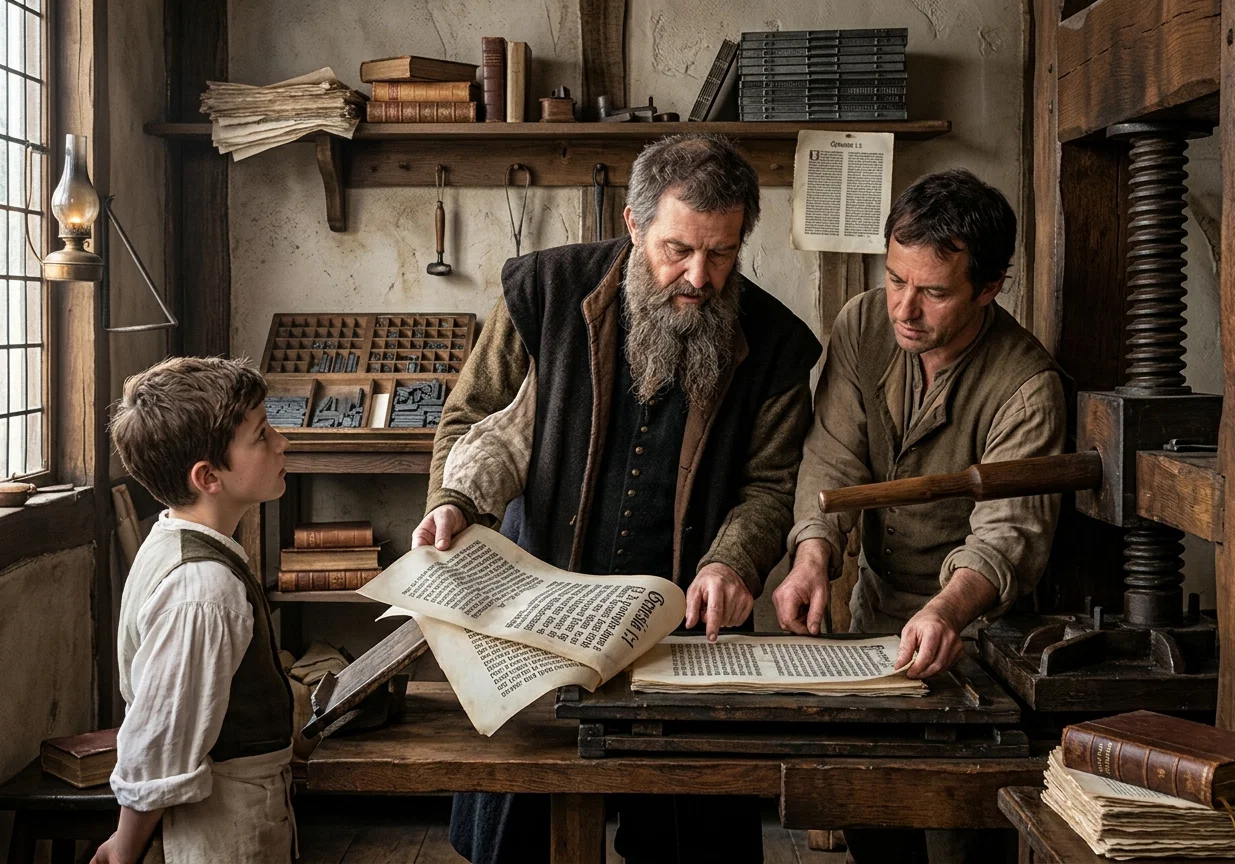
GUTENBERG AT WORK ON THE FIRST PRINTED BIBLE
“All Scripture is given by inspiration of God, and is profitable for doctrine, for reproof, for correction, for instruction in righteousness: that the man of God may be perfect, thoroughly furnished unto all good works. I charge thee therefore before God, and the Lord Jesus Christ, who shall judge the quick and the dead at his appearing and his kingdom; Preach the word.” 2 Tim. 3:16 to 4:2.
From this scripture we learn that the Sacred Writings are profitable for various uses, and that their purpose is to make the man of God perfect, “throughly furnished unto all good works.” The minister of the gospel is therefore charged to preach the Word of God as a sufficient message to those who may be inclined to turn away from the truth and “be turned unto fables.”
Through the prophet John a solemn warning is given against either adding to or taking away from the revelation made through him:—
“I testify unto every man that heareth the words of the prophecy of this book, if any man shall add unto these things, God shall add unto him the plagues that are written in this book: and if any man shall take away from the words of the book of this prophecy, God shall take away his part out of the book of life, and out of the holy city, and from the things which are written in this book.” Rev. 22:18, 19.
While this warning is given with special reference to the book of Revelation, it applies in principle with equal force to all the books which comprise the Bible.
The words of Christ to the Pharisees ought to have special weight in the discussion of this subject:—
“He answered and said unto them, Well hath Esaias prophesied of you hypocrites, as it is written, This people honoreth me with their lips, and their heart is far from me. Howbeit in vain do they worship me, teaching for doctrines the commandments of men. For laying aside the commandment of God, ye hold the tradition of men, as the washing of pots and cups; and many other such like things ye do. And he said unto them, Full well ye reject the commandment of God, that ye may keep your own tradition. For Moses said, Honor thy father and thy mother; and, Whoso curseth father or mother, let him die the death; but ye say, If a man shall say to his father or mother, It is corban, that is to say, a gift, by whatsoever thou mightest be profited by me; he shall be free. And ye suffer him no more to do aught for his father or his mother; making the word of God of none effect through your tradition, which ye have delivered; and many such like things do ye.” Mark 7:9–13.
Every Pharisee was, like the apostle Paul, “more exceedingly zealous of the traditions of my fathers.” While professing great reverence for the Word of God, he did not hesitate to transgress the precepts of that Word if he could find some tradition which would justify such transgression. Such a course was strongly rebuked by the words of Christ, and the conclusion may be legitimately drawn that every so-called tradition should be tested by the Word. This principle has been well stated by the metropolitan of Moscow in Article VIII of his “Comparison of the Differences in Doctrines of Faith Betwixt the Eastern and Western Churches.”—
“The traditions of the church are to be tried by the Holy Scriptures; and traditions respecting articles of faith, which are not to be found in them, ought not to be received; for the Holy Scriptures in many places, forbid the adding of anything whatsoever to the doctrines contained in them.”
It is worthy of notice in this connection that in his teaching and in defending himself against the charges brought against him by the Pharisees, Christ never appealed to tradition, but always to the Scriptures. Thus we find him saying: “Have ye not read what David did?” Matt. 12:3, “Have ye not read?” Matt. 19:4, “Have ye never read?” Matt. 21:16, “Have ye not read?” Matt. 22:31, “Have ye not read this scripture?” Mark 12:10, “Have ye not read in the book of Moses?” Mark 12:26, “Is it not written in your law?” John 10:34, “What is written in the law? how readest thou?” Luke 10:26. Other instances might be cited, but these are sufficient to show that it was the uniform rule of Christ to appeal to the written Word as final authority.
This is the true Protestant principle which was set forth at the very beginning of the Reformation in the sixteenth century:—
“We are resolved, with the grace of God, to maintain the pure and exclusive preaching of his only Word, such as it is contained in the Biblical books of the Old and New Testament, without adding anything thereto that may be contrary to it.”—From the Protest at the Diet of Spires, April 10, 1520, quoted in “History of the Reformation,” D’Aubigné, book 13, chap. 6, par. 13.
It is not surprising that the Reformers, who were coming out of the darkness into light, did not see all things clearly, and that in their teaching they did not repudiate all the errors of Romanism. It remains for the descendants of the Reformers, upon whom a clearer light is shining, to attain to a fuller realization of the principle laid down in the sixteenth century, and to apply to its logical limit the Protestant principle that the Holy Scriptures are a sufficient rule of faith and practice. This will necessarily lead to these results:—
1. All doctrines and practices must be brought to the test of the Holy Scriptures.
2. The statements in any creed must be regarded as entirely subordinate to the teaching of the Bible, and to be tested thereby.
3. Every doctrine and practice which on careful investigation is found to rest upon creed or tradition rather than upon the plain teachings of the Scripture, must be repudiated.
4. No teaching should be condemned as unevangelical which is based upon the authority of the Scriptures, even though it may be out of harmony with some of the modern creeds.
5. In every case the appeal should be made to the Scriptures rather than to a creed or the practice of the church.

“How Readest Thou?”

It is one thing to read the Bible through, Another thing to read to learn and do. Some read it as their duty once a week, But no instruction from the Bible seek; Some read to bring themselves into repute By showing others how they can dispute; While others read because their neighbors do, To see how long ’twill take to read it through.
Some read it for the wonders that are there,— How David killed a lion and a bear; While others read it with uncommon care, Hoping to find some contradictions there. One reads with father’s specs upon his head, And sees the thing just as his father said. Some read to prove a preadopted creed; Hence understand but little that they read, For every passage in the book they bend To make it suit that all-important end. Some people read, as I have often thought, To teach the book instead of being taught; And some there are who read it out of spite.—
I fear there are but few who read it right. So many people in these latter days Have read the Bible in so many ways That few can tell which system is the best, For every party contradicts the rest. But read it prayerfully, and you will see. Although men contradict, God’s words agree; For what the early Bible prophets wrote, We find that Christ and his apostles quote; So trust no creed that trembles to recall What has been penned by one and verified by all.

THE BEREAN LIBRARY

All who desire to study further the important Bible subjects presented in THE PRESENT TRUTH should order from this list of valuable books put up in paper covers, postpaid, at the following very low prices:—
Steps to Christ, 144 pages........$ .25 Thoughts on Daniel, 345 pages........ .25 Thoughts on Revelation, 430 pages........ .35 His Glorious Appearing, 124 pages........ .15 The Sabbath in the Scriptures, 216 pages........ .25 The Sabbath in History, 600 pages........ .50 Capital and Labor, 208 pages........ .25 Here and Hereafter, 360 pages........ .25 Bible Footlights, 320 pages........ .35 Our Paradise Home, 128 pages........ .15 Religious Liberty in America, 448 pp........ .35 The Coming King, 320 pages........ .50
Order from the publishers, whose address is given below.

You have reached the end of this edition.

Review and Herald · Jan 11, 1915