Your ShelfYour Projects

Signs of the Times, Vol. 34, No. 21.

Comfort to God's People

Signs of the Times

May 20, 1908

Pacific Press Publishing Company · Mountain View, California · May 20, 1908

Comfort to God's People

Comfort ye, comfort My people, saith your God: Speak ye comfortably to Jerusalem, and cry to her, That the period of her warfare is fulfilled; That the expiation of her iniquity is accepted; For she hath received from the hand of Jehovah, A full measure of punishment for all her sins. A voice crieth in the wilderness; "Prepare the way of Jehovah! Make straight in the desert, a highway for our God." Every valley shall be exalted, And every mountain and hill shall be brought low; And the crooked shall be made straight, And the rough places a smooth plain: And the glory of Jehovah shall be revealed, And all flesh shall see the salvation of our God: For the mouth of Jehovah hath spoken it. A voice saith, "Proclaim." And what said I shall I proclaim? "Proclaim that all flesh is but grass, And all its glory as the flower of the field: The grass withereth, the flower fadeth, When a vehement wind bloweth upon it: Verily the people are grass. The grass withereth, the flower fadeth, But the word of our God shall stand forever." Ascend, O daughter upon a high mountain, Thou that bringest good tidings to Zion; Exalt thy voice with strength, Thou that bringest good tidings to Jerusalem. Exalt thou it; be not afraid; Say to the cities of Judah, "Behold your God." Behold, the Lord Jehovah shall come with might, And His own arm shall rule for Him. Behold the recompense which He giveth is with Him, And the reward which He bestoweth is before Him. —Isa. 40:1-10. Boothroyd.

With Our Inquirers

“If ye will inquire, inquire ye.”
[All questions to this department will be answered which to the editors will seem to minister to the good of the readers and to the mission of the paper. The same question can not be answered repeatedly in the same volume. The name and address must accompany question, not for publication, but as an evidence of good faith, and that answer may be made by letter if deemed advisable. It is well always to enclose a stamp for reply.]

2505.—The Seed of the Woman.

(1) What is the antecedent of the pronoun “his” in Gen. 3:15? (2) What is the “enmity,” same verse? (3) What is the significance of the one’s “head” and the other’s “heel” being bruised?
1. The antecedent of the pronoun “his” is the “Seed” of the woman, the one great subject of God’s word from that time forward, the one great thing about which all the other great truths of the Bible revolve, until that Seed shall come, whose is the right of the inheritance, and to whom God will give it. That Seed preeminently is Christ, and thru Christ all those who are His.
2. When man sinned, he utterly yielded to Satan. God in His great mercy put a desire for righteousness into the heart of humanity, and that desire for righteousness is also a hatred of the tyranny and the slavery which sin brings. It is that in the human heart and conscience to which the Spirit of God appeals, and which is found in every heart unless that heart is wholly depraved.
3. Sufficiently wounding the head results in fatality; the heel simply that of injury. Satan would be able to bruise the heel of the Seed by persecution, by crippling God’s work in every way possible. Such has been the case thru all the ages. But the bruising of the head will be the utter and absolute destruction of Satan and all who are identified with him.

2506.—Personality of God.

Who is meant by this, the Father, the Son, or both? If both are meant, should it not be personalities of God? God who talked with Moses at the burning bush is God the Son, God who gave His only-begotten Son is God the Father; and then there is the Comforter, the Spirit of God. B. B. No. 1410.
The term “personality of God” almost invariably is used with reference to the invisible God, the Father, concerning whom no image or representation should be made by His children. Thru all Biblical times the Son was in subjection, a representative of the Father. He “gave Himself” “from the foundation of the world,” “became a servant;” and in all the manifestations of Him, either as the “Angel of the covenant” or as Jesus of Nazareth, He was still in the capacity of a servant, the representative of God. During all this time He did not reveal Himself; that was not His object. The purpose of Satan was to reveal himself; the purpose of Christ to reveal the Father, and therefore He tells us, “No man knoweth the Son save the Father; nor knoweth any man the Father, save the Son and he to whomsoever the Son will reveal Him.”
The Spirit of God is common both to Father and Son, “the Spirit of God,” “the Spirit of Christ.” It is that which brings both the Father and the Son to the individual, and this is so stated in those wonderful discourses in John 14 to 16. “I will pray the Father, and He shall give you another Comforter, that He [the Father] may abide with you forever.” John 14:16. Verse 17 states the Spirit “dwelleth with you, and shall be in you;” but He brings Christ, for the eighteenth verse declares, “I will not leave you comfortless; I will come to you.” And again in verse 23, “If a man love Me, he will keep My words; and My Father will love him, and We will come unto him, and make Our abode with him.” They do this by the Spirit which brings Their presence. That Spirit is said to be “poured out,” “shed forth.” “The Holy Spirit is the breath of the spiritual life of the soul. The impartation of the Spirit is the impartation of the life of Christ.” “It is thru the Spirit that Christ dwells in us, and the Spirit of God received in the heart by faith is the beginning of the life eternal.”
The expression, the “Godhead bodily,” is found in Col. 2:9. It simply means that dwelling in the flesh of Jesus Christ was all the power of the Godhead; simply an equivalent of chapter 1:19, “For it pleased the Father that in Him should all the fulness dwell.”

2509.—Baptism.

Can one be baptized without the sprinkling of water or any preacher’s ceremony? If one has truly repented, and his sins are forgiven of God, and has promised to do only what is right, is he not baptized? Baptism does not consist of water, does it?
It seems as tho the inquirer could easily settle his own question. If one truly repents of his sins and receives forgiveness of God, and promises God to do what is right, then he will be baptized, will he not? Baptism means immersion, whelming, covering, and baptism in water, such as John’s baptism. The way in which Jesus Himself was baptized, the way in which the apostles were baptized, and all the early Christians, was the baptism in water which was enjoined by the Lord. “Repent, and be baptized every one of you,” reads the word. The mere act itself does not save. Baptism is an expression of one’s faith. There is a baptism into the Spirit of God, for which the outward baptism in life is to some extent the sign. That does not set aside water baptism, however, any more than it does the Lord’s Supper.

2507.—Swedenborgianism.

What is Swedenborgianism?

Swedenborgianism is the doctrine of one Emanuel Swedenborg, or the system of philosophy and theology taught by him, and which has been developed from his writings by his followers; the doctrine, usages, organization, and characteristics of Swedenborgians. Swedenborg himself lived between the years 1688 and 1772. His form of mysticism was based on revelations claimed to have been received by him, teaching especially an intercourse with the spiritual world and the law of correspondences by which every material thing has a spiritual thing corresponding to it, closely connected with it, or upon the Scriptures allegorically interpreted. According to it there are in things three degrees of being, corresponding to three degrees of being in God; love, the celestial degree; wisdom, the spiritual; and use, the natural; answering to end, cause, and effect. In other words, it is an early form of Spiritualism, and is based on the ancient falsehood of the serpent, “Ye shall not surely die.” They hold that man is an immortal spirit, having a body of flesh, which is laid aside at death, after which man wakes to consciousness in the spiritual world, and according to the life he has acquired on earth dwells in heaven as an angel or seeks an abode with his like in hell. They hold that the second coming of Christ has already taken place, in not the coming in person, but a revelation of Christ in an internal sense of His word, and is the beginning of a new Christian church of divine promise, and a new era of enlightenment and progress among men, all of which is unscriptural.

2508.—The Victories of Joshua.

Verses 23 and 24 of Joshua 10 tell us that the kings of Jerusalem, Hebron, Jarmuth, Lachish, and Eglon were brought forth from the cave, slain, and hanged on five trees. Verses 36 and 37 relate that Joshua captured Hebron, and verse 37 mentions that they took it and smote it (Hebron) with the edge of the sword, and the king thereof. Was there another king of Hebron besides Hoham?
B. B. No. 387.
Evidently there was. The five kings, when they left their cities, joined their forces in the battlefield, and there Joshua met them. Of course when they left their cities, they must have placed some one to rule in their stead, and as soon as they were killed, the rulers left in the cities would naturally be the kings. It is to these, evidently, that verses 36 and 37 refer.

2510.—Taking the Life of Animals.

Does the commandment, “Thou shalt not kill,” mean the prohibiting of taking the life of anything created, such as cattle, sheep, birds, reptiles, insects, etc? M.
Not at all. The command pertains to the human. The Decalogue guides in love to God and love to our fellow men. To try to make it refer to all kinds of beasts, reptiles, and insects, is pushing it to an extreme which will logically lead to fanaticism. The command to Peter, related by Peter in Acts 10:13, 15, teaches this one lesson, that Peter should “not call any man common or unclean.” The vision was given for that purpose and nothing else. The sincere Christian will aim to carry out in his life 1 Cor. 10:31: “Whether therefore ye eat, or drink, or whatsoever ye do, do all to the glory of God.” It will not be mere happiness or safety which will control under such circumstances, but the question will be, What will fit me for better service and will best glorify God?

2511.—Departing and Being with Christ.

Will you explain Phil. 1:21-24?
B. B. No. 839.
The passage reads as follows: “For me to live is Christ and to die is gain. But if I live in the flesh, this is the fruit of my labor; yet what I shall choose I wot not. For I am in a strait betwixt two, having a desire to depart, and to be with Christ; which is far better: nevertheless to abide in the flesh is more needful for you.” If we will read the twentieth verse, we will learn that whether Paul died or lived Christ would be magnified; therefore he did not know which to choose, life or death. If he lived, his life would glorify Christ; if he died, his death as a martyr would arouse others to magnify the One for whom Paul lived and died. Therefore he could not choose between these; he was in a strait betwixt the two. There was, however, a third thing which he preferred, “having a desire to depart and to be with Christ;” which was far, far better than the death, better than the life. The word rendered “depart” is from the same root as the word rendered “return” in Luke 12:36, “And ye yourselves like unto men that wait for their Lord, when He will return from the wedding.” The time that the apostle expected his reward was when Christ should come the second time. See 1 Thess. 4:23-28; Phil. 3:19-21. It was to the time of the second coming that Jesus ever pointed as the reward of His children. Matt. 25:31; 16:27. It was for that returning, that being with Christ, that the apostle longed. That would come about in either of two ways: by the translation of Paul, or by the second coming of Christ, when Paul would be translated with all the righteous.

2512.—Raise from the Dead.

Is there any prophecy in the Old Testament stating that Jesus was to die and rise from the dead on the third day?
Hosea 6:2 is believed by many to refer to this event, the death and resurrection of Jesus. His death is clearly pointed out in Isaiah 53 and in Dan. 9:26, 27.

Made the Stars Also

2513.—Made the Stars Also.—C. K.—The language of Gen. 1:16 does not necessarily teach that the stars were made on the fourth day. After telling us that God brought the sun and moon to be the light-bearers to the world, it gives the added statement, “He made the stars also,” before the six days’ work, but they were made visible on the fourth day by the removal of the clouds which obscured them.

Our Comfort in Trial

By Mrs. E. G. White
GOD sees and tenderly sympathizes with those who are tempted. He hears the voice of supplication and distress. Not a groan, not a tear, not a sigh, escapes His notice. Christ came to this world to work out the plan of redemption in man's behalf, to show him how to overcome the temptations of the enemy. Will God, then, withhold from His children anything that will perfect their characters? If He did not love us, this great sacrifice would not have been made.
THE DIVINE COMFORTER.
The Father's presence encircled Christ, and nothing befell Him but that which infinite love permitted for the blessing of the world. Here was His source of comfort, and it is for us. He who is imbued with the Spirit of Christ abides in Christ. Whatever comes to him comes from the Saviour, who surrounds him with His presence. Nothing can touch him except by the Lord's permission. All our sufferings and sorrows, all our temptations and trials, all our sadness and griefs, all our persecutions and privations, in short, all things work together for good. All experiences and circumstances are God's workmen whereby good is brought to us.
The gift of Christ is our pledge of help in trouble, and of victory in conflict. In Christ is the strength of His people; for to Him all power has been given. "He giveth power to the faint, and to them that have no might He increaseth strength. Even the youths shall faint and be weary, and the young men shall utterly fall; but they that wait upon the Lord shall renew their strength; they shall mount up with wings as eagles; they shall run, and not be weary; and they shall walk, and not faint."
In the darkest hour, let faith pierce the cloud surrounding you; for Christ is behind, and He does all things well. We have a covenant-keeping God, who knows all our necessities, a God who unites with His majesty the gentleness and tenderness of the shepherd. He has pledged Himself to supply all our need. Have faith in Him; for His honor is at stake. He will not alter the thing that has gone out of His mouth. He will fulfil His promise. Absolute power is His, and no obstacle can stand before Him. His understanding is infinite; He can not err. He is never in perplexity in regard to the means that He will employ. He says,
"Fear thou not; for I am with thee. . . . I the Lord thy God will hold thy right hand, saying unto thee, Fear not, I will help thee."
Nothing of the world can make sad those whom Jesus makes glad by His presence. In perfect acquiescence there is perfect peace. "Thou wilt keep him in perfect peace, whose mind is stayed on Thee; because he trusted in Thee." Our lives may seem a tangle; but as we commit our lives to the keeping of the Master-worker, He will bring out the pattern of life and character that will be to His own glory.
As thru Jesus we enter into rest, heaven begins here. We respond to His invitation, "Come, learn of Me," and in thus coming, we begin the life eternal. Heaven is a ceaseless approaching to God thru Christ. The longer we are in the heaven of bliss, the more and still more of glory will be revealed to us; and the more we know of God the more intense will beour happiness. As we walk with Jesus in this life, we may be filled with His love, satisfied with His presence. All that human nature can bear, we may receive here. But what is this compared with the hereafter! There “are they before the throne of God, and serve Him day and night in His temple; and He that sitteth on the throne shall dwell among them. They shall hunger no more, neither thirst any more; neither shall the sun light on them, nor any heat. For the Lamb which is in the midst of the throne shall feed them, and shall lead them unto living fountains of waters; and God shall wipe away all tears from their eyes.”

The Gospel in Christ Jesus

By Charles L. Taylor

Christ the Creator.

“Jesus Christ the same yesterday, and to-day, and forever.”
GOD would have all men truly to know His Son, the Christ of the Bible. He has therefore introduced Him as One who is “the same yesterday, and to-day, and forever.” To know the Christ of “to-day” we must know the Christ of “yesterday.” To-day He is “the same” that He was yesterday. When one has been taught Him as He was yesterday, he is able to trust Him as He is to-day; and being able to trust Him as He is to-day, the believer enjoys in anticipation all that He will be thruout the “forever.”
“The same yesterday, and to-day, and forever.” What a marvelous “yesterday”! What a glorious “to-day”! What a sublime “forever”!
What was our Lord’s “yesterday”? And what the “forever”? Ah, “yesterday” was the eternal past, even as “forever” is the eternal future. And from the standpoint of the little moment called “to-day,” we are permitted to view the Christ of those two eternities, and to know that into “to-day” God would press for our salvation all the glory of Him who is “from everlasting to everlasting” (Ps. 90:2), “whose goings forth have been from of old, from the days of eternity” (Micah 5:2, margin).
Jesus Christ is the “I Am” of Scripture. Of Himself He said (John 8:58), “Before Abraham was, I am.” By prophetic pen He caused it also to be written: “The Lord possessed Me in the beginning of His way, before His works of old. I was set up from everlasting. . . . When He appointed the foundations of the earth, then I was by Him, as one brought up with Him; and I was daily His delight, rejoicing always before Him.” Prov. 8:22-30.
“Before the foundation of the world” (Eph. 1:4), away back in the unknown, eternal past, Jesus Christ was one with the Father in might, in wisdom, and in counsel. “The Sovereign of the universe was not alone in His work of beneficence. He had an Associate,—a Coworker who could appreciate His purposes, and could share His joy in giving happiness to created beings,” as “Wonderful, Counselor, the mighty God, the everlasting Father, the Prince of Peace” (Isa. 9:6). He united with the Father in planning the great universe, and as supreme Commander of the forces of heaven, He carried into execution the divine scheme.
This is all told in the beautiful, familiar words of the beloved disciple: “In the beginning was the Word; and the Word was with God, and the Word was God. The same was in the beginning with God. All things were made by Him; and without Him was not anything made that was made.” John 1:1-3. See also Col. 1:13-16.
But while Jesus Christ is thus placed before us as the great Creator, we must bear in mind that the Father also wrought in the work. That Father and Son were together in framing the worlds and their inhabitants is clearly set forth in the record of man’s creation: “And God said, Let Us make man in Our image.”
The Christ of “yesterday” was most emphatically the Creator of all things “that are in heaven, and that are in earth.” By the word of Christ of “yesterday” “were the heavens made; and all the host of them by the breath of His mouth.” “For He spake, and it was done; He commanded, and it stood fast.” Ps. 33:6, 9. The Christ of “yesterday” spoke, and forth from the depths of His own eternal infinitude sprang the worlds of the universe. He could and did speak of “things which be not as tho they were” (Rom. 4:17); for when He uttered His creative word, things which had not been came into existence.
But, listen! The Christ of “yesterday” is “the same” to-day. He is our Creator (Isa. 40:28), and He is also our Redeemer (Isa. 41:14). The power that operated to give the world a being and form and beauty is the power which in the Gospel recreates man unto everlasting life; for “if any man be in Christ, he is a new creature.” 2 Cor. 5:17. He who at the beginning said, “Let there be light” (Gen. 1:3), is He who to-day speaks light and life and joy to mankind (2 Cor. 4:6). And He who created worlds and who, by His power, upholds them and keeps them moving on in their ceaseless rounds (Isa. 40:26), is He who to-day can and does uphold every man, woman, and child (Heb. 7:25; Jude 24).
Thank God, the Christ of “yesterday” is the Christ of “to-day.” Creator and Upholder of all things in heaven and earth yesterday, He is Creator and Upholder of all things in heaven and earth to-day. He is “our dwelling-place in all generations.” Ps. 90:1. Truly, the child of God, tho often travel-stained, footsore, and weary, has been given “a strong consolation,” “an anchor of the soul, both sure and steadfast” (Heb. 6:18-20) in the Creator-Christ of to-day.

What Hinders Prayer.

We are hindered from prayer, not so much by intellectual skepticism as to the reality and efficacy of prayer as by our moral timidity and cowardice. We do not want to venture out upon God. We do not want the deeper potencies of life struck open in us. We do not want to meet the moral challenge and test of prayer. Or our hearts are not really simple and trustful. They are proud and self-confident. They prefer to be at ease, and shrink from the exposing contact of God. If we were willing to pray, we should soon know of prayer whether it be a futility or a fellowship and a power.
What is all this but to say that life is living,—not offering excuses for not living, not speculating as to how to live, not lamenting that it is impossible ever to know how, but living. We must live. And there is only one way to live, and that is to live right. The fundamental question is the moral question. Faith is action. "Have faith in God," said Jesus, commanding faith, as is legitimate only if faith is action. And those who are of the truth hear His voice and respond.—The Sunday School Times.

Never Alone

In speaking of the promise “And, lo, I am with you alway, even unto the end of the world,” Dr. Mabie told of a missionary who had spent years in the heart of China, cut off from communication with his people for eighteen months at a time, who said, “I have been much alone, but never lonely,” and all because of that surprising thing—that wonderful Presence.

Action and Endurance

The life of a man is made up of action and endurance; and life is fruitful in the ratio in which it is laid out in noble action or in patient perseverance.

Wherever Jesus Comes

WHEREVER Jesus comes, somebody knows and wants to be where He is; for the great, throbbing, weary, weeping, sad, broken heart of the world needs Jesus.

Our King.

THERE is a King of glory, Erelong on earth to rise, Sung in prophetic story, Descending from the skies; The Babe in Bethlehem, 'tis He; It is the Man of Calvary— Not crowned with thorns to-day, But crowned with everlasting glory now! Not crowned with thorns, and gory, Not mocked and led away, But crowned with glory now! —Anon.

The Bible Scientific

By G. D. Ballou
READER, when you see this word "scientific," don't get frightened and look around for something else to read. Let us sit down and reason together for a short time. What is science?—Knowledge systematized. Knowledge put in order, made simple, made plain, made clear, so that a common mind can grasp it.
That is "science falsely so-called" which puts knowledge in such terms that it takes years to conquer the language used in conveying it, or, to say the very least, it is a very false, unkind, and foolish method of attempting to teach science.
The most profoundly learned men of all times have used the simplest language in conveying to the people important truths. The practical science of arithmetic, the foundation of all numerical calculation and of all business, is taught in language so simple that the sixteen-year-old boy can conquer every principle taught in the book.
History, that science of the past which reveals the effects of all sciences upon all the race in all ages, to be acceptable must be so stated as not to tax the mind too greatly in mastering it. The most successful writers have used the language of the common people so as to make visible to human minds the thoughts and actions of ages gone. Impartiality has been a factor of chief importance with every successful writer.
The common family almanac is a marvel of scientific attainment. This document in its calculations of the great problems of astronomy uses mainly the language of appearance. It says, The sun rises and sets, the moon rises and sets, Venus rises and sets; and uses almost as simple language in reference to all the phenomena of the heavens.
Now the Bible is noted for the sublime simplicity of its language. The story of Creation, the terseness of the Ten Commandments, the comprehensiveness of the Sermon on the Mount, especially the Lord's Prayer and the Golden Rule; the mathematical accuracy of its history, yea, even of its prophecies, stamps it thru and thru with the seal of genuine science. This book, too, uses the language of appearance. It says the sun rises and sets. It says the sun stood still at Joshua's command. In that wonderful ancient case of spirit materialization, when the witch had presented to her the form of Samuel, it uses simply the language of appearance, just what the on-looker seemed to see, that is what the record states.
The record it gives of men's lives is a towering monument to its wonderful impartiality. The great boast of science is its justice and impartiality. Did ever human writer produce such impartial biographies as are found in this book? Take the life of David or Solomon. Has the best profane historian ever been so successful in telling the exact truth, both the good and the evil, as the scripture writer? Without bias of fear or favor, the life is laid bare. No attempt to shield the friend, nor the shadow of an attempt to denounce the enemy.
There is a divinity about this book which reveals the science of humanity—its past, present, and future. As Saul said about the Christ after He revealed Himself to him on the way to Damascus: "I count all things but loss for the excellency of the knowledge of Christ Jesus my Lord: for whom I have suffered the loss of all things, and do count them but dung, that I may win Christ." So there is an excellency in the divine science, once it is appreciated, that makes the human pretensions to science look exceedingly meager and cheap.
We can not help feeling a kind of commiseration for the man who is ready to laud the wordy vaporings of the so-called science of evolution to the skies, and despise the simple story of Creation. The record of Moses needs no defense, explanation, or apology, but modern geology is all the while revamping and remodeling itself. No sooner has one writer finished than another feels sure he can do better with his system of suppositions, and so the process of "evoluting" geology goes on. Taking it as a whole it looks about like one fact, two suppositions, three guesses, and a conclusion; and it seems as if there must be something wrong with the heart and soul and mind that can be so satisfied with a system that demands so much readjusting and that can flippantly reject the Bible science of creation which fully explains every fact of geology.
The doctrine of a flood is the only thing that can explain how fossilized beasts were surprised by a sudden catastrophe and overwhelmed just as they perished. It will take nothing less than the humility and meekness of a child to be able to bow in submission to the divine will. Logic alone will not even accept of the perfect science.
(Concluded next week.)

The Only Blessed Hope.

THE resurrection of Christ and His second coming are the hope, the only hope, “the blessed hope” (Titus 2:13) of the children of God. If these great events do not occur, man is forever lost. But they will take place. The Son of God will come with all the shining angelic host; the dead shall hear His voice, and those who sleep in Him shall come forth to everlasting life and immortality.
This was the hope of the promise made by God unto the fathers that God should raise the dead. Acts 26:6-8. It was the hope of the patient patriarch (Job 19:25-27; 14:15); it was the hope of David (Ps. 17:15); it was the hope of the prophets (Isa. 26:19; Jer. 31:15-17; Ezekiel 37; Dan. 12:1; Hosea 13:14). Christ taught it, and the same promise and hope and comfortwere set before the church by His inspired apostles.
Why, then, will so many Christians reject the plain teachings of the word on so important and vital a subject, and accept a pagan theory of which the pagans were not certain. The Bible theory,—eternal life only thru our Lord Jesus Christ at His coming and the resurrection, thru faith in Him,—it is true, does not glorify or exalt man, but it does glorify our God and Christ Jesus our Lord.

When Jesus Comes.

SOME people seem surprised at the eagerness which Adventists display for the return of the Lord Jesus Christ to this earth. But why should they not be eager for His return, when that return means—
Reunion for the parted; Health for the sick; Land for the landless; Habitations for the homeless; Plenty for the destitute; Bread for the hungry; Water for the thirsty; Sight for the blind; Hearing for the deaf; Speech for the dumb; Youth for the aged; Liberty for the captives; Riches for the poor; “Beauty for ashes;” Immortality for mortality; Life for the dead; “The oil of joy for mourning;” Peace for the troubled; Rest for the weary; Gladness for the sorrowing; Songs for the sighing; Society for the friendless; Perfect bodies for the crippled; Crowns for crosses; Light for darkness; Strength for weakness; Harmony for discord. “With an eternal inheritance in the kingdom of God for all His ransomed people.”

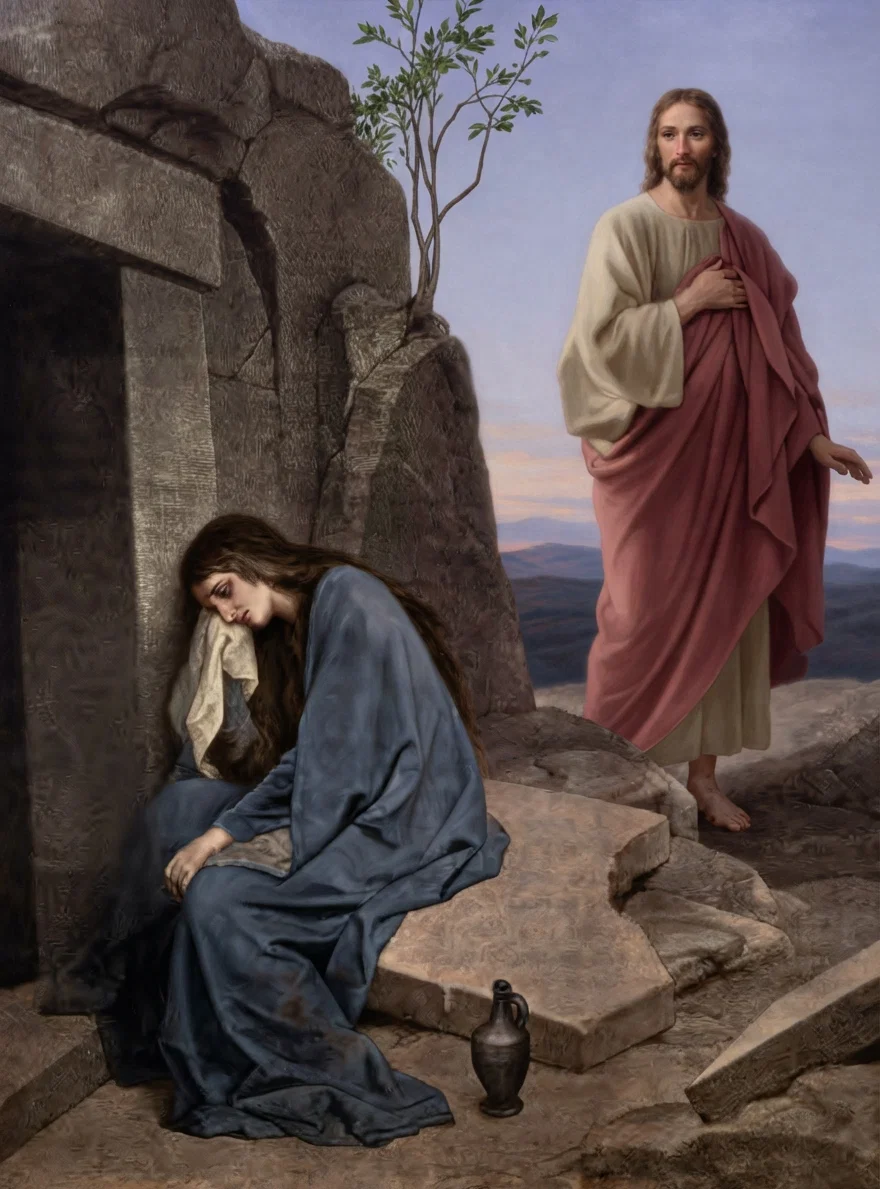
Christ Risen!

How full of meaning! It points backward and looks forward. Christ risen implies Christ crucified, dead, buried; death and the grave conquered, redemption sealed, a way of salvation for the whole race of mankind provided as a gift.
So, to contemplate this great fact is to be reminded of the suffering of our Lord, His obedience even unto death for our sake. We can not look upon Christ risen and not see the judgment hall, the mockings and the scourging, the cross, and hear His dying groans, His plea for mercy in behalf of those who sinned against His body on the tree.
But Christ risen inspires faith in us for the future. The cross is transformed into a synonym for hope and blessed assurance. It sheds a radiant light on the future. “Because I live, ye shall live also.” He conquered death not only for Himself, but equally for all who believe in Him. He rose from the dead, and is able to raise others from the dead.
Christ risen is the greatest fact in history and the most comforting theme of the Gospel. It is the keystone of the whole structure of Christianity. Christ dead demonstrates His humanity; Christ risen proves His divinity beyond question, both of which facts are essential to the plan of salvation. Christ risen is the Rock upon which our hope depends. So taught Paul by inspiration, saying: “If Christ be not risen, then is our preaching vain, and your faith is also vain. But now is Christ risen from the dead, and become the first-fruits of them that slept. O death, where is thy sting? O grave, where is thy victory? Thanks be to God, which giveth us the victory thru our Lord Jesus Christ.” We look back to the triumph of Christ and joyfully look forward to our own victory over the grave thru Him who is the Resurrection and the Life.—The Evangelical Messenger.

Entering in at the Door.

JESUS said, "I am the door; by Me if any man enter in, he shall be saved, and shall go in and go out, and shall find pasture."
In these beautiful words are set forth the perfect freedom and liberty of the true child of God. He that hath truly entered in by Christ, may enjoy all this freedom to go in and come out and feed continuously in the green pastures that the Good Shepherd has provided for His flock.
But the difficulty lies in getting in at the Door. It is simple and easy, if undertaken in God's appointed way; while it is utterly impossible, if undertaken in any other way. Many are so unwilling to heed the instruction to enter in by the Door, that they fail entirely of entering in, or, perchance, brand themselves as thieves and robbers by seeking to climb up some other way.
It will be noticed that Jesus uses the significant expression of "climbeth up," regarding those who seek to get in by some other way. This suggests at once that many are unsatisfied with the conditions of entering in by the Door. They consider it too humiliating—beneath them. They must "climb up," put forth some distinguished effort of their own, in order to get in. But God has made no mistake in placing the Door. It is amply large to let in any sin-sick, repentant lost one, but no one big with self can find admittance.
"I am the door." No Pharisee can enter. No one filled with self-esteem is admitted. No rich man, counting on his wealth as an asset for entrance, can come in. No person, trusting in his morality, any inherent goodness he may think to possess, will be welcomed by the humble Shepherd. No false accuser of his brethren, no liar, no dishonest or deceitful person, can enter. It is useless to offer a bribe, for that Holy One can not be swerved in any manner by the richest of earth's gifts. Ah! there is but one way—to fall at His feet, and say what the publican of old said: "Be merciful to me, a sinner." This sincere cry for help is immediately recognized by the true Shepherd. It is the cry of distress. As the helpless call of the babe in distress reaches the ear of the mother, so this cry reaches the trained ear of Him who was sent to seek and to save the lost; and no soul ever yet touched this self-surrendered chord who was refused. This is entering "by the Door" into the fold.
Peter entered that chilly morning of his Master's betrayal, when he turned aside after denying his Lord, and wept bitterly, confessing his sin. The repentant one entered when she found herself alone with the Sinless One, her accusers all having departed; and thru her tears looked up into the peaceful face of her Deliverer, and saw His kind look when He spoke the forgiveness of her sins in the words, "Neither do I condemn thee: go thy way; from henceforth sin no more." Paul was admitted when he reached that place in his experience where he could say, "Howbeit what things were gain to me, these have I counted loss for Christ. Yea verily, and I count all things to be loss for the excellency of the knowledge of Christ Jesus my Lord: for whom I suffered the loss of all things, and do count them but refuse, that I may gain Christ." Phil. 3:7, 8.
God has purposed that Christ alone shall be exalted. His name must stand above every other name. Those unwilling to yield their wills to the will of the Father proclaim themselves unworthy of the joys of companionship with those within the fold, and, more than this, reveal that they are unacquainted with the lovely character of the Shepherd who gave Himself for the sheep.
Jesus waits to give entrance to all who in contriteness of heart seek admittance. He has given those within the fold the precious privilege of "going out," that they may enter into the joy with Him of seeking for and gathering other lost ones into the sheltered place of His presence, where there is found such an abundance of peace and joy and rest, before the storm-cloud bursts without. It is His will that they also "may have life, and may have it abundantly."
Reader, have you entered in by the Door? Have you experienced the joy of a full self-surrender for Christ? If not, you have not yet really lived at all. You are feeding upon husks. Your life is vain. You are lost. Why trust longer in such a vain hope? Why not surrender that proud, deceitful heart, and receive in exchange a new, clean one? May God's Spirit not leave you until you make the wise choice of yielding your worthless, sinful life, and receiving in its place all that Heaven has for you.
T. E. BOWEN.
Continue reading: Apostolic Example