JESUS in His childhood lived in a little mountain village. He was the Son of God, and He might have had any place on earth for His home. He would have been an honour to any place. But He did not go to the homes of rich men or the palaces of kings. He chose to dwell among the poor in Nazareth.
Jesus wants the poor to know that He understands their trials. He has borne all that they have to bear. He can sympathise with them and help them.
Of Jesus in His early years the Bible says, “The child grew, and waxed strong in spirit, filled with wisdom; and the grace of God was upon Him” “And Jesus increased in wisdom and stature, and in favour with God and man.” His mind was bright and active. He was of quick understanding, and showed a thoughtfulness and wisdom beyond His years. Yet His ways were simple and childlike, and He grew in mind and body as other children grow.
But Jesus was not in all things like other children. He always showed a sweet, unselfish spirit. His willing hands were always ready to serve others. He was patient and truthful. Firm as a rock in standing for the right, He never failed to be gentle and courteous toward all. In His home, and wherever He might be, He was like a cheerful sunbeam.
He was thoughtful and kind toward the aged and the poor, and He showed kindness even to the dumb animals. He would care tenderly for a little wounded bird, and every living thing was happier when He was near.
In the days of Christ the Jews gave much care to the education of their children. Their schools were connected with the synagogues, or places of worship, and the teachers were called rabbis, men who were supposed to be very learned. Jesus did not go to these schools, for they taught many things that were not true. Instead30of God's word, the sayings of men were studied, and often these were contrary to that which God had taught through His prophets.
God Himself by His Holy Spirit instructed Mary how to bring up His Son. Mary taught Jesus from the Holy Scriptures, and He learned to read and study them for Himself.
Jesus also loved to study the wonderful things which God had made, in the earth and in the sky. In this book of nature He saw the trees and plants and animals, and the sun and the stars. Day by day He watched them, and tried to learn lessons from them, and to understand the reason of things. Holy angels were with Him, and helped Him to learn from these things about God. Thus, as He grew in height and strength, He grew also in knowledge and wisdom.
Every child may gain knowledge as Jesus did. We should spend our time in learning only that which is true. Falsehood and fables will do us no good. Only the truth is of any value, and this we may learn from God's Word and from His works. As we study these things the angels will help us to understand. We shall see the wisdom and goodness of our heavenly Father. Our minds will be strengthened, our hearts will be made pure, and we shall become more like our Saviour.
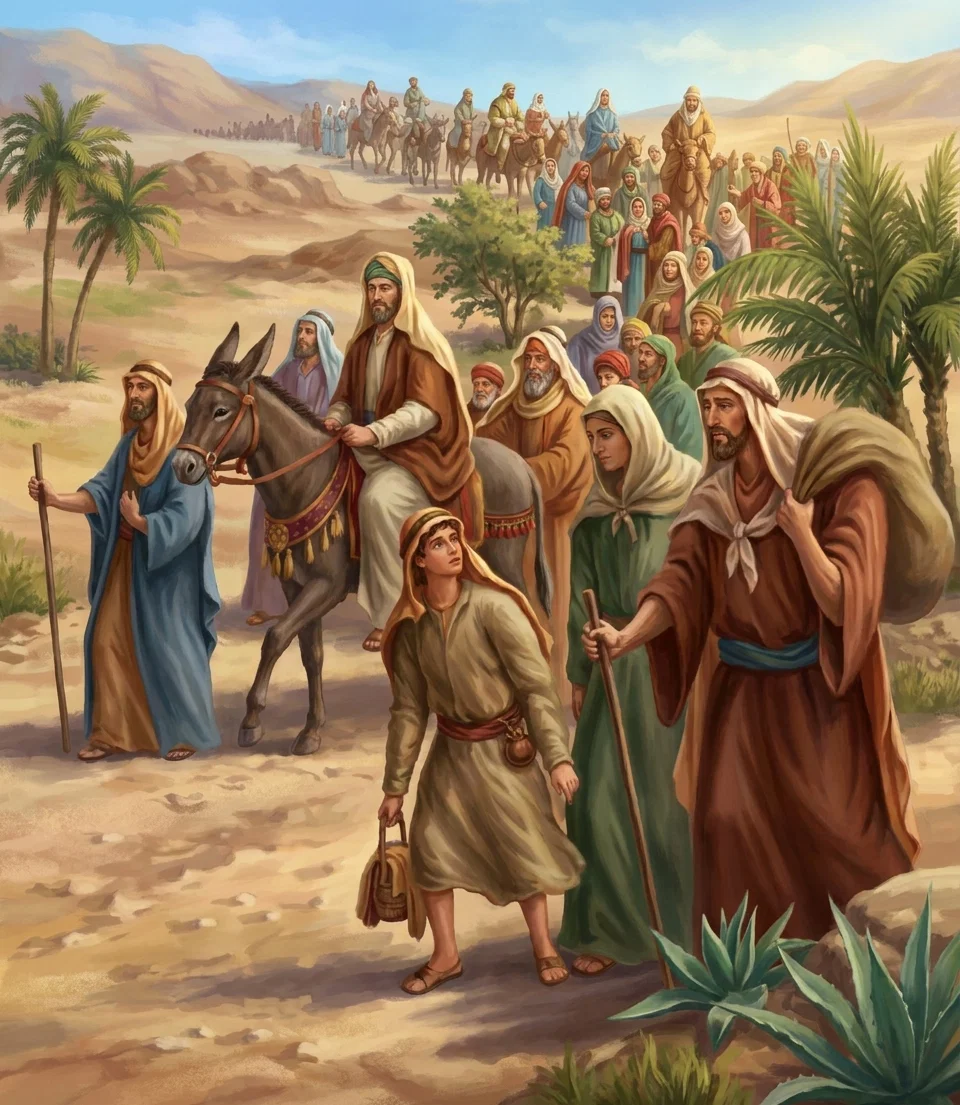
Every year Joseph and Mary went to Jerusalem to the feast of the Passover. When Jesus was twelve years old, they took Him with them.
GOING UP TO THE PASSOVER.
This was a pleasant journey. The people travelled on foot, or rode on oxen or asses, and it took several days to go. From all parts of the land, and even32from other countries, the people went to this feast, and those from the same place usually travelled together, in a large company. The feast was held near the close of March or the beginning of April. This was springtime in Palestine, and the whole land was bright with flowers, and glad with the song of birds. As they travelled, parents told their children of the wonderful things that God had done for Israel in ages past. And often they sang together some of the beautiful psalms of David.
In the days of Christ the people had grown cold and formal in their service to God. They thought more of their own pleasure than of His goodness to them. But it was not so with Jesus. He loved to think about God. As He came to the temple, He watched the priests in their work. He bowed with the worshippers as they knelt to pray, and His voice joined in the songs of praise.
Every morning and evening a lamb was offered upon the altar. This was to represent the death of the Saviour. As the child Jesus looked upon the innocent victim, the Holy Spirit taught Him its meaning. He knew that He Himself, as the Lamb of God, must die for the sins of men.
With such thoughts in His mind, Jesus wanted to be alone. So He did not stay with His parents in the temple, and when they started for home He was not with them.
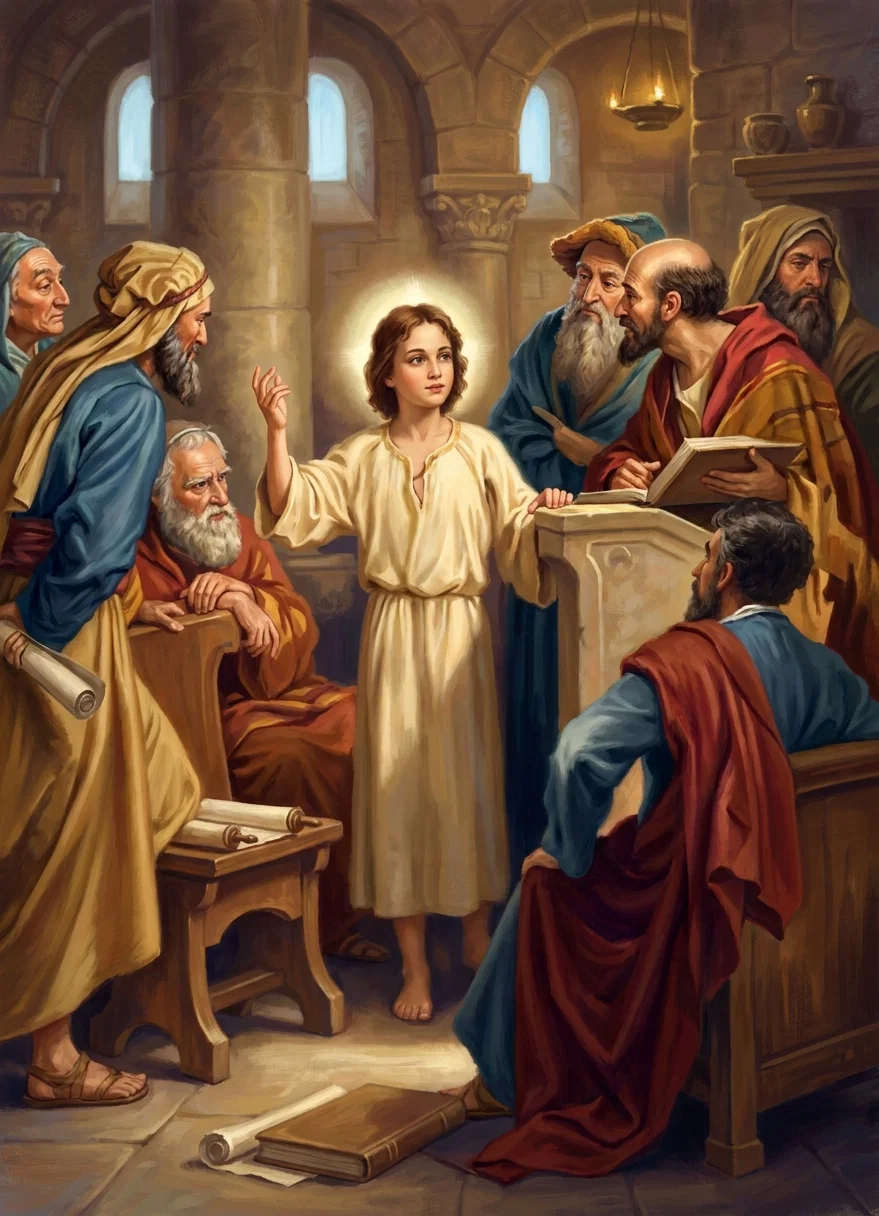
In a room connected with the temple there was a school taught by the rabbis, and to this place after a while the child Jesus came. He sat with the other youth at the feet of the great teachers, and listened to their words. The Jews had many wrong ideas about the Messiah. Jesus knew this, but He did not contradict the learned men. As one who wished to be taught, He asked questions about what the prophets had written. The fifty-third chapter of Isaiah speaks of the Saviour’s death, and Jesus read this chapter, and asked its meaning.
The rabbis could give no answer. They began to question Jesus, and they were astonished at His knowledge of the Scriptures. They saw that He understood the Bible far better than they did. They saw that their teaching was wrong, but they were not willing to believe anything different.
Yet Jesus was so modest and gentle that they were not angry with Him. They wanted to keep Him as a student, and teach Him to explain the Bible as they did.
When Joseph and Mary left Jerusalem on their journey toward home, they did not notice that Jesus stayed behind. They thought that He was with some of their friends in the company. But on stopping to camp for the night, they missed His helpful hand. They looked for Him throughout the company, but in vain.
The Child Jesus Among the Doctors.
Joseph and Mary were in great fear. They remembered how Herod had tried to kill Jesus in His infancy, and they were afraid that some evil had now befallen Him. With sorrowful hearts they hastened back to Jerusalem; but it was not till the third day that they found Him.
Great was their joy at seeing Him again, yet Mary thought that He was to blame for leaving them. She said:—
“Son, why hast Thou thus dealt with us? behold, Thy father and I have sought Thee sorrowing.”
“How is it that ye sought Me?” Jesus answered; “wist ye not that I must be about My Father’s business?”
As He spoke these words, Jesus pointed upward. On His face was a light at which they wondered. Jesus knew that He was the Son of God, and He had been doing the work for which His Father had sent Him into the world.
Mary never forgot these words. In the years that followed, she better understood their wonderful meaning.
Joseph and Mary loved Jesus, yet they had been careless in losing Him. They had forgotten the very work which God had given them to do. By one day's neglect they lost Jesus. In the same way to-day many lose the Saviour from their company. When36we do not love to think about Him, or pray to Him; when we speak idle, unkind, or evil words, we separate ourselves from Christ. Without Him, we are lonely and sad. But if we really desire His company, He will always be with us. With all who seek His presence, the Saviour loves to stay. He will brighten the poorest home, and gladden the lowliest heart.
Though He knew that He was the Son of God, Jesus went home to Nazareth with Joseph and Mary. Until thirty years of age, He was "subject unto them." He who had been the Commander of heaven was on earth a loving and obedient son. The great things brought to His mind by the service of the temple were hidden in His heart. He waited until God's time to begin His appointed work.
Jesus lived in the home of a peasant, a poor37man. Faithfully and cheerfully He did His part in helping to support the family. As soon as He was old enough, He learned a trade, and worked in the carpenter's shop with Joseph.
In the coarse dress of a common labourer He passed through the streets of the little town, going to and from His work. He did not use His divine power to make His life easier for Himself.
As Jesus worked in childhood and youth, He grew strong in body and mind. He tried to use all His powers in such a way as to keep them in health, that He might do the best work in every line. Whatever He did was done well. He wanted to be perfect, even in the handling of tools. By His example He taught that we ought to be industrious, that we should do our work carefully and well, and that such work is honourable. All should find something to do that will be helpful to themselves and to others. God gave us work as a blessing, and He is pleased with children who cheerfully take their part in the duties of the household, sharing the burdens of father and mother. Such children will go out from the home to be a blessing to others.
The youth who try to please God in all that they do, who do right because it is right, will be useful in the world. By being faithful in a humble place they are fitting themselves for a higher position.
DAYS OF CONFLICT.
The Jewish teachers made many rules for the people, and required them to do many things that God had not commanded. Even the children had to learn and obey these rules. But Jesus did not try to learn what the rabbis taught. He was careful not to speak disrespectfully of these teachers, but He studied the Scriptures, and obeyed the laws of God. Often He was reproved for not doing what others did. Then He showed from the Bible what was the right way.
Jesus was always trying to make others happy. Because He was so kind and gentle, the rabbis hoped to make Him do as they did. But they could not. When urged to obey their rules He asked what the Bible taught. Whatever that said, He would do.
This made the rabbis angry. They knew that their rules were contrary to the Bible, and yet they were displeased with Jesus for refusing to obey them. They complained of Him to His parents. Joseph39and Mary thought the rabbis good men, and Jesus suffered blame, which was hard to bear.
The brothers of Jesus took sides with the rabbis. The words of these teachers, they said, should be heeded as the word of God. They reproved Jesus for setting Himself above the leaders of the people.
The rabbis thought themselves better than other men, and they would not associate with the common people. The poor and ignorant they despised. Even the sick and suffering they left without hope or comfort.
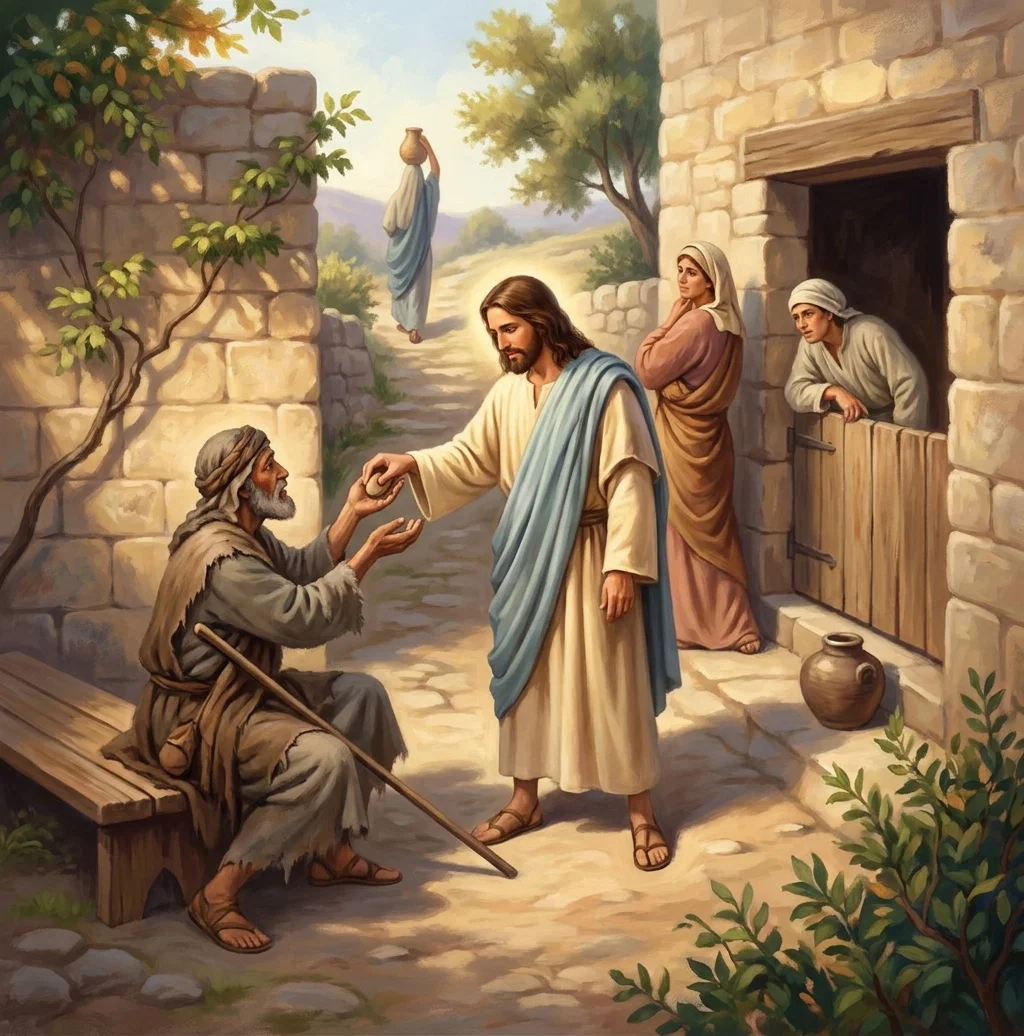
Jesus showed a loving interest in all men. Every suffering one whom He met, He tried to help. He had little money to give, but He often denied Himself of food in order to help others. When His brothers spoke harshly to poor, wretched beings, Jesus would go to these very ones and speak words of kindness and encouragement. To those who were hungry and thirsty, He would bring a cup of cold water, and often would give them the food intended for His own meal.
All this displeased His brothers. They threatened and tried to terrify Him, but He kept right on, doing as God had said.
Many were the trials and temptations that Jesus had to meet. Satan was always watching to overcome Him. If Jesus could have been led to do one wrong act, or to speak one impatient word, He could40not have been our Saviour, and the whole world would have been lost. Satan knew this, and it was for this reason that he tried so hard to lead Jesus into sin. The Saviour was always guarded by heavenly angels, yet His life was one long struggle against the powers of darkness. Not one of us will ever have to meet such fierce temptations as He did.
Jesus Giving to the Poor.
But to every temptation He had one answer: "It is written." The wrong-doing of His brothers He did not often rebuke, but He told them what God had said.
Nazareth was a wicked town, and the children and youth tried to have Jesus follow their evil ways. He was bright and cheerful, and they liked His company. But His godly principles roused their anger. Often for refusing to join in some forbidden act, He was called a coward. Often He was sneered at, as being altogether too particular about little things. To all this His answer was: It is written, “The fear of the Lord, that is wisdom; and to depart from evil is understanding.”
Jesus did not contend for His rights. When roughly used, He bore it patiently. Because He was so willing and uncomplaining, His work was often made needlessly hard. Yet He was not discouraged, for He knew that God smiled upon Him.
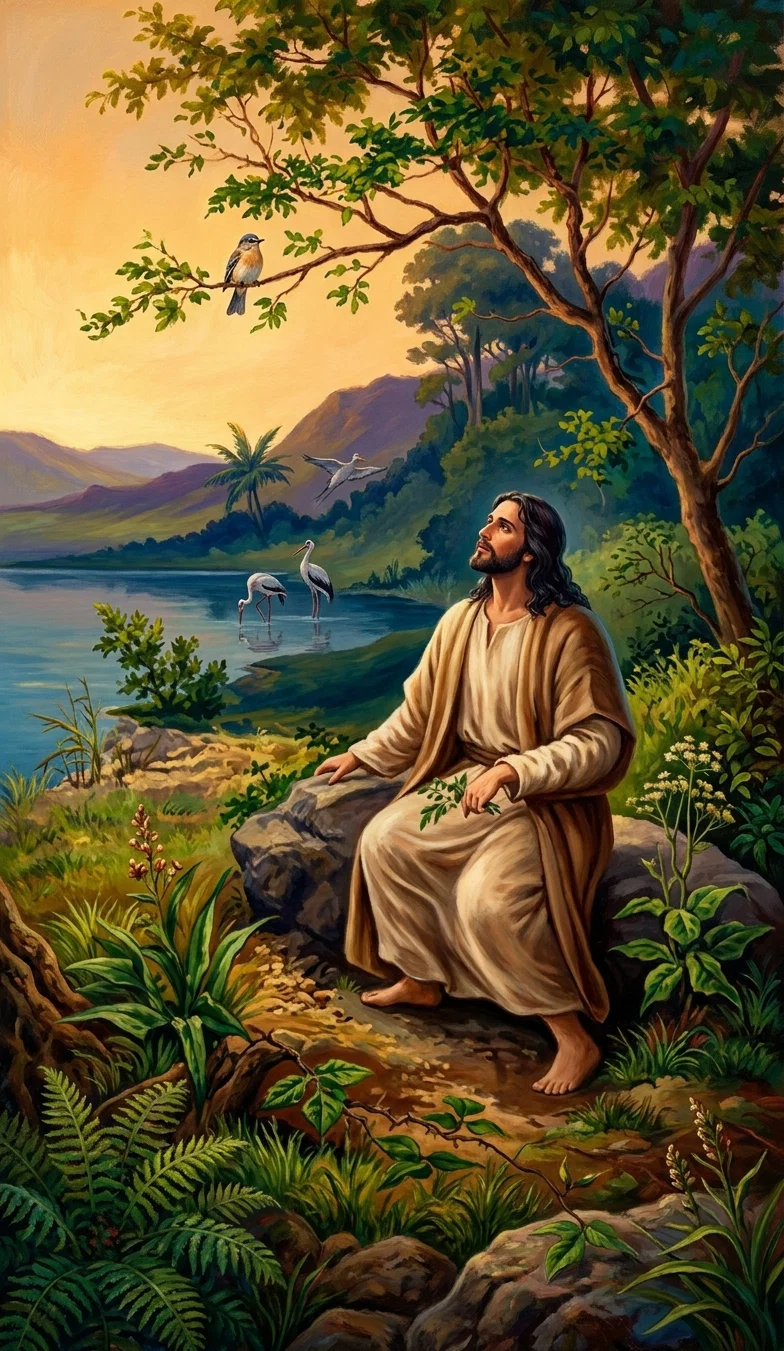
His happiest hours were found when alone with nature and with God. When His work was done, He loved to go into the fields, to meditate in the green valleys, to pray to God on the mountain-side, or amid the trees of the forest. He listened to the lark carolling forth music to its Creator, and His voice joined the song of praise and thanksgiving. With the voice of singing He welcomed the morning42light. The break of day often found Him in some quiet place, thinking about God, studying the Bible, or in prayer. From these peaceful hours He would return to His home to take up His duties again, and to give an example of patient toil.
Wherever He was, His presence seemed to bring the angels near. The influence of His pure, holy life was felt by all classes of people. Harmless and undefiled, He walked among the thoughtless, the rude, the uncourteous; amid the unjust taxgatherers, the reckless prodigals, the unrighteous Samaritans, the heathen soldiers, and the rough peasants. He spoke a word of sympathy here, and a word there, as He saw men weary, yet compelled to bear heavy burdens. He shared their burdens, and repeated to them the lessons He had learned from nature, of the love, the kindness, the goodness of God.
He taught them to look upon themselves as having precious talents, which if rightly used would gain for them eternal riches. By His own example He taught that every moment of time is of value, and should be put to some good use. He passed by no human being as worthless, but tried to encourage the roughest and most unpromising. He told them that God loved them as His children, and that they might become like Him in character.
So in a quiet way Jesus from His very childhood worked for others. This work none of the learned teachers, nor even His own brothers, could make Him give up. With an earnest purpose He carried out the design of His life, for He was to be the light of the world.
THE BAPTISM.
WHEN the time for Christ’s public ministry had come, His first act was to go to the river Jordan, and be baptised by John the Baptist.
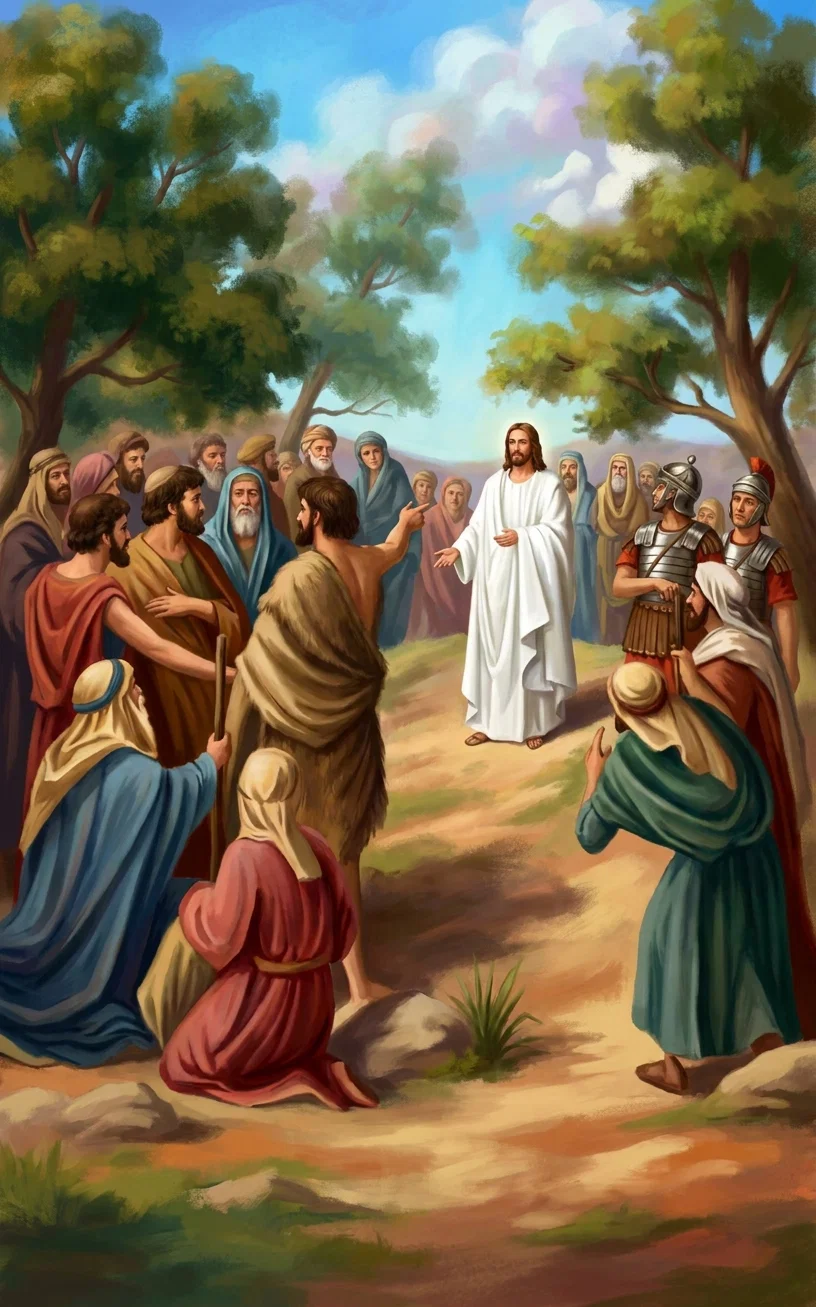
John had been sent to prepare the way for the Saviour. He had preached in the wilderness, saying, “The kingdom of God is at hand ; repent ye, and believe the gospel.” Multitudes flocked to hear him. Many were convicted of their sins, and were baptised by him in the Jordan.
God had made known to John that some day the Messiah would come to him and ask to be baptised. He had also promised that a sign should be given him, so that he might know who it was. When Jesus came, John saw in His face such signs of His holy life, that he forbade Him, saying: “I have need to be baptised of Thee, and comest Thou to me?”
“And Jesus answering, said unto him, Suffer it to be so now; for thus it becometh us to fulfil all45righteousness.” And as He said this, there was seen upon His face the same heavenly light that Simeon had beheld.
So John led the Saviour down into the waters of the beautiful Jordan, and there he baptised Him in the sight of all the people.
Jesus was not baptised to show repentance for His own sins; for He had never sinned. He did it to set an example for us.
When He came up out of the water, He kneeled on the river-bank, and prayed. Then the heavens were opened, beams of glory streamed forth, “and He saw the Spirit of God descending like a dove, and lighting upon Him.” His face and form were all aglow with the light of the glory of God.
And from heaven the voice of God was heard saying:—
“This is My beloved Son, in whom I am well pleased.”
The glory that rested upon Christ was a pledge of the love of God for us. The Saviour came as our example; and just as surely as God heard His prayer, He will hear ours. The most needy, the most sinful, the most despised, may find access to the Father. When we come to Him in Jesus’ name, the voice which spoke to Jesus speaks to us, saying: This is My beloved child, in whom I am well pleased.
THE TEMPTATION.
AFTER His baptism, Christ was led by the Spirit into the wilderness, to be tempted of the devil.
In going into the wilderness, Christ was led by the Spirit of God. He did not invite temptation. He wanted to be alone, that He might contemplate His mission and work. By prayer and fasting He was to brace Himself for the blood-stained path He must travel. But Satan knew where the Saviour had gone; so he went there to tempt Him.
As Christ left the Jordan, His face was lighted with the glory of God. But after He entered the wilderness, this glory disappeared. The sins of the world were upon Him, and His face showed such sorrow and anguish as man had never felt. He was suffering for sinners.
Adam and Eve in Eden had disobeyed God by eating of the forbidden fruit. Their disobedience47had brought sin and sorrow and death into the world. Christ came to give an example of obedience. In the wilderness, after fasting forty days, He would not, even to obtain food, depart from the will of His Father.
One of the temptations that overcame our first parents was the temptation to indulge appetite. By this long fast Christ was to show that appetite can be brought under control.
Satan tempts men to indulgence, because this weakens the body and beclouds the mind. Then he knows that he can the more easily deceive and destroy them. But Christ’s example teaches that every wrong desire must be overcome. Our appetites are not to rule us; we must rule them.
When Satan first appeared to Christ, he looked like an angel of light. He claimed to be a messenger from heaven. He told Jesus it was not the will of His Father that He should endure this suffering: He was to show only a willingness to suffer.
When Jesus was struggling against the keenest pangs of hunger, Satan said to Him:—
“If Thou be the Son of God, command that these stones be made bread.”
But since the Saviour had come to live as our example, He must endure suffering as we have to endure it; He must not work a miracle for His48own good. His miracles were all to be for the good of others. To the demand of Satan He answered:—
“It is written, Man shall not live by bread alone, but by every word that proceedeth out of the mouth of God.”
Thus He showed that it is far less important to provide ourselves with food than that we should obey the word of God. Those who obey God's word have the promise of all things needed for the present life, and they have also the promise of the future life.
“If Thou be the Son of God, command that these stones be made bread.”
Satan had failed to overcome Christ in the first great temptation; he next carried Him to a pinnacle of the temple at Jerusalem, and said:—
“If Thou be the Son of God, cast Thyself down;49for it is written, He shall give His angels charge concerning Thee; and in their hands they shall bear Thee up, lest at any time Thou dash Thy foot against a stone.”
Satan here followed Christ’s example in quoting Scripture. But this promise is not for those who wilfully venture into danger. God had not told Jesus to throw Himself down from the temple. Jesus would not do it to please Satan. He said:—
“It is written again, Thou shalt not tempt the Lord thy God.”
We should trust in the care of our heavenly Father; but we must not go where He does not send us. We must not do that which He has forbidden.
Because God is merciful, and ready to forgive, there are those who say that it is safe to disobey Him. But this is presumption. God will forgive all who seek pardon and turn away from sin. But those who choose to disobey Him He cannot bless.
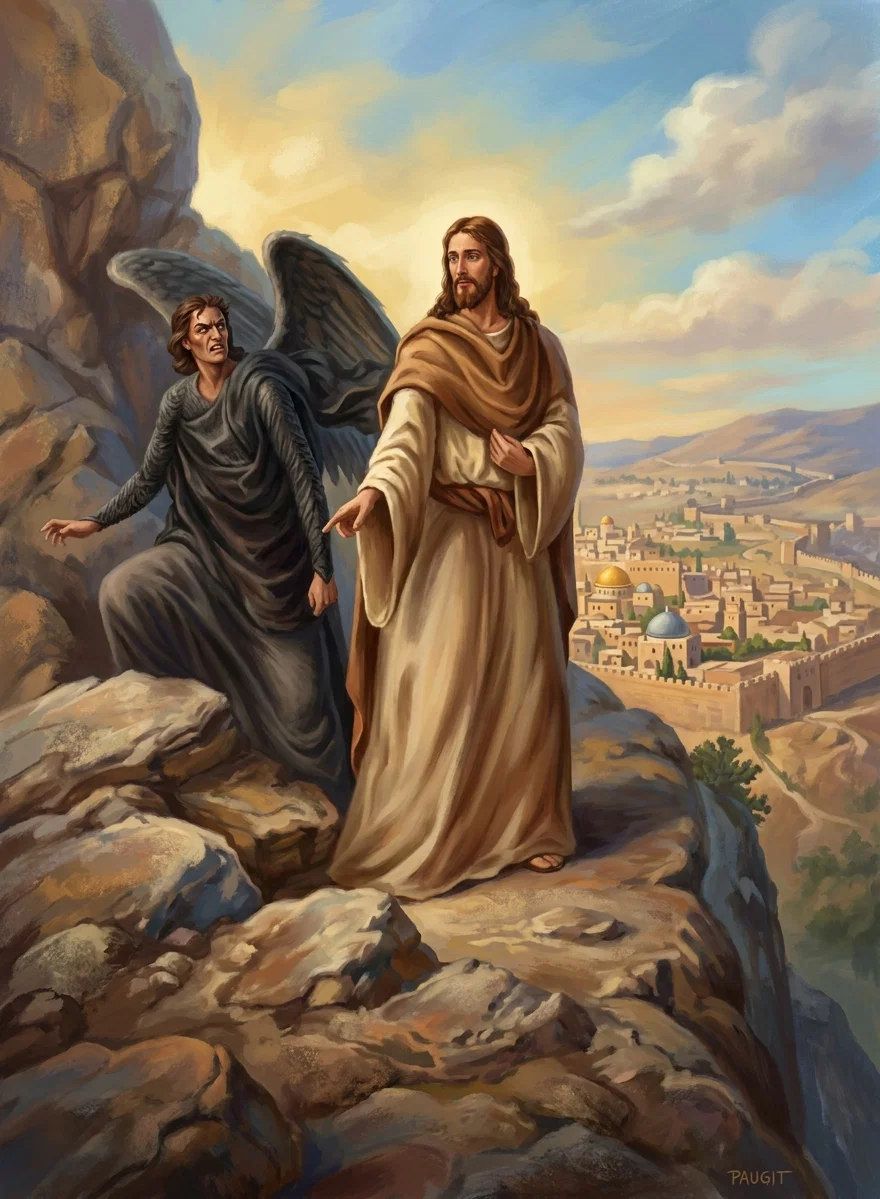
Satan now appeared what he really was,—the prince of the powers of darkness. He took Jesus to the top of a high mountain, and showed Him all the kingdoms of the world. The sunlight lay on splendid cities, marble palaces, fruitful fields and vineyards. And Satan said:—
“All these things will I give Thee, if Thou wilt fall down and worship me.”
For a moment Christ looked upon the scene. Then He turned away. Satan had presented the world to50Him in the most attractive light; but the Saviour looked beneath the outward beauty. He saw the world in its wretchedness and sin, apart from God. All this misery was the result of man's turning away from God to worship Satan.
Christ was filled with longing to redeem that which was lost. He longed to restore the world to more than its Eden beauty. He wanted to place men on vantage-ground with God. For them He was withstanding temptation. He was to be an overcomer, that they might overcome, that they might be equal with the angels, and be worthy to be acknowledged as the sons of God.
To Satan's demand for worship, Christ answered:—
“Get thee hence, Satan; for it is written, Thou shalt worship the Lord thy God. and Him only shalt thou serve.”
The love of the world, the lust for power, and the pride of life,—everything that draws man away from the worship of God,—was embraced in this last great temptation of Christ. Satan offered Christ the world and its riches if He would pay homage to the principles of evil. So Satan presents to us the advantages to be gained by wrong-doing.
He whispers to us, “In order to succeed in this world, you must serve me. Do not be too particular about truth and honesty. Obey my counsel, and I will give you riches, honour, and happiness.”
In obeying this counsel we are worshipping Satan instead of God. It will bring us only misery and ruin.
Christ has shown us what we should do when tempted. When He said to Satan, “Get thee hence,” the tempter could not resist the command. He was compelled to go.
temptation and sin
Writhing with baffled hate and rage, the rebel chief left the presence of the world’s Redeemer. The contest was ended for the time. Christ’s victory was as complete as had been the failure of Adam.
So we may resist temptation, and overcome Satan. The Lord says to us, “Resist the devil, and he will flee from you. Draw nigh to God, He will draw nigh to you.”
Return to the Jordan. “Behold the Lamb of God, which taketh away the sin of the world.”