Christ Our Saviour

0%
Earlier text: CONDEMNED BY PILATE.

“HE IS RISEN.”

THE greatest care had been taken to guard the Saviour's tomb, and the entrance had been closed with a great stone. Upon this stone the Roman seal had been placed in such a way that the stone could not be moved without breaking the seal.
Around the tomb was the guard of Roman soldiers. They were to keep strict watch, that the body of Jesus might not be molested. Some of them were constantly pacing to and fro before the tomb, while the others rested on the ground near by.
But there was another guard around that tomb. Mighty angels from heaven were there. Any one of this angel guard, by putting forth his power, could have stricken down the whole Roman army.
The night of the first day of the week has worn slowly away, and the darkest hour, just before daybreak, has come.
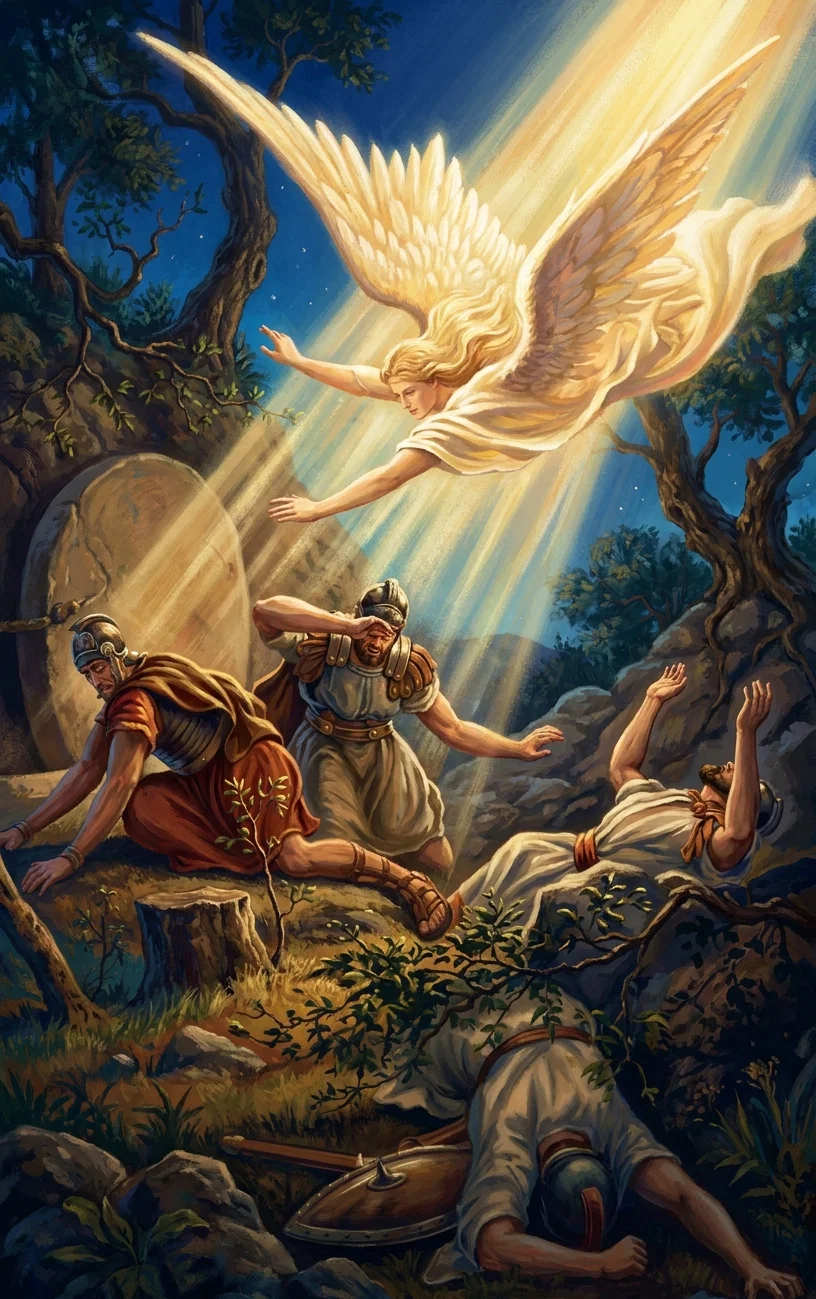
One of the most powerful angels is sent from heaven. His countenance is like lightning, and his garments white as snow. He parts the darkness from his track, and the whole heavens are lighted with his glory. [171]
The Heavenly Messenger. “He parts the darkness from his track, and the whole heavens are lighted with his dazzling glory.”
The sleeping soldiers awake, and start to their feet. With awe and wonder they gaze at the open heavens, and the vision of brightness which is nearing them.
The earth trembles and heaves as that powerful being from another world approaches. He is coming on a joyful errand, and the speed and power of his flight shake the world like a mighty earthquake. Soldiers, officers, and sentinels fall as dead men to the ground.
There had been still another guard about the Saviour’s tomb. Evil angels were there. Because the Son of God had fallen in death, His body was even then claimed as the prey of him who has the power of death,—the devil.
The angels of Satan were present to see that no power should take Jesus from their grasp. But as the mighty being sent from the throne of God approached, they fled in terror from the scene.
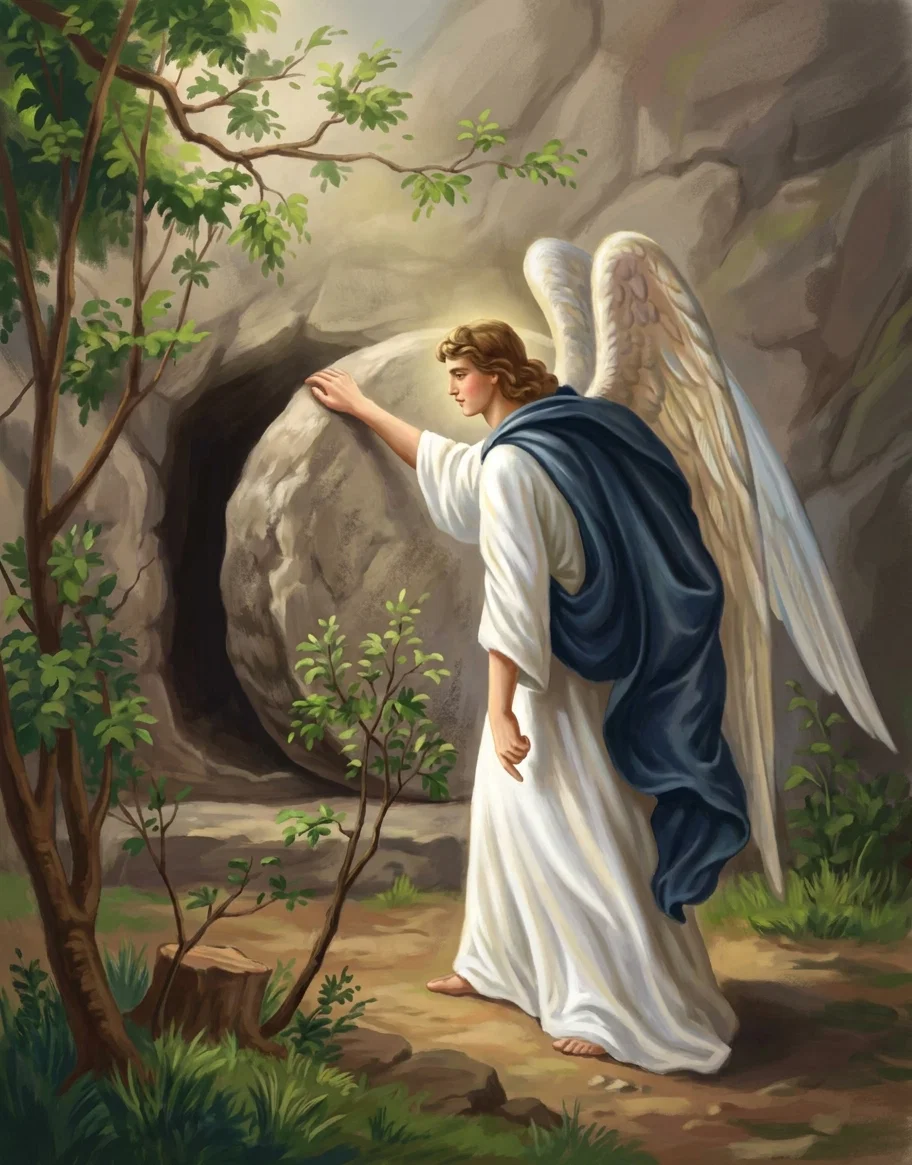
The angel laid hold of the great stone at the mouth of the tomb, and rolled it away, as if it had been but a pebble. Then with a voice that caused the earth to tremble, he cried :— “Jesus, Thou Son of God, come forth, Thy Father calls Thee!”
Then He who had earned the power over death and the grave came forth from the tomb. Above the rent sepulchre He proclaimed, "I am the resurrectionand the life." And the angel host bowed low in adoration before the Redeemer, and welcomed Him with songs of praise.
Jesus came forth with the tread of a conqueror. At His presence the earth reeled, the lightning flashed, and the thunder rolled.
“Jesus, Thou Son of God, come forth. Thy Father calls Thee!”
An earthquake marked the hour when Christ laid down His life. An earthquake also witnessed the moment when He took it up in triumph.
Satan was bitterly angry that his angels had fled at the approach of the heavenly messenger. He had dared to hope that Christ would not take up His life again, and that the plan of redemption was to fail. But as he saw the Saviour come forth from the tomb in triumph, all hope was lost. Satan now knew that his kingdom would have an end, and that he must finally be destroyed.

GO TELL MY DISCIPLES.

LUKE, in his account of the Saviour’s burial, speaks of the women who were with Him at His crucifixion, and says:—
“They returned, and prepared spices and ointments; and rested the Sabbath day according to the commandment.”
The Saviour was buried on Friday, the sixth day of the week. The women prepared spices and ointments with which to embalm their Lord, and laid them aside, until the Sabbath was past. Not even the work of embalming the body of Jesus would they do upon the Sabbath day.
“And when the Sabbath was past, . . . very early in the morning, the first day of the week, they came unto the sepulchre at the rising of the sun.”
As they neared the garden, they were surprised to see the heavens beautifully lighted up, and to feel the earth trembling beneath their feet. They hastened to the tomb, and were still more astonished to findthat the stone was rolled away, and that the Roman guard was not there.
Mary Magdalene had been the first to reach the place. Seeing that the stone was removed, she hurried away to tell the disciples. When the other women came up, they noticed a light shining about the tomb, and looking in, saw that it was empty.
As they lingered about the place, they suddenly beheld a young man in shining garments sitting by the tomb. It was the angel who had rolled away the stone. In fear they turned to flee, but the angel said:—
“Fear not ye; for I know that ye seek Jesus, which was crucified. He is not here; for He is risen, as He said. Come, see the place where the Lord lay.
“And go quickly, and tell His disciples that He is risen from the dead; and, behold, He goeth before you into Galilee; there shall ye see Him.”
As the women looked again into the tomb, they saw another shining angel, who inquired of them:—
“Why seek ye the living among the dead? He is not here, but is risen; remember how He spake unto you when He was yet in Galilee, saying, The Son of man must be delivered into the hands of sinful men, and be crucified, and the third day rise again.”
The angels then explained the death and resurrection of Christ. They reminded the women of the words that Christ Himself had spoken, in which He had told them beforehand of His crucifixion and His resurrection. These words of Jesus were now plainto them, and with fresh hope and courage they hastened away to tell the glad news.
“Touch Me not; for I am not yet ascended to My Father.”
Mary had been absent during this scene, but now returned with Peter and John. When they went back to Jerusalem, she stayed at the tomb. She could not bear to leave until she should learn what had become of the body of her Lord. As she stood weeping, she heard a voice which asked:—
“Woman, why weepest thou? whom seekest thou?”
Her eyes were so blinded by tears that she did not notice who it was that spoke to her. She thought it might be the gardener, and said to him pleadingly:—
“Sir, if thou have borne Him hence, tell me where thou hast laid Him, and I will take Him away.”
She thought that if this rich man’s tomb was considered too honourable a place for her Lord, she herself would provide a place for Him. But now the voice of Christ Himself fell upon her ears. He said:—
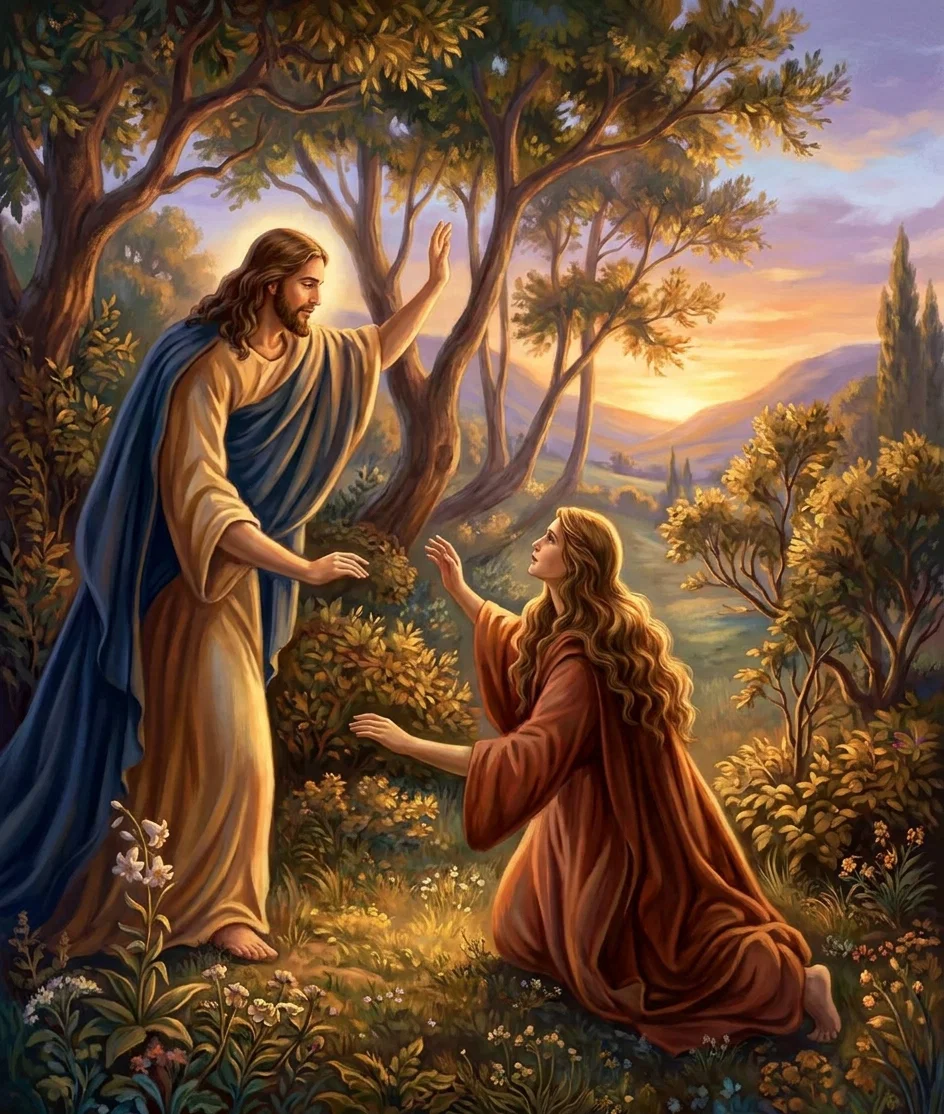
“Mary.”
Her tears were quickly brushed away, and she beheld the Saviour. Forgetting, in her joy, that He had been crucified, she stretched forth her hands to Him, saying:—
“Rabboni” (Master):
Jesus then said, "Touch Me not; for I am not yet ascended to My Father; but go to My brethren,and say unto them, I ascend unto My Father, and your Father: and to My God, and your God."
Jesus refused to receive the homage of His people until He should know that His sacrifice had been accepted by the Father. He ascended to the heavenly courts, and from God Himself heard the assurance that His atonement for the sins of men had been ample, that through His blood all might gain eternal life.
All power in heaven and on earth was given to the Prince of Life, and He returned to His followers in a world of sin, that He might impart to them His power and glory.
JOURNEY TO EMMAUS
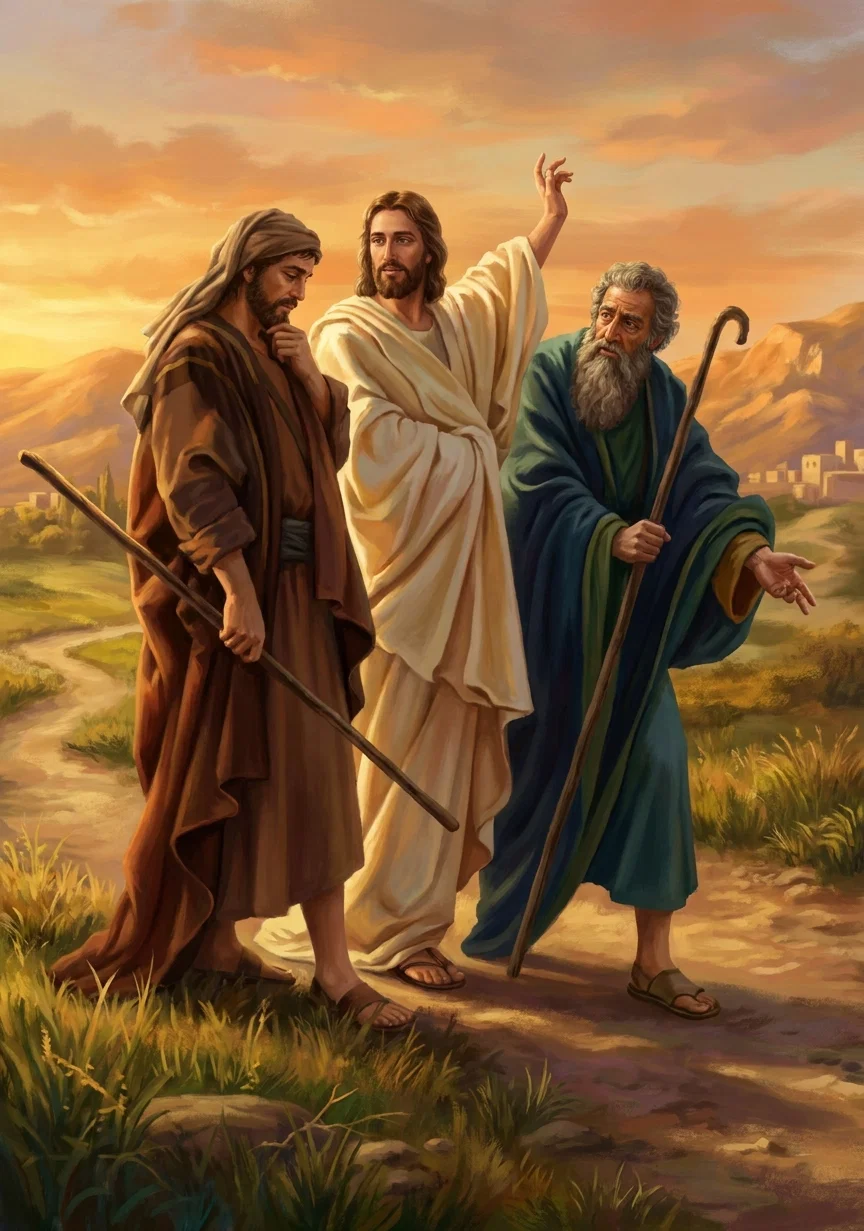
“What manner of communications are these that ye have one to another, as ye walk, and are sad?”
JOURNEY TO EMMAUS “What manner of communications are these that ye have one to another, as ye walk, and are sad?”

WITNESSES.

Late in the afternoon of the day of the resurrection, two of the disciples were on their way to Emmaus, a little town eight miles from Jerusalem.
They were perplexed over the events that had recently taken place, and especially concerning the reports of the women who had seen the angels, and had met Jesus after His resurrection.
They were now returning to their home, to meditate and pray, in hope of gaining some light in regard to those matters which were so dark to them.
As they journeyed, a stranger came up and went with them; but they were so busy with their conversation that they hardly noticed His presence.
These strong men were so burdened with grief that they wept as they travelled along. Christ’s pitying heart of love saw here a sorrow which He could comfort.
Disguised as a stranger, He began to talk withthem. "But their eyes were holden, that they should not know Him. And He said unto them:—
“What manner of communications are these that ye have one to another, as ye walk, and are sad?”
“And the one of them, whose name was Cleopas, answering said unto Him:—
“Art Thou only a stranger in Jerusalem, and hast not known the things which are come to pass there in these days?
“And He said unto them, What things?
“And they said unto Him, Concerning Jesus of Nazareth, which was a prophet mighty in deed and word before God and all the people.”
They then told what had taken place, and repeated the report brought by the women who had been at the tomb early that same morning. Then He said:—
“O fools, and slow of heart to believe all that the prophets have spoken! ought not Christ to have suffered these things, and to enter into His glory?
“And beginning at Moses and all the prophets, He expounded unto them in all the Scriptures the things concerning Himself.”
The disciples were silent from amazement and delight. They did not venture to ask the stranger who He was. They listened eagerly as He explained to them Christ’s mission.
Had the Saviour first made Himself known tothe disciples, they would have been satisfied. In the fulness of their joy they would have desired nothing more. But it was necessary for them to understand how His mission had been foretold by all the types and prophecies of the Old Testament. Upon these their faith must be established. Christ performed no miracle to convince them, but it was His first work to explain the Scriptures. They had looked upon His death as the destruction of all their hopes. Now He showed from the prophets that this was the very strongest evidence for their faith.
In teaching these disciples, Christ showed the importance of the Old Testament as a witness to His mission. Many now reject the Old Testament, claiming that it is no longer of any use. But such is not Christ’s teaching. So highly did He value it, that at one time He said, “If they hear not Moses and the prophets, neither will they be persuaded, though one rose from the dead.”
As the sun was setting, the disciples reached their home. Jesus “made as though He would have gone further.” But the disciples could not bear to part from the one who had brought them such joy and hope.
So they said to Him, “Abide with us; for it is toward evening, and the day is far spent. And He went in to tarry with them.”
The simple evening meal was soon ready, and Christ took His place at the head of the table, as His custom was.
It was usually the duty of the head of the family to ask a blessing upon the food; but Christ placed His hands upon the bread and blessed it. And the eyes of the disciples were opened.
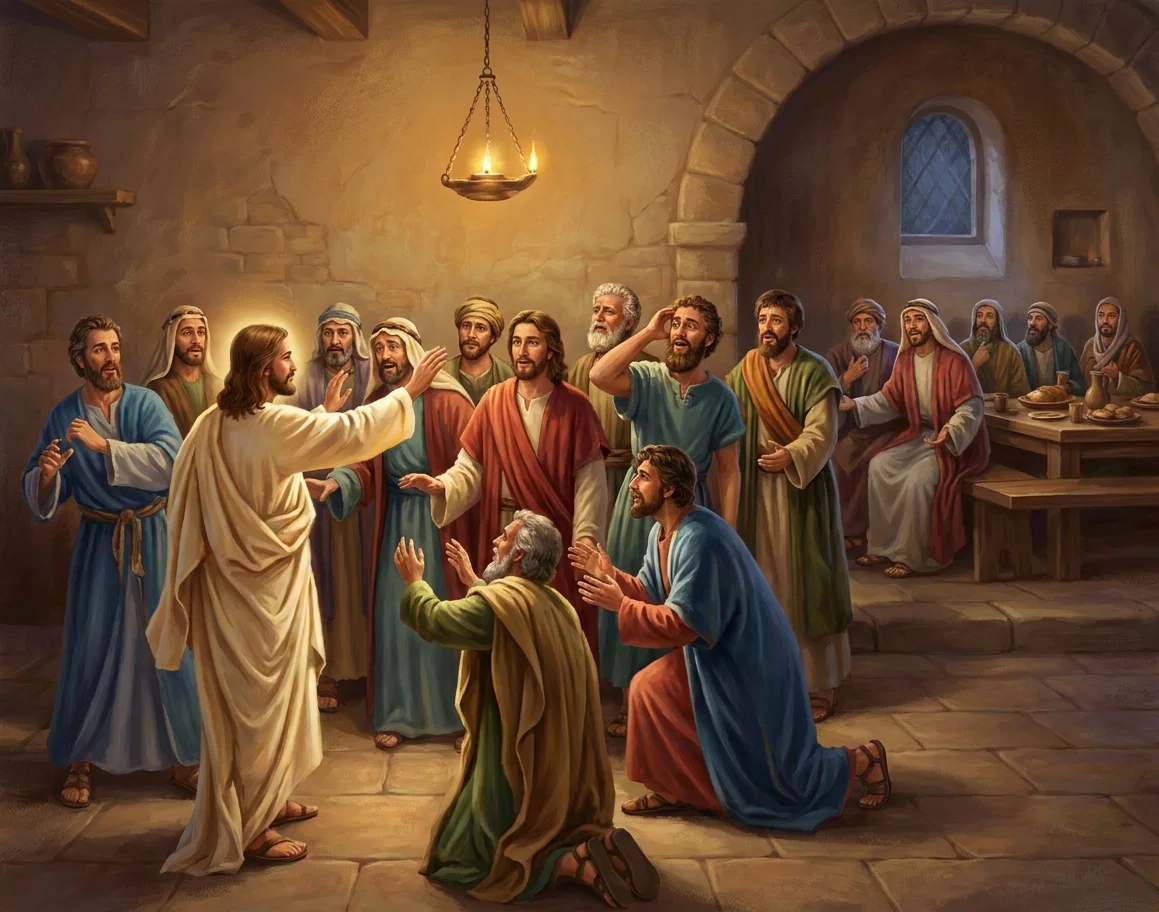
Peace be unto you.
Peace be unto you.
The act of blessing the food, the sound of the now familiar voice, the prints of the nails in His hands, all proclaimed Him their beloved Master.
For a moment they sat spellbound; then they arose to fall at His feet and worship Him; but He suddenly disappeared.
In their joy they forgot their hunger and weariness. They left the meal untasted, and hastened back to Jerusalem with the precious message of a risen Saviour.
As they were relating these things to the disciples, Christ Himself stood among them, and, with hands uplifted in blessing, said :—
“Peace be unto you.”
At first they were frightened; but when He had shown them the prints of the nails in His hands and feet, and had eaten before them, they believed and were comforted. Faith and joy now took the place of unbelief, and with feelings which no words could express, they acknowledged their risen Saviour.
At this meeting, Thomas was not with them. He refused to believe the reports in regard to the resurrection. But after eight days Jesus appeared to the disciples when Thomas was present.
On this occasion He again showed in His hands and feet the marks of the crucifixion. Thomas was at once convinced, and cried :—
“My Lord and my God.”
In the upper chamber, Christ again explained the Scriptures concerning Himself. Then He told His disciples that repentance and forgiveness of sins should be preached in His name among all nations, beginning at Jerusalem.
Before His ascension to heaven, He said to them, "Ye shall receive power, after that the Holy Ghost is come upon you; and ye shall be witnesses unto Me both in Jerusalem, and in all Judea, and inSamaria, and unto the uttermost part of the earth." "And, lo, I am with you alway, even unto the end of the world."
You have been witnesses, He said, of My life of self-sacrifice in behalf of the world. You have seen that all who come to Me, confessing their sins, I freely receive. All who will, may be reconciled to God, and have everlasting life.
To you, My disciples, I commit this message of mercy. It is to be given to all nations, tongues, and peoples.
Go to the farthest part of the habitable globe; but know that My presence will be there. Labour in faith and confidence; for the time will never come when I will forsake you.
The Saviour’s commission to the disciples included all the believers. It includes all believers in Christ to the end of time. All who receive the life of Christ are to work for the salvation of their fellow-men.
Not all can preach to congregations; but all can minister to individuals. Those minister who relieve the suffering, who help the needy, who comfort the sorrowing, and who tell the sinner of Christ’s pardoning love. These are Christ’s witnesses.

THIS SAME JESUS.

The Saviour’s work on earth was finished. The time had now come for Him to return to His heavenly home. He had overcome, and was again to take His place by the side of His Father upon His throne of light and glory.
Jesus chose the Mount of Olives as the place of His ascension. Accompanied by the eleven, He made His way to the mountain. But the disciples did not know that this was to be their last interview with their Master. As they walked, the Saviour gave them His parting instruction. Just before leaving them, He made that precious promise so dear to every one of His followers:— “Lo, I am with you alway, even unto the end of the world.”
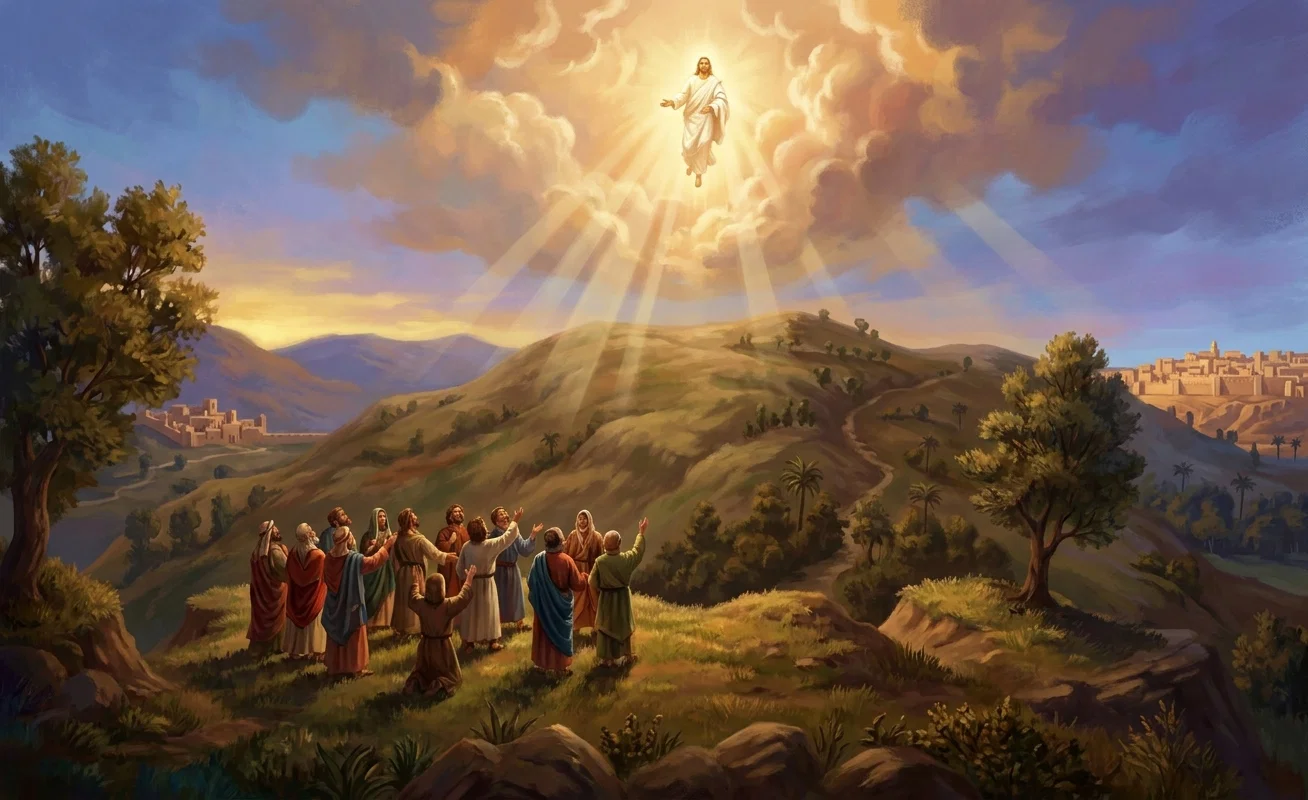
They crossed the summit, to the vicinity of Bethany. Here they paused, and the disciples gathered about their Lord. Beams of light seemed to radiatefrom His countenance as He looked with love upon them. Words of the deepest tenderness were the last which fell upon their ears from the lips of the Saviour.
The Ascension. “With hands outstretched in blessing. He slowly ascended from among them.”
With hands outstretched in blessing, He slowly ascended from among them. As He passed upward, the awe-stricken disciples looked with straining eyes for the last glimpse of their ascending Lord. A cloud of glory received Him from their sight. At the same time there floated down to them the sweetest and most joyous music from the angel choir.
While the disciples were still gazing upward, voices addressed them which sounded like richest music. They turned, and saw two angels in the form of men, who spoke to them, saying:—
“Ye men of Galilee, why stand ye gazing up into heaven? this same Jesus, which is taken up from you into heaven, shall so come in like manner as ye have seen Him go into heaven.”
These angels belonged to the company that had come to escort the Saviour to His heavenly home. In sympathy and love for those left below, they had stayed to assure them that this separation would not be forever.
Jesus had promised to come again, for He said:— “Let not your heart be troubled : ye believe in God, believe also in Me. In My Father’s house are many mansions : if it were not so, I would have told,you. I go to prepare a place for you. And if I go and prepare a place for you, I will come again, and receive you unto Myself ; that where I am, there ye may be also.”
The angels declared to the disciples that Christ would “so come in like manner,” as they had seen Him go into heaven. He ascended bodily, and they saw Him as He left them and was received by the cloud. He will return on a great white cloud, and “every eye shall see Him.”
Enoch testified, “Behold, the Lord cometh with ten thousands of His saints, to execute judgment upon all.”
Isaiah prophesied that the righteous will declare at His coming, "Lo, this is our God; we have waited for Him, and He will save us."
The apostle Paul, describing the same scene, said:—
“The Lord Himself shall descend from heaven with a shout, with the voice of the archangel, and with the trump of God: and the dead in Christ shall rise first:
“Then we which are alive and remain shall be caught up together with them in the clouds, to meet the Lord in the air; and so shall we ever be with the Lord.”
Thus will our Saviour come to the earth to take to Himself forever those who have been loyal to Him.

THEIR ASCENDED LORD.

When the disciples returned to Jerusalem, the people looked upon them with amazement. After the trial and crucifixion of their Master, it had been thought that they would appear downcast and ashamed. Their enemies expected to see upon their faces an expression of sorrow and defeat. Instead of this, there was only gladness and triumph. Their faces were aglow with a happiness not born of earth. They did not mourn over disappointed hopes, but were full of praise and thanksgiving to God.
With rejoicing they told the wonderful story of Christ’s resurrection and His ascension to heaven, and their testimony was received by many.
The disciples no longer had any distrust of the future. They knew that the Saviour was in heaven, and that His sympathies were with them still. They knew that He was pleading before God the merits of His blood. He was showing to the Father Hiswounded hands and feet, as an evidence of the price He had paid for His redeemed.
They knew that He would come again, with all the holy angels with Him, and they looked for this event with great joy and longing anticipation.
When Jesus passed from the sight of His disciples on the Mount of Olives, He was met by a heavenly host, who, with songs of joy and triumph, escorted Him upward.
At the portals of the city of God an innumerable company of angels await His coming. As Christ approaches the gates, the angels who are escorting Him, in triumphant tones address the company at the portals:—
“Lift up your heads, O ye gates; And be ye lift up, ye everlasting doors; And the King of glory shall come in.”
The waiting angels at the gates inquire:—
“Who is this King of glory?”
This they say, not because they know not who He is, but because they desire to hear the answer of exalted praise:—
“The Lord strong and mighty, The Lord mighty in battle. Lift up your heads, O ye gates; Even lift them up, ye everlasting doors; And the King of glory shall come in.”
Again the waiting angels ask:—
“Who is this King of glory?”
The escorting angels reply in melodious strains:—
“The Lord of hosts, He is the King of glory.”
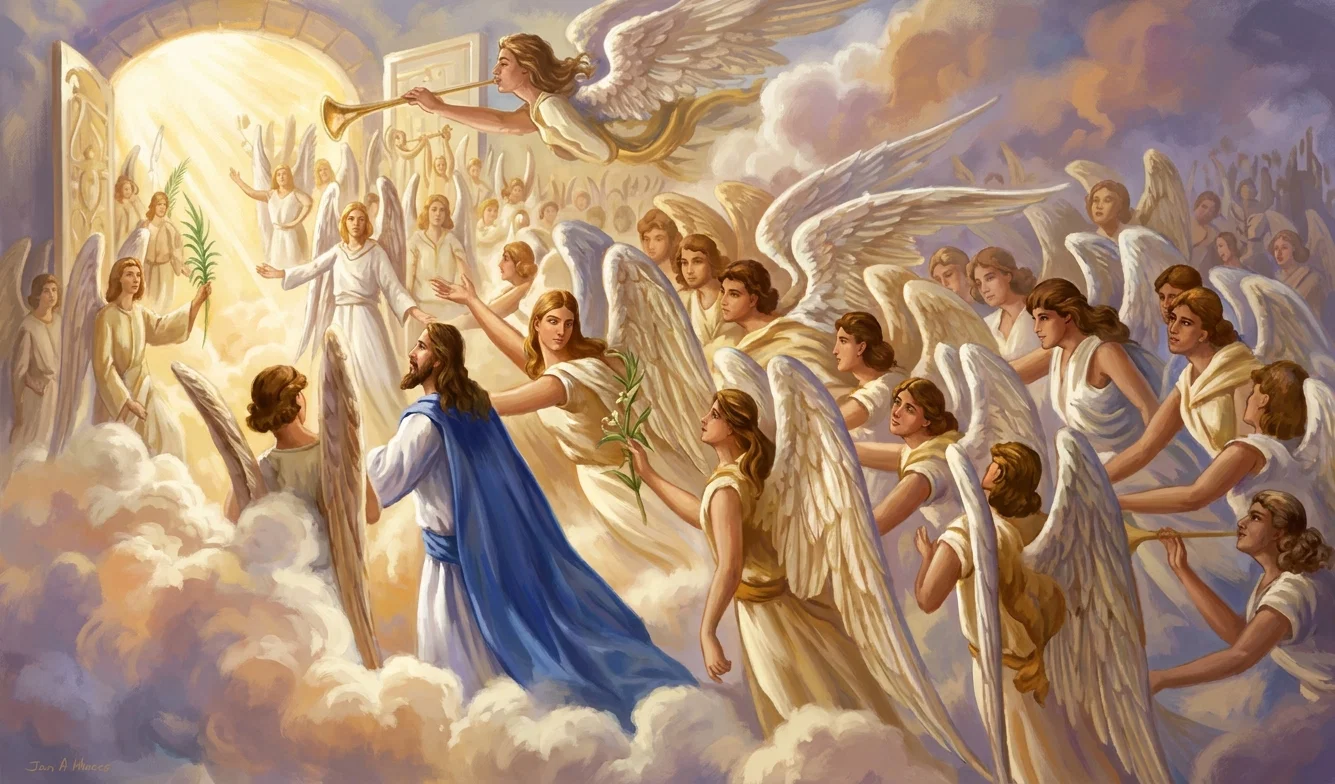
Then the portals of the city of God are opened wide, and the angelic throng sweep through the gates amid a burst of rapturous music.
All the heavenly host are waiting to honour their returned Commander. They wait for Him to take His place upon the throne of the Father.
But He cannot yet receive the coronet of glory and the royal robe. He has a request to present before the Father concerning His chosen ones on the earth. He cannot accept honour till before the heavenly universe His church shall be justified and accepted.
“Lift up your heads, O ye gates; . . . and the King of glory shall come in.”
He asks that where He is, there His people may be. If He is to have glory, they must share it withHim. Those who suffer with Him on the earth must reign with Him in His kingdom.
For this Christ pleads for His church. He identifies His interests with theirs, and, with a love and constancy stronger than death, advocates the rights and titles purchased by His blood.
The Father's answer to this appeal goes forth in the proclamation:—
“Let all the angels of God worship Him.”
Joyfully the leaders of the heavenly host adore the Redeemer. The innumerable company of angels bow before Him, and the courts of heaven echo and re-echo with the glad shout:—
“Worthy is the Lamb that was slain to receive power, and riches, and wisdom, and strength, and honour, and glory, and blessing.”
Christ’s followers are “accepted in the Beloved.” In the presence of the heavenly host, the Father has ratified the covenant made with Christ, that He will receive repentant and obedient men, and will love them even as He loves His Son. Where the Redeemer is, there the redeemed shall be.
The Son of God has triumphed over the prince of darkness, and conquered death and sin. Heaven rings with voices in lofty strains proclaiming:—
“Blessing, and honour, and glory, and power be unto Him that sitteth upon the throne, and unto the Lamb forever and ever.”

You have reached the end of this volume.

Christ Our SaviourEllen G. White