HE Saviour kept the Sabbath, and taught His disciples to keep it. He knew how it should be kept, for He Himself had made it holy.
The Bible says, “Remember the Sabbath day, to keep it holy.” “The seventh day is the Sabbath of the Lord thy God.” “For in six days the Lord made heaven and earth, the sea, and all that in them is, and rested the seventh day; wherefore the Lord blessed the Sabbath day, and hallowed it.”
Christ had worked with His Father in creating the earth, and He had made the Sabbath. The Bible says that “all things were made by Him.” When we look on the sun and the stars, the trees and the beautiful flowers, we should remember that Christ made them all. And He made the Sabbath to help us keep in mind His love and power.
The Jewish teachers had made many rules about72the way to keep the Sabbath, and they wanted every one to obey their rules. So they watched the Saviour, to see what He would do.
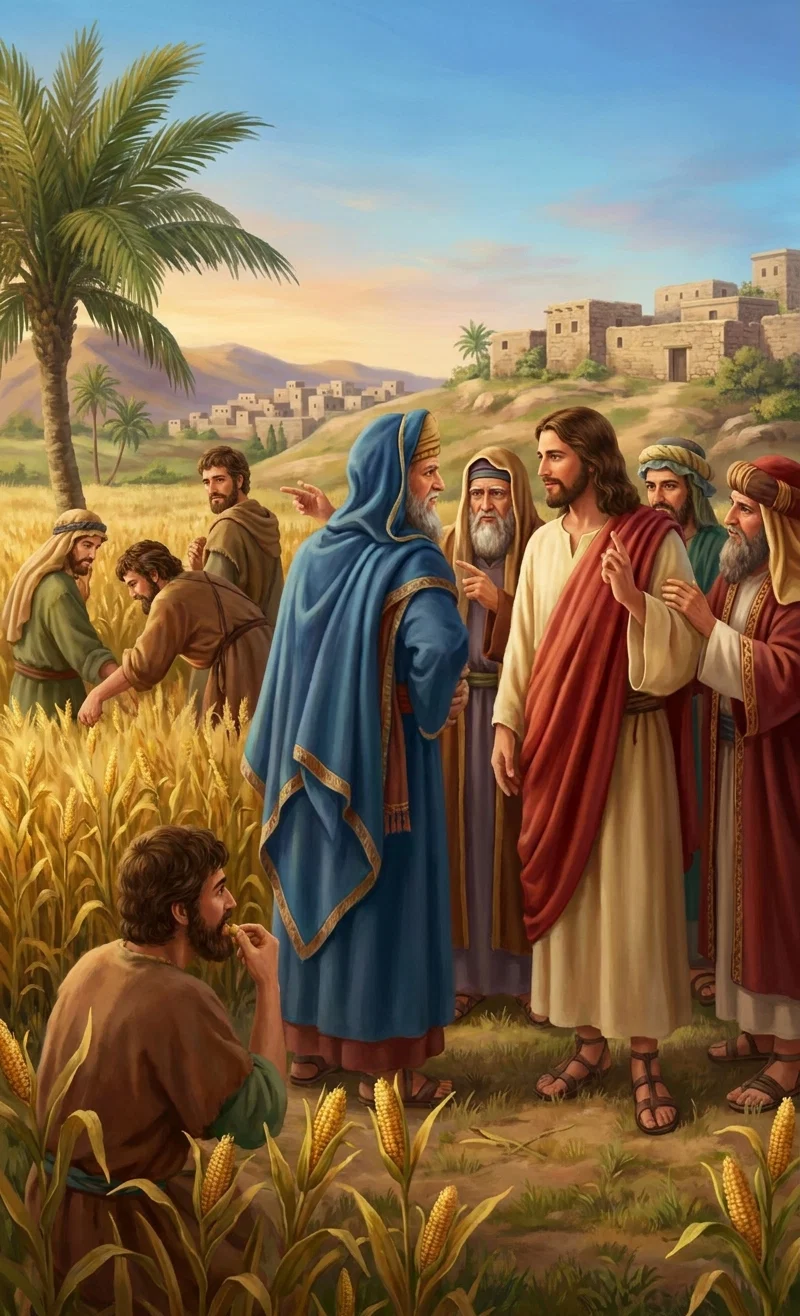
THE DISCIPLES PLUCKING CORN.
“Behold, thy disciples do that which is not lawful to do upon the Sabbath day.”
One Sabbath, as Christ and His disciples were going home from the synagogue, they passed through a field of grain. It was late, and the disciples were hungry. So they broke off some of the heads of grain, rubbed them in their hands, and ate the kernels. On any other day, one passing through a field or an orchard was allowed to gather what he wanted to eat. But it was not so on the Sabbath. Christ’s enemies saw what the disciples were doing, and they said to the Saviour:—
“Behold, Thy disciples do that which is not lawful to do upon the Sabbath day.”
But Christ defended His followers. He reminded His accusers of David, who, when in need, had eaten of the sacred bread of the tabernacle, and had given it to his hungry followers. If it was right for David when hungry to eat this sacred bread, then was it not right for the disciples when hungry to pluck the grain on the sacred hours of the Sabbath?
The Sabbath was not made to be a burden to man. It was to do him good, to give him peace and rest. Therefore our Lord said, “The Sabbath was made for man, and not man for the Sabbath.”
“And it came to pass also on another Sabbath,74that He entered into the synagogue and taught; and there was a man whose right hand was withered.
“And the scribes and Pharisees watched Him, whether He would heal on the Sabbath day; that they might find an accusation against Him.
“But He knew their thoughts, and said to the man which had the withered hand, Rise up, and stand forth in the midst. And he arose and stood forth.
“Then said Jesus unto them, I will ask you one thing: Is it lawful on the Sabbath days to do good, or to do evil? to save life, or to destroy it?”
“And when He had looked round about on them with anger, being grieved for the hardness of their hearts, He saith unto the man, Stretch forth thine hand. And he stretched it out; and his hand was restored whole as the other.”
“And they were filled with madness; and communed one with another what they might do to Jesus.”
The Saviour showed how unreasonable they were, by asking them a question. “And He said unto them, What man shall there be among you that shall have one sheep, and if it fall into a pit on the Sabbath day, will he not lay hold on it, and lift it out?”
This they could not answer. So He said, “How much then is a man better than a sheep? Wherefore it is lawful to do well on the Sabbath days.”
“It is lawful,” that is, it is according to law. Christ never reproved the Jews for keeping the law of God, or for honouring the Sabbath. On the contrary, He ever upheld the law in all its completeness.
Isaiah prophesied of Christ, “He will magnify the law, and make it honourable.” To magnify is to make larger, to raise to a higher position. Christ magnified the law by showing in every part its wonderful meaning. He showed that it is to be obeyed, not only in the actions, which are seen by men, but in the thoughts, which are known only to God.
To those who claimed that He came to set aside the law, He said, “Think not that I am come to destroy the law, or the prophets; I am not come to destroy, but to fulfil.” To fulfil means to keep, or perform. So when He came to be baptised by John the Baptist, He said, “Thus it becometh us to fulfil all righteousness.” To fulfil the law is to obey it perfectly.
God’s law can never be changed; for Christ said, “Till heaven and earth pass, one jot or one tittle shall in no wise pass from the law, till all be fulfilled.”
When He asked the question, "Is it lawful on the Sabbath days to do good, or to do evil? to save life, or to destroy it?" Christ showed that He could read the hearts of the wicked Pharisees who accused Him.76While He was trying to save life by healing the sick, they were trying to destroy life by putting Him to death. Was it better to slay upon the Sabbath, as they were planning to do, than to cure the suffering ones, as He had done? Was it better to have murder in the heart on God's holy day than to have love toward all men,—love which is shown in kindness and deeds of mercy?
Many times the Jews charged Christ with breaking the Sabbath. Often they tried to kill Him because He did not keep it according to their traditions. But this made no difference with Him. He kept the Sabbath as God wanted it to be kept.
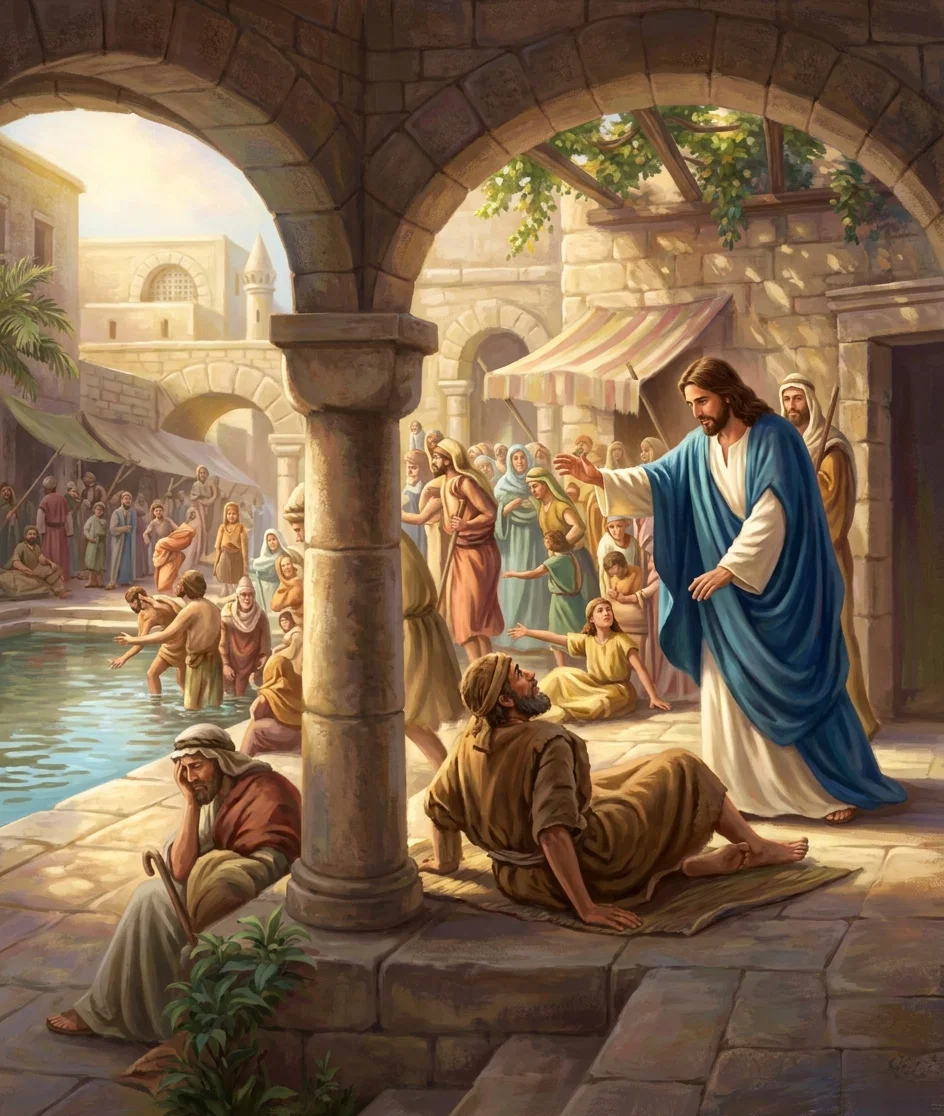
In Jerusalem there was a large pool of water called Bethesda. At certain times this pool was troubled; the people believed that an angel of the Lord went down into it, and stirred the waters, and that the first one who stepped in after the waters were stirred would be cured of whatever disease he had.
Great numbers of people came to the place, hoping to be cured; but most of them were disappointed. At the moving of the waters there was such a crowd, that many could not even get to the edge of the pool.
One Sabbath day Jesus came to Bethesda. His heart was filled with pity as He saw the poor sufferers there. One man seemed more wretched than the others. For thirty-eight years he had been a helpless77cripple. No doctor could cure him. Many times he had been brought to Bethesda; but when the waters were troubled, another would step in before him.
On this Sabbath he had tried once more to reach the pool, but in vain. Jesus saw him as he crept back to the mat which was his bed. His strength was almost gone. Unless help should come soon, he must die. As he lay thus, now and then lifting his eyes to look at the pool, a loving face bent over him, and he heard a voice say:—
“Wilt thou be made whole?”
The man answered sorrowfully, "Sir, I have no man, when the water is troubled, to put me into the pool; but while I am coming, another steppeth down before me."
He did not know that the One beside him could heal, not one only, but all who should come to Him. Christ said to the man:— “Rise, take up thy bed, and walk.”
At once he tried to obey the command, and strength came to him. He sprang to his feet, and found that he could stand and could walk. What a delight it was!
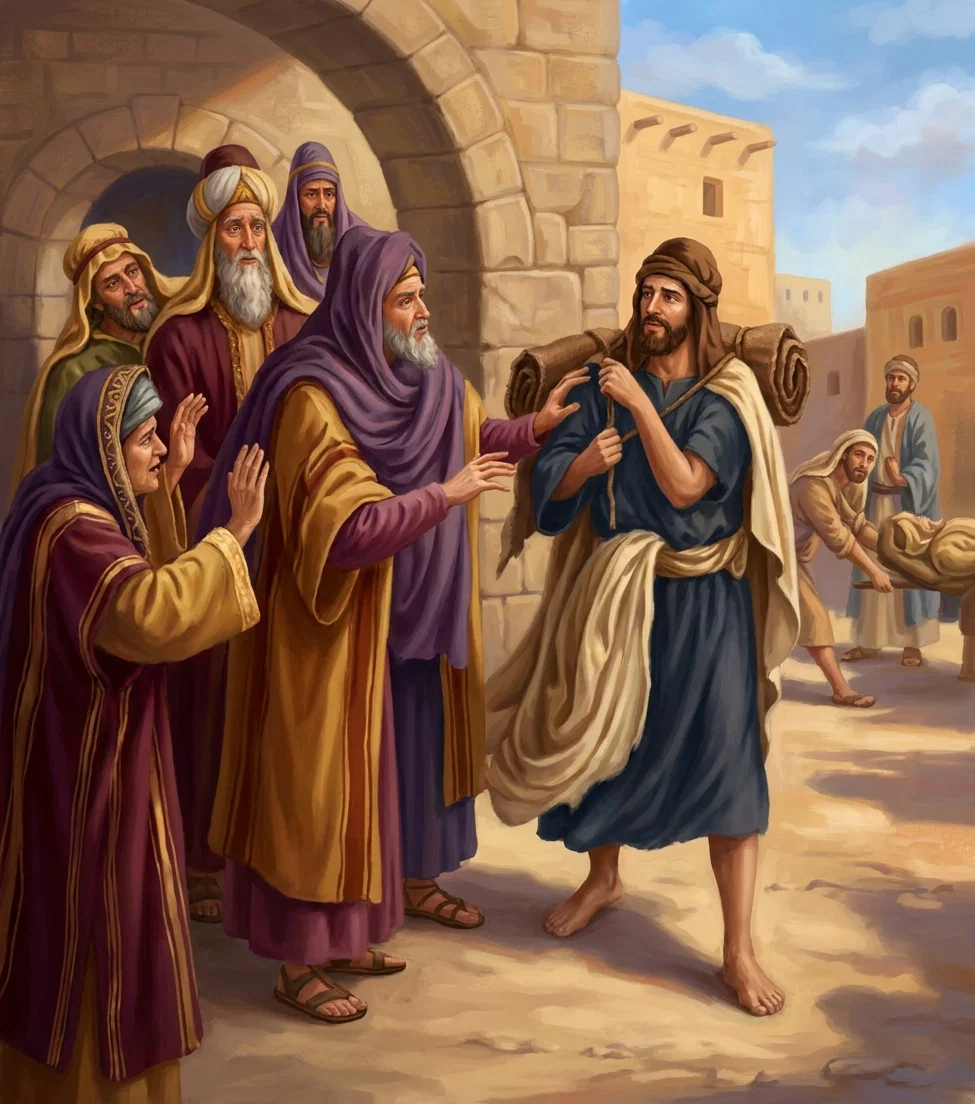
He took up his bed and hurried away, praising God at every step. Soon he met some of the Pharisees, and told them of his wonderful cure. They did not seem glad, but reproved him for carrying his bed on the Sabbath day. The man told them:—
“He that made me whole, the same said unto me, Take up thy bed, and walk.”
Then they were no longer displeased with him, but they blamed the one who had told him to carry his bed on the Sabbath day.
At Jerusalem, where the Saviour now was, many of the learned rabbis lived. Here their false ideas about the Sabbath were taught to the people. Great numbers came to worship at the temple, and thus the rabbis’ teaching was spread far and wide. Christ wished to correct these errors. This was why He healed the man on the Sabbath day, and told him to carry his bed. He knew that this act would attract the attention of the rabbis, and thus would give Him an opportunity to instruct them.
So it proved. The Pharisees brought Christ before the Sanhedrim, the chief council of the Jews, to answer the charge of Sabbath-breaking.
The Saviour declared that His action was in harmony with the Sabbath law. It was in harmony with the will and the work of God. "My Father worketh hitherto," He said, "and I work." God works continually in sustaining every living thing. Was His work to cease upon the Sabbath day?
“Take up thy bed and walk.”
Should God forbid the sun to fulfil its office on the Sabbath? Should He cut off its rays from warming the earth and nourishing vegetation? Should the brooks stay from watering the fields, and the80waves of the sea still their ebbing and flowing? Must the wheat and maize stop growing, and the trees and flowers put forth no bud or blossom on the Sabbath?
Then man would miss the fruits of the earth, and the blessings that sustain his life. Nature must continue her work, or man would die. And man also has a work to do on this day. The necessities of life must be attended to, the sick must be cared for, the wants of the needy must be supplied. God does not desire His creatures to suffer an hour's pain that may be relieved on the Sabbath or any other day.
Heaven’s work never ceases, and we should never rest from doing good. Our own work the law forbids us to do on the rest-day of the Lord. The toil for a livelihood must cease; no labour for worldly pleasure or profit is lawful upon that day. But the Sabbath is not to be spent in useless inactivity. As God ceased from His labour of creating, and rested upon the Sabbath, so we are to rest. He bids us lay aside our daily occupations, and devote those sacred hours to healthful rest, to worship, and to holy deeds.
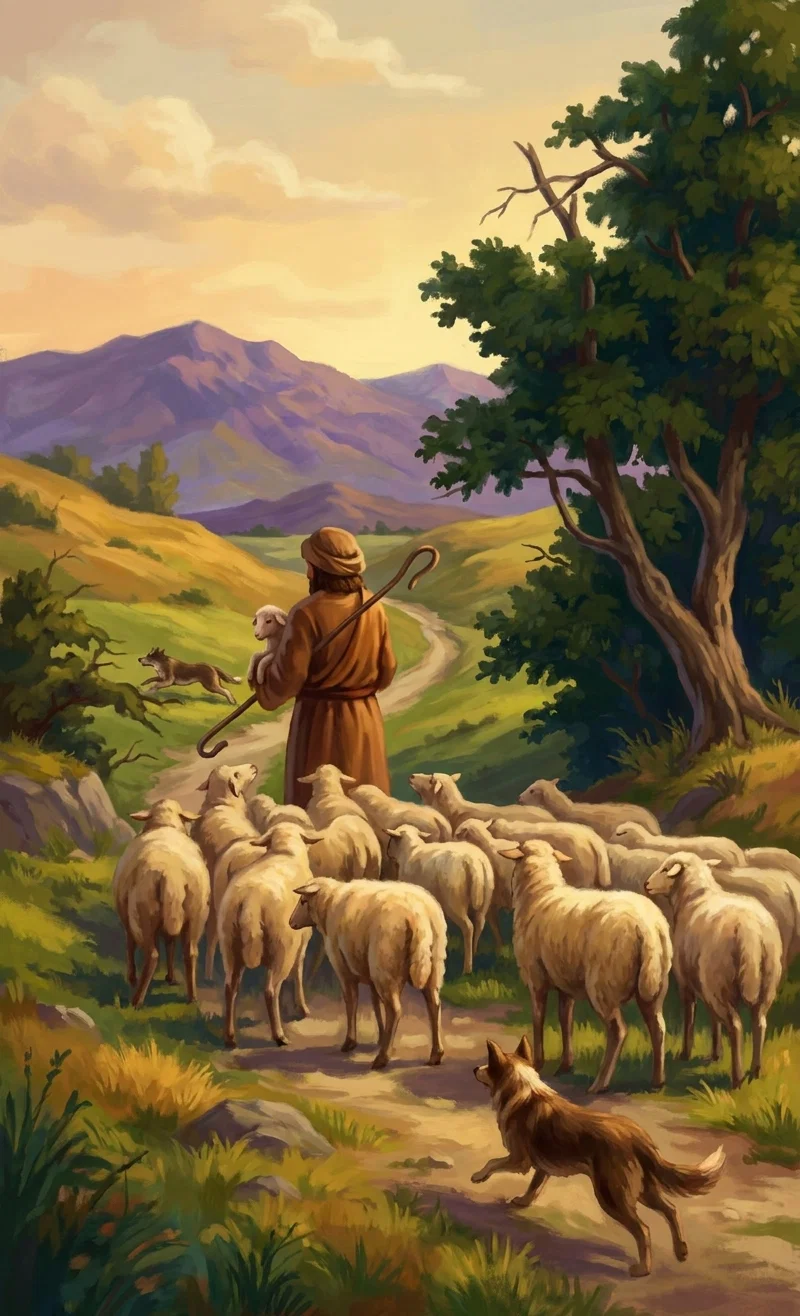
THE GOOD SHEPHERD.
The Saviour spoke of Himself as a shepherd, and of the disciples as His flock. He said:—
“I am the Good Shepherd, and know My sheep, and am known of Mine.”
Christ was soon to leave His disciples, and He said this to give them comfort. When He should be no more with them, they would remember His words. Whenever they saw a shepherd watching his flock, they would think of the Saviour's love and care for them.
In that land the shepherd stayed with his flock day and night. Over the rocky hills and through the forests he led them by day, to pleasant, grassy fields by the river-side. Through the night he watched them, guarding them from wild beasts and from robbers, that were often lurking near.
“I AM THE GOOD SHEPHERD.”
Tenderly he cared for the feeble and sickly ones. The little lambs he took in his arms, and carried in his bosom.
However large the flock, the shepherd knew every sheep. He had a name for each, and called it by its name.
So Christ, the heavenly Shepherd, cares for His flock that is scattered throughout the world. He knows us all by name. He knows the very house in which we live, and the name of each inmate. He cares for each one as if there were not another in the whole world.
The shepherd went before his sheep, and met all the dangers. He encountered the wild beasts and the robbers. Sometimes the shepherd was killed while guarding his flock.
So the Saviour guards His flock of disciples. He has gone before us. He has lived on earth, as we live. He was a child, a youth, a man. He overcame Satan and all his temptations, so that we may overcome. He died to save us. Though now He is in heaven, He does not forget us for a moment. He will safely keep every sheep. Not one that follows Him can be taken by the great enemy.
A shepherd might have a hundred sheep, but if one was missing he did not stay with those that were in the fold. He went to search for the lost one.
Out in the dark night, through the storm, over mountains and valleys, he would go. He would not rest till the sheep was found.
Then he took it in his arms, and carried it back to the fold. He did not complain of the long, hard search, but gladly said:—
“Rejoice with me; for I have found my sheep which was lost.”
So the care of the Saviour-Shepherd is not for those only who are in the fold. He says, "The Son of man is come to save that which was lost."
“I say unto you, That likewise joy shall be in heaven over one sinner that repenteth, more than over ninety and nine just persons, which need no repentance.”
We have sinned, and have wandered away from God. Christ says we are like the sheep that has wandered away from the fold. He came to help us live without sin. This He calls bringing us back to the fold.
When we return with the Shepherd, and cease to sin, Christ says to the angels in heaven:—
“Rejoice with Me; for I have found My sheep which was lost.”
And a joyful anthem rings out from the angelic choir, filling all heaven with richest melody.
Christ presents to us no picture of a sorrowful85shepherd returning without the sheep. Here is a pledge that not even one of the straying sheep of God's fold is overlooked. Not one is left unhelped. Every one that will submit to be ransomed, the Saviour will rescue from the wilds of sin.
Then let every wanderer from the fold take courage. The Good Shepherd is searching for you. Remember that His work is "to save that which was lost." That means you. To doubt the possibility of your salvation is to doubt the saving power of Him who purchased you at an infinite cost. Let faith take the place of unbelief. Look at the hands that were pierced for you, and rejoice in their power to save.
Remember that God and Christ are interested in you, and that all the host of heaven are engaged in the work for the salvation of sinners.
While Christ was on earth, He showed by His miracles that He had power to save unto the uttermost. By curing the diseases of the body, He showed that He was able to take away sin from the heart.
He caused the lame to walk, the deaf to hear, and the blind to see. He cleansed the poor lepers, and healed the man with palsy, and those who had all kinds of diseases.
By His word, even the devils were driven out from the ones whom they had been possessing. Those who saw this wonderful work were astonished, and86said: "What a word is this! for with authority and power He commandeth the unclean spirits, and they come out!"
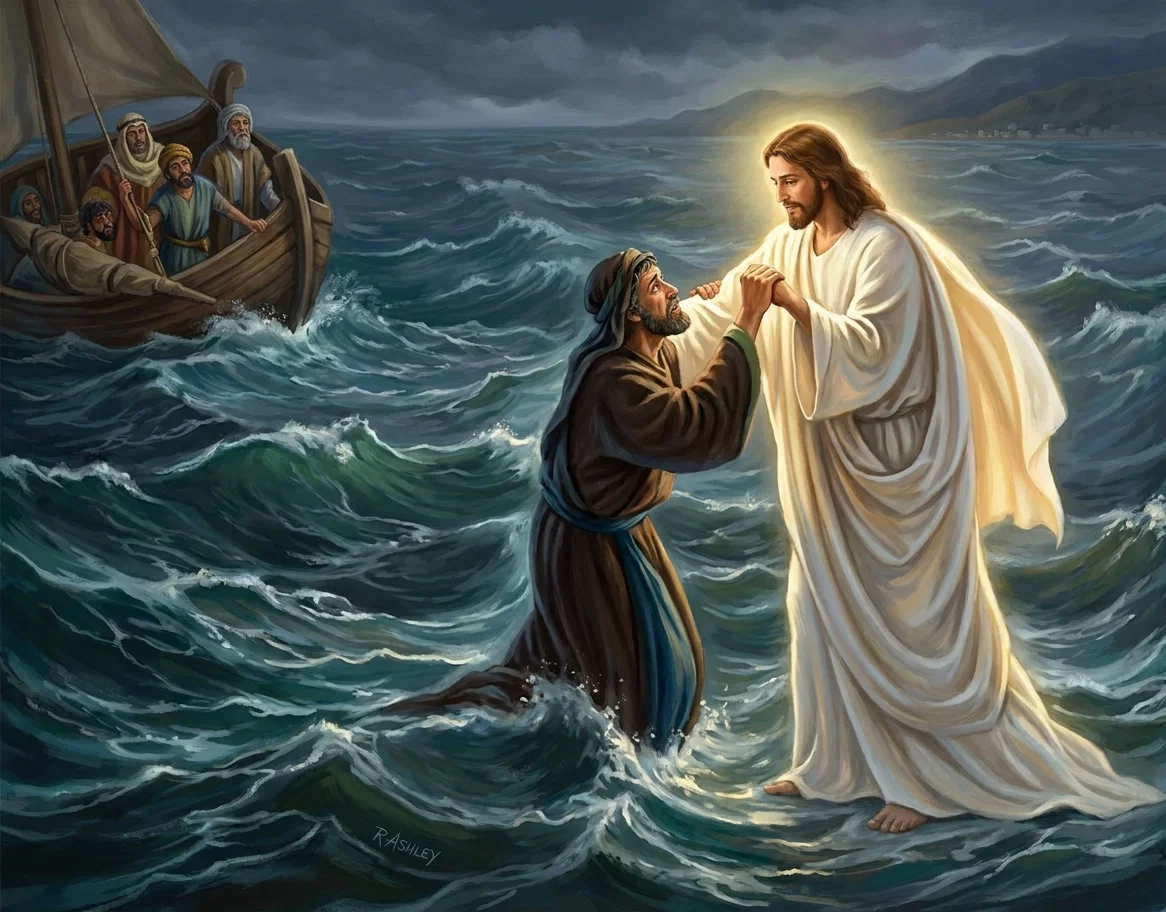
At the command of Jesus, Peter was able to walk on the water. But he had to keep his eyes on the Saviour. As soon as he looked away, he began to doubt and sink. Then he cried, "Lord, save me," and the Saviour's hand was stretched forth to lift him up. So whenever one cries to Him for help, the hand of Christ is stretched forth to save.
Saviour. As soon as he looked away, he began to doubt and sink. Then he cried, “Lord, save me,” and the Saviour’s
Christ raised the dead to life. One of these was the widow's son at Nain. The people were carrying him to the grave, when they met Jesus. He took87the young man by the hand, lifted him up, and gave him alive to his mother. Then the company went back to their homes, with shouts of rejoicing and praise to God.
So also the daughter of Jairus was raised, and by Christ’s word, Lazarus, who had been dead four days, was called forth from the tomb.
So when Christ shall come to the earth again, His voice will pierce the tombs, and “the dead in Christ shall rise” to glorious, immortal life; and so shall they “ever be with the Lord.”
It was a wonderful work done by our Lord during His ministry on earth. Of this work He spoke in the answer He sent to John the Baptist. John was in prison, and had become despondent; he was even troubled by doubts as to whether Jesus was really the Messiah. So he sent some of his followers to ask the Saviour:—
“Art Thou He that should come, or do we look for another?”
When the messengers came to Jesus, there were about Him many sick, whom He was healing. All day the messengers waited, while He worked with tireless activity to help the suffering ones. At last He said:—
“Go and show John again those things which ye do hear and see: the blind receive their sight, and88the lame walk, the lepers are cleansed, and the deaf hear, the dead are raised up, and the poor have the gospel preached to them.”
So, for three years and a half, Jesus "went about doing good." Then the time came for His ministry on earth to be finished. With His disciples He must go up to Jerusalem to be betrayed, condemned, and crucified.
Thus were to be fulfilled His own words, "The Good Shepherd giveth His life for the sheep."
“Surely He hath borne our griefs, and carried our sorrows. . . . He was wounded for our transgressions, He was bruised for our iniquities; the chastisement of our peace was upon Him; and with His stripes we are healed. All we like sheep have gone astray; we have turned every one to his own way; and the Lord hath laid on Him the iniquity of us all.”
The Ninety and Nine.
There were ninety and nine that safely
In the shelter of the fold, lay
But one was out on the hills away,
Far off from the gates of gold;
Away on the mountains wild and bare,
Away from the tender Shepherd’s care.
“Lord, Thou hast here Thy ninety and nine;
Are they not enough for Thee?”
But the Shepherd made answer: “One of Mine
Has wandered away from Me;
And although the road be rough and steep,
I go to the desert to find My sheep.”
But none of the ransomed ever knew
How deep were the waters crossed;
Nor how dark was the night that the Lord passed through
Ere He found His sheep that was lost.
Far out in the desert He heard its cry,
Fainting and helpless and ready to die.
“Lord, whence are these blood-drops all the way
That mark out the mountain’s track?”
“They were shed for one who had gone astray,
Ere the Shepherd could bring him back.”
“Lord, why are Thy hands so rent and torn?”
“They are pierced to-night by many a thorn.”
But all through the mountains, thunder-riven,
And up from the rocky steep,
There rose a cry to the gate of heaven,
“Rejoice, I have found My sheep!”
And the angels sang around the throne,
“Rejoice, for the Lord brings back His own!”
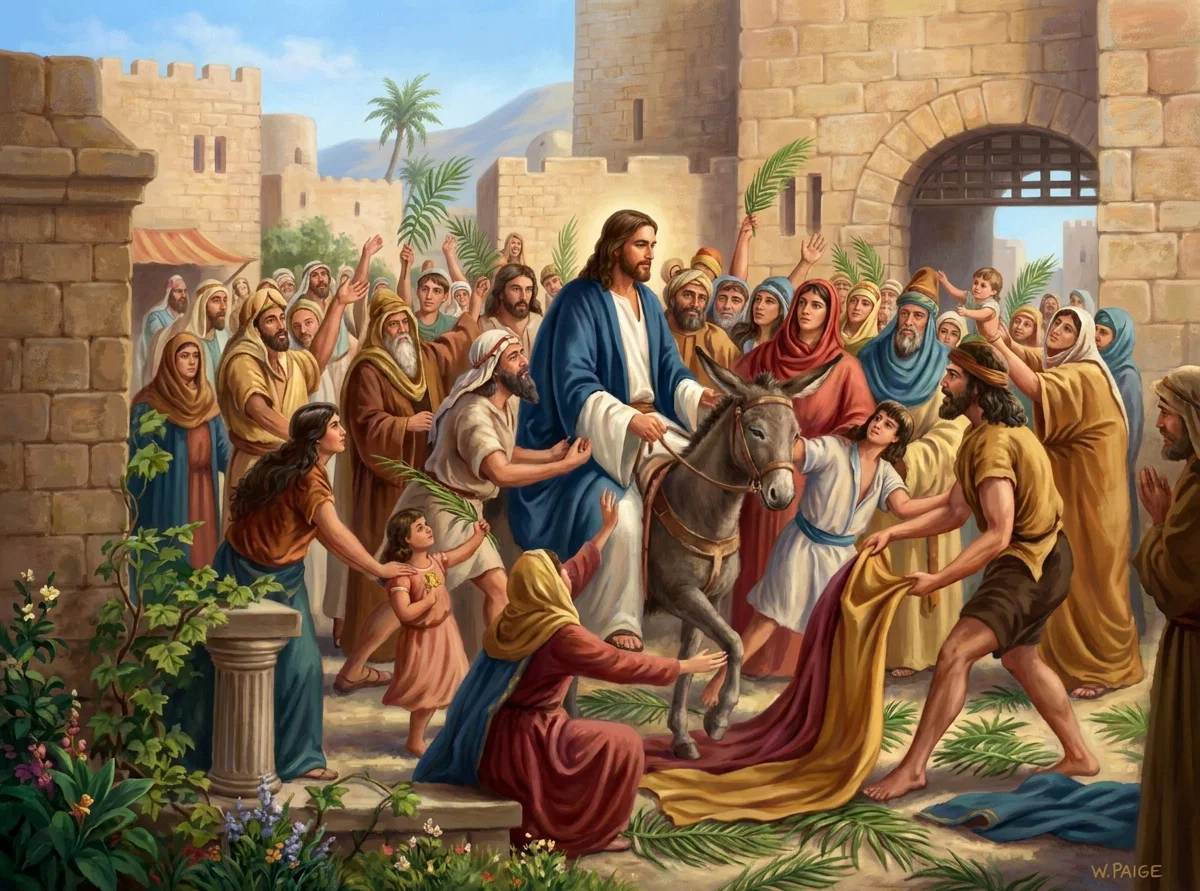
Riding into Jerusalem. “They spread their outer garments as a carpet, in His path.”
RIDING INTO JERUSALEM.
JESUS was nearing Jerusalem to attend the passover. He was surrounded by multitudes who were also going up to this great yearly feast.
At His command two of the disciples brought an ass’s colt that he might ride into Jerusalem. They spread their garments upon the beast, and placed their Master upon it.
As soon as He was seated, a loud shout of triumph rent the air. The multitude hailed Him as Messiah, their King. More than five hundred years before, the prophet had foretold this scene:—
“Rejoice greatly, O daughter of Zion . . . behold, thy King cometh unto thee . . . lowly and riding upon an ass, and upon a colt the foal of an ass.”
All in the rapidly increasing throng were happy and excited. They could not offer him costly gifts, but they spread their outer garments, as a carpet, in his path. They broke off the beautiful branches of92the olive and the palm, and strewed them in the way. They thought they were escorting Christ to take possession of the throne of David in Jerusalem.
The Saviour had never before allowed His followers to show Him kingly honours. But at this time He desired especially to manifest Himself to the world as its Redeemer.
The Son of God was about to become a sacrifice for the sins of men. His church in all succeeding ages must make His death a subject of deep thought and study. It was necessary, then, that the eyes of all people should now be directed to Him.
After such a scene as this, His trial and crucifixion could never be hidden from the world. It was God's design that each event in the closing days of the Saviour's life should be so plainly marked that no power could cause it to be forgotten.
In the vast multitude surrounding the Saviour were the evidences of His miracle-working power.
The blind whom He had restored to sight were leading the way.
The dumb whose tongues He had loosed, shouted the loudest hosannas.
The cripples whom He had healed leaped for joy, and were most active in breaking the palm branches and waving them before Him.
Widows and orphans were exalting the name of Jesus for His works of mercy to them.
The loathsome lepers who had been cleansed by a word, spread their garments in the way.
Those who had been raised from the dead by the life-giving voice of the Saviour were there.
And Lazarus, whose body had seen corruption in the grave, but who was now enjoying the strength of glorious manhood, was with the happy throng that escorted the Saviour to Jerusalem.
As new numbers were added to the throng, they caught the inspiration of the hour, and joined in the shouts that echoed and re-echoed from hill to hill and from valley to valley :—
“Hosanna to the Son of David! Blessed is He that cometh in the name of the Lord! Hosanna in the highest”
Many Pharisees witnessed this scene, and were displeased. They felt that they were losing the control of the people. With all their authority they tried to silence them; but their threats and appeals only increased the enthusiasm.
Finding that they could not control the people, they pressed through the crowd to where Jesus was, and said to Him:—
“Master, rebuke Thy disciples.”
They declared that such a tumult was unlawful, and would not be permitted by the rulers.
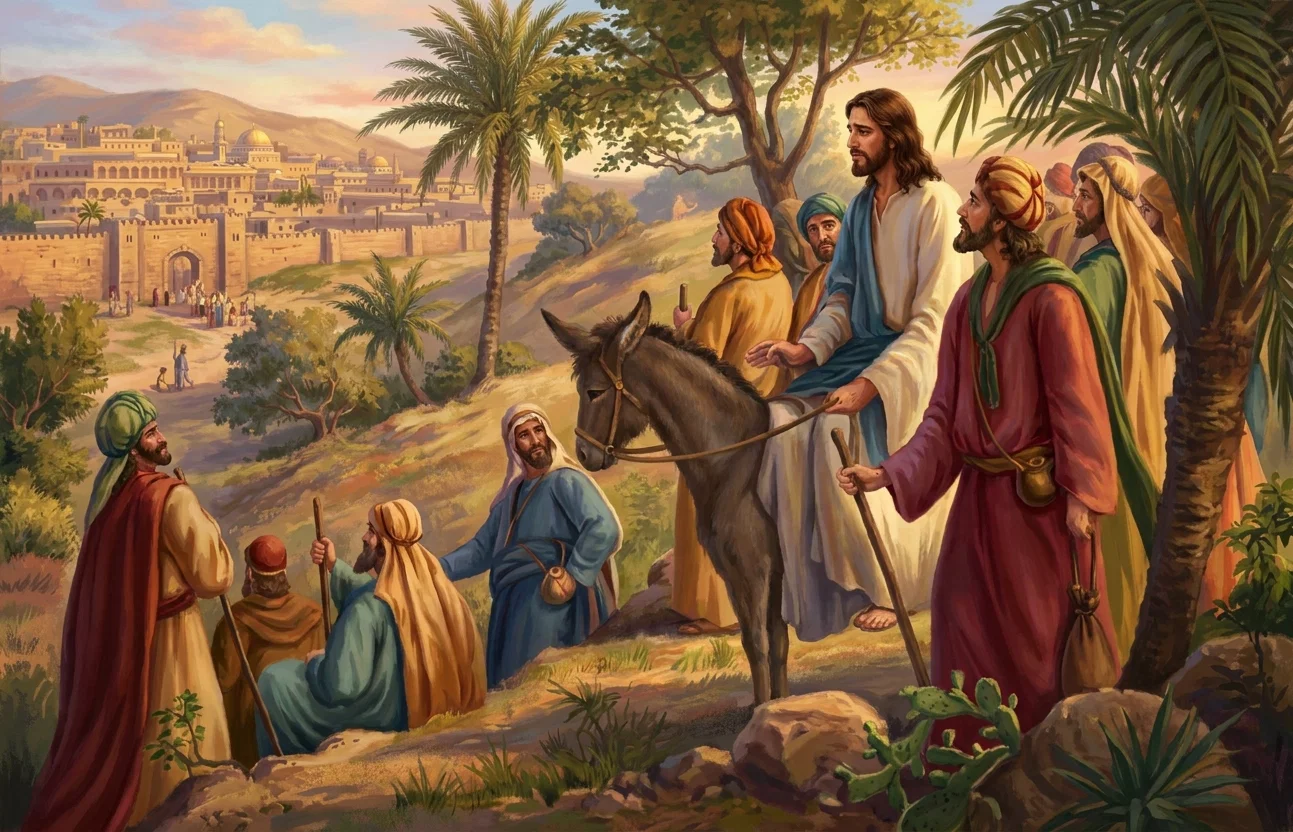
Viewing Jerusalem. “Jesus halted, and a cloud of sorrow gathered upon His countenance.”
Jesus answered, "I tell you that, if these should hold their peace, the stones would immediately cry out."
This scene of triumph was of God's own appointing; it had been foretold by the prophets, and no earthly power could stop it. The work of God will ever go forward, in spite of all that man may do to hinder it or tear it down.
As the procession came to the brow of the hill overlooking Jerusalem, the full splendour of the city met their view. The vast multitude hushed their shouts, spell-bound by the sudden vision of beauty. All eyes turned upon the Saviour, expecting to see in His countenance the admiration which they themselves felt.
Jesus halted, and a cloud of sorrow gathered upon His countenance, and the multitude were astonished to see Him burst into an agony of weeping.
Those who surrounded the Saviour could not understand His grief; but He wept for the city that was doomed. It had been the child of His care, and His heart was filled with anguish as He realised that it would soon be made desolate.
Had her people given heed to Christ's teaching, and received Him as the Saviour, Jerusalem would have "stood forever." She might have become the96queen of kingdoms, free in the strength of her God-given power. There would then have been no armed soldiers waiting at her gates, no Roman banners waving from her walls. From Jerusalem the dove of peace would have gone to all nations. She would have been the crowning glory of the world.
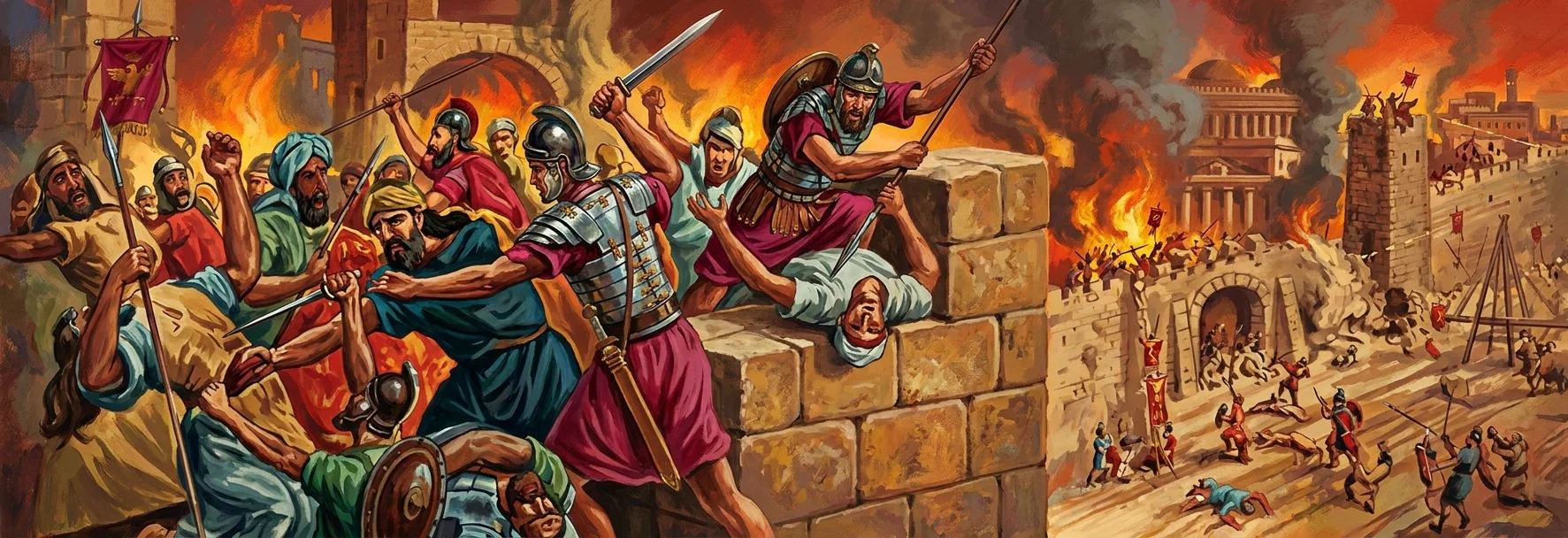
“The City that was Doomed.”
But the Jews had rejected their Saviour; they were about to crucify their King. And when the sun should set that night, the doom of Jerusalem would be forever sealed.
Reports had come to the rulers that Jesus was nearing the city with a vast company of followers. They went out to meet Him, hoping to scatter the throng. With a show of much authority they asked:—
“Who is this?”
The disciples, filled with the Spirit of inspiration,97answered: "Adam will tell you, It is the seed of the woman that shall bruise the serpent's head."
“Ask Abraham, he will tell you, It is Melchisedek, King of Salem, King of Peace.”
“Jacob will tell you, He is Shiloh of the tribe of Judah.”
“Isaiah will tell you, Immanuel, Wonderful, Counsellor, the mighty God, the everlasting Father, the Prince of Peace.”
“Jeremiah will tell you, The Branch of David, the Lord, our righteousness.”
“Daniel will tell you, He is the Messiah.”
“Hosea will tell you, He is the Lord God of Hosts, the Lord is His memorial.”
“John the Baptist will tell you, He is the Lamb of God that taketh away the sin of the world.”
“The great Jehovah has proclaimed from His throne, This is My beloved Son.”
“We, His disciples, declare, This is Jesus, the Messiah, the Prince of Life, the Redeemer.”
“And even the prince of the power of darkness acknowledges Him, saying, I know Thee who Thou art, the Holy One of God!”