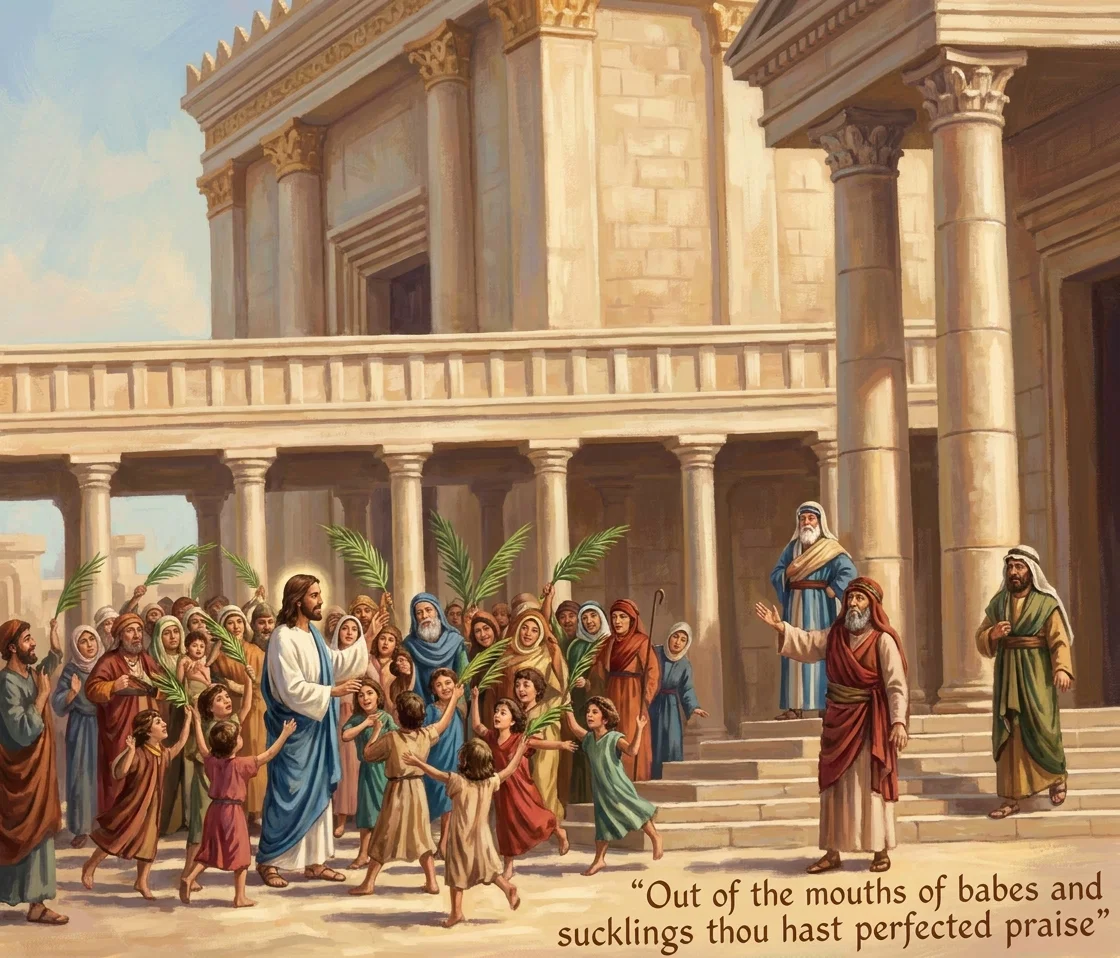
The next day Christ entered the temple. Three years before, He had found men buying and selling in the outer court, and had rebuked them and driven them out. Now as He came again to the temple, He found the same traffic still carried on. The court was filled with cattle, sheep, and birds. These were sold to those who wished to offer sacrifice for their sins. Extortion and robbery were practised by those engaged in this traffic. So great was the babel of sounds from the court, that it seriously disturbed the worshippers within.
Christ stood on the steps of the temple, and again His piercing gaze swept over the court. All eyes were turned toward Him. The voices of the people and the noise of the cattle were hushed. All looked with astonishment and awe upon the Son of God. The divine flashed through the human, and gave Jesus a dignity and glory He had never manifested100before. The silence became almost unbearable. At last He said in clear tones, and with a power that swayed the people like a mighty tempest:— “It is written, My house is the house of prayer; but ye have made it a den of thieves.”
With still greater authority than He had manifested three years before, He commanded:— “Take these things hence.”
Once before the priests and rulers of the temple had fled at the sound of this voice. Afterward they were ashamed of their fear. They felt that they would never flee in this way again. Yet they were now more terrified, and in greater haste than before to obey His command, and they rushed from the temple, driving their cattle before them.
Soon the court was filled with people who brought their sick to be healed by Jesus. Some were dying. These afflicted ones felt their distressing need. They fixed their eyes imploringly upon the face of Christ, fearing to see there the severity which had driven out the buyers and sellers. But they saw in His face only love and tender pity.
Jesus kindly received the sick, and disease and suffering fled at the touch of His hand. He tenderly gathered the children in His arms, soothed their fretful cries, banished sickness and pain from their little forms, and handed them back, smiling and healthy, to their mothers.101What a scene to greet the priests and rulers as they cautiously made their way back to the temple! They heard the voices of men, women, and children praising God. They saw the sick healed, the blind restored to sight, the deaf receive their hearing, and the lame leap for joy.
Out of the mouths of babes and sucklings thou hast perfected praise
The children took the lead in these rejoicings. They repeated the hosannas of the day before, and waved palm branches before the Saviour. The temple echoed and re-echoed with their shouts:—
“Hosanna to the Son of David!
“Blessed is He that cometh in the name of the Lord!”
“Behold, thy King cometh unto thee; He is just, and having salvation.”
The rulers tried to silence the shouts of the happy children, but all were filled with joy and praise for the wonderful works of Jesus, and they would not be silenced.
The rulers then turned to the Saviour, hoping that He would command them to cease. They said to Him :—
“Hearest Thou what these say?”
Jesus replied, “Yea; have ye never read, Out of the mouth of babes and sucklings, thou hast perfected praise?”
The blessed privilege of heralding the birth of Christ and forwarding His work in the earth had been refused by the haughty rulers of the people. His praises must be sounded; and God chose the children to do it. Had the voices of those rejoicing children been silenced, the very pillars of the temple would have cried out in the Saviour’s praise.
AT THE PASSOVER SUPPER.
The children of Israel ate the first passover supper at the time of their release from bondage in Egypt.
God had promised to set them free. He had told them that the first-born son in every family of the Egyptians was to be slain. He had told them to mark their own door posts with the blood of the slain lamb, that the angel of death might pass them by.
The lamb itself they were to roast and eat at night, with unleavened bread and with bitter herbs, which represented the bitterness of their slavery. When they ate the lamb, they must be all ready for a journey. They must have their shoes on their feet, and their staves in their hands.
They did as the Lord had said, and that very night the king of Egypt sent them word that they might go free. In the morning they started on their way to the land of promise.
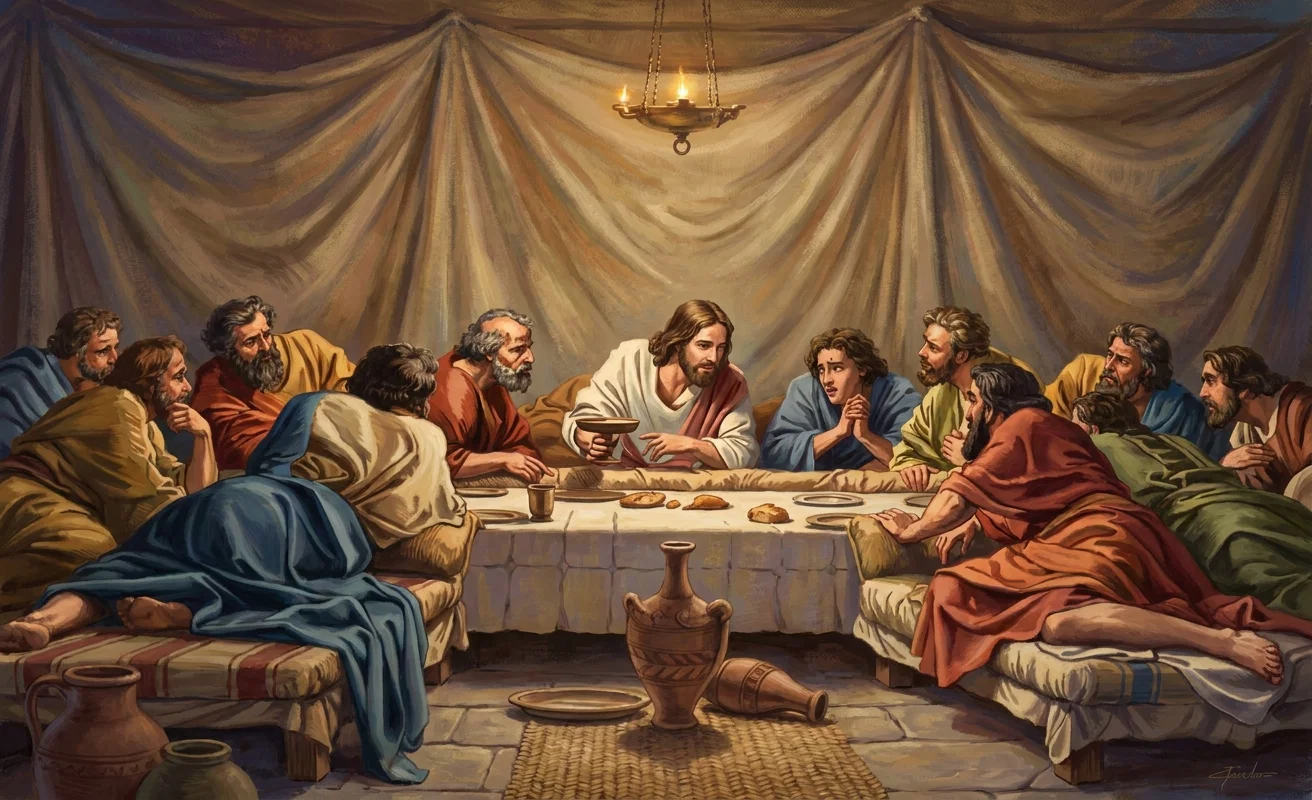
THE LAST SUPPER. “With desire I have desired to eat this passover with you before I suffer.”
So every year, the same night on which they left Egypt, all the Israelites kept the feast of the passover at Jerusalem. At this feast each family had a roasted lamb, with bread and bitter herbs, as their forefathers had in Egypt. And they told their children the story of God's goodness in freeing His people from slavery.
The time had now come when Christ was to keep the feast with His disciples, and He told Peter and John to find a place, and make ready the passover supper.
A great many people came to Jerusalem at this time, and those who lived in the city were always ready to give a room in their houses for visitors to keep the feast.
The Saviour told Peter and John that when they had gone into the street, they would meet a man carrying a pitcher of water. Him they were to follow, and they were to go into the house where he went. And they were to say to the good man of that house:—
“The Master saith unto thee, Where is the guest chamber, where I shall eat the passover with My disciples?”
This man would then show them a large upper room furnished for their needs; there they were to prepare the passover supper. And it all happened just as the Saviour had told them it would.
At the passover supper the disciples were alone with Jesus. The time they spent with Him at these feasts had always been a time of joy; but now He was troubled in spirit.
At last He said to them in tones of touching sadness:—
“With desire I have desired to eat this passover with you before I suffer.”
There was sweet wine on the table, and He took a cup of it, “and gave thanks, and said:—
“Take this, and divide it among yourselves; for I say unto you, I will not drink of the fruit of the vine, until the kingdom of God shall come.”
This was the last time that Christ was to keep the feast with His disciples. It was really the last passover that was ever to be kept. For the lamb was slain to teach the people about Christ's death; and when Christ, the Lamb of God, should be slain for the sins of the world, there would be no need of slaying a lamb to represent His death.
When the Jews sealed their rejection of Christ by putting Him to death, they rejected all that gave to this feast its value and significance. Henceforth its observance by them was a worthless form.
As Christ joined in the paschal service, there was before His mind the scene of His last great sacrifice.107He was now in the shadow of the cross, and the pain was torturing His heart. He knew all the anguish that awaited Him. He knew the ingratitude and cruelty that would be shown Him by those He had come to save. But it was not of His own suffering that He thought. He pitied those who would reject their Saviour and lose eternal life.
And the thought of His disciples was uppermost in His mind. He knew that after His own suffering was over, they would be left to struggle in the world. He had much to tell them that would be a stay to their hearts when He should walk no more with them. Of these things He had hoped to speak at this their last meeting before His death.
But He could not tell them now. He saw that they were not ready to listen.
There had been a contention among them. They still thought that Christ was soon to be made king, and each of them wanted the highest place in His kingdom. So they had jealous and angry feelings toward one another.
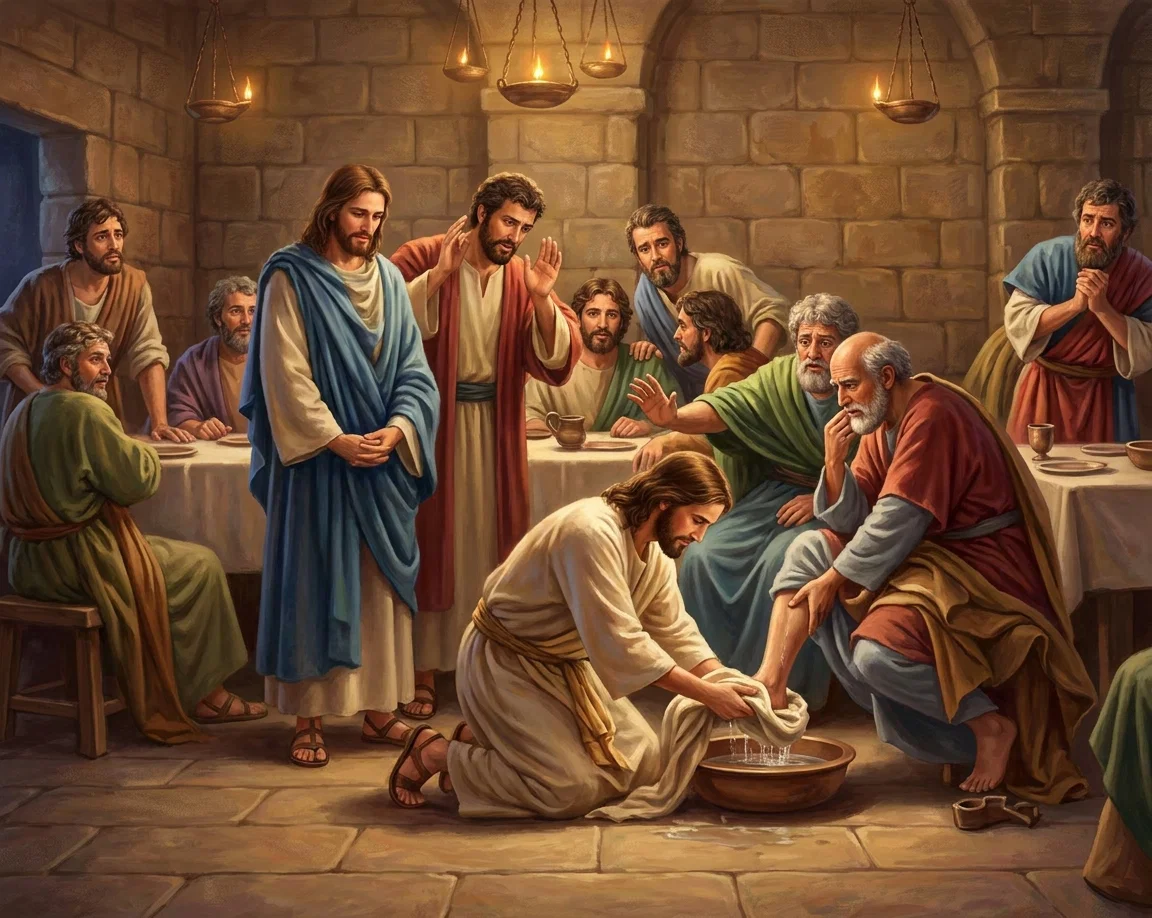
There was another cause of trouble. At a feast it was the custom for a servant to wash the feet of the guests, and on this occasion preparation had been made for the service. The pitcher of water, the basin, and the towel were there, ready for the feet-washing. But no servant was present, and it was the disciples’ part to perform it.
But each of the disciples thought that he would not be a servant to his brethren. He was not willing to wash their feet. So, in silence they had taken their places at the table.
Jesus waited awhile to see what they would do. Then He Himself rose from the table. He girded Himself with the towel, poured water into the basin, and began to wash the disciples' feet. He had been grieved by their contention, but He did not reprove them by sharp words. He showed His love by acting as a servant to His own disciples. When He had finished, He said to them:—
“If I then, your Lord and Master, have washed your feet; ye also ought to wash one another’s feet. For I have given you an example, that ye should do as I have done to you.”
In this way Christ taught them that they ought to help one another. Instead of seeking the highest place for himself, each should be willing to serve his brethren.
The Saviour came into the world to work for others. He lived to help and save those who are needy and sinful. He wants us to do as He did.
The disciples were now ashamed of their jealousy and selfishness. Their hearts were filled with love for their Lord and for one another. Now they could give heed to Christ’s teaching.
As they were still at the table, Jesus took bread, and gave thanks, and broke it, and gave to them, saying, "This is My body which is given for you; this do in remembrance of Me."
“Likewise also the cup after supper, saying, This cup is the new testament in My blood, which is shed for you.”
The Bible says, “As often as ye eat this bread, and drink this cup, ye do show the Lord’s death till He come.”
The bread and the wine represent the body and the blood of Christ. As the bread was broken, and the wine poured out, so on the cross Christ's body was broken, and His blood shed to save us. By eating the bread and drinking the wine we show110that we believe this. We show that we repent of our sins, and that we receive Christ as our Saviour.
As the disciples sat at the table with Jesus, they saw that He still seemed greatly troubled. A cloud settled on them all, and they ate in silence.
At last Jesus spoke and said, “Verily I say unto you, That one of you shall betray Me.”
The disciples were grieved and amazed at these words. Each began to look into his heart to see if there was any shadow of an evil thought against their Master.
One after another they asked, “Lord, is it I?”
Judas alone remained silent. This drew the eyes of all to him. When he saw that he was observed, he too asked, “Master, is it I?”
And Jesus solemnly replied, "Thou hast said."
Jesus had washed the feet of Judas, but this had not caused him to love the Saviour more. He was angry that Christ should do a servant’s work. Now he knew that Christ would not be made king, and he was the more determined to betray Him.
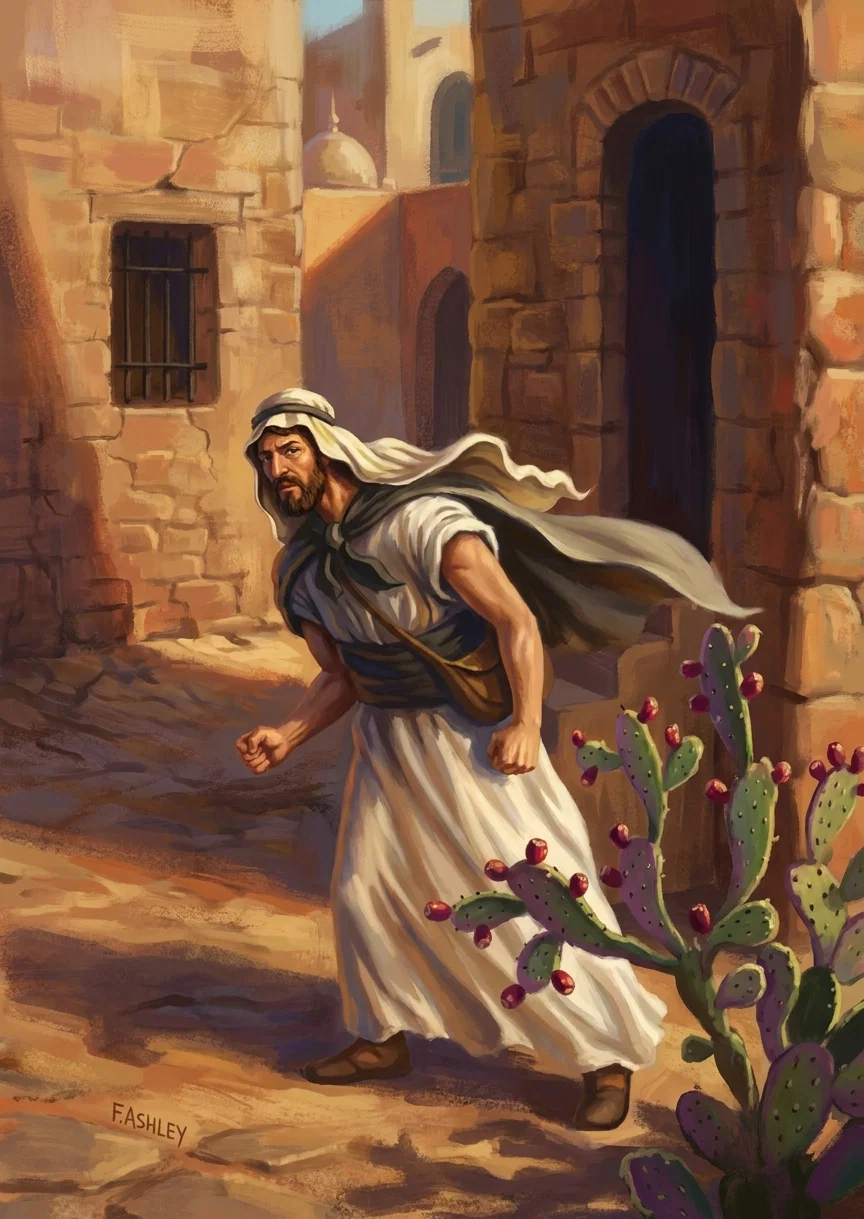
When he saw that his purpose was known, even this did not cause him to fear. In anger he quickly left the room, and went away to carry out his wicked plan.
The going of Judas was a relief to all present. The Saviour’s face lighted, and at this the shadow was lifted from the disciples.
Christ now talked for some time with His disciples. He was going to His Father's house, He said, to make a place ready for them, and He would come again to take them to Himself. He promised to send the Holy Spirit to be their teacher and comforter while He was gone. He told them to pray in His name, and their prayers would surely be answered. He then prayed for them, asking that they might be kept from evil, and might love one another as He had loved them.
Jesus prayed for us as well as for the first disciples. He said: "Neither pray I for these alone, but for them also which shall believe on Me through their word; that they all may be one; as Thou, Father, art in Me, and I in Thee, that they also may be one in us: that the world may believe that Thou hast sent Me, . . . and hast loved them, as Thou hast loved Me."
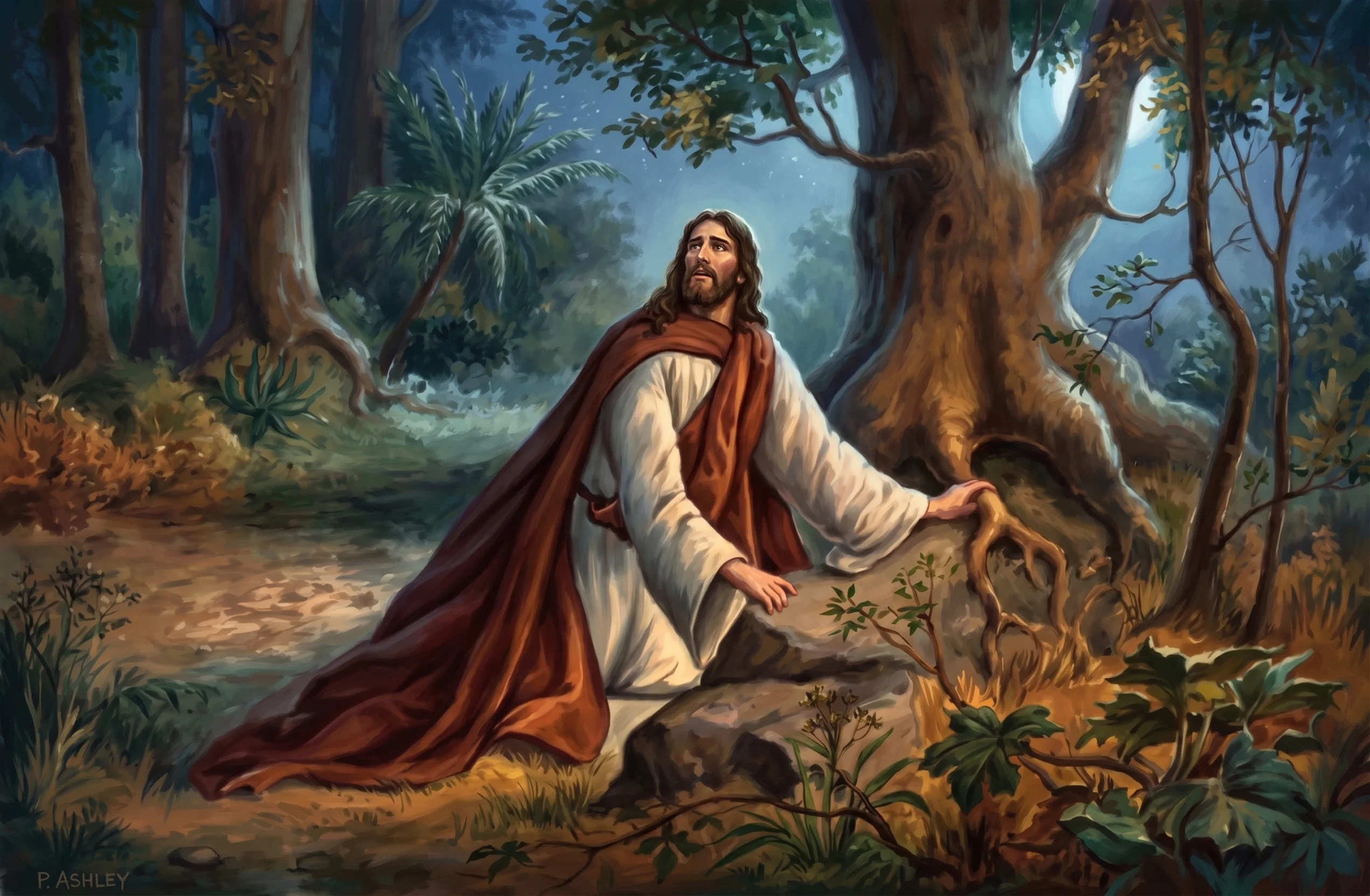
The Agony in the Garden. “O My Father, if this cup may not pass away from Me, except I drink it, Thy will be done.”
IN GETHSEMANE.
HE Saviour’s life on earth was a life of prayer. Many were the hours He spent alone with God. Often did He send up His earnest petitions to His heavenly Father. Thus He received strength and wisdom to sustain Him in His work, and to keep Him from falling under temptations of Satan.
After eating the passover supper with His disciples, Jesus went with them to the garden of Gethsemane, where He often went to pray. As He walked, He talked with them, and taught them; but as they neared the garden, He became strangely silent.
All His life, Jesus had lived in the presence of His Father. The Spirit of God had been His constant guide and support. He always gave God the glory for His works on earth, and said, "I can of Mine own self do nothing."
We can do nothing of ourselves. It is only by relying on Christ for all our strength that we can114overcome, and do His will on earth. We must have the same simple, childlike trust in Him that He had in His Father. Christ said, “Without Me ye can do nothing.”
The terrible night of agony for the Saviour began as they neared the garden. It seemed that the presence of God, which had been His support, was no longer with Him. He was beginning to feel what it was to be shut out from His Father.
Christ must bear the sins of the world. As they were now laid upon Him, they seemed more than He could endure. The guilt of sin was so terrible, He was tempted to fear that God could no longer love Him.
As He felt the awful displeasure of the Father against evil, the words were forced from Him, "My soul is exceeding sorrowful, even unto death."
Near the gate of the garden, Jesus had left all His disciples except Peter, James, and John, and He had gone into the garden with these three. They were His most earnest followers, and had been His closest companions. But He could not bear that even they should witness the suffering He was to endure. He said to them:—
“Tarry ye here, and watch with Me.”
He went a short distance from them, and fell prostrate upon the ground. He felt that by sin He115was being separated from the Father. The gulf between them appeared so broad, so black, so deep, that He shuddered before it.
Christ was not suffering for His own sins, but for the sins of the world. He was feeling the displeasure of God against sin as the sinner will feel it in the great judgment day.
In His agony, Christ clung to the cold ground. From His pale lips came the bitter cry, “O My Father, if it be possible, let this cup pass from Me; nevertheless not as I will, but as Thou wilt.”
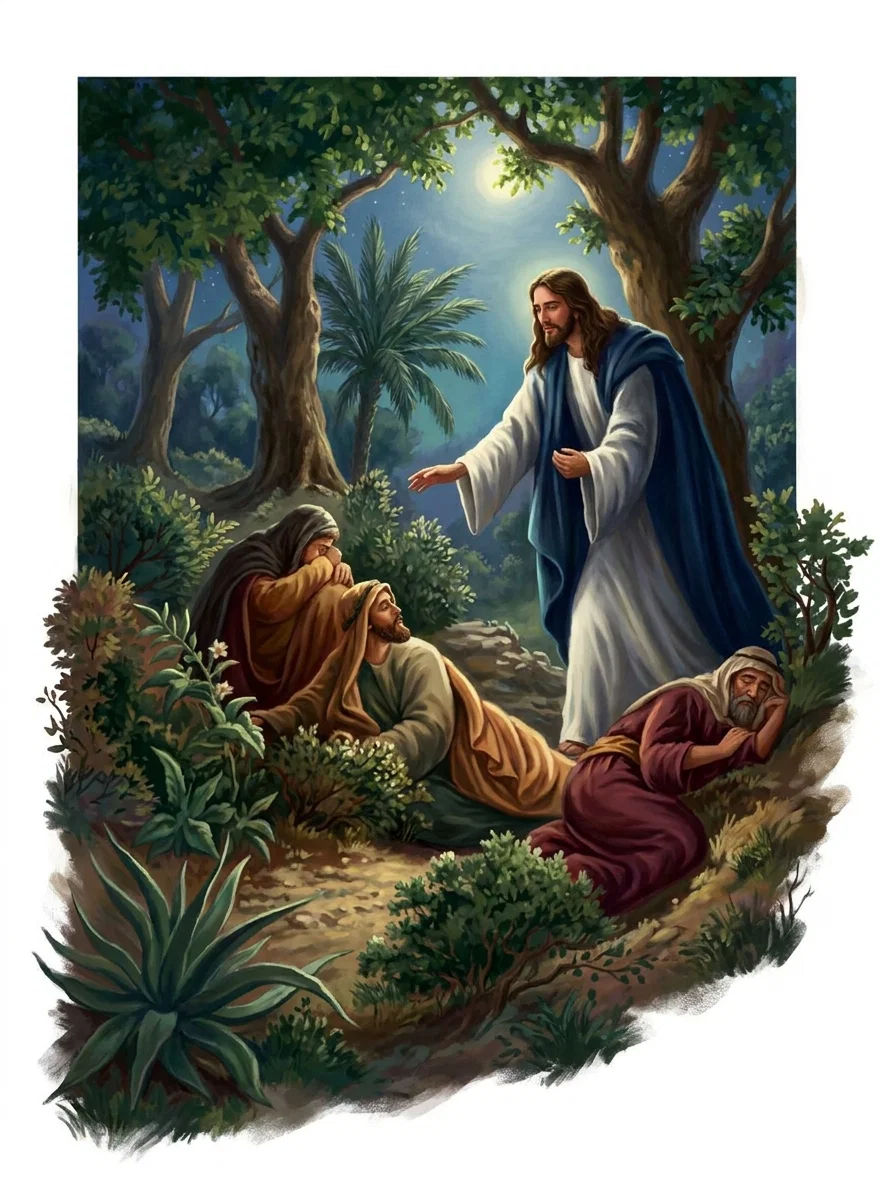
For an hour Christ bore this terrible suffering alone. Then He came to the disciples, hoping for some word of sympathy. But no sympathy awaited Him, for they were asleep. They awoke at the sound of His voice, but they hardly knew Him, His face was so changed by anguish. Addressing Peter, He said:—
“Simon, sleepest thou? Couldest not thou watch one hour?”
Just before He bent His footsteps to the garden, Christ had said to the disciples, “All ye shall be offended because of Me this night.” They had given Him the strongest assurance that they would go with Him to prison and to death. And poor, self-sufficient Peter had added, “Although all shall be offended, yet will not I.”
But the disciples trusted to themselves. They did not look to the Mighty Helper as Christ had counselled them to do. So when the Saviour was most in need of their sympathy and prayers, they were found asleep. Even Peter was sleeping.
And John, the loving disciple who had leaned upon the breast of Jesus, was asleep. Surely the love of John for his Master should have kept him awake. His earnest prayers should have mingled with those of his loved Saviour in the time of His great agony. The Redeemer had spent whole nights in praying for His disciples, that their faith might not fail in the hour of trial. Yet they could not remain awake with Him even one hour.
Had Christ now asked James and John, "Can ye drink of the cup that I drink of? and be baptised with the baptism that I am baptised with?" they117would not have answered so readily as they did before, "We can."
The Saviour’s heart was filled with pity and sympathy at the weakness of His disciples. He feared that they could not endure the test which His suffering and death would bring upon them.
Yet He did not sternly reprove them for their weakness. He thought of the trials before them, and said:—
“Watch and pray, that ye enter not into temptation.”
He made an excuse for their failure in duty toward Him: “The spirit indeed is willing, but the flesh is weak.” What an example of the tender loving pity of the Saviour!
Again the Son of God was seized with superhuman agony. Fainting and exhausted, He staggered back, and prayed as before:—
“O My Father, if this cup may not pass away from Me, except I drink it, Thy will be done.”
The agony of this prayer forced drops of blood from His pores. Again He sought the disciples for sympathy, and again He found them sleeping. His presence aroused them. They looked upon His face with fear, for it was stained with blood. They could not understand the anguish of mind which His face expressed.
The third time He sought the place of prayer. A horror of great darkness overcame Him. He had lost the presence of His Father. Without this, He feared that in His human nature He could not endure the test.
The third time He prays the same prayer as before. Angels long to bring relief, but it may not be. The Son of God must drink this cup, or the world will be lost forever. He sees the helplessness of man. He sees the power of sin. The woes of a doomed world pass in review before Him.
He makes the final decision. He will save man at any cost to Himself. He has left the courts of heaven, where all is purity, happiness, and glory, to save the one lost sheep, the one world that has fallen by transgression, and He will not turn from His purpose. His prayer now breathes only submission:—
“If this cup may not pass away from Me, except I drink it, Thy will be done.”
The Saviour now falls dying to the ground. No disciple is there, to place his hand tenderly beneath his Master's head, and bathe that brow, marred indeed more than the sons of men. Christ is alone; of all the people there are none with Him.
But God suffers with His Son. Angels behold the Saviour's agony. There is silence in heaven. No harp is touched. Could men have viewed the amazement of the angelic host as in silent grief they119watched the Father separating His beams of light, love, and glory from His beloved Son, they would better understand how offensive in His sight is sin.
A mighty angel now comes to the side of Christ. He lifts the head of the divine sufferer upon his bosom, and points toward heaven. He tells Him that He has come off victor over Satan. As the result, millions will be victors in His glorious kingdom.
A heavenly peace rests upon the Saviour’s blood-stained face. He has borne that which no human being can ever bear; for He has tasted the sufferings of death for every man.
Again Christ sought His disciples, and again He found them sleeping. Had they remained awake, watching and praying with their Saviour, they would have received help for the trial before them. Missing this, they had no strength in their hour of need.
Looking sorrowfully on them, Christ said, “Sleep on now, and take your rest; behold, the hour is at hand, and the Son of man is betrayed into the hands of sinners.”
Even as He spoke these words, He heard the footsteps of the mob in search of Him, and said:—
“Rise, let us be going; behold, he is at hand that doth betray Me.”
THE BETRAYAL AND ARREST.
traces of His recent suffering were to be seen as the Saviour stepped forth to meet His betrayer. Standing in advance of His disciples, He asked the mob:—
“Whom seek ye?”
They answered, “Jesus of Nazareth.”
Jesus replied, "I am He."
As Jesus spoke these words, the angel who had recently ministered to Him moved between Him and the mob. A divine light illuminated the Saviour's face, and a dove-like form overshadowed Him.
In the presence of this divine glory the murderous throng could not stand for a moment. They staggered back. The priests, elders, and soldiers dropped as dead men to the ground.
The angel withdrew, and the light faded away. Jesus could have escaped, but He remained, calm and self-possessed. His disciples were too much amazed to utter a word.
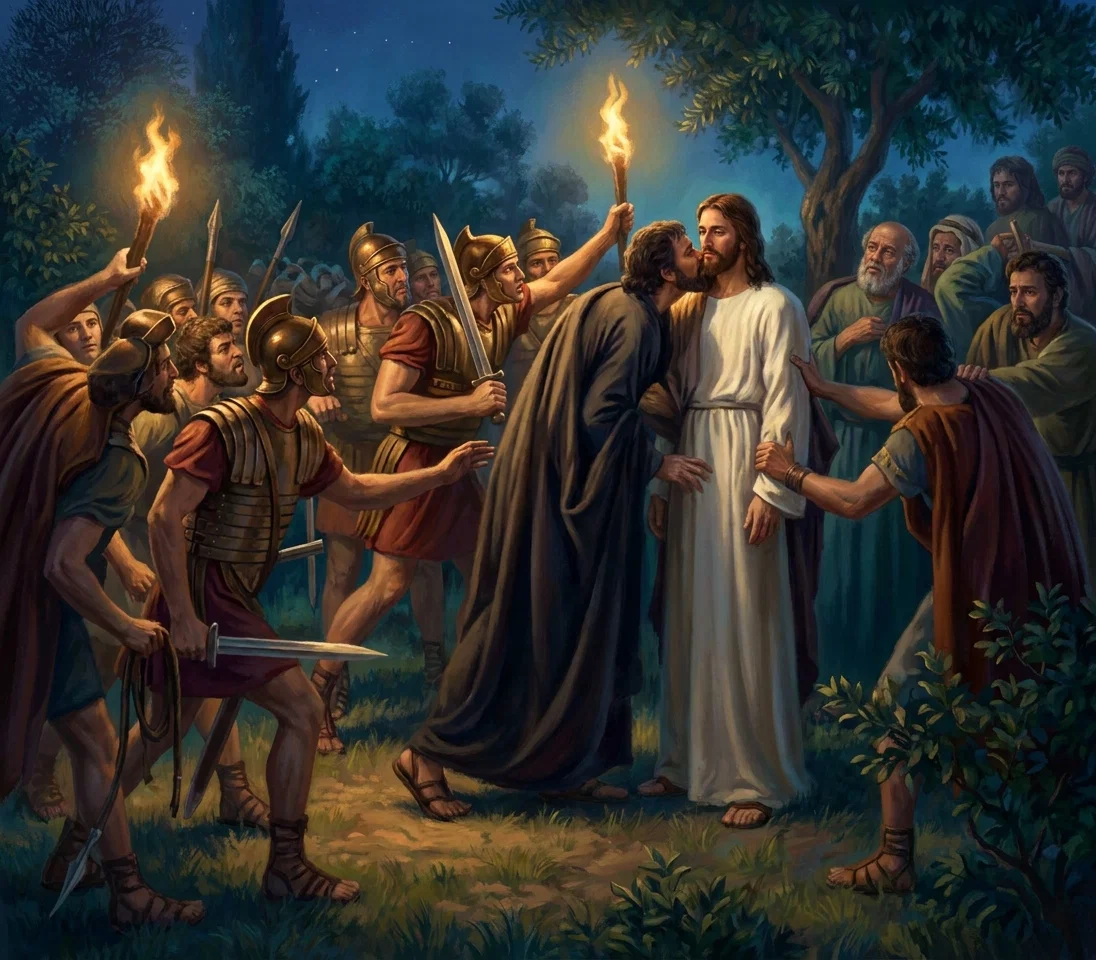
The Roman soldiers soon started to their feet.121With the priests and Judas, they gathered about Christ. They seemed ashamed of their weakness, and fearful that He would escape. Again the question was asked by the Redeemer:—
“Whom seek ye?”
Again they answered, “Jesus of Nazareth.”
The Saviour then said, “I have told you that I am He. If therefore ye seek Me, let these [pointing to His disciples] go their way.”
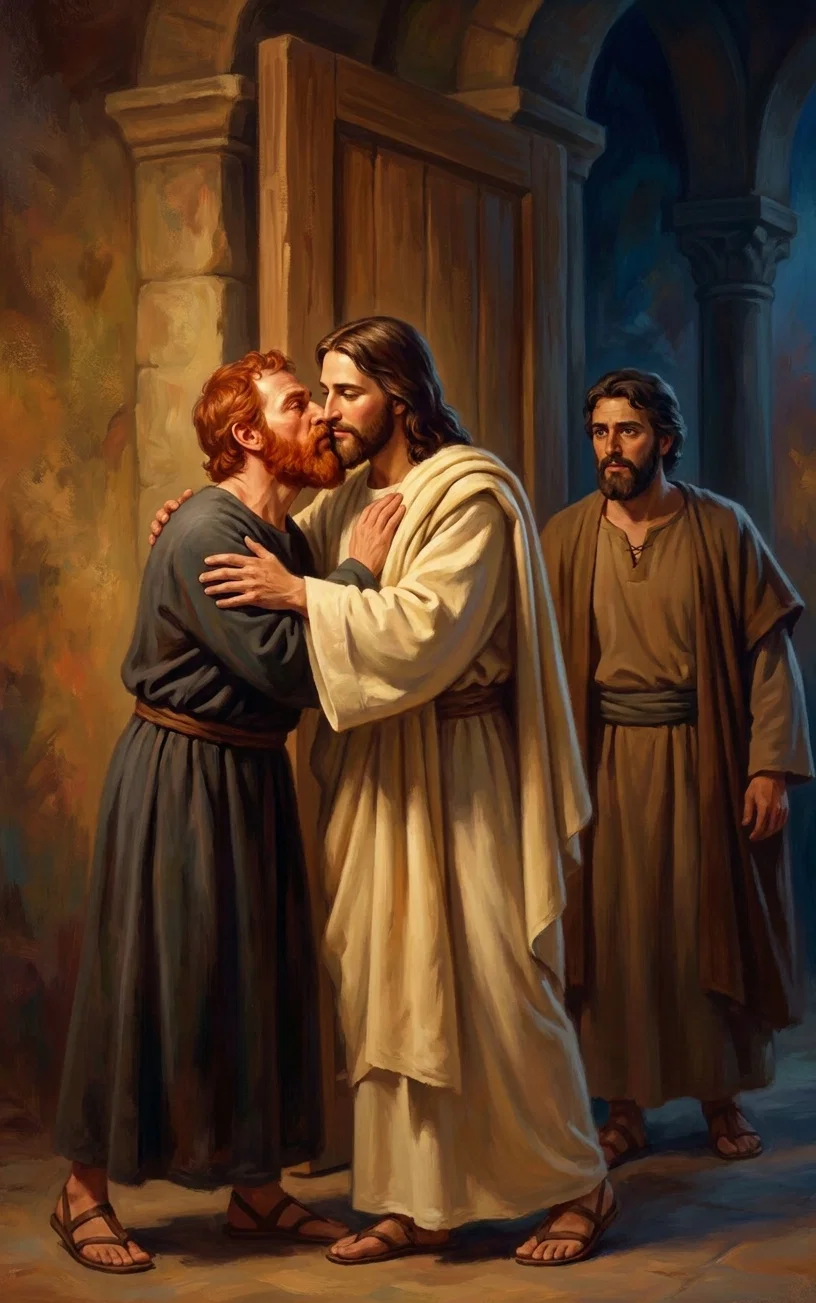
The Traitor's Kiss.
In this hour of trial, Christ's thoughts were for His beloved disciples. He did not wish to have them suffer, even though He must go to prison and to death.
Judas, the betrayer, did not forget the part he was to act. He came close to Jesus, and kissed Him.
Jesus said to him, “Friend, wherefore art thou come?” His voice trembled as He added, “Betrayest thou the Son of man with a kiss?”
These gentle words should have touched the heart of Judas; but all tenderness and honour seemed to have left him. Judas had yielded himself to the control of Satan. He stood boldly before the Lord, and was not ashamed to give Him up to the cruel mob.
Christ did not refuse the traitor’s kiss. In this He gave us an example of forbearance, love, and pity. If we are His disciples, we must treat our enemies as He treated Judas.
The murderous throng became bold as they saw Judas touch the form which had so recently been glorified before their eyes. They now laid hold of the Saviour, and bound those hands that had ever been employed in doing good.
The disciples did not think that Christ would allow Himself to be taken. They knew that the power which could strike down the mob as dead men could keep them helpless till Christ and His companions should escape.
They were disappointed and indignant as they saw the cords brought forward to bind the hands of Him whom they loved. Peter, in his anger, rashly drew his sword, and tried to defend his Master. But he only cut off an ear of the high priest’s servant.
When Jesus saw what was done, He released His123hands, though held firmly by the Roman soldiers, and saying, "Suffer ye thus far," He touched the wounded ear, and it was instantly made whole.
He then said to Peter, “Put up again thy sword into his place; for all they that take the sword shall perish with the sword. Thinkest thou that I cannot now pray to My Father, and He shall presently give Me more than twelve legions of angels? But how then shall the Scriptures be fulfilled, that thus it must be?” “The cup which My Father hath given Me, shall I not drink it?”
Christ then turned to the chief priests and the captains of the temple, who were with the mob, and said, "Are ye come out, as against a thief, with swords and with staves to take Me? I was daily with you in the temple teaching, and ye took Me not; but the Scripture must be fulfilled."
The disciples were offended when they saw that the Saviour made no effort to deliver Himself from His enemies. They blamed Him for not doing so. They could not understand His submission to the mob, and, terror-stricken, they forsook Him and fled.
Christ had foretold this desertion. "Behold," He had said, "the hour cometh, yea, is now come, that ye shall be scattered, every man to his own, and shall leave Me alone; and yet I am not alone, because the Father is with Me."
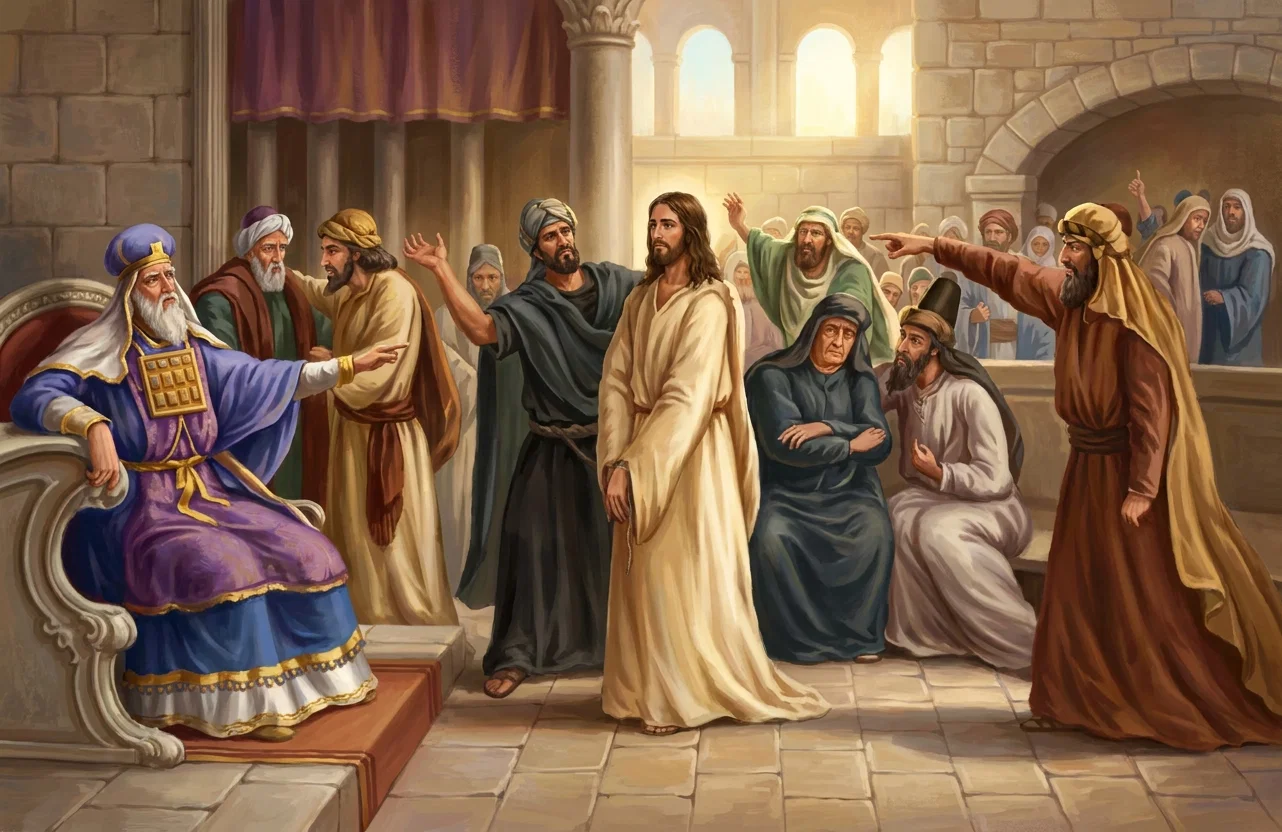
Before the Sanhedrim. “He is brought as a lamb to the slaughter, and as a sheep before her shearers is dumb, so He openeth not His mouth.”