Jesus was followed from the garden of Gethsemane by the hooting mob. He moved painfully, for His hands were tightly bound, and He was closely guarded. He was taken first to the house of Annas, who had formerly been the high priest, but whose place was then filled by his son-in-law, Caiaphas. The wicked Annas had requested that he might be the first to see Jesus of Nazareth a bound captive. He hoped to draw from Him some evidence by which to secure His condemnation.
With this in view he questioned the Saviour with regard to His disciples and His teachings. Christ answered:—
“I spake openly to the world; I ever taught in the synagogue, and in the temple, whither the Jews always resort; and in secret have I said nothing.”
Then, turning upon the questioner, He said, “Why askest thou Me? Ask them which heard Me, what I have said.”
The priests themselves had set spies to watch Christ and report His every word. Through these spies they knew of His sayings and of His works at every gathering of the people He had attended. The spies had sought to entrap Him in His words, that they might find something by which to condemn Him. So the Saviour said, “Ask them which heard Me.” Go to your spies. They have heard what I have said. They can tell you what My teaching has been.
The words of Christ were so searching and pointed that the priest felt that his prisoner was reading his very soul.
But one of the servants of Annas, thinking that his master was not treated with proper respect, struck Jesus in the face, saying :—
“Answerest Thou the high priest so?”
To this Jesus mildly said:—
“If I have spoken evil, bear witness of the evil; but if well, why smitest thou Me?”
Christ could have summoned legions of angels from heaven to His aid. But it was a part of His mission to endure in His humanity all the taunts and insults that men might heap upon Him.
From the house of Annas, the Saviour was taken to the palace of Caiaphas. He was to be tried before the Sanhedrim, and while its members were being127called together, Annas and Caiaphas again questioned Him, but they gained no advantage.
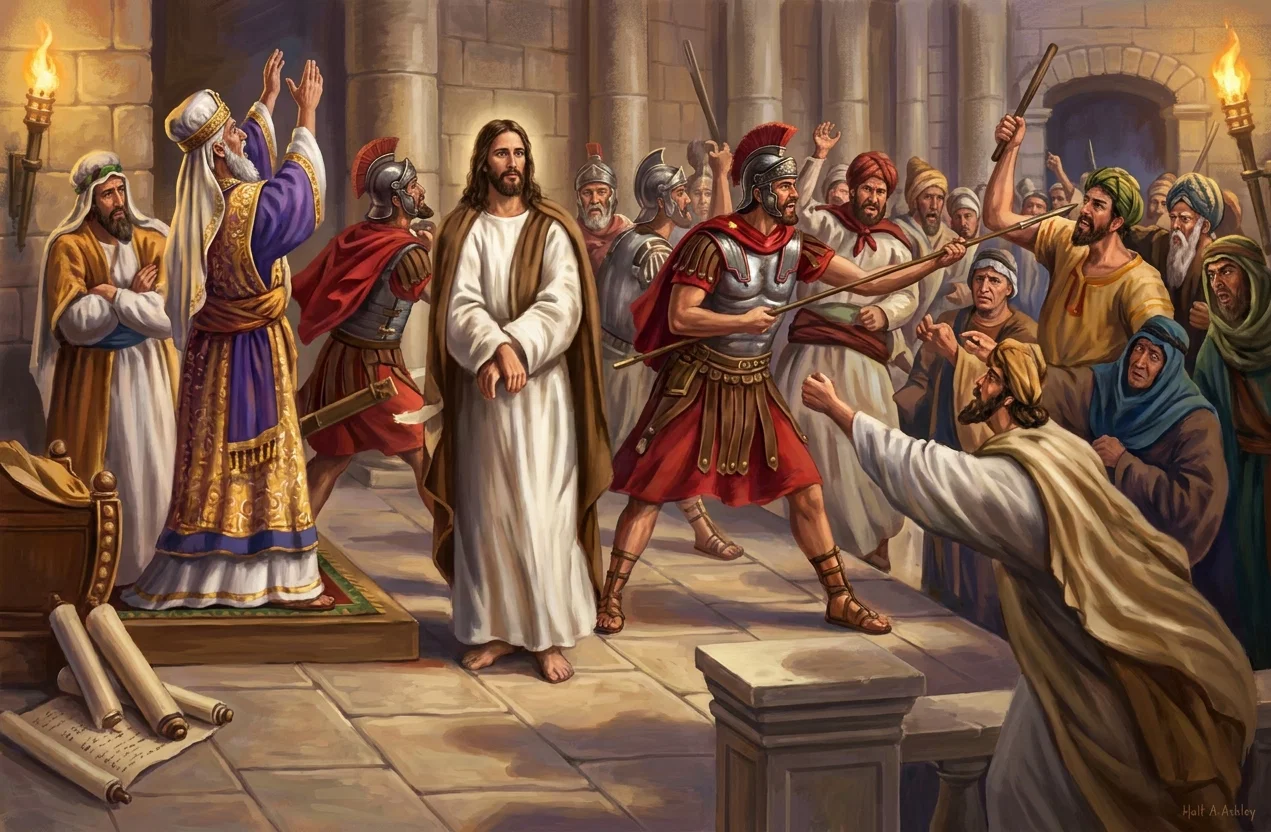
When the members of the Sanhedrim had assembled, Caiaphas took his seat as the president. On each side were the judges; before them stood the Roman soldiers guarding the Saviour; back of these was the accusing mob.
Caiaphas then bade Jesus work one of His mighty miracles before them. But the Saviour gave no sign that He heard a word. Had He responded by even one soul-searching look, such as He gave the buyers and sellers in the temple, the whole murderous throng would have been compelled to flee from His presence.
The Jews were at this time subject to the Romans, and were not allowed to punish any one with death. The Sanhedrim could only examine the prisoner, and pass judgment to be ratified by the Roman authorities.
To accomplish their wicked purpose, they must find something against the Saviour that would be regarded as criminal by the Roman governor. They could secure abundant evidence that Christ had spoken against the Jewish traditions and many of their ordinances. It was easy to prove that He had denounced the priests and scribes, and that He had called them hypocrites and murderers. But this would not be listened to by the Romans, for they themselves were disgusted with the pretensions of the Pharisees.
Many charges were brought against Christ, but either the witnesses disagreed, or the evidence was of such a nature that it would not be accepted by the Romans. They tried to make Him speak in answer to their accusations, but He appeared as if He had not heard them. The silence of Christ at this time had been thus described by the prophet Isaiah :—
I adjure thee by the living God,— Art thou the Christ, the Son of God
“He was oppressed, and He was afflicted, yet He opened not His mouth : He is brought as a lamb to the slaughter, and as a sheep before her shearers is dumb, so He openeth not His mouth.”
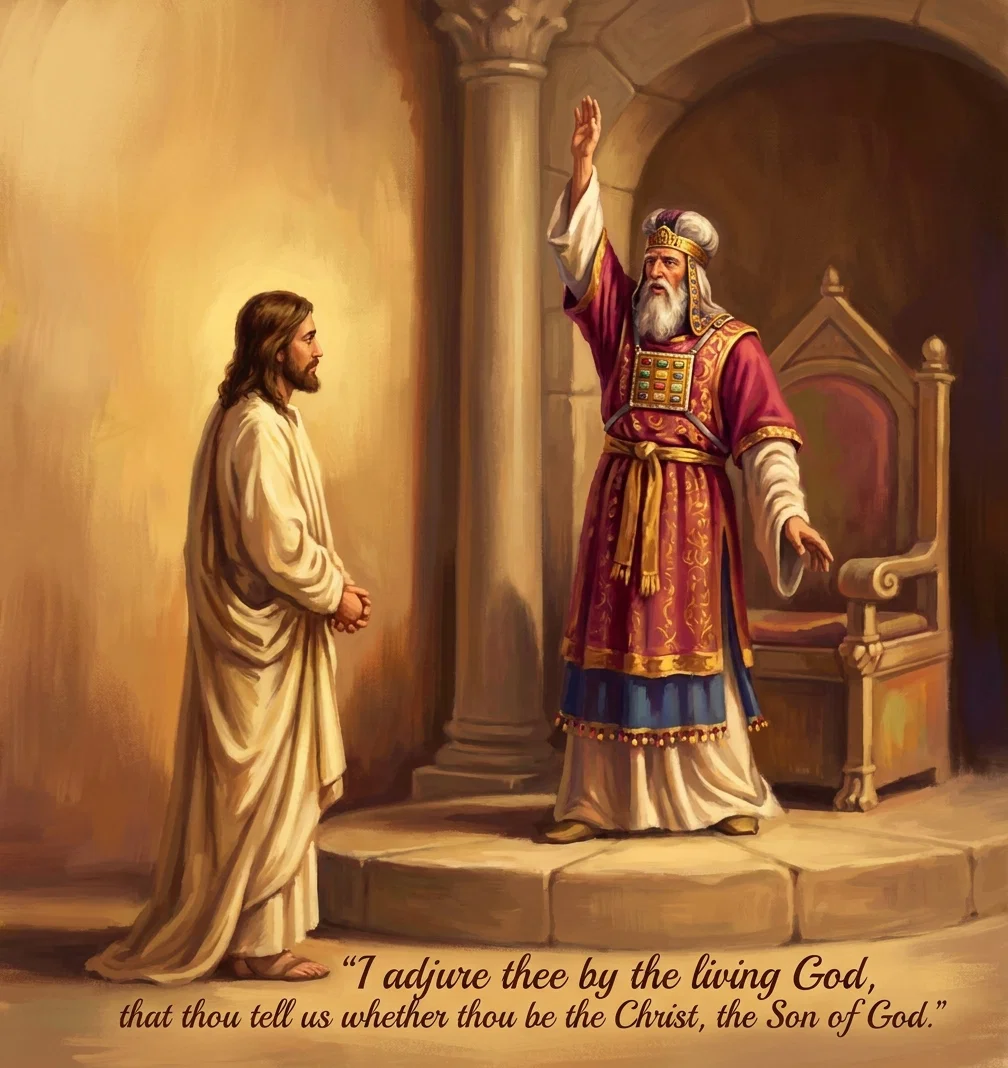
The priests began to fear that they would fail of obtaining any evidence which they could bring against their prisoner before Pilate. They felt that one last effort must be made. The high priest raised his right hand toward heaven, and addressed Jesus in the form of a solemn oath :—
"I adjure Thee by the living God, that Thou tell us whether Thou be the Christ, the Son of God."
The Saviour never denied His mission or His relation to the Father. He could remain silent to personal insult, but He ever spoke plainly and decidedly when His work or His Sonship to God was called in question.
Every ear was bent to listen, and every eye was fixed upon Him as He answered:—
“Thou hast said.”
In the custom of those days this was the same as answering, “Yes,” or, “It is as thou hast said.” This was the strongest form of an affirmative answer. A heavenly light seemed to illuminate the pale countenance of the Saviour as He added:—
“Nevertheless I say unto you, Hereafter shall ye see the Son of man sitting on the right hand of power, and coming in the clouds of heaven.”
In this statement the Saviour presented the reverse of the scene then taking place. He pointed forward to the time when He shall occupy the position of supreme Judge of heaven and earth. He will then be seated upon the Father’s throne, and from His decisions there will be no appeal.
He brought before His hearers a view of that day, when, instead of being surrounded and abused by a riotous mob, He will come in the clouds of heaven with power and great glory. Then He will be escorted by legions of angels. Then He will pronounce130sentence upon His enemies, among whom will be that same accusing throng.
As Jesus spoke the words declaring Himself to be the Son of God, the Judge of the world, the high priest rent his robe, as if to show his horror. He lifted his hands toward heaven, and said:—
“He hath spoken blasphemy; what further need have we of witnesses? behold, now ye have heard His blasphemy. What think ye?” The judges answered, “He is guilty of death.”
“He is guilty, put Him to death!”
have we of witnesses?
behold; now ye have
It was contrary to the Jewish law to try a prisoner by night. Though the condemnation of Christ had been determined, there must be a formal trial by day.
Jesus was taken to the guard room, and there suffered mockery and abuse from the soldiers and the rabble.
At daybreak He was again brought before His judges, and the final sentence of condemnation was pronounced.
A satanic fury took possession of the leaders and the people. The roar of voices was like that of wild beasts. They made a rush for Jesus, crying, "He is guilty, put Him to death!" and had it not been for the soldiers, He would have been torn in pieces. But Roman authority interposed, and by force of arms restrained the violence of the mob.
Priests, rulers, and the rabble joined in abusing the Saviour. An old garment was thrown over His head; and His persecutors struck Him in the face, saying:—
“Prophesy unto us, Thou Christ, Who is he that smote Thee?”
When the garment was removed, one of the mocking throng spat in the Saviour’s face.
The angels of God faithfully recorded every insulting look, word, and act against their beloved Commander. One day those base men who scorned and spat upon the calm, pale face of Christ will look upon it in its glory, shining brighter than the sun.
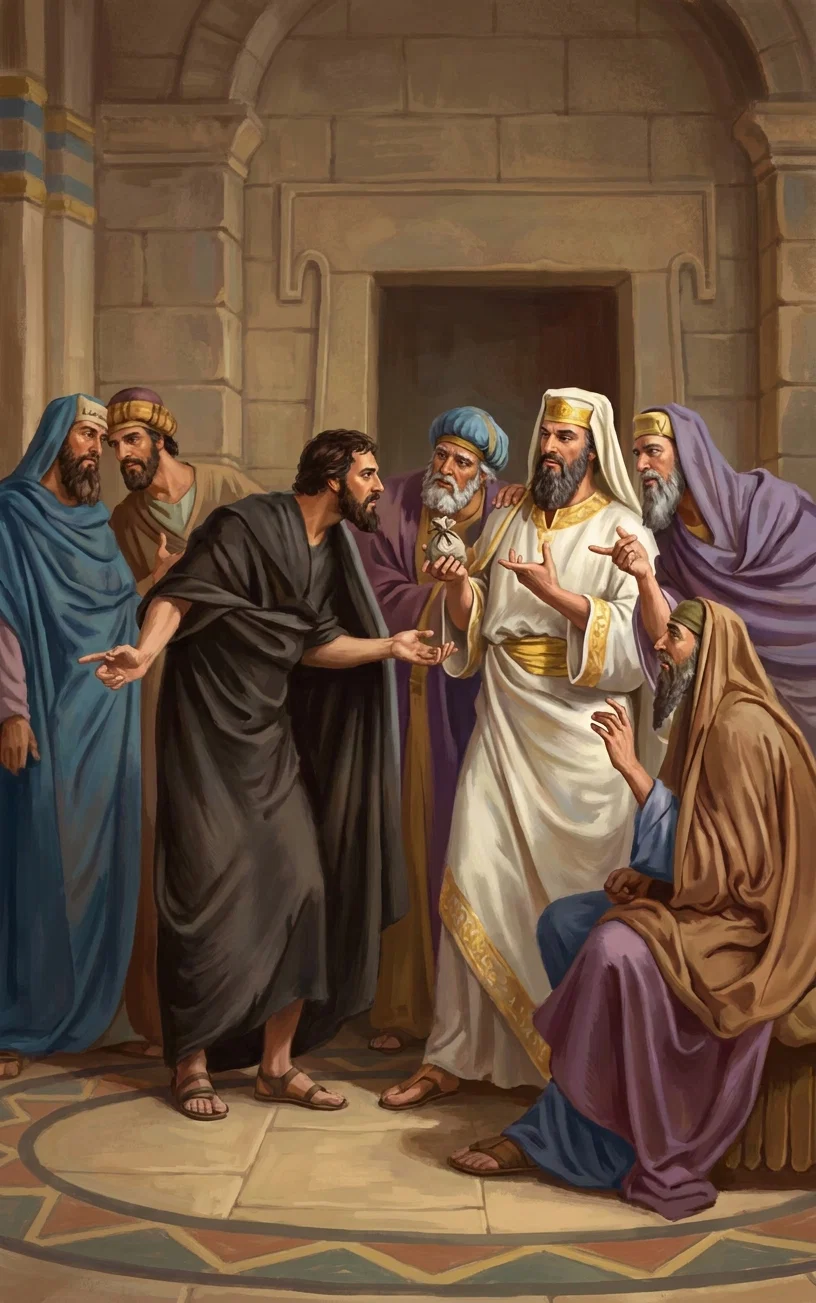
JUDAS SELLING CHRIST. “He could now sell his Lord for thirty pieces of silver.”
JUDAS.
The Jewish rulers had been anxious to get Jesus into their power, but for fear of raising a tumult among the people they had not dared to take Him openly. So they had sought some one who would secretly betray Him, and had found in Judas, one of the twelve disciples, the man who would do this base act.
Judas had naturally a strong love for money, but he had not always been wicked and corrupt enough to do such a deed as this. He had fostered the evil spirit of avarice until it had become the ruling motive of his life, and he could now sell his Lord for thirty pieces of silver, the price of a slave. He could now betray the Saviour with a kiss in Gethsemane.
But he followed every step of the Son of God, as He went from the garden to the trial before the Jewish rulers. He had no thought that the Saviour would allow the Jews to kill Him, as they had threatened to do.
At every moment he expected to see Him released134and protected by divine power, as had been done in the past. But as the hours went by, and Jesus quietly submitted to all the indignities that were heaped upon Him, a terrible fear came to the traitor, that he had indeed betrayed his Master to His death.
As the trial drew to a close, Judas could endure the torture of his guilty conscience no longer. All at once there rang through the hall a hoarse voice, which sent a thrill of terror to the hearts of all present:—
He is innocent. Spare Him, O Caiaphas. He has done nothing worthy of death!
The tall form of Judas was now seen pressing through the startled crowd. His face was pale and haggard, and large drops of sweat stood on his forehead. Rushing to the throne of judgment, he threw down before the high priest the pieces of silver that had been the price of his Lord's betrayal.
He eagerly grasped the robe of Caiaphas, and begged him to release Jesus, declaring that He had done no wrong. Caiaphas angrily shook him off, and said with scorn:—
“What is that to us? see thou to that.”
Judas then threw himself at the Saviour’s feet. He confessed that Jesus was the Son of God, and begged Him to deliver Himself from His enemies.
The Saviour knew that Judas did not really repent for what he had done. The false disciple135feared that punishment would come upon him for his terrible deed; but he felt no real sorrow because he had betrayed the spotless Son of God.
Yet Christ spoke to him no word of condemnation. He looked with pity upon Judas, and said:—
“For this hour came I into the world.”
A murmur of surprise ran through the assembly. With amazement they beheld the forbearance of Christ toward His betrayer.
Judas saw that his entreaties were in vain, and he rushed from the hall, crying:—
It is too late! It is too late!
He felt that he could not live to see Jesus crucified, and in despair went out and hanged himself.
Later that same day, on the road from Pilate’s judgment-hall to Calvary, the wicked throng were leading the Saviour to the place of crucifixion. Suddenly there came an interruption to their shouts and jeers. As they passed a retired spot, they saw at the foot of a lifeless tree the dead body of Judas.
It was a revolting sight. His weight had broken the cord by which he had hanged himself to the tree. In falling, his body had been horribly mangled, and dogs were now devouring it.
His remains were immediately buried out of sight; but there was less mockery, and many a pale face revealed the fearful thoughts within. Retribution seemed already to be visiting those who were guilty of the blood of Jesus.
BEFORE PILATE.
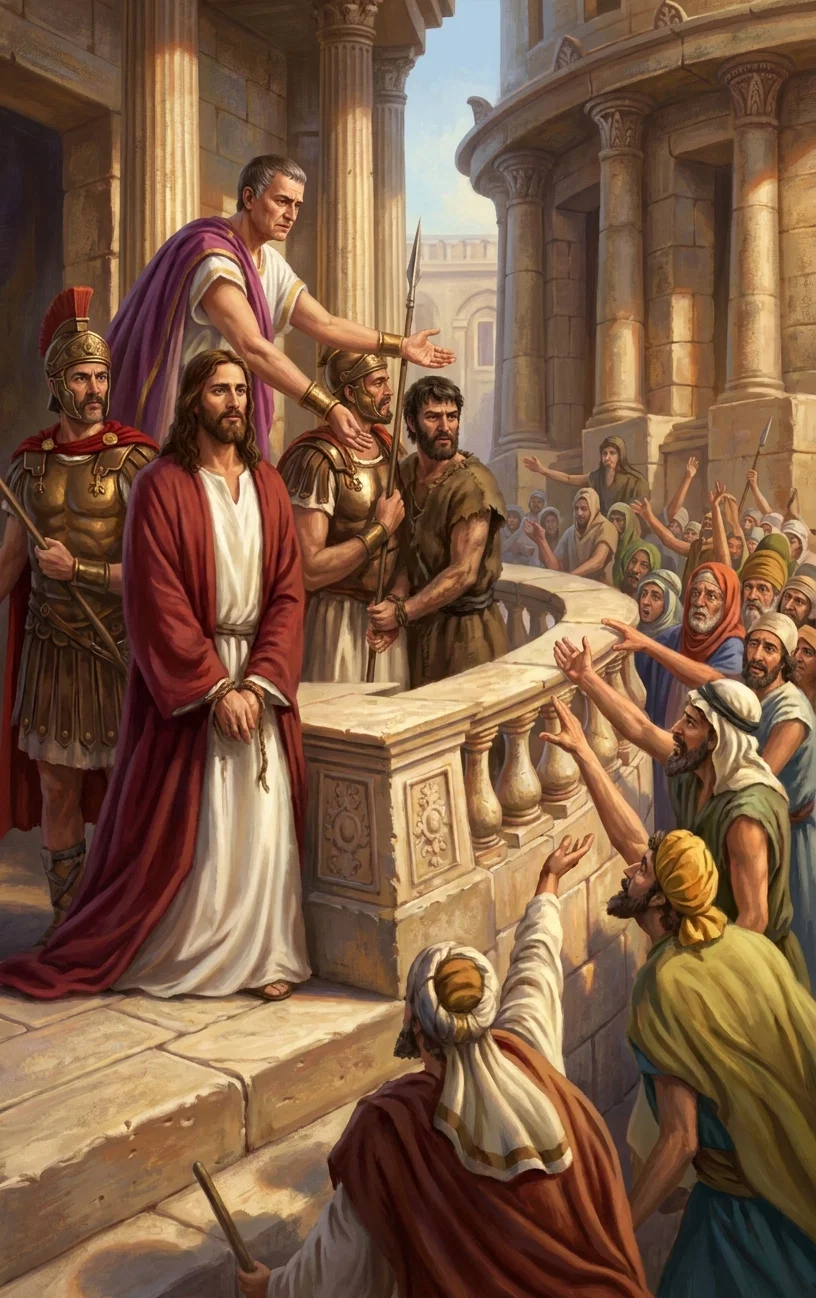
AFTER Christ had been condemned by the judges of the Sanhedrim, He was taken at once to Pilate, the Roman governor, to have the sentence confirmed and executed.
The Jewish priests and rulers could not themselves enter the judgment hall of Pilate. By the ceremonial laws of their nation, they would become defiled by so doing, and thus be debarred from taking part in the feast of the passover.
In their blindness they did not see that Christ was the real passover lamb, and that since they had rejected Him, this great feast had for them lost its meaning.
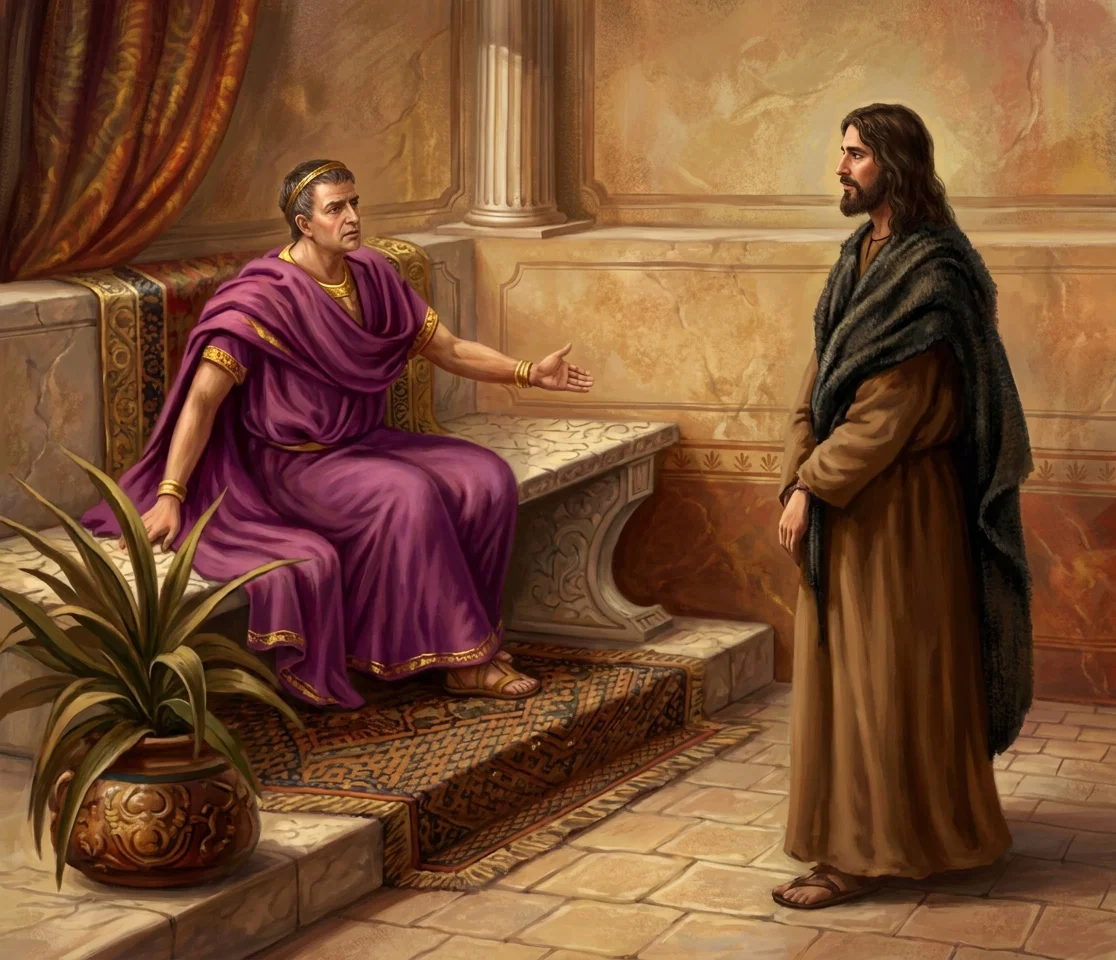
As Pilate beheld Jesus, he saw a man of noble countenance and dignified bearing. No trace of crime was to be seen in His face. Pilate turned to the priests and asked:—
“What accusation bring ye against this man?”
His accusers did not wish to state particulars, and so were not prepared for this question. They knew that they could bring no truthful evidence on which the Roman governor would condemn Him.
“Art Thou the King of the Jews?”
So the priests called the false witnesses to their aid. “And they began to accuse Him, saying:—
“We found this fellow perverting the nation, and forbidding to give tribute to Cæsar, saying that He Himself is Christ a King.”
This was false, for Christ had plainly sanctioned138the payment of tribute to Cæsar. When the lawyers had tried to entrap Him in regard to this very matter, He had said :—
“Render therefore unto Cæsar the things which are Cæsar’s.”
Pilate was not deceived by the testimony of the false witnesses. He turned to the Saviour, and asked :—
“Art Thou the King of the Jews?”
Jesus answered, “Thou sayest.”
When they heard this answer, Caiaphas and those who were with him called Pilate to witness that Jesus had admitted the crime of which they accused Him. With noisy cries they demanded that He be sentenced to death.
As Christ made no answer to His accusers, Pilate said to Him:—
“Answerest Thou nothing? behold how many things they witness against Thee.
“But Jesus yet answered nothing.”
Pilate was perplexed. He saw no evidence of crime in Jesus, and he had no confidence in those who were accusing Him. The noble appearance and quiet manner of the Saviour were in direct contrast to the excitement and fury of His accusers. Pilate was impressed with this, and was well satisfied of His innocence.
Hoping to gain the truth from Him, he took Jesus by Himself, and questioned Him:—
“Art Thou the King of the Jews?”
Christ did not give a direct answer to this question, but asked:—
“Sayest thou this thing of thyself, or did others tell it thee of Me?”
The Spirit of God was striving with Pilate. The question of Jesus was intended to lead him to examine his own heart more closely. Pilate understood the meaning of the question. His own heart was opened before him, and he saw that his soul was stirred by conviction. But pride arose in his heart, and he answered:—
“Am I a Jew? Thine own nation and the chief priests have delivered Thee unto me: what hast Thou done?”
Pilate’s golden opportunity had passed. But Jesus desired Pilate to understand that He had not come to be an earthly king, therefore He said:—
“My kingdom is not of this world. If My kingdom were of this world, then would My servants fight, that I should not be delivered to the Jews; but now is My kingdom not from hence.”
Pilate then asked “Art Thou a king then?
“Jesus answered, Thou sayest that I am a king. To this end was I born, and for this cause came I into140the world, that I should bear witness unto the truth. Every one that is of the truth heareth My voice.”
Pilate had a desire to know the truth. His mind was confused. He eagerly grasped the words of the Saviour, and his heart was stirred with a great longing to know what the truth really was, and how he could obtain it. He asked Jesus:—
“What is truth?”
But he did not wait to receive an answer. The tumult of the crowd outside the hall of justice had increased to a roar. The priests were clamorous for immediate action, and Pilate was recalled to the interests of the hour. Going out to the people, He declared:—
“I find in Him no fault at all.”
These words from a heathen judge were a scathing rebuke to the base perfidy and falsehood of the rulers of Israel who were accusing the Saviour.
As the priests and elders heard this from Pilate, their disappointment and rage knew no bounds. They had long plotted and waited for this opportunity. As they saw the prospect of the release of Jesus, they seemed ready to tear Him in pieces.
They lost all reason and self-control, and gave vent to curses, behaving more like demons than like men. They loudly denounced Pilate, and threatened him141with the censure of the Roman government. They accused Pilate of refusing to condemn Jesus, who, they affirmed, had set Himself up against Cæsar. They then raised the cry:—
“He stirreth up the people, teaching throughout all Jewry, beginning from Galilee to this place.”
Pilate at this time had no thought of condemning Jesus. He was sure of His innocence. But when he heard that Christ was from Galilee, he decided to send Him to Herod, the ruler of that province, who was then in Jerusalem. By this course Pilate thought to shift the responsibility of the trial from himself to Herod.
Jesus was faint from hunger, and weary from loss of sleep. He was also suffering from the cruel treatment He had received. But Pilate delivered Him again to the soldiers, and He was dragged away, amid the jeers and insults of the merciless mob.
Mocking the Saviour. “He submitted to the coarsest insult and outrage with dignified composure.”
BEFORE HEROD.
EROD had never met Jesus, but he had long desired to see Him, and to witness His marvellous power. As the Saviour was brought before him, the rabble surged and pressed about, some crying one thing, and some another. Herod commanded silence, for he wished to question the prisoner.
He looked with curiosity and pity upon the pale face of Christ. He saw there the marks of deep wisdom and purity. He was satisfied, as Pilate had been, that malice and envy alone had caused the Jews to accuse the Saviour.
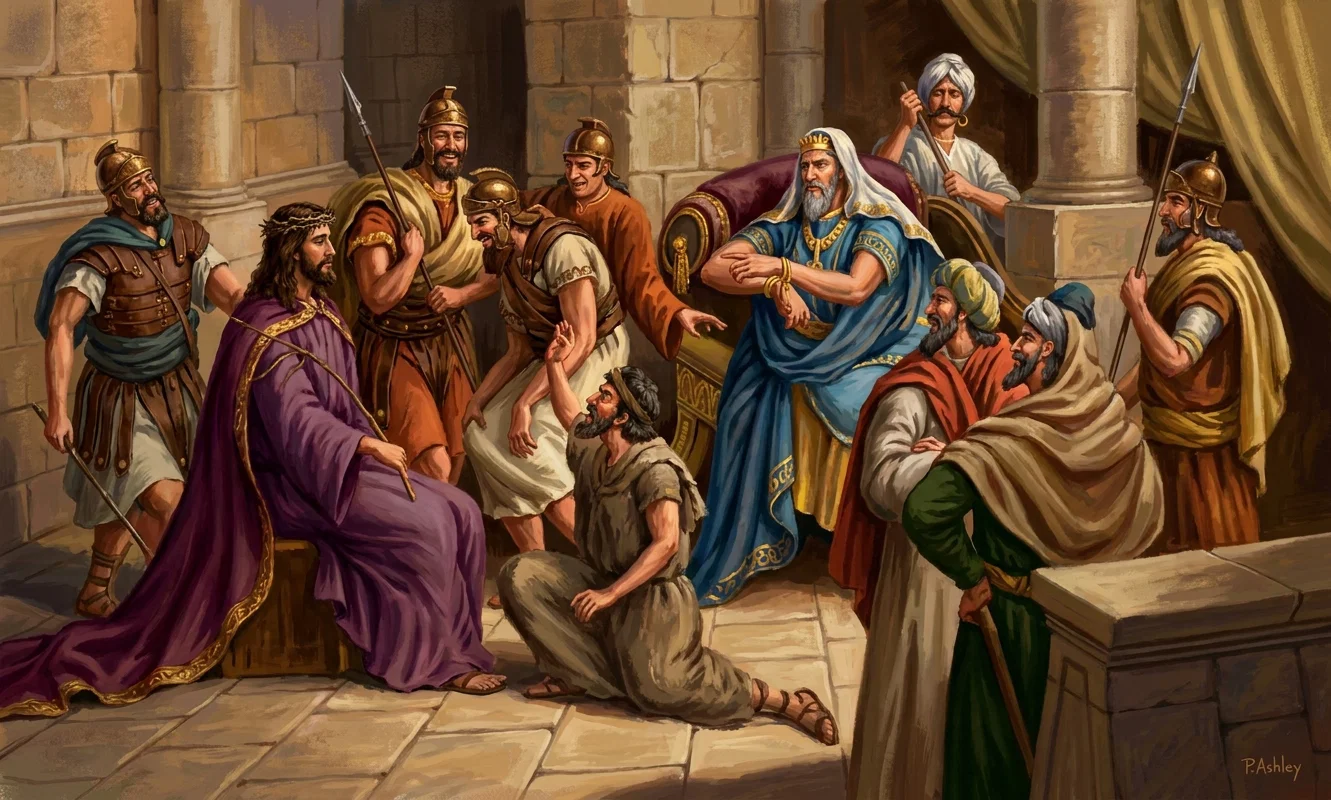
Herod urged Christ to perform one of His wonderful miracles before him. He promised to release Him if He would do so. By his direction, crippled and deformed persons were brought in, and he commanded Jesus to heal them. But the Saviour stood before Herod as one who neither saw nor heard.
The Son of God had taken upon Himself man's nature. He must do as man must do in similar circumstances.144Therefore He would not work a miracle to gratify curiosity, or to save Himself from the pain and humiliation that man must endure when placed in a similar position.
His accusers were terrified when Herod demanded of Christ a miracle. Of all things they dreaded most an exhibition of His divine power. Such a manifestation would be a death-blow to their plans, and would perhaps cost them their lives. So they set up the cry that Jesus worked miracles through the power given Him by Beelzebub, the prince of the devils.
Several years before this, Herod had listened to the teaching of John the Baptist. He had been deeply impressed, but he had not forsaken his life of intemperance and sin. So his heart grew harder, and at last in a drunken revel he had commanded that John should be slain to please the wicked Herodias.
Now he had become still more hardened. He could not bear the silence of Jesus. His face grew dark with passion, and he angrily threatened the Saviour, who still remained unmoved and silent.
Christ had come into the world to heal the broken-hearted. Could He have spoken any word to heal the bruises of sin-sick souls, He would not have kept silent. But He had no words for those who would but trample the truth under their unholy feet.
The Saviour might have spoken to Herod words that would have pierced the ears of the hardened145king. He might have stricken him with fear and trembling by laying before him the full iniquity of his life, and the horror of his approaching doom. But Christ's silence was the severest rebuke that He could have given.
That ear which had ever been open to the cry of human woe, had no place for the command of Herod. That heart, ever touched by the plea of even the worst sinners, was closed to the haughty king who felt no need of a Saviour.
In anger, Herod turned to the multitude, and denounced Jesus as an impostor. But the accusers of the Saviour knew that He was no impostor. They had seen too many of His mighty works to believe this charge.
Then the king began to shamefully abuse and ridicule the Son of God. “And Herod with his men of war set Him at naught, and mocked Him, and arrayed Him in a gorgeous robe.”
As the wicked king saw Jesus accepting all this indignity in silence, he was moved with a sudden fear that this was no common man before him. He was perplexed with the thought that this prisoner might be a heavenly being come down to the earth.
Herod dared not ratify the condemnation of Jesus. He wished to relieve himself of the terrible responsibility, and so sent the Saviour back to Pilate.
Christ or Barabbas. “Away with this man, and release unto us Barabbas.”