From the wilderness, Christ returned to the Jordan, where John the Baptist was preaching. At that time men sent by the rulers at Jerusalem were questioning John as to his authority for teaching and baptising the people. They asked if he was the Messiah, or Elijah, or “that prophet,” meaning Moses. To all this he answered, “I am not.” Then they asked:—
“Who art thou? that we may give an answer to them that sent us.”
He said, “I am the voice of one crying in the wilderness, Make straight the way of the Lord, as said the prophet Esaias.”
In old times when a king had to travel from one part of his country to another, men were sent ahead of his chariot to prepare the roads. They had to cut down trees, gather out the stones, and fill up the hollows, so that the way would be clear for the king. So when Jesus, the heavenly King, was coming, John54the Baptist was sent to prepare the way by telling the people, and calling on them to repent of their sins.
As John answered the messengers from Jerusalem, he saw Jesus standing on the river-bank. His face lighted up, and stretching out his hands, he said:—
“There standeth One among you, whom ye know not; He it is, who coming after me, is preferred before me, whose shoe’s latchet I am not worthy to unloose.”
The people were greatly moved. The Messiah was among them! They looked about eagerly to find the one of whom John had spoken. But Jesus had mingled with the multitude, and was lost to sight.
The next day John again saw Jesus, and, pointing to Him, cried:—
“Behold the Lamb of God, which taketh away the sin of the world!”
Then John told of the sign that had been seen at Christ’s baptism. “I saw, and bare record,” he added. “that this is the Son of God.”
With awe and wonder the hearers looked upon Jesus. They questioned with themselves, Is this the Christ?
They saw that Jesus bore no tokens of worldly wealth or greatness. His clothing was plain and simple, such as poor people wore. But in His pale,55worn face was something that moved their hearts. In that face they read dignity and power; and every glance of the eye, every feature of the countenance, spoke of divine compassion and unutterable love.
But the messengers from Jerusalem were not drawn to the Saviour. John had not said that which they desired to hear. They expected the Messiah to come as a great conqueror. They saw that this was not the mission of Jesus, and in disappointment they turned from Him.
The next day John again saw Jesus, and again he cried, "Behold the Lamb of God!" Two of John's disciples were standing near, and they followed Jesus. They listened to His teaching, and became His disciples. One of the two was Andrew, the other John. Andrew soon brought to Jesus his own brother, Simon, whom Christ named Peter. The next day, on the way to Galilee, Christ called another disciple, Philip. As soon as Philip found the Saviour, he brought his friend Nathanael.
In this way Christ’s great work on earth was begun. One by one He called His disciples, and one brought his brother, another his friend. This is what every follower of Christ is to do. As soon as he himself knows Jesus, he is to tell others what a precious Friend he has found. This is a work that all can do, whether they are young or old.
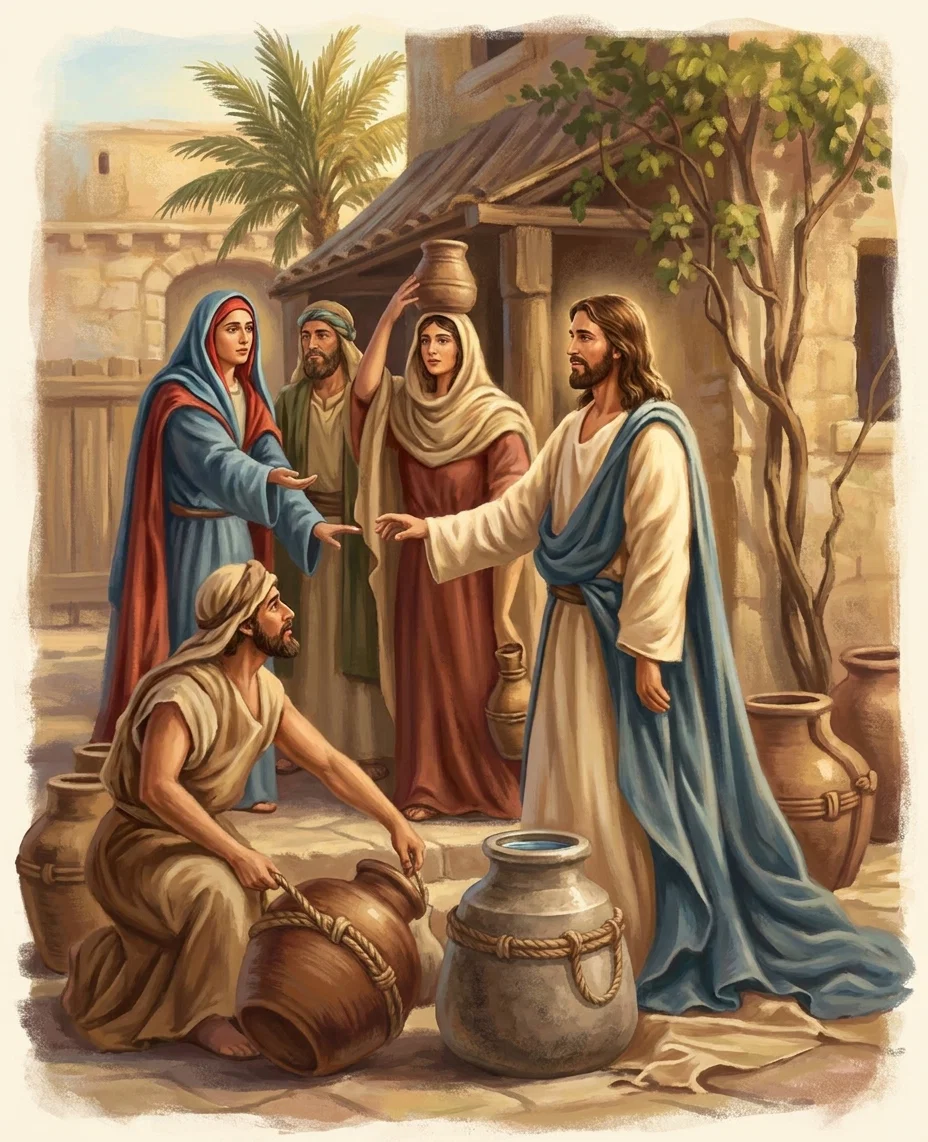
At Cana in Galilee, Christ, with His disciples, attended a marriage feast. For the happiness of this household gathering, His wonderful power was put forth.
It was the custom in that country to use wine on such occasions. Before the feast was ended, the supply of wine had failed. The lack of wine at a feast would be thought to show a want of hospitality, and this was regarded as a great disgrace. Christ was told of what had happened, and He bade the servants fill six large stone jars with water. Then He said, “Draw out now, and bear unto the governor of the feast.”
Instead of water, there came forth wine. This wine was much better than that which had been served before, and there was enough for all.
After working the miracle, Jesus quietly went away. Not till He had gone, did the guests know of the work He had done.
Christ’s gift to the marriage feast was a symbol. The water represented baptism, and the wine His blood, that was to be shed for the world.
The wine which Jesus made was not fermented liquor. Such wine is a cause of drunkenness and many great evils, and God has forbidden its use. He says, “Wine is a mocker, strong drink is raging; and whosoever is deceived thereby is not wise.” “It biteth like a serpent, and stingeth like an adder.”
The wine used at the feast was the pure, sweet juice of the grape. It was like that which the prophet Isaiah calls “the new wine . . . in the cluster;” and he says, “A blessing is in it.”
By going to the marriage feast, Christ showed that it is right to meet together in this pleasant way. He liked to see people happy. Often He visited them in their homes, and tried to have them forget their cares and troubles, and think of God's goodness and His love.
Wherever He might be, Christ was always trying to do this. Wherever a heart was open to receive the divine message, He unfolded the truths of the way of salvation.
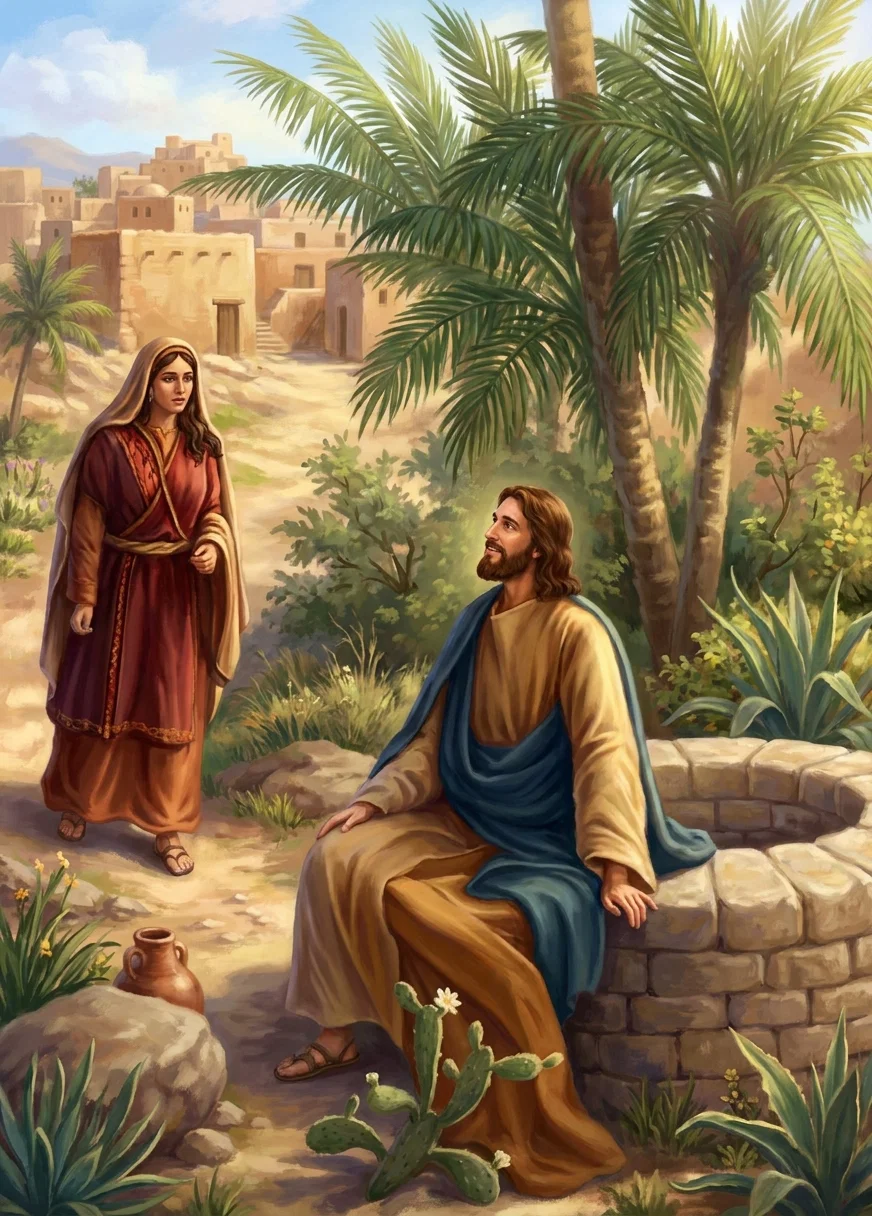
One day, as He was passing through the country58of Samaria, He sat down by a well to rest. When a woman came to draw water, He asked her for a drink.
The woman wondered at this, for she knew how the Jews hated the Samaritans. But Christ told her that if she would ask of Him, He would give her living water. At this she wondered the more. Then He said:—
“Whosoever drinketh of this water shall thirst again; but whosoever drinketh of the water that I shall give him shall never thirst; but the water that I shall give him shall be in him a well of water springing up into everlasting life.”
By the living water is meant the Holy Spirit. As a thirsty traveller needs water to drink, so do we need God's Spirit in our hearts. He who drinks of this water shall never thirst. The Holy Spirit brings God's love into our hearts. It satisfies our longings, so that the riches and honours and pleasures of this world do not attract us.
And it fills us with such joy that we want others to have it too. It will be in us like a spring of water, that flows out in blessing to all around.
And every one in whom God's Spirit dwells, will live for ever with Christ in His kingdom. Received into the heart by faith, it is the beginning of the life eternal.
This precious blessing Christ told the woman He would give her if she asked for it. So He will give it to us.
This woman had broken God's commandments, and Christ showed her that He knew the sins of her life. But He showed, too, that He was her friend, that He loved and pitied her, and that if she was willing to forsake her sins, God would receive her as His child.
that He was her
loved and pitied
she was willing
sins, God would
How glad she was to know this! In her joy she hurried away to the town near by, and called the people to come and see Jesus.
So they came to the well, and asked Him to stay with them. He remained two days, and taught them, and many listened to His words. They repented of their sins, and believed on Him as their Saviour.
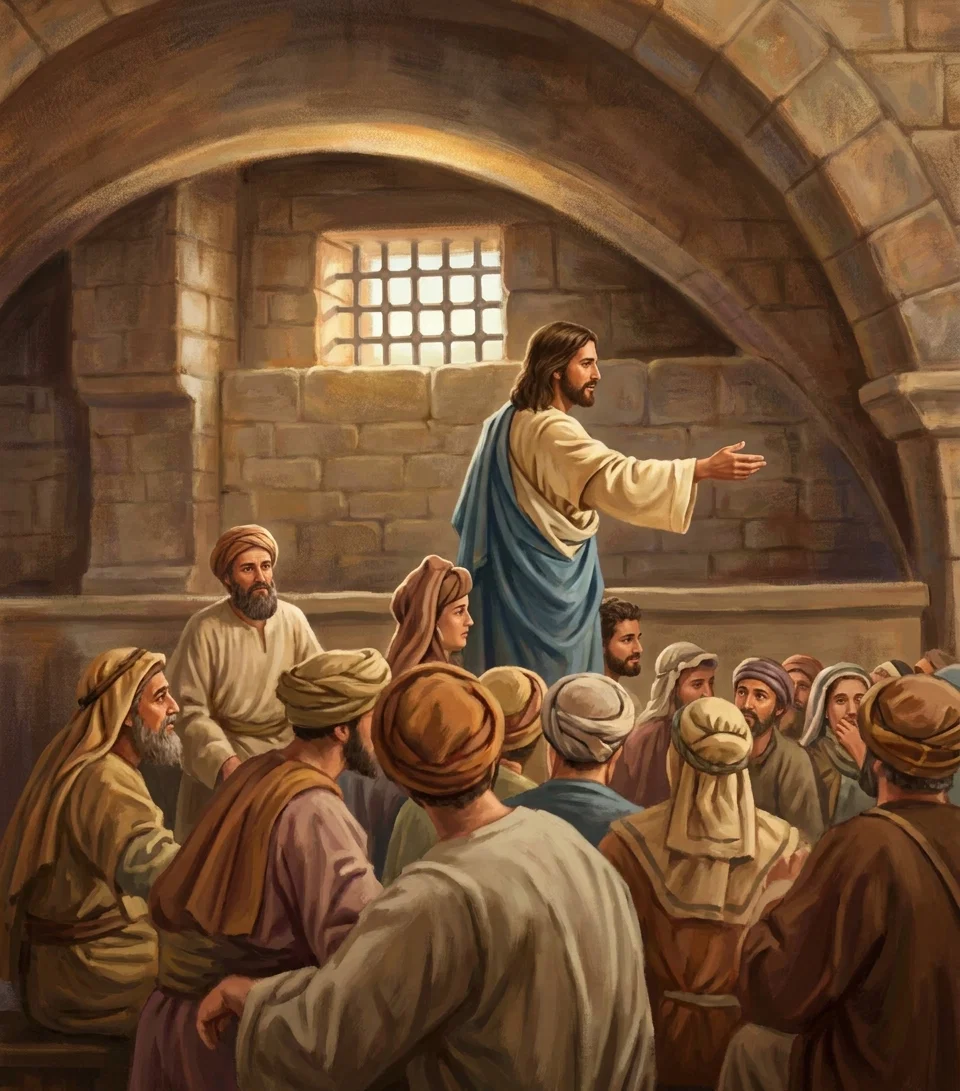
During His ministry, Jesus twice visited His old home at Nazareth. At the first visit He went to the synagogue on the Sabbath day.
Here He read from Isaiah's prophecy about the work of the Messiah,—how He was to preach good tidings to the poor, to comfort the sorrowing, to give sight to the blind, and to heal those that were bruised. Then He told the people that all this was fulfilled that day. This was the work that He Himself was doing.
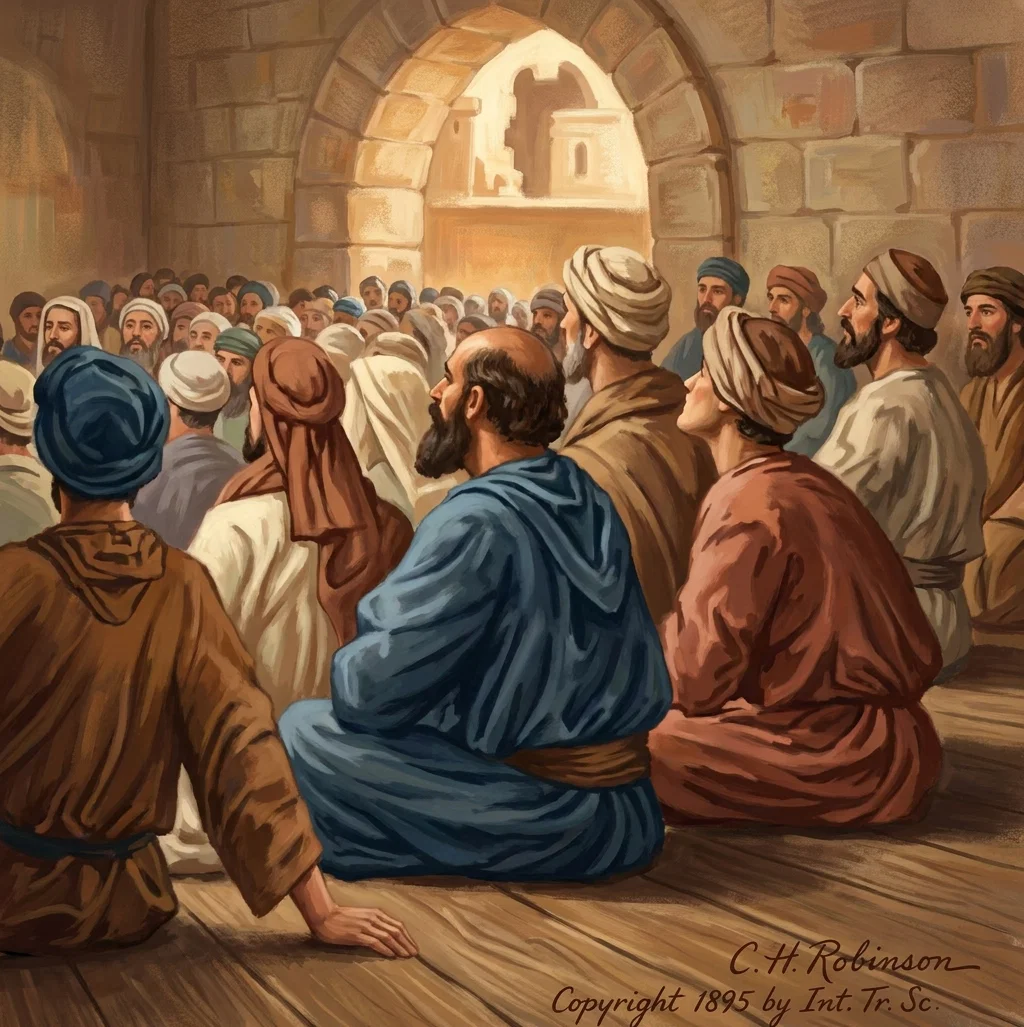
IN THE SYNAGOGUE AT NAZARETH.
At these words the hearers were filled with joy. They believed that Jesus was the promised Saviour. Their hearts were moved upon by the Holy Spirit, and they responded with fervent amens and praises to the Lord.
Then they remembered how Jesus had lived among them as a carpenter. Often they had seen Him working in the shop with Joseph. Though in His61whole life there had been only deeds of love and mercy, they would not believe that He was the Messiah.
By such thoughts as these they opened the way for Satan to control their minds. Then they were filled with wrath against the Saviour. They cried out against Him, and determined to take His life.
They hurried Him away, meaning to throw Him over the steep side of a hill. But holy angels were near to protect Him. He passed safely through the crowd, and was not to be found.
The next time He came to Nazareth, the people were no more ready to receive Him. He went away, never to return.
Christ worked for those who wanted His help, and all through the country the people flocked about Him. As He healed and taught them, there was great rejoicing. Heaven seemed to come down to the earth, and they feasted upon the grace of a merciful Saviour.
TEACHINGS OF CHRIST.
AMONG the Jews, religion had come to be little more than a round of ceremonies. As they had departed from the true worship of God, and lost the spiritual power of His word, they had tried to supply the lack by adding ceremonies and traditions of their own.
Only the blood of Christ can cleanse from sin. Only His power can keep men from sinning. But the Jews depended upon their own works and the ceremonies of their religion to earn them salvation. Because of their zeal for these ceremonies they thought themselves righteous, and worthy of a place in God's kingdom.
But their hopes were fixed on worldly greatness. They longed for riches and power, and these they expected as the reward for their pretended piety. They looked for the Messiah to set up His kingdom on this earth, and to rule as a mighty prince among men. Every worldly blessing they hoped to receive at His coming.
Jesus knew that their hopes were to be disappointed. He had come to teach them of something far better than they had sought. He had come to restore the true worship of God. He was to bring in a pure heart-religion, that would manifest itself in a pure life and a holy character.
“He explained what God thinks most precious”
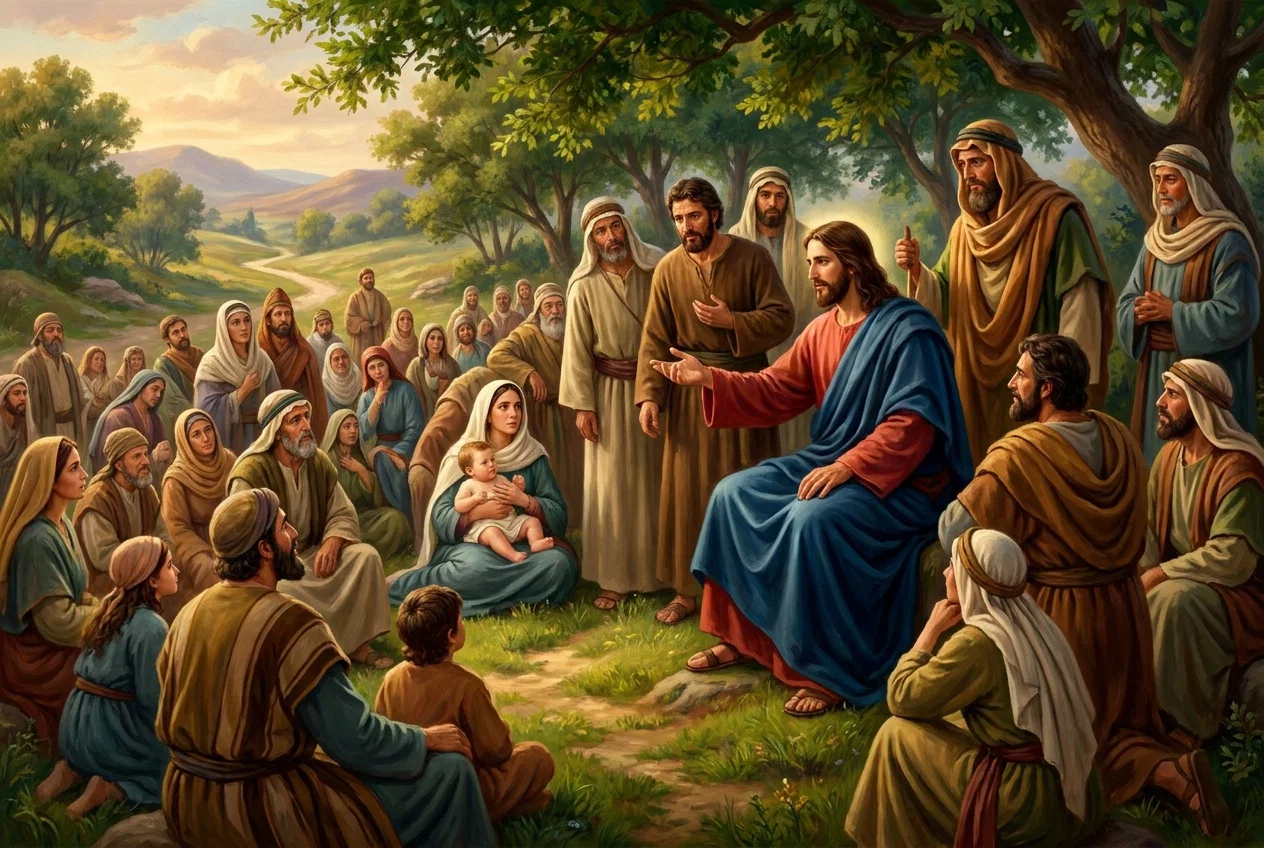
In the beautiful sermon on the mount He explained what God thinks most precious, and what would give real happiness.
The Saviour’s disciples had been influenced by the teachings of the rabbis; and for these disciples, first of all, Christ’s lessons were spoken. That which He taught them is for us also. We need to learn the same things.
“Blessed are the poor in spirit,” Christ said. The poor in spirit are those who know their own sinfulness and need. They know that of themselves they can do no good thing. They desire help from God, and to them His blessing is given. “For thus saith the high and lofty One that inhabiteth eternity, whose name is Holy: I dwell in the high and holy place, with him also that is of a contrite and humble spirit, to revive the spirit of the humble, and to revive the heart of the contrite ones.”
“Blessed are they that mourn.” This does not mean those who complain and murmur, and who go about with a sour, downcast look. It means those who are truly sorry for their sins, and who ask God for pardon. All such He will freely forgive. He says, “I will turn their mourning into joy, and will comfort them, and make them rejoice from their sorrow.”
“Blessed are the meek.” Christ says, “Learn of Me; for I am meek and lowly in heart.” When He was wrongfully treated, He returned good for evil. In this He has given us an example, that we should do as He has done.
“Blessed are they which do hunger and thirst after righteousness.” Righteousness is right-doing. It is obedience to the law of God; for in that law the principles of righteousness are set forth. The Bible says, “All Thy commandments are righteousness.” That law Christ, by His own example, taught men to obey. The righteousness of the law is seen in His life. We hunger and thirst after righteousness when we want to have all our thoughts, our words, and our actions, like Christ’s.
And we may be like Christ if we really desire to be. We may have our lives like His life, our actions in harmony with the law of God. The Holy Spirit will bring God's love into our hearts, so that we shall delight to do His will. God is more willing to give us His Spirit than parents are to give good things to their children. His promise is, “Ask, and it shall be given you.” All that hunger and thirst after righteousness, “shall be filled.”
“Blessed are the merciful.” To be merciful is to treat others better than they deserve. So God has treated us. He delights to show mercy. He is kind to the unthankful and to the evil. So He teaches us to treat one another. He says, “Be ye kind one to another, tender-hearted, forgiving one another, even as God for Christ’s sake hath forgiven you.”
“Blessed are the pure in heart.” God cares more66for what we really are than for what we say we are. He does not care how beautiful we may look, but He wants our hearts pure. Then all our words and actions will be right. King David prayed, “Create in me a clean heart, O God.” “Let the words of my mouth, and the meditation of my heart, be acceptable in Thy sight, O Lord, my strength, and my Redeemer.” This should be our prayer.
“Blessed are the peacemakers.” He who has the meek and lowly spirit of Christ will be a peacemaker. Such a spirit provokes no quarrel, gives back no angry answer. It makes the home happy, and brings a sweet peace that blesses all around.
“Blessed are they which are persecuted for righteousness’ sake.” Christ knew that for His sake many of His disciples would be put in prison, and many would be killed. But He told them not to mourn because of this. Nothing can harm those who love and follow Christ. He will be with them in every place. They may be put to death, but He will give them a life that will never end, and a crown of glory that fadeth not away.
And from them others will learn about the dear Saviour. Christ said to His disciples:—
"Ye are the light of the world." Jesus was soon going away from the world to His heavenly home.67But the disciples were to teach the people of His love. They were to be as lights among men. The lamp in the lighthouse, shining out in the darkness, guides the ship safely to the harbour; so Christ's followers are to shine in this dark world, to guide men to Christ and the heavenly home. This is what all the followers of Christ are to do. He calls them to work with Him in saving others.
Such lessons were strange and new to Christ’s hearers, and He repeated them many times. At one time a lawyer came to Him with the question:—
“Master, what shall I do to inherit eternal life?”
Jesus "said unto him, What is written in the law? how readest thou?
“And he answering said, Thou shalt love the Lord thy God with all thy heart, and with all thy soul, and with all thy strength, and with all thy mind; and thy neighbour as thyself.
“Thou hast answered right,” said Christ; “this do, and thou shalt live.”
The lawyer had not done this. He knew that he had not loved others as himself. Instead of repenting, he tried to find an excuse for his selfishness. So he asked Jesus:—
“Who is my neighbour?”
The priests and rabbis often disputed about this question. They did not call the poor and ignorant their neighbours, and would show them no kindness. Christ took no part in their disputes; He answered the question by a story about something that had happened a short time before.
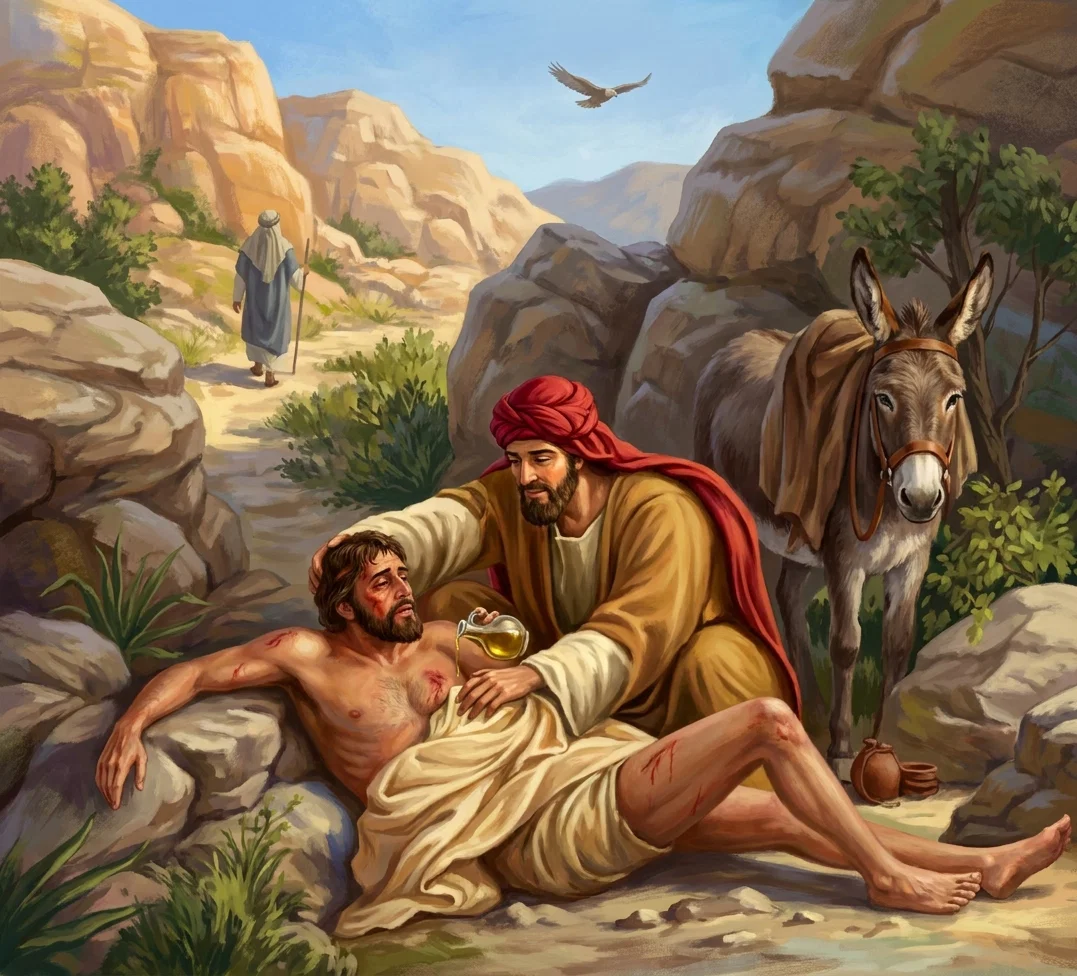
A certain man, He said, was going down from Jerusalem to Jericho. The road was steep and rocky, and passed through a wild, lonely region. Here the man was seized by robbers, and stripped of all that he had. He was beaten and bruised, and left for dead.
As he lay thus, a priest and then a Levite from the temple at Jerusalem came that way. But instead69of helping the poor man, they passed by on the other side. These men had been chosen to minister in God's temple, and they ought to have been like Him, full of mercy and kindness. But their hearts were cold and unfeeling.
After a time a Samaritan came near. The Samaritans were despised and hated by the Jews. To one of these people a Jew would not give so much as a drink of water or a morsel of bread. But the Samaritan did not stop to think of this. He did not stop even to think of the robbers who might be watching for him.
There lay the stranger, bleeding and ready to die. The Samaritan took off his own cloak, and wrapped it about him. He gave him his own wine to drink, and poured oil on his wounds. He put him on his own beast, brought him to an inn, and took care of him all night.70The next morning, before going away, he paid the inn-keeper to care for him till he should be strong again. So Jesus told the story. Then, turning to the lawyer, He asked:—
“Which now of these three, thinkest thou, was neighbour unto him that fell among the thieves?”
The lawyer answered, “He that showed mercy on him.”
Then Jesus said, “Go, and do thou likewise.”
So Jesus taught that every person who needs our help is our neighbour. We are to treat him just as we ourselves would like to be treated.
The priest and the Levite pretended to keep God's commandments, but it was the Samaritan who really kept them. His heart was kind and loving. In taking care of the wounded stranger, he was showing love to God as well as to man. For it pleases God to have us do good to one another. We show our love for Him by being kind to those about us.
A kind, loving heart is worth more than all the riches in the world. Those who live to do good show that they are children of God. They are the ones who will dwell with Christ in His kingdom.