Your ShelfYour Projects

Signs of the Times, Vol. 22, No. 25.

IN CHRIST

Signs of the Times

Jun 25, 1896

Pacific Press Publishing Company · Oakland, California · Jun 25, 1896

IN CHRIST.
I have a life with Christ to live, But, ere I live it, must I wait Till learning can clear answer give Of this and that book’s date? I have a life in Christ to live, I have a death in Christ to die,— And must I wait till science give All doubts a full reply?
Nay, rather, while the sea of doubt Is raging wildly round about, Questioning of life and death and sin, Let me but creep within Thy fold, O Christ, and at thy feet Take but the lowest seat, And hear thine awful voice repeat, In gentlest accents, heavenly sweet: “Come unto me and rest; Believe me, and be blest.”
—John Campbell Shairp.

RIGHTEOUSNESS IS LIFE.

BY L. A. PHIPPENY.
Righteousness is of God. He is called “the righteous God,” “the righteous Lord,” “the Lord our righteousness.” Ps. 7:9; 11:7; Jer. 23:6. In his prayer, Daniel said, “O Lord, righteousness belongeth unto thee” (Dan. 9:7); and again it is said, “Thy righteousness is an everlasting righteousness” (Ps. 119:142), while the Lord himself says, “My righteousness shall not be abolished,” “My righteousness shall be forever.” Isa. 51:6, 8. Life is also of God. “With thee is the fountain of life” read the words of the psalmist in Ps. 36:9. Paul, preaching at Athens, told the men of that city that among the “all things” that all men receive from God, are “life and breath.” Acts 17:25. “The Father hath life in himself,” are words of Christ, in John 5:26; and another scripture, addressing the Lord, says, “From everlasting to everlasting, thou art God.” Ps. 90:2. Thus, righteousness and life are shown to be eternal attributes of the everlasting God.
One definition of righteousness is rectitude, a condition or state of right-doing. This is the character of God, as we see from the testimony above, and it never changes; for with him “is no variableness, neither shadow of turning.” James 1:17. His acts are right acts, and just. He moves in a right line, straightforward, without deviation. So, righteousness—right-doing—and judgment—right division—are the habitation, or foundation, of his throne. Ps. 97:2. That all may know what the character of God is, he has revealed it in words, and, as his acts correspond with his character, these words thus become the fundamental law or constitution of the universe. It is therefore clear that his purposes, his right-doings, his righteousness, are expressed in his law of Ten Commandments. This is also the testimony of Scripture: “All thy commandments are righteousness,” “Thy judgments are righteousness.” Ps. 119:172, 75, margin. This law, then, is the universal guide, for it states plainly what the Lord desires his creatures to do. If this law is in the heart, the possessors of it will know righteousness (Isa. 51:7), will do righteousness, and will be “righteous, even as he is righteous” (1 John 3:7).
We will now consider the result of right-doing or doing righteousness. The words of the Lord himself are, “The work of righteousness shall be peace; and the effect of righteousness quietness and assurance forever.” Isa. 32:17. The wise man bears this testimony: “In the way of righteousness is life;” “righteousness tendeth to life;” “righteousness delivereth from death.” Prov. 12:28; 11:19; 10:2. The words of Christ on one occasion were, “If thou wilt enter into life, keep the commandments” (Matt. 19:17); and “Moses describeth the righteousness which is of the law, That the man which doeth those things shall live by them” (Rom. 10:5). Whoever, therefore, does no wrong, but only what is right, according to the great standard of righteousness, is not only righteous, but he has life, he lives. That is, the instant he becomes righteous, he begins living an eternal life; for righteousness and life go hand in hand. They are as interwoven in him as they are in God, who bestows them, and from whom they can not be separated; and, if allowed to do so, they will work out in him God’s design concerning man when he placed him on the earth. In the beginning God created an upright, honest, righteous man. He was righteous because he came from the hands of a righteous Being, whose glory he reflected. His was the right to eat of the tree of life and live forever, if he should continue in harmony with the law of life. But in an evil moment he compromised his glorious privileges, spoiled the righteous nature originally given him, and lost his capacity for enjoying an endless life. He sinned, and his sinful nature passed upon all men.
But thanks be to God that his original purpose has never changed, and that every word and promise concerning righteousness and life are still living and full of power; for the word was given because man did fall. Thank him for the wondrous plan of salvation, that places this righteousness within the reach of every man, woman, and child, and for the same everlasting life which goes with it. In its broadest sense, always and forever, righteousness is life.

Grace Reigns Through Righteousness

“WHERE sin abounded, grace did much more abound; that as sin hath reigned unto death, even so might grace reign through righteousness unto eternal life by Jesus Christ our Lord.”

SIN IS DEATH.

BY H. P. H.
God is the life-giver; Satan, the life-destroyer. The work of God in creation was a manifestation of life in various forms. The first work of Satan in the world was to destroy the life that God had given; for when he induced man to disobey God, it brought the penalty, “Thou shalt surely die.” Hence, Satan is called “a murderer from the beginning.” Man’s life depended on obedience. As soon as he disobeyed, the death sentence was pronounced. This disobedience was sin; hence sin is death.
Man’s moral and physical natures were made in harmony with God’s laws governing the moral and physical universe. His life would continue so long as he lived in harmony with these laws; but every violation of them would be a step in death. It is a well-known fact that physical health depends on living in harmony with the laws of health, and that every violation of these laws destroys health, or life. The same is true of man’s moral nature.
The Hebrew expression rendered, “Thou shalt surely die,” more literally means, “Dying thou shalt die.” This indicates progressive movement towards death, and this is literally what occurs in the sinner. Every sin committed leaves the sting of death. Experience teaches that every transgression weakens the sinner; the farther one advances in sin, the harder, or more nearly dead, he becomes. This is not so because of an arbitrary sentence of God; but it lies in the very nature of sin. The work of death is in no sense the work of God, but wholly that of the enemy.
In Rom. 5:12 we read: “Wherefore, as by one man sin entered into the world, and death by sin; and so death passed upon all men, for that all have sinned.” This makes it further evident that sin is death; and being death, it can work nothing else but death. It alluringly promises pleasure and good days; but it can give only sighs and regrets, and pangs of sorrow; “for the wages of sin is death.” As all are born in sin, death is in all. As sin is manifested in the flesh, death is working, and continues its work till its victim is destroyed.
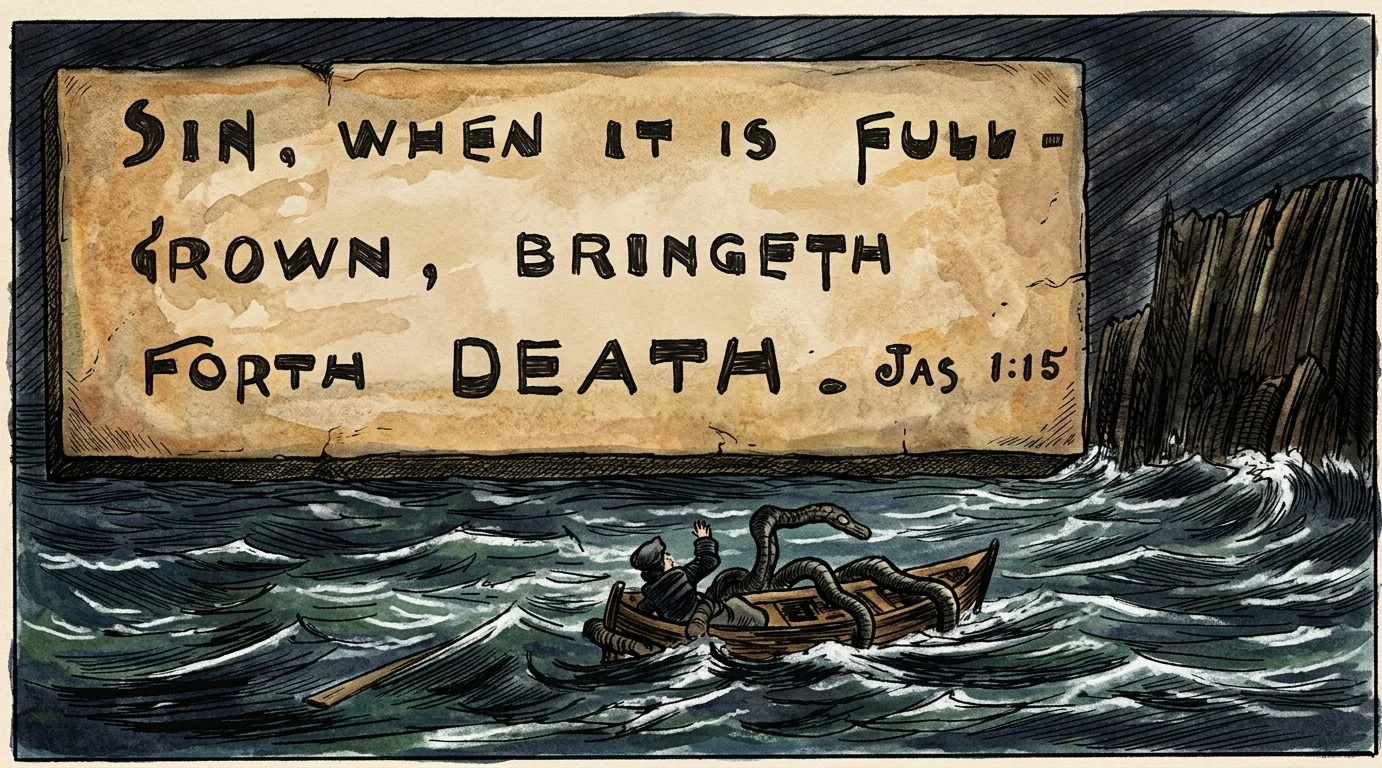
The workings of sin are called “lusts of the flesh.” If we yield to these enticing, pleasure-promising lusts, we become the servants of sin; for “know ye not that to whom ye yield yourselves servants to obey, his servants ye are to whom ye obey; whether of sin unto death, or of obedience unto righteousness?” Sin never fails to pay its servants; its unfailing wage is death. The process and outcome of sin are thus described by James: “Then when lust hath conceived, it bringeth forth sin; and sin, when it is finished, bringeth forth death.” 1:15.
Man is an instrument, which higher forces will use for good or evil. Left to himself, he will be the instrument of sin; for sin dwelling in his flesh being more powerful, uses him as its instrument. “Then it is no more I that do it, but sin that dwelleth in me.” Rom. 7:17. This working of sin in our members is called “this body of death.” Verse 24, margin.
But while man is only an instrument, his will is sovereign. God exhorts man not to yield his members to sin as its instruments; and the moment that a man wills to be free from sin, “the body of this death,” the Lord Jesus is there to set him free and keep him free as long as he desires righteousness more than sin. As long as a man wills to follow the Spirit instead of the lusts of the flesh, God will use his members as instruments of righteousness; and thus he is delivered from the body of death and turned to life. To follow the lusts of the flesh, or “to be carnally minded, is death;” but to follow the Spirit, or “to be spiritually minded, is life.” Rom. 8:6.
As all are born in sin, all are stung with death. But as God has provided a way of escape, and will free every one from “the body of this death” that will accept his deliverance, the responsibility rests with every individual as to whether he shall remain the victim of sin and death, or not. Let no one be deceived; as long as sin and disobedience are in his members, he is a child of death, and will reap the unfailing penalty. If you are not the instrument of righteousness to-day, you are surely the instrument of sin; and sin has no other wages than death. To whom are ye yielding yourself as servant to-day?
Basel, Switzerland.

CHRIST OUR RIGHTEOUSNESS.

BY WM. COVERT.
ALTHO man is a sinner and a child of death, yet there is hope; for Jesus “came into the world to save sinners.” 1 Tim. 1:15. Even if sin be death, the dying for sin has been done by him who knew no sin. 2 Cor. 5:21; Rom. 5:6. Besides this we may become the righteousness of God in him, and thus be connected again with eternal life. Rom. 5:21. It has been shown that righteousness is life; therefore we have life, because the righteousness in Christ is ours. For “this is his name whereby he shall be called, THE LORD OUR RIGHTEOUSNESS.” Jer. 23:6.
Christ is made unto us righteousness (1 Cor. 1:30); for it was considered both in his living and in his dying that all was done for us. So it is written that “while we were yet sinners, Christ died for us;” and “being reconciled [by his death], we shall be saved by his life.” Rom. 5:8, 10.
The obedience of Christ in the flesh was performed for us: for “by the obedience of One shall many be made righteous.” Rom. 5:19. But his righteousness is also built up within the believer. As expressed by the apostle it is “even the righteousness of God which is by faith of Jesus Christ unto [“into,” R. V.] all and upon all them that believe.” Rom. 3:22.
All that Christ was when here in the flesh, and all that he is now, is imputed to the believer upon the exercise of faith. Following that event, the Gospel work of grace builds that the righteousness of Christ into the life of him to whom it is imputed. Rom. 8:2–4. Faith begins a new life. “Ye are all the children of God by faith in Christ Jesus.” Gal. 3:26. We are then baptized into Christ, and put on Christ. Verse 27. We are in Christ—joined to him, and live by him. Rom. 6:10, 11. Then his righteousness becomes ours. His standing in the law, and all his fulness, are gifts of his grace. The gift is not bestowed as something of only property value; but it is to be inwrought, and grown into the very being of the receiver. It becomes that “good part” which can not be taken away. By this gift of imparted righteousness a man is made “more precious than fine gold; even a man than the golden wedge of Ophir.” Isa. 13:12.
Earthly treasures and worldly blessings, such as money, houses, lands, stocks, reputation and friends, are but transient, and many pass in one day, to come to us no more. But the true riches are to become a part of the eternal completeness of man. Through the righteousness which is now ours in Christ, we are to be made enduring as eternity.
“He hath made Him to be sin for us, that we might be made the righteousness of God in Him.” To do this for us, it became necessary for the Son of God to take man’s place in the flesh, and in the law, and stand for him, and actually become man. To reach those far down in the fall, he left riches, glory, honor, and strength. “Forasmuch then as the children are partakers of flesh and blood, he also himself likewise took part of the same. . . . For verily he took not on him the nature of angels; but he took on him the seed of Abraham. Wherefore in all things it behoved him to be made like unto his brethren, that he might be a merciful and faithful high priest in things pertaining to God, to make reconciliation for the sins of the people.” Heb. 2:14–17. The prophet in vision (Isa. 53:2–8) saw our Saviour in this humble condition. He says: “He hath no form nor comeliness; and when we shall see him, there is no beauty that we should desire him.” Tho noble in bearing and countenance, yet he had not beauty to attract; so he was despised and rejected. He was not possessed of wealth to recommend him to the favor of the great. He was poorer than the beasts and the birds. Heaven, with its glory and riches, was given up that he might reach us. “He was wounded for our transgressions, he was bruised for our iniquities.” “The Lord hath laid on him the iniquity of us all.” “And with his stripes we are healed.” “For the transgression of My people was he stricken.” The stroke fell upon him that was due to us for our disobedience. Having identified himself with us, and become one of us, he really gave himself to us and for us. As told by words inspired, he “gave himself for us, that he might redeem us from all iniquity, and purify unto himself a peculiar people, zealous of good works.” Titus 2:14. Well then might the prophet say, “In the Lord have I righteousness and strength;” for Jesus himself is ours. His righteousness in all its fulness he freely gives. “It pleased the Father that in him should all fulness dwell.” “Full of grace and truth.” “Of his fulness have all we received.” John 1:16.
He is now in heaven, to appear in the presence of God for us. Heb. 9:24. He is there to answer to our names, to stand in our stead. He is there to pass us throughjudgment in his own righteousness—our Surety, our Advocate, our Obedience. In truth, he is everything to us and all for us.
That righteousness made it impossible for Christ to be held in death, and if our faith holds to him, we shall just as certainly pass through the portals of the tomb, or experience the transition from mortal to immortality at his coming. Only our choice to leave him and trust in self can separate us from the power and the joy of that righteousness.

JESUS AND THE RESURRECTION.

BY W. N. GLENN.

The Resurrection a Necessity.

ERRONEOUS doctrines crept into the Christian church at a very early period in its history. While the apostle Paul was yet on the stage of action, he said, “The mystery of iniquity doth already work.” 2 Thess. 2:7. He also gave warning to the elders of the church at Ephesus, in these words: “I know this, that after my departing shall grievous wolves enter in among you, not sparing the flock. Also of your own selves shall men arise, speaking perverse things, to draw away disciples after them.” Acts 20:29, 30. Of course the great adversary of souls is not only the originator of all false doctrines, but the instigator of those who promulgate them.
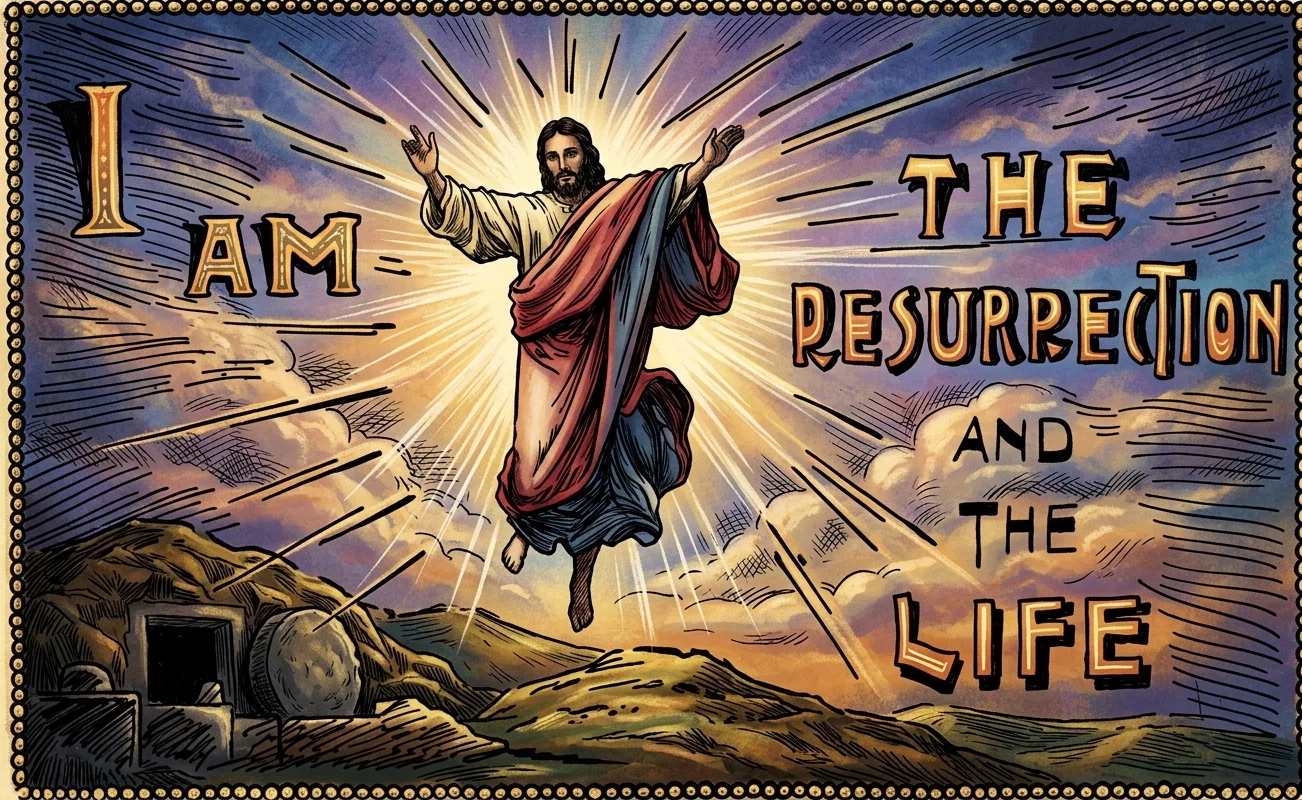
We would naturally suppose that in attacking Gospel truth, the enemy would attack some fundamental principle. We would also expect, from his well-known subtlety, that he would make the attack somewhat indirectly. The Gospel of salvation is positively presented to men as eternal life through Jesus Christ. This is very plainly stated in two familiar texts: “For God so loved the world, that he gave his only-begotten Son, that whosoever believeth in him should not perish, but have everlasting life.” John 3:16. “The wages of sin is death; but the gift of God is eternal life through Jesus Christ our Lord.” Rom. 6:21. To this idea of life through Christ, he himself adds positively that which is implied in the texts just quoted; he says, “I am the resurrection and the life.” Thus he places the resurrection as the practical means through which the object of the believer’s hope is obtained.
Then we are not surprised to find the adversary of souls striking at the Gospel hope by aiming to depreciate the importance of the doctrine of the resurrection. This we see by Paul’s second letter to Timothy: “But shun profane and vain babblings; for they will increase unto more ungodliness. And their word will eat as doth a canker; of whom is Hymeneus and Philetus; who concerning the truth have erred, saying that the resurrectionis past already; and overthrow the faith of some.” Chap. 2:16-18. In the first epistle to Timothy, Paul had given him a similar warning: “O Timothy, keep that which is committed to thy trust, avoiding profane and vain babblings, and oppositions of science falsely so called; which some professing have erred concerning the faith.” Chap. 6:20, 21. So we see that science—Christian science, if you please—interposing to depreciate the importance of the resurrection, is not by any means a new delusion.
But the extreme of the delusion was attained in the church at Corinth, where some went so far as to say that “there is no resurrection of the dead.” 1 Cor. 15:12. Satan had previously brought the aristocratic faction of the Jews, the Sadducees, to the point where they denied the resurrection, and did so in what to them was very superior wisdom. See Matt. 22:23-34. But the Lord soon put them “to silence,” showing them that they were in error, “not knowing the Scriptures, nor the power of God.” The wily enemy of truth had also fully imbued the heathen with beliefs entirely subversive of the doctrine of the resurrection. When Paul came to Athens and secured an opportunity to speak to the learned men of that renowned seat of worldly wisdom, they gave him respectful attention until he spoke of the resurrection. “And when they heard of the resurrection of the dead, some mocked; and others said, We will hear thee again of this matter.” Acts 17:32.
The continuous and persistent efforts of the adversary, even to the present day, to decoy both the world and the church away from the truth by means of doctrines which either deny the resurrection or make it a matter of secondary importance, are of themselves sufficient to show that it is a matter of more than ordinary moment. But the Scriptures place it where the believer can not ignore it, or even give it secondary consideration.
Man was created of the dust of the earth; he is “of the earth, earthy.” 1 Cor. 15:47. When he disobeyed God, his sentence was: “In the sweat of thy face shalt thou eat bread, till thou return unto the ground; for out of it wast thou taken; for dust thou art, and unto dust shalt thou return.” Gen. 3:19. The breath of life which he had was the life common to all animal creation. See Gen. 2:7; 7:15, 22; Job 27:3; Eccl. 3:19, 20. God gave the man life; he forfeited it by sin; he dies, and the spirit of life returns to God who gave it. Eccl. 12:7. Whatever it was before man was created, or was born, it is again; it is no part of the man. “His breath goeth forth, he returneth to his earth; in that very day his thoughts perish.” Ps. 146:4. “Their love, and their hatred, and their envy, is now perished; neither have they any more a portion forever in anything that is done under the sun.” Eccl. 9:6.
We give these extended quotations (and there are others) to show the nature and ultimate extinction of man without a Saviour. Now comes the plan of salvation. God gave his Son that men might be saved, might have life. Notwithstanding this, however, man must die. They still have the Adamic nature; and “in Adam all die.” Job asks, “If a man die, shall he live again?” And he answers, “All the days of my appointed time will I wait, till my change come.” Chap. 14:14. Where would he wait? Let him answer: “If I wait, the grave is my house; I have made my bed in darkness.”
But what about the promise of eternal life? “As in Adam all die, so in Christ shall all be made alive.” The word “resurrection” means a rising again, life from the dead, and Christ says, as before stated, “I am the resurrection.” Why is he the resurrection?—Evidently because it is necessary to resurrect the dead in order to fulfil the promise of life. In death man is extinct; a resurrection is a recreation, without which there could be no life for the dead. Jesus made it very clear to the Sadducees that a resurrection was necessary because he was the God of Abraham, and Isaac, and Jacob; and he is not the God of the dead, but of the living. They live in his purpose, and the resurrection will complete the promise. They “all died in faith, not having received the promises.” Heb. 11:13. The children of God are “the children of the resurrection.” Luke 20:36.
But the apostle Paul places the absolute necessity of the resurrection in the consummation of the plan of salvation beyond all question. Referring to the idea that had obtained in the Corinthian church that “there is no resurrection of the dead,” he says: “But if there be no resurrection of the dead, then is Christ not risen; and if Christ be not risen, then is our preaching vain, and your faith is also vain.” 1 Cor. 15:13, 14. Emphasizing the importance of the thought, he repeats it: “For if the dead rise not, then is not Christ raised; and if Christ be not raised, your faith is vain; ye are yet in your sins. Then they also which are fallen asleep in Christ are perished.” Verses 16-18.
Then there must be a resurrection, or there is no salvation. The fulfilment of the promises, which are all yea and amen in Christ, depend upon it. And the risen Christ sends back this comforting assurance from his Father’s presence: “I am he that liveth, and was dead; and, behold, I am alive forevermore, Amen; and have the keys of hell and of death.” Rev. 1:18.

CHRIST OUR LIFE.

BY RODERICK S. OWEN.
ALL men desire life; all shrink from death; and yet how few there are who are walking in the way of life! The words of Jesus to the Jews, are equally applicable to-day: “And ye will not come to me, that ye might have life.” John 5:40. Christ is the One through whom all life comes; “for as the Father hath life in himself; so hath he given to the Son to have life in himself;” “for the bread of God is he which cometh down from heaven, and giveth life unto the world.” John 5:26; 6:33. It has been shown in preceding articles that sin and death are inseparably connected. The presence of the one, proves the existence of the other. So that all who sin are under sentence of death. Since “all have sinned and come short of the glory of God,” death reigns over all the human family. “For as by one man sin entered into the world, and death by sin; and so death passed upon all men, for that all have sinned.”
Just at the point of the first transgression is the time where Jesus, who is the Author of the life, becomes life to the sinner, in the sense of saving the transgressor from immediate death, and extending his existence through a probationary period, in spite of his repeated offenses; so that we are indebted to Christ for our every breath. O, how sad to think that so many spend the breath thus given in mercy, in profaning and abusing Him who has Himself suffered, to become the donor of life—thus cursing the hand extended in blessing!
But Christ “is the Saviour of all men,” and “specially of those that believe.” Yes, there is a life beyond a mere physical existence, and this is found in Christ Jesus. “He that believeth on the Son hath everlasting life; and he that believeth not the Son shall not see life; but the wrath of God abideth on him.” John 3:36. He who finds this, finds the power of that endless life, which is manifest in Jesus, to destroy the works of the devil. “He shall not come into condemnation, but is passed from death unto life.” “For the law of the spirit of life in Christ Jesus hath made me free from the law of sin and death. For what the law could not do, in that it was weak through the flesh, God sending his own Son in the likeness of sinful flesh, and for sin, condemned sin in the flesh; that the righteousness of the law might be fulfilled in us, who walk not after the flesh, but after the Spirit.” Such an one can say: “I am crucified with Christ; nevertheless I live, yet not I, but Christ liveth in me; and the life which I now live in the flesh I live by the faith of the Son of God, who loved me, and gave himself for me.”
Such an one having been born from above, and being risen with Christ, he walks in newness of life, his affection not set on things of the earth, but on things above. He being dead with Christ, his life is hid with Christ in God; and when Christ who is his life, shall appear, then shall he also appear with him in glory. For Jesus said: “I am come that they might have life, and that they might have it more abundantly.” John 10:10.
But this life in the flesh, or mortal state, is not all, even though in it we do find a victory over the power of temptation. “For our conversation is in heaven; from whence also we look for the Saviour, the Lord Jesus Christ; who shall change our vile body, that it may be fashioned like unto his glorious body, according to the working whereby he is able even to subdue all things unto himself.” Phil. 3:20, 21. For we who have received the first-fruits of the Spirit, “even we ourselves groan within ourselves, waiting for the adoption, to wit, the redemption of our body.” Rom. 8:23. For “we shall not all sleep, but we shall all be changed, in a moment, in the twinkling of an eye, at the last trump; for the trumpet shall sound, and the dead [in Christ] shall be raised incorruptible, and we shall be changed. For this corruptible must put on incorruption, and this mortal must put on immortality.” 1 Cor. 15:51–53. Immortality! O, what a life, coequal with God! Free from corruption! not subject even to a liability to die! And all this comes to us through the Saviour, which God has provided for us, in giving his only begotten Son to die, that we might have everlasting life.
Thus we see that Christ is our life:—
  1. Because he is the Author of our existence.
  2. Because he saves us, as sinners, from immediate death, giving us a probationary life.
  3. Because he imparts to us eternal life now, which lifts us above the power of sin, and which enables us, though in the flesh, to walk in newness of life.
  4. Because, at his glorious appearing, he will clothe with immortality all who trust in him.
God grant that we may all know Him whom God hast sent, whom to know is life everlasting.

SIN IS DEATH.

Not only is the penalty of sin death, but sin of itself is death. Not only is death in the sin, but the sin of itself is all death. Sin may not appear death. In the beginnings of leprosy we do not see the dread disease, but when full grown we see it in all its fearful effects and repulsiveness. But it is no less incurable in the beginning than when fully developed. The human family is stricken by the dread disease of sin. In its incipient stages it does not seem death, and we laugh at its presence, amuse ourselves with its mild stings, and slumber under its intoxicating wine; yet, nevertheless, “sin, when it is full-grown, bringeth forth death.” Death is its legitimate fruitage. He, therefore, who chooses sin chooses death. It matters not how harmless, beautiful, entrancing, delightful, or joyous sin may seem, to choose it means to choose death.
To choose sin against light and warning, means to reap by and by utter extinction of being. For it is not God’s will that sin should exist forever; he will sometime have a clean universe, where all intelligences praise him.
Rev. 5:13. Sin will be destroyed, and every soul which has identified himself with sin will be destroyed with it. He thereby cuts himself off from the life of God, and must apart from him inevitably and eternally perish.
Continue reading: TO SAVE MEN'S LIVES