Your ShelfYour Projects

Signs of the Times, Vol. 25, No. 3.

THE FLIGHT INTO EGYPT

Signs of the Times

Jan 18, 1899

Pacific Press Publishing Company · Oakland, California · Jan 18, 1899

THE FLIGHT INTO EGYPT.
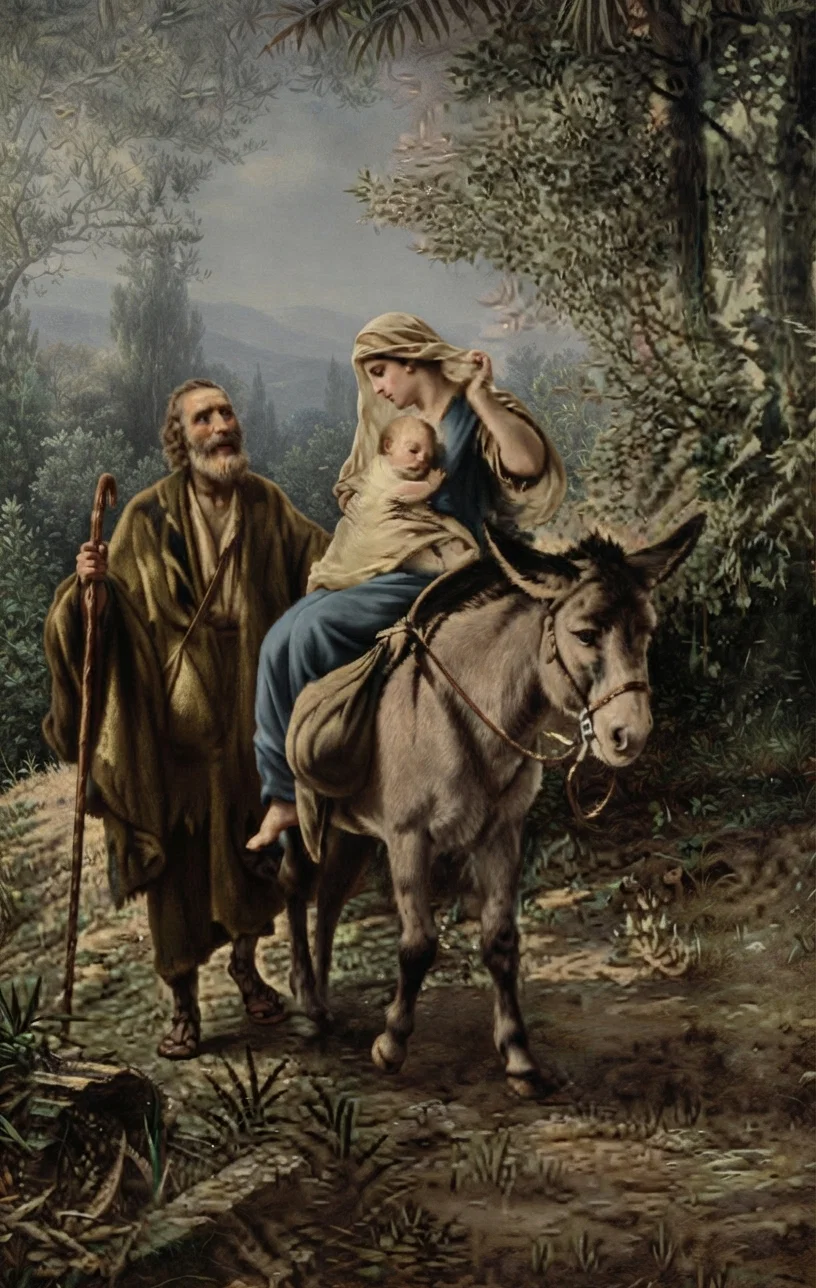
"AND the dragon stood before the woman which was ready to be delivered, for to devour her Child as soon as it was born." Rev. 12:4. That the dragon was Satan is shown by verse 9. The agent of Satan in the attempt to destroy the infant Saviour was the Roman Government, under whose auspices Herod had been made king of Judea, to which was added Trachonitis and the district of Paneas.
When certain wise men came from the East to Jerusalem seeking for Him who was born King of the Jews, having seen His star and been guided by it into Judea, Herod's jealousy was greatly aroused. He determined to destroy the One whom he supposed was to be his rival in the kingdom. Having learned from the priests and scribes that Christ was to be born in Bethlehem, he sent the wise men to that city with instructions to find the Child and bring word back to him. He pretended that he also wanted to go and worship the One who was born King, but his real design was to put Him to death.
Herod was a most cruel and ambitious man, and would stop at nothing by which there was any probability of his gaining his object. This was shown not merely by the appalling deeds which he did accomplish, but especially by his deliberate attempt to put Christ to death. That this was his purpose is shown by his demanding of the chief priests and scribes where Christ should be born, and then plotting to kill the Child who was announced as the Christ. Herod is the only man, excepting Judas, who, professing to believe that Jesus was the Messiah, deliberately set about to destroy Him. This shows that he was actuated by the spirit of the "dragon," and was indeed the active agent of the "dragon," under the Roman Government, in the attempt to "devour" the Man Child "as soon as He was born."
But the Lord had not sent His Son to earth without ample provision for the protection of His life until His work should be finished. God's ministering spirits, the angels, were on hand to keep the Only-begotten from the jaws of the devourer. And this is just what they do for the disciples of Christ to-day. "Are they not all ministering spirits, sent forth to minister for them who shall be heirs of salvation?" Heb. 1:14. Then, no matter what danger may confront the people of God, the entire angelic host is at their service; and "all things work together for good to them that love God." Rom. 8:28.
FLIGHT INTO EGYPT.
FLIGHT INTO EGYPT.
God, having given His Son to the work of redemption, had given all. "He that spared not His own Son, but delivered Him up for us all, how shall He not with Him also freely give us all things?" Verse 32. So if the "dragon" could, through the agency of Herod, who proved a most willing tool, put to death this Child before His earthly ministration was finished, Heaven's resources for the redemption of the human race and the destruction of the adversary of souls, would be exhausted without avail. Satan knew this, and had been awaiting the opportunity. He "stood before the woman which was ready to be delivered, for to devour her Child as soon as it was born." He was confident of success; he had overcome the first Adam in the vigor of manhood, while he was yet untrammeled by the consequences of sin; surely he could manage to destroy a mere infant.
Everything seemed favorable to the success of the scheme. The purpose was locked in the secret chambers of the king's breast, and he was not aware that he was actuated by any other than his own arbitrary will. The messengers whom the king sent to find the Child were men of God whose sole purpose was adoration of the new-born King. They supposed that Herod was just as honest in his expressed desire to come and worship the Child as they were. There was no doubt of Herod's power to kill all the children in Bethlehem, for he had absolute sway throughout his jurisdiction. So it seemed that there was nothing for the "dragon" to do but to spring the trap that had been so cleverly prepared.
But the all-seeing, never-sleeping Eye had long comprehended the whole scheme, and the heavenly host which had announced the holy incarnation were still on guard in Bethlehem. The wise men of the East came by heavenly guidance to the humble abode of Joseph and Mary and the Child. They offered their tribute of praise and adoration, and presented their material gifts. ("Bring an offering, and come into His courts." Ps. 96:8.) Then the Lord quietly spoke to the wise men in a dream and told them not to return to Herod; so "they departed into their own country another way." So quietly, so wisely was it all done that to this day it is not revealed by what way they went. It was the "still small Voice" that upset the Satanic scheme."And when they were departed, behold, the angel of the Lord appeareth to Joseph in a dream, saying, Arise, and take the young Child and His mother, and flee into Egypt, and be thou there until I bring thee word; for Herod will seek the young Child to destroy Him." Matt. 2:13. God was equal to the emergency, for the reason that He knew the end from the beginning. He knew that the "dragon" would be "wroth," and not only pursue the world's Redeemer to the bitter end, but would have revenge because of his failure to carry out what seemed to him an impenetrable scheme. The Lord had long before, by his prophet, depicted the scene of Herod's Satanic retaliation: "A voice was heard in Ramah, lamentation, and bitter weeping; Rachel weeping for her children refused to be comforted for her children, because they were not" Jer. 31:15.
But the Lord could take care of His own, tho He had to send Him into Egypt to do it. Now Egypt is the synonym of the grossest darkness. Yet such was the condition in the land which had been the most highly favored of all lands that the infant Son of God was safer in Egypt than in Israel. Another point in this connection is that when God sent His Son into the world that the world through Him might be saved, He sent Him into the darkest corner of it. The Father's care over Him while there is indicated in the expression, "be thou there until I bring thee word." Then the Lord's people are to be patient under whatever circumstances until He brings them out. That the Lord foresaw all this experience is shown by the prophet Hosea in the statement, "Out of Egypt have I called My Son."
From that day to this the "dragon" has been persecuting "the woman [the true church] which brought forth the Man Child." As the end nears, the most dangerous place for the true people of God will be in the professed church, the synonym of apostate Israel in Herod's day. The apostle John says: "I saw another angel come down from heaven, having great power; and the earth was lightened with his glory. And he cried mightily with a strong voice, saying, Babylon the great is fallen, is fallen, and is become the habitation of devils, and the hold of every foul spirit, and a cage of every unclean and hateful bird. . . . And I heard another voice from heaven, saying, Come out of her, My people, that ye be not partakers of her sins, and that ye receive not of her plagues." Babylon means confusion, and stands for the apostate church, of whatever name or combination of names, which has departed from the plain Word of God. For their own safety, those who stand for the Word are called out into the world—in the world, but not of it—and when the Master brings them word again, it will be to call them out of Egypt into the heavenly mansions.

A NEW YEAR'S THOUGHT.

THROUGH the whole new year before us we are going to be under the eye of God. The eyes of the Lord thy God are upon thee from the beginning of the year even unto the end of the year. We could not have a better text, or a better thought, than that for the coming New Year's day. It will give us strength to make resolutions, and it will give us grace to perform our resolutions. Such a thought is a warning from sin, a power in labor, and a comfort in sorrow. The presence of an earthly friend will put out of our mind a temptation, or give us strength to overcome it; and, more than that, in the presence of that friend, there is the joy of companionship, and the confidences and the whole atmosphere of love. So is the presence of God; it is both a glory and a covering. God's friendship through the year is our bulwark and our high tower, our sweet solace and our great joy.—S. S. Times.

HIDDEN TREASURE.

"A GAIN, the kingdom of heaven is like unto treasure hid in a field; the which when a man hath found, he hideth, and for joy thereof goeth and selleth all that he hath, and buyeth that field."
In ancient times it was customary for men to hide their treasures in the earth. The country was always in danger of being invaded by marauding armies, and the earth was looked upon as a safe hiding-place. Often the owner himself was unable to find the treasure he had secretly buried. It was not uncommon to find in neglected land old coins and ornaments of gold and silver.
A man hires land to cultivate, and as the oxen plow the soil, buried treasure is unearthed. As the man discovers this treasure, he sees that he has a fortune before him. He restores the gold to its hiding-place, making sure that no one knows of his discovery. He returns to his home, and sells all that he has to purchase the field containing the treasure. His family and his neighbors think that he is acting like a madman. Looking at the field, they see no value in the neglected soil. But the man knows what he is doing, and when he has a title to the field, he searches every part of it to find the treasure that he has secured.
This parable illustrates the truth that painstaking effort should be made to secure the heavenly treasure. The treasures of the Gospel are hidden, for many have eyes, but they see not; they have ears, but they hear not; they have intellect, but they discern not the hidden treasure. A man might pass over the place where treasure had been hidden. In dire necessity he might sit down to rest at the foot of a tree, knowing not of the riches hidden at its roots. So it was with the Jews. They had eyes, but they did not see Christ. The treasure-house of all knowledge was opened to them, but they knew it not.
Christ wept over Jerusalem, saying, "If thou hadst known, even thou, at least in this thy day, the things which belong unto thy peace! but now they are hid from thine eyes." "Therefore," He said, "speak I to them in parables; because they seeing see not; and hearing they hear not, neither do they understand. And in them is fulfilled the prophecy of Esaias, which saith, By hearing ye shall hear, and shall not understand; and seeing ye shall see, and shall not perceive; for this people's heart is waxed gross, and their ears are dull of hearing, and their eyes they have closed; lest at any time they should see with their eyes, and hear with their ears, and should understand with their heart, and should be converted, and I should heal them."
Christ gave the Jewish people abundant evidence that He was the Messiah, but His teaching called for a decided change in their lives. They saw that if they received Christ, they must give up their cherished maxims and traditions, their selfish, ungodly practises. It involved a cross to receive changeless, eternal truth. Therefore they would not admit the most conclusive evidence that God could give to establish faith in Christ. They professed to believe the Old Testament Scriptures, yet they refused to accept the testimony contained therein concerning Christ's life and character. They were afraid of being convinced, lest they should be converted, and be compelled to yield up their preconceived opinions. The Treasure of the Gospel, the Way, the Truth, and the Life, was among them, but they rejected the greatest Gift that heaven could bestow.
"Among the chief rulers also many believed on Him," we read, "but because of the Pharisees they did not confess Him, lest they should be put out of the synagog." They were convinced; they believed Christ to be the Son of God; but it was not in harmony with their ambitious desires to confess Him. They had not the faith that works by love and purifies the soul, the faith that would have made them doers of the Word, and secured for them the heavenly treasure. They were seeking worldly treasure.
And to-day the world is eagerly seeking for earthly treasure. Men think that if they could obtain their desires, they would have peace. But were they to gain all that they seek, they would not find rest. These longing souls forget that they carry the disturber of their peace with them. By precept and example they exalt earthly riches above eternal riches. Minds which should have been educated to reach the highest attainments, allow worldly business to exclude God from their thoughts. They are restless and unhappy, and they wonder why it is. But if they would seek for the peace Christ came to give, they would find rest. He declared: "Peace I leave with you, My peace I give unto you; not as the world giveth, give I unto you. Let not your heart be troubled, neither let it be afraid."
The Saviour saw that men were absorbed in getting gain, and He undertook to correct this evil. He sought to break the infatuating spell which was paralyzing every spiritual sinew and muscle. Lifting up His voice like the trump of God, He cried, "What is a man profited, if he shall gain the whole world, and lose his own soul? or what shall a man give in exchange for his soul?" He presents before fallen humanity the nobler world they have lost sight of, that they may behold eternal realities. He takes them to the threshold of the infinite, flushed with the indescribable glory of God, and shows them the treasures there.
Many poor souls torture themselves, many go on long pilgrimages, thinking to find Christ. But if this were the way to secure the treasure, many would be in a hopeless condition. The afflicted, the lame, and the blind would fail to find Christ. But salvation is given without money and without price. It is not necessary to go on pilgrimages to gain it. All we are asked to do is to believe on Christ as our personal Saviour, and be doers of His Word. "Ho, every one that thirsteth, come ye to the waters, and he that hath no money; come ye, buy and eat; yea, come, buy wine and milk without money and without price."
"The righteousness which is of faith speaketh on this wise, Say not in thine heart, Who shall ascend into heaven? (that is, to bring Christ down from above) or, Who shall descend into the deep? (that is, to bring up Christ again from the dead.) But what saith it? The word is nigh thee, even in thy mouth, and in thy heart; that is, the word of faith, which we preach; that if thou shalt confess with thy mouth the Lord Jesus, and shalt believe in thine heart that God hath raised Him from the dead, thou shalt be saved. For with the heart man believeth unto righteousness; and with the mouth confession is made unto salvation."The treasures of God's Word are to be sought for, and they are found by all who seek for them in sincerity. But they are hidden from those whose minds are filled with worldly, ambitious thoughts. Paul speaks of a class who have lost their spiritual eyesight. "The natural man receiveth not the things of the Spirit of God; for they are foolishness unto him; neither can he know them, because they are spiritually discerned."
Paul speaks of a class who have lost their spiritual eyesight. "If our Gospel be hid," he declares, "it is hid to them that are lost; in whom the god of this world hath blinded the minds of them which believe not, lest the light of the glorious Gospel of Christ, who is the image of God, should shine unto them. For we preach not ourselves, but Christ Jesus the Lord; and ourselves your servants for Jesus' sake. For God, who commanded the light to shine out of darkness, hath shined in our hearts, to give the light of the knowledge of the glory of God in the face of Jesus Christ. But we have this treasure in earthen vessels, that the excellency of the power may be of God, and not of us."
Faith in Christ as the world's Redeemer calls for an acknowledgment of the enlightened intellect, controlled by a heart that can discern and appreciate the heavenly treasure. The Scriptures are not to be adapted to meet the prejudices and jealousy of men. They can be understood only by those who are humbly seeking the hidden treasure. These receive the truth of prophecy, and submit to its authority. They are sanctified, soul, body, and spirit. This faith is inseparable from repentance and transformation of character. To have faith means to find and accept the Gospel treasure, with all the obligations which it imposes. Such believers are represented by the man who found hidden treasure in a field.
Philip found the Lord, and fully believed in Him. He was so filled with joy because he had found this treasure, that he went to look for Nathanael. He found him under a fig tree, and said unto him, "We have found Him, of whom Moses in the law, and the prophets, did write, Jesus of Nazareth, the son of Joseph." The treasure that Philip had found was a knowledge that Christ, the Son of God, was among them.
If the heavenly treasure could be made plain to the eye of men, as the gold was revealed to the man's wondering, delighted eyes, those thus blessed would be so rejoiced that they could not hide the treasure. They would go everywhere, saying, Hear what the Lord has done for me. Their hearts would be filled with rejoicing; for the value of this treasure is above gold or silver. The contents of the richest of earth's mines can not compare with it. "It can not be gotten for gold, neither shall silver be weighed for the price thereof. . . . The gold and the crystal can not equal it; and the exchange of it shall not be for jewels of fine gold. No mention shall be made of coral, or of pearls; for the price of wisdom is above rubies."
"Except a man be born again, he can not see the kingdom of God." He may conjecture and imagine, but he can not see the treasure with the eye of faith. Christ gave His life to secure for us this inestimable treasure. But without shedding of blood there is no remission of sins, no treasure for any perishing soul. Received by faith into the heart, the Gospel changes the whole man. Taken into the life, it transforms the character, making the coarse refined, the rough gentle, the selfish generous. By it the impure are cleansed, washed in the blood of the Lamb.
MRS. E. G. WHITE.

THE EVER-PRESENT CROSS.

OUR last lesson in Galatians, closing with verse 16 of the second chapter, showed us that men are saved only by faith in Christ, and that faith in Him is a personal matter. It is by "the faith of Christ," His own personal faith, and no other, that we are justified; and this faith of Christ we get by receiving Christ Himself. Believing in Christ is receiving Him; and when Christ dwells in the heart by faith, and is thus recognized as Lord, He exercises the faith which alone is able to save; for
The Law Can Not Justify.—"By the works of the law shall no flesh be justified." Gal. 2:16. Shall we say, "Then we will away with the law"? That is what every confirmed criminal thinks. Persistent law-breakers would gladly do away with the law which declares them guilty and will not say that wrong is right. But the law of God can not be abolished, for it is the statement of the will of God. Rom. 2:18. "The law is holy, and the commandment holy, and just, and good." Rom. 7:12. We read the law, and find in it our duty made plain. But we have not done it; therefore we are guilty. "All have sinned, and come short of the glory of God." "There is none that doeth good, no, not one." Rom. 3:23, 12. Moreover, there is not one who has strength to do the law, its requirements are so great. Then it is very evident that no one can be justified by the works of the law, and it is equally evident that the fault is not in the law, but in the individual. Let the man get Christ in the heart by faith, and then the righteousness of the law will be there also, for Christ says, "I delight to do Thy will, O My God; yea, Thy law is within My heart." Ps. 40:8. He who would throw away the law because it will not call evil good, would reject God, because He "will by no means clear the guilty." Ex. 34:7. But God will remove the guilt, will make the sinners righteous, that is, in harmony with the law, and then the law which before condemned them will witness to their righteousness.

Lesson for the Weak.

"But if, while we seek to be justified by Christ, we ourselves also are found sinners, is therefore Christ the minister of sin? God forbid. For if I build again the things which I destroyed, I make myself a transgressor. For I through the law am dead to the law, that I might live unto God. I am crucified with Christ; nevertheless I live; yet not I, but Christ liveth in me; and the life which I now live in the flesh I live by the faith of the Son of God, who loved me, and gave Himself for me. I do not frustrate the grace of God; for if righteousness come by the law, then Christ is dead in vain. O foolish Galatians, who hath bewitched you, that ye should not obey the truth, before whose eyes Jesus Christ hath been evidently set forth, crucified among you?" Gal. 2:17-21; 3:1.
What Was Destroyed.—"If I build again those things which I destroyed, I prove myself a transgressor." R.V. We ask again, What was destroyed the building up of which will prove us to be transgressors? Remembering that the apostle is talking of those who have believed in Jesus Christ, that they might be justified by the faith of Christ, we find the answer to the question in Rom. 6:6: "Knowing this, that our old man is crucified with Him, that the body of sin might be destroyed, that henceforth we should not serve sin." Also Col. 2:10, 11: "Ye are complete in Him, which is the head of all principality and power; in whom also ye are circumcised with the circumcision made without hands, in putting off the body of the sins of the flesh by the circumcision of Christ." That which is destroyed is the body of sin, and it is destroyed only by this personal faith of Christ. It is destroyed in order that we may not serve sin. But now if, after having believed in Christ, we put our trust in something else, it is evident that that which was destroyed by faith is built up by lack of it, and so we are found transgressors through our own fault; for Christ is not the minister of sin, but of righteousness."Dead to the Law."—Many seem to fancy that "dead to the law" means the same as that the law is dead. Not by any means. The law must be in full force, else there could be no death to it. How does a man become dead to the law?—By receiving its full penalty, which is death. He is dead, but the law which put him to death is still as ready as ever to put to death another criminal. Suppose now that the man who was executed for gross crimes, should by some miraculous power come to life again, would he not still be dead to the law?—Certainly; nothing that he had done could be mentioned to him by the law; but if he should again commit crimes, the law would again execute him, but as another man. Now Paul says that he through the law is dead to the law, that he might live unto God. By the body of Christ he is raised from the death which he has suffered from the law because of his sin, and now he walks "in newness of life," a life unto God. Like Saul of old, he is by the Spirit of God "turned into another man." 1 Sam. 10:6. That this is the case is shown by what follows.
Crucified with Christ.—"I am crucified with Christ," says Paul; "nevertheless I live; yet not I, but Christ liveth in me." Christ was crucified; He was "delivered for our offenses, and was raised again for our justification." Rom. 4:25. But unless we are crucified with Him, His death and resurrection profit us nothing. If the cross of Christ is separated from us, and outside of us, even though it be but a moment of time and an hair's breadth of space, it is to us all the same as if He were not crucified. No one was ever saved simply by looking forward to a cross to be erected and a Christ to be crucified at some indefinite time in the future, and no one can now be saved simply by believing that at a certain time in the past Christ was crucified. No; if men would see Christ crucified, they must look neither forward nor backward, but upward; for the arms of the cross that was erected on Calvary, reach from Paradise lost to Paradise restored, and cover the entire world. But let us note particularly in the following paragraphs how it is that Christ must be crucified in every soul that derives any real benefit from the sacrifice.
Sin a Personal Matter.—Christ was delivered for our offenses. He "His own self bare our sins in His own body on the tree." 1 Peter 2:24. He bears the sins of the world. John 1:29. But every man is guilty only of the sins which he himself has committed. Now I do not sin where I am not, but where I am. Sin is in the heart of man: "For from within, out of the heart of men, proceed evil thoughts, adulteries, fornications, murders, thefts, covetousness, wickedness, deceit, lasciviousness, an evil eye, blasphemy, pride, foolishness; all these evil things come from within." Mark 7:21-23. "The heart is deceitful above all things, and desperately wicked." Jer. 17:9. Others have sinned as well as I; but their sin is not mine, and I do not have to answer for it. What I need is freedom from my own personal sin,—that sin which not only has been committed by me personally, but which dwells in the heart,—the sin which constitutes the whole of my life.
What I Can Not Do.—I can not free myself from sin. "His own iniquities shall take the wicked himself, and he shall be holden with the cords of his sins." Prov. 5:22. "For tho thou wash thee with nitre, and take thee much soap, yet thine iniquity is marked before Me, saith the Lord." Jer. 2:22. My sin is committed by myself, in myself, and I can not separate it from me. Cast it on the Lord? Ah, yes, that is right, but how? Can I gather it up in my hands, and cast it from me, so that it will light upon Him?—I can not. If I could separate it but a hair's breadth from me, then I should be safe, no matter what became of it, since it would not be found in me. In that case I could dispense with Christ; for if sin were not found on me, it would make no matter to me where it was found. I should be clear. But no works of any kind that I can do can save me; therefore all my efforts to separate myself from my sins are unavailing.
Christ Bears the Sin in Us.—It is evident from what has been said that whoever bears my sins must come where I am, yea, must come into me. And this is just what Christ does. Christ is the Word, and to all sinners who would excuse themselves by saying that they can not know what God requires of them. He says, "The Word is very nigh thee, in thy mouth, and in thy heart, that thou mayest do it." Deut. 30:11-14. Therefore He says: "If thou shalt confess with thy mouth the Lord Jesus, and shalt believe in thine heart that God hath raised Him from the dead, thou shalt be saved." Rom. 10:9. Confess what about the Lord Jesus?—Why, confess the truth, that He is nigh thee, even in thy mouth and in thy heart, and believe that He is there risen from the dead. "Now that He ascended, what is it but that He also descended first into the lower parts of the earth?" Eph. 4:9. The risen Saviour is the crucified Saviour. So as Christ risen is in the heart of the sinner, so also is Christ crucified there. If it were not so, there would be no hope for any. A man may believe that Jesus was crucified eighteen hundred years ago, and may die in his sins; but he who believes that Christ is crucified and risen in him, has salvation.
What a glorious thought that wherever sin is, there is Christ, the Saviour from sin! He bears sin, all sin, the sin of the world. Sin is in all flesh, and so Christ is come in the flesh. Christ is crucified in every man that lives on earth. This is the word of truth, the Gospel of salvation, which is to be proclaimed to all.
Living by Faith.—In the tenth chapter of Romans, as already noted, we learn that Christ is in every man, "a very present help in trouble." He is in the sinner, in order that the sinner may have every incentive and facility for turning from sin to righteousness. He is "the way, the truth, and the life." John 14:6. There is no other life than His. He is the life. But although He is in every man, not every man has His righteousness manifested in his life; for some "hold down the truth in unrighteousness." Rom. 1:18, R.V. Now Paul's inspired prayer was that we might be strengthened with might by the Spirit of God in the inner man, "that Christ may dwell in your hearts by faith; . . . that ye might be filled with all the fulness of God." Eph. 3:16-19. The difference, then, between the sinner and the Christian is this, that, whereas Christ crucified and risen is in every man, in the sinner He is there unrecognized and ignored, while in the Christian He dwells there by faith.
Christ is crucified in the sinner, for wherever there is sin and the curse, there is Christ bearing it. All that is needed now is for the sinner to be crucified with Christ, to let Christ's death be his own death, in order that the life of Jesus may be manifested in his mortal flesh. Faith in the eternal power and divinity of God, that are seen in all the things that He has made, will enable any one to grasp this mystery. The seed is not quickened "except it die." 1 Cor. 15:36. "Except a corn of wheat fall into the ground and die, it abideth alone; but if it die, it bringeth forth much fruit." John 12:24. So the one who is crucified with Christ, begins at once to live, but it is as another man. "I live; yet not I, but Christ liveth in me."
The Life of the World.—"But Christ was actually crucified eighteen hundred years, and more, ago, was He not?"—Certainly. "Then how can it be that my personal sins were upon Him? or how can it be that I am now crucified with Him?" Well, it may be that we can not understand the fact, but that makes no difference with the fact. But when we remember that Christ is the life, even "that eternal life, which was with the Father, and was manifested unto us" (1 John 1:2), we may understand something of it. "In Him was life; and the life was the light of men,"—"the true light, which lighteth every man that cometh into the world." John 1:4, 9. The scene on Calvary was the manifestation of what has taken place as long as sin has existed, and will take place until every man is saved who is willing to be saved,—Christ bearing the sins of the world. He bears them now. One act of death and resurrection was sufficient for all time, for it is eternal life that we are considering; therefore, it is not necessary for the sacrifice to be repeated. That life pervades and upholds all things, so that whoever accepts it by faith has all the benefit of the entire sacrifice of Christ. By Himself He "made purification of sins." Whoever rejects the life, or is unwilling to acknowledge that the life which he has is Christ's life, loses, of course, the benefit of the sacrifice.
The Faith of the Son of God.—Christ lived by the Father. John 6:57. His faith in the word that God gave Him was such that He repeatedly and positively maintained that when He died He should rise again the third day. In this faith He died, saying, "Father, into Thy hands I commend My Spirit." Luke 23:46. That faith which gave Him the victory over death (Heb. 5:7), because it gave Him the complete victory over sin, is the faith which He exercises in us when He dwells in us by faith; for He is "the same yesterday, and to-day, and forever." It is not we that live, but Christ that lives in us, and uses His own faith to deliver us from the power of Satan. "What have we to do?"—Let Him live in us in His own way. "Let this mind be in you, which was also in Christ Jesus." How can we let Him?—Simply by acknowledging Him, by confessing Him.
The Gift for Me.—"Who loved me, and gave Himself for me." How personal this is! I am the one whom He loved. Each soul in the world can say, "He loved me, and gave Himself for me." Leave Paul out of the question in reading this. Paul is dead, but the words that he wrote are yet alive. It was true of Paul, but no more so than of every other man. They are the words which the Spirit puts in our mouths, if we will but receive them. The whole gift of Christ is for each individual me. Christ is not divided, but every soul gets the whole of Him, just the same as if there were not another person in the world. Each one gets all the light that shines. The fact that there are millions of people for the sun to shine upon, does not make its light any the less for me; I get the full benefit of it, and could not get more if I were the only person in the world. It shines for me. So Christ gave Himself for me, the same as if I were the only sinner in the world; and the same is true of every other sinner. "Thanks be unto God for His unspeakable gift."
Christ Not Dead in Vain.—"I do not frustrate the grace of God; for if righteousness come by the law, then Christ is dead in vain." If righteousness came by the law, then there would have been no use for the death of Christ. The law itself can do nothing except point out men's duty; therefore to speak of righteousness coming by the law, means by our works, by our individual effort. So the text is equivalent to the statement that if we could save ourselves, Christ died for nothing; for salvation is the one thing to be gained. Well, we can not save ourselves; and Christ is not dead in vain; therefore there is salvation in Him. He is able to save all that come unto God by Him. Some must be saved, else He has died in vain. So the promise is sure: "He shall see His seed, He shall prolong His days, and the pleasure of the Lord shall prosper in His hand. He shall see of the travail of His soul, and shall be satisfied." Isa. 53:10, 11. "Whosoever will" may be of the number. Since He died not in vain, see to it "that ye receive not the grace of God in vain."
Christ Crucified before Us.—"Who did bewitch you, before whose eyes Jesus Christ was openly set forth crucified?" R.V. The first part of the verse, concerning witchcraft, we shall leave until next week. What we are now concerned with is that Jesus was set forth before the Galatians, when Paul preached to them, as openly crucified before their eyes. So vivid was the presentation that they could actually see Christ crucified. It was not skilful word painting on the part of Paul, nor imagination on the part of the Galatians, for then it would have been only deception. No; it was an actual fact; Christ was there, crucified, before their eyes, and Paul by the Spirit enabled them to see Him. We know that it was not Paul's skill in making beautiful word pictures that enabled them to fancy that they saw the crucifixion, for elsewhere Paul says that he determined to know nothing but Jesus Christ and Him crucified, and that he purposely and carefully refrained from using the wisdom of words, for fear that he should make the cross of Christ without effect. 1 Cor. 1:17, 18; 2:1-4. Christ is crucified before us, and each blade of grass, each leaf in the forest, reveals the fact. Yea, we have the testimony in our own bodies. Many there are who can testify that it is something more than a figure of speech, when the apostle says that Christ was crucified before the eyes of the Galatians. They have had the experience. God grant that this study of Galatians, before it is finished, may be the means of opening the eyes of many more, so that they may seeChrist crucified before their eyes, and know Him crucified in them and for them.
E. J. WAGGONER.

A Missionary

A MISSIONARY is God's man, in God's place, doing God's work, in God's way, and for God's glory.—Geraldine Guinness.
Continue reading: THE DECALOGUE
