THE Bible is the most accurate and complete history in the world. It is the history of the beginning of things, and contains the prophecies touching the end of all things. The Bible is the only history that chronicles the creation of our world, that records the origin of life, of nations, of sin, and of salvation. While secular histories have their place, in the study of history, yet no one can be a thorough historian without knowing Biblical history. And the discoveries and researches of modern times, year by year, tend to confirm, more and more, the Bible records of past events.
For example, in the historical study of the Bible, let us take the tenth chapter of Genesis. Here we have the origin of nations, through the three sons of Noah—Shem, Ham, and Japheth. And the descendants of these sons of Noah can be traced, by reference to other parts of the Bible and to history, until the origin of all the nations in the world to-day can be quite accurately worked out. Let us first examine
The Sons of Japheth.
1. Gomer.—From Gomer came the ancient Cimmerians who lived in the region of the Crimea, and from whom came the Welsh of to-day. Through one of his sons, Ashkenaz, down through the Teutons, came the English people; while another son of Gomer, Riphath, is the ancestor of the Celts who peopled Britain, Ireland, and Scotland; also some of the Scandinavians, as well as the ancient Germans, the Franks, Anglo-Saxons, Irish, etc. And still from a third son of Gomer, Togarmah, came the Armenians.
2. Magog (See Eze. 38:2, 3). From this second son of Japheth, came the ancient Scythians, from whom came the Mongolians, Chinese, Siamese, Burmese, Thibetans, Japanese, and aborigines of North and South America; the Malays, the ancient Huns (the Bulgarians of to-day), the Tartars, Turks, Finns, and the Sarmatians (from whom descended the people of Russia, Poland, Bohemia, and Servia), and the Parthians. The foundation of all this history is found in the tenth chapter of Genesis. Take your concordance and look up these descendants of Noah, in other parts of the Bible where numerous mention is made of them.
3. Madai, the father of the Medes.
4. Javan, from whom came the Greeks.
5. Tubal, whose offspring became more or less blended with his brother, Meshech, and continued as the Russian nation.
6. Meshech, the Muscovites, who built Moscow, now found in Russia.
7. Tiras, the ancient Thracians, from whom came the Ostrogoths and the Visigoths.
1. Cush—the Cushites were the Ethiopians (see Isa. 45:14). Cush had many sons, who settled in all parts of Africa, the greatest of whom was Nimrod, the founder and organizer of the first earthly government. See Gen. 10:8.
2. Mizraim settled in and peopled Egypt.
3. Phut, the country of ancient Libya.
4. Canaan, whose many sons founded the various tribes found in the land of Canaan when Joshua led the children of Israel over Jordan.
The Sons of Shem.
1. Elam, from whom came the Persians.
2. Asshur, father of the great Assyrian nation.
3. Arphaxad, from whom descended Abraham.
4. Lud, the founder of the kingdom of Lydia.
5. Aram, who settled in Syria and founded Damascus.
Now if you will look up, with the aid of the concordance, the kingdoms of Babylon, Egypt, Assyria, and other nations of ancient history, and gather together the matter found in the Bible, in connection with works of reference, and history, the Bible will be found to be the pivot, around which all history turns; and one consoling thing about Bible history is, that when you read it, you know it is true; it is authentic; it is inspired.
THREE REASONS WHY RAILWAY MEN SHOULD READ THE BIBLE.
By Editor
[This was written by a railway brother, whose name and address we have lost. It was not on copy. If this reaches his knowledge we would like to know his name and address.]
1. Because it is the only Timetable ever issued by which human lives can be run with safety; it will never be cancelled, and every life run by its rules of love will be a grand success.
2. Because its invitations are the most glorious, its promises the mightiest, and its warnings the greatest, that God can give, or men are able to receive.
3. Because it talks to us so plainly and sweetly of Jesus Christ, who only can save us from the wrath of God, and give us the right of entrance into His kingdom of light and love and eternal joy.
A STRIKING FULFILMENT OF PROPHECY.
By J. L. Shuler
BY J. L. SHULER.
IN the Orient we behold that a terrible war is raging. The mighty empire of Russia is being defeated by a seemingly insignificant nation. Have you not been surprised at this? Did you ever stop to think that Japan's victories were foretold in the Bible by the prophet Ezekiel? Have you not noticed that the outcome of the present war was definitely foretold ages ago, and we are now seeing it actually fulfilled before our eyes? No doubt you have. Possibly you have not. But whether you have or not you are here invited to a short study of this subject.
To show that Russia is mentioned in the prophecies of the Bible, let us read Eze. 38:2: "Son of man, set thy face toward Gog, of the land of Magog, the prince of Rosh, Meshech, and Tubal, and prophecy against him." From Gen. 10:1, 2, we learn that Magog, Meshech, and Tubal were grandsons of Noah.
1. What is meant by the land of Magog?—This name is given to the land which lies north of the Black and Caspian Seas, which is now a part of Russia. In ancient time the people who inhabited this region were called Scythians, they are now known as Siberians.
2. Meshech settled in the region around Moscow, a place named after him. The people are called Muscovites. This is now one of the principal parts of Russia.
3. Tubal settled in the region east of the Ural Mountains which is almost in the center of the great Russian empire. This region still bears his name, that of Tobolsk. There is also a river in this region called Tobol river.
4. Now the prince of Rosh is chief of all these. Eze. 38:3. What is the significance of that word "Rosh"?—It is the very word from which Russia derives her name. From the word Rosh come Russ or Russia and the Russians. Do not these facts identify Russia as the nation of whom the prophet is speaking?
From what part of the earth is this force to come?—Let the prophet answer our question: "And thou shalt come from thy place out of the north parts." Eze. 38:15. Does Russia come from the north parts?—Glance at a map and see if Russia does not occupy the north parts of the eastern world.
The prophet says that this power will have "a great company, and a mighty army." Eze. 38:15. Is that true of Russia?—She boasts of a standing army of a million, which is the largest in the world. She has transported to Manchuria an army of almost three-quarters of a million. This is indeed "a great company, and a mighty army." These facts establish the point beyond all doubt that Russia is the nation spoken of in Ezekiel's prophecy. This prophecy of Ezekiel regarding Russia was an accurate statement of what would happen "in the latter days." Eze. 38:16. The following is what the prophet said would overtake Russia in the war in which she is now engaged: "And say, Thus saith the Lord God: Behold, I am against thee; . . . and I will turn thee back, and put hooks into thy jaws, and I will bring thee forth, and all thine army, horses and horsemen." Eze. 38:3, 4. Has Russia been turned back in this present struggle?—Stop and consider the hundreds of miles the Russians have been driven back in Manchuria since the war began. They have been defeated in every battle. Ever since the war began it has been an almost continual retreat on their part. There was the Baltic fleet, after sailing thousands of miles around to the Orient, utterly defeated by the victorious Japanese. The Japanese have indeed turned back the Russian bear and put the hooks into his jaws.
Now, there is something remarkable about the success of the Japanese. Look, for instance, at Port Arthur, the Russian stronghold. It was deemed invincible; yet the Japanese captured it. Also the battle of Liao Yang. The Japanese had tried repeatedly to capture the Russian position by direct assault, but it was all in vain. The Japanese were beaten off in their attack, and they were badly used up, almost on the verge of a defeat. But at this critical time, the Japanese general, Kuroki, saved the day by hurling his army around that of the Russians, thus threatening the Russian rear and their line of communication. This forced the Russians to turn back and withdraw. Why was it that the Russians were turned back when they seemingly had victory in their grasp?—Because "the Scripture can not be broken." John 10:35. God had said that they would be turned back, and it must be fulfilled, no matter what the circumstances. His words "shall be fulfilled in their season," that is, when a fulfilment is due. Luke 1:20. God's word can not return unto Him void, and it will always accomplish that which He pleases, Isa. 55:11. Heaven and earth shall pass away, but His words shall not pass away. It is easier for heaven and earth to pass away than for one of God's words to fail. Luke 16:17. The grass may wither, the flowers may fade, but the word of our God shall stand forever. "The word of God liveth and abideth forever." His words are settled forever in heaven. Ps. 119:89.
The world looks on in amazement at the success of the Japanese. At the beginning of the war, every one prophesied defeat for Japan. People said that it was like a swarm of hornets attacking a bear. But now we behold that they have destroyed Russia's fleet and defeated her army. The Russians are more in number, larger in stature, have greater resources to draw on, and are more or less on their own ground, yet Russia is going down in helpless defeat. And why?—Because God has said it would be that way. "For I am the Lord; I will speak, and the word that I shall speak shall come to pass." Eze. 12:25. God has purposed it, hence it can not fail. He says: "I have spoken it, I will also bring it to pass; I have purposed it, I will also do it."
Is not the outcome of this present struggle a striking fulfilment of prophecy? What man could have foretold 2,500 years ago the outcome of this present war? "Produce your cause, saith the Lord; bring forth your strong reasons. . . . Let them bring them forth, and show us what shall happen; let them show the former things, what they be, that we may consider them, and know the latter end of them; or declare us things for to come. Show the things that are to come hereafter, that we may know that ye are gods." Isa. 41:21-23. What is the response to this challenge?—"Behold, ye are of nothing, and your work of naught. . . . For I beheld, and there was no man, . . . that, when I asked of them, could answer a word." Verses 24-28. Man can not foretell the future. Does not, then, the fact that God can foretell the future, even the end from the beginning, and from ancient times the things that are not yet done, prove that He is God, and there is none else? "I am God, and there is none like Me." Isa. 46:9, 10. "Who hath declared this from ancient time? . . . have not I the Lord? and there is no God else beside Me." Isa. 45:21.
Seeing then that this prophecy concerning Russia was given ages ago, and is now being accurately fulfilled before our eyes, ought we not to believe God's Word? Does not this demonstrate the Bible to be true? Does not this show that God still lives and rules in the affairs of earth? Is it not a living witness against infidelity? Is there not something in this to strengthen our faith in God's Word?
In the fulfilment of prophecy we have one of the most impressive proofs of the inspiration of the Bible. God has foretold this thing so that when it came to pass we might believe that He is God and His Word is true. John 13:19. Let us then have more faith in His Word "that we through patience and comfort of the Scriptures might have hope." Rom. 15:4. I hope that no one who reads this article will get the idea that it is sensational because it is based on facts and not on theories. "Beware therefore, lest that come upon you, which is spoken of in the prophets: Behold, ye despisers, and wonder, and perish; for I work a work in your days, a work which ye shall in nowise believe, tho a man declare it unto you." Acts 13:40, 41.
Farmington, Ill.
FIFTY REASONS FOR SABBATH OBSERVANCE.
By D. T. Bourdeau
BY D. T. BOURDEAU.
Forty-third.
WE observe the seventh-day Sabbath because God sent His Son into the world that the righteousness of the law, of which the Sabbath precept forms an important part, might be fulfilled in us; in other words, that the righteousness of the Son of God, or His obedience to the law in question, might become our own, and that, with the Son of God dwelling and operating in us by His Spirit, we might obey the divine law of which the Sabbath is a part. The following are some of the numerous passages of Scripture that establish this truth: Rom. 8:3, 4: "For what the law could not do [justify and give us life], in that it was weak through the flesh [because we had transgressed it], God sending His own Son in the likeness of sinful flesh, and for sin, condemned sin in the flesh; that the righteousness of the law might be fulfilled in us, who walk not after the flesh, but after the Spirit." Rom. 5:19: "For as by one man's disobedience many were made sinners, so by the obedience of one shall many be made righteous." Gal. 2:17, last part: "Is therefore Christ the minister of sin? God forbid." Verse 20, first part: "I am crucified with Christ; nevertheless I live; yet not I; but Christ liveth in me." Eph. 2:10: "For we are His workmanship, created in Christ Jesus unto good works, which God hath before ordained that we should walk in them." Rom. 8:13, 6, 7: "For if ye live after the flesh, ye shall die; but if ye through the Spirit do mortify the deeds of the body, ye shall live." "For to be carnally minded is death; but to be spiritually minded is life and peace. Because the carnal mind is enmity against God; for it is not subject to the law of God, neither indeed can be."
Forty-fourth.
We observe it because we can not approve the work of changing the times and the law of God, seeing it is written: "And he shall speak words against the Most11High, and shall wear out the saints of the Most High; and he shall think to change the times ["time," the French by Ostervald] and the law" (Hebrew "law," and so the Revised versions). It is not our Lord Jesus Christ who is here referred to. He has never spoken against the Most High, nor destroyed the saints of the Most High. And the times and the law that some power was to think to change are not those of an earthly government. It would not at all be strange that an earthly government conquering another earthly government should change its times and its laws. How clear it is that the times and the law in question are those of Him against whom the power referred to was to speak, destroying the saints, and that the change of the Sabbath is here a subject of prophecy. What power professing Christianity has, through its teachings, changed two of God's times embraced in the Sabbath? Has it not substituted Sunday, the day formerly dedicated to sun-worship, for the Sabbath, and brought in the pagan Roman practise of commencing the day at midnight, thus setting aside the divine plan of having the day begin with the evening and at sunset? See Genesis 1; Mark 1:32; Luke 23:54-56; Neh. 13:19.
Forty-fifth.
We observe it, having it at heart to keep all the commandments of God, because the Spirit of prophecy apprises us of the fact that the adversary of God and of His law will make war with the remnant of the church which keep the commandments of God, and have the testimony of Jesus Christ; and we prefer to be on the side of Jesus Christ and of Christians who are oppressed because they obey God and Jesus Christ than to be on the side of the great adversary and of those who oppress the innocent. Rev. 12:17: "And the dragon [Satan, verses 7 and 9] was wroth with the woman [the church, verses 1-5, etc.], and went to make war with the remnant of her seed, which keep the commandments of God, and have the testimony of Jesus Christ."
Forty-sixth.
We observe it because prophecy sets forth as saints and as possessing patience those who keep the commandments of God and the faith of Jesus before the second coming of the Son of Man. Rev. 14:12-14: "Here is the patience of the saints; here are they that keep the commandments of God, and the faith of Jesus. . . . And I looked, and behold a white cloud, and upon the cloud one sat like unto the Son of Man, having on His head a golden crown, and in His hand a sharp sickle."
THE LORD'S WITNESSES.
1. For what does Isaiah say Christ was given?
"Behold, I have given Him for a Witness to the people, a Leader and Commander to the people." Isa. 55:4; also John 18:37 and Rev. 1:5.
2. What did Christ give up in order to be an earthly witness for God?
"Existing in the form of God, [He] counted not the being on an equality with God a thing to be grasped, but emptied Himself, taking the form of a servant, being made in the likeness of men." Phil. 2:6, 7.
3. What does Christ design that His disciples should be?
"Ye shall receive power, when the Holy Spirit is come upon you; and ye shall be My witnesses both in Jerusalem, and in all Judea and Samaria, and unto the uttermost part of the earth." Acts 1:8.
4. Of what must the true disciple deprive himself?
"Whosoever he be of you that renounceth not all that he hath, he can not be My disciple?" Luke 14:33.
"I count all things to be loss for the excellency of the knowledge of Christ Jesus My Lord; for whom I suffered the loss of all things, and do count them but refuse, that I may gain Christ." Phil. 3:8.
5. From whom do we receive all that we have?
It is God that "giveth to all life, and breath, and all things." Acts 17:25.
"Thine, O Jehovah, is the greatness, and the power, and the glory, and the victory, and the majesty; for all that is in the heavens and in the earth is Thine." 1 Chron. 29:11.
6. To whom do we ourselves belong?
"Know ye not that your body is a temple of the Holy Spirit which is in you, which ye have from God? and ye are not your own; for ye were bought with a price." 1 Cor. 6:19, 20.
7. To whom then is all our service due?
"Glorify God therefore in your body." 1 Cor. 6:20.
"I beseech you therefore, brethren, by the mercies of God, to present your bodies a living sacrifice, holy, acceptable to God, which is your spiritual service." Rom. 12:1.
8. In what way may we witness that we love the Lord?
"If ye love Me, keep My commandments." John 14:15.
"And this commandment have we from Him, that he who loveth God love his brother also." 1 John 4:21; also verse 20.
9. In what way would God have us witness to our obligation to Him?
"Honor Jehovah with thy substance, and with the first-fruits of all thine increase." Prov. 3:9.
"Bring ye the whole tithe into the storehouse, that there may be food in My house." Mal. 3:10.
"God loveth a cheerful giver." 2 Cor. 9:7.
10. What would God have us specially witness to the world?
"Go ye therefore, and make disciples of all the nations, . . . teaching them to observe all things whatsoever I commanded you." Matt. 28:19, 20.
"And this Gospel of the kingdom shall be preached in the whole world for a testimony [witness] unto all the nations; and then shall the end come." Matt. 24:14.
How They Became Convinced
By Editor
[Believing it would be of interest to our readers, the editor of the SIGNS OF THE TIMES has asked Sabbath-keeping ministers and evangelical workers to tell in a few words the scripture or scriptures, the truths and principles, which constrained them to accept the unpopular truth of the seventh-day Sabbath. These testimonies must not exceed 500 words. Let us hear from all.]
CXCIX.
IN the winter of 1894-95, altho county surveyor, I was teaming in Mariposa County, Cal., with headquarters at Mormon Bar. I rested with my team on Sunday, but I met and became acquainted with another teamster by the name of Warren, who rested with his team on the Sabbath (Saturday). I inquired the reason of his faith, when he referred me to various passages in the Word, and, among other things, told me to read the fourth chapter of Hebrews, when I went home.
Soon after, I told my wife of the conversation with him, and read to her the chapter above mentioned. Not finding the explanation I wanted, I said from my heart, as in prayer, "This does not satisfy me. I do wish I could get more light on this Sabbath question." At this time we were at my sister's home in Jerseydale, she having gone to Pea Ridge.
I had scarcely finished the sentence, when my wife handed me a book, saying, "Here is a book I found in the sitting-room to-day, which I think would be good to read." She had only glanced through it, and had brought it out and laid it on the table in the dining-room, being as yet ignorant of its contents. I took the book, opened it incidentally, and, on looking down, found a chapter about the Sabbath.
After glancing at a few lines, I said, "Why, Addie, here is the very light that I want." So I read the chapter through. I then noticed that the book was entitled, "The Great Controversy between Christ and Satan." I afterward started at the beginning and read to my wife every evening. The book was so intensely interesting, that I could not quit reading it until eleven or twelve o'clock, beginning as early as six in the evening. The reading was necessarily slow, because I followed every foot-note, and searched the Bible for every reference given, forming my conclusions from the Word alone.
In two weeks we had completed about three-fourths of the book. But on a Friday I had to go back to Mormon Bar; so I told my wife that I was going to begin keeping the Sabbath the next day, and she replied, "I will go with you."
Praise God for answering my prayer; and may He ever bless Brother Warren and his good wife for bringing us into the truth. When my sister returned, we found that she had bought the "Great Controversy" from a one-armed man, through sympathy, and had laid it away without knowing what it was about.
STONEWALL JACKSON HARRIS.
County Surveyor Mariposa Co., and U. S. Deputy Mineral Surveyor, Mariposa, Cal.
CC.
HAVING been reared in the Roman Catholic faith, I was taught that the church had the right to make laws binding on the human conscience. So I kept Sunday until I was about eighteen years old, when I began drifting away, and did not go to any church for several years. Then, as I happened to move near a church of United Brethren, I attended their meetings for a while, until a man loaned me a book, "The Great Controversy." Before I had read it half through, I was converted and accepted present truth with gladness, and it is becoming dearer to me every day. I want to be among those of whom it is said, "Here are they that keep the commandments of God, and the faith of Jesus."
JOHN SCHOTT.
CCI.
HAVING been brought up by God-fearing parents, I have in consequence a fair knowledge of the Bible. Until the year 1897, all of us were Sunday-keepers, and I used to wonder very often why Sunday was observed as the Sabbath when it was quite evident that it was the first day of the week.
In the year above mentioned my father, after careful searching of the Scriptures, announced his determination to keep the seventh day as the Sabbath. It needed very little argument to convince me that Saturday was the right day, and now, I am glad to say, we are all Sabbath-keepers through God's great mercy.
G. E. HUNTER-DAVIS, M. D.
Watchful Christian Conduct
A saintly bishop once said: "I never move about my home, I never step out of my house, I never pass along any street or path, I am never anywhere without being likely to be seen by some one who knows me. A knowledge of this fact always makes me watchful of myself, and cautious. I want it to be so that whoever sees me, at any time or anywhere, will be able to see nothing in me that is inconsistent with the character of a loyal and faithful servant of Christ." Such a spirit can not help glorifying God wherever it is lived.
A Good Soldier in Battle
By H. A. Mitchell
Don't get alarmed and desert the ranks; a good soldier never runs in the time of battle. We have a great Captain. Stay in your company; victory is sure; be on hand at roll-call. The reward and the crown will be yours. —H. A. Mitchell.
THE PURCHASE OF A CHURCH BUILDING FOR NASHVILLE, TENN.
By Geo. I. Butler
IN the recent recommendations of the General Conference Committee, made since the last General Conference, we have the following:
"That we encourage the Nashville church to purchase the Baptist meeting-house now offered to them for five thousand dollars, and that calls be issued in the Review, Watchman, and SIGNS for gifts to assist in the payment of same."
There are certain facts which came to the knowledge of the General Conference Committee which caused them to make this recommendation that may be of interest to the readers of the SIGNS.
Nashville was chosen by our denomination to be the headquarters of the Southern Union Conference, and the leading center of the work in the great Southern field. As such, the Southern Publishing Association was established for the publication of our books, pamphlets, and tracts, and the Watchman, the organ of the Southern field.
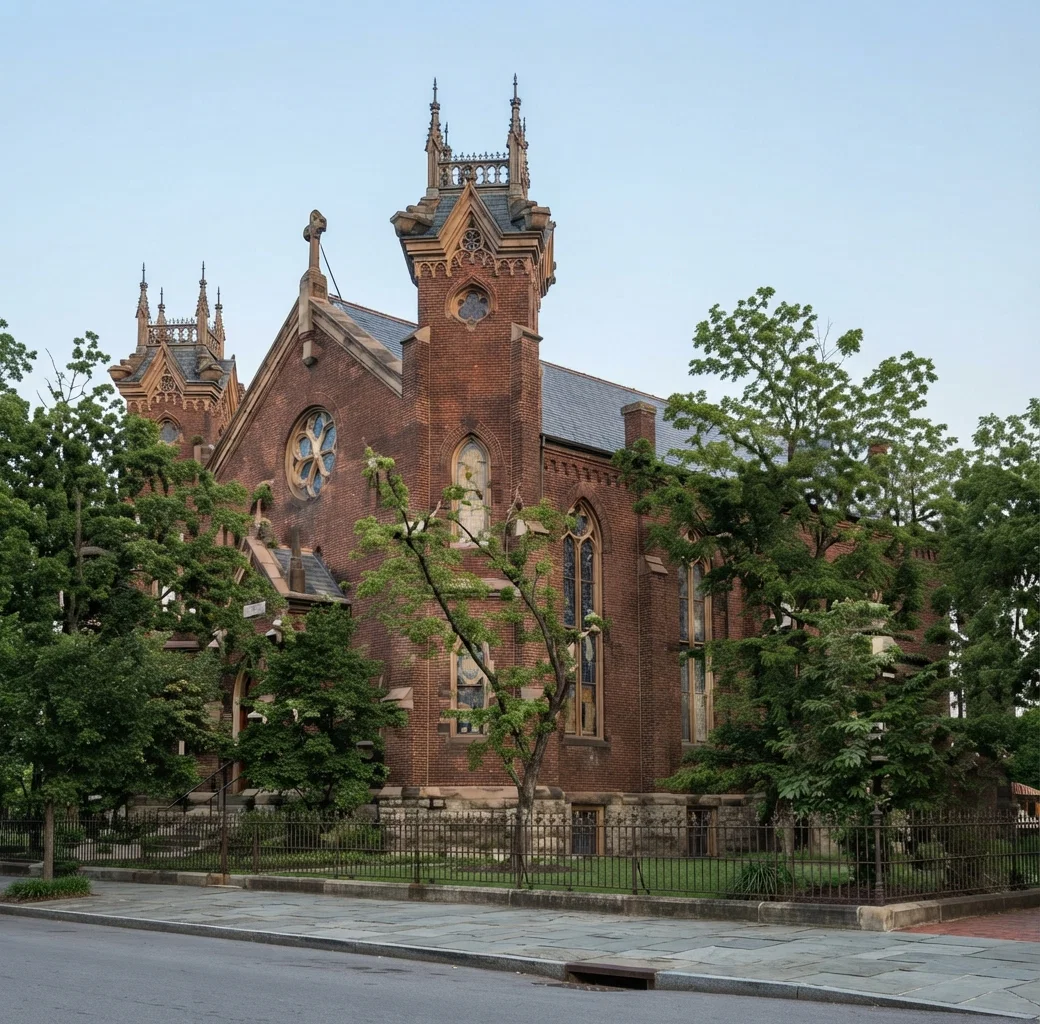
The Memorial Church at Nashville, Tenn.
The Sanitarium, also, is established here, which, of course, is growing up from a small affair to fill an important place in the work.
Nashville is one of the oldest, most influential, and leading cities of the South. It has quite a history in the past, and is the capital city of the state of Tennessee, which furnished two Presidents of the Union, Andrew Jackson and James K. Polk. Nashville is an important educational center, going forward with a steady growth, and contains many of the old substantial families of the past generation. It is the seat of the great Vanderbilt University, one of the
most important educational institutions in the South, and also the famous Fisk University for the colored people, which has obtained quite a high position among the schools of that class. It has, also, many other educational institutions of varying rank and importance.
There is less racial animosity in Nashville than in many of the southern cities. The two classes seem to be getting along on very friendly terms. There is a colored bank in the city, and a very large Baptist publishing house of that race, probably the largest in the country.
There are many facts of this character which show the wisdom of our establishing our headquarters here.
Our people have been treated very kindly and courteously by the citizens of Nashville, tho, of course, we are not a popular people.
Our church in Nashville is not large, and its members are generally poor. Many of them are sisters whose husbands are not in the truth, or single women, laboring in the office at small pay. We have no wealthy men in the church, and hence it would be impossible for the local church to erect such a building as would really be needed in an important center like this. We have thus far had no church building suitable for calling in citizens of the place to listen to the truths of the message. Our only chapel is located on the second floor of our office building, with an entrance on a back street, with small space for anything like a large attendance.
The general public have never attended meetings here, and it never could be expected of them, because it is in no sense a church as commonly understood by the citizens of such a city. It is a mere chapel, mainly to convoke the office workers, and enlarged sufficiently so that our small membership could attend meetings on the Sabbath. Our general meetings have been conducted here, also.
We have all felt that the time had come when we must have a more commodious church building.
A course of lectures in the large tent is about to be commenced. Probably the effort will be continued until cold weather shall come, in the fall. Then we shall greatly need a church building, when the tent comes down, to accommodate those who will be interested, so that the meetings can be carried on through the winter.
Previous to the General Conference steps had been taken by the church to see if we could not, in some way, secure a church building sufficient to meet the wants of the cause in this southern center. Some pledges have been made.
About this time our Baptist friends in the city, who had a very commodious church in which their services had been held for years in the past, concluded that it was necessary, because of the growth of their membership, to have a new and larger building. They had really outgrown the present building, and were anxious to dispose of their church. When they learned that we desired to secure a proper building, they made us very favorable offers.
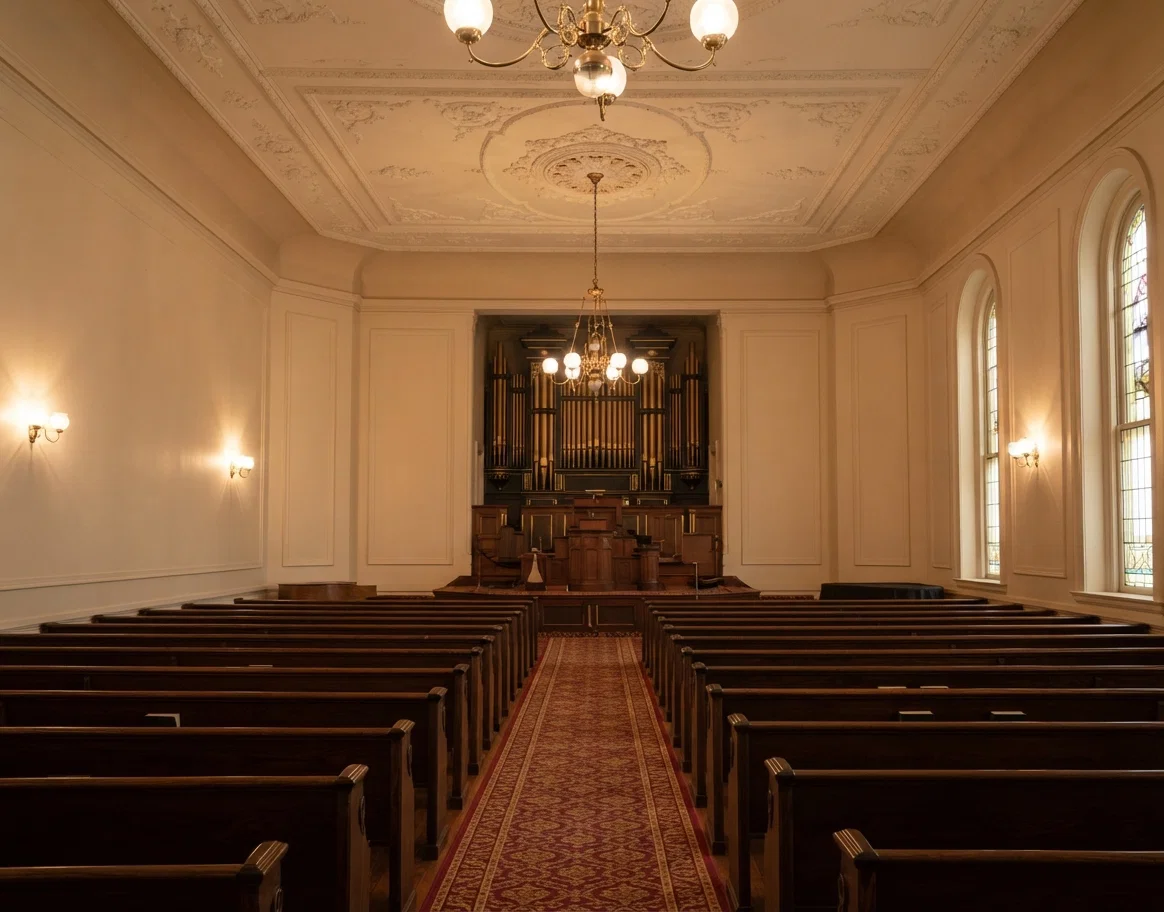
Their church auditorium will seat from three hundred and fifty to four hundred people, comfortably. It is a brick building. Everything is substantial, and it is in very good repair, only it needs papering, and painting, and brightening up, to be in first-class condition. It has an organ back of the pulpit, which cost two thousand dollars some few years since, and really made to fit into a reasonably small space, and a carpet which cost five hundred dollars, a year or two since. The seats are well cushioned, and very comfortable.
The vestry below is also seated, and will accommodate two hundred and fifty or more people. There prayer-meetings, Sabbath-schools, and other gatherings could be held.
It also had a very good piano that would go with the building. They offered all of this for five thousand dollars. It cost, with all its furniture, etc., nearly twenty thousand dollars.
The locality of the building is very favorable, surrounded by fine dwellings, and evidently a good class of people. It is situated on the corner of Seventh and Fatherland Streets, with the street-cars running by the door. The lower part would be excellent for a church school, or anything else of that kind. It opens at a side entrance.
Men of property, land agents, and others have said there was no such bargain ever offered in the city. We all felt that it was providential.
The main facts above stated were brought before the General Conference Committee, and they have made the foregoing recommendation. They have considered the matter of sufficient importance to promise the help of the Review and Watchman, and they ask for the co-operation of the SIGNS OF THE TIMES, in securing subscriptions from our people generally.
The matter stands on the same basis of principle as the Memorial Church in Washington, purchased a year or two since, to which our people contributed liberally.
Interior of Nashville Memorial Church,
Indeed, our church will accommodate more people than the Washington church, and its surroundings are still more favorable, as it has a lot by itself with a nice plot of grass surrounding the building, while the Washington church stands right in close connection with other buildings. That church was thought to be very cheap at a cost of twelve thousand dollars. This costs less than half as much.
We present these facts before the readers of the SIGNS in harmony with this recommendation of the leading committee of our denomination, asking them to kindly help the poor, needy church of Nashville to a building that will suitably entertain the citizens of that place in coming to hear the truths of the glorious message which God has given us to proclaim in these last days. The matter, to those of us on the ground, seems an absolute necessity, in order that the cause here should be properly represented, and we believe our people, when they consider these facts, will esteem it a privilege to help us at once to secure the funds for the payment due on the church. The General Conference Committee kindly loaned us the sum of one thousand dollars for the first payment on the church—so the building is really open for our use. This one thousand dollars has been paid, and the church has been deeded to our board of trustees, on condition that the other four thousand dollars is paid by the first of October. We can use it for Sabbath meetings during the present summer, while our Baptist friends hold their meetings in it on Sunday until that time, when they hope to get into their larger building.
Will not our brethren and sisters who may read this notice in the SIGNS feel it a privilege to assist us in this good work? We could not erect such a church, and obtain the valuable things that come to us with it for twice the sum that this will cost us. All who have seen the building feel that it is a great bargain; a most remarkable opportunity to secure what we need at small expense. We lay this matter before our friends through the SIGNS OF THE TIMES, and ask for their generous assistance.
GEO. I. BUTLER,
President Southern Union Conference.
HE COMES!
By M. L. Mornis
BY M. L. MORNIS.
He comes in majesty and might!
He comes, the eternal Word!
To claim earth's kingdoms as His own,
He comes earth's rightful Lord!
He comes to spoil the power of death,
Take from the grave its prey,
And o'er its night in glory bring
The resurrection day!
He comes—all things beneath His feet—
In peace and power to reign!
To banish from the earth redeemed
All sin, all grief, all pain!
He comes! He comes! He quickly comes!
Lord, even so! Amen!
Thy saints, both quick and dead, await
Thy hast'ning hour—Amen!