Your ShelfYour Projects

Signs of the Times, Vol. 27, No. 11.

HE CARES FOR HIS CREATURES

Signs of the Times

Mar 13, 1901

Pacific Press Publishing Company · Oakland, California · Mar 13, 1901

HE CARES FOR HIS CREATURES.
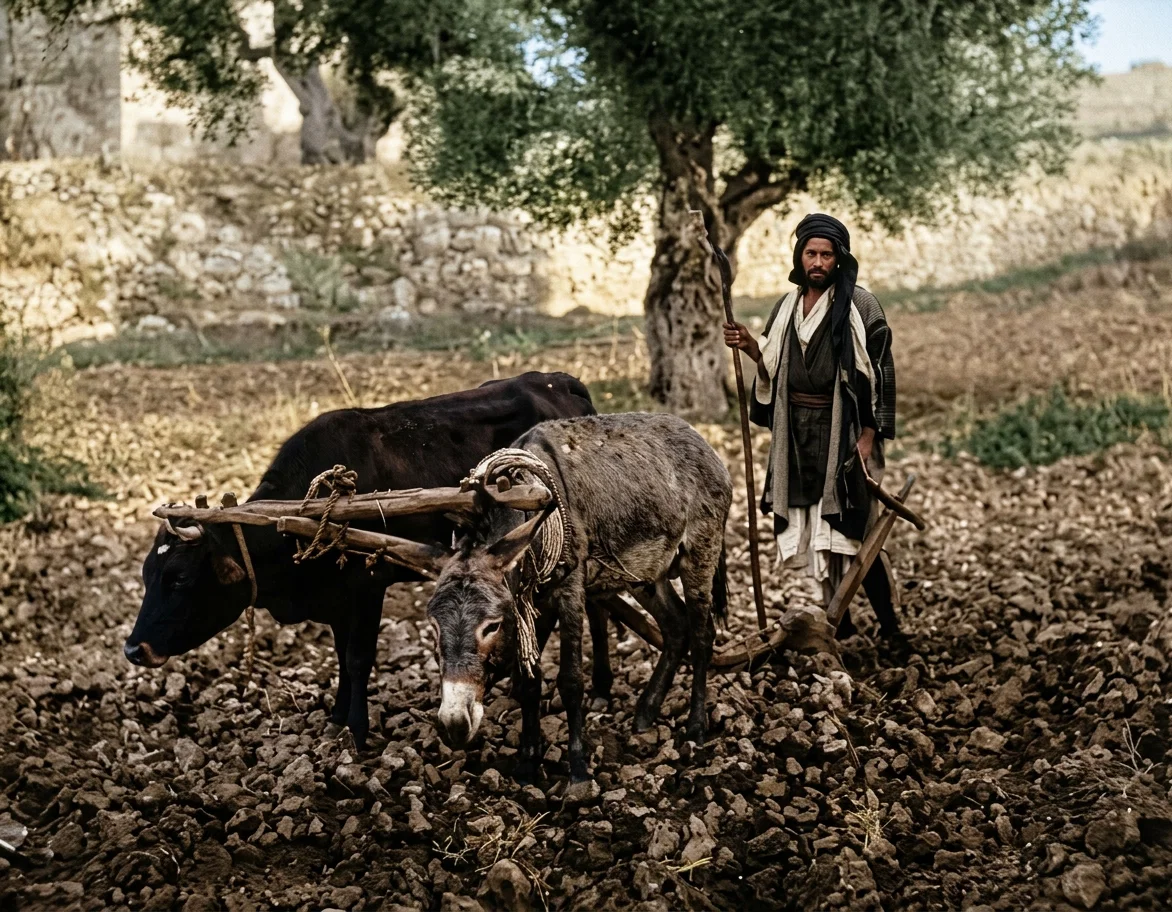
THERE is no creature that the Lord has created that does not receive His care and attention. He not only shows His regard for man, but the bird and the dumb brute as well have the evidence of the Lord’s kindness toward them.
A PEASANT OF PALESTINE.
“BEHOLD the fowls of the air; for they sow not, neither do they reap, nor gather into barns; yet your heavenly Father feedeth them.” Then the Saviour adds, “Are ye not much better than they?” Matt. 6: 26. The Lord would have us observe His care for the birds, and from this learn a lesson of His care for us.
AGAIN do we see the Lord’s care for his dumb creatures in the words, “Thou shalt not plow with an ox and an ass together.” Deut. 22: 10. Either the harness of the ass or the yoke of the ox would be galling the one to the other. They are two different species of animals, and to be yoked together in work could not be pleasant. If the man in our illustration were heeding this Scripture command, the artist could not have given us the picture that he has.
THE Lord created the dumb brute, as well as man. But to man was given the dominion. He was to have authority over the beast of the field. And the man who is in harmony with his Maker will not merely exercise authority over the brute, and make it serve him, but the animal will cause his mind to revert to the Creator. The thought will ever be on the kindness of God in creating these domestic animals for man to enjoy and use. Their grace and beauty, as well as their strength, will be a continued source of delight. This is as the heavenly Father intended that it should be.
NO MAN can be a true Christian and abuse any one of God’s creatures. If God’s care for the sparrows is a lesson to us of how He cares for us, it also should be a lesson to us of how He cares for the sparrows. That which is so carefully regarded by the Lord should receive tender consideration from us. And when we are tempted to abuse a dumb creature, we should think of the fact that the Creator of that animal or bird is hurt thru the pain that I am inflicting upon it.
IF we would only take the time to study the Lord’s ways more, we would be impressed with His tenderness and kindness. His care for the lowliest of His creatures shows the gentleness of His nature, notwithstanding His infinite greatness. Then how can we offend ourkind heavenly Father by unkind words and deeds. How much brighter and happier this world would be if we only studied to know and practise the real gentleness of God!
“THOU hast also given me the shield of Thy salvation; and Thy gentleness hath made me great. Thou hast enlarged my steps under me; so that my feet did not slip.” 2 Sam. 22: 36, 37. David in this psalm is telling his experience. He had passed thru sore trials. His life had been eagerly sought by King Saul. But during this time David had been studying the gentleness of the Lord, rather than plotting revenge on Saul. The Lord dealt with Saul and all the rest of David’s enemies, and as the result of the trial David could say, “Thy gentleness hath made me great.”
LET us study to know the gentleness of God. There is powerful character in it. It is a power in doing aggressive good, and it is also a powerful bulwark against the aggressiveness of all evil. T.

IMITATORS OF GOD.

Be ye therefore imitators of God, as beloved children.” Eph. 5:1, R.V. If God Himself had not commanded us to do this, we might think that the requirement was a manifest impossibility, but since it is God Himself who bids us be like Him, to say that it is impossible is to charge God with light and foolish talking. Impossible instructions only bring ridicule upon the person who issues them.
God’s ambition for men is only limited by the length and breadth of His own life, and as this is infinite, so is His mercy toward the children of men. “For as the heaven is high above the earth, so great is His mercy toward them that fear Him.” Ps. 103:11.
God is love, and love can not be content with bestowing less than its all upon the loved one. God loved His Son, and to Christ was given all the fulness of the Godhead, the very brightness of the Father’s glory. But the same love was extended to us, and so the Saviour says, “The glory which Thou hast given Me I have given unto them; . . . that the world may know that Thou . . . lovedst them, even as Thou lovedst Me.” John 17:22, 23.
It is as beloved children that we are to be imitators of God. A father counts nothing too good for his children. They inherit his life and physical characteristics, and in addition, all the means and advantages that he is able to bestow. If we are children of God, we are heirs, “heirs of God, and joint-heirs with Christ.” The servants of a king may by faithful service rise to high rank, but they never earn the throne. That is reserved for one who never did anything to attain to it, for the child who was born to the privilege. So also no one becomes the child of God by virtue of his own efforts or sacrifices. He is born to the position, and then that right to the kingdom and free share in all his Father’s glory, which he never could hope to win as a servant, are his birthright.
To how many is this wonderful privilege given? The word “therefore” connects with the preceding sentence, so that we read, “Be ye kind one to another, tender-hearted, forgiving each other, even as God also in Christ forgave you. Be ye therefore imitators of God.” The children do not become so by reason of their spotless character. They have stood in sore need of a free forgiveness. They are not beloved children because they are so lovable. It is in Christ that God forgives them. “God commendeth His own love toward us, in that, while we were yet sinners, Christ died for us.” Rom. 5:8, R.V.
Since, then, not a single soul becomes a beloved child by his own deserving, it is evident that the way is as open for any one to have his sins forgiven and become a child and an imitator of God, as it can possibly be for any other one. If a single soul obtains the salvation, it will condemn every other one who does not; for the way is equally open to all, and the fact that one can be saved shows that all may if they will. Whosoever will, let him come and take of the water of life freely.
Remember that the imitating of God is to be done “as dear children.” We are to walk in love, as Christ also hath loved us. The son does not work for what he receives from his father. The greater the wealth and power of the father, the better it is to be born his son. So, as God’s holiness and ways are seen to be infinite, the children will not gaze with despair at the awful distance that separates God from them, but instead will rejoice in the riches of the glory of the inheritance. The ever-deepening sense of God’s glory will not bring a corresponding depression of mind and quenching of hope, but will produce an ever-deepening thankfulness at the remembrance of His much holiness. “Behold, what manner of love the Father hath bestowed upon us, that we should be called the sons of God.” 1 John 3:1.
“As ye have therefore received Christ Jesus the Lord, so walk ye in Him.” Col. 2:6. He is received as a free, undeserved gift, and all that pertains to life and godliness comes in the same way. Many think that it is a very simple matter to get their sins forgiven, but a very complicated and difficult matter to live a Christian life, such as God commands. This is because they think they must rely upon themselves in part to complete the good work which Christ has begun in them. It is as easy for God to keep us from falling and present us faultless at last, as it is for Him to lift us out of the miry clay in the first place. He does both by imparting Himself, “and if Christ be in you, the body is dead because of sin; but the spirit is life because of righteousness.” Rom. 8:10. E. J. Waggoner.

TESTS OF LOYALTY.

MAN was created for God’s glory. Isa. 43:7. It is therefore man’s duty to serve Him. Matt. 4:10. “Fear God, and give glory to Him; for the hour of His judgment is come; and worship Him that made heaven, and earth, and the sea, and the fountains of waters.” Rev. 14:7.
When man sinned, he sold himself to a slavery from which he could neither redeem himself nor his brother. Rom. 7:14; Ps. 49:7. He has reaped, and is reaping, the wages of sin,—death, vanity, nothingness. But tho he has sold himself for naught, God in His love and mercy buys him back. “Ye have sold yourselves for naught; and ye shall be redeemed without money.” Isa. 52:3. “Ye are not your own; for ye were bought with a price; glorify God therefore.” 1 Cor. 6:19, R.V. “Ye were redeemed, not with corruptible things, with silver or gold, from your vain manner of life handed down from your fathers; but with precious blood, as of a lamb without blemish and without spot, even the blood of Christ.” 1 Peter 1:18, 19, R.V.
In a double sense, then, we belong to God. Our all is His. It is therefore our duty to love the Lord our God with all the heart, and mind, and soul, and strength. This is the first and great commandment. Deut. 6:4-6; Matt. 22:37, 38. And there is no true service of God which does not make this acknowledgment of God’s claims. Christianity is neither more nor less than this. Thus Christ did; thus will all those do who have the faith of Christ.
True love is true service. True loyalty is faithful obedience. It does not question God’s commands, nor discriminate between them. Neither will true love seek to be a law unto itself. There is much that is called love which is of this character. It says much in words and does little in deeds. It perverts liberty into license, love into lust. It loves in word, not in deed.
In order to weed out the spurious, in order that man himself might discern, in the light of God, his own motives, and so distinguish between the base and genuine, God has appointed two general tests of man’s love. One of these pertains to time, and one to means.

The Test of Time.

The test of time is the Sabbath day, to be kept unto the Lord. God gives man six days as specially his own, which man may use for himself, and yet in all of which God’s ownership is to be recognized. The Lord chose that proportion of time which was perfectly adapted to man’s nature. And He whose wisdom determined the proportion, marked out by the septenary cycle and in the septenary cycle just where that seventh part of time should fall, namely, on the seventh day. “The seventh day [the day just preceding ‘the first day of the week,’ Matt. 28:1; Mark 16:1, 2] is the Sabbath of the Lord thy God.” Ex. 20:8-11. Neither time, nor age, nor man, nor angel, can change man’s duty to God in this respect. From Eden to Eden the Sabbath has been a test of loyalty to God (save in dark human-blinded periods of earth’s history), filled with glorious blessing from God to His children. Gen. 2:2, 3; Ex. 20:8-11; Isa. 58:13; 66:22.

The Test of Means.

Another test of loyalty is that of means. As all we have belongs to God, He demands of us a tenth. He intrusts to us as stewards nine-tenths of all we receive, to be used as our wisdom and the guidance of His Spirit indicate. But one-tenth he reserves for Himself. He neither gives that to us, nor does he intrust it to our care to be used as we may determine. It is His: “And all the tithe of the land, whether of the seed of the land, or of the fruit of the tree, is the Lord’s;it is holy unto the Lord. . . . And concerning the tithe of the herd, or of the flock, . . . the tenth shall be holy unto the Lord.” Lev. 27:30-32.
This is not a law of the Levitical dispensation. It was a recognized law among the patriarchs of old. Jacob paid tithes; Abraham paid tithes to Melchizedek, and that in a way which showed that he recognized the obligation.
It is a law of the Christian dispensation. Jesus condemned the Pharisees for passing over judgment, mercy, and faith, and the love of God, while paying tithes of mint, and rue, and anise, and cummin. But He tells them that, while they “ought to have done” the former, they ought not to leave undone the latter. Matt. 23:23; Luke 11:42.
Paul, in 1 Cor. 9:1-19, discourses upon the Christian ministry and their support. He refers to the Levitical priesthood, who ministered in sacred things, and who were supported by the tithes. Num. 18:21, 26-28; Neh. 10:37. God has called men in this dispensation to give their whole time for the labor of souls. These constitute the Christian ministry. This is what the apostle says of their support: “Know ye not that they which minister about sacred things eat of the things of the temple [the tithes, especially], and they which wait upon the altar have their portion with the altar? Even so [“in this manner,” “in this fashion”] did the Lord ordain that they which proclaim the Gospel should live of the Gospel.” 1 Cor. 9:13, 14, R.V. Therefore the duty of tithe-paying is as incumbent on the Christian since Christ as upon those who lived before Christ.
The same truth is taught in Heb. 7:8: “And here men that die [the Levites] receive tithes; but there [in Melchizedek, the type] He [Christ] receiveth them, of whom it is witnessed that He liveth.”
The same is taught in Mal. 3:10, which, with its context, is as truly instruction for the Christian dispensation as any prophecy of old. It is especially for the last days, when Christ is about to come to judgment. Verses 2-5. Now note the simple, clear words of the Lord: “Bring ye the whole tithe into the storehouse [God’s house], that there may be meat in Mine house, and prove Me now herewith, saith the Lord of hosts, if I will not open you the windows of heaven, and pour you out a blessing, that there shall not be room enough to receive it.”
Not only is the tithe a test of our loyalty to God, it is a means of proving, testing God. The good steward of God’s means, who recognizes God’s ownership, and who renders a faithful tithe, can come to God in the full assurance of faith. God is his partner in all the transactions of life. He has yielded to do all God requires; God will certainly do all on His part.
O, there is a blessing in faithful tithe-paying,—a blessing worth far more with nine-tenths than ten-tenths are without it! We may take the whole, and with it the curse. We may be loyal to God, live in the current of His life, and receive of His glorious, overflowing blessings; for the heart that has not room for all that comes to it, overflows to others. And this is what God wants His church to be. He wants it to have meat for the hungry souls dying while pleading for the bread of life. He wants each soul of that church, and so the church, to be so full of His life, and power, and love that all the nations shall know it. And all this will be if God’s ownership and man’s stewardship are recognized and man is loyal to God. X.

UNIVERSAL SUN-WORSHIP.

The following is only one of the many evidences which are found in the history of every land and people of the universality of sun-worship. This is from “Notes on Irish History,” in the Catholic Mirror of February 9, 1901, by M. P. Kehoe:—
The mixed nature of the creed of the ancient Irish seems to be intimated in their mode of designating their own priesthood, to whom they applied the Celtic as well as the Persian denomination, calling them Druids or Magi.
The great object of Phœnic adoration, the sun, was under the name of Baal or Bel, the chief deity of the Irish. That the worship of the sun formed a part of the pagan system which St. Patrick found established on his arrival, appears from the following passage of his confession: “The sun whom we behold rises daily at the command of God for our use. Yet will he never reign, nor shall his splendor endure; and all those who adore him will descend wretchedly into punishment. But we believe and adore the true sun, ‘Christ.’”
Even at the present time there remains evidence of the Fire Worshipers, in the custom of the peasants lighting bonfires on the first night of May, and in some parts of Ireland they carry a “May bush,” on which a number of candles are lighted.
The worship of fire, once common to all religions of the world, constituted a part of the old Irish superstitions, and the inextinguishable fire of St. Brigid was a transfer to Christian shrines of a rite connected thru long ages with the religious feelings of the people.
Annually, at the time of the vernal equinox, the great festival of La Baaltinne, or the Day of the Baal-fire, was celebrated, and thru every district of Ireland it was strictly ordered that on that night all fires should be extinguished, nor could any, under the pain of death, be lighted again until the pile of sacrifices in the Palace of Tara was kindled.
Among the almost universal customs which have come down from the ancient sun-worship is the observance of Sunday, which a writer has well characterized “the wild solar holiday of all pagan times.” Just as sun-worship usurped the place of the true worship of God, so Sunday usurped the place of the Sabbath of the true God.

THE HIDDEN TREASURE.

The kingdom of heaven is like unto treasure hid in a field; the which when a man hath found, he hideth, and for joy thereof goeth and selleth all that he hath, and buyeth that field.” Matt. 13:44.
This field is the Bible, in appearance similar to all other books, but, like this one field, it contains, above all other books, the precious and costly treasures of God. And, like the treasure in the field, its riches do not appear on the surface, but are hidden from the natural mind, which “receiveth not the things of the Spirit of God.” “As it is written, Eye hath not seen, nor ear heard, neither have entered into the heart of man, the things which God hath prepared for them that love Him. But God hath revealed them unto us by His Spirit; for the Spirit searcheth all things, yea, the deep things of God.” 1 Cor. 2:14, 9, 10.
The Spirit of God, then, is the key that will unlock the treasure-house of truth. It is the guide that will show where these treasures are hid. Hence Christ says: “Howbeit when He, the Spirit of truth, is come, He will guide you into all truth; for He shall not speak of Himself; but whatsoever He shall hear, that shall He speak; and He will show you things to come. He shall glorify Me; for He shall receive of Mine, and shall show it unto you.” John 16:13, 14.
This “Mine,” which is a mine indeed, and from which we may receive eternal riches, is Christ, who is “the Word;” for “the Word was made flesh, and dwelt among us (and we beheld His glory, the glory as of the only begotten of the Father), full of grace and truth.” John 1:1, 2, 14. And Paul, in speaking of “being knit together in love, and unto all riches of the full assurance of understanding, to the acknowledgment of the mystery of God,” directs our attention to Christ, “in whom,” He says, “are hid all the treasures of wisdom and knowledge.” Col. 2:2, 3. But if “all the treasures of wisdom and knowledge” are hid in Christ, then they are hid in “the Word;” for the Word is the expression of it all.
How many consider that the Bible they possess is the widest field for investigation and research, an inexhaustible treasure-house, a Book in which God has stored all wisdom and knowledge? The Spirit of God exhorts all, “Seek ye out of the Book of the Lord, and read.” Isa. 34:16. Everything He has commanded, and all that His Spirit has gathered for the uplifting and edification and enlightenment of the human race, is found in “the Book of the Lord.” Nothing is lacking; nothing is wanting. One may go to this Book and receive information and guidance on any topic of value.
But, above all, God has in the Bible revealed unto His people the most glorious of all sciences, the “knowledge of salvation . . . by the remission of their sins, thru the tender mercy of our God; whereby the Dayspring from on high visited us, to give light to them that sit in darkness and in the shadow of death, to guide our feet into the way of peace.” Luke 1:77–79.
In contemplating the greatness and the sublimity of the Word of God, the psalmist exclaims: “I will praise Thee with my whole heart; before the gods will I sing praise unto Thee. I will worship toward Thy holy temple, and praise Thy name for Thy loving-kindness and for Thy truth; for Thou hast magnified Thy Word above all Thy name.” Ps. 138:1, 2.
Is this the language of thy heart?
Many are fostering the idea that the Spirit of God will communicate knowledge to them in a supernatural way without any effort on their part; and strange indeed are many of the doctrines which it is claimed they have thus been obtaining. But we have no such promise. The Spirit is given to guide us in searching the Word of God, which not only “is truth,” but contains “all truth.” John 17:17; 16:13. And right here we may fitly apply the adage, No struggle, no victory; no effort, no reward. We may as well expect to obtain worldly wisdom by folding our arms and doing nothing asto think of obtaining “the knowledge of God” without an earnest, persistent effort on our part in searching for it.
The Word of God has itself pointed out the way in which we may make its treasures our own. Listen to the counsel of the wise man: “My son, if thou wilt receive My words, and hide My commandments with thee; so that thou incline thine ear unto wisdom, and apply thine heart to understanding; yea, if thou criest after knowledge, and liftest up thy voice for understanding; if thou seekest her as silver, and searchest for her as for hid treasures; then shalt thou understand the fear of the Lord, and find the knowledge of God.” Prov. 2:1–5.
Thus is the whole secret revealed: First, a sense of our great need, then a willing heart and an earnest desire to know the truth; and then a seeking as after silver, and a searching as for hid treasures. This is not the effort of a day, but a life-work, yea, the work of an eternal life; for thru the ceaseless ages of eternity the Word of God will constitute “the wells of salvation,” out of which the redeemed shall draw water with joy. Isa. 12:3.
A superficial reading of the Bible can not possibly reveal its hidden treasures, any more than a casual walk along the mountainside will bring to view the riches of its depths. Tho we may find a few gems in this way, it is only the one who, like the miner, “digs out the ore,” “and to the uttermost searcheth out the rocks that are in the darkness,” who will find his efforts crowned with success. “His eye seeth every precious thing; . . . and the thing that is hid bringeth He forth to light.” Job 28:1–11. As the miner follows the rich vein, so one must take up subject after subject, and follow them thru the different books of the Bible, until he has gathered all that God has spoken on these special points. In such work the Spirit will help and guide. It is in this way we may search out “the deep things of God.”
To this end the Bible gives several examples. After Philip had ascended the chariot of the inquiring Ethiopian, he “opened his mouth, and began at the same scripture, and preached unto him Jesus.” Acts 8:35. The eunuch desired Philip to be his “guide” in his seeking after truth. Verse 31. And what was the result? The record says, “He went on his way rejoicing.” Verse 39. In the same way Paul reasoned with the Thessalonians “out of the Scriptures, opening and alleging, that Christ must needs have suffered, and risen again from the dead; and that this Jesus, whom I preach unto you, is Christ.” Acts 17:1–3.
Read also of the meeting between Christ and the two disciples on their way to Emmaus. They did not understand the things that had occurred in Jerusalem, but in explaining, Jesus said: “O fools, and slow of heart to believe all that the prophets have spoken; ought not Christ to have suffered these things, and to enter into His glory? And beginning at Moses and all the prophets, He expounded unto them in all the Scriptures the things concerning Himself.” Luke 24:13–27. And what was their testimony?—“Did not our heart burn within us, while He talked with us by the way, and while He opened to us the Scriptures?” Verse 32. Surely “the entrance of Thy words giveth light; it giveth understanding unto the simple.” Ps. 119:130.
Even so now we may go our way rejoicing, and our hearts may burn within us, if we take hold in earnest to study the Scriptures in the way God Himself has indicated. They will then open to us hitherto hidden things, and they will be so precious in our eyes that we will exclaim, with the apostle Paul: “But what things were gain to me, those I counted loss for Christ. Yea doubtless, and I count all things but loss for the excellency of the knowledge of Christ Jesus my Lord.” Phil. 3:7, 8. C. CASTBERG.
Fruitvale, Cal.

OUR WORDS.

BUT as He which hath called you is holy, so be ye holy in all manner of conversation.” 1 Peter 1:15. Before we can attain to that standard of perfection to which God would have us, our words must be pure and elevating,—words chosen of God.
Our words have a deep and wide influence; they make an impression on the mind either for good or for evil, and this impression is not always easily erased. Our constant prayer should be, “Let the words of my mouth, and the meditation of my heart, be acceptable in Thy sight, O Lord, my Strength, and my Redeemer.” Ps. 19:14.
We should be living in a condition to receive the Spirit of God, and when we are thoroly imbued with that Spirit, our hearts will be pure and our words must consequently be pure; “for out of the abundance of the heart the mouth speaketh.” Matt. 12:34.
We should not allow a satanic spirit to enter our conversation; for it is then the tongue pierces as a sword. Words spoken in such a spirit mar the soul, and have an influence for evil, and are often the means of stirring up strife; but kind words have the opposite effect.
It would be very unbecoming for a professed Christian to use corrupt language. James tells us, “If any man among you seem to be religious, and bridleth not his tongue, . . . this man’s religion is vain.” James 1:26. We need wisdom in order that we may know what to speak. This wisdom we do not possess of ourselves, but we must apply to God, the Source of all wisdom, to obtain it. “If any of you lack wisdom, let him ask of God, that giveth to all men liberally, and upbraideth not; and it shall be given him. But let him ask in faith, nothing wavering. For he that wavereth is like a wave of the sea driven with the wind and tossed.” James 1:5, 6.
Our every word, our every thought and act, must be wrought in God. Where we have God dwelling in us, our every word and thought will be love; for God is love. As love is the life of God, and life is power, the love of God must be the power of God, and thru the power of God we are able to do all things. We should be very careful in our every word; for “every idle word that men shall speak, they shall give account thereof in the day of judgment. For by thy words thou shalt be justified, and by thy words thou shalt be condemned.” Matt. 12:36, 37. C. H. BLAKE.
Onawa, Iowa.

A SAMPLE OF HINDU PHILOSOPHY.

THE teaching of so-called “Christian Science” as to the unreality of matter, is but a revival of the old Vedanta philosophy of Hinduism. It is difficult to speak of the philosophy of Hinduism, for, as has been well said, the religious writings of India “belong to the realm of myth-making and of poetizing, rather than to that of philosophy.”
There is a philosophy of a certain kind, however. It is very similar, in its avoidance of all that concerns practical life, to the systems of the fighting schoolmen of the Dark Ages, who left the people to perish in Europe while they discussed subtleties which only an unbalanced mind could compass. They learnedly reasoned about nothings, while at the same time the folk-lore stories of the former days, interwoven with legends of the saints, were serious literature. The epic sacred poems of the Hindus are on a level with the fairy tales of the childhood of Europe.
The one system of interpretation of their sacred literature that can assume to be a philosophy, holds that the universe is an illusion. On thru mazy arguments it discusses the mysterious meaning of the words in the “Great Sentence,” “Thou art That,” and of the corresponding assertion, “That art Thou.” Meanwhile the people perished, and knew nothing whatever of religion save as a system of charms and sacrifices to keep off evil spirits.
The idea is that Brahma is the great essence, and that all else is non-existent. He is the magician who spins the non-existent matter out of himself. How possibly Brahma can find pleasure in producing illusions when there is nobody to be deluded by them but himself, is a hard question; but the system of philosophy maintains that “unreasonableness is no objection.” How thoroly this Hindu philosopher affects to do away with personality may be best shown by an illustration from one of the sacred books. One Nidagha is watching the arrival of a prince who is entering a city. A stranger approaches.
“Tell me,” said the stranger, “which is here the king, and which is any other man.”
“The king,” he replied, “is he who is seated on the elephant; the others are his attendants.”
“Tell me, venerable sir, which is the king and which is the elephant.”
“The elephant,” answered Nidagha, “is underneath; the king is above him.”
“What is meant by underneath, and what is termed above?” Upon this Nidagha, thinking doubtless to try a simpler form of argument with the stranger, jumped upon him and said:—
“I am above, like the rajah; you are underneath, like the elephant.”
“Very well,” said the stranger, “tell me which of us two is you; which is I.”
“When Nidagha heard these words,” says the sacred book, “heimmediately fell at the feet of the stranger, and said, ‘Of a surety, thou art my saintly preceptor Ribhu; the mind of no other person is so fully imbued with the doctrine of unity as that of my teacher.’”
The man who argued after this fashion would usually be set down as a bit weak mentally. But this is the height of reason after the philosophy of the Vedanta. The old Sanscrit word for truth meant, “That which is.” It is a good definition. Truth is the enduring reality. False systems of philosophy have ever been trying to deny that which is. Leaving the practical living of the life of God which is in every man, this kind of philosophy, often called theology, speculates and spins webs of reasonings so vain that the mind reels in trying to fix itself for the moment upon vacancy. The mental attitude best calculated to lead the mind into the understanding of these subtleties is abstraction. One way of inducing pure abstraction, fit state for the contemplation of nothing, is to look steadily at the crossed fingers or at the point of the nose, and think of nothing.
Christianity’s joyful message brings something to think of, the practical reality of sin and salvation, life and death, and a judgment now at hand, a God-ordered work for these days, and a soon-coming Saviour. W. A. SPICER.
Calcutta, India.

THE SPIRITS IN PRISON.

CHRIST also hath once suffered for sins,” says an apostle, “the just for the unjust, that He might bring us to God, being put to death in the flesh, but quickened by the Spirit; by which also He went and preached unto the spirits in prison; which sometime were disobedient, when once the long-suffering of God waited in the days of Noah, while the ark was a-preparing, wherein few, that is, eight souls were saved by water.” 1 Peter 3 : 18-20.
Many, as they have read the above verses, have thought that Christ, between His death and resurrection, preached to these spirits (men are also called souls, Gen. 46 : 26, 27) that were in prison, and that they had at this time another opportunity to hear the Gospel. But rightly to understand this subject it is necessary to note carefully what the text says, and to compare the same with other scriptures. Peter does not say that Christ preached to these spirits while His body was in the tomb, but that He was “put to death in the flesh, but quickened by the Spirit; by which [the Spirit] also He went and preached to the spirits in prison; which sometime were disobedient, when once the long-suffering of God waited in the days of Noah.” It was in the days of Noah that Christ preached to the spirits here mentioned, while they lived on the earth, and not after they were dead.
But the question may arise, What does Peter mean when he says that the Gospel has been preached also to them that are dead? 1 Peter 4 : 6. He means that it was preached to them while they were alive, because it would be impossible for them to hear or accept it after they were dead, as we can see by the following scriptures:—
“The grave can not praise Thee, death can not celebrate Thee; they that go down into the pit can not hope for Thy truth.” Isa. 38 : 18.
“For the living know that they shall die; but the dead know not anything, neither have they any more a reward; for the memory of them is forgotten.” Eccl. 9 : 5.
“In death there is no remembrance of Thee; in the grave who shall give Thee thanks?” Ps. 6 : 5.
“So man lieth down, and riseth not; till the heavens be no more, they shall not awake, nor be raised out of their sleep.” “His sons come to honor, and he knoweth it not; and they are brought low, but he perceiveth it not of them.” Job 14 : 12, 21.
These, as well as many other texts of Scripture, clearly show that man, between death and the resurrection, is in an unconscious state, and that it would be impossible for him to hear or believe the Gospel.
So Christ preached to them that did not believe, in the days of Noah, by His Spirit. The Spirit of Christ was in the prophets 1 Peter 1 : 10, 11. Noah was a prophet. Christ preached thru him 120 years to the people that lived at that time. They would not believe, and rejected the warning message that was proclaimed to them; the flood came, and they all perished.
If, then, after this should be given them another opportunity to receive salvation (which would have been impossible, as the dead know not anything, but sleep in the dust of the earth, Dan. 12 : 2), it would not have been by faith, and “without faith it is impossible to please” God (Heb. 11 : 6). Noah, by believing God, and carrying out the instructions given to him, “condemned the world, and became heir of the righteousness which is by faith.” Verse 7.
We have now noticed how Christ preached to these spirits that would not believe; but now the question arises, What prison were they in?—It was the prison-house of sin, as is clearly shown by the following:—
“Then said Jesus to those Jews which believed on Him, If ye continue in My word, then are ye My disciples indeed; and ye shall know the truth, and the truth shall make you free. They answered Him, We be Abraham’s seed, and were never in bondage to any man; how sayest Thou, Ye shall be made free? Jesus answered them, Verily, verily, I say unto you, Whosoever committeth sin is the servant of sin.” John 8 : 31-34. When men are servants of sin, they are in the snare of the devil, “taken captive by him at his will.” 2 Tim. 2 : 25, 26. This snare is a dark prison. Isa. 42:6, 7; Ps. 107:10-14.
The mission of Christ is, and always has been, to set at liberty these captives. He says:—
“The Spirit of the Lord God is upon Me; because the Lord hath anointed Me to preach good tidings unto the meek; He hath sent Me to bind up the broken-hearted, to proclaim liberty to the captives, and the opening of the prison to them that are bound.” Isa. 61:1; Luke 4:18.
In all ages, ever since sin came into the world, and men became servants thereof, it has been Christ that has preached liberty to them, and they that have believed have been delivered out of bondage.
Christ would have set those free that lived before the flood. For this reason He preached to them thru His servant Noah, and the promise to them was just as sure as the one given to the Jews while He was personally upon the earth: “If the Son therefore shall make you free, ye shall be free indeed.” John 8 : 36. CHAS. NELSON.

BUT ONE ANSWER.

“Who changed the Sabbath?” is a question often asked: The question is asked because the Bible does not intimate that any change has been made, or would be made. Prophecy foretells that a certain power would “think to change times and the law” (Dan. 7:25, R.V.), but that power is one that speaks “great words against the Most High,” and wears out “the saints of the Most High.” Therefore, it has no authority to make any change in God’s law, and in fact is powerless to do so. Whatever appears to be a change is but the thought, or aim, of an unauthorized and powerless party.
The power that for centuries wore out the saints of the Most High by the most cruel persecutions is so well known that it need not be mentioned by name. That is the power that thought to change the Sabbath; that claims to have done so, and boasts of that evidence of its authority to rule the church of God on earth. The assumption that the Sabbath has been changed is now so generally recognized that the masses of Christendom take it for granted that the so-called change is legitimate. Yet the question, “Who changed the Sabbath?” does not down. There is but one answer, and that is, No one has changed the Sabbath. It is an institution of God, made in the beginning of the history of man (Gen. 2:2, 3); was made for man (Mark 2:27), and is to stand forever (Isa. 66:22, 23).
The enemy of souls would fain have us believe that mortal man has the power to change the law of God and the institutions and ordinances of His planting. This point granted, and the whole Word of God becomes subject to manipulation to suit the imagination and dictum of any authority that the “mystery of iniquity” may set up in opposition to the authority of God. The Sabbath has not been changed, and all claims to that effect are fraudulent, are delusions to ensnare the unwary and lead them away from the plain commandment of God. “Let no man deceive you.” On the question of the Sabbath, as on all doctrine, test them by the Word. “To the law and to the testimony; if they speak not according to this Word, it is because there is no light in them.” Isa. 8:20. G.
Continue reading: None of Us Liveth to Himself