Your ShelfYour Projects

Signs of the Times, Vol. 40, No. 37.

4183 — The Rest That Remains

Signs of the Times

Sep 23, 1913

Pacific Press Publishing Association · Mountain View, California · Sep 23, 1913

4183 — The Rest That Remains

Please explain the rest spoken of in Hebrews 4. It seems to be spoken of in connection with the Sabbath rest,— verses 4 and 5. What other rest day did Jesus speak of? Verse 8. F. K.
If we will read the context, including the last part of Hebrews 3, we will see the rest of which the apostle is speaking. God's people of old did not enter into His rest. God wanted to give them rest in Canaan — spiritual rest from sin, and physical rest in a land of peace. They could not get the physical rest in Canaan from their wars and foes, because they did not get the spiritual rest in God, and so we read in verse 2 of chapter 4 that "the word preached did not profit them, not being mixed with faith in them that heard it." The only hope man has of obtaining rest is in accepting the righteousness of God for his own righteousness (which is but sin), of God's works for his own works. This gives peace and rest in God. And the pledge that God will do this, is shown in the fact that God's work for the children of men — that is, His home for the children of men — is finished from the foundation of the world; and the constant pledge and memorial of this is the Sabbath day which He has given us.
Now just as the earth was as it came from the hand of God, so God designed that His people should be before Him — very good, worthy of enjoying the beautiful home that He made for them. But man sinned; and yet God's plan still holds good. He still has the home in His own purpose, and that power by which He re-creates man will re-create the home; and the Sabbath day will still be the memorial of God's wonderful works for the children of men, and a pledge of His power to change or re-create. The word "Jesus" in verse 8 ought to be "Joshua." "Jesus" in Greek is the same as "Joshua" in Hebrew. You will note, if you have a Bible with marginal references, that the margin is "Joshua." Now Joshua did not give them rest when he led them into Canaan.
If he had given them that perfect rest, another day would not have been mentioned; but inasmuch as he did not, God gave them no other time here in this world than to-day. And so it is mentioned in David, "To-day if ye will hear His voice, harden not your hearts." To-day — every day as it comes — that is the "another day." We can find rest in God by yielding to Him through faith to-day. By and by all the children will be gathered home, and will enter upon that eternal physical rest of which the spiritual rest is the type. So "there remaineth therefore a rest," or the keeping of a Sabbath, which shall know no sin to the people of God. The scripture has nothing whatever to do with another Sabbath appointed in this world.

4185 — Members of the Federal Council of Churches

Would you kindly tell me, through your Question Corner, the names of each denomination that has joined the Federal Council of Churches?
A volume entitled "Federal Council of the Churches of Christ in America," edited by the corresponding secretary, Elias B. Sandford, D. D., published by Revell in 1909, gives the following list of churches as those that shall be entitled to representation in the Federal Council on their approval of the purpose and plan of the organization: Baptist churches of the United States; Free Baptist General Conference; National Baptist Convention (African); Christians (the Christian Connection); Congregational churches; Congregational Methodist churches; Disciples of Christ; Evangelical Association; Evangelical Synod of North America; Friends; Evangelical Lutheran Church, General Synod; Methodist Episcopal Church; Methodist Episcopal Church, South; Primitive Methodist Church; Colored Methodist Church in America; Methodist Protestant Church; African Methodist Episcopal Church; African Methodist Episcopal Zion Church; General Conference of the Mennonite Church of North America; Moravian Church; Presbyterian Church in the United States of America; Presbyterian Church in the United States; Welsh Calvinistic Methodist or Presbyterian Church; Reformed Presbyterian Church; United Presbyterian Church; Protestant Episcopal Church; Reformed Church in America; Reformed Church of the United States of America; Reformed Episcopal Church; Seventh-day Baptist churches; Swedish Lutheran Augustana Synod; United Brethren in Christ; United Evangelical Church.
It is but fair to state, however, that there are those in every one of these churches, and preeminently so in the Baptist Church, who have protested against such federation. They feel that it is taking away the individuality from the church, and is compromising some important particulars in their faith.

4152—"A Building of God," "Eternal in the Heavens," 2 Cor. 5:1

"For we know that if our earthly house of this tabernacle were dissolved, we have a building of God, an house not made with hands, eternal in the heavens." What does this passage mean? Please explain.
Read the whole context, beginning with verse 1 of 2 Corinthians 5, closing with verse 9. Note that three conditions are there named: first, "our earthly house" and "this tabernacle" in verse 1; "in this," verse 2; "this tabernacle," verse 4; "at home in the body," verse 6. The second condition is that of death: "dissolved," verse 1; "naked," verse 3; "unclothed," verse 4. The third condition is at home with God: "a building of God," and "a house not made with hands," verse 1; "clothed upon with our house which is from heaven," verse 2; "being clothed," verse 3; "clothed upon" and "swallowed up of life," verse 4; "present with the Lord," verse 8. There may be other expressions which have kindred meaning, but these are clear enough so that we may know what is meant. The apostle is not looking for death, nor anxious for death. This he expresses by the terms "dissolved" and "found naked." He does not want to be in either of these conditions. He is not looking for death at all. Neither would he like to remain in this present state, for in this he groans. He is in sorrow and trouble. He is, however, longing for a third—neither death, nor to remain here, but for the building of God—for the state of life which shall swallow up mortality. He wants "to be present with the Lord." But when will this be? The Scriptures very clearly tell us.
Rom. 8:23 tells us for what Paul groaned: "Even we ourselves groan within ourselves, waiting for the adoption, to wit, the redemption of our body." That will be when the saints of God are raised from the dead.
When will mortality be swallowed up of life? Let the same apostle tell us that: "We shall not all sleep, but we shall all be changed, in a moment, in the twinkling of an eye, at the last trump: for the trumpet shall sound, and the dead shall be raised incorruptible, and we shall be changed. For this corruptible must put on incorruption, and this mortal must put on immortality." And again, it is the second coming of Christ and the resurrection to which the apostle looked.
Once more: When would he be with the Lord? Listen to the words of comfort in 1 Thess. 4:16, 17: "For the Lord Himself shall descend from heaven with a shout, with the voice of the Archangel, and with the trump of God: and the dead in Christ shall rise first: then we which are alive and remain shall be caught up together with them in the clouds, to meet the Lord in the air: and so shall we ever be with the Lord."
For what, then, did the apostle long?—For Christ's coming, when he expected to be with the Lord, when mortality would be swallowed up of life, when the groaning would be over and the body redeemed from the grave. Hos. 13:14. There are many other passages which teach the same thing. It was to that time that the apostle looked forward: "For we must all appear before the judgment-seat of Christ." 2 Cor. 5:10.

4154—What Army, Joel 2:2-12?

Will you please give an explanation, through the columns of your paper, of Joel 2:2-12? I would like to know to what army this refers. B. B. P.
We do not know that the army of Joel 2, as well as Joel 1, refers to anything else but just what God says. In verse 20 He says, "I will remove far off from you the northern army," and in verse 25, "I will restore to you the years that the locust hath eaten, the canker-worm, and the caterpillar, and the palmer-worm, My great army which I sent among you." It is a prophecy of the many devouring pests of the last days. The caterpillar and the canker-worm and the palmer-worm and the locusts are types, so to speak, of all the various devouring insects which we have at the present time, and to meet which millions upon millions of money is expended every year. There is probably nothing more costly in America to-day, at least in large sections of America where fruit is grown especially, than the meeting of these various pests. It is one constant fight during much of the year to obtain perfect fruit at all. Some have used these locusts as types of armies of men, as they are doubtless used in Revelation 9. That, however, is a highly symbolical prophecy, while this itself seems to be a literal one. We have the war spirit and the war preparations mentioned in Joel, but these are not brought in through figurative language; nor do we understand that these locusts are figurative. They are what men are actually meeting to-day and will meet more and more in the future. The old earth is twisted and warped and degenerate; and its smallest creatures, multiplying in vast numbers, become the most formidable of foes.

4186 — Evil Spirits

In 1 Sam. 16:14, 15, 23, it says that "an evil spirit from the Lord troubled him," that is, Saul. Does God have evil spirits to do His bidding?
What God permits is sometimes spoken of as His doing. He permitted an evil spirit to come upon Saul. Saul had turned away from God and His Spirit, and the Lord allowed an evil spirit to come upon him. That is all. Just the same as we are told in 2 Thess. 2:11, "And for this cause God sendeth them a working of error [or, "a strong delusion"], that they should believe a lie." That is, when man will not accept the love of the truth, God allows Satan to work his will in the heart of the man who has turned away from all that will save him. So it was with Saul. He had turned from the instruction that would save him, and the Lord left him to himself.

The Gospel of Mark

Schedule for the Week Ending September 27, 1913
Sunday September 21 Mark 1
Monday " 22 " 2
Tuesday " 23 " 3
Wednesday " 24 " 4
Thursday " 25 " 5
Friday " 26 " 6
Sabbath " 27 " 7
We pass, this week, to the New Testament, going back to the Old only in the reading of the Psalms. Our lesson of this week lies wholly within the Gospel of Mark. Mark was not an apostle, as some suppose. His full name was John Mark. (See Acts 12:12, 25; 15:37.) He was the son of Mary, at whose house in Jerusalem the early Christians seem to have frequently met. He was a cousin of Barnabas (Col. 4:10, A.R.V.), and the attendant of Paul and Barnabas when they first started out on their missionary journey. This seems to have been harder for Mark than he supposed it would be, and he left them at Perga. Because of his lack of zeal, a sharp contention arose over him between Paul and Barnabas. Acts 15:39. It is good to know, however, that in later days he and Paul were reconciled (Col. 4:10; Philemon 24). Paul wished that Mark should come to him, because he was "profitable" to him for the ministry. 2 Tim. 4:11.
Mark is said to be the interpreter of Peter, learning the facts of his Gospel from him, which were written by inspiration of the Holy Spirit. His Gospel is very direct. One of the words that we find repeated over and over again is "immediately," or "forthwith." It is felt to be the orderly Gospel. That is, it has the events of Christ's life in more direct chronological order than the others.

"IF YE WILL INQUIRE, INQUIRE YE."

This Inquirers' Department is conducted for the purpose of helping those who are studying the Bible. The answers are oftentimes only suggestive. They are never to be considered infallible, only as they agree with the infallible Word. The writer who may answer these questions does not consider that his opinion is infallible. He will simply give the best that he has, and plead with the inquirer to search the Word. Such questions only will be answered as, to the editors, seem to minister to the good of the readers and to the mission of the paper. We can not answer repeatedly in the same volume questions upon the same scripture. The name and address must accompany question, not for publication, but as an evidence of good faith, and that answer may be made by letter if deemed advisable. No letters are answered which do not contain the name of the writer. It is well always to enclose stamp for reply.

Question Corner

Have Light in Yourselves
By Mrs. E. G. White
WE have most precious promises in the word of God, which ought to give us courage and confidence. They should enable us to come out of uncertainty and darkness, to come where we may know that the Spirit beareth witness with our spirit that we are the children of God. There is nothing wanting in the storehouse of our God.
Jesus has said: "Believe Me that I am in the Father, and the Father in Me; or else believe Me for the very works' sake. Verily, verily, I say unto you, He that believeth on Me, the works that I do shall he do also; and greater works than these shall he do; because I go unto My Father." The disciples of Christ are to do greater works than Jesus Himself has done. He says further: "Whatsoever ye shall ask in My name, that will I do, that the Father may be glorified in the Son. If ye shall ask anything in My name, I will do it." Christ spoke these words for the comfort of all who should have faith in Him, and it is our privilege to believe that God will do just as He has said He would.
It is not enough to say, "I believe;" we must exercise the living faith that claims the promises of God as our own, knowing that they are sure and steadfast. The enemy of our souls would be glad to steal away these precious promises from us, and cast darkness before our eyes, so that we should not be able to appropriate the good things that God means that we shall have. God is waiting to do great things for us as soon as we come into a right relation with Him; but if we hold ourselves in doubt and unbelief, the enemy can keep the control of our minds, and intercept the promises of God. Unbelief always results in a great loss to our souls. It was said concerning one place where Christ visited, "He did not many mighty works there because of their unbelief." Christ can not work in our behalf if we do not manifest faith in Him. We should train our souls to have faith in God. But instead of this, how many there are who educate themselves to doubt! It is not God's will that we should be in this position. It is our privilege to walk in the light, as Christ is in the light. He is at our right hand to strengthen us, and He tells us that greater works than He has done shall we do, because He goes to the Father. He is ready to impart to us the rich blessing and grace of God.
How shall we encourage you to have faith in God? You say: "How can I talk faith, how can I have faith, when clouds and darkness and despondency come over my mind? I do not feel as tho I could talk faith; I do not feel that I have any faith to talk." But why do you feel in this way? It is because you have permitted Satan to cast his dark shadow across your pathway, and you can not see the light that Jesus sheds upon your pathway.
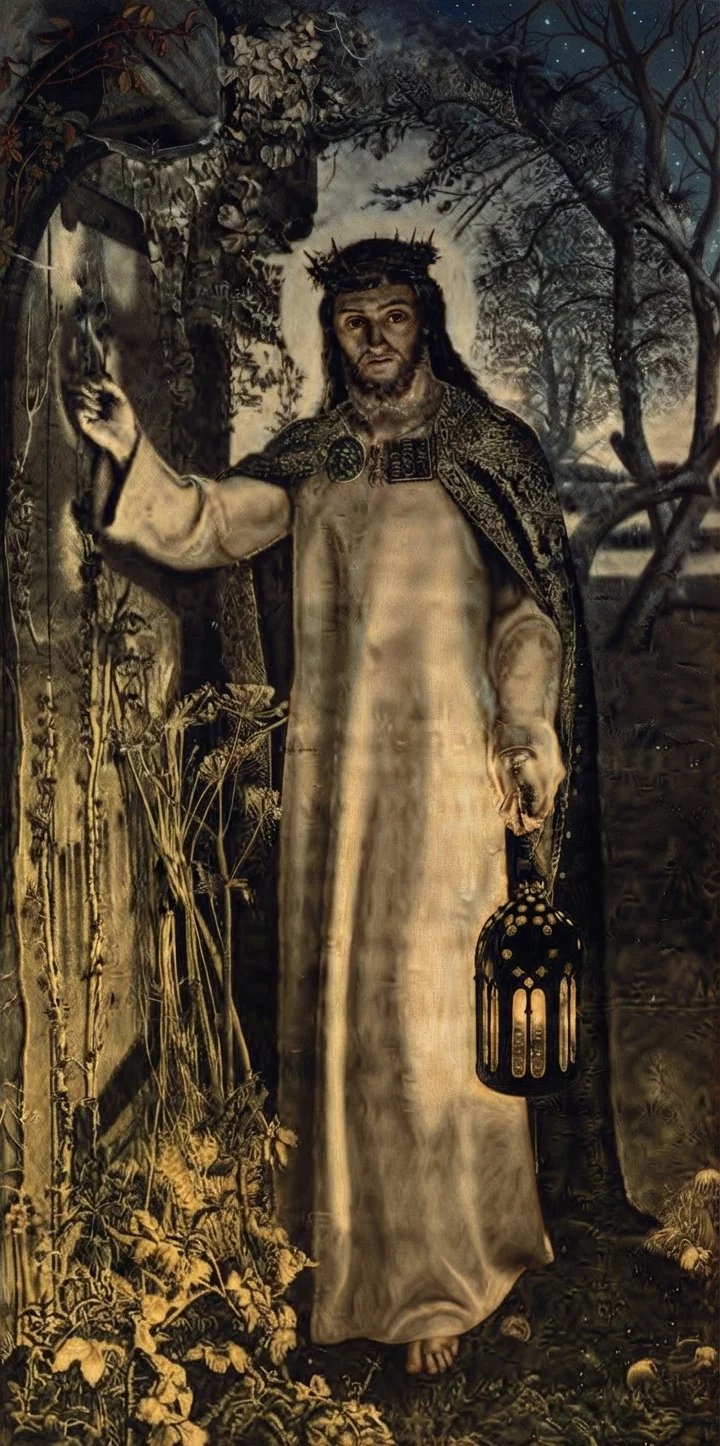
Holman Hunt. Jesus the Light of the World. He knocks at the door of every heart, desiring to enter.
But another says, "I am very frank; I say just what I feel, I talk just as I think." Is that the best way to do?—No; God wants us to educate ourselves so that we shall speak right words,—words that will be a blessing to others, that will shed rays of light upon their souls.
Suppose that at times we are destitute of the joy we should like to experience, can we not feel assured that the promises of God are still yea and amen in Christ Jesus? The promises of God do not rest upon feeling. They have a foundation as distinct from feeling as light is from darkness. We must learn to move from principle; and when we learn to do this, we shall move understandingly, and not be controlled by varying emotions.
Christ has said, "If ye abide in Me, and My words abide in you, ye shall ask what ye will, and it shall be done unto you." God desires that we shall have a thoro understanding of the truth as it is in Jesus. We should dig in the mine of truth for the rich treasures of knowledge that are hidden in God's word. If we employ our talents in searching the Scriptures, and in imparting knowledge to others, we shall become channels of light. You should not allow the channel between God and your soul to become obstructed. You should not be moved by circumstances. You should refuse to listen to the suggestions of Satan, that he may not paralyze your efforts to do good.
What we need is Bible religion; for if Christ is abiding in us, and we in Him, we shall be continually advancing in the divine life. If we are connected with the source of all wisdom and power, we shall not fail of becoming strong men and women in Christ Jesus. If we fully receive the truth of heavenly origin, we shall not fail of becoming sanctified through it; and when trials come, we shall not go to complaining, as did the children of Israel, and forget the source of our strength. We must gather up the divine rays of glory, not to hide our light by putting it under a bushel or under a bed, but to set it on a candlestick, where it will give light to others. We must put our talents out to the exchangers, that we may accumulate more talent to bring to Jesus.
In this way, we shall be growing Christians, and every word we speak will be ennobling and sanctifying. We should educate ourselves to speak in such a way that we shall not have cause to be ashamed of our words when we meet them in the judgment. We should seek to have our actions of such a character that we will not shrink from having our Saviour look upon them.
We must fight the good fight of faith. Satan will try to sever the connection which faith makes between our souls and God. He will seek to discourage us by telling us that we are unworthy of the grace of God, and need not expect to receive this or that favor, because we are sinners. These suggestions should not cut off our confidence; for it is written, "Jesus Christ came into the world to save sinners; of whom I am chief." There is no reason why we should not claim the promises of the Lord. There is no reason why we should not be light-bearers. There is no reason why you should not advance, why you should not become more and more intelligent in prayer and testimony, and make manifest that God hears and answers your petitions.
We should have more wisdom and confidence to-day than we had yesterday. Why are we so well satisfied with our feeble attainments? Why do we settle down content with our present deficient experience? We should not always be fed upon the milk of the Word; we must seek for meat, that we may become strong men and women in Christ. God will give you everything that you are prepared for, everything that will minister to your strength. He will make peace with you if you lay hold of His strength. But He will not let His power drop upon you without effort on your part. You must coöperate with God in the work of salvation. We need to grow in the knowledge of our Lord and Saviour Jesus Christ.
Christ says: "Verily, verily, I say unto you, He that believeth on Me, the works that I do shall he do also; and greater works than these shall he do; because I go unto My Father. And whatsoever ye shall ask in My name, that will I do, that the Father may be glorified in the Son. If ye shall ask anything in My name, I will do it. If ye love Me, keep My commandments. And I will pray the Father, and He shall give you another Comforter, that He may abide with you forever."

The "I Come" Which Has Been

By L. F. Starr
"Then said He, Lo, I come to do Thy will, O God." Heb. 10:9. "Then said I, Lo, I come: in the volume of the book it is written of Me, I delight to do Thy will, O My God." Ps. 40:7, 8.
WE are invited to an important sursum corda ("lift up your hearts") in Scripture. Let us look up from beside the sacred cradle, to the heavens of heavens, and ponder well the antecedent to Bethlehem, the self-consecration of the eternal Son to His incarnate life and work.
The Scripture, with both its hands, the prophetic and the apostolic, lifts for us here the veil, and discloses for us the mind that was in Christ Jesus, when, in eternity, He the Son, the beloved and only-begotten of the Father, before the foundation of the world, willed to come down and become flesh. It utters to us the true thought with which He, being God, elected to be also man.
It lets us hear His resolve to come, and to do the Father's will by keeping His commandments, setting us an example that we should by faith follow His steps and be saved.
As we listen to His voice speaking through inspiration, He speaks to us of surrender and service. Let us, with the Scripture in our memory, recall in shortest summary some of the truths told us through this utterance, "Lo, I come to do Thy will." Why does He come, as to the urgent element of His purpose? What is the aim set in the foreground of the eternal thought, indicated in the Psalms and developed in the epistles?
Is it immediately to redeem the race by incarnation? Is it to be "sacrifice and offering"?
Is it to do the last work foreshadowed in type and ceremonies?
Is it that He, the Incarnate Being, might put away sin by the sacrifice of Himself? Such was the first, ruling purpose of the self-consecration of the Son. The Self-consecrator had in view, above all things, His death, His sacrifice, His expiation, His propitiation. He came to "reveal God to the world as a God of love, full of mercy, tenderness, and compassion."
"The thick darkness with which Satan had endeavored to enshroud the throne of Deity was swept away by the world's Redeemer, and the Father was again manifest to men as the light of life." When Philip made the request, "Show us the Father, and it sufficeth us," the Saviour answered him: "Have I been so long time with you, and yet hast thou not known Me, Philip? he that hath seen Me hath seen the Father; and how sayest thou then, Show us the Father?" Christ declares Himself to be the Representative, the Revealer, of the Father. Possessing the qualities of nobility in character, and tender pity, in His love and goodness He stood before men as the divine perfection of God, "being the brightness of His [the Father's] glory, and the express image of His person." In the Psalms and Hebrews the Philippians, all, in this manner, gravitate upon the crucifixion.
"A body hast Thou prepared Me." He took share, with His brethren, in flesh and blood, that by means of death He might destroy him that has power over death, that is, the devil. Heb. 2:14. Being the brightness of His Father's glory, by Himself He purged our sins. He "became obedient unto death, even the death of the cross."
The Scriptures are eloquent of the pain and yet joy of the untold humiliation of our Lord. They tell us of His willingness to be made like us, with a likeness that would be no mere trope or figure, but a reality to its depths.
They reveal His divinely felt consent in the full light of God's eternal love, who "so loved the world, that He gave His only-begotten Son" to die in our stead. He willed as God, that He might will as man, to experience by growth and development what it is to weep, and to feel the pains and sorrows of humanity, and to say, "Thy will be done," not only in heaven, as the Son eternal, but as the Son of Man, under the olives of Gethsemane.
He willed to cry, when the last darkness gathered round the cross, to Him whose will He was wholly content to do, "My God, My God, why hast Thou forsaken Me?"
The perfect example of His filial love shines forth with undimmed luster upon His followers to-day.
The splendor of God, once poured upon the field of the shepherds, shines forever upon His redeemed.
The great warrior angels, the choiring heavenly army who waited the signal to declare the news of His birth to the world, were near the cross at His death, watching with amazement His despairing agony, and triumphed at His victory over death.
Well for us that He planted His banner upon the eternal heights! Was not there joy among the heavenly angels? Thank God, the roots of our Christian joy are watered with the sorrows and sacrifices of our Redeemer. They cost Him dear. They involved His infinite humiliation.
Let us bless Him with the love of penitents; let us follow Him with the love of witnessing disciples.
"Lo, I come," said the Saviour, in view of His cradle, His cross and death of shame. He saw them from the heavenly heights. "Lo, I come to do Thy will."
And we are His, by purchase; and through Him and faith in His name, we do and will ever triumph in His name.
Let us, the members of His family, draw from Him the power to say, I delight "to do the will of Him that sent me, and to finish His work."

The Unanswerable Argument on Immortality

By Alexander Ritchie

I. An Argument from the Bible

WHEN Moses was comparing the heathen with Israel, he said, "For their rock is not as our Rock." When Christ was portraying the difference between the wise man and the foolish man, He declared the wise man built on the rock, but the foolish man built upon the sand. In both these scriptures, the great difference between the two classes is shown in the radically different foundation upon which they build.
John says, "We know that we are of God, and the whole world lieth in wickedness." And the same inspired writer declares yet again, in the book of Revelation, that the "old serpent, called the devil, and Satan, . . . deceiveth the whole world."
Yet that same "old serpent" is "the god of this world." A god of any kind expects worship, and usually receives it from those who are of like character. "The whole world lieth in wickedness;" and yet the whole world is religious. All believe in something above themselves. All worship that which they believe in. And the form of their belief is a fairly good measure of the character of their god.
The word of God is truth; and that Word speaks truth when it declares, "The whole world lieth in wickedness." And as everybody knows that the whole world worships, it is only in harmony with the premise to find the same Word calling "the god of this world" "that wicked one." So we have a wicked world worshiping a wicked god. Christ said: "He is a liar, and the father of it." "He was a murderer from the beginning, and abode not in the truth." He deceives his worshipers, for he "deceiveth the whole world." He blinds his worshipers, for he "hath blinded the minds of them which believe not."
The first lie he ever uttered in this world was, "Ye shall not surely die." That lie first blinded Mother Eve, and then murdered both her and Adam. It cut them off from God; it cut them off from the tree of life; and it drove them from Eden, to die physically, and become food for worms. This first lie was so horribly successful in performing the work it was designed to do, that it at once became Satan's favorite lie; and probably ninety-nine per cent of all the inhabitants of this world from that day to this, have believed it with a reverential devotion.
O, weird fascination! O, stony blindness! O, mystery inscrutable! that a falsehood which could destroy perfection, separate from God, despoil peace, and murder the fairest handiwork of God, should nevertheless be received and welcomed, and defended as heavenly truth, to this very day! In vain does the God of truth declare: God "only hath immortality." "The dead know not anything." "His sons come to honor, and he [the dead man] knoweth it not." "The soul that sinneth, it shall die." "Death can not celebrate Thee." "The wages of sin is death." "Fear Him which is able to destroy both soul and body in hell." "Seek for glory and honor and immortality." "He that believeth not the Son shall not see life."
The great deceiver has such subtle power over his worshipers, that by various artful devices, he teaches them how to evade the sword of truth, and explains away the glorious truths which to the unsophisticated mind would be unmistakable in meaning.
To the dreadful results of the first utterance of that lie, "Ye shall not surely die," time has added other inevitable results. The immediate results of its acceptance, to Adam and Eve, are now lost sight of largely, in the dim vistas of time. But the awful results of the acceptance of that hoary lie, by the teeming millions who people the world to-day, are painfully present and real. For look squarely at this fact, dear reader: That doctrine of inherent immortality is the rock upon which every heathen religion in the world to-day is built. And that being undeniable, how can "their rock" be the same as "our Rock"?
Their rock is "natural immortality." Our Rock is "Christ the Lifegiver."
They are building upon the sands of fable, imagination, sentiment, and "the precepts of men," resting at bottom upon Satan's lie. Their foundation is "the deathlessness of the human spirit."
Our foundation is Him who "brought life and immortality to light through the gospel."
Their hope is in death. Our hope is in the resurrection. Therefore "their rock is not as our Rock, even our enemies themselves being judges."
This being so, the doctrine of inherent immortality, which is the foundation rock upon which every heathen religion in the world is built, can not possibly be the foundation of the religion of Jesus Christ. Instead of that, in very deed, it is His most insolent enemy. How? It pours contempt upon His death. It makes His resurrection a needless thing. It makes His second coming but an empty show. It robs Him of His glory as the Lifegiver. And it involves His reputation in this world, and His character in the heavenly world, in dishonor, because it pictures Him as the author of punishment, which, upon immortal sinners, could only mean immortal suffering.
Away with such a doctrine! Fie, upon its fiendish author! It has no place in the Christian religion; and how can any people who profess to be Bible Christians, believe, defend, and propagate such a teaching? The immortality of man is the channel through which "the god of this world" draws to himself the worship and devotion which belong to God only. And demons impersonate the dead, to confirm the lie uttered by their father in Eden. For "the things which the Gentiles sacrifice, they sacrifice to demons, and not to God."

The Two Covenants and the Sabbath

By Orno Follett

THE laws of nations are an expression of the character of the people who framed those laws. Good men will make good laws, and evil men will make evil laws.
A nation without laws of some kind would become a stronghold for anarchists and confusion. Might would make right. The strong would domineer over the weaker ones, regardless of right, justice, and mercy.
That is why Blackstone, the noted English statesman, said that a poor law is better than no law at all.
God's law is a good law. Rom. 7:12. It is perfect. Ps. 19:7. It is eternal. Ps. 111:8. God is likewise good, perfect, and eternal. Therefore the law of God is the expression of His divine character.
The transgression of God's law is sin. 1 John 3:4. "By the law is the knowledge of sin" (Rom. 3:20; 7:7); and "where no law is, there is no transgression" (Rom. 4:15). This same law will be the standard in the judgment. Eccl. 12:13, 14. The wages of sin—transgression of God's law—is death. Rom. 6:23.
Abraham, through human weakness, and a temporary lack of faith, attempted to do for himself, in his own way, what God had promised to do for him. Read the fifteenth, sixteenth, and twenty-second chapters of Genesis. In Gal. 4:22-31, Paul compares this experience of Abraham with the old and the new covenant.
The old covenant (agreement), as made between God and His people as a nation, is recorded in Ex. 19:3-9. This covenant was made concerning the Ten Commandments. Ex. 24:8. The people, not God, broke this covenant, or their part of it, over and over again; first when they made a golden calf (Exodus 32), and later by disobeying the requirements of the Ten Commandments. Heb. 8:9; Deut. 5:29.
Rom. 7:1-4 is used by some to prove that God's holy law is done away. Read on to the twelfth verse. Notice that it is not the law that is dead; it is the old man, the man of sin. Now that sin has died out of our members, we are married to another, even Christ. Rom. 7:4. The same law still lives, and binds us to Him. Rom. 7:6, 7, 12; 3:31. Kind reader, will you be true to Him?
In Heb. 9:16, 17, we read: "For where a testament is, there must also of necessity be the death of the testator. For a testament is of force after men are dead; otherwise it is of no strength at all while the testator liveth."
"Tho it be but a man's covenant, yet if it be confirmed, no man disannulleth, or addeth thereto." Gal. 3:15.
Now, if you will read Luke 23:46-56 and 24:1-21, and notice especially the twenty-first verse, you will learn that the first day of the week can not be the Sabbath of the new covenant, because it came in three days too late, since the new covenant was sealed by the blood of Christ three days before the Sunday sabbath is even claimed to have been observed by Christians. As our Saviour hung upon the cross late Friday afternoon, He said, "It is finished," then sealed the new covenant with His blood. Since then, no man can disannul or add thereto.
The new covenant is God's promise to write His law—not a new law, but His PERFECT AND ETERNAL LAW—within the minds and hearts of His people. Heb. 8:8-10. Therefore we can say with Paul: "Do we then make void the law through faith? God forbid; yea, we establish the law." Rom. 3:31.

The Ferry-Boat Across the Flood

By Delwin Rees Buckner
The deluged deep is brackish with the tears Of the deluded, drowning sons of Eve Who six score years delighted to believe Shrewd, egoistic, self-conceited seers, Who urged their pupils to expel all fears, For Noah's aim could be but to deceive, So it was nonsense to feel sad and grieve; The earth was young, and could not die for years. But while in the annihilating tide The sceptic giants drop their vital blood, And e'en the archfiend in dumb terror cowers, With God's own master, pilot hand to guide, The ark conveys its freight across the flood, A ferry-boat from Noah's world to ours. Solis, Argentina.

V. The Sabbath — Closing Hours

By Violet Miriam Beck
The Sabbath is almost done, With the golden rays of the setting sun Streaming through windows opened wide, By the organ's side Let us gather in loving throng, And sing from our "Christ in Song." Let us sing about God's love, The story we never are weary of. "I love to tell the story Of unseen things above, Of Jesus and His glory, Of Jesus and His love."
Perhaps, in the city heavenly, Our Jesus we shall see. In the holy place, We shall see His beautiful face, On a sacred day That will never pass away.
As twilight comes down over the fields, Once more let us kneel and pray, With a love that yields Thanks unto God for the rest and peace of the day, Dear loved ones, with a simple trust and sweet, Kneeling at Jesus' feet!
Steadfast and calm the lives in God's control. Through the storm's distress, They may anchor deep the soul In the One who has power to bless.
When away where the world does not understand, I know that loved ones pray That my soul may stay In the hollow of God's hand.
God bless the dear ones who keep Sabbath day!
Continue reading: The Everlasting Covenant