Pacific Press Publishing Association · Mountain View, California · Sep 6, 1910
"IF YE WILL INQUIRE, INQUIRE YE."
By Editor
This Inquirers' Department is conducted for the purpose of helping those who are studying the Bible. The answers are oftentimes only suggestive. They are never to be considered infallible, only as they agree with the infallible Word. The writer who may answer them does not consider that his opinion is infallible. He will simply give the best that he has, and plead with the inquirer to search the Word. Such questions only will be answered as, to the editors, seem to minister to the good of the readers and to the mission of the paper. We can not answer repeatedly in the same volume questions upon the same scripture. The name and address must accompany question, not for publication, but as an evidence of good faith, and that answer may be made by letter if deemed advisable. No letters are answered which do not contain the name of the writer. It is well always to enclose stamp for reply.
3233.— Sprinkle Clean Water
Please explain Eze. 36:25-27. The passage reads as follows:
"Then will I sprinkle clean water upon you, and ye shall be clean: from all your filthiness, and from all your idols, will I cleanse you. A new heart also will I give you, and a new spirit will I put within you: and I will take away the stony heart out of your flesh, and I will give you an heart of flesh. And I will put My Spirit within you, and cause you to walk in My statutes, and ye shall keep My judgments, and do them."
Does the sprinkling show a form of baptizing used in those days? A friend of mine pointed to that as a reason for sprinkling now. B. B. 1601.
The passage has no reference whatever to baptism, rather it refers to the ceremony of cleansing described in Lev. 14:50-52, and elsewhere in the laws of Moses. The sprinkling of water in that ceremony meant authoritative cleansing. Judicially the man stood clean before God, and to this the Lord declares through the prophet, "I will sprinkle clean water upon you, and ye shall be clean." See also Ps. 51:7, first clause. It means that God will absolutely take away their sin, so that the law shall not hold them guilty. He promises to do more than that; He will give them a new heart and a new spirit, and the new spirit shall cause them to walk in God's statutes and keep His commandments in the love which it bears toward them.
3234.—Ministration of the Spirit and of Righteousness
By Editor
Please explain what the ministration of the spirit and the ministration of righteousness are as compared to that of death and condemnation. What is it that "remaineth," mentioned in verse 11? 2 Cor. 3:7-11.
For a full explanation of this scripture see Bible Students' Library No. 149, "What Is Done Away in Christ?" price 2 cents. As a brief explanation we would say, first, The letter kills, but the spirit gives life. The accepting of the letter of the law is simply taking it as it may come to us, a written code. The law then is without. We accept it simply as a theory, and it always condemns and never justifies. The spirit of the law is the very life and power of that law; and the receiving of the spirit is having that law written within our very being until it is a vital part of ourselves, and that always gives life, for the law in Christ Jesus is life.
To go back to the illustration which the apostle gives of Israel and Moses, it is sufficient to remark that Israel accepted that law in the letter, and it brought to them condemnation; it condemned them to death on account of sin. That they did not love the law, is evident from the fact that they said, "Let not God speak to us any more." Read the account in Exodus 20. Not so with Moses. Moses not only saw himself condemned by that law, but he let the Spirit of God take away the condemnation, and write the great principles of that law in his heart. The law in that case was to him spirit and life. It became a part of his very being. The glory upon his face was the outshining of the glory within.
To the sinner the law comes in condemnation and death. It condemns the transgressor to death. To him who has faith in the Lord Jesus Christ the law comes in Christ as spirit and as life, and therefore shines away the condemnation and the death. That which was done away in Moses was the condemnation; that which is done away in the Christian who steadfastly seeks God, even the condemned, is the condemnation and the death. And there come in its place the glorious righteousness and life and peace of God through Jesus Christ which remain. God would have sin ever done away from His people. He would not have them condemned by His law. He would have His Spirit write that law in their hearts (Heb. 8:10), so that they shall love His commandments and do them.
Concerning Joel 2:18-32, doubtless a good part of it would have been fulfilled back in the very time in which the prophet spoke it, in the times of the backsliding of Judah and Israel, 800 years before Christ. It is typical of God's children in the last days, and it seems to us that its ultimate fulfilment will not take place until the old earth passes into the new. While great spiritual blessings will be poured out upon God's children before Christ comes, when they will seek Him with all their heart as Joel intimates, the great fruitful earth will not be seen till the Lord Himself shall become its King, and sin is forever passed away.
The plagues there brought to view, or the great northern army which the Lord sends, seem to us to be the great hordes of insects, crop-destroying and life-destroying, which will come upon the world in the last days. The ravages committed by insects is even now appalling. The loss climbs away up into the millions of dollars every year. These will increase as the years go by. God will deliver His people, but the great fruitfulness of the future will be only when the new earth is ushered in as recorded in verses 25 and 26.
The "afterward" of verse 28 should be interpreted by Acts 2:17, "It shall come to pass in the last days." In the Hebrew Bible verse 28 begins an entirely new chapter.
3335.— What Promise Did Abraham Receive?
By Editor
Will you please give me some light on the harmony of two texts that puzzle me somewhat? Heb. 11:39 and 6:15. What promise did Abraham receive contrary to the text in chapter 11, while Abraham is one of those who have not received the promise, as it seems to me to read? See also chapter 6:12, saying the promises are still future. M. D. M. K.
Perhaps our querist has placed too strong a meaning upon the word "obtained." It does not mean the fulfilment of the promise, but the bestowment of God's promise itself. God did not make the promise to one who was unworthy, but Abraham through his faithfulness obtained that promise; that is, the promise that through him and his seed should all the nations of the earth be blessed. Heb. 11:39 refers to the receiving of the things promised. All those great examples of faith that endured to the very end, did not receive the thing promised. They were heirs of the promises, but the inheritance had not come; and so also it was with Abraham, the father of those that believed. And that is all that is stated in Heb. 6:12, 15. The promise was made to him, it belonged to him, and he obtained it; but the inheritance of the things promised he will not receive until the resurrection.
3236.—Christ's Brothers
How could the brothers of Christ be older than Himself when His mother was a virgin? L. S.
They were without doubt the children of Joseph by a former wife. That they seemed to have been older than Jesus is indicated first, by the knowledge which even the critics had of His brothers; and secondly, by the fact that they assumed to advise and direct Jesus. Take for instance in Mark 6:3. They say, "Is not this the carpenter, the Son of Mary, the brother of James, and Joses, and of Juda, and Simon? and are not His sisters here with us?" They seemed to have been longer acquainted with them than they were with Him. They say in effect, "He is the same as His older brothers and sisters are." And then in John 7:3 His brothers urged Him to go to Jerusalem. The very way in which they do it, would indicate that they were older and held His work in some contempt. Considering themselves older, they seemed to have the prerogative of advising Him. Altho Joseph was not the real father of Jesus, in law he was, and in law these children of His father would be counted His brothers.
3238.— Allowing a Thief
By Editor
Are we, in the light of Luke 6:30, to allow a thief a free opportunity to steal?
No. That is not the thought of the text. The thought of the text seems to be that when one is persecuted by the law or by those in authority and his goods taken away, let them have them. It does not mean that one should not use prudence in his work; but there come times when violent men will persecute, will smite, will rob, because of one's religion, and in that case results should be left with God.
3239.—Married Disciples
How many of the disciples were married?
The Gospels record the marriage of but one, and that is Peter. We read in Mark 1:30 that Simon's wife's mother lay sick of a fever. Simon, then, was married. There is an expression used by the apostle Paul in 1 Cor. 9:5, "Have we not power to lead about a sister, a wife, as well as other apostles, and as the brethren of the Lord, and Cephas?" It would seem from that that some of the other apostles had wives, but we are not told as to who they were.
Readings in Isaiah
OUR readings continue in Isaiah to the close of the book in which prophecy after prophecy is given of God's people and the reforms which the Lord desires to work among them, especially in the last days of probationary work upon the earth. These chapters are all Messianic in their nature. They refer to Christ and the Christian dispensation. They point out the backslidings, the great apostasy, they show the Sabbath reform to take place in the last days, and the awful condition of the religious world just prior to that. The book closes with the prophecy of the new earth and the destruction of sin and sinners.
New Testament Readings Begin with Matthew
THESE prophecies of Christ's work are a fitting introduction to the New Testament, to the One of whom the prophet spoke so abundantly; consequently our first readings in the New Testament begin with Matthew, the earliest of the evangelical prophets, covering the introduction, the birth of our Lord, His genealogy, and the Sermon on the Mount. This last really is not at the first of Christ's ministry as we are sometimes told. It was not spoken until the second year of His ministry. The first year of His ministry was largely spent in Judea. It would be impossible for us to read Christ's life in chronological view without combining all the various Gospels in one.
THE ancient sanctuary service, which was the Gospel in type, completed a specific round every year. Morning and evening sacrifice, offered at a stated hour, was continual. Whatever happened, this service was never omitted. It was the atonement for sin committed by the whole congregation, tho that sin never came to their knowledge. No individual among the tribes of Israel was responsible for this offering, nor did any individual, save the priest, lay his hand upon the offering in confession of sin. Other offerings, as we noticed in a previous article, were of an individual nature and were brought to the priest by the person involved.
At the end of the sacred year, on the tenth day of the seventh month, was the Day of Atonement, the most important, most sacred, and most vital of all the days of the year, for on this day every man's destiny was determined. On this day every Israelite having reached the age of accountability, must make a final decision whether he would rid himself from sin, have atonement made for every transgression, and begin the new year with a clean record, or whether his name should be everlastingly cut off from the book of God's remembrance as one of His people. And to the present day, the Jew, tho he has wandered far from God's ancient teachings, unless he be entirely reprobate, will close his place of business before the setting of the sun on the evening of the ninth day of the seventh month, and will fast and pray and make confession until the sunset of the tenth, thus showing that there still remains in the mind of the Hebrew the solemn import of God's ancient teaching in regard to the Day of Atonement.
The Daily Service
In chapters twenty-eight and twenty-nine of the book of Numbers, the morning and evening sacrifice, lately referred to, is called "a continual burnt offering." "It is a continual burnt offering, which was ordained in Mount Sinai for a sweet savor, a sacrifice made by fire unto the Lord." Num. 28:6. And tho numerous other offerings are mentioned in these two chapters, yet at the conclusion of any given offering, the Lord specifically declares that such and such an offering is to be made "besides the continual burnt offering and his drink-offering." Thus at least sixteen times in these two chapters the Lord makes clear the fact that this offering for all the tribes of Israel is, or was, continual.4Not only were these offerings continual, but from Num. 4:7 we find that the showbread, or bread of the presence, is called "the continual bread." Likewise, the same expression is used in 2 Chron. 2:4. In Lev. 24:4, speaking of the golden candlestick and Aaron's command pertaining thereto, God says, "He shall order the lamps upon the pure candlestick before the Lord continually."
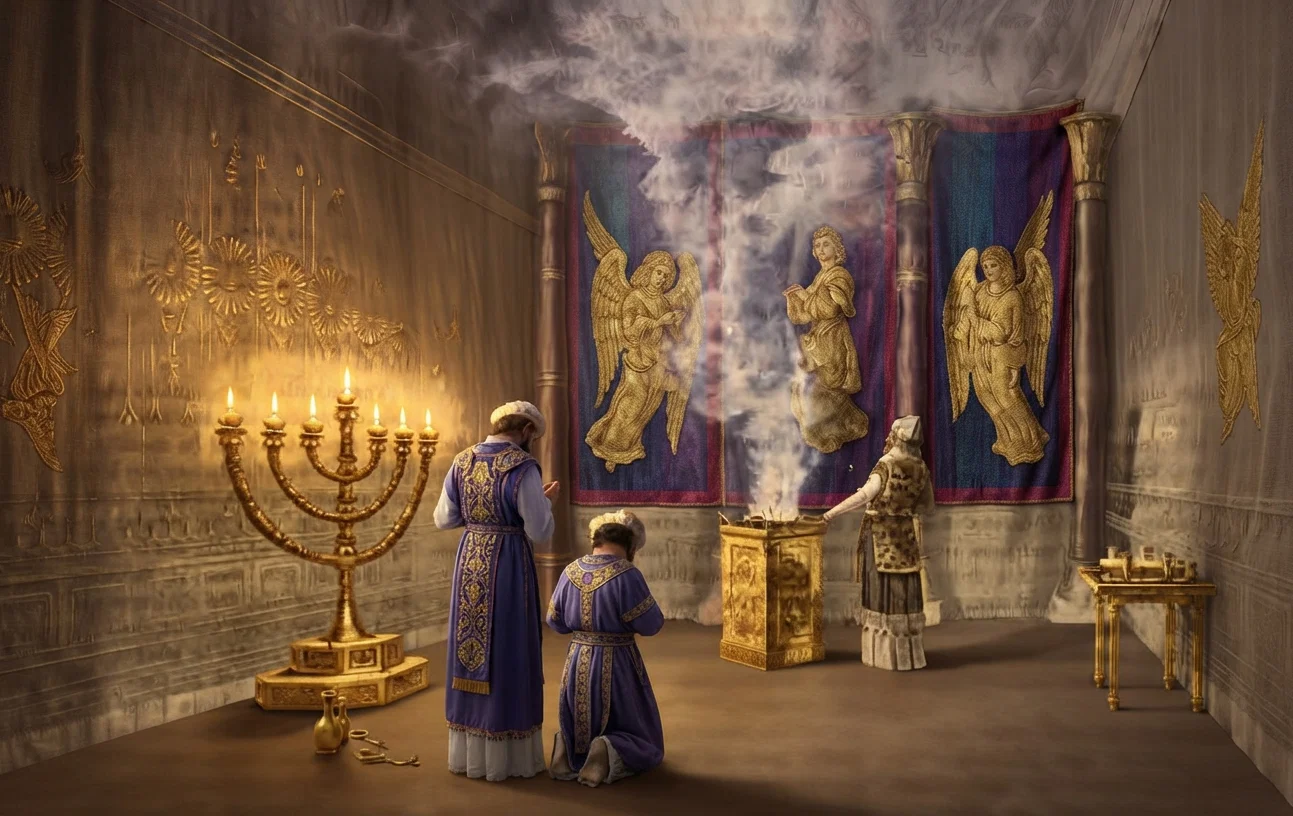
THE HOLY PLACE OF THE EARTHLY TABERNACLE
The incense is called, in Ex. 30:8, perpetual incense. "He shall burn incense upon it, a perpetual incense before the Lord throughout your generations." Thus we have continual burnt offerings, continual showbread, the lamps burning continually, and the incense perpetually rising with the prayers of Israel before the throne of God.
Now as a type of our great High Priest, Jesus Christ, who has ascended into the heavens, there to appear in the presence of God for us, sat Aaron the high priest, and upon Aaron's breast were borne the breastplate composed of twelve stones representing the twelve tribes of Israel. "And thou shalt put in the breastplate of judgment the Urim and the Thummim; and they shall be upon Aaron's heart, when he goeth in before the Lord: and Aaron shall bear the judgment of the children of Israel upon his heart before the Lord continually." Ex. 28:30. Thus Aaron in the type, and Christ in the antitype, bear the sins of all God's people upon the heart before the Lord continually. Says Jesus through His prophet Isaiah: "Can a woman forget her sucking child, that she should not have compassion on the son of her womb? yea, they may forget, yet will I not forget thee. Behold, I have graven thee upon the palms of My hands; thy walls are continually before Me."
An Abiding Saviour
Without this continual provision made for sin, without the abiding presence of Christ day and night continually before the throne of God, some poor sinner might, in a special time of need, find his Advocate off duty. Were Christ as feeble as man, or did He need the recuperation of sleep by night, and a summer vacation by the seaside, as many of His under-shepherds feel they do; did He have office hours, or times when He could be seen or not seen,— then might earth's sorrowful inhabitants be anxious concerning the possibility of their being heard before the courts above. But, thank Heaven, it is not so with Christ. "But this Man, because He continueth ever, hath an unchangeable priesthood. Wherefore He is able also to save them to the uttermost that come unto God by Him, seeing He ever liveth to make intercession for them." "Who needeth not daily, as those high priests, to offer up sacrifice, first for His own sins, and then for the people's: for this He did once, when He offered up Himself." Heb. 7:24, 25, 27.
But the continual service of Christ, our Advocate, in the courts above, and the type in the earthly sanctuary which pointed to that continual service, would be incomplete if our "continual" or "perpetual" service were omitted. God intends that when He makes continual provision for the forgiveness of sin, for the cleansing of iniquity, and for the upholding of sinful man against the power of Satan's temptations, our services should also be continual. The Bible records at least one man whose service was of this kind, and even the heathen among whom he lived recognized this fact. For did not Darius, king of the Medes, say to the prophet Daniel, "Thy God whom thou servest continually, He will deliver thee"? And also, "Is thy God, whom thou servest continually, able to deliver thee from the lions?" Dan. 6:16, 20. And every child remembers that Daniel's God, whom he served continually, was not only able to deliver him from the lions, but did deliver him grandly.
To serve God to-day and desert Him tomorrow, only to call upon His mercy the day following, to desert Him again, shows neither gratitude nor trust. To claim that forgiveness of sin carries with it no power to recover one from the snares of sin, to deliver one from its control, is in a word to make Christ the minister of sin. But He came to save His people from their sins. He caused it to be written, "Sin shall not have dominion over you." Rom. 6:14. And even of the weakest one God has spoken, saying, "Yea, he shall be holden up: for God is able to make him stand." Rom. 14:4.
"Now unto Him that is able to keep you from falling, and to present you faultless before the presence of His glory with exceeding joy, to the only wise God our Saviour, be glory and majesty, dominion and power, both now and ever. Amen." Jude 24, 25.
The Day of Atonement
As already mentioned, the Day of Atonement with ancient Israel was a final balancing of accounts with the most high God. Day after day, through the entire year, through the blood of the sacrifices, the record had been made, in the sanctuary, of sin and its remedy; but the final disposition of sin and its record was not made until the tenth day of the seventh month of the Jews' year. On this day a final atonement was made for the sins, first, of the priests, and then of the people. For Aaron and his sons a bullock was offered; and for the people, a goat.
On this day, and no other, the high priest went into the most holy place, the second apartment of the sanctuary, which contained the ark of God's covenant, and the Ten Commandments, which had been transgressed in every sin committed during the year. Seven times was the blood of the atonement sprinkled upon the mercy-seat covering the ark; and this indicated that complete satisfaction had been made for all the transgressions of every repentant sinner. Coming out of the sanctuary, Aaron bore upon himself, in figure, the sins of all the people; and approaching the scapegoat, he placed both his hands upon his head, and confessed over him all the iniquities of the children of Israel, and all their transgressions in all their sins, putting them upon the head of the goat, and then sent him away, by the hand of a fit man, into the wilderness. And the goat shall "bear upon him all their iniquities unto a land not inhabited: and he shall let go the goat in the wilderness." Concerning this latter work we shall have more to say in a future article.
This Day of Atonement was otherwise known as the day of cleansing the sanctuary. Aaron was to "cleanse it, and hallow it from the uncleanness of the children of Israel;" also, "on that day shall the priest make an atonement for you [said the Lord], to cleanse you, that ye may be clean from all your sins before the Lord." Hence it was, that both the sanctuary and the people were cleansed, the one from the record of sin, and the other from sin itself. This record of the cleansing of the sanctuary and people from sin on the tenth day of the seventh month is found complete in the sixteenth chapter of Leviticus, from which the above quotations are taken. This was final with every member of the congregation of Israel; and that no man might pass that day without making his record clear and having final atonement made for himself, is evident from the following words: "For whatsoever soul it be that shall not be afflicted in that same day, he shall be cut off from among his people." Lev. 23:29.
This service has also its antitype; and therefore the time must come, in the plan of Christ's redemption for sinners, when all the congregation of the Lord throughout the whole earth must finish their transgression and make an end of sins. But as in the type their cleansing and expiation from the guilt of sin was not due to any act of righteousness performed on their part, so with the antitype; when the time shall come for God to close the record of sin for this whole world, it will be only by the atonement of the blood of Christ that sins will be forgiven, the soul temple cleansed, and the sinner sealed for eternity.
[The next article in this series is entitled "Christ's Sacrifice and Priesthood."]
Self Knowledge
By Arthur V. Fox
"KNOW thyself" was one of the sayings of the wise men of Greece. It was ascribed to Solon, the wisest of them all, and cut upon the entrance of Apollo's Delphic temple.
Men are strongly inclined to examine each other—to scan with curious eye the fears and hopes, the motives and purposes, of those with whom they associate. This inclination is manifested in savage as well as in civilized life, by youth and age, weakness and wisdom; and too often it is like the vulture, which in a world of fragrance scents corruption only.
For the discovery of evil in others we have an amazing capability; we can see a mote in another's eye when we can not discover a beam in our own. Often we abhor the task of gazing inward. Nor is this wonderful. When the sinner looks within he sees an awful void. He shrinks instinctively as from the verge of a precipice, and flies to business, pleasure, books—anything that will divert attention from himself. When the Christian looks within, he, too, sees many things to pain his sight. Too often does he go to the temple when he should enter the closet.
The morning is peculiarly appropriate to this duty of examining self, when the soul rises renovated from its nightly rest, before business raises its distracting hum, or temptation uncovers its alluring scenes. Nor is the evening unfit for mental introversion; by its silence and its shade it is suited to awaken solemn thought, to remind us of the close of life, the darkness of the tomb, and the day when Christ shall appear with all His holy angels to awaken His sleeping saints. It will not be darkness then; for as the lightning shines from the east even to the west, so shall His coming be.
At the close of the week how fitting that we should retrospect its labors! Who can but admire the old Bible custom which observes the evening and the morning as the first5day, because it secures us a preparation night, calm, sober, inviting to self-communion!
Good it is to spend the hours that immediately precede the Sabbath in preparation for its holy rest. If we do not, at least let us set apart the Sabbath morn to examine the history of the previous week. The Sabbath is His day. What searching of heart and memory to meet an earthly judge! What surpassing self-exploration to near the God of judgment!
We meet in the temple to enjoy the light of God's Word; if we would have its beams, we must not only close the shutters of business, but open the windows of the soul.
We assemble to proclaim His most worthy praise; but with what heart, if we have not surveyed His mercies? We come together to ask those things that are necessary as well for the soul as the body; but how shall we know for what to ask without previous inquiry of the inner man?
ARTHUR V. FOX.
Los Angeles, California.
Entering the Strait Gate
By Mrs. E. G. White
By Mrs. E. G. White
"Ask, and it shall be given you; seek, and ye shall find; knock, and it shall be opened unto you." Why is it that we do not take God at His word? Asking and receiving are closely linked together. If you ask in faith for the things which God has promised, you will receive. Look to Jesus for the things which you need. Ask Him for forgiveness of sins, and as you ask in faith your heart will be softened, and you will forgive those who have injured you, and your petitions will go up to God fragrant with love. With praying comes watching unto prayer, and every thought and word and act will be in harmony with your earnest petition for reformation in life. The prayer of faith will bring corresponding returns. But a mere form of words, without earnest sincerity and fervent desire for help, with no expectation of receiving, will avail nothing. Let not such petitioner think he shall receive anything of the Lord. Those who come to God must believe that He is, and that He is a rewarder of them that diligently seek Him.
A Teachable Spirit
After asking the Lord for a knowledge of His will, for heavenly wisdom, for the light of the Holy Spirit, the petitioner will search the Scriptures, and find that passages that were dark to his mind have suddenly grown clear, and he understands his duty as never before. Jesus said: "My doctrine is not Mine, but His that sent Me. If any man will do His will, he shall know of the doctrine, whether it be of God, or whether I speak of Myself." The knowledge of divine truth is promised to those who will render obedience to the light and truth that have been given to them. An entrance into the strait gate is not dependent upon the possession of learning or riches, but it is dependent upon the possession of a teachable spirit. He who appreciates the first ray of heavenly light, and appropriates it, and walks in it, bringing his actions into harmony with that ray, and becoming sanctified through it, will receive yet more light. He will understand that the Gospel is the plan of salvation.
Striving to enter in at the strait gate means that we give the subject of the future life our first attention. We are to cut away from every hindrance that would prevent our entering in at the strait gate. Inclination to evil must be denied, habits and practises not in harmony with the Word of God must be overcome. We must examine the Scriptures, determined to know what is truth; and whoever comes to the Bible with a humble, teachable spirit, whether he be rich or poor, honored or despised, he shall know of the doctrine as he renders obedience to the rays of light that fall upon his pathway. He will not be left to be deceived by the delusions of the enemy, to be swayed hither and thither by the doctrines of devils.
What It Means
"Strive to enter in at the strait gate." This means nothing else than to be one with Christ, to make Him the sole object of attraction. He who thus strives to enter in at the strait gate will hear the voice of Jesus saying: "Come unto Me, all ye that labor and are heavy laden, and I will give you rest. Take My yoke upon you, and learn of Me; for I am meek and lowly in heart: and ye shall find rest unto your souls. For My yoke is easy, and My burden is light."
He who would enter in at the strait gate can not expect the aid of the world in his necessities, for it is the world that has proved a snare to his soul, and has brought him into a position of hopelessness from which he needs to be rescued. But as he detaches his affections from the world, and accepts the life of self-denial and self-sacrifice that Jesus lived, giving him an example both by precept and performance, he enters in at the strait gate, to travel the narrow path which leads to the celestial city.
Firmness of Purpose
He who has an obedient heart, that is ready to do the will of God, will not only gladly receive truth, but will earnestly seek for truth as for hidden treasure. He will come to the Scriptures with a humble and teachable spirit, seeking to understand how he may walk in the light, and saying, "Lord, what wouldst Thou have me to do?" He is ready to sacrifice anything and everything, if required, in order that he may be in harmony with the will of God. It is not always an easy matter to render obedience to the will of God. It demands firmness of purpose to enter in at the strait gate and to travel in the narrow path that leads to eternal life, for on every hand are voices inviting the soul into bye and forbidden paths. Those who love wealth and honor and high position, will not enter in at the strait gate unless they part with their idols. There is not room to enter in at the strait gate and carry the things of this world along. He who would enter in at the strait gate must make an entire consecration of his all to God. Jesus says, "If any man will come after Me, let him deny himself, and take up his cross, and follow Me."
Single-Heartedness
He who will follow Jesus through evil as well as good report, knows something of what is truth. He who will walk in the light as it comes, not waiting to have every mystery solved and every chance of doubt removed, will know of the doctrine, and will understand what are the advantages of entering in at the strait gate, and of walking in the narrow way. But he who would carry the world with him, will never enter in at the strait gate. There is no room for one to walk the narrow way and yet carry along evil surmisings, doubts, criticisms, jealousies, and unkindness. Such a one will refuse to enter in at the strait gate, because he can not see the whole path to the Paradise of God. He has many obstacles to present, many difficulties to bring to view, and Satan is ready to supply the soul with excuses for not entering in at the strait gate. Refusing to walk in the first rays of light, he fails to see the light that shineth more and more unto the perfect day. If he would walk while he has the light, the path would be illuminated as he advanced, and all would be made plain.
The Promised Land
By Amos E. Flint
By Amos E. Flint
THERE is a land by faith I've seen,
Where skies no clouded regions know;
Where fields of verdure wave serene,
And Sharon's fragrant roses grow.
No shadows fall to blight the view
Where realms ambrosial ever bloom;
No mourner's tears the eye bedew
Where Zion's hills the air perfume.
Life-giving streams there gently flow
That never dry through endless time,
And on their banks perennial grow
The fairest fruit in Eden clime.
That country has a city bright,
Whose streets are paved with purest gold;
No need of sun to give it light,—
Its light the Lamb by sevenfold.
That land no want has ever known,
Nor pain nor sickness nor distress;
Its dwellers 'neath no burdens groan
That anxiously their joys oppress.
Upon that vernal, blissful shore
Death, the last enemy, is slain;
There those who meet shall part no more,
And those long parted meet again.
O glory-flooded home of love,
Where toilers, freed from care, are blest!
Had I fleet pinion of a dove,
I'd quickly fly to thee and rest.
Granger, Wash.
God’s Permission and God’s Will
By C. H. Pridgeon
THOSE of you who desire the guidance of God, be careful not to take God's permission for God's will.