Pacific Press Publishing Association, Mountain View, California
Page 1
Signs of the Times
Jun 20, 1911
Pacific Press Publishing Association · Mountain View, California · Jun 20, 1911
Pacific Press Publishing Association, Mountain View, California
Pacific Press Publishing Association, Mountain View, California
THE ROSES OF JUNE
By Mrs. L. D. Avery-Stuttle
By Mrs. L. D. Avery-Stuttle
Sweet month of the roses, we hail thee to-day,
Thou beautiful rose-bedecked sister of May!
The skies are aglow, and the world is atune
With the splendor and beauty and music of June.
Sweet month of the roses, so glad and so fair,
Thou breathest the perfume of Eden so rare;
The roses of Sharon, the lilies so sweet,
Are strewn in the path of thy fast flying feet.
Sweet month of the roses, thy flowers must fade,
Like the flush on the cheek of a beautiful maid;
For alas, there is writ on thy banners so gay,
That saddest of legends, “We’re passing away.”
But we dream of the day when this glorified earth
Shall don once again the fair robes of her birth.
In the gardens of God, on that evergreen shore,
The flowers of beauty shall fade nevermore.
"IF YE WILL INQUIRE, INQUIRE YE."
By Editor
This Inquirers' Department is conducted for the purpose of helping those who are studying the Bible. The answers are oftentimes only suggestive. They are never to be considered infallible, only as they agree with the infallible Word. The writer who may answer them does not consider that his opinion is infallible. He will simply give the best that he has, and plead with the inquirer to search the Word. Such questions only will be answered as, to the editors, seem to minister to the good of the readers and to the mission of the paper. We can not answer repeatedly in the same volume questions upon the same scripture. The name and address must accompany question, not for publication, but as an evidence of good faith, and that answer may be made by letter if deemed advisable. No letters are answered which do not contain the name of the writer. It is well always to enclose stamp for reply.
3470 — The Brothers of Jesus Again
By Editor
Several correspondents, each of whom has read but a part of what has been said, are still puzzled over the question of the brothers of Jesus. Was Jesus the older? Or were His brothers older than He?
1. While the original word "adelphas" means brother, one born of the same mother, it is used in the New Testament in a far broader sense, for brothers in the faith or of the same nation. This is its general use, especially in the plural. See Luke 22:32; John 20:17; Acts 2:37; 7:23; 1 Cor. 8:13; 16:12. Members of the same family or household could properly be called brothers. This has led some to believe that the "brothers" of Jesus were His cousins.
2. That Jesus was the first-born of Mary is very clear from the record of His birth in Luke 1.
3. The "brothers" of Jesus seem to have been older than Himself. If younger, brought up with Him as they were, they would naturally believe on Him; but for some time they did not. John 7:5.
4. Assuming to advise Him as to His duty would indicate they were older. John 7:3, 4. They felt that He needed to be controlled. Luke 8:19; Mark 3:31; Matt. 12:47.
5. That so many of the brothers of Jesus were well known, and that in the mention of them in connection with Him He alone is designated as the son of Mary, would also indicate that they were older than He, by another mother. See Matt. 13:55; Mark 6:3. The other scriptures, such as 1 Cor. 9:5 and Gal. 1:19, are not out of harmony with this.
6. Then, too, if Mary had had other sons, would Jesus at His death have commended His mother to John? John 19:26, 27. Joseph must have died long before this, as we find no mention of his living after the early days of Jesus.
Therefore, it seems to us, the easiest solution of the problem is that the brothers of Jesus were sons of Joseph by a former marriage. A far more important question with each of us is, Are we brothers and sisters of Jesus? We may be. See Matt. 12:50.
3471 — Duty to a Husband
By Editor
Does God's Word bind a wife to her husband who has been abusive and cruel ever since marriage? Every now and then she has had to take a whipping for more than half a score of years. She is economical, but he is so afraid she will spend his money that he hires her to do his work; constantly ridicules her religion without a cause. Would she be justified in taking her child and living by herself in peace? A Sister.
On the face of it, yes, leave him. See 1 Cor. 7:10 and the last clause of verse 15. Whether she could save him by remaining, is for her to decide. If God has placed upon her no such burden, we would not. It would be a blessing to such a man to live in a certain part of Scotland, where the women of a neighborhood took into their own hand the punishment of wife-beaters. A goodly company took the wife-beater down to the beach and ducked him again and again, and repeated the operation till he reformed. For many years, the account is, there has been no wife-beating in that neighborhood. If the wife is but a hired woman, she can leave when she will. It might do him good if she would very kindly, very Christianly, very firmly, tell him so, and then do it in the same spirit. A few months of such treatment may help him. Then if she returns, let it be as a wife, with legal papers to show she is a partner in the business.
3472—The Civil Year of the Jews
How many months in the civil year of the Jews? C. M. D.
The ecclesiastical year of the Jews began with the month Nisan, or Abib (Ex. 12:1, 2), equivalent nearly with our April. The civil year of the Jews began in the seventh month of the sacred, or ecclesiastical, year, Tisri corresponding nearly with our October. Then the fruits of the year were gathered in, and the plowing and sowing of the next year began.
It means reverential awe, a sense of God's greatness, holiness, glory, with a fitting sense of our own littleness, unworthiness, sinfulness. Such reverence or fear will prompt us to faithful obedience to all His commandments. Ps. 111:10; Job 28:28.
If the above terms always mean the last days of this earth's history, the meaning must be in the adjective "last" or "latter," and not in the term "days," for that is from the common terms for days throughout the Old and New Testaments. It must therefore be in the adjectives rendered "latter" and "last." The Hebrew word is "acharseth," meaning the last or end of that to which it is applied. See Job 8:7 compared with 42:12; Num. 23:10; 24:14, 20. Moab long ago perished. The general term, as in Isa. 2:2 coupled with Heb. 1:2, seems to refer to the Christian dispensation. See also 1 Peter 1:5, 20. 1 Tim. 4:1 has no such meaning; it simply refers to "later times," "subsequent seasons." But "last days" must include the very last, and therefore the period extends to the close of the Christian dispensation. The event prophesied of, however, as to take place in the "latter days," might occur in the beginning of that period, as in Hosea 3:5, when a great remnant returned in the early days of Christianity. The latter days or last days of Isa. 2:2; 2 Tim. 3:1; 2 Peter 3:3 must include the times, and therefore pertain to that period, immediately preceding Christ's coming. As to Joel 2:31, why not accept the inspired interpretation of Acts 2:17? Joel referred to days subsequent to his time. God would have been glad to give the abundant outpouring on the return from the Babylonian captivity, but His people were not ready. It did not come till Pentecost.
3475 — Easter and Its Authority
By Editor
Please explain the authority or Bible proof for what are called Easter services; and where in the Bible can we find the word "Easter" outside of Acts 12:4, or anything that would lead to such elaborate services? D. A. E.
There is absolutely no Bible authority for Easter services. The origin of the feast of Easter is purely pagan. The term "Easter" or "Eostre" is the name of an Anglo-Saxon goddess of spring. Her worship was nature-worship, neither pure nor elevating. It is to this generation an inheritance of early apostasy. The word is found in no place in the Bible save Acts 12:4, and there it ought to be "Passover," as it is in the Revised Versions, and nearly all others.
It is well to celebrate the resurrection of our Lord; but the truest way, the best service, is the living of the life of Christ — the new resurrection life — every day. Such a celebration would glorify God and convert souls. The substitute largely brings glory to men.
3476 — Is Polygamy a Sin?
By Editor
How could polygamy be truthfully called a sin if it be not a violation of the Decalogue?
The seventh commandment of the Decalogue forbids adultery, but it does not define adultery, the meaning of which, in its broad sense, is unlawful sexual connection, extended by our Lord to cherished thought and motive. Matt. 5:28. By that commandment guarding the purity of marriage we are carried back to the beginning, when God created for man one wife, and one only. It is not, the three or four should be one flesh, but "the two shall become one flesh." Mark 10:7, 8. See also Mal. 2:14, 15. Every moral precept and truth in God's Word is but the expanding of the Decalogue. See Hosea 8:12, A.R.V. All Bible history shows that polygamy is evil.
3477 — Eating of Fat
By Editor
Can Ps. 63:5; Isa. 25:6, and many other similar texts be made to harmonize with the claim that fat is unwholesome and should not be eaten?
The prohibition of fat of beasts offered in sacrifice was clearly defined. See Ex. 29:13; Leviticus 3; and other scriptures. Certain fat of certain parts belonged to God. That must not be eaten. But this did not forbid the regular fat of meat used for food, as shown in various places. However, too much fat is injurious, and flesh meats of all kinds are the poorest of food. Why eat them at all? There is fatness in milk and butter, and in abundance in grains and fruits.
The Passover
By A. K.
3478 — A. K. The Passover — The Passover supper that Jesus ate with His disciples was, it seems to us, anticipatory, by a few hours, of the regular Passover, but on the same day. The exact time was met by His death upon the cross. The divisions of the day were known by the first hour in the division. The first hour continued till nine o'clock; the third hour, till 12; the sixth hour, till 3 p.m.; the twelfth hour, till 6. Jesus died after the ninth hour was passed, after the darkness ended, "between the two evenings," as indicated by Ex. 12:6, margin.
3479 — Lord of Hosts
What is the meaning of the "Lord of Hosts"? H.
Jehovah of Hosts; the Commander of all the armies and resources of God. See Ps. 24:7-10, where the term is directly applied to our Lord Jesus Christ when He ascends a victor over sin and death. "The Lord of Sabaoth" means the same thing.
They are the prevailers by faith as was Jacob. Gen. 32:28. They are the remnant and only the remnant of the seed of Jacob who are true to God. See Rom. 9:6, 7; Gal. 3:29; 4:28; Rom. 11:2-5; 9:27-29, A. R. V. They are those ingrafted upon the stock of Israel by faith. Rom. 11:15-20.
3481 — A. K. 1 Cor. 7:27-29 — Each soul must, as the text and context indicate, make individual application of the scripture to himself. It is not a crusade text. Let verse 31 have its place, and also chapter 10:31.
The King of Assyria
3482—L. H. Amos 6:14—The prophet refers to the King of Assyria, who completely subdued the ten-tribe kingdom. 2 Kings 17:5, 6.
Mark of the Beast
By Editor
3483 — G. K. The Mark of the Beast — This will be explained soon in the studies on the Revelation.
Schedule for Week Ending July 1, 1911
Lessons from Chronicles
Sunday
June 25
1 Chronicles
1-3
Monday
" 26
"
4-6
Tuesday
" 27
"
7-9
Wednesday
" 28
"
10-12
Thursday
" 29
"
13-16
Friday
" 30
"
17-20
Sabbath
July 1
"
21-23
Not of particular interest will be the first three days' reading of this week. Long lists of names are not inviting, especially if hard to pronounce. But let us fasten upon these two helpful things: (1) God is particular. If He instructed His people to keep record of genealogies, if He moved upon His scribes to record them, we may know that a faithful record of each soul is kept in the books of heaven. The only genealogies that were kept unbroken till our Lord's first advent were those of Judah and Levi; for Jesus was of the tribe of Judah, of the family of David, according to the prophecy, and the Aaronic priesthood must continue till the Jews ceased from being a nation and the priesthood was superseded by that of Christ. (2) There are little gems and solemn facts, and items of interest, gathered throughout the dry genealogies. See 1 Chron. 1:19; 2:3, 7, 35; 3:4, 9; 4:9, 10, 22, 23, 27, 38-43; 5:1, 2, 17-22, 25, 26; 6:15, 31, 32; 7:5, and others. Note the description, in chapter 12, of the contingents from each tribe that gathered to David, "mighty men," "faces as lions," "swift as roes," of great skill and wisdom, of "perfect heart." What an army of loyal men they were!
Chronicles are in one book in the Jewish canon, named, "Words of Days," Records of Events. Kings deals more fully with the northern, or ten-tribe, kingdom, Chronicles with the kingdom of Judah. The first part of Chronicles is parallel to the last part of Samuel. Our lesson closes in the prosperous years of David's reign.
The Gospel in Type and Antitype
By Loretta V. Robinson
II. God's Sanctuaries, or Temples
When Israel was a child, then I loved him, and called My son out of Egypt. Hosea 11:1.
The Lord's portion is His people; Jacob is the lot of His inheritance. He found him in a desert land, and in the waste howling wilderness; He led him about, He instructed him, He kept him as the apple of His eye. Deut. 32:9, 10.
AND to this people God committed His law, and the sacred truths concerning the plan of salvation; not alone for their benefit, but also to give to a world lying dead in trespasses and sins. On their way from Egypt to the land of Canaan, as they were encamped at Mount Sinai, the Lord called Moses up into the Mount, and there gave to him what is called the ceremonial law, and also instruction in reference to building a sanctuary through which He might make known to them by object-lessons the wonderful plan of salvation.
The psalmist says, "Thy way, O God, is in the sanctuary." Ps. 77:13. We can best learn a person's ways by being brought in close contact with him; hence God said to Moses, "Let them make Me a sanctuary; that I may dwell among them." Ex. 25:8. This has always been God's desire, and He never will be satisfied until that voice is heard from heaven saying, "Behold, the tabernacle of God is with men, and He will dwell with them, and they shall be His people, and God Himself shall be with them, and be their God." Rev. 21:3.
Very minute details were given in reference to building the earthly sanctuary. "According to all that I show thee, after the pattern of the tabernacle, and the pattern of all the instruments thereof, even so shall ye make it," were God's words to Moses. Ex. 25:9.
In Heb. 8:1, 2 we find that Christ is seated "on the right hand of the throne of the Majesty in the heavens; a minister of the sanctuary, and of the true tabernacle, which the Lord pitched, and not man." If then the earthly sanctuary was built after the pattern of "the tabernacle," it must have been fashioned after the heavenly sanctuary, as that is spoken of as the true one. Verse 5 makes this plain. Speaking of the service of the earthly priests, it says that they served "unto the example and shadow of heavenly things, as Moses was admonished of God when he was about to make the tabernacle: for, See, saith He, that thou make all things according to the pattern showed to thee in the mount." Then the4pattern showed to him in the mount must have been of "heavenly things;" namely, the heavenly sanctuary.
Again Heb. 9: 24 says, "Christ is not entered into the holy places made with hands, which are the figures of the true; but into heaven itself."
Then the sanctuary on earth was a "pattern," "figure," "example," and "shadow" of the heavenly.
Another Temple
But let us not forget that God has another sanctuary or temple, without which the other two would never have been brought into existence, and for which all their services are performed.
Thus saith the Lord, The heaven is My throne, and the earth is My footstool: where is the house that ye build unto Me? and where is the place of My rest? For all those things hath Mine hand made: . . . but to this man will I look, even to him that is poor and of a contrite spirit, and trembleth at My Word. Isa. 66:1, 2.
Can not God be satisfied with all heaven and the earth? O no. All those things His hand has made; and His loving heart will not be satisfied till we build Him a house, till we find Him a place. "To this man will I look."
"For thus saith the high and lofty One that inhabiteth eternity, . . . I dwell in the high and holy place, with him also that is of a contrite and humble spirit." Isa. 57: 15. Reference is made to this same fact where it is said, "But—Christ as a son over His own house; whose house are we." Heb. 3: 6. Again, "Ye are the temple of the living God; as God hath said, I will dwell in them, and walk in them." 2 Cor. 6: 16.
Both the earthly and heavenly sanctuaries, with all their furniture and services, are not only object-lessons of how we are to build, but to assist us in building a temple that is holy and undefiled, a fit dwelling-place for the Most High.
In the book entitled "Education," page 36, the writer sets forth this thought in the following beautiful language:
Through Christ was to be fulfilled the purpose of which the tabernacle was a symbol,—that glorious building, its walls of glistening gold reflecting in rainbow hues the curtains inwrought with cherubim, the fragrance of ever-burning incense pervading all, the priests robed in spotless white, and in the deep mystery of the inner place, above the mercy-seat, between the figures of the bowed, worshiping angels, the glory of the Holiest. In all, God desired His people to read His purpose for the human soul.
It was the same purpose long afterwards set forth by the apostle Paul speaking by the Holy Spirit: "Know ye not that ye are the temple of God, and that the Spirit of God dwelleth in you? If any man defile the temple of God, him shall God destroy; for the temple of God is holy, which temple ye are." 1 Cor. 3: 16, 17. "In the preparation of the sanctuary and in its furnishing, all the people were to coöperate. . . . And they were to coöperate also in the preparation of the spiritual building—God's temple in the soul."
The Earthly Sanctuary
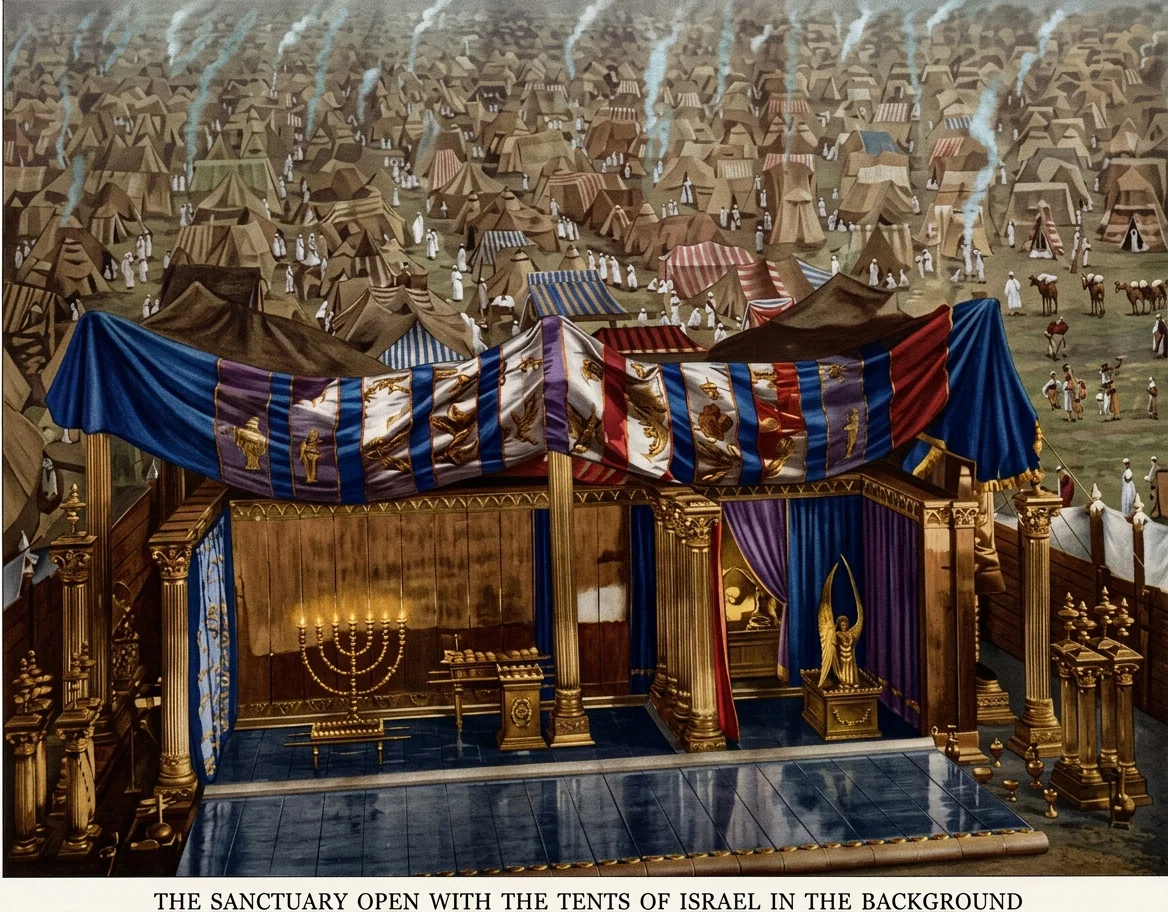
The earthly sanctuary was a small building not more than fifty-five feet in length and eighteen in breadth and height. The walls consisted of upright boards set in silver sockets and held firm by pillars and connecting bars. And all, being overlaid with gold, had the appearance of solid gold.
The building was divided into two apartments by a beautiful curtain or veil, suspended from gold plated pillars; and a similar veil closed the entrance of the first apartment.
The tabernacle was enclosed in an open space called the court, and was surrounded with hangings of fine linen, suspended from pillars of brass. The entrance to the enclosure was at the east end.
In the court, near the entrance, stood the brazen altar of burnt offerings. Between the altar and the door of the tabernacle was the laver, at which the priests were to wash their hands and their feet before going into the sanctuary. As we enter the door, or veil, of the first apartment, we see on the north side the table of showbread, and standing over against it on the south side the seven-branched candlestick with its seven lamps. Just before the veil separating the holy from the most holy, stood the golden altar of incense. Beyond the veil in the most holy place, stood the ark that contained the tables of stone, on which God Himself had inscribed the Ten Commandments. Heb. 9: 2-5.
As has been stated, the earthly sanctuary was a pattern of the heavenly; and as to John in vision was shown the temple of God in heaven, he beheld "seven lamps of fire burning before the throne, which are the seven Spirits of God." Rev. 4: 5. He also saw an angel offering up the prayers of saints at the golden altar of incense. Rev. 8: 3, 4. Hence he must have been permitted a view of the first apartment of the heavenly sanctuary.
Again, "the temple of God was opened in heaven," and there he saw the "ark of His testament," the copy of which was in the most holy place of the sanctuary on earth. Rev. 11: 19.
Thus we must conclude that not only the building but "the pattern of all the instruments thereof" was but a shadow of heavenly things.
As God could not take all His people to heaven to view the place where Jesus ministers for us, and it being essential that our faith should grasp the reality of it, He brought as much of heaven down to us as humanity could bear, in the earthly sanctuary and its services.
Even the furniture was an object-lesson of the spiritual things we must have in our temple, the body, to make it a fit dwelling-place for God.
The Heavenly Light
There was no window in the sanctuary—no natural light ever penetrated there. Its light came from the golden candlestick with its seven lamps of fire, which the Word says represent the seven Spirits of God, or the Spirit of God with its diversity of operations. So with man, all was darkness and sin until "God, who commanded the light to shine out of darkness, shined into our hearts" by His Holy Spirit, until, as the seven lamps lighted up the sanctuary, so we are to become the light of the world.
The candlestick faced the table of showbread, which pointed to Christ, the living bread, who is ever in the presence of God for us. Christ, the food for the spiritual life, is found in the Word of God. John 6: 48, 53, 63.
The table is prepared, the food is there; but without the light of the Spirit we shall never find it.
This bread was removed every Sabbath, and fresh hot bread put in its place. Lev. 24: 8; 1 Sam. 21: 6. So every Sabbath we may expect new supplies of grace fresh from the Father's hand.
As we draw near the veil that separates between the holy and the most holy place, we find the altar of incense, or altar of prayer. No temple for the Lord can be complete without communion with Him. As the stated hour for prayer draws near, how often we hear His voice, as did Adam, calling, "Where art thou?" O, let us not disappoint the yearning heart of our loving Father, who seeks communion with His child, by allowing trivial things to keep us away from this altar, fragrant with the incense of the merits and intercession of Christ, which alone can make our worship acceptable to God.
Christ the Way
The only way into the court was by the gate; the one way into the holy place was by the door; and the way into the holiest of all was by the veil. That gate, door, and veil represented Jesus Christ, the only divinely appointed entrance into the kingdom of God; and yet many people are trying to get to heaven by the door of legal righteousness—by their own personal obedience to the law of God. Man may seek long and earnestly by the way of legal righteousness, but he can never, never find it. But God has provided another way, which He calls a new and living way, into the holiest of all.
This way is consecrated—new-made—for us through the veil, that is to say, His flesh. Heb. 10: 19, 20.
What was it that came in between us and God, and cut us off from communion with Him? The prophet Isaiah says, "The Lord's hand is not shortened, that it can not save; . . . but your iniquities have separated between you and your God, and your sins have hid His face from you." Isa. 59: 1, 2.
So Christ gathered up all our sins into5Himself, He became the veil, the sin that separated us from God. “He was made to be sin,” and bore the fearful separation from His Father until His heart broke; and when He thus died, “the veil of the earthly sanctuary was rent in twain,” not only to show that that sanctuary was no longer sacred, but that there was now nothing between the sinner and God, but Christ, and He is there as the open door, the rent veil, the new-made way to God.
The following quotation from “Christ’s Object Lessons,” page 386, makes plain Christ’s purpose in dying: “Christ came to demolish every wall of partition, to throw open every compartment of the temple, that every soul may have free access to God.” This places poor souls “within reach of the throne of God, the throne encircled by the rainbow of promise.”
The way is now open to the altar of burnt offering, where justification can be had; to the laver, where purity can be obtained; to the holy place, where both light and food are to be enjoyed; and to the throne, where mercy is obtained, and where grace is found. Heb. 4:16.
“Whosoever will, let him come” and take every blessing freely.
[The next article in this series is “The Earthly Priesthood and Its Services.”]
THE SANCTUARY OPEN WITH THE TENTS OF ISRAEL IN THE BACKGROUND
SIGNS OF THE TIMES
"Even as we have been approved of God to be entrusted with the Gospel, so we speak; not as pleasing men, but God, who proveth our hearts."
Blessed Saviour, lead me ever
In the strait and narrow way;
From this moment let me never
From Thy precepts go astray.
Many teachers, many teachings,
Scoffing law, of grace they sing;
But how can my soul be loyal,
Without law, to God my King?
Law is but my Lord's revealing
Character that must abide;
It is carnal, heart and treason
That would set the law aside.
It is grace that gives the sinner
Time of treason to repent;
Men grow hard at God's forbearance
And in sin live on content.
From the warning of the ages
They turn scoffingly away,
Gazing as the tempter rages,
To the end of life's last day.
All the way-marks of the ages
Have on time been found in place;
Still man blindly, madly rages
In his folly and disgrace.
Keep me, Lord, in Thy commandments;
And when comes earth's final strife,
Through them and the faith of Jesus
Give me everlasting life.