THERE are two points on which I find I can freely talk with Moslems; namely, temperance, and the second coming of Christ. I have thanked God for these avenues of approach in speaking of this message of the Lord's soon coming and of the preparation to meet Him.
BOSPHORUS WITH CASTLE OF EUROPE, PILGRIMS ON THE WAY TO MECCA, TOMB OF SULTAN MAHMOUD, CONSTANTINOPLE
Speaking the other day to a company of Moslems visiting the Greek proprietor of a wine shop, they were pleased to hear that the Christian Scriptures were against the use of intoxicating drinks. I appealed to the Greek proprietor for confirmation, and he said, Yes. Then, to cover his confusion, he raised a general laugh by asking a Moslem if he would buy a bottle.
This message of the coming kingdom must go to all before the end comes in this generation. This thought urges us to be up and doing.
GEORGE KEOUGH.
Sohag, Egypt.
Colporter Work in Turkey
By E. Frauchiger
IN these new times in Turkey, we have thanked God that permission has been granted us by the Sublime Porte to sell our literature even among Moslems, tho forbidden to enter Turkish houses. Nevertheless our colporters have been arrested nearly every week, and the officers of the old régime can not understand that the Sublime Porte has allowed the sale of such publications in the Turkish language.
Workers have had the pamphlets thrown back in their faces, and some have been spit upon. Others have been beaten, and were thankful to escape with their life.
Yet the work goes on, and our printers are surprised at the editions ordered. They are astonished to see how much literature we are selling, where they formerly could hardly find people to take tracts as a gift. Some of the Moslem leaders have been taking counsel together as to how to interrupt our work. Our trust is in God, who opens doors that no man can shut.
E. FRAUCHIGER.
Constantinople.
H. DIRKSEN
By H. Dirksen
By the Caspian Sea
LITTLE evangelizing has been done among the Moslems of the Caucasus. An American missionary is now writing the first Christian tract for the Moslem Tartars, who are numerous here.
One apparently honest Mohammedan has been visiting our German-Russian meetings here. He is a member of the police force of the city. His heart has been much softened by the advent truths. Conversing with him, through an interpreter, he told me that he had been reading the Bible for six years, and believed it. I asked him whether he now accepted the forgiveness of sins through the blood of Christ. After thinking a while, he said, "I do not know."
The average Mussulman believes that he comes to God through his good works. We read to this man the text, "No man can come to Me, except the Father which hath sent Me draw him." I tried to tell him that we can come to God only as we yield to the drawing of His Spirit, and that thus salvation is dependent upon the mercy and goodness of God, through the merits of Jesus Christ. He seems quite convicted, and we have hopes of him.
Another Mohammedan exclaimed, "If I should do as you preach, my fellows would shoot me." But God knows each Mussulman heart, and will yet do a great work for many of them.
H. DIRKSEN
Baku.
A Sad, Shameful, and Striking
By Editor
Contrast for All to Consider
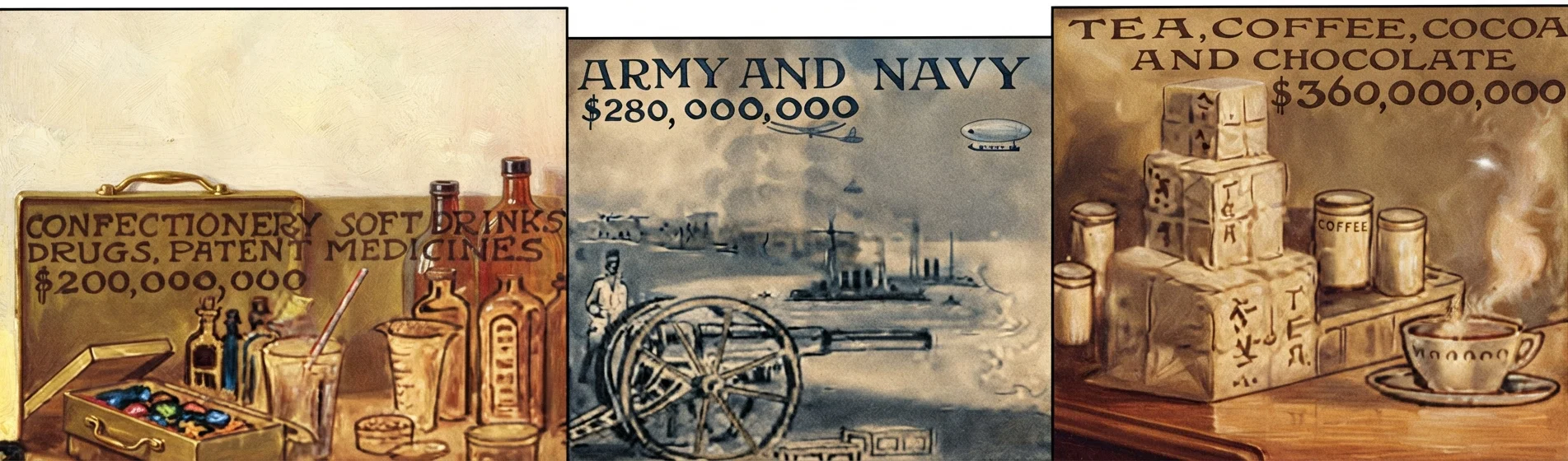
AMERICA, sometimes called "Christian America," spends over two billion, eleven million dollars for intoxicating liquors. America — this nation of the United States — spends over nine hundred twenty-six million dollars a year for tobacco; she spends three hundred sixty million dollars a year for tea and coffee and chocolate; she spends at least two hundred million dollars a year for confectionery, soft drinks, patent medicines, and body- and soul-destroying drugs; she spends for army and navy two hundred eighty million dollars per annum.
Here is an aggregate sum of more than three and three-quarters billion dollars expended for things worse than useless. This does not include what is lost in gambling, horse-racing, prize-fighting, wanton extravagances in a thousand ways, and in unnamable vices. It is not over-stating it to say that more than four billion dollars is thus expended for things not one of which is necessary to life, comfort, or happiness, and nearly all of which, if not all, are positive detriments to health, to mental vigor, to peace of home and community, to temporal prosperity, to life itself. It is not overstating it to say that an average of forty dollars per annum for each man, woman, and child in Christian America is expended in these ways.
America gives yearly, it is said, for foreign missions seven and a half millions, an average per man, woman, and child of seven and a half cents. To make the estimate liberal, there may be ten millions spent every year for foreign missions. That would be ten cents per capita. Think of it! Forty dollars for self-indulgence, for expenditures worse than useless; 10 cents for God!
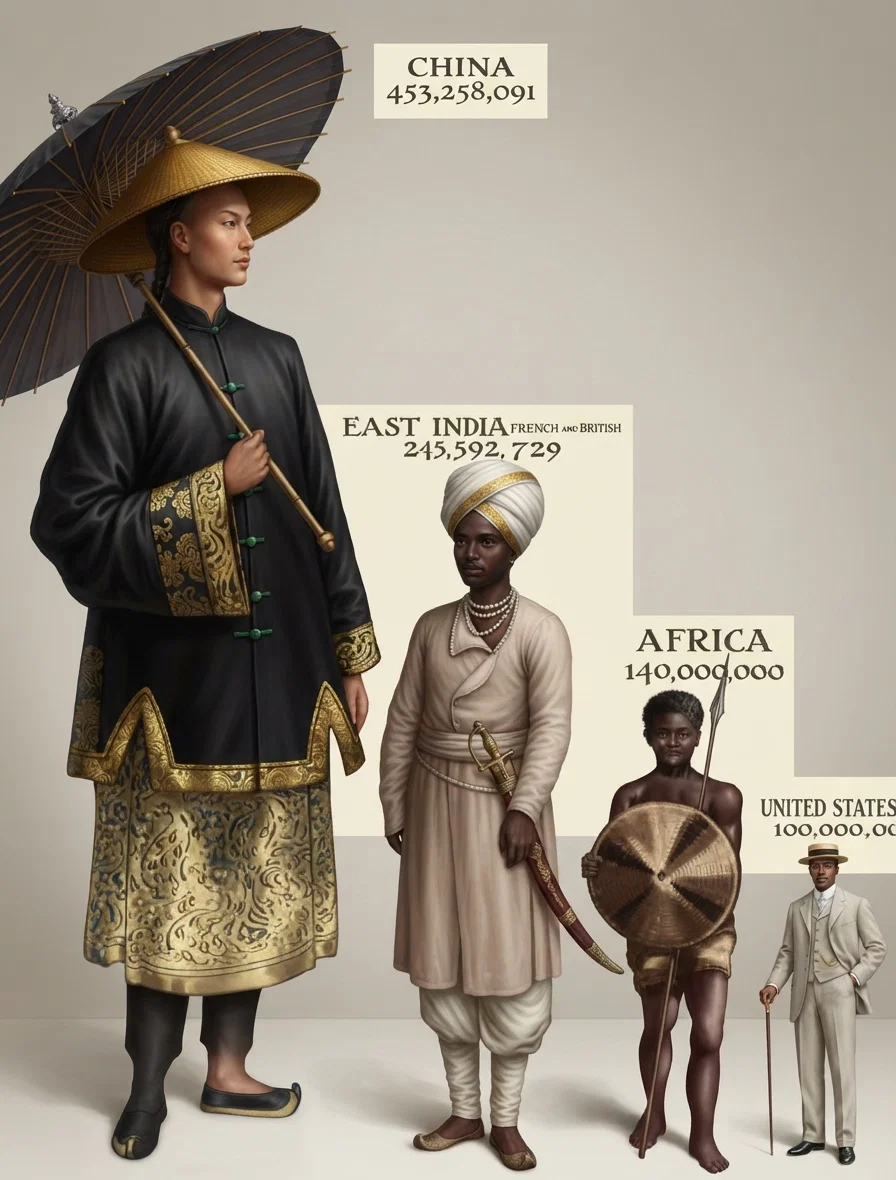
But not more than seventy per cent indulge in these wasteful extravagances, and in these body- and soul-destroying habits and vices. This would be nearly sixty dollars per capita thus expended. There are in this country less than one hundred million souls, but there are in China four hundred fifty-three million. There are in East India, exclusive of Malaysia, forty-five million; in "dark Africa," all the way from one hundred forty to one hundred seventy million; in Japan, over fifty million; in Malay Islands, over sixty million; in the rest of Asia not named, nearly seventy million. The most of these do not know Christ, do not know the blessings of Christian civilization. Yet the people are all humans, the same as we17have; but these have not been touched by the life of Christianity.
UNITED STATES 100,000,000 REST OF ASIA 68,405,000 MALAY ISLANDS 62,688,362 JAPAN 51,458,037 ISLANDS OF THE SEA 1,000,000
Compare their conditions with conditions where Christianity prevails. How would you, reader, like to be in their place? And if you were in their place and they were in yours, what do you think their duty would be to you? In many of these nations woman is considered but little, if any, better than a beast, in some cases even lower; yet these women have the same impulses, desires, the same human affections, as do women in America. What is our duty toward them? Besides all these, there are millions upon millions in Europe, in South America, yea, in our own land, who, tho they have heard the name of Christ, do not know Him as a personal Saviour, as the One above all others who is the Friend and Saviour of sinners. What is the duty of those who do know Him? Look on these pictures, study them, take time to drink in their lessons. There are one thousand five hundred million souls for whom Christ died in this world! How very little are those giving to His cause who profess to know Him! How a contemplation of these things ought to lead Christians to a deeper consecration! Those who are Christ's give all to Him, hold themselves stewards of the manifold grace of God, count themselves, like Paul, "debtor both to the Greeks, and to the barbarians; both to the wise, and to the unwise." Rom. 1: 14.
Christian, do not the more than one billion souls out of Christ appeal to you? How small is enlightened America, with its one hundred million, compared with these! Are you Christ's? You are a debtor to the world, the need of which — your need, our need — moved the heart of God to give heaven's richest treasure — His only-begotten Son. That need demands that we, who have tasted of the sweets of Christianity, shall sacrifice to save the lost. But what shall be sacrificed? First of all, the very life, with all it implies, should be laid upon the altar of Christ, to die or to live for Him. Surely this includes those things which are only and always an unmitigated and direful curse. Great blessings would come to men who do not know Christ, who would do this for His sake and the sake of souls. It would be an opening to their heart which would bring greater blessings. Think of what America's alcohol bill would be if it were turned to the salvation of humanity! Christian America pouring down its throat two billion dollars' worth of cursing and crime and death! Think of what America's tobacco bill would be if turned toward Christian missions — Christian America burning, smoking, chewing, snuffing nearly a billion dollars' worth of tobacco a year — tobacco, a feeder of alcohol, a breeder of disease, a stunter of intellect, a wicked waste of time and means, a tyrant over soul and body! Think of it! What a help to missions would be the tea and coffee expenditure, nerve-destroying stimulants, useless and worse than useless! And these expenditures are increasing yearly in far greater proportion than are gifts, sacrifices, for God and for souls. What will be the end? Is it not time for a humbling of heart, and a seeking of God? The Master's question to us is:
"I gave, I gave My life for thee;
What hast thou given for Me?"
And our response ought to be, in truth, in the words sung by so many thoughtlessly:
"Were the whole realm of nature mine,
That were a tribute far too small;
Love so amazing, so divine,
Demands my life, my soul, my all."
Then would soon be fulfilled this prophecy of the Master: "This Gospel of the kingdom shall be preached in all the world for a witness unto all nations; and then shall the end come."
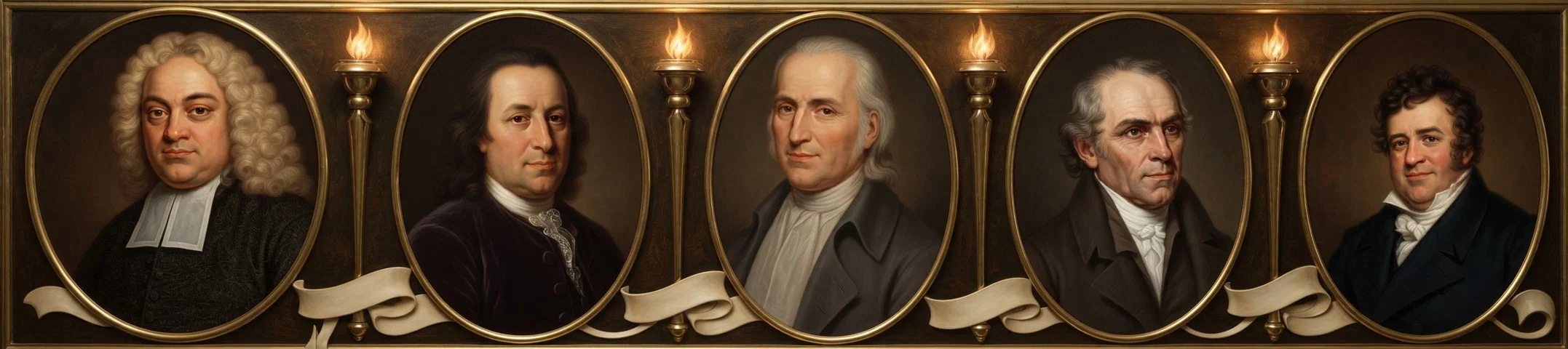
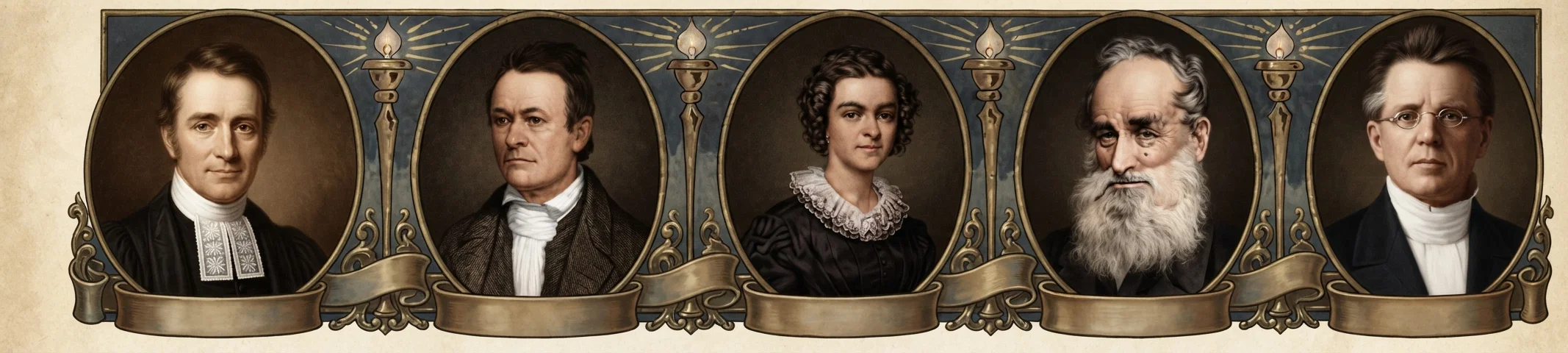
ZIEGENBALG ZINZENDORF SCHWARTZ CAREY MORRISON
Some of God's Heroes in Modern Missions
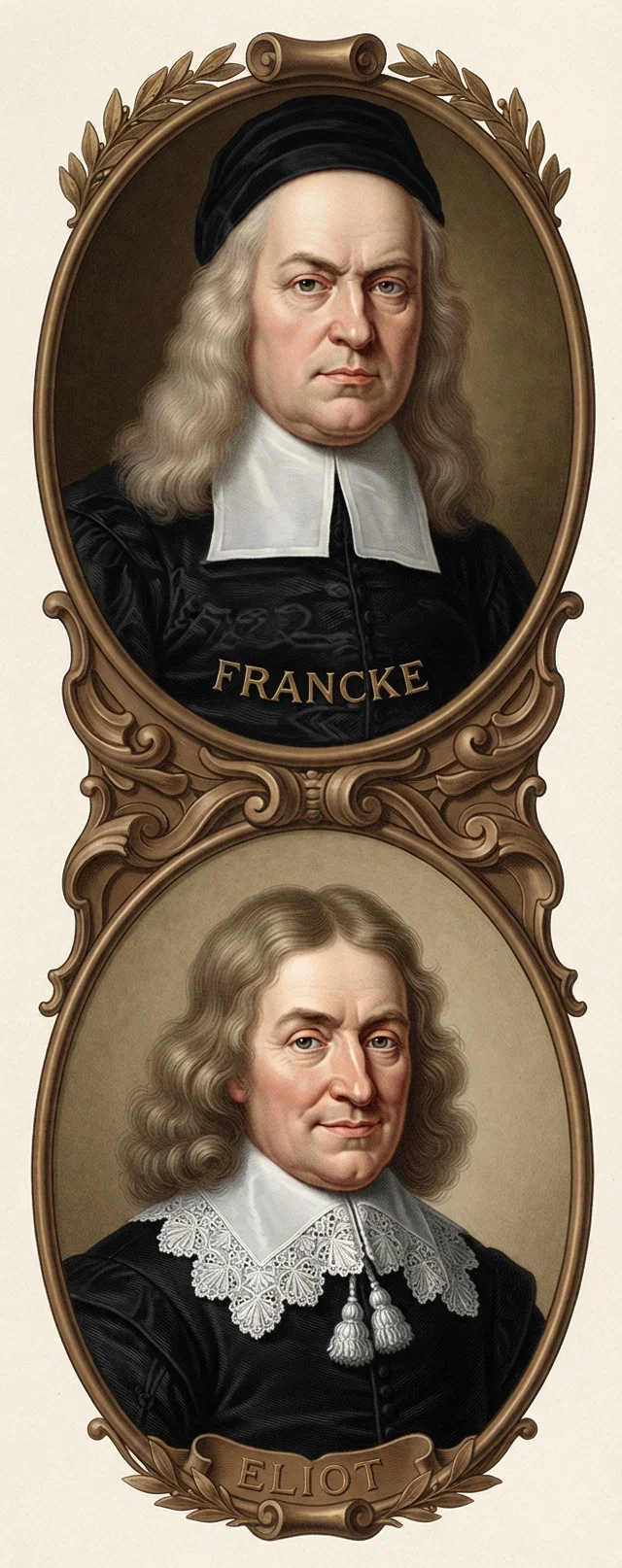
1. JOHN ELIOT. Born in Nasing, England, 1604, early chose ministry for a life-work. Well versed in Hebrew and Greek. Came to America in 1631. Pioneer missionary among the North American Indians. He translated the Ten Commandments, The Lord's Prayer, and later the Bible, into a native tongue. He died in 1690.
2. AUGUST FRANCKE. 1663-1727. Missionary educator at Halle. His Biblical lectures were distinguished for piety, warmth, and zeal, under whose instruction sat Ziegenbalg, Zinzendorf, and Schwartz. To his large-hearted Christian philanthropy and zeal the cause of missions owes a great debt.
3. BARTHOLOMEW ZIEGENBALG. 1683-1719. Danish pioneer missionary to Tranquebar, 1706. Having neither grammar nor dictionary in native tongue, yet in less than a year he was preaching, and souls were converted. His New Testament in Tamil was the first in any language in India.
FRANCKE AND ELIOT
4. COUNT NICHOLAS LUDWIG ZINZENDORF. 1700-1760. A native Saxon, he early came into connection with some of the scattered followers of John Huss, the Moravians, and became their leader. He formed bands among them for more effective missionary work. A decade before Carey preached his memorable sermon, they had 27 stations, and supported 165 missionaries.
5. CHRISTIAN FREDERICK SCHWARTZ. 1726-1798. Native of Prussia. Educated at Halle, as were Zinzendorf and Ziegenbalg. Began labors in India, 1750. In 12 years he had baptized 1,238. The last 20 years of his life in Tanjore. He died mourned by all.
6. WILLIAM CAREY. 1761-1834. Native of England. Early a preacher of the Gospel, keeping school by day and cobbling shoes at night. Devoted his life to missions to heathendom. His motto: "Expect great things from God, attempt great things for God." His work in India, against all kinds of opposition, hardship, and trial, was greatly blessed of God. He brought out the Bible in Bengali in five volumes in 1809, and translated it in whole or in part into twenty-four native languages or dialects, rendering the Bible accessible to more than three hundred million human beings.
7. ROBERT MORRISON. 1782-1834. Native of England, Scotch descent. He early decided to become a missionary to the heathen. Was appointed the first missionary of the London Missionary Society to China, and thus became the pioneer of Protestant missionaries in China. Translated the Scriptures and prepared a Chinese dictionary. He was in China 27 years, when he died.
HEBER JUDSON MRS. JUDSON MOFFAT SCUDDER
Some of God's Heroes in Modern Missions
8. REGINALD HEBER. 1783-1826. Became a preacher in 1822, was consecrated bishop of Calcutta in 1823. He labored with great zeal in India for three years. Among his hymns which will never grow old are "From Greenland's Icy Mountains" and "Holy, Holy, Holy, Lord God Almighty."
9. ADONIRAM JUDSON. 1788-1850. Native of Massachusetts. A most devoted man from his youth, one of the first missionaries sent by the American Board, but afterward became a Baptist, and was the pioneer missionary in Burma. He and his wife suffered fearful hardships in the years 1824-26, during the war between England and Burma. Translated the Bible in Burmese. Efforts at first seemed fruitless, but in 1838 there were said to be a thousand converts from heathendom formed into churches.
10. ANN HASSELTINE JUDSON. 1789-1826. Adoniram Judson's first wife. Native of Massachusetts. One of the noble army of women who have given their lives for missions. Never physically strong, she labored almost incessantly. While her husband was in prison, she was called to share his sufferings, following him from prison to prison, ministering to his wants, continuing this for a year and a half, walking miles in feeble health in the darkness of night or under the noonday sun, much of the time with a babe in her arms.
11. ROBERT MOFFAT. 1795-1883. Native of Scotland. His mother saturated him while young with a knowledge of the Bible and stories of the early Moravian brethren. Offered himself to the London Missionary Society for a missionary, and was accepted, sailing for South Africa at the age of 21. His chief service lay in the region of Bechuanaland, the Orange River country. Most noted of his achievements was the translation of the entire Bible into Bechuana.
12. JOHN SCUDDER, M.D. 1793-1855. Native of New Jersey. Was led by a tract to give his life to missionary work, and sailed in 1819 to Ceylon under the American Board. In 1836 was transferred to Madras, where he founded a new mission with Dr. Winslow.
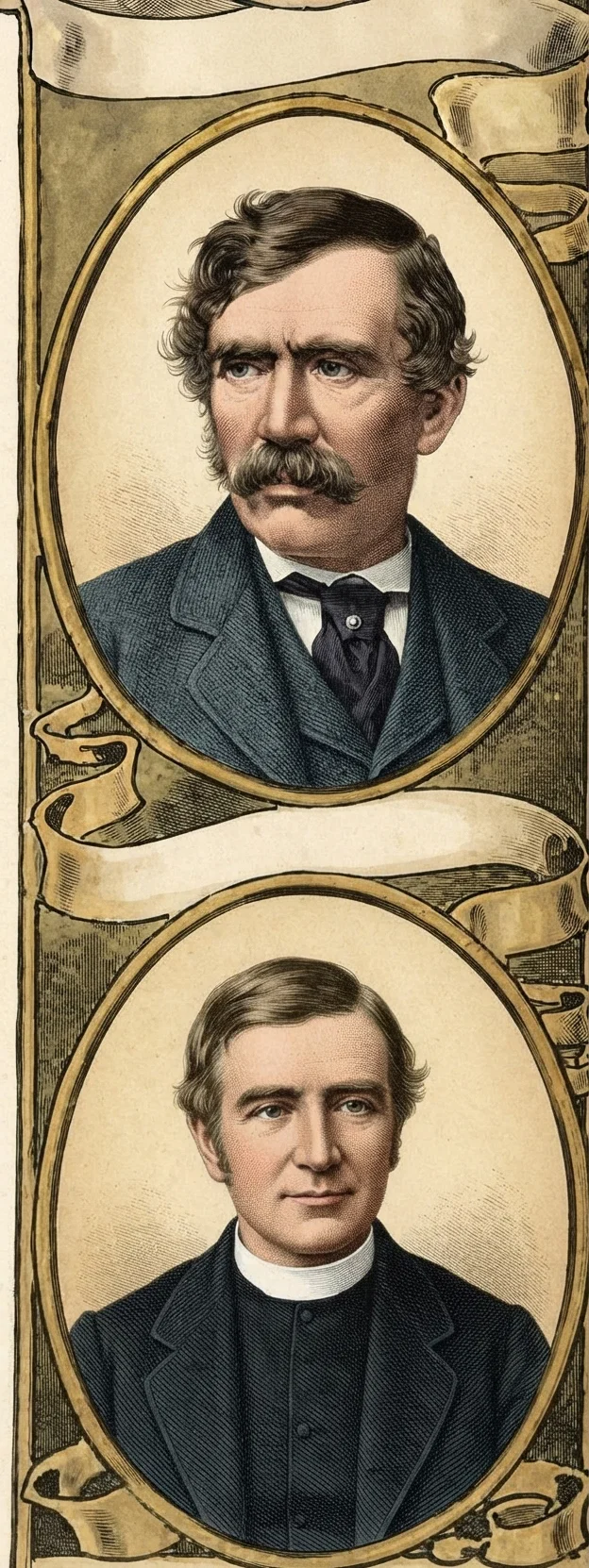
13. DAVID LIVINGSTONE. 1813-1873. Noted African explorer and missionary. Native of Scotland; died in the "Dark Continent," on his knees. At 19 he resolved to be a medical missionary, and was called in 1838 by the London Missionary Society. His faithful men, after embalming his body, carried it a year's journey to the coast at Zanzibar, one of the most heroic journeys ever undertaken.
14. JOHN C. PATTESON. 1827-1871. Missionary martyr of Melanesia. Native of England, son of Sir John Patteson, the distinguished English judge, his mother a niece of Samuel Coleridge the poet. He made many voyages in the missionary ship "Southern Cross." He was killed, evidently by mistake, on a voyage to Nukapu Island.