Your ShelfYour Projects

Signs of the Times, Vol. 38, Nos. 43, 44.

Signs of the Times
Earlier text: A Cry for Help from Heathen Lips

An Inherent Part of the Gospel

THERE is no doubt that much of the misery that exists in the world, both of body and mind, is traceable to strong drink.
According to reports from the United States and State government officials, there is sixty-seven per cent more crime in cities where drink is sold than in those where drink is prohibited, and there exists eighty per cent more pauperism. In fact, all social evils are increased in like proportion. To take into the body a poison that tends to dethrone reason and to destroy every noble instinct, is SIN, from which the Gospel purposes to save man.
The man who is careless in his habits of eating has poisons generated within, which are just as real as the alcohol taken by the drinking man, and sometimes they are more injurious to both mind and body. Patience is a virtue that is not usually associated with intemperance in either eating or drinking. A dyspeptic is seldom good-natured. It is difficult, if not impossible, for a person to have a sweet, amiable disposition and a sour stomach at the same time. In order to sweeten the disposition, the stomach must be sweetened by correcting wrong habits of eating.
The Gospel exerts a refining influence, and leads to the abandonment of all habits which tend to interfere with moral development and spiritual growth. For this reason, the Gospel and temperance or physical reforms are intimately associated.
Every true revival of godliness has associated with it health and temperance reforms.
The revival of the Gospel among the children of Israel which led to their departure from Egypt, was designed to lead them to forsake their Egyptian habits of eating and drinking as well, just as later the revival that began at Pentecost resulted in greater simplicity in dress, in food, and in drink. They had "all things common," and "took their food with gladness and singleness of heart."
The revival which began with John the Baptist, called for reforms in eating and drinking.
During the Dark Ages, revivals were unheard-of, the Gospel was withheld from the people, and as a result the body and its needs were ignored. Filth was considered a virtue. The body designed of God to be the temple of the Holy Spirit was defiled.
At the time of the end, with an open Bible, the Gospel was again preached, knowledge increased, and remarkable reforms resulted. Delavan L. Leonard, D.D., in his book, "The Story of Oberlin," in speaking of the marvelous revivals at this period, says, "These seasons of refreshing which first made their appearance in 1798-1803 were of frequent occurrence for two decades, throughout the Eastern and Middle States, in 1825-1845 were well-nigh continuous, and extended to the West and South."
Between the years 1826 and 1830, two hundred thousand converts joined the leading denominations. Sixty thousand of these were young men. It is estimated that from the year 1800 to 1830 not far from one million one hundred thousand were added to the four leading churches—the Congregational, the Baptist, the Presbyterian, and the Methodist, the latter increasing in number sevenfold. "Reaching the destitute and perishing with the bread of life came to be a ruling passion." Colleges for the training of missionaries sprang into being. The Bible was given its proper place in the system of education. Missionary societies were organized whose aim it was to evangelize the world in a short period of time. Among other reforms, abstinence from tobacco, tea, coffee, condiments, and other unwholesome foods and drinks was urged and strictly enforced. At Oberlin a covenant was drawn up, a part of which read as follows: "That we may have time and health for the Lord's service, we will eat only plain and wholesome food, renouncing all bad habits, and especially smoking and chewing of tobacco, . . . and deny ourselves all strong and unnecessary drinks, even tea and coffee as far as practicable," "and will while living, provide for the widows, orphans, and families of the sick, as for ourselves."
Evangelist Finney, who took probably the foremost part in these revivals, was at this time president of Oberlin. He was greatly benefited himself by the adoption of a simple diet, and became a strong advocate of these reforms, pushing them with boundless energy and perseverance. Both he and Mr. Shipard, the former president, "held pronounced opinions adverse to coffee and tea, and did what they could to convert others to their way of thinking." "Vegetarianism found quite general acceptance among the wise and learned," especially at the colleges and seminaries. "The Oberlin pulpit," we are told, "became aggressively Grahamite." Men and women were called upon to repent of the sins of the table. The habitual use of tea was made a matter of church discipline.
At this period temperance societies were also organized. At first they merely called for abstinence from spirituous or distilled liquors, the use of wine being permissible. A little later, through Capt. Joseph Bates a society was organized at Fairhaven, Massachusetts, whose members agreed to abstain from the use of all alcoholic beverages, including wine and other fermented drinks. This was a new departure. To them was first applied the name of teetotalers. Captain Bates later abandoned the use of tobacco, tea, and coffee, and still later the use of flesh foods and condiments. In the year 1844, in his study of the Scriptures, he discovered that the seventh day was God's holy day, and not the first. He then wrote a tract, calling for a reform in Sabbath observance. Thus health reform and Sabbath reform became associated.
LOMA LINDA SANITARIUM, CALIF
This was the period also of the general awakening as to the study of the prophetic scriptures showing the second advent of Christ to be near at hand; and out of this period of awakening to Bible truth and health and temperance reform has grown the work of Seventh-day Adventists, with their system of sanitarisms, treatment rooms, vegetarian cafés, food manufactories, etc. To save men from the use of alcohol, tobacco, tea, coffee, and all other injurious or unwholesome foods and drinks, is by this denomination considered an essential and inherent part of the everlasting Gospel.
That both physical and moral degeneracy exist, and are rapidly increasing, is so evident to all observing men and women, that it has ceased to be a matter of doubt. While epidemic diseases have been checked, and thus the average age of life has been increased, there are fewer centenarians living to-day, to the number of this world's population, than at any previous period; and in fact, there are fewer who reach the age of eighty, seventy, sixty, or even fifty years. The human family is aging prematurely. Men die at an age when they really should begin actually to live and do their best work; not by accident or germ diseases, but degeneracy is the chief cause of death.
The arteries of the average modern man, at the age of forty-five, have lost their elasticity, and are no longer able to assist in propelling the blood throughout the body to supply nutriment to its tissues. Degeneracy of the brain, the liver, the kidneys, the germinal and the mammary and other glands of the body, is the result. This degeneracy is largely responsible for the great decrease in the birth-rate; for the inability on the part of the modern mother to suckle those that are born; for the great increase in the number of deaths due to liver and kidney diseases; for the brain degeneracy, and the consequent moral degeneracy, that exist; for the alarming increase of insanity, crime, and social impurity. It is responsible also for the many sudden deaths due to heart failure and apoplexy, which a century ago were seldom heard of.
In all civilized countries there is a very marked decline in the birth-rate. So pronounced is this becoming that the extermination of these races is inevitable if the present decline continues; for a nation, to perpetuate itself, must at least be able to fill the vacancies made by death. This some at present are unable to do. A decline in the number of children should create no alarm. It would, in fact, be of benefit to the race if the quality could be thereby improved. But there exists a depreciation in quality as well as in quantity. It is estimated that there are in the United States about twelve million children of school age that are defectives. So long as the quality is bad, the fewer the children born, the better. This degeneracy in children is due to degeneracy in parents. A degenerate tree will bring forth degenerate fruit, and ultimately no fruit. The remedy lies in making the tree good, that its fruit may be good also.
In the past, the peasants, whose habits are simple, have been the backbone of civilized nations. Upon these the perpetuation of these nations has been dependent. The United States owes her rapid increase in population to the influx of these peasant immigrants. But as country life is by them exchanged for city life, and their former natural and simple habits for the luxurious habits of the city dweller, degeneracy becomes marked. It has been found, for instance, that the first generation of foreign women have more children than the American women; that the first generation of foreign women have more children than the second; that those living in rural districts have more and better children than city dwellers; and those living in poorer parts of the city, in spite of the disadvantages of insanitary conditions, have more than the well-to-do, who can afford more of the modern luxuries; and that the well-to-do have more than the extravagant wealthy. Directly and indirectly this degeneracy is traceable to the use of alcohol, tobacco, tea, and coffee, the four great poisoners of the human race. Four hundred years ago, tobacco, tea, and coffee were practically unknown in civilized lands. To-day their use is as wide-spread as that of alcohol.
The total amount paid out by the people of the United States last year for these four destroyers equals the amount of money in circulation, including gold and silver coins, certificates, and United States and national bank-notes.
The production of coal is considered one of our greatest industries in the United States; but the value of all the coal produced during the year 1910 falls short by about three hundred millions of dollars of paying the tobacco bill for the same year. Even the gold coined in the United States last year would be inadequate to pay for the tobacco consumed during the year.
In spite of the efforts on the part of faithful women and men to prohibit the sale of intoxicating drinks, last year twenty-four million more gallons of distilled liquors was sold in the United States than the year before, and about ninety million more gallons of beer; also one hundred and sixty million more cigars, and a full billion more of cigarettes, were smoked.
The amount spent during the year for coffee, tea, and other beverages containing caffeine would more than cover all the losses by fire. With the amount thus squandered, we could construct a Panama Canal each year.
It is this universal use of alcohol, tobacco, tea, and coffee that is chiefly responsible for the degenerate arteries and glands in the man of forty or fifty. It is chiefly responsible for premature old age; for the declining birth-rate; for the physically and mentally defective youths; and for the rapid increase of the insane and criminal classes. It is also responsible for most of the immorality that everywhere prevails.
Meat is consumed altogether too freely. The waste products it contains tend to physical and moral decadence. They also irritate the tissues and fever the blood, and thus create an unnatural thirst that water fails to quench. Narcotics afford temporary relief from these symptoms by numbing the nerves. When the influence has worn off, all the symptoms are intensified, and the demand for the narcotic is increased. Thus the habit becomes fixed. It is not a mere happen-so that in the Bible the drinking of wine and the eating of flesh are associated.
WAHROONGA AUSTRALIA, NASHVILLE TENN. SANITARIUM, A SANITARIUM BY THE SEA SKODSBORG - DENMARK
In Prov. 23:20 this association is seen: "Be not among wine-bibbers; among riotous eaters of flesh," intimating that where one is found, the other is likely to be, and that the person who is a riotous eater of flesh is almost certain to be a wine-bibber.
Again, in Isa. 22:12, 13, the Lord calls to repentance a people who are "slaying oxen, and killing sheep, eating flesh, and drinking wine."
On Babylon's table, laden with meats and other luxuries, naturally we find also the wine. Daniel, the Hebrew captive, when called upon to eat at the king's table, "purposed in his heart that he would not defile himself with the portion of the king's meat, nor with the wine which he drank." He requested that instead he might have "pulse to eat, and water to drink." There is just as natural an association between the food of his choice and the drink of his choice, as there was between meat of Babylon's choice, and her drink. The children of Israel were given manna to eat, and water out of the rock to quench their thirst. These simple, natural, non-irritating foods call for no drink stronger than water.
The adoption of a bloodless diet is one of the greatest aids in overcoming the desire for both alcohol and tobacco.
The inebriate who was admonished to straighten up and be a man, significantly replied, "You good people have a great deal to say about my drink, but you have nothing to say about my thirst." He recognized that if the craving for drink did not exist, he would experience very little difficulty in giving it up. The reason why strong drink and tobacco and other narcotics are so widely used, is because of the unnatural but universal craving that exists for them. There exists no doubt that, in order for a teetotal propaganda to accomplish its ends to the fullest extent, wives and mothers must be educated in the preparation of simple, wholesome, palatable, non-irritating, and non-stimulating foods and drinks. The desire for narcotics is created in our homes; the saloon weeds out those who are weak in will-power, or the mental defectives. Wherever the everlasting Gospel is preached, there will necessarily be reforms in eating and drinking. Sanitariums, vegetarian cafés, and food manufactories are instrumentalities which have been brought into existence to teach these principles of reform. They are therefore an inherent part of the Gospel plan.
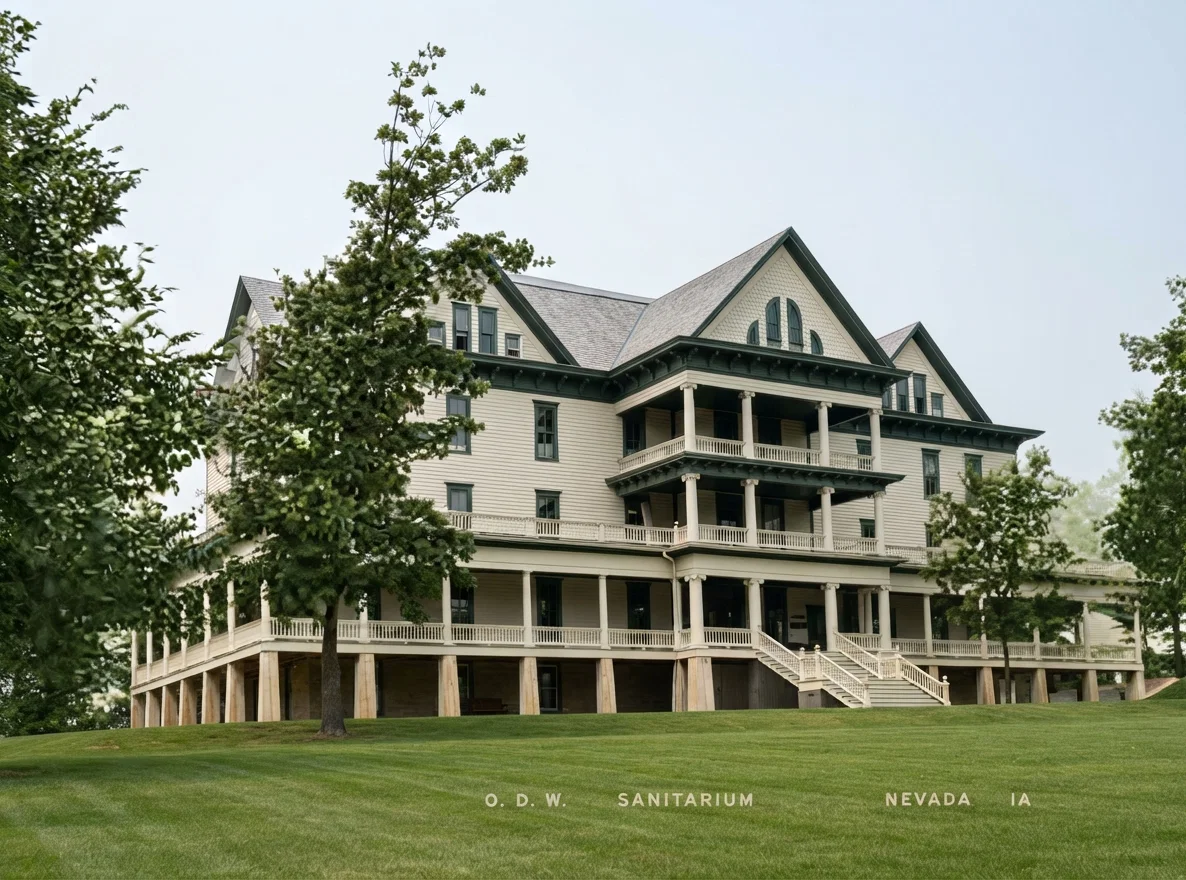
O. D. W. SANITARIUM, NEVADA, IA.

God's Law of Life

(From "Ministry of Healing")
LET it be made plain that the way of God's commandments is the way of life. God has established the laws of nature, but His laws are not arbitrary exactions. Every "Thou shalt not," whether in physical or in moral law, implies a promise. If we obey it, blessing will attend our steps. God never forces us to do right, but He seeks to save us from the evil and lead us to the good.
Let attention be called to the laws that were taught to Israel. God gave them definite instruction in regard to their habits of life. He made known to them the laws relating to both physical and spiritual well-being; and on condition of obedience He assured them, "The Lord will take away from thee all sickness."
"Set your hearts unto all the words which I testify among you this day." "For they are life unto those that find them, and health to all their flesh."
God desires us to reach the standard of perfection made possible for us by the gift of Christ. He calls upon us to make our choice on the right side, to connect with heavenly agencies, to adopt principles that will restore in us the divine image. In His written Word and in the great book of nature He has revealed the principles of life. It is our work to obtain a knowledge of these principles, and by obedience to coöperate with Him in restoring health to the body as well as to the soul.
Men need to learn that the blessings of obedience, in their fulness, can be theirs only as they receive the grace of Christ. It is His grace that gives man power to obey the laws of God.

It Is Not a Strange Thing

JESUS, the anointed Son of God, came once to this world. We can not explain the mystery of His incarnation. It is beyond us; yet in a lesser way it has been demonstrated in the lives of millions of believers who have been regenerated by His creative power.
It is not a strange thing that the Creator of heaven and earth should call His Son, the sinless One, back from death and the grave. Life belongs to the righteous. "In the way of righteousness is life."
It is not a strange or unreasonable thing that Christ our Lord should come again in the glory which to Him belongs. It is but right that as He laid it by or veiled it in humanity to save all who would receive Him, He should come for His own in glory undimmed, that they may see Him as He is. "And every one that hath this hope set on Him purifieth himself, even as He is pure."

John Eliot's Motto

"Prayer and Pains"
John Eliot, one of the Pilgrim Fathers, learned the Indian tongue, and in 1663, twenty years after he began the language study, brought out the first complete Bible ever issued in a heathen tongue. Eliot also compiled a grammar of the language. At the end of this grammar he wrote: "I have now finished what I shall do at present: And in a word or two to satisfie the prudent Enquirer how I found out these new wayes of Grammar, which no other Learned Language (so far as I know) useth; I thus inform him: God first put into my heart a compassion over their poor Souls, and a desire to teach them to know Christ, and to bring them into his Kingdome. Then presently I found out (by Gods wise providence) a pregnant witted young man, who had been a Servant in an English house, who pretty well understood our Language, better than he could speak it, and well understood his own Language, and hath a clear pronunciation: Him I made my Interpreter. By his help I translated the Commandments, the Lords Prayer, and many Texts of Scripture: also I compiled both Exhortations and Prayers by his help. I diligently marked the difference of their Grammar from ours: When I found the way of them, I would pursue a Word, a Noun, a Verb, through all variations I could think of. And thus I came at it. We must not sit still, and look for Miracles: Up, and be doing, and the Lord will be with thee. Prayer and Pains, through Faith in Jesus Christ, will do any thing."
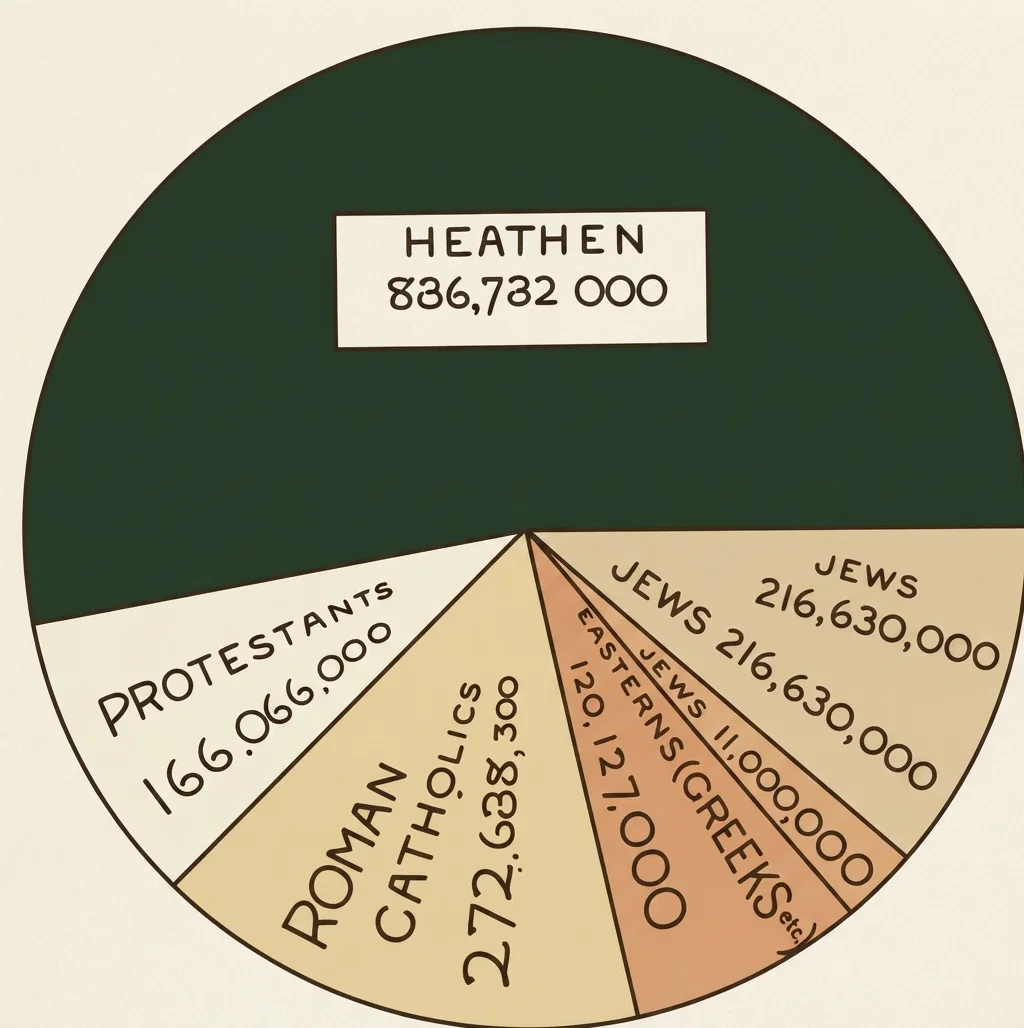
Religions of the World

Six Korean Leaders

In "Korea in Transition," Dr. Gale tells a wonderful story of six Korean leaders whom the old emperor had locked in his criminal prison because he feared they wanted to introduce reform along Western lines. They were put in without trial, made to work hard, suffered from cold, ill treatment, vermin, and filth, and were in constant fear of execution. They had proud blood in their veins and a deadly desire for vengeance in their hearts. They hoped for escape, for the opportune moment, the keen knife and the squaring of accounts, when all unexpectedly there came into their midst the New Testament, Bunyan's 'Pilgrim's Progress,' and some of D. L. Moody's tracts, in Chinese. Their prison was visited regularly by Dr. and Mrs. A. D. Bunker, and became first an inquiry room, then a house of prayer, then a chapel for religious exercises, then a theological hall; and when the course was completed, God let them all out of prison and set them to work. With their high social standing and superior training they became the first Christian leaders of the capital."—Bombay Guardian.

THE PUBLISHING WORK

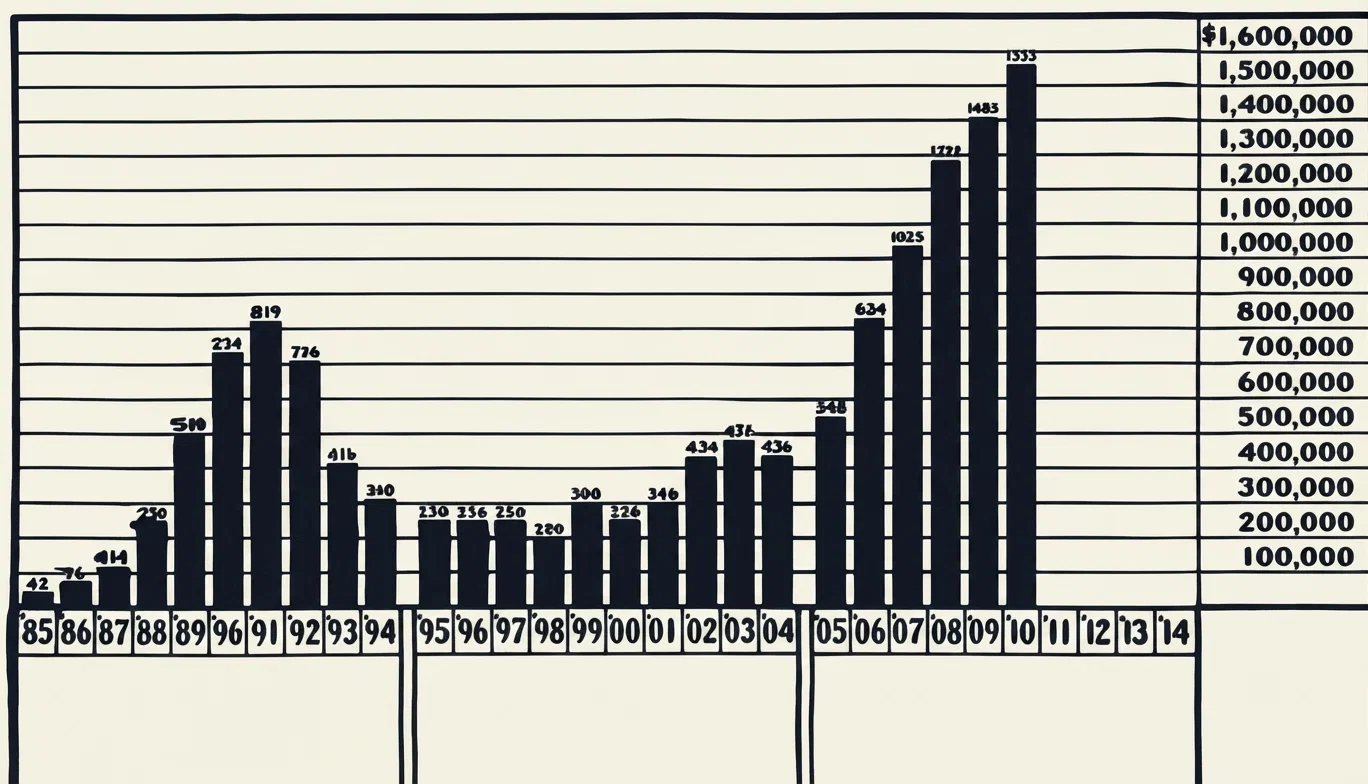
GRAPHIC OUTLINE - - - 1885-1910

GRAPHIC COVERING 1885-1910
From the above diagram it will be seen that the publishing work in the last six years has nearly equaled in amount that of the twenty years previous. The printed page is an important factor in God's work.

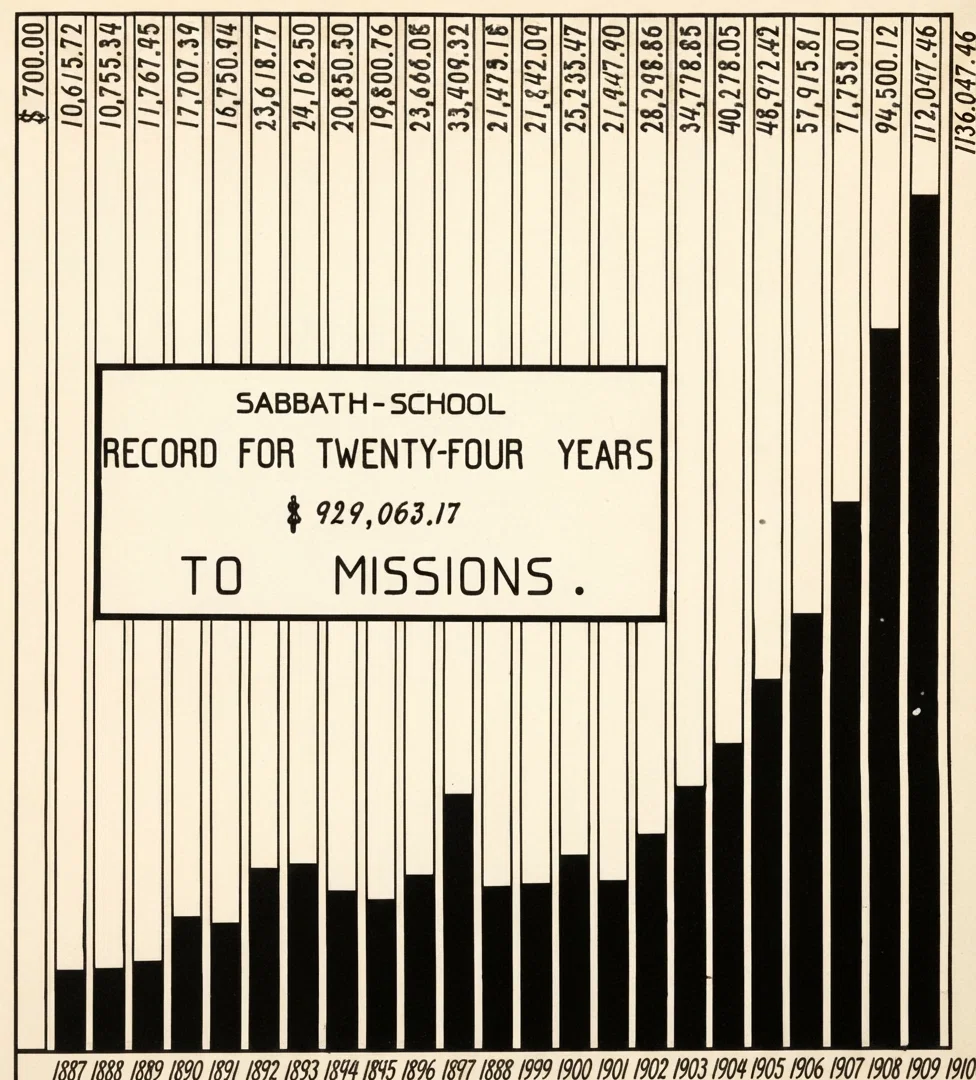
Contributions for Distinctively Mission Work as Reported by the United States Census Bureau for 1906

Average per Member
All denominations reporting $ 1.08
Protestant bodies 1.09
Northern Baptist Convention 2.50
Southern Baptist Convention .33
Other Baptists (3 bodies) .07
Congregationalists 2.66
Disciples, or Christians 1.11
Evangelical bodies (2 bodies) 2.22
German Evangelical of North America .19
General Synod of Evangelical Lutheran in United States .89
General Council Evangelical Lutheran in North America .40
Evangelical Lutheran Synodical Conference of America .23
United Norwegian Lutheran Church of America .54
Other Lutheran bodies (17 bodies) .39
Presbyterian Church in the United States of America 2.88
United Presbyterian Church of North America 5.30
Presbyterian Church in the United States 1.87
Other Presbyterian bodies (7 bodies) 1.07
Protestant Episcopal Church 1.82
Reformed bodies (3 bodies) 1.18
United Brethren (2 bodies) .66
Other Protestant bodies 1.28
Seventh-day Adventists 6.88
Other Adventist bodies (2 bodies) 1.28
Latter-day Saints (Mormons, 2 bodies) .88
Other bodies (4 bodies) .15
In 1906 the highest average per member for all purposes was the Northern Baptist Convention . . . . . . . . . . . . . . . . 11.93
In 1909 the average per member for all purposes of the Seventh-day Adventists . . . . . . . . . . . . . . . . . . . 19.66

Religious Population of the Earth

Creed No. of Followers
Confucianism 256,000,000
Hinduism 190,000,000
Mohammedanism 176,000,000
Buddhism 147,000,000
Taoism 43,000,000
Shintoism 14,000,000
Judaism 10,186,000
Polytheism 117,681,000
Total antagonistic to Christianity ... 953,867,000

Nominally Christian

| Roman Catholic | 230,866,533 | | Orthodox Greek Church | 98,016,000 | | Church of Abyssinia | 3,000,000 | | Coptic Church | 120,000 | | Armenian Church | 1,690,000 | | Nestorians | 80,000 | | Jacobites | 70,000 | | Protestant | 143,237,625 | Total ... 477,080,158
Infidel and Non-professor ... 91,752,842 Population of the world ... 1,522,700,000
How few even of the nominal Christians know Christ! You are God's steward; what will you do about it?

I Never Heard Before

A picture of old age in hopeless darkness is given by a China Inland missionary, in Szechuen.
"I traveled," he said, "the first day in a passenger-boat down-stream. At the small river ports we were continually taking in and dropping off passengers. Late in the afternoon an aged dame, accompanied by a youthful grandson, came on board for a few miles. Most of the passengers having dropped off, I had a quiet, blessed opportunity of telling her the way of salvation. She was white-haired, deaf, and bent, already in her eightieth year. Alas, how dark, O, so dark, was her soul, and eternity drawing nigh! When questioned about God, heaven, salvation, of life beyond the grave, in sorrow or joy, her sad answer, still ringing in my ears, was, 'I never heard before.'"
Of God, who heaven above did spread, Made this fair earth whereon I tread, Supplied my needs, my daily bread— I never heard before.
That from above a Saviour came To save me from my sin and shame, Jesus His sweet and blessed name— I never heard before.
Death was to me a dismal door To flee life's ills—to be no more! Of life beyond when death was o'er— I never heard before.
O, why should China's millions lie In heathen darkness, hopeless die? Why should this aged sinner cry, "I never heard before?" —Anon.

In Three Days the San Francisco

Overland Limited

Takes You to Chicago : : : :
Across Great Salt Lake and High Sierra by Daylight. Luxurious High-Class Equipment. Electric Lighted Throughout.
¶ Pullman Drawing-Room, Stateroom, Vestibuled Sleeping-Cars, Careful and Attentive Dining Service, Parlor Observation-Car with Library and Cafe, Ladies' Reading-Room, Daily News Bulletins, Latest Papers and Magazines.

Southern Pacific

Gospel Publications

"The Lord gave the word; great was the company of those that published it."
The Seventh-day Adventist denomination now owns and operates twenty-eight publishing houses,—six in North America and twenty-two in foreign lands. This does not include numerous college and private printing plants, nor the sixty-five affiliated tract societies handling our literature in as many local conferences.
Continue reading: Bible Tracts