Your ShelfYour Projects

Signs of the Times, Vol. 25, No. 14.

OF SUCH IS THE KINGDOM OF HEAVEN
Earlier text: SHALL WOMEN SPEAK IN THE CHURCHES?

FRANCE’S SUBMARINE BOAT.

In his speech supporting the navy estimates, M. Lockroy, the French minister of marine, among many other things said:—
“We now possess a remarkable engine of war in the form of a submarine boat that is capable of real service. The experiments with the Gustave Zede have been conclusive. She not only succeeded in torpedoing an ironclad at a distance of 400 meters, but displayed good sea-going qualities. She made the trip from Toulon to Marseilles in very rough weather.
“The vessel had only one great fault, she was blind and unmanageable at a certain distance below the surface, but this had been remedied. The boat had been fitted with a conning apparatus, which allowed her to be steered without coming to the surface, and enabled her to perceive enemies and strike them with accurate aim. France thus has in her hands a new and destructive weapon of terrible power.”
It has been rumored for some time that the French were making some very successful experiments in submarine boat building. And this official announcement through her minister of marine changes the rumor into a settled fact. But if France has really succeeded in constructing a “destructive weapon of terrible power,” she will not long stand alone in her superiority that the new submarine torpedo-boat gives her. The other nations will feel obliged to follow suit, and that means still more energy and more millions wasted in producing still greater facilities for the wholesale slaughter of mankind.
This is not an age of peace, but, on the other hand, it is the time foreseen by the prophet and described in the following graphic language:—
“Proclaim ye this among the Gentiles: Prepare war, wake up the mighty men, let all the men of war draw near; let them come up; beat your plowshares into swords, and your pruning-hooks into spears; let the weak say, I am strong. . . . Multitudes, multitudes in the valley of decision: for the day of the Lord is near in the valley of decision.” Joel 3:9-14.
T.

My Sorrows Have Not Been So Light

My sorrows have not been so light Thy chastening hand I could not trace, Nor have my blessings been so great That they have hid my Father's face.
—Phoebe Cary.

A BLESSED VISION.

WHILE upward gazing through the heavens blue, A glorious vision broke upon my view. I dreamed I saw a cloudy chariot bright, And angels clothed in garments pure and white, While loudly rang the trump of Gabriel.
And while I looked, earth's trembling pillars shook; Creation quailed; e'en every winding brook And living fountain, from their place removed; As Jesus came to gather His beloved, The wicked prayed for hiding and for death.
The blessed Crucified, the Morning Star, In matchless beauty from those realms afar, In whom we hope, before whom angels bow, In grandeur robed, was swiftly coming now, Mid fearful, fiery flames and glory bright
What rapturous joy, with sweetest comfort fraught, The gladdening vision to His faith- ful brought! And was He coming, Christ, the mighty Son of God, To earth again, where once His footsteps trod, To welcome home His righteous children all?
As I beheld, the mighty moun- tains fled, The islands moved from out the ocean's bed; For He had come, the glorious Prince of Peace, To end earth's sorrows and bring sweet release; To raise the sleeping, and the living change.
Together, then, the sleeping mill- ions sprang From out the dust; their joyful voices sang: "O grave, where now is all thy victory, Since we are raised to immortal- ity? And where is all thy boasted sting, O death?" MRS. ALICE M. AVERY-HARPER. Laingsburg, Mich.

THE PHILADELPHIA GOSPEL HELP MISSION.
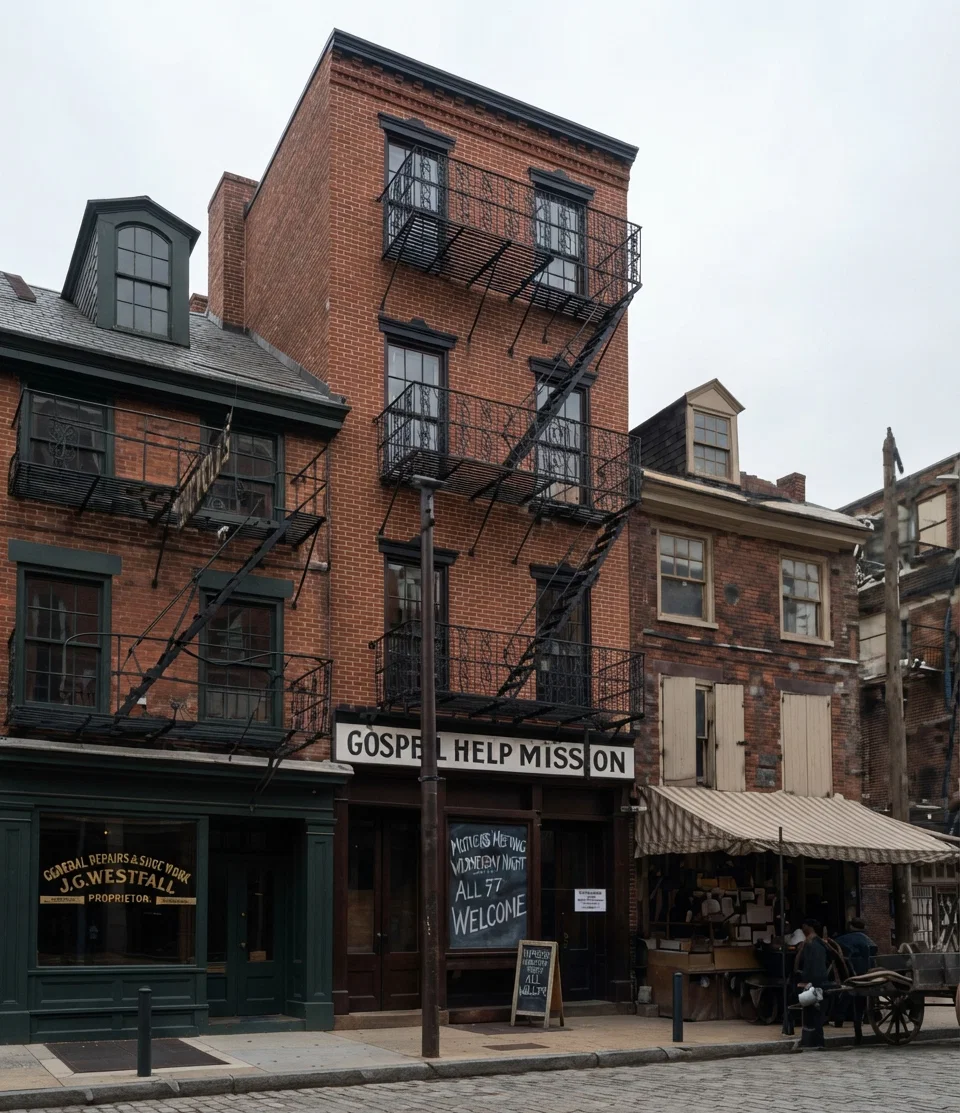
WHILE Christian help work is an integral part of our faith, and institutions are springing up in many large cities, we would like to present in the columns of the SIGNS OF THE TIMES a short statement of what is being done in this line in the city of Philadelphia.
One year ago, under the auspices of the church here, a building at 931 Spring Garden Street was rented, and work begun. The winter was far advanced when this home was opened, with E. A. Merrell, our pastor, as superintendent, and the brethren and sisters in the church as his supporters. In the four months that this home continued, there were furnished, at about cost, to homeless men, 14,000 meals and 8,000 lodgings, with bath and other privileges free.
Meetings were held each evening, with an average attendance of sixty men, with good results; and afternoon meetings for women and children were conducted weekly, in which was given instruction in cooking, domestic economy, and hygiene, for women; and for the children, morals, deportment, and physical culture. Food and clothing were distributed to poor families in the neighborhood of the mission. When the spring came, the location not being near enough to the quarter of the city where poverty and distress are most prevalent, and the building not well adapted for our needs, the mission was closed, with the expectation that the work would be resumed when cold weather should come. About sixty dollars was left over from this first venture, and was deposited for use in the reorganization.
Early in the fall of 1898, those who compose the present board of control counseled together on reopening the mission, with the result that the commodious four-story building shown in the cut, located at 210 North Second Street, was leased, and the trustees of the estate to which it belongs put it in excellent condition for the use we were to make of it.
Gospel Help Mission, Philadelphia, Pa.
The first floor, in which the meeting hall is located as one of the rooms, is ninety-seven feet long; the second and third floors are seventy-seven feet long; and the fourth floor, fifty feet long. To the untiring efforts of the superintendent, by the help of God, is due much of the success of the enterprise that is apparent to-day.
The board of control is composed of the following persons: W. H. Edwards, president; Dr. W. L. Winner, secretary; Pastor E. A. Merrell, treasurer and superintendent; O. B. Hatton, and A. E. Tabor; all of Philadelphia. The secretary of the board has held himself personally responsible to the estate for the rent, and has in many ways conducted to the integrity of the work.
Almost from the start, the mission has been nearly self-supporting. It is true that a small debt was accrued to properly equip the building, complete the necessary amount of plumbing demanded by the city for the number we wished to accommodate, and arrange the cooking and bath departments. The present income pays all the costs for rent, food, fuel, et cetera, except the wages to two helpers. The small debt mentioned has been cut down two-thirds, and will be wholly wiped out, we trust, before the winter is gone.
We are now furnishing five hundred meals a day, and sheltering eighty men nightly, on the average. We have followed hygiene strictly in the dietary, and if it does not give satisfaction there is no complaint. We are circulating moderately in town an announcement stating the object of our work, also a card having the cut of the mission building on one side, and on the other side the bill of fare and name and number of the mission, hours of meeting, etc.
The cost of living at this modest hotel is: 2 rolls, 1 cent; oatmeal, 1 cent; cereal coffee, 1 cent; bowl of bean soup, 1 cent; bowl of pea soup, 1 cent; bowl of stew, and rolls, 5 cents; night shelter, cereal coffee, and rolls, 5 cents; lodging (good bed), cereal coffee, and rolls, 10 cents.
The "shelter" is in a large room on the second floor, well warmed by furnace heat, where the men may sit up, or lie on the floor, and be saved from the stifling atmosphere of the police station, or from freezing on the streets. The meetings are an interesting feature of our mission work. The hall is generally filled, and utmost and polite attention is given to the word spoken. When a call is made for sinners and backsliders to manifest a desire for prayers in their behalf, from five to fifteen arise. While hymns are sung, workers go to these and secure seats by their side, by politely requesting the one nearest to the man to take another seat, and the name and past experience are learned, and how deep is his desire for a better life. If possible, he is induced to kneel right there, and is prayed for and urged to pray for himself, which some do. These men are kept sight of, and soon work is secured, tho they may have been hunting it for six months.
We were much encouraged recently by the visits, labors for a few days each, and words of approval, from the pioneer workers in these lines—Brethren W. S. Sadler and Thomas Mackay, of Chicago, who had been assisting the mission in Brooklyn, N. Y., and came over in different weeks to help us. They expressed themselves to the board as much gratified to see the mission so far advanced in its work in so short a time. Workers from different missions in the city have visited our place, and say that there is nothing in this city—so full of charitable and humanitarian efforts, under many names and guises—exactly like ours, and commend the method.
We are also encouraged at the interest shown by some of the business people of the city, in their words and assistance. The secretary of the board, a few days ago, received ten dollars to aid the mission; and one of the largest grocers in town sent to the writer asupply of tapioca, oatmeal, and other grains, with a pleasant note, asking that the things be accepted for the use of the mission. Others have given money, fuel, clothing, and bedding, for all of which the board feel grateful. The more we get by donations, the more meals we can dispense to those who haven't even the penny or the nickel.
It is a work for the salvation of the soul, as well as of the temporal man. In Philadelphia, as probably in all cities, the man who partakes of the hospitality of our mission for nothing, or for a nominal sum, feels some degree of gratitude to those who extend it, as he knows, not for gain, but for love of him. It does not take him long to decide that it is not man who is moving in this work, but Christ. Knots of men may be seen in the reading-room canvassing the subject and arguing that we must be Christians to establish such a place for outcasts like themselves. To God belongs the glory.
Brother W. F. Swartz has charge of the house, under the direction of the superintendent, and leads the nightly services in the absence of other help. Brother J. G. Hanna assists Brother Swartz and spends some time in the city holding cottage meetings. These two brethren are paid by the Pennsylvania Conference and the Medical Missionary and Benevolent Association. There are others who are helpers in various ways. The expenses of these last named have to be met by our board.
The members of the church take hold energetically to keep up the interest, by playing the organ, singing, and visiting in the neighborhood of the mission, and collecting and distributing clothing.
We feel satisfied that the Lord was with us in opening the mission, and we believe some souls will be found in the kingdom through the instrumentality of the Gospel Help Mission of 210 North Second Street, Philadelphia.
If any wish to donate money, food supplies, or bedding, the board will receive it with gratitude, and dispense it for the Master.
We would be deeply grateful if we could have a sufficient income to keep the mission open all the year. It has cost too much time and labor to fit it up to close the work in the spring, and then have to go over the work again next fall, and perhaps not secure so favorable a place as the house we now have. If money could be donated for the purchase of a dozen more double-decked iron bedsteads, and other bed appointments, also to pay the wages not otherwise provided for as mentioned, it would greatly assist in continuing the mission through the summer months.
All offerings should be sent to the treasurer, E. A. Merrell, 1724 North Fifteenth Street, Philadelphia.
W. H. EDWARDS.

One Point Lacking.

In the Missionary Review we find this little story by Dr. Mary Eddy, of Syria:—
"I was called upon by a young farmer, very tall and strong, but fearfully cross-eyed. 'Will you fix my eyes?' he said. 'How far away is your village?' He replied, 'Two hours.' 'Well,' I said, 'go home and wash your face and head-covering and I will do your eyes.' He had chronic granular affection of the lids, and had heard that I remove granulations with an instrument, while I supposed he desired to have his eyes straightened. He came the next day, and when the operation was completed, I gave him the mirror to view the improvement. He gazed at himself open-mouthed. He had never heard that eyes could be straightened, and you never saw astonishment and rejoicing struggle for utterance as in that poor fellow's case. He went home, and sent me all the lame, the halt, and the blind from his place."
The last sentence sounds like some of the incidents recorded of Jesus, but it lacks the sequel attached to those Scripture narratives,—"And they were all healed." Why is it? "And these signs shall follow them that believe: In My name shall they cast out devils; they shall speak with new tongues; they shall take up serpents; and if they drink any deadly thing, it shall not hurt them; they shall lay hands on the sick, and they shall recover."

OUR WORK AND WORKERS.

BROTHER H. P. HOLSER is taking steps to open the work in Palestine.
A HOUSE of worship is being erected by the brethren at Scotia, Humboldt County, Cal.
THE addition of five to our ranks at La Grande, Wash., is reported by Brother F. W. Hiddleson.
SUNDAY evening, March 26, four persons were baptized in San Francisco by Brother E. E. Andross.
REPORTS from Selma and Arroyo Grande, Cal., say that the Quarter-Centennial SIGNS is still being sold in those vicinities.
AT Kingston, Jamaica, Sister F. I. Richardson holds weekly meetings with the women, which are fraught with interest and profit.
SINCE the first of last September, Battle Creek (Mich.) College has sent out eighty-four young people as self-supporting missionaries.
A BROTHER in Germany who will not do military duty because of the Sabbath is at the present time confined in the darkest dungeon three days every week.
ON Sunday evening, March 26, eight persons were baptized in the church in this city by Brother J. W. Bagby. Two of the number have united with the church in Alameda.
MEETINGS at Hilgard, Wash., had, when last reported to the Reaper, resulted in eight taking their stand for the truth. The meetings are conducted by Brother W. C. Young.
BROTHER E. E. ANDROSS, who has been assigned to the work in England, left San Francisco March 28, expecting to join the company of laborers who go to that field from the eastern side of the continent. A farewell service was held in the Laguna Street Church, San Francisco, the evening previous.
A REPORT concerning the work of Brethren G. W. Rine and H. H. Dexter at Pacific Grove, Cal., says that they had been obliged to secure a larger meeting place than that in which they began their effort in that place.
THE March number of the Battle Creek College magazine, entitled Training School Advocate, is full of treasure gems on the subject which it advocates. Monthly; price, 25 cents a year, which is merely nominal.
THE new officers of the Seventh-day Adventist Publishing Association, Battle Creek, Mich., are as follows: President and general manager, W. C. Sisley; vice-president, S. H. Lane; treasurer, C. D. Rhodes; secretary, U. Smith; superintendent, J. I. Gibson; auditor, L. McCoy.
THE Helping Hand Mission at St. Paul, Minn., is bearing visible as well as prospective fruit. A report in the Worker of March 15 notes the baptism of three converts. "The meals furnished average about 2,000 per week, and from 30 to 35 beds are occupied each night. The attendance at the Gospel meetings each evening is very good."
AT the late session of the General Conference the Atlantic Conference was divided. A new conference was formed, to be known as the Chesapeake Conference, which will include Virginia, Maryland, District of Columbia, and Delaware, with Elder K. C. Russell as president. The Atlantic Conference will, when all arrangements are completed, simply include Greater New York City and the State of New Jersey.
BROTHER S. THURSTON writes from Stockton, Cal., under date of March 19: "The work here seems favorable for additions to the church. Sister Fish has been doing a good work, and we are pleased with the outlook. I sent an item some time ago regarding our work in Nevada. As the result of work by Brother J. S. Harmon and myself at Fallons, I baptized twenty-two candidates in Carson River. They united with the St. Clair church."

Self-restraint

Self-restraint.—A writer for the Home and Foreign Mission Record notes this peculiar trait of the people of India:—
“The people generally are singularly gentle and passive, are polite to one another, and especially to strangers, and have much more restraint over their tempers than the people of Western nations. They rightly estimate the value of self-restraint, and consider it to be an exercise of religious principle to be free from anger and to be unmoved by provocation. They will sometimes argue with missionaries with the sole object of exciting their tempers and inducing them to utter a hasty remark. Should they accomplish their object, they at once close the controversy, quietly stating that a religious man should never get out of temper. Should their efforts, however, prove futile, they will compliment him with whom they have been discussing, acknowledging that his religion must be good because it has produced such sweetness of temper. The Hindus are often scandalized at the quick, angry, overbearing spirit sometimes exhibited by Europeans, and are apt to reason that Christianity must be at fault, seeing that it fails to soften the dispositions of its votaries. It must not be supposed that the Hindus can not be roused to passion and animosity like other mortals. The records of the mutiny of 1857 tell a different tale. The truth is that they are slow to move, but when once moved, they are violent and vindictive, resisting every effort to appease them.”

PERIODICALS WANTED.

CLEAN copies of our periodicals, especially the SIGNS, Review, and Sentinel, for reading-rack and hospital work. Address, post-paid, James F. Agard, Columbus, Ga.

Request for Missionary Literature

Mrs. Rosella Ann Gunyon, Box 338, Baldwinville, Mass., solicits clean copies of the Signs, Review, Sentinel, Our Little Friend, and tracts, post-paid, for missionary work.

Request for Denominational Literature

Mrs. Lulu Wightman requests any of our denominational papers or tracts to use in her work at Geneva, N. Y. Address, 67 Castle Street.

WATERMELON SEEDS.

ANY brother or sister who would like first-rate watermelon seeds to plant in a missionary garden can have enough for twenty to fifty hills by sending the postage to Mrs. C. M. Finch, 36 De Russey Street, Binghamton, N. Y.

PACIFIC SABBATARIAN ASSOCIATION.

The annual meeting of the stockholders of the Pacific Sabbatarian Association, a corporation, organized and existing under and by virtue of the laws of the State of California, will be held at the office of the company, corner of Twelfth and Castro Streets, in the city of Oakland, county of Alameda, State of California, on Tuesday, the 25th day of April, A.D. 1899, at 9:30 A.M., for the purpose of electing a board of nine directors, and transacting any other business that may properly come before the meeting. By order of
WM. SAUNDERS,
President of Pacific Sabbatarian Association.
E. A. CHAPMAN,
Secretary of Pacific Sabbatarian Association.

PACIFIC PRESS PUBLISHING COMPANY.

The annual meeting of the stockholders of the Pacific Press Publishing Company, a corporation organized and existing under and by virtue of the laws of the State of California, will be held at the office of the company, corner of Twelfth and Castro Streets, in the city of Oakland, county of Alameda, State of California, on Monday, the 24th day of April, A.D. 1899, at 9:30 A.M., for the purpose of electing a board of seven directors, and transacting any other business that may properly come before the meeting.
By order of C. H. JONES, President of Pacific Press Publishing Company. S. C. STICKNEY, Secretary of Pacific Press Publishing Company.

ANNUAL MEETING.

The regular annual meeting of the Society of the Seventh-day Adventist Church of Oakland, Cal., will be held at the house of worship, corner Twelfth and Brush Streets, Wednesday evening, April 5, 1899, at 7:30 o'clock. A general attendance of resident members is desired. By order of the president.
E. A. CHAPMAN, Secretary.

LESSON IV.—SABBATH, APRIL 22, 1899.

HEALING THE MULTITUDE.

Capernaum and Parts of Galilee.

14 "AND when Jesus was come into Peter's house, He saw his 15 wife's mother lying sick of a fever. And He touched her hand, and the fever left her; and she arose, and ministered unto 16 Him. And when even was come, they brought unto Him many possessed with devils; and He cast out the spirits with 17 a word, and healed all that were sick; that it might be fulfilled which was spoken by Isaiah the prophet, saying, Himself took our infirmities, and bare our diseases."
29 "And straightway, when they were come out of the synagogue, they came into the house of Simon and Andrew, with James 30 and John. Now Simon's wife's mother lay sick of a fever; 31 and straightway they tell Him of her; and He came and took her by the hand, and raised her up; and the fever left her, and she ministered unto them.
32 "And at even, when the sun did set, they brought unto Him all that were sick, and them that were possessed with devils. 33 And all the city was gathered together at the door. And He 34 healed many that were sick with divers diseases, and cast out many devils; and He suffered not the devils to speak, because they knew Him.
35 "And in the morning, a great while before day, He rose up and went out, and departed into a desert place, and there 36 prayed. And Simon and they that were with him followed 37 after Him; and they found Him, and say unto Him, All are 38 seeking Thee. And He saith unto them, Let us go elsewhere into the next towns, that I may preach there also; for to this 39 end came I forth. And He went into their synagogues throughout all Galilee, preaching and casting out devils.
40 "And there cometh to Him a leper, beseeching Him, and kneeling down to Him, and saying unto Him, If Thou wilt, 41 Thou canst make me clean. And being moved with compassion, He stretched forth His hand, and touched him, and saith 42 unto him, I will; be thou made clean. And straightway the 43 leprosy departed from him, and he was made clean. And He strictly charged him, and straightway sent him out, and saith 44 unto him, See thou say nothing to any man; but go thy way, show thyself to the priest, and offer for thy cleansing the things 45 which Moses commanded, for a testimony unto them. But he went out, and began to publish it much, and to spread abroad the matter, insomuch that Jesus could no more openly enter into a city, but was without in desert places; and they came to Him from every quarter."
12 "And it came to pass, while He was in one of the cities, behold, a man full of leprosy; and when he saw Jesus, he fell on his face, and besought Him, saying, Lord, if Thou wilt, Thou 13 canst make me clean. And He stretched forth His hand, and touched him, saying, I will; be thou made clean. And 14 straightway the leprosy departed from him. And He charged him to tell no man; but go thy way, and show thyself to the priest, and offer for thy cleansing, according as Moses commanded, for a testimony unto them. But so much the more 15 went abroad the report concerning Him; and great multitudes came together, to hear, and to be healed of their infirmities. 16 But He withdrew Himself in the deserts, and prayed."
NOTE.—The texts inclosed in marks of parentheses, while not essential to the lesson study, will be found to throw much light upon the lesson, and are suggested for those who wish to study further.
SUGGESTIVE QUESTIONS.
1. After leaving the synagogue, where did Jesus go? Mark 1:29. Note 1. (Luke 4:38; Matt. 8:14.)
2. Upon entering the house, of what was Jesus informed? Verse 30.
3. Taking her by the hand, what did He do? With what result? Verse 31. (Luke 4:39; Matt. 8:15.)
4. When the day closed, what demonstration took place before the house where Jesus was? Matt. 8:16. Note 2. (Mark 1:32, 33; Isa. 49:24, 25.)
5. What did the Lord then do for all these? Verse 16. (Luke 4:41; Isa. 53:4, 5.)
6. Before daylight the following morning, where did Jesus go? For what purpose? Mark 1:35. (Luke 6:12; Matt. 14:23.)
7. Who followed Him to His retreat? Verse 36. (Luke 4:42.)
8. Upon finding Him, how did Peter address Him? Verse 37.
9. Notwithstanding the apparent great interest to hear the truth, what course did the Saviour take? Verses 38, 39. (Luke 4:43.)
10. While on this circuit, what particularly diseased person met Jesus? Mark 1:40. Note 3. (Luke 5:12.)
11. What did he say to Jesus?
12. On beholding the man's wretchedness, what moved the Lord to help him? Verse 41. (Matt. 20:34; Heb. 4:15.)
13. At the word of Jesus, what instantly took place? Verse 42. (Luke 5:13.)
14. Before sending the man away healed, what charge did He give him? Verses 43, 44. Note 4. (Luke 5:14.)
15. What, however, did the man do? With what result? Verse 45. (Luke 5:15.)
Side Lights.—Luke 4:38-43; 5:12-16; "Desire of Ages," pp. 259-266.

NOTES.

1. The house of Simon.—It appears that, altho Peter's home had shortly before been at Bethsaida (John 1:44), a little southwest of Capernaum, on the sea, he was at this time living in the house with his wife's mother, in the latter place. On this particular occasion James and John, as well as Andrew and Peter, were present.
2. When even was come.—Jewish tradition had placed so many restrictions around the Sabbath that none were supposed, on that day, to make a journey of more than two thousand paces. It was also considered unlawful to heal the sick on that day. Luke 6:7; 13:14; John 5:18; 9:16. These regulations gave the Saviour a short respite from labor. But from the report of the incident in the synagogue during the service of the day, every one was in expectation. All knew where Jesus was quartered, and as soon as the trumpet blast announced the Sabbath closed, all the people of that region flocked to Peter's house, bringing their sick with them. Every disease was there represented,—leprosy, fever, asthma, consumption, dropsy, palsy, deaf, dumb, and those possessed with devils.
3. There cometh to Him a leper.—Leprosy was a loathsome disease of that day, supposed by some to be similar to the worst form of modern elephantiasis. It began in small specks on the eyelids or hands, and spread until it affected every part of the body, causing angry swellings and putrefying sores. From the skin it ate through the tissues to the bones, rotting the entire body by degrees. When the malady arrived at this stage, death was a welcome messenger. The man in this case was "full" of the dread disease, which debarred him from approaching a member of the community, or permitting another to come toward him without his giving the warning cry, "Unclean, unclean." Faith alone in the saving power of Christ, after hearing of and perhaps seeing from afar His wonderful work, could possibly have induced him to be so bold.
4. Say nothing to any man.—It was too early in the ministry of Christ for so great a stir to be made as was sure to follow public announcement of such miraculous healing, as it would likely precipitate undue opposition from the priests, and this would interfere with the intended work of Christ. See Isa. 42:2-4. So the word was, "See thou say nothing to any man." Jesus knew that it was better to let the priest decide that the man's leprosy was departed, and so publish it, as the law required.

LESSON IV.—SUNDAY, APRIL 23, 1899.

JESUS THE WAY, THE TRUTH, AND THE LIFE.

Lesson Scripture, John 14:1-14, R.V.

1 "Let not your heart be troubled; ye believe in God, believe 2 also in Me. In My Father's house are many mansions; if it were not so, I would have told you; for I go to prepare a place 3 for you. And if I go and prepare a place for you, I come again, and will receive you unto Myself; that where I am, there 4 ye may be also. And whither I go, ye know the way. Thomas 5 saith unto Him, Lord, we know not whither Thou goest; how 6 know we the way? Jesus saith unto him, I am the way, and the truth, and the life; no one cometh unto the Father, but by Me. 7 If ye had known Me, ye would have known My Father also; 8 from henceforth ye know Him, and have seen Him. Philip saith unto Him, Lord, show us the Father, and it sufficeth 9 us. Jesus saith unto him, Have I been so long time with you, and doest thou not know Me, Philip? he that hath seen Me hath seen the Father; how sayest thou, Show us the Father? 10 Believest thou not that I am in the Father, and the Father in Me? the words that I say unto you I speak not from Myself; 11 but the Father abiding in Me doeth His works. Believe Me 12 that I am in the Father, and the Father in Me; or else believe Me for the very works' sake. Verily, verily, I say unto you, He that believeth on Me, the works that I do shall he do also; and greater works than these shall he do; because I go unto 13 the Father. And whatsoever ye shall ask in My name, that 14 will I do, that the Father may be glorified in the Son. If ye shall ask Me anything in My name, that will I do."
Golden Text: "Jesus saith unto him, I am the way, the truth, and the life."
(1) In what condition of mind were the disciples after the last supper with Jesus? What words of encouragement did He speak to them? V. 1. Note 1. (2) What assurance did He give them in regard to His going away? V. 2. Note 2. (3) What further promise did He give? V. 3. Note 3. (4) What did He say of their knowledge? V. 4. (5) What did Thomas say to this? V. 5. (6) What did Jesus say in reply to Thomas? V. 6. Note 4. (7) What did He say about their knowing the Father? V. 7. (8) Then what request did Philip make? V. 8. (9) How did Jesus reply to this request? V. 9. Note 5. (10) What further question did He ask concerning Philip's faith? What did He say of His own words and works? V. 10. (11) What further proof did Jesus offer of the truthfulness of His words? V. 11. Note 6. (12) What assurance of power does He give to those who believe? V. 12. (13) What promise is given to those who prove their faith by asking of Him? What must be the actuating motive in asking? Vs. 13, 14. Note 7.

NOTES.

1. "Believe also in Me."—Practically the disciples did not believe in Jesus, that is, not in the true sense. They believed that He was the Messiah in the sense in which the Jews in general believed in a Messiah, namely, a brilliant leader who would deliver them from the Roman yoke and set up a universal kingdom. They were following Him in the hope of being on hand to get the first places when He should decide to begin aggressive operations. They did not believe in His death and resurrection and priestly rule in heaven as antecedents of His glorious reign as King on the new earth. As yet they were all unconverted men. Hence, when He spoke of going away, they were sorrowful not only for losing His companionship, but mainly because they felt that their expectations were all frustrated. This is shown by the fact that as soon as He permitted Himself to be arrested they gave up all hope.
2. "A place for you."—This verse would have been very comforting had the discouraged disciples believed the assurance. If the Master were going away from them for "a little while," it was on their behalf. It was to perfect the plan of salvation—to prepare a place in the many mansions of the Father's illimitable house, or domain, which comprises the universe.
3. "I will come again."—Another comforting word, but its force was all lost through unbelief. But the promise was not for them alone; it is for believers to-day, and is just as good as ever. As long as Christ exists the promises are sure; "for all the promises of God in Him are yea, and in Him Amen, unto the glory of God by us." 2 Cor. 1:20. "Receive you unto Myself."—Both the going away and the coming again are in behalf of His disciples, those who believe. Not only Christ, but all the heavenly host, are engaged in the work of salvation of sinful man. Of the angels it is said, "Are they not all ministering spirits, sent forth to do service for the sake of them that shall inherit salvation?" Heb. 1:14, R.V. And their salvation will be complete when Christ comes again to receive them unto Himself. Matt. 25:31-34.
4. "I am the way."—Man's greatest need is to be reconciled to God. Naturally he is a stranger to God, being alienated by sin. And there is but one way of finding God and being at peace with Him. That way is Jesus Christ. "Now in Christ Jesus ye who sometimes were far off are made nigh by the blood of Christ. For He is our peace." See Eph. 2:12-14. Through Him we have access to the Father. Verse 18. It is not only through Him, but through Him only. Acts 4:12. He is "the truth," and it is through the truth we are to be sanctified. John 17:17. He is also "the life;" for "this is the record, that God hath given to us eternal life, and this life is in His Son. He that hath the Son hath life; and he that hath not the Son of God hath not life." 1 John 5:11, 12.
5. "Hath seen the Father."—This was a hard saying to those who could not take the Lord at His simple word. And so it is yet. It took faith to see God in Jesus Christ; for the divinity was vailed or covered up, in humanity. Yet it was there, God was "manifest in the flesh" (1 Tim. 3:16), and in Christ "dwelleth all the fulness of the Godhead bodily" (Col. 2:9).
6. Believe for the works' sake.—The works of God are always sufficient evidence of His being and of His wisdom and power. Those who reject God and His Word in full view of His works are "without excuse." See Rom. 1:19-21. And Jesus Christ did works that no other man had done previous to His coming, thereby leaving the Jews without excuse for not believing on Him. Yet because He was going to the Father, to be associated with and have access to all power, He would endue His disciples with power to do even greater works than He had done among them.
7. "Whatsoever."—That is a very expressive term; it marks no limit in itself. But the promise is limited to that which will glorify the Father. The purpose of granting whatsoever the disciple asks is "that the Father may be glorified." No doubt many disappointments are experienced in praying just because the petitioners lose sight of that fact. Anxiety is not faith, and earnest desire is not always unselfish. That deep, entire consecration which can desire only the glory of God in a petition is exceedingly rare, else there would be greater manifestations of the power of God among His professed followers.

SABBATH, DECEMBER 31, 1898.

How SOLEMN the thought of the year's rapid flight, Of the close of to-day, and the coming of night! Of this century's years, one more is the last, Unwritten, as yet, on the scroll of the past.
'Tis the last of the week, of the month, of the year, With the close of the century drawing so near! Soon, soon in the west will the sun pass away; And then will have vanished the year and the day.
How soon will the century, also, be o'er, But its years that are gone will return nevermore! Unchanged must remain all the deeds that are done; Unchanged must remain the careers that are run.
There's a voice in the winds that are raging around, And the trumpet of wo gives a more certain sound. That voice and that trumpet, O, heed while you hear; They tell Christ is coming, His kingdom is near!
When the nations shall crumble like vessels of clay, And the reign of the gentiles shall vanish away, Then the Word, who the seventh day hallowed and blest, Will give to His church the millennial rest. E. S. BROOKS.
Continue reading: GRAN'S THIEF